Dr. Angelo Smith M.D
WHPL
• Melanocytes are special cells in our skin
that specialize in making a molecule
called melanin.
• What is Melanin?
• Melanin is something called a pigment,
which is the molecule that gives our skin
colour a darker shade.
MELANOCYTES AND MELANIN
What does melanin actually do?
Melanin protects our skin from the damaging
Ultraviolet (UV) rays from the sun.
Going sun tanning induces your body to
produce more melanin, which is why people
who return from tanning look darker.
More melanin in the skin is the reason why
people who are darker usually do not get
sunburned.
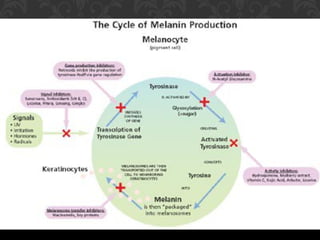
MELANOGENESIS
• Melanoblast
• Melanocyte
• Melanin
• Phenylalanine → Tyrosine
• Color of the Race → Rate of melanin
production.
In our skin, we all have around the same number
of melanocytes, which are the cells that produce
melanin.
However, the melanocytes in each of our bodies
produce different amounts of melanin.
The more melanin you have in your skin, the
darker your skin color will be.
FACTS
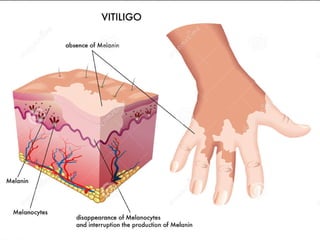
• It is a skin condition that can manifest after
birth at any point in someone’s life.
• It leads to death or loss of function of the
melanocytes in the body, which leads to the
inability to produce any more melanin in the
skin.
• Vitiligo is very visible on someone with a very
dark complexion due to the prevalence of white
splotches of skin.
• Chronic skin disease
• Other name = Leukoderma
• White spots occur when the skin no longer
forms melanin (pigment that determines the
color of your skin, hair, and eyes)
• The white patches of irregular shapes begin to
appear on your skin
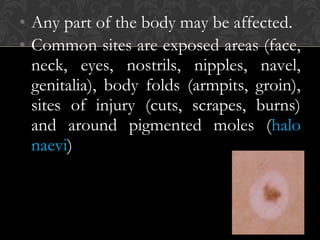
• Any part of the body may be affected.
• Common sites are exposed areas (face,
neck, eyes, nostrils, nipples, navel,
genitalia), body folds (armpits, groin),
sites of injury (cuts, scrapes, burns)
and around pigmented moles (halo
naevi)
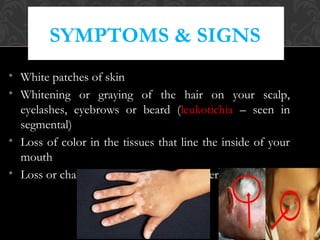
SYMPTOMS & SIGNS
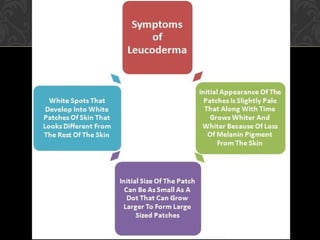
• White patches of skin
• Whitening or graying of the hair on your scalp,
eyelashes, eyebrows or beard (leukotichia – seen in
segmental)
• Loss of color in the tissues that line the inside of your
mouth
• Loss or change in color of the inner layer of your eye
• The degree of pigment loss can vary within
each vitiligo patch which means that there
may be different shades of brown in a
vitiligo patch.
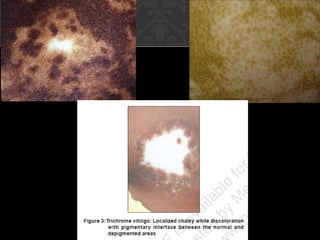
• This is called ‘trichrome’.
• A border of darker skin may circle an area
of light skin.
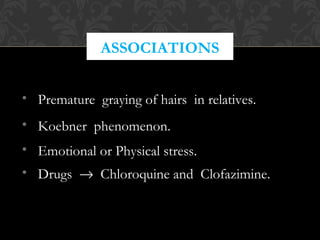
ASSOCIATIONS
• Premature graying of hairs in relatives.
• Koebner phenomenon.
• Emotional or Physical stress.
• Drugs → Chloroquine and Clofazimine.
SYSTEMIC
ASSOCIATIONS
• ↑ risk of Autoimmune diseases.
•  Thyroid dis. [Hashimoto’s, Grave’s]
•  Addison’s disease
•  Pernicious Anemia
•  Insulin dependent Diabetes
•  Alopecia Areata
SYSTEMIC ASSOCIATIONS
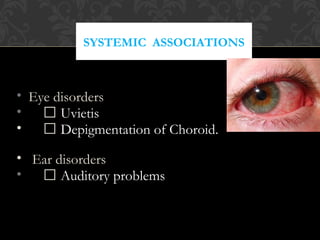
• Eye disorders
•  Uvietis
•  Depigmentation of Choroid.
• Ear disorders
•  Auditory problems
PSYCHOLOGICAL IMPACT
• Feelings of stress, embarrassment and self
consciousness.
• Perception of discrimination.
• Low self esteem.
• Disturbed sexual relationships.
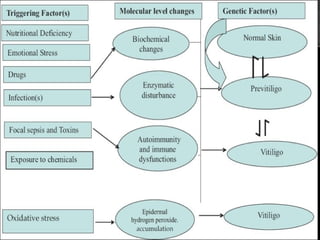
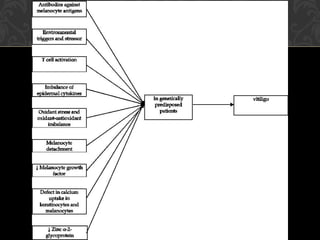
ETIOLOGICAL THEORIES
• Familial Theory
• Auto-immune Theory
• Autocytotoxic Theory
• Neural Theory
• Self destruction Theory
FAMILIAL THEORY
• Epidemilogically, 25 - 33% have family
members with disease.
• Close biologic relatives → 4 - 5 folds
increased risk.
• HLA studies have variable results.
• No specific genetic pattern.
AUTO-IMMUNE
THEORY
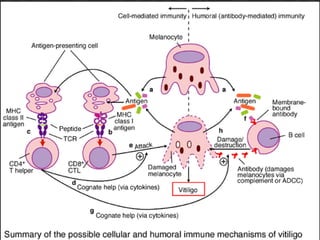
• Antibodies against melanocyte surface
antigens, correlate with the extent of
depigmentation.
• Antityrosinase ab., Antimelanin ab. and
melanin-sensitized lymphocytes.
• Leukocyte migration inhibition factor
levels and circulating immune complex
levels markedly elevated.
AUTOCYTOTOXIC
THEORY
• Increased melanocyte activity, leads to its own
demise.
• Inhibition of Thioredoxin reductase, by
Calcium.
• Higher Ca levels cause ↑↑ superoxide radicle
formation.
• Levels of Catalase, markedly decreased.
NEURAL THEORY
• Based on the following observations:
• Patients with nerve injury and vitiligo in
denervated areas .
• Clinical evidence of segmental dermatomal
vitiligo.
• Increased sweating and vasoconstriction in
vitiliginous areas.
NEURAL THEORY…
[CONT.]
• Depigmentation in animal models with severed
nerve fibres.
• Degenerative and regenerative autonomic
nerves in depigmented patches.
• Increased urinary excretion of VMA and HVA
in active vitiligo.
• It suggests that melanocytes are
destroyed by flaws in the protective
mechanism that removes the chemical
toxins that is generated in
melanogenesis.
SELF DESTRUCTION THEORY
MEDICAL SCREENINGS:
 A family history of vitiligo
 Look to see if there is a rash,
sunburn, or other skin trauma
that has occurred within 2 or
3 months after pigmentation
was discovered
 Premature graying of the hair
(before age 35)
 Stress or physical illness
 Also they may ask for an eye
examination (inflammation of
your eye) and/or blood test
(autoimmune disease)
HISTOPATHOLOGY
• Uniform absence of Melanocytes.
• Periphery of depigmented patch show : signs of
cellular death.
• Dilatation of rough endoplasmic reticulum in
melanocytes.
• Inflammatory changes in dermis.
EVALUATION
• Total body Wood’s light examination.
• TSH levels [Thyroid disease].
• CBC [Pernicious anemia].
• Evaluation about Diabetes Mellitus.
• Ophthalmological examination.
TREATMENT
1. Cosmetic
2. PUVA
a. Topical
b. Systemic
3. Corticosteroids
4. Surgical Treatment
5. Monobenzyl ether of Hydroquinone
COSMETIC TREATMENT
• Patches on exposed parts can be concealed by:
Make up brands : Cover Mark, Derma blend, Derma color
etc.
Topical dyes : Clinique bronze gel, Vitadye, Dyoderm etc.
Tanning creams : Chromelin, self tanning milk etc.
Advantages:
Cost, ease of application, lack of side effects.
Disadvantages:
Vigorous physical activities and in extensive disease.
P U V A
• Historically, Egyptians in 13th century
The herb “Ammi majus linnaeus”
Ammoidin
8-MOP, 5-MOP and 8-isoamylene OP
• 1904, Montgomery, Light therapy in vitiligo
• 1948, Al-Moftey, First use of light therapy in
combination with psoralens.
MECHANISM OF ACTION [PUVA]
• Immunologically mediated action.
• Stimulation of tyrosinase activity.
• Inhibition of DNA and protein synthesis.
• Depletion of EGF expression.
• Depletion of vitiligo - associated melanocyte
antigens.
MELANOCYTE
REPIGMENTATION
• Activation of inactive cells [spared in vitiligo
process] in the middle and lower part of follicle
and in outer sheath.
• These inactive cells contain structural and
melanosomal proteins, but do not contain
enzymes, required for melanogenesis.
MELANOCYTE REPIGM. [CONT.]
• Migration of melanocyte from lower hair follicle to
epidermis, depends on :
a) Cytokine release, like FGF, IL-1,
b) Inflammatory mediators such as : TGF-α,
leukotriene C4, D4, and endothelin-1.
TOPICAL PSORALENS
• Patients with less than 20% of total body
surface.
• Initially 0.05% or 0.1% strength.
• Artificial UVA source for 30 seconds initially
and increasing exposure to up to10 minutes 2 - 3
times per week.
• At 10 minutes, higher strength (0.1% to 0.15%)
prescribed.
TOPICAL PSORALENS (CONT.)
• Shielding uninvolved skin and eyes.
• Wash off the topical solution immediately
after treatment.
• Sun blocks, Avoiding direct and filtered
sunlight for the rest of the day.
• Side effects →→ Blistering, Burning and
Perilesional hyperpigmentation.
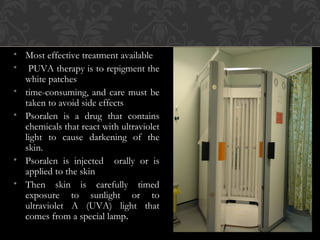
• Most effective treatment available
• PUVA therapy is to repigment the
white patches
• time-consuming, and care must be
taken to avoid side effects
• Psoralen is a drug that contains
chemicals that react with ultraviolet
light to cause darkening of the
skin.
• Psoralen is injected orally or is
applied to the skin
• Then skin is carefully timed
exposure to sunlight or to
ultraviolet A (UVA) light that
comes from a special lamp.
ORAL PSORALEN / UVA
• Patients with extensive disease.
• 0.5 mg / kg, 2 hours before treatment.
• Started at 1-2 j / cm2
of light 2 - 3 times a week.
• Darker pigmented patients and children
respond better to PUVA.
ORAL PSORALEN / UVA
• Trunk, proximal extremities and face respond
better to PUVA.
• Distal extremities, periorificial and dermatomal
lesions do not respond better.
• Side effects →→ burns, nausea, erythema,
pruritus, xerosis, fatigue, carcinogenecity,
pigmentation, cataracts and aging.
ORAL PSORALEN / UVA
• Contraindicated in →
• Pregnant women, breast feeding, h/o skin cancer,
arsenic exposure, photosensitivity, radiotherapy,
and cataracts.
• Advised to →
• Visit Ophthalmologist yearly, wear goggles, avoid
direct and filtered sunlight for 24 hours after
treatment.
CORTICOSTEROIDS
• First used in 1959 by Japanese.
• Both systemic and oral.
• Localized depigmented patches.
• High potency steroids for 1 - 2 months.
• Slowly tapered to lower strength.
• Usual side effects.
TOPICAL STEROID THERAPY
• The use of steroid creams may be helpful in returning the color to
the white patches
• A mild topical corticosteroid cream for children under 10 years
old and a stronger one for adults
• Cream must be applied to the white patches on the skin for at
least 3 months before seeing any results
• Corticosteroid creams are the simplest and safest treatment for
vitiligo, but are not as effective as psoralen photo chemotherapy
• SIDE EFFECTS occur in areas where the skin is thin, such as on
the face and armpits, or in the genital region
• They can be minimized by using weaker formulations of steroid
creams in these areas.
SURGICAL MODALITIES
• Localized non-progressive patch in a non- acral
location.
• Epidermal grafting
• Autologous minigrafting
• Transplantation of in vitro-cultured epidermis.
• Transplantation of non-cultured melanocytes.
EPIDERMAL GRAFTING
• Blisters at donor and recipient sites by suction or
liquid nitrogen.
• Roof of the blister is removed from both sites and
donor epidermis is placed on denuded recipient site.
• Reinforcement with biological dressing.
• Repigmentation seen in 2 weeks to 3 months.
• Pre-treating donor site with topical PUVA, to
stimulate melanogenesis, may enhance re-
pigmentation.
• Low incidence of scarring.
AUTOLOGOUS MINIGRAFTING
Multiple small punch biopsy specimens.
At Inconspicuous donor site, close together.
At recipient site, separated by 4 - 5 mm.
Test area chosen and 3 - 5 minigrafts are placed to
determine the ability.
After 2 months, if the pigment has spread, grafting
of the entire region continued.
IN VITRO CULTURED EPIDERMIS
Blisters at both donor and recipient sites.
Epidermis from donor site is treated with trypsin.
Melanocytes isolated and grown in cell culture for
3 weeks.
Melanocytes adhere to Vaseline gauze, which is
divided, and placed over the denuded recipient
site.
IN VITRO CULTURED EPIDERMIS
With this procedure, repigmented site can be as
large as 10 times the donor site.
Pitfalls of this technique :
1. Variegated color, due to variable
melanocyte concentration on the gauze.
2. Spotty graft failure
NON CULTURED MELANOCYTES
Non cultured melanocytes obtained with
dermatome from donor site.
Melanocytes treated with trypsin, EDTA, and
placed in a saline solution.
Injected as suspension into blisters in the recipient
site created by liquid nitrogen.
Repigmentation is faster than in vitro melanocytes.
HYDROQUINONES
Used in extensive disease where, remaining normal
skin is depigmented.
Inhibit tyrosinase, Decrease the number of
melanized melanosome, Alter melanosomal
configuration, and Cause melanocyte organelle
disuption and lysis.
Results may take from one month to one year, to
depigment completely.
• Vitiligo frequently begins with a rapid loss of
pigment which may be followed by a lengthy
period when the skin color does not change.
• Later, the pigment loss may begin again.
• The loss of color may continue until, for
unknown reasons, the process stops.
• Cycles of pigment loss followed by periods of
stability may continue indefinitely.
PROGNOSIS

Vitiligo

  • 1.
  • 3.
    • Melanocytes arespecial cells in our skin that specialize in making a molecule called melanin. • What is Melanin? • Melanin is something called a pigment, which is the molecule that gives our skin colour a darker shade. MELANOCYTES AND MELANIN
  • 4.
    What does melaninactually do? Melanin protects our skin from the damaging Ultraviolet (UV) rays from the sun. Going sun tanning induces your body to produce more melanin, which is why people who return from tanning look darker. More melanin in the skin is the reason why people who are darker usually do not get sunburned.
  • 5.
    MELANOGENESIS • Melanoblast • Melanocyte •Melanin • Phenylalanine → Tyrosine • Color of the Race → Rate of melanin production.
  • 7.
    In our skin,we all have around the same number of melanocytes, which are the cells that produce melanin. However, the melanocytes in each of our bodies produce different amounts of melanin. The more melanin you have in your skin, the darker your skin color will be.
  • 8.
  • 9.
    • It isa skin condition that can manifest after birth at any point in someone’s life. • It leads to death or loss of function of the melanocytes in the body, which leads to the inability to produce any more melanin in the skin. • Vitiligo is very visible on someone with a very dark complexion due to the prevalence of white splotches of skin.
  • 10.
    • Chronic skindisease • Other name = Leukoderma • White spots occur when the skin no longer forms melanin (pigment that determines the color of your skin, hair, and eyes) • The white patches of irregular shapes begin to appear on your skin
  • 11.
    • Any partof the body may be affected. • Common sites are exposed areas (face, neck, eyes, nostrils, nipples, navel, genitalia), body folds (armpits, groin), sites of injury (cuts, scrapes, burns) and around pigmented moles (halo naevi)
  • 12.
    SYMPTOMS & SIGNS •White patches of skin • Whitening or graying of the hair on your scalp, eyelashes, eyebrows or beard (leukotichia – seen in segmental) • Loss of color in the tissues that line the inside of your mouth • Loss or change in color of the inner layer of your eye
  • 13.
    • The degreeof pigment loss can vary within each vitiligo patch which means that there may be different shades of brown in a vitiligo patch. • This is called ‘trichrome’. • A border of darker skin may circle an area of light skin.
  • 21.
    ASSOCIATIONS • Premature grayingof hairs in relatives. • Koebner phenomenon. • Emotional or Physical stress. • Drugs → Chloroquine and Clofazimine.
  • 22.
    SYSTEMIC ASSOCIATIONS • ↑ riskof Autoimmune diseases. •  Thyroid dis. [Hashimoto’s, Grave’s] •  Addison’s disease •  Pernicious Anemia •  Insulin dependent Diabetes •  Alopecia Areata
  • 23.
    SYSTEMIC ASSOCIATIONS • Eyedisorders •  Uvietis •  Depigmentation of Choroid. • Ear disorders •  Auditory problems
  • 24.
    PSYCHOLOGICAL IMPACT • Feelingsof stress, embarrassment and self consciousness. • Perception of discrimination. • Low self esteem. • Disturbed sexual relationships.
  • 25.
    ETIOLOGICAL THEORIES • FamilialTheory • Auto-immune Theory • Autocytotoxic Theory • Neural Theory • Self destruction Theory
  • 26.
    FAMILIAL THEORY • Epidemilogically,25 - 33% have family members with disease. • Close biologic relatives → 4 - 5 folds increased risk. • HLA studies have variable results. • No specific genetic pattern.
  • 27.
    AUTO-IMMUNE THEORY • Antibodies againstmelanocyte surface antigens, correlate with the extent of depigmentation. • Antityrosinase ab., Antimelanin ab. and melanin-sensitized lymphocytes. • Leukocyte migration inhibition factor levels and circulating immune complex levels markedly elevated.
  • 29.
    AUTOCYTOTOXIC THEORY • Increased melanocyteactivity, leads to its own demise. • Inhibition of Thioredoxin reductase, by Calcium. • Higher Ca levels cause ↑↑ superoxide radicle formation. • Levels of Catalase, markedly decreased.
  • 30.
    NEURAL THEORY • Basedon the following observations: • Patients with nerve injury and vitiligo in denervated areas . • Clinical evidence of segmental dermatomal vitiligo. • Increased sweating and vasoconstriction in vitiliginous areas.
  • 31.
    NEURAL THEORY… [CONT.] • Depigmentationin animal models with severed nerve fibres. • Degenerative and regenerative autonomic nerves in depigmented patches. • Increased urinary excretion of VMA and HVA in active vitiligo.
  • 32.
    • It suggeststhat melanocytes are destroyed by flaws in the protective mechanism that removes the chemical toxins that is generated in melanogenesis. SELF DESTRUCTION THEORY
  • 35.
    MEDICAL SCREENINGS:  Afamily history of vitiligo  Look to see if there is a rash, sunburn, or other skin trauma that has occurred within 2 or 3 months after pigmentation was discovered  Premature graying of the hair (before age 35)  Stress or physical illness  Also they may ask for an eye examination (inflammation of your eye) and/or blood test (autoimmune disease)
  • 36.
    HISTOPATHOLOGY • Uniform absenceof Melanocytes. • Periphery of depigmented patch show : signs of cellular death. • Dilatation of rough endoplasmic reticulum in melanocytes. • Inflammatory changes in dermis.
  • 37.
    EVALUATION • Total bodyWood’s light examination. • TSH levels [Thyroid disease]. • CBC [Pernicious anemia]. • Evaluation about Diabetes Mellitus. • Ophthalmological examination.
  • 38.
    TREATMENT 1. Cosmetic 2. PUVA a.Topical b. Systemic 3. Corticosteroids 4. Surgical Treatment 5. Monobenzyl ether of Hydroquinone
  • 39.
    COSMETIC TREATMENT • Patcheson exposed parts can be concealed by: Make up brands : Cover Mark, Derma blend, Derma color etc. Topical dyes : Clinique bronze gel, Vitadye, Dyoderm etc. Tanning creams : Chromelin, self tanning milk etc. Advantages: Cost, ease of application, lack of side effects. Disadvantages: Vigorous physical activities and in extensive disease.
  • 40.
    P U VA • Historically, Egyptians in 13th century The herb “Ammi majus linnaeus” Ammoidin 8-MOP, 5-MOP and 8-isoamylene OP • 1904, Montgomery, Light therapy in vitiligo • 1948, Al-Moftey, First use of light therapy in combination with psoralens.
  • 41.
    MECHANISM OF ACTION[PUVA] • Immunologically mediated action. • Stimulation of tyrosinase activity. • Inhibition of DNA and protein synthesis. • Depletion of EGF expression. • Depletion of vitiligo - associated melanocyte antigens.
  • 42.
    MELANOCYTE REPIGMENTATION • Activation ofinactive cells [spared in vitiligo process] in the middle and lower part of follicle and in outer sheath. • These inactive cells contain structural and melanosomal proteins, but do not contain enzymes, required for melanogenesis.
  • 43.
    MELANOCYTE REPIGM. [CONT.] •Migration of melanocyte from lower hair follicle to epidermis, depends on : a) Cytokine release, like FGF, IL-1, b) Inflammatory mediators such as : TGF-α, leukotriene C4, D4, and endothelin-1.
  • 44.
    TOPICAL PSORALENS • Patientswith less than 20% of total body surface. • Initially 0.05% or 0.1% strength. • Artificial UVA source for 30 seconds initially and increasing exposure to up to10 minutes 2 - 3 times per week. • At 10 minutes, higher strength (0.1% to 0.15%) prescribed.
  • 45.
    TOPICAL PSORALENS (CONT.) •Shielding uninvolved skin and eyes. • Wash off the topical solution immediately after treatment. • Sun blocks, Avoiding direct and filtered sunlight for the rest of the day. • Side effects →→ Blistering, Burning and Perilesional hyperpigmentation.
  • 46.
    • Most effectivetreatment available • PUVA therapy is to repigment the white patches • time-consuming, and care must be taken to avoid side effects • Psoralen is a drug that contains chemicals that react with ultraviolet light to cause darkening of the skin. • Psoralen is injected orally or is applied to the skin • Then skin is carefully timed exposure to sunlight or to ultraviolet A (UVA) light that comes from a special lamp.
  • 47.
    ORAL PSORALEN /UVA • Patients with extensive disease. • 0.5 mg / kg, 2 hours before treatment. • Started at 1-2 j / cm2 of light 2 - 3 times a week. • Darker pigmented patients and children respond better to PUVA.
  • 48.
    ORAL PSORALEN /UVA • Trunk, proximal extremities and face respond better to PUVA. • Distal extremities, periorificial and dermatomal lesions do not respond better. • Side effects →→ burns, nausea, erythema, pruritus, xerosis, fatigue, carcinogenecity, pigmentation, cataracts and aging.
  • 49.
    ORAL PSORALEN /UVA • Contraindicated in → • Pregnant women, breast feeding, h/o skin cancer, arsenic exposure, photosensitivity, radiotherapy, and cataracts. • Advised to → • Visit Ophthalmologist yearly, wear goggles, avoid direct and filtered sunlight for 24 hours after treatment.
  • 50.
    CORTICOSTEROIDS • First usedin 1959 by Japanese. • Both systemic and oral. • Localized depigmented patches. • High potency steroids for 1 - 2 months. • Slowly tapered to lower strength. • Usual side effects.
  • 51.
    TOPICAL STEROID THERAPY •The use of steroid creams may be helpful in returning the color to the white patches • A mild topical corticosteroid cream for children under 10 years old and a stronger one for adults • Cream must be applied to the white patches on the skin for at least 3 months before seeing any results • Corticosteroid creams are the simplest and safest treatment for vitiligo, but are not as effective as psoralen photo chemotherapy • SIDE EFFECTS occur in areas where the skin is thin, such as on the face and armpits, or in the genital region • They can be minimized by using weaker formulations of steroid creams in these areas.
  • 52.
    SURGICAL MODALITIES • Localizednon-progressive patch in a non- acral location. • Epidermal grafting • Autologous minigrafting • Transplantation of in vitro-cultured epidermis. • Transplantation of non-cultured melanocytes.
  • 53.
    EPIDERMAL GRAFTING • Blistersat donor and recipient sites by suction or liquid nitrogen. • Roof of the blister is removed from both sites and donor epidermis is placed on denuded recipient site. • Reinforcement with biological dressing. • Repigmentation seen in 2 weeks to 3 months. • Pre-treating donor site with topical PUVA, to stimulate melanogenesis, may enhance re- pigmentation. • Low incidence of scarring.
  • 54.
    AUTOLOGOUS MINIGRAFTING Multiple smallpunch biopsy specimens. At Inconspicuous donor site, close together. At recipient site, separated by 4 - 5 mm. Test area chosen and 3 - 5 minigrafts are placed to determine the ability. After 2 months, if the pigment has spread, grafting of the entire region continued.
  • 55.
    IN VITRO CULTUREDEPIDERMIS Blisters at both donor and recipient sites. Epidermis from donor site is treated with trypsin. Melanocytes isolated and grown in cell culture for 3 weeks. Melanocytes adhere to Vaseline gauze, which is divided, and placed over the denuded recipient site.
  • 56.
    IN VITRO CULTUREDEPIDERMIS With this procedure, repigmented site can be as large as 10 times the donor site. Pitfalls of this technique : 1. Variegated color, due to variable melanocyte concentration on the gauze. 2. Spotty graft failure
  • 57.
    NON CULTURED MELANOCYTES Noncultured melanocytes obtained with dermatome from donor site. Melanocytes treated with trypsin, EDTA, and placed in a saline solution. Injected as suspension into blisters in the recipient site created by liquid nitrogen. Repigmentation is faster than in vitro melanocytes.
  • 58.
    HYDROQUINONES Used in extensivedisease where, remaining normal skin is depigmented. Inhibit tyrosinase, Decrease the number of melanized melanosome, Alter melanosomal configuration, and Cause melanocyte organelle disuption and lysis. Results may take from one month to one year, to depigment completely.
  • 59.
    • Vitiligo frequentlybegins with a rapid loss of pigment which may be followed by a lengthy period when the skin color does not change. • Later, the pigment loss may begin again. • The loss of color may continue until, for unknown reasons, the process stops. • Cycles of pigment loss followed by periods of stability may continue indefinitely. PROGNOSIS