.
• Sudden episodes of exacerbation occurring during the silent course of
leprosy
CLASSIFICATION
• Based on the shift of immune status
• Or in leprosy patients on treatment
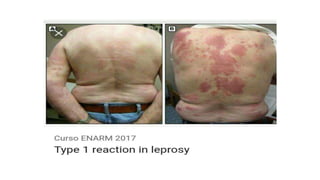
• TYPE 1 : REVERSAL REACTION
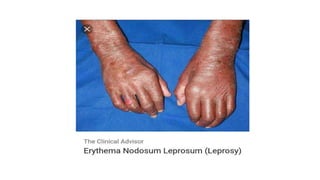
• TYPE 2 : ERYTHEMA NODOSUM LEPROSUM
TYPE 1 : Reversal Reactions
• Borderline groups are unstable and move across the spectrum in either
direction
1. UPGRADING REACTION
– In BL patients on Rx
– Increased CML
– Upgrade towards tuberculous type
2. DOWNGRADING REACTION
– In BT patients who downgrade to lepromatous type
– Lowering of CML
.
• Type 4 hypersensitivity reaction
• Do not occur in immunologically stable polar groups
• Skin &nerve involvement
• Previous lesions become erythematous edematous and
sharply delineated and maybe tender
• Nerves involved – thickened , tender & deficit
• Constitutional symptoms absent
• Occurs early in the course of Rx
.
TYPE 2 : Erythema nodosum leprosum
• In lepromatous patients
• After Rx
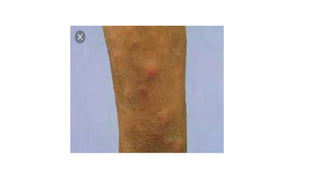
• Tender cutaneous nodules
• Fever
• Iridocyclitis , Epididymo orchitis , periostitis
• Synovitis , dactylitis , glomerulonephritis , myositis
• Lymph node involvement
• Type 3 hypersensitivity reaction
• Occur chiefly in LL
• Occur late in the course of Rx
• Crops of eruthematous Tender papules and nodules
• Mainly On the face and extremities
• Lesions stay for 2-3 days and may turn necrotic – erythema nodosum
necroticans
• Accompanied by fever , malaise & bodyache
• Raised ESR & Polymorph I nuclear leucocytosis
.
.
HISTOPATHOLOGY
• Type 1 REVERSAL REACTION
– Upgrading : increase of lymphocytes, edema , necrosis at centre , reduced BI
– Downgrading :dispersal and spread of granulomas , increased lepra bacilli
• Type 2 ENL
– Infiltration by neutrophils , eosinophils
– Vasculitis and panniculitus
– Bacillary load increased
– Secondary amyloidosis may follow repeated attacks of ENL
THANK YOU

Lepra reactions

  • 2.
    . • Sudden episodesof exacerbation occurring during the silent course of leprosy
  • 3.
    CLASSIFICATION • Based onthe shift of immune status • Or in leprosy patients on treatment • TYPE 1 : REVERSAL REACTION • TYPE 2 : ERYTHEMA NODOSUM LEPROSUM
  • 4.
    TYPE 1 :Reversal Reactions • Borderline groups are unstable and move across the spectrum in either direction 1. UPGRADING REACTION – In BL patients on Rx – Increased CML – Upgrade towards tuberculous type 2. DOWNGRADING REACTION – In BT patients who downgrade to lepromatous type – Lowering of CML
  • 5.
    . • Type 4hypersensitivity reaction • Do not occur in immunologically stable polar groups • Skin &nerve involvement • Previous lesions become erythematous edematous and sharply delineated and maybe tender • Nerves involved – thickened , tender & deficit • Constitutional symptoms absent • Occurs early in the course of Rx
  • 6.
  • 7.
    TYPE 2 :Erythema nodosum leprosum • In lepromatous patients • After Rx • Tender cutaneous nodules • Fever • Iridocyclitis , Epididymo orchitis , periostitis • Synovitis , dactylitis , glomerulonephritis , myositis • Lymph node involvement
  • 8.
    • Type 3hypersensitivity reaction • Occur chiefly in LL • Occur late in the course of Rx • Crops of eruthematous Tender papules and nodules • Mainly On the face and extremities • Lesions stay for 2-3 days and may turn necrotic – erythema nodosum necroticans • Accompanied by fever , malaise & bodyache • Raised ESR & Polymorph I nuclear leucocytosis
  • 9.
  • 10.
  • 11.
    HISTOPATHOLOGY • Type 1REVERSAL REACTION – Upgrading : increase of lymphocytes, edema , necrosis at centre , reduced BI – Downgrading :dispersal and spread of granulomas , increased lepra bacilli • Type 2 ENL – Infiltration by neutrophils , eosinophils – Vasculitis and panniculitus – Bacillary load increased – Secondary amyloidosis may follow repeated attacks of ENL
  • 12.