Alopecia Areata Abdullatif Sami Al Rashed
Dermatology block 5.5
College of medicine, King Fiasal University
Al Ahsa, Saudi Arabia
Introduction
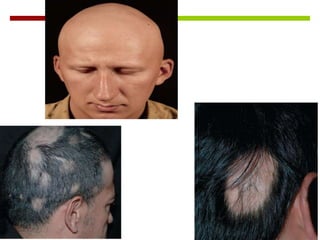
 A localized loss of hair in round or oval areas with no
apparent inflammation of the skin.
 Nonscarring; hair follicle intact; hair can regrow.
 Clinical findings: Hair loss ranging from solitary patch to
complete loss of all terminal hair.
 Prognosis: good for limited involvement. Poor for
extensive hair loss.
 Management: intralesional triamcinolone effective for
limited number of lesions.
Etiology
 Unknown.
 Association with other autoimmune diseases and
immunophenotyping of lymphocytic infiltrate
around hair bulbs suggests an anti–hair bulb
autoimmune process
Age of Onset
 Young adults (<25 years);
 children are affected more frequently.
Clinical Manifestations
 Duration of Hair Loss: Gradual over weeks to
months.
 AW: Autoimmune thyroiditis. Down syndrome.
Autoimmune poly-endocrinopathy-candidiasis–
ectodermal dysplasia syndrome.
Hair
 Round patched of hair loss. Single or multiple. May
coalesce.
 Alopecia often sharply defined with normal-
appearing skin with follicular openings present.
 Exclamation mark hairs.
 Diagnostic: broken-off stubby hairs (distal ends are
broader than proximal ends)
Sites of Predilection
 Scalp most commonly.
 Any hair-bearing area. Beard, eyebrows, eyelashes,
pubic hair.
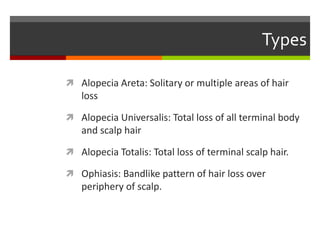
Types
 Alopecia Areta: Solitary or multiple areas of hair
loss
 Alopecia Universalis: Total loss of all terminal body
and scalp hair
 Alopecia Totalis: Total loss of terminal scalp hair.
 Ophiasis: Bandlike pattern of hair loss over
periphery of scalp.
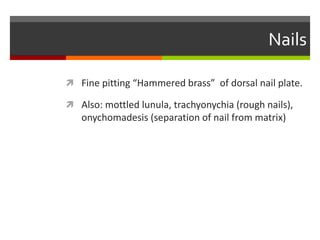
Nails
 Fine pitting “Hammered brass” of dorsal nail plate.
 Also: mottled lunula, trachyonychia (rough nails),
onychomadesis (separation of nail from matrix)
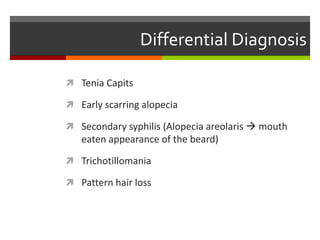
Differential Diagnosis
 Tenia Capits
 Early scarring alopecia
 Secondary syphilis (Alopecia areolaris  mouth
eaten appearance of the beard)
 Trichotillomania
 Pattern hair loss
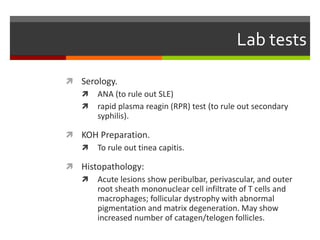
Lab tests
 Serology.
 ANA (to rule out SLE)
 rapid plasma reagin (RPR) test (to rule out secondary
syphilis).
 KOH Preparation.
 To rule out tinea capitis.
 Histopathology:
 Acute lesions show peribulbar, perivascular, and outer
root sheath mononuclear cell infiltrate of T cells and
macrophages; follicular dystrophy with abnormal
pigmentation and matrix degeneration. May show
increased number of catagen/telogen follicles.
Course
 Spontaneous remission more with patchy AA, not
with AAT or AAU
 Poor prognosis if:
 Late onset
 Fx of AA
 Atopy
 Nail involvement and body hair loss
 High recurrence
Management
 No curative TTT
 Psychological support
 Steroids (interlesional or systemic)
 Cyclosporin
 Oral PUVA (Photochemotherapy).
 Induction of Allergic Contact Dermatitis:
 Dinitrochlorobenzene, squaric acid dibutylester, or
diphencyprone
 Causes local discomfort due to allergic contact dermatitis
and swelling of regional lymph nodesposes a problem.
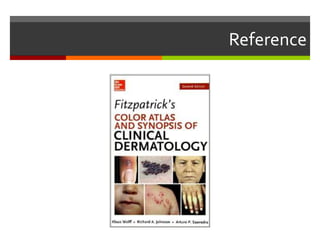
Reference
ThankYou 

Alopecia Areata

  • 1.
    Alopecia Areata AbdullatifSami Al Rashed Dermatology block 5.5 College of medicine, King Fiasal University Al Ahsa, Saudi Arabia
  • 3.
    Introduction  A localizedloss of hair in round or oval areas with no apparent inflammation of the skin.  Nonscarring; hair follicle intact; hair can regrow.  Clinical findings: Hair loss ranging from solitary patch to complete loss of all terminal hair.  Prognosis: good for limited involvement. Poor for extensive hair loss.  Management: intralesional triamcinolone effective for limited number of lesions.
  • 4.
    Etiology  Unknown.  Associationwith other autoimmune diseases and immunophenotyping of lymphocytic infiltrate around hair bulbs suggests an anti–hair bulb autoimmune process
  • 5.
    Age of Onset Young adults (<25 years);  children are affected more frequently.
  • 6.
    Clinical Manifestations  Durationof Hair Loss: Gradual over weeks to months.  AW: Autoimmune thyroiditis. Down syndrome. Autoimmune poly-endocrinopathy-candidiasis– ectodermal dysplasia syndrome.
  • 7.
    Hair  Round patchedof hair loss. Single or multiple. May coalesce.  Alopecia often sharply defined with normal- appearing skin with follicular openings present.  Exclamation mark hairs.  Diagnostic: broken-off stubby hairs (distal ends are broader than proximal ends)
  • 8.
    Sites of Predilection Scalp most commonly.  Any hair-bearing area. Beard, eyebrows, eyelashes, pubic hair.
  • 9.
    Types  Alopecia Areta:Solitary or multiple areas of hair loss  Alopecia Universalis: Total loss of all terminal body and scalp hair  Alopecia Totalis: Total loss of terminal scalp hair.  Ophiasis: Bandlike pattern of hair loss over periphery of scalp.
  • 10.
    Nails  Fine pitting“Hammered brass” of dorsal nail plate.  Also: mottled lunula, trachyonychia (rough nails), onychomadesis (separation of nail from matrix)
  • 11.
    Differential Diagnosis  TeniaCapits  Early scarring alopecia  Secondary syphilis (Alopecia areolaris  mouth eaten appearance of the beard)  Trichotillomania  Pattern hair loss
  • 12.
    Lab tests  Serology. ANA (to rule out SLE)  rapid plasma reagin (RPR) test (to rule out secondary syphilis).  KOH Preparation.  To rule out tinea capitis.  Histopathology:  Acute lesions show peribulbar, perivascular, and outer root sheath mononuclear cell infiltrate of T cells and macrophages; follicular dystrophy with abnormal pigmentation and matrix degeneration. May show increased number of catagen/telogen follicles.
  • 13.
    Course  Spontaneous remissionmore with patchy AA, not with AAT or AAU  Poor prognosis if:  Late onset  Fx of AA  Atopy  Nail involvement and body hair loss  High recurrence
  • 14.
    Management  No curativeTTT  Psychological support  Steroids (interlesional or systemic)  Cyclosporin  Oral PUVA (Photochemotherapy).  Induction of Allergic Contact Dermatitis:  Dinitrochlorobenzene, squaric acid dibutylester, or diphencyprone  Causes local discomfort due to allergic contact dermatitis and swelling of regional lymph nodesposes a problem.
  • 15.
  • 16.