VITILIGO
PREPARED BY
Abarna Lakshmi.R
Pharm.D (INTERN)
C.L.Baid Metha college of pharmacy,
Chennai-97
CONTENTS
 Definition
 Epidemiology
 Etiology
 Classification
 Clinical manifestations
 Pathogenesis.
 Diagnosis
 Treatment
 References
DEFINITION
 Vitiligo is a progressive depigmentation disorder of the skin due to postnatal
loss of epidermal melanocytes (pigment-producing cells), which results in the
formation of white macules.
 The white patches characteristic of this condition cause considerable anxiety to
many patients.
 There are few treatments for this disorder that provide effective and long-
lasting repigmentation, particularly in the active phase when depigmentation is
spreading.
 While the precise mechanisms that lead to depigmentation are not known, but
postulated that a trigger induces stress in the melanocytes that cannot be
overcome, leading to an autoimmune disorder that targets melanocytes.
EPIDEMIOLOGY
 Vitiligo affects an estimated 0.5 -1% of the population worldwide, with no
predilection for gender, race, or geography.
 In India, 1.3% population were affected by it.
 The average age of onset of the disorder is about 20–25 years, with
approximately 50% of individuals developing their first lesion before the age of
20, and 25% before the age of 10.
 Segmental vitiligo affects a greater proportion of children than non-segmental
vitiligo.
 Although the ratio of males to females affected by this condition is
approximately 1:1 females seek treatment more often than males.
ETIOLOGY
 The precise cause of vitiligo is not known, lesions are known to result from
melanocyte death. The mechanisms responsible for melanocyte death are not
yet defined.
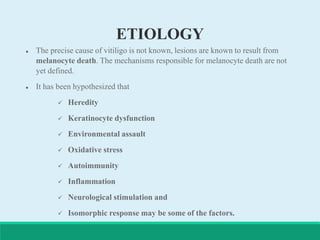
 It has been hypothesized that
 Heredity
 Keratinocyte dysfunction
 Environmental assault
 Oxidative stress
 Autoimmunity
 Inflammation
 Neurological stimulation and
 Isomorphic response may be some of the factors.
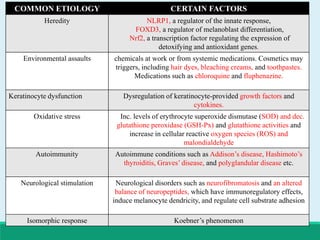
COMMON ETIOLOGY CERTAIN FACTORS
Heredity NLRP1, a regulator of the innate response,
FOXD3, a regulator of melanoblast differentiation,
Nrf2, a transcription factor regulating the expression of
detoxifying and antioxidant genes.
Environmental assaults chemicals at work or from systemic medications. Cosmetics may
triggers, including hair dyes, bleaching creams, and toothpastes.
Medications such as chloroquine and fluphenazine.
Keratinocyte dysfunction Dysregulation of keratinocyte-provided growth factors and
cytokines.
Oxidative stress Inc. levels of erythrocyte superoxide dismutase (SOD) and dec.
glutathione peroxidase (GSH-Px) and glutathione activities and
increase in cellular reactive oxygen species (ROS) and
malondialdehyde
Autoimmunity Autoimmune conditions such as Addison’s disease, Hashimoto’s
thyroiditis, Graves’ disease, and polyglandular disease etc.
Neurological stimulation Neurological disorders such as neurofibromatosis and an altered
balance of neuropeptides, which have immunoregulatory effects,
induce melanocyte dendricity, and regulate cell substrate adhesion
Isomorphic response Koebner’s phenomenon
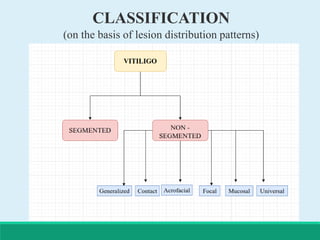
CLASSIFICATION
(on the basis of lesion distribution patterns)
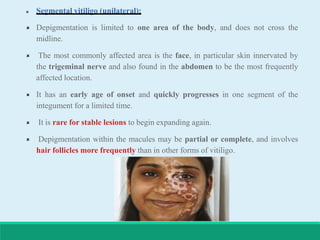
 Segmental vitiligo (unilateral):
 Depigmentation is limited to one area of the body, and does not cross the
midline.
 The most commonly affected area is the face, in particular skin innervated by
the trigeminal nerve and also found in the abdomen to be the most frequently
affected location.
 It has an early age of onset and quickly progresses in one segment of the
integument for a limited time.
 It is rare for stable lesions to begin expanding again.
 Depigmentation within the macules may be partial or complete, and involves
hair follicles more frequently than in other forms of vitiligo.
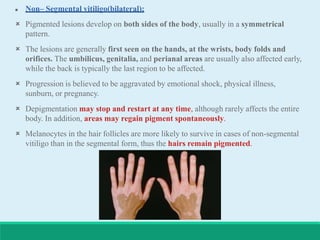
 Non– Segmental vitiligo(bilateral):
 Pigmented lesions develop on both sides of the body, usually in a symmetrical
pattern.
 The lesions are generally first seen on the hands, at the wrists, body folds and
orifices. The umbilicus, genitalia, and perianal areas are usually also affected early,
while the back is typically the last region to be affected.
 Progression is believed to be aggravated by emotional shock, physical illness,
sunburn, or pregnancy.
 Depigmentation may stop and restart at any time, although rarely affects the entire
body. In addition, areas may regain pigment spontaneously.
 Melanocytes in the hair follicles are more likely to survive in cases of non-segmental
vitiligo than in the segmental form, thus the hairs remain pigmented.
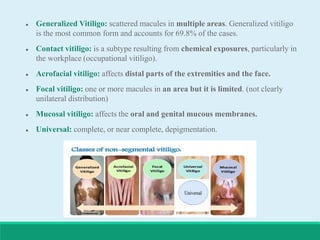
 Generalized Vitiligo: scattered macules in multiple areas. Generalized vitiligo
is the most common form and accounts for 69.8% of the cases.
 Contact vitiligo: is a subtype resulting from chemical exposures, particularly in
the workplace (occupational vitiligo).
 Acrofacial vitiligo: affects distal parts of the extremities and the face.
 Focal vitiligo: one or more macules in an area but it is limited. (not clearly
unilateral distribution)
 Mucosal vitiligo: affects the oral and genital mucous membranes.
 Universal: complete, or near complete, depigmentation.
CLINICAL MANIFESTATIONS
 Vitiligo lesions present as white macules.
 Depigmentation, while clearly visible in individuals with dark skin, is not
readily observed in individuals with fair skin.
 Lesions are however easily defined by fluorescence with the aid of a Wood’s
lamp.
 Buccal mucosa, and gingiva (both attached and unattached) are reported to
depigment, although this is also more evident in darker skinned individuals.
 Vitiligo may extend to the hair, which is secondary to a loss of melanocytes in
the hair follicle.
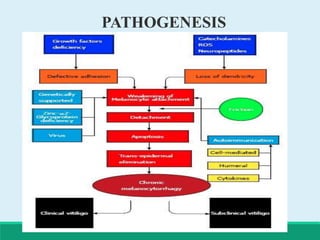
PATHOGENESIS
DIAGNOSIS
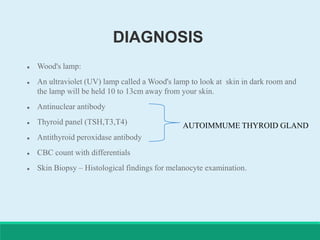
 Wood's lamp:
 An ultraviolet (UV) lamp called a Wood's lamp to look at skin in dark room and
the lamp will be held 10 to 13cm away from your skin.
 Antinuclear antibody
 Thyroid panel (TSH,T3,T4)
 Antithyroid peroxidase antibody
 CBC count with differentials
 Skin Biopsy – Histological findings for melanocyte examination.
AUTOIMMUME THYROID GLAND
TREATMENT
 Phototherapy
 Laser therapy
 Topical therapy
 Corticosteroids
 Calcineurin inhibitors
 Vitamin-D analogs
 Hormonal therapy
 Janus Kinase (JAK) inhibitor therapy
 Sytemic corticosteroid therapy
 Depigmentation therapy
 Surgical care
 Noncultured epidermal suspension
 Thin dermoepidermal grafts
 Suction epidermal grafting
 Punch minigrafting
 Cultured melanocyte suspensions
 Phototherapy:
 Phototherapy induces satisfactory repigmentation in a majority of
patients with early or localized disease. Prolonged phototherapy courses
should be encouraged, as a treatment period of at least 6 months may be
necessary to accurately assess the responsiveness to the phototherapy.
 Narrowband UV-B (NB-UVB) is widely used and has become the first
choice of phototherapy for adults and children with generalized vitiligo.
Wavelengths of 311-312 nm typically are used. Treatment frequency is
2-3 times weekly. This treatment can be safely used in children, pregnant
women, and lactating women.
 Psoralen photochemotherapy involves the use of psoralens combined
with UV-A radiation and is also known as PUVA. Psoralens can be applied
either topically or taken orally, followed by exposure to artificial UV-A
radiation or natural sunlight.
 Laser therapy:
 The excimer laser produces monochromatic rays at 308 nm to treat limited,
stable patches of vitiligo.
 This new treatment is an efficacious, safe, and well-tolerated treatment for
vitiligo. However, therapy is expensive.
 Localized lesions of vitiligo are treated twice weekly for an average of 24-48
sessions.
 Topical therapy:
 Steroids:
 A topical corticosteroid preparation is often chosen as a first-line treatment
for localized vitiligo because it is easy and convenient for patients.
 Depending on the area being treated, a moderately potent topical steroid can
be applied daily for a period of months and then tapered depending on
response
 Patients should be monitored closely for the possibility of steroid atrophy.
 Calcineurin inhibitors:
 Topical tacrolimus ointment (0.03% or 0.1%) and pimecrolimus cream
are effective therapies for vitiligo, particularly when the disease involves
the head and neck.
 These may be used in combination with topical steroids.
 Studies have suggested that augmenting topical calcineurin inhibitors with
laser therapy or NB-UVB may yield better treatment results.
 Vitamin-D analogs:
 Vitamin D analogs, particularly calcipotriol and tacalcitol, have been
used as topical therapeutic agents in vitiligo.
 They do this by inhibition of the transition of T cells (early to late G1
phase) and inhibition of the expression of various proinflammatory
cytokines that encode tumor necrosis factor-alpha and interferon-gamma.
 These vitamin D3 compounds influence melanocyte maturation and
differentiation, in addition to up-regulating melanogenesis through
pathways that are activated by specific ligand receptors
 Hormonal therapy :
 Afamelanotide is an emerging treatment for vitiligo that is a long-lasting
synthetic analog of alpha-melanocyte–stimulating hormone (α-MSH).
 Afamelanotide binds to the melanocortin-1 receptor and stimulates melanocyte
proliferation and melanogenesis.
 Janus kinase (JAK) inhibitor therapy:
 Oral tofacitinib and other JAK inhibitors (topical ruxolitinib) have
revolutionized the treatment of vitiligo.
 A small proof-of-concept study using twice-daily topical ruxolitinib 1.5%
showed promising results.
 Systemic corticosteroid therapy:
 Systemic steroids (prednisone) have been used, although this treatment method is
not recommended owing to its toxicity.
 Depigmentation therapy:
 If vitiligo is widespread and attempts at repigmentation do not produce
satisfactory results, depigmentation may be attempted in very carefully selected
patients.
 A 20% cream of monobenzylether of hydroquinone is applied twice daily for 3-12
months.
 Burning or itching may occur. Allergic contact dermatitis may be seen.
 The toxicity of monobenzylether of hydroquinone has been deemed mild;
 However, no research has been performed on the safety of using the drug over
large surface areas of skin to induce widespread pigmentation.
 Surgical Care:
 Surgical alternatives exist for the treatment of vitiligo; however,
because of the time-consuming nature of surgical therapies, these
treatment regimens are limited to segmental vitiligo or localized
vitiligo that is limited to a small region.
 Characteristics of vitiligo patients that may be a surgical candidate
include the following:
Segmental vitiligo
Vitiligo localized to a small area
Vitiligo in areas that tend not to repigment well (eg, dorsal fingers,
ankles, forehead, hairline)
REFERENCES
 Boissy RE, Manga P. On the etiology of contact/occupational vitiligo. Pigment
Cell Research. 2004 Jun;17(3):208-14.
 https://www.nhs.uk/conditions/vitiligo.
 Mohammed GF, Gomaa AH, Al-Dhubaibi MS. Highlights in pathogenesis of
vitiligo. World Journal of Clinical Cases: WJCC. 2015 Mar 16;3(3):221.
 Castanet J, Ortonne JP. Pathophysiology of vitiligo. Clinics in dermatology. 1997
Nov 1;15(6):845-51.
 https://my.clevelandclinic.org/health/diseases/12419-vitiligo/diagnosis-and-tests
 https://emedicine.medscape.com/article/1068962-treatment
THANK YOU

Vitiligo

  • 1.
    VITILIGO PREPARED BY Abarna Lakshmi.R Pharm.D(INTERN) C.L.Baid Metha college of pharmacy, Chennai-97
  • 2.
    CONTENTS  Definition  Epidemiology Etiology  Classification  Clinical manifestations  Pathogenesis.  Diagnosis  Treatment  References
  • 3.
    DEFINITION  Vitiligo isa progressive depigmentation disorder of the skin due to postnatal loss of epidermal melanocytes (pigment-producing cells), which results in the formation of white macules.  The white patches characteristic of this condition cause considerable anxiety to many patients.  There are few treatments for this disorder that provide effective and long- lasting repigmentation, particularly in the active phase when depigmentation is spreading.  While the precise mechanisms that lead to depigmentation are not known, but postulated that a trigger induces stress in the melanocytes that cannot be overcome, leading to an autoimmune disorder that targets melanocytes.
  • 4.
    EPIDEMIOLOGY  Vitiligo affectsan estimated 0.5 -1% of the population worldwide, with no predilection for gender, race, or geography.  In India, 1.3% population were affected by it.  The average age of onset of the disorder is about 20–25 years, with approximately 50% of individuals developing their first lesion before the age of 20, and 25% before the age of 10.  Segmental vitiligo affects a greater proportion of children than non-segmental vitiligo.  Although the ratio of males to females affected by this condition is approximately 1:1 females seek treatment more often than males.
  • 5.
    ETIOLOGY  The precisecause of vitiligo is not known, lesions are known to result from melanocyte death. The mechanisms responsible for melanocyte death are not yet defined.  It has been hypothesized that  Heredity  Keratinocyte dysfunction  Environmental assault  Oxidative stress  Autoimmunity  Inflammation  Neurological stimulation and  Isomorphic response may be some of the factors.
  • 6.
    COMMON ETIOLOGY CERTAINFACTORS Heredity NLRP1, a regulator of the innate response, FOXD3, a regulator of melanoblast differentiation, Nrf2, a transcription factor regulating the expression of detoxifying and antioxidant genes. Environmental assaults chemicals at work or from systemic medications. Cosmetics may triggers, including hair dyes, bleaching creams, and toothpastes. Medications such as chloroquine and fluphenazine. Keratinocyte dysfunction Dysregulation of keratinocyte-provided growth factors and cytokines. Oxidative stress Inc. levels of erythrocyte superoxide dismutase (SOD) and dec. glutathione peroxidase (GSH-Px) and glutathione activities and increase in cellular reactive oxygen species (ROS) and malondialdehyde Autoimmunity Autoimmune conditions such as Addison’s disease, Hashimoto’s thyroiditis, Graves’ disease, and polyglandular disease etc. Neurological stimulation Neurological disorders such as neurofibromatosis and an altered balance of neuropeptides, which have immunoregulatory effects, induce melanocyte dendricity, and regulate cell substrate adhesion Isomorphic response Koebner’s phenomenon
  • 7.
    CLASSIFICATION (on the basisof lesion distribution patterns)
  • 8.
     Segmental vitiligo(unilateral):  Depigmentation is limited to one area of the body, and does not cross the midline.  The most commonly affected area is the face, in particular skin innervated by the trigeminal nerve and also found in the abdomen to be the most frequently affected location.  It has an early age of onset and quickly progresses in one segment of the integument for a limited time.  It is rare for stable lesions to begin expanding again.  Depigmentation within the macules may be partial or complete, and involves hair follicles more frequently than in other forms of vitiligo.
  • 9.
     Non– Segmentalvitiligo(bilateral):  Pigmented lesions develop on both sides of the body, usually in a symmetrical pattern.  The lesions are generally first seen on the hands, at the wrists, body folds and orifices. The umbilicus, genitalia, and perianal areas are usually also affected early, while the back is typically the last region to be affected.  Progression is believed to be aggravated by emotional shock, physical illness, sunburn, or pregnancy.  Depigmentation may stop and restart at any time, although rarely affects the entire body. In addition, areas may regain pigment spontaneously.  Melanocytes in the hair follicles are more likely to survive in cases of non-segmental vitiligo than in the segmental form, thus the hairs remain pigmented.
  • 10.
     Generalized Vitiligo:scattered macules in multiple areas. Generalized vitiligo is the most common form and accounts for 69.8% of the cases.  Contact vitiligo: is a subtype resulting from chemical exposures, particularly in the workplace (occupational vitiligo).  Acrofacial vitiligo: affects distal parts of the extremities and the face.  Focal vitiligo: one or more macules in an area but it is limited. (not clearly unilateral distribution)  Mucosal vitiligo: affects the oral and genital mucous membranes.  Universal: complete, or near complete, depigmentation.
  • 11.
    CLINICAL MANIFESTATIONS  Vitiligolesions present as white macules.  Depigmentation, while clearly visible in individuals with dark skin, is not readily observed in individuals with fair skin.  Lesions are however easily defined by fluorescence with the aid of a Wood’s lamp.  Buccal mucosa, and gingiva (both attached and unattached) are reported to depigment, although this is also more evident in darker skinned individuals.  Vitiligo may extend to the hair, which is secondary to a loss of melanocytes in the hair follicle.
  • 12.
  • 14.
    DIAGNOSIS  Wood's lamp: An ultraviolet (UV) lamp called a Wood's lamp to look at skin in dark room and the lamp will be held 10 to 13cm away from your skin.  Antinuclear antibody  Thyroid panel (TSH,T3,T4)  Antithyroid peroxidase antibody  CBC count with differentials  Skin Biopsy – Histological findings for melanocyte examination. AUTOIMMUME THYROID GLAND
  • 15.
    TREATMENT  Phototherapy  Lasertherapy  Topical therapy  Corticosteroids  Calcineurin inhibitors  Vitamin-D analogs  Hormonal therapy  Janus Kinase (JAK) inhibitor therapy  Sytemic corticosteroid therapy  Depigmentation therapy  Surgical care  Noncultured epidermal suspension  Thin dermoepidermal grafts  Suction epidermal grafting  Punch minigrafting  Cultured melanocyte suspensions
  • 16.
     Phototherapy:  Phototherapyinduces satisfactory repigmentation in a majority of patients with early or localized disease. Prolonged phototherapy courses should be encouraged, as a treatment period of at least 6 months may be necessary to accurately assess the responsiveness to the phototherapy.  Narrowband UV-B (NB-UVB) is widely used and has become the first choice of phototherapy for adults and children with generalized vitiligo. Wavelengths of 311-312 nm typically are used. Treatment frequency is 2-3 times weekly. This treatment can be safely used in children, pregnant women, and lactating women.  Psoralen photochemotherapy involves the use of psoralens combined with UV-A radiation and is also known as PUVA. Psoralens can be applied either topically or taken orally, followed by exposure to artificial UV-A radiation or natural sunlight.
  • 17.
     Laser therapy: The excimer laser produces monochromatic rays at 308 nm to treat limited, stable patches of vitiligo.  This new treatment is an efficacious, safe, and well-tolerated treatment for vitiligo. However, therapy is expensive.  Localized lesions of vitiligo are treated twice weekly for an average of 24-48 sessions.  Topical therapy:  Steroids:  A topical corticosteroid preparation is often chosen as a first-line treatment for localized vitiligo because it is easy and convenient for patients.  Depending on the area being treated, a moderately potent topical steroid can be applied daily for a period of months and then tapered depending on response  Patients should be monitored closely for the possibility of steroid atrophy.
  • 18.
     Calcineurin inhibitors: Topical tacrolimus ointment (0.03% or 0.1%) and pimecrolimus cream are effective therapies for vitiligo, particularly when the disease involves the head and neck.  These may be used in combination with topical steroids.  Studies have suggested that augmenting topical calcineurin inhibitors with laser therapy or NB-UVB may yield better treatment results.  Vitamin-D analogs:  Vitamin D analogs, particularly calcipotriol and tacalcitol, have been used as topical therapeutic agents in vitiligo.  They do this by inhibition of the transition of T cells (early to late G1 phase) and inhibition of the expression of various proinflammatory cytokines that encode tumor necrosis factor-alpha and interferon-gamma.  These vitamin D3 compounds influence melanocyte maturation and differentiation, in addition to up-regulating melanogenesis through pathways that are activated by specific ligand receptors
  • 19.
     Hormonal therapy:  Afamelanotide is an emerging treatment for vitiligo that is a long-lasting synthetic analog of alpha-melanocyte–stimulating hormone (α-MSH).  Afamelanotide binds to the melanocortin-1 receptor and stimulates melanocyte proliferation and melanogenesis.  Janus kinase (JAK) inhibitor therapy:  Oral tofacitinib and other JAK inhibitors (topical ruxolitinib) have revolutionized the treatment of vitiligo.  A small proof-of-concept study using twice-daily topical ruxolitinib 1.5% showed promising results.  Systemic corticosteroid therapy:  Systemic steroids (prednisone) have been used, although this treatment method is not recommended owing to its toxicity.
  • 20.
     Depigmentation therapy: If vitiligo is widespread and attempts at repigmentation do not produce satisfactory results, depigmentation may be attempted in very carefully selected patients.  A 20% cream of monobenzylether of hydroquinone is applied twice daily for 3-12 months.  Burning or itching may occur. Allergic contact dermatitis may be seen.  The toxicity of monobenzylether of hydroquinone has been deemed mild;  However, no research has been performed on the safety of using the drug over large surface areas of skin to induce widespread pigmentation.
  • 21.
     Surgical Care: Surgical alternatives exist for the treatment of vitiligo; however, because of the time-consuming nature of surgical therapies, these treatment regimens are limited to segmental vitiligo or localized vitiligo that is limited to a small region.  Characteristics of vitiligo patients that may be a surgical candidate include the following: Segmental vitiligo Vitiligo localized to a small area Vitiligo in areas that tend not to repigment well (eg, dorsal fingers, ankles, forehead, hairline)
  • 22.
    REFERENCES  Boissy RE,Manga P. On the etiology of contact/occupational vitiligo. Pigment Cell Research. 2004 Jun;17(3):208-14.  https://www.nhs.uk/conditions/vitiligo.  Mohammed GF, Gomaa AH, Al-Dhubaibi MS. Highlights in pathogenesis of vitiligo. World Journal of Clinical Cases: WJCC. 2015 Mar 16;3(3):221.  Castanet J, Ortonne JP. Pathophysiology of vitiligo. Clinics in dermatology. 1997 Nov 1;15(6):845-51.  https://my.clevelandclinic.org/health/diseases/12419-vitiligo/diagnosis-and-tests  https://emedicine.medscape.com/article/1068962-treatment
  • 23.