GETTING THE PATIENT PERSPECTIVE ON
VITILIGO : A CHRONIC SKIN
DISORDER
By:- Amzad Ansari
Roll No. :- BP5012383
HIMACHAL INSTITUTE OF PHARMACY
CO-ORDINATOR:-
Dr. Alok Semwal
Associate Professor
Pharmaceutical Chemistry
WHAT IS VITILIGO?
• An acquired skin pigmentation disorder
• Characterized by white patches
• Often surrounded by a heavily pigmented border
EFFECTS OF VITILIGO
• Gradual loss of melanin resulting in
depigmentation
• White patches on different parts of the body
which may start progression
• Psychological disorders
• Does not cause any organic harm
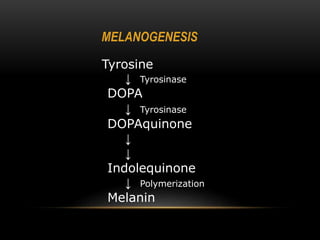
Tyrosine
↓ Tyrosinase
DOPA
↓ Tyrosinase
DOPAquinone
↓
↓
Indolequinone
↓ Polymerization
Melanin
MELANOGENESIS
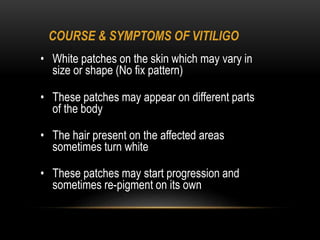
COURSE & SYMPTOMS OF VITILIGO
• White patches on the skin which may vary in
size or shape (No fix pattern)
• These patches may appear on different parts
of the body
• The hair present on the affected areas
sometimes turn white
• These patches may start progression and
sometimes re-pigment on its own
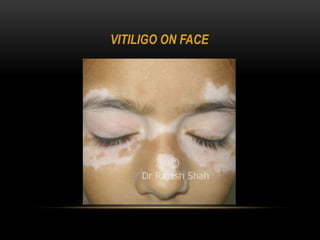
VITILIGO ON FACE
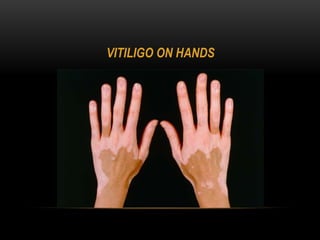
VITILIGO ON HANDS
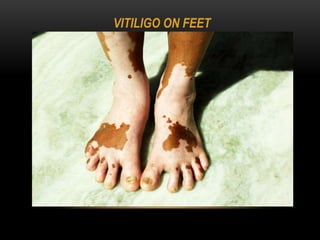
VITILIGO ON FEET
CAUSES OF VITILIGO
• Inheritance
• Severe mental or physical trauma
• Other autoimmune diseases
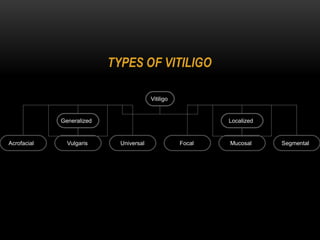
TYPES OF VITILIGO
Vitiligo
Generalized Localized
Acrofacial Vulgaris Universal Focal SegmentalMucosal
GENERALIZED VITILIGO
Generalized vitiligo has three types:-
Acrofacial Vitiligo:
– Occurs on the parts away from the center of the body
Vulgaris Vitiligo:
– Scattered patches
– Widely distributed
Universal Vitiligo:
– Nearly complete depigmentation
LOCALIZED VITILIGO
• Localized vitiligo has three types
• Focal Vitiligo:
– Limited to one or few areas
– Does not progress
– Not clearly in a segmental distribution
• Segmental Vitiligo:
– Unilateral and asymmetric in distribution
– Only one side of the body is affected
– Common in children
• Mucosal Vitiligo:
– Mucous membranes are affected
TREATMENT
1.Photochemotherapy
 Psoralens + UVA exposure – PUVA
• Mainstay of vitiligo therapy
• Psoralens – Tricyclic furocoumarins
8- Methoxypsoralen
Topical/Systemic
• UVA- in special chambers containing UVA emitting tubes
 PUVA sol – psoralen + sunlight
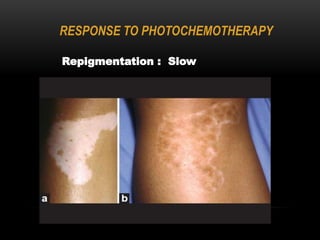
RESPONSE TO PHOTOCHEMOTHERAPY
Repigmentation : Slow
2. PHOTOTHERAPY: NARROW BAND UVB (311NM)
INDICATIONS :
 Indicated in children and pregnant women
 Patients in which psoralens C/I
 REGIMEN – Gradually increasing doses of
UVB, given from specialized chambers.
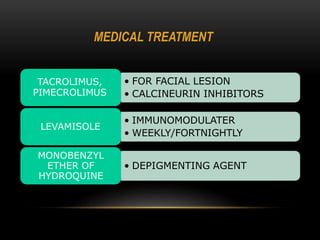
MEDICAL TREATMENT
TACROLIMUS,
PIMECROLIMUS
LEVAMISOLE
MONOBENZYL
ETHER OF
HYDROQUINE
• FOR FACIAL LESION
• CALCINEURIN INHIBITORS
• IMMUNOMODULATER
• WEEKLY/FORTNIGHTLY
• DEPIGMENTING AGENT
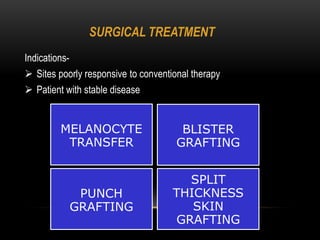
SURGICAL TREATMENT
Indications-
 Sites poorly responsive to conventional therapy
 Patient with stable disease
MELANOCYTE
TRANSFER
BLISTER
GRAFTING
PUNCH
GRAFTING
SPLIT
THICKNESS
SKIN
GRAFTING
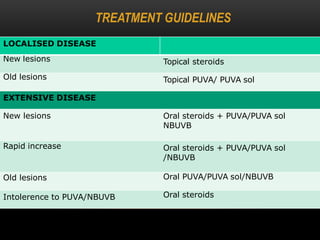
TREATMENT GUIDELINES
Topical steroids
Topical PUVA/ PUVA sol
LOCALISED DISEASE
New lesions
Old lesions
EXTENSIVE DISEASE
New lesions
Rapid increase
Old lesions
Intolerence to PUVA/NBUVB
GENERALISED LESIONS
Oral steroids + PUVA/PUVA sol
NBUVB
Oral steroids + PUVA/PUVA sol
/NBUVB
Oral PUVA/PUVA sol/NBUVB
Oral steroids
Monobenzyl ether of hydroquinone
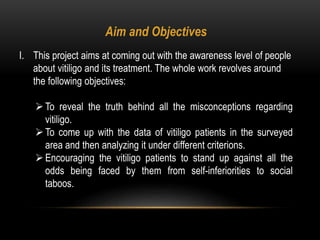
Aim and Objectives
I. This project aims at coming out with the awareness level of people
about vitiligo and its treatment. The whole work revolves around
the following objectives:
To reveal the truth behind all the misconceptions regarding
vitiligo.
To come up with the data of vitiligo patients in the surveyed
area and then analyzing it under different criterions.
Encouraging the vitiligo patients to stand up against all the
odds being faced by them from self-inferiorities to social
taboos.
To aware people about the all possible treatments available for
the disease.
To discover whether the patients use some indigenous
treatments or not.
Try to come up with some new drugs that could help with the
disease.
Continued…
1. Priyanka et al., 2010; Navneet et al., 2012
It involves different topical formulations of steroids and immune-modulators.
Steroids applied topically are helpful to treat the patches of vitiligo. Potent
corticosteroids like betamethasone, valerate, triaminolone and very potent
corticosteroids like alobetasol, fluticasone propionate are helpful to obtain
marked or almost complete repigmentation of the skin. Immune-modulators
like tacrolimus and pimecrolimus are helpful in the treatment of vitiligo when
applied topically. These can also be used to treat the small and difficult areas
like eyelids
Review Of Literature
2. Navneet et al., 2012
It is a drastic form of treatment for vitiligo. It involves fading the rest of the
skin of the body so the whole body appears in white colour. For that
permanent melanocytotoxic agents like monobenzyl ester of hydroquinone
cream and 4-methoxyphenol can be used.
3. Priyanka et al., 2010; Navneet et al., 2012
If no treatment works for the treatment than alternative cover-ups can be
used. Leukodermic skin easily gets damaged to the sunburn and the effect
lasts for very long time. So to avoid the excess exposure to the sunlight and
prevent the sunburn sunscreens can be used. To hide the untreated white
patches onto the skin cosmetics cover-ups are very useful
SURVEY DESCRIPTION
Out of the total people surveyed :
 75% suffer from acrofacial vitiligo
 Only few of them inherited the disease from their parents
 Mostly people prefer ayurvedic & homeopathic treatment
 Most people believe that the disease is more prominent during
summer
 Most of them get sunburnt easily
 Many of them were prescribed topical ointment containing
Tacrolimus Salt
 Some of them also go for traditional methods of controlling the
disease
Continued…
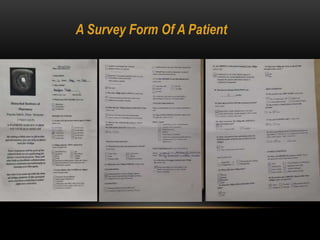
A Survey Form Of A Patient
CONCLUSION
 Vitiligo is chronic skin disorder that produces white patches on
skin.
 It may start at any age and affect any part of the body.
 The main causes of this disease are inheritance and mental or
physical trauma.
 It is not a harmful disease.
 It causes psychological problems like tension,
embarrassment or loss of self-confidence.
Vitiligo: A Chronic Skin Disorder

Vitiligo: A Chronic Skin Disorder

  • 1.
    GETTING THE PATIENTPERSPECTIVE ON VITILIGO : A CHRONIC SKIN DISORDER By:- Amzad Ansari Roll No. :- BP5012383 HIMACHAL INSTITUTE OF PHARMACY CO-ORDINATOR:- Dr. Alok Semwal Associate Professor Pharmaceutical Chemistry
  • 2.
    WHAT IS VITILIGO? •An acquired skin pigmentation disorder • Characterized by white patches • Often surrounded by a heavily pigmented border
  • 3.
    EFFECTS OF VITILIGO •Gradual loss of melanin resulting in depigmentation • White patches on different parts of the body which may start progression • Psychological disorders • Does not cause any organic harm
  • 4.
  • 5.
    COURSE & SYMPTOMSOF VITILIGO • White patches on the skin which may vary in size or shape (No fix pattern) • These patches may appear on different parts of the body • The hair present on the affected areas sometimes turn white • These patches may start progression and sometimes re-pigment on its own
  • 6.
  • 7.
  • 8.
  • 9.
    CAUSES OF VITILIGO •Inheritance • Severe mental or physical trauma • Other autoimmune diseases
  • 10.
    TYPES OF VITILIGO Vitiligo GeneralizedLocalized Acrofacial Vulgaris Universal Focal SegmentalMucosal
  • 11.
    GENERALIZED VITILIGO Generalized vitiligohas three types:- Acrofacial Vitiligo: – Occurs on the parts away from the center of the body Vulgaris Vitiligo: – Scattered patches – Widely distributed Universal Vitiligo: – Nearly complete depigmentation
  • 12.
    LOCALIZED VITILIGO • Localizedvitiligo has three types • Focal Vitiligo: – Limited to one or few areas – Does not progress – Not clearly in a segmental distribution • Segmental Vitiligo: – Unilateral and asymmetric in distribution – Only one side of the body is affected – Common in children • Mucosal Vitiligo: – Mucous membranes are affected
  • 13.
    TREATMENT 1.Photochemotherapy  Psoralens +UVA exposure – PUVA • Mainstay of vitiligo therapy • Psoralens – Tricyclic furocoumarins 8- Methoxypsoralen Topical/Systemic • UVA- in special chambers containing UVA emitting tubes  PUVA sol – psoralen + sunlight
  • 14.
  • 15.
    2. PHOTOTHERAPY: NARROWBAND UVB (311NM) INDICATIONS :  Indicated in children and pregnant women  Patients in which psoralens C/I  REGIMEN – Gradually increasing doses of UVB, given from specialized chambers.
  • 16.
    MEDICAL TREATMENT TACROLIMUS, PIMECROLIMUS LEVAMISOLE MONOBENZYL ETHER OF HYDROQUINE •FOR FACIAL LESION • CALCINEURIN INHIBITORS • IMMUNOMODULATER • WEEKLY/FORTNIGHTLY • DEPIGMENTING AGENT
  • 17.
    SURGICAL TREATMENT Indications-  Sitespoorly responsive to conventional therapy  Patient with stable disease MELANOCYTE TRANSFER BLISTER GRAFTING PUNCH GRAFTING SPLIT THICKNESS SKIN GRAFTING
  • 18.
    TREATMENT GUIDELINES Topical steroids TopicalPUVA/ PUVA sol LOCALISED DISEASE New lesions Old lesions EXTENSIVE DISEASE New lesions Rapid increase Old lesions Intolerence to PUVA/NBUVB GENERALISED LESIONS Oral steroids + PUVA/PUVA sol NBUVB Oral steroids + PUVA/PUVA sol /NBUVB Oral PUVA/PUVA sol/NBUVB Oral steroids Monobenzyl ether of hydroquinone
  • 19.
    Aim and Objectives I.This project aims at coming out with the awareness level of people about vitiligo and its treatment. The whole work revolves around the following objectives: To reveal the truth behind all the misconceptions regarding vitiligo. To come up with the data of vitiligo patients in the surveyed area and then analyzing it under different criterions. Encouraging the vitiligo patients to stand up against all the odds being faced by them from self-inferiorities to social taboos.
  • 20.
    To aware peopleabout the all possible treatments available for the disease. To discover whether the patients use some indigenous treatments or not. Try to come up with some new drugs that could help with the disease. Continued…
  • 21.
    1. Priyanka etal., 2010; Navneet et al., 2012 It involves different topical formulations of steroids and immune-modulators. Steroids applied topically are helpful to treat the patches of vitiligo. Potent corticosteroids like betamethasone, valerate, triaminolone and very potent corticosteroids like alobetasol, fluticasone propionate are helpful to obtain marked or almost complete repigmentation of the skin. Immune-modulators like tacrolimus and pimecrolimus are helpful in the treatment of vitiligo when applied topically. These can also be used to treat the small and difficult areas like eyelids Review Of Literature
  • 22.
    2. Navneet etal., 2012 It is a drastic form of treatment for vitiligo. It involves fading the rest of the skin of the body so the whole body appears in white colour. For that permanent melanocytotoxic agents like monobenzyl ester of hydroquinone cream and 4-methoxyphenol can be used. 3. Priyanka et al., 2010; Navneet et al., 2012 If no treatment works for the treatment than alternative cover-ups can be used. Leukodermic skin easily gets damaged to the sunburn and the effect lasts for very long time. So to avoid the excess exposure to the sunlight and prevent the sunburn sunscreens can be used. To hide the untreated white patches onto the skin cosmetics cover-ups are very useful
  • 23.
    SURVEY DESCRIPTION Out ofthe total people surveyed :  75% suffer from acrofacial vitiligo  Only few of them inherited the disease from their parents  Mostly people prefer ayurvedic & homeopathic treatment  Most people believe that the disease is more prominent during summer  Most of them get sunburnt easily
  • 24.
     Many ofthem were prescribed topical ointment containing Tacrolimus Salt  Some of them also go for traditional methods of controlling the disease Continued…
  • 25.
    A Survey FormOf A Patient
  • 26.
    CONCLUSION  Vitiligo ischronic skin disorder that produces white patches on skin.  It may start at any age and affect any part of the body.  The main causes of this disease are inheritance and mental or physical trauma.  It is not a harmful disease.  It causes psychological problems like tension, embarrassment or loss of self-confidence.