VITILIGO
By Reinfried Haule
Objectives
 Introduction
 Epidemiology
 Etiology
 Classification
 Pathophysiology
 Clinical presentation
 Diagnosis
 Differential diagnosis
 Treatment
 complications
Introduction
 To understand Vitiligo one must know about
the following terms;
 Melanocytes
These are one of the skin cells found at the bottom
layer (stratum basale) of the skin epidermis,
middle layer of the eye (uvea), inner ear and
vaginal epithelium which functions in the
production of Melanin.
Melanin
Is a dark pigment of the skin primarily
responsible for skin coloration. It also
acts in the protection of skin cells from
DNA(1)- (antagonist) which can lead to
skin cancer
 Vitiligo (simple definition)
corruption and murdering of melanocytes
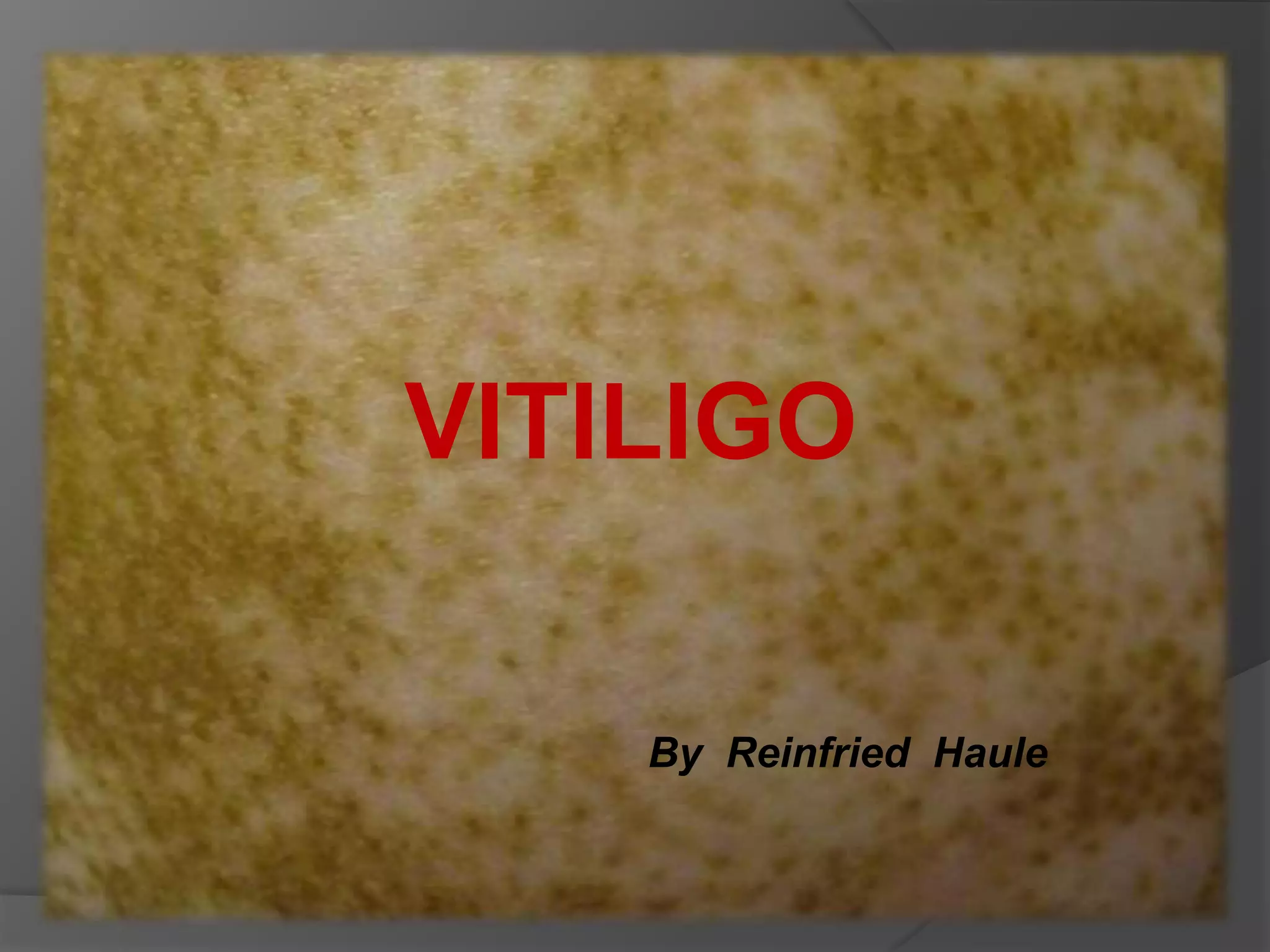
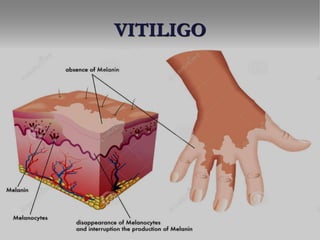
VITILIGO
VITILIGO
Definition
Is a skin disease in which pigment cells of the
body (melanocytes) are destroyed in certain
areas of the body
• Its present by white skin patches (macules) in
any location of the body due to
depigmentation
• Vitiligo effects is also seen in hairs since they
also contain melanin
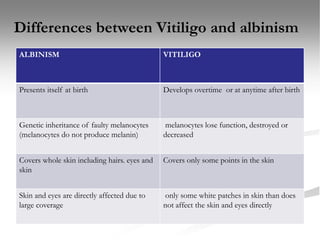
ALBINISM VITILIGO
Presents itself at birth Develops overtime or at anytime after birth
Genetic inheritance of faulty melanocytes
(melanocytes do not produce melanin)
melanocytes lose function, destroyed or
decreased
Covers whole skin including hairs. eyes and
skin
Covers only some points in the skin
Skin and eyes are directly affected due to
large coverage
only some white patches in skin than does
not affect the skin and eyes directly
Differences between Vitiligo and albinism
EPIDERMIOLOGY
 As long as every human being has got
skin, the it can affects all races though
its more noticeable to people with dark
skin.
 Estimated to affect 1% of the worlds
population
 May appear at any age but mostly
affects the age between 20 and 30
years
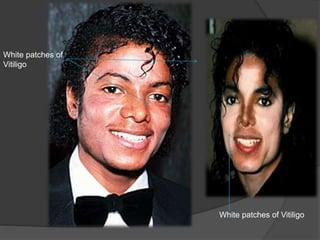
White patches of
Vitiligo
White patches of Vitiligo
ETIOLOGY
 The cause of Vitiligo is yet unknown
though some theories suggests the
defects in melanocytes functioning due
to auto immunity
 Its also possible due to history of family
members with Vitiligo
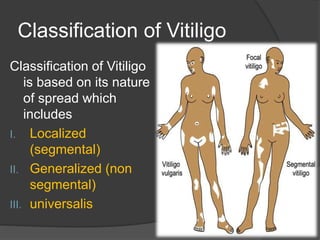
Classification of Vitiligo
is based on its nature
of spread which
includes
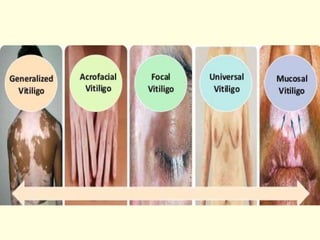
I. Localized
(segmental)
II. Generalized (non
segmental)
III. universalis
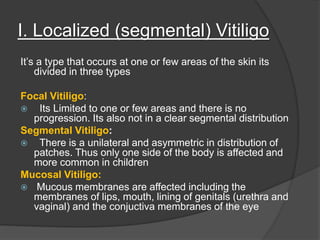
I. Localized (segmental) Vitiligo
It’s a type that occurs at one or few areas of the skin its
divided in three types
Focal Vitiligo:
 Its Limited to one or few areas and there is no
progression. Its also not in a clear segmental distribution
Segmental Vitiligo:
 There is a unilateral and asymmetric in distribution of
patches. Thus only one side of the body is affected and
more common in children
Mucosal Vitiligo:
 Mucous membranes are affected including the
membranes of lips, mouth, lining of genitals (urethra and
vaginal) and the conjuctiva membranes of the eye
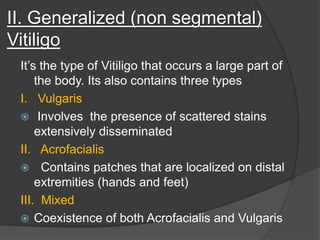
II. Generalized (non segmental)
Vitiligo
It’s the type of Vitiligo that occurs a large part of
the body. Its also contains three types
I. Vulgaris
 Involves the presence of scattered stains
extensively disseminated
II. Acrofacialis
 Contains patches that are localized on distal
extremities (hands and feet)
III. Mixed
 Coexistence of both Acrofacialis and Vulgaris
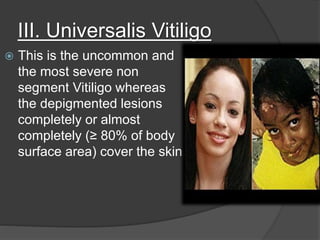
III. Universalis Vitiligo
 This is the uncommon and
the most severe non
segment Vitiligo whereas
the depigmented lesions
completely or almost
completely (≥ 80% of body
surface area) cover the skin.
PATHOGENESIS
 Vitiligo is a multifactorial polygenic disorder
with a complex pathogenesis. It is related to
both genetic and non genetic factors.
 Although several theories have been
proposed about the pathogenesis of vitiligo,
the precise cause remains unknown.
These theories includes;
 Autoimmune and cytotoxicity theory
 Intrinsic defect of melanocytes
 Neural hypothesis
 Oxidant –antioxidant mechanism
Autoimmune and cytotoxicity
theory
 Autoimmune theory proposes that there is
alteration in humoral and cellular immunity in
destruction of melanocytes. A theory gives
relevance to non segmental Vitiligo is more
frequently associated with autoimmune
conditions than in segmental
 It is due to circulating antibodies against
melanocytes proteins in patients with Vitiligo.
 Its destruction may also be mediated by
CD8+T cells (cellular immunity). Thus
activated CD8+T cells have been seen in
perilesional Vitiligo skin.
INTRINSIC DEFECT OF MELANOCYTES
 Melanocytes have an inherent abnormality
that impedes their growth and
differentiation in conditions that support
normal melanocytes
NEURAL HYPOTHESIS
 A neurochemical mediator destroys
melanocytes or inhibits melanin production.
OXIDANT-ANTIOXIDANT MECHANISM
 An intermediate or metabolic product of
melanin synthesis causes melanocyte
destruction
Clinical presentation
 There is no history of preceding
inflammation.
 Patients are very susceptible to sunburn.
 Lesions are often symmetrical and
frequently involve the face, hands and
genitalia.
 Trauma may induce new lesions.
 Spontaneous repigmentation can occur and
often starts around hair follicles, giving a
speckled appearance
Clinical presentation…………
 White patches of skin
 Whitening or graying of the hair on your
scalp,
 eyelashes, eyebrows or beard
(leukotichia – seen insegmental)
 Loss of color in the tissues that line the
inside of your mouth
 • Loss or change in color of the inner
layer
Investigations
 Proper history taking and physical
examinations lead to diagnosis of Vitiligo.
Examine and rule out other medical
problems such as dermatitis or psoriasis.
 Skin biopsy of the affected skin for cytology
 Wood lamp examination
 TSH levels [Thyroid disease].
 • CBC [Pernicious anemia].
 • Evaluation about Diabetes Mellitus.
 • Ophthalmological examination
Differential diagnosis
 Cutaneous melanoma
 Dermatologic manifestation of leprosy
 Idiopathic Guttate hypomelanosis
 Mycosis fungoides
 Pityriasis Alba
 Tinea versicolor
 Dermatologic aspects of Addison
Disease
Treatment
 There is no cure for vitiligo, but there are
number of treatments that can improve the
condition.
 Sun blocks should be used to prevent
burning. Potent topical steroids or
phototherapy help some individuals.
 Betamethasone valerate 0.1% 12 hourly for
2-4 months
 Finally, referral to a specialist camouflage
clinic is often the most helpful 'treatment'
Complications
 Social and psychological stress
 Sunburn and skin cancer
 Eye problems such as inflammation of
iris (iritis)
 Hearing loss.
Que Dieu soit avec
vous

Vitiligo presentation

  • 1.
  • 2.
    Objectives  Introduction  Epidemiology Etiology  Classification  Pathophysiology  Clinical presentation  Diagnosis  Differential diagnosis  Treatment  complications
  • 3.
    Introduction  To understandVitiligo one must know about the following terms;  Melanocytes These are one of the skin cells found at the bottom layer (stratum basale) of the skin epidermis, middle layer of the eye (uvea), inner ear and vaginal epithelium which functions in the production of Melanin.
  • 4.
    Melanin Is a darkpigment of the skin primarily responsible for skin coloration. It also acts in the protection of skin cells from DNA(1)- (antagonist) which can lead to skin cancer  Vitiligo (simple definition) corruption and murdering of melanocytes
  • 5.
  • 6.
    VITILIGO Definition Is a skindisease in which pigment cells of the body (melanocytes) are destroyed in certain areas of the body • Its present by white skin patches (macules) in any location of the body due to depigmentation • Vitiligo effects is also seen in hairs since they also contain melanin
  • 7.
    ALBINISM VITILIGO Presents itselfat birth Develops overtime or at anytime after birth Genetic inheritance of faulty melanocytes (melanocytes do not produce melanin) melanocytes lose function, destroyed or decreased Covers whole skin including hairs. eyes and skin Covers only some points in the skin Skin and eyes are directly affected due to large coverage only some white patches in skin than does not affect the skin and eyes directly Differences between Vitiligo and albinism
  • 8.
    EPIDERMIOLOGY  As longas every human being has got skin, the it can affects all races though its more noticeable to people with dark skin.  Estimated to affect 1% of the worlds population  May appear at any age but mostly affects the age between 20 and 30 years
  • 9.
  • 10.
    ETIOLOGY  The causeof Vitiligo is yet unknown though some theories suggests the defects in melanocytes functioning due to auto immunity  Its also possible due to history of family members with Vitiligo
  • 11.
    Classification of Vitiligo Classificationof Vitiligo is based on its nature of spread which includes I. Localized (segmental) II. Generalized (non segmental) III. universalis
  • 12.
    I. Localized (segmental)Vitiligo It’s a type that occurs at one or few areas of the skin its divided in three types Focal Vitiligo:  Its Limited to one or few areas and there is no progression. Its also not in a clear segmental distribution Segmental Vitiligo:  There is a unilateral and asymmetric in distribution of patches. Thus only one side of the body is affected and more common in children Mucosal Vitiligo:  Mucous membranes are affected including the membranes of lips, mouth, lining of genitals (urethra and vaginal) and the conjuctiva membranes of the eye
  • 13.
    II. Generalized (nonsegmental) Vitiligo It’s the type of Vitiligo that occurs a large part of the body. Its also contains three types I. Vulgaris  Involves the presence of scattered stains extensively disseminated II. Acrofacialis  Contains patches that are localized on distal extremities (hands and feet) III. Mixed  Coexistence of both Acrofacialis and Vulgaris
  • 14.
    III. Universalis Vitiligo This is the uncommon and the most severe non segment Vitiligo whereas the depigmented lesions completely or almost completely (≥ 80% of body surface area) cover the skin.
  • 16.
    PATHOGENESIS  Vitiligo isa multifactorial polygenic disorder with a complex pathogenesis. It is related to both genetic and non genetic factors.  Although several theories have been proposed about the pathogenesis of vitiligo, the precise cause remains unknown. These theories includes;  Autoimmune and cytotoxicity theory  Intrinsic defect of melanocytes  Neural hypothesis  Oxidant –antioxidant mechanism
  • 17.
    Autoimmune and cytotoxicity theory Autoimmune theory proposes that there is alteration in humoral and cellular immunity in destruction of melanocytes. A theory gives relevance to non segmental Vitiligo is more frequently associated with autoimmune conditions than in segmental  It is due to circulating antibodies against melanocytes proteins in patients with Vitiligo.  Its destruction may also be mediated by CD8+T cells (cellular immunity). Thus activated CD8+T cells have been seen in perilesional Vitiligo skin.
  • 18.
    INTRINSIC DEFECT OFMELANOCYTES  Melanocytes have an inherent abnormality that impedes their growth and differentiation in conditions that support normal melanocytes NEURAL HYPOTHESIS  A neurochemical mediator destroys melanocytes or inhibits melanin production. OXIDANT-ANTIOXIDANT MECHANISM  An intermediate or metabolic product of melanin synthesis causes melanocyte destruction
  • 19.
    Clinical presentation  Thereis no history of preceding inflammation.  Patients are very susceptible to sunburn.  Lesions are often symmetrical and frequently involve the face, hands and genitalia.  Trauma may induce new lesions.  Spontaneous repigmentation can occur and often starts around hair follicles, giving a speckled appearance
  • 20.
    Clinical presentation…………  Whitepatches of skin  Whitening or graying of the hair on your scalp,  eyelashes, eyebrows or beard (leukotichia – seen insegmental)  Loss of color in the tissues that line the inside of your mouth  • Loss or change in color of the inner layer
  • 21.
    Investigations  Proper historytaking and physical examinations lead to diagnosis of Vitiligo. Examine and rule out other medical problems such as dermatitis or psoriasis.  Skin biopsy of the affected skin for cytology  Wood lamp examination  TSH levels [Thyroid disease].  • CBC [Pernicious anemia].  • Evaluation about Diabetes Mellitus.  • Ophthalmological examination
  • 22.
    Differential diagnosis  Cutaneousmelanoma  Dermatologic manifestation of leprosy  Idiopathic Guttate hypomelanosis  Mycosis fungoides  Pityriasis Alba  Tinea versicolor  Dermatologic aspects of Addison Disease
  • 23.
    Treatment  There isno cure for vitiligo, but there are number of treatments that can improve the condition.  Sun blocks should be used to prevent burning. Potent topical steroids or phototherapy help some individuals.  Betamethasone valerate 0.1% 12 hourly for 2-4 months  Finally, referral to a specialist camouflage clinic is often the most helpful 'treatment'
  • 24.
    Complications  Social andpsychological stress  Sunburn and skin cancer  Eye problems such as inflammation of iris (iritis)  Hearing loss.
  • 26.
    Que Dieu soitavec vous