What is it?
0 Disorder of pilosebaceous complex which
predominantly affects the peripubertal population
and manifest as
comedones, papules, nodules, pustules and cysts and
heals with scars.
ETIOLOGY
0 Increased sebum secretion.
0 Follicular duct hypercornification.
0 Increased colonization with Propionibacterium.
0 Inflammation.
PATHOGENESIS
0 Occlusion of
pilosebaceous orifice.
0 Increased sebum
secretion.
0 Microbial colonization.
0 Release of
inflammatory
mediators.
OCCLUSION OF PILOSEBACEOUS
ORIFICE
Occluded by keratinous plug induced by chemicals and
reduced level of linoleic acid in sebum
Retention of sebum encouraging growth of microbes.
Distended follicle rupture, releasing proinflammatory
chemicals into dermis
Stimulate inflammation.
INCREASED SEBUM
SECRETION
0Occurs due to end organ sensitivity to androgens.
Increased activity of 5α reductase in sebaceous
gland.
Converts testosterone to 5 α testosterone
Binds to receptors in sebaceous gland
Increase sebaceous secetion.
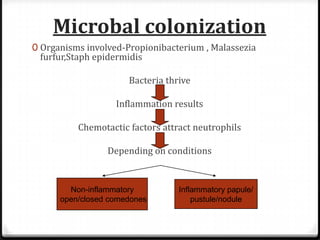
Microbal colonization
0 Organisms involved-Propionibacterium , Malassezia
furfur,Staph epidermidis
Bacteria thrive
Inflammation results
Chemotactic factors attract neutrophils
Depending on conditions
Non-inflammatory
open/closed comedones
Inflammatory papule/
pustule/nodule
EPIDEMIOLOGY
0 PREVELANCE -affects all adolescents.
0 AGE-
Onset-12-14 years.
0 GENDER-
Both sexes equally but nodulocystic acne common in
males.
FACTORS
1. GENETIC PREDISPOSITION
Found to be familial
Identical twins shows greater concordance of severity of acne.
2) DIET
High glycemic diet.
3. COSMETICS
Seen in women using oil based cosmetics for long time.
Follows facial massage.
4. MENSTRUAL CYCLE
Premenstrual edema of pilosebaceous duct.
5. PSYCHOLOGICAL FACTORS
MORPHOLOGY
0 Polymorphic eruption consisting of
papules, pustules, nodules, cysts, and pathognomic
open and closed comedones on a background of
oilness.
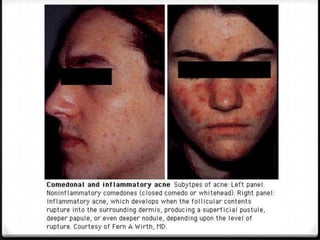
COMEDONES
0 Hyperkeratotic plug made of sebum and keratin in
follicular canal.
0 Pathognomic lesions of acne vulgaris.
0 2 types:
1. Open comedones.
2. Closed comedones.
OPEN COMEDONES
0 Also known as Black head.
0 Due to plugging of pilosebaceous orifice by keratin
and sebum on the skin surface.
CLOSED COMEDONES
0 Due to keratin and sebum accretions plugging the
pilosebaceous ducts below the skin surface.
0 SUBMARINE COMEDONES-deep seated and seen by
stretching the skin.
Grades of Acne (Pillsburry’s
classification)
 Grade I: Comedones (open or closed), occasionally
pustules or papules; no scarring.
 Grade II: papules, comedones, few pustules; mild scarring.
 Grade III: predominant pustules, nodules, abscesses;
moderate scarring.
 Grade IV: mainly cysts, abscesses, scars; severe scarring.
SCARS
0 Acne scars can be:
Depressed scars
1. Ice pick scars- deep pits.
2. Box car scars-superficial/deep
3. Rolling scars
Hypertrophic and keloidal scars.
VARIANTS
ACNE CONGLOBATA
0 Severe form of acne characterised by
intercommunicating abscess, cysts, and sinuses
loaded with serosanguinous fluid or pus.
0 Multiporous comedones.
0 Lesions take months to heal and on healing leave
behind deep pitted or hypertrophic scars.
OCCUPATIONAL ACNE
0 Caused by exposure to industrial chemicals
(tar, chlorinated hydrocarbons) and cutting oils.
0 Predominantly comedones
COSMETIC ACNE
0 Seen in women using cosmetics(oil based ones)
0 Comedones
0 Frequently on the chin
DRUG INDUCED ACNE
0 Steroids, androgens, oral
contraceptives, antitubercular
drugs, iodides, bromides and anticonvulsants.
0 Lesions are monomorphic, consisting of papules and
pustules
0 Site- trunk especially back.
INFANTILE ACNE
0 Due to presence of maternal hormones in child.
0 Common in males.
LATE ONSET ACNE
0 Onset after 25 years of age.
0 Predominantly women.
0 Deep seated persistent lesions on lower half of face.
ACNE EXCORIEE
0 Seen in young girls, who obsessively pick their mild
acne.
0 Results in discrete excoriations on face, while
comedones, and papules are few and far between.
ACNE FULMINANS
0 Acute onset.
0 Crusted ulcerated lesions.
0 Associated with fever, myalgia and arthralgia.
ACNE AFTER FACIAL
MASSAGE
0 3-6 weeks later as acneiform eruption.
0 Indolent deep seated nodules with vey few
comedones.
0 Predominantly on cheeks along the mandible.
DIFFERENTIAL DIAGNOSIS
0 Rosacea
0 Folliculitis
0 Acne scarring may be mistaken for acne
keloidalis, varioliform, atrophy and porphyria cutanea
tarda
TREATMENT
0 General measures
0 Topical therapy
0 Systemic therapy
0 Physical therapy
GENERAL MEASURES
1. Local hygiene
Regular cleansing with soap and water and avoiding
use of oil based cosmetics.
2. Diet
Avoid use of high glycemic diet.
3. Stress
TOPICAL THERAPY
0 Retinoids
Most frequently used agent in acne.
Effective against comedones and inflammatory acne.
Reduces formation of microcomedo.
Side effects include irritation and photosensitivity.
0 Benzoyl peroxide
Powerful antimicrobial which decrease population of
Propionibacterium acnes.
Used in both inflammatory acne and non inflammatory
acne.
Side effects include irritation and bleaching of hair.
0 Topical antibiotics
Clindamycin(1-2%) and erythromycin(2-4%)
Used in inflammatory acne since it suppress P.acnes.
Side effect: antibiotic resistance. So should be
combined with retinoids or benzoyl peroxide.
Systemic treatment
0 Antibiotics
Mostly Doxycycline and minocycline; Erythromycin and
azithromycin.
Inhibit growth of P.acnes and has direct anti
inflammatory effect.
ADVERSE EFFECTS
 Doxycycline - onycholysis, oesophagitis with
ulceration, fixed drug eruptions, photosensitivity etc.
 Minocycline - benign intracranial hypertension,
pappiloedema, blue-black pigmentation and rarely
hypersensitivity reactions
 Macrolide group - gastritis, diarrhoea.
HORMONES
0 Act by decreasing sebum secretion rate.
0 Used only in females with late onset acne and
menstrual irregularities.
Adverse effects of hormonal
therapy
 Weight gain
 Menstrual irregularity
 Occasional fluid retention
 Melasma
 Hypertension
 Thrombophlebitis
 Pulmonary embolism
ISORETINOIN
13-cis- retinoic acid (Vitamin A derivative )
 Mechanism of action:
◦ Inhibiting sebum secretion.
◦ Alters the composition of sebum
◦ Lowers P.acnes concentration and has anti-
inflammatory activity
 Indicated for :
◦ Nodulocystic/ severe Acne
◦ Pyoderma faciale
◦ Excessive seborrhoea
◦ Depression / Dysmorphophobia
◦ Acne conglobata / other unusual variants
◦ Scarring
 Dose: 0.5 – 1 mg/ kg per day is given after meals.
Cumulative dose: 120-150 mgs/kg
 Side effects
◦ Teratogenicity
◦ Mucocutaneous side effects, dryness
◦ Elevation of serum lipids
◦ Neurological : pseudotumor cerebri
Optic Neuritis, depression, mood swing
◦ Arthritis, myalgia
◦ Acne flares
PHYSICAL MODALITIES
0 Intralesional corticosteroids
0 Cryotherapy
0 Laser therapy
0 Photodynamic treatment
0 Dermabrasion
0 Fillers
Thank You…..

Acne

  • 3.
    What is it? 0Disorder of pilosebaceous complex which predominantly affects the peripubertal population and manifest as comedones, papules, nodules, pustules and cysts and heals with scars.
  • 4.
    ETIOLOGY 0 Increased sebumsecretion. 0 Follicular duct hypercornification. 0 Increased colonization with Propionibacterium. 0 Inflammation.
  • 5.
    PATHOGENESIS 0 Occlusion of pilosebaceousorifice. 0 Increased sebum secretion. 0 Microbial colonization. 0 Release of inflammatory mediators.
  • 6.
    OCCLUSION OF PILOSEBACEOUS ORIFICE Occludedby keratinous plug induced by chemicals and reduced level of linoleic acid in sebum Retention of sebum encouraging growth of microbes. Distended follicle rupture, releasing proinflammatory chemicals into dermis Stimulate inflammation.
  • 7.
    INCREASED SEBUM SECRETION 0Occurs dueto end organ sensitivity to androgens. Increased activity of 5α reductase in sebaceous gland. Converts testosterone to 5 α testosterone Binds to receptors in sebaceous gland Increase sebaceous secetion.
  • 8.
    Microbal colonization 0 Organismsinvolved-Propionibacterium , Malassezia furfur,Staph epidermidis Bacteria thrive Inflammation results Chemotactic factors attract neutrophils Depending on conditions Non-inflammatory open/closed comedones Inflammatory papule/ pustule/nodule
  • 10.
    EPIDEMIOLOGY 0 PREVELANCE -affectsall adolescents. 0 AGE- Onset-12-14 years. 0 GENDER- Both sexes equally but nodulocystic acne common in males.
  • 11.
    FACTORS 1. GENETIC PREDISPOSITION Foundto be familial Identical twins shows greater concordance of severity of acne. 2) DIET High glycemic diet. 3. COSMETICS Seen in women using oil based cosmetics for long time. Follows facial massage. 4. MENSTRUAL CYCLE Premenstrual edema of pilosebaceous duct. 5. PSYCHOLOGICAL FACTORS
  • 12.
    MORPHOLOGY 0 Polymorphic eruptionconsisting of papules, pustules, nodules, cysts, and pathognomic open and closed comedones on a background of oilness.
  • 13.
    COMEDONES 0 Hyperkeratotic plugmade of sebum and keratin in follicular canal. 0 Pathognomic lesions of acne vulgaris. 0 2 types: 1. Open comedones. 2. Closed comedones.
  • 14.
    OPEN COMEDONES 0 Alsoknown as Black head. 0 Due to plugging of pilosebaceous orifice by keratin and sebum on the skin surface.
  • 15.
    CLOSED COMEDONES 0 Dueto keratin and sebum accretions plugging the pilosebaceous ducts below the skin surface. 0 SUBMARINE COMEDONES-deep seated and seen by stretching the skin.
  • 17.
    Grades of Acne(Pillsburry’s classification)  Grade I: Comedones (open or closed), occasionally pustules or papules; no scarring.  Grade II: papules, comedones, few pustules; mild scarring.  Grade III: predominant pustules, nodules, abscesses; moderate scarring.  Grade IV: mainly cysts, abscesses, scars; severe scarring.
  • 18.
    SCARS 0 Acne scarscan be: Depressed scars 1. Ice pick scars- deep pits. 2. Box car scars-superficial/deep 3. Rolling scars Hypertrophic and keloidal scars.
  • 19.
  • 20.
    ACNE CONGLOBATA 0 Severeform of acne characterised by intercommunicating abscess, cysts, and sinuses loaded with serosanguinous fluid or pus. 0 Multiporous comedones. 0 Lesions take months to heal and on healing leave behind deep pitted or hypertrophic scars.
  • 22.
    OCCUPATIONAL ACNE 0 Causedby exposure to industrial chemicals (tar, chlorinated hydrocarbons) and cutting oils. 0 Predominantly comedones
  • 23.
    COSMETIC ACNE 0 Seenin women using cosmetics(oil based ones) 0 Comedones 0 Frequently on the chin
  • 24.
    DRUG INDUCED ACNE 0Steroids, androgens, oral contraceptives, antitubercular drugs, iodides, bromides and anticonvulsants. 0 Lesions are monomorphic, consisting of papules and pustules 0 Site- trunk especially back.
  • 25.
    INFANTILE ACNE 0 Dueto presence of maternal hormones in child. 0 Common in males.
  • 26.
    LATE ONSET ACNE 0Onset after 25 years of age. 0 Predominantly women. 0 Deep seated persistent lesions on lower half of face.
  • 27.
    ACNE EXCORIEE 0 Seenin young girls, who obsessively pick their mild acne. 0 Results in discrete excoriations on face, while comedones, and papules are few and far between.
  • 28.
    ACNE FULMINANS 0 Acuteonset. 0 Crusted ulcerated lesions. 0 Associated with fever, myalgia and arthralgia.
  • 29.
    ACNE AFTER FACIAL MASSAGE 03-6 weeks later as acneiform eruption. 0 Indolent deep seated nodules with vey few comedones. 0 Predominantly on cheeks along the mandible.
  • 30.
    DIFFERENTIAL DIAGNOSIS 0 Rosacea 0Folliculitis 0 Acne scarring may be mistaken for acne keloidalis, varioliform, atrophy and porphyria cutanea tarda
  • 31.
    TREATMENT 0 General measures 0Topical therapy 0 Systemic therapy 0 Physical therapy
  • 32.
    GENERAL MEASURES 1. Localhygiene Regular cleansing with soap and water and avoiding use of oil based cosmetics. 2. Diet Avoid use of high glycemic diet. 3. Stress
  • 33.
    TOPICAL THERAPY 0 Retinoids Mostfrequently used agent in acne. Effective against comedones and inflammatory acne. Reduces formation of microcomedo. Side effects include irritation and photosensitivity.
  • 34.
    0 Benzoyl peroxide Powerfulantimicrobial which decrease population of Propionibacterium acnes. Used in both inflammatory acne and non inflammatory acne. Side effects include irritation and bleaching of hair.
  • 35.
    0 Topical antibiotics Clindamycin(1-2%)and erythromycin(2-4%) Used in inflammatory acne since it suppress P.acnes. Side effect: antibiotic resistance. So should be combined with retinoids or benzoyl peroxide.
  • 36.
    Systemic treatment 0 Antibiotics MostlyDoxycycline and minocycline; Erythromycin and azithromycin. Inhibit growth of P.acnes and has direct anti inflammatory effect.
  • 37.
    ADVERSE EFFECTS  Doxycycline- onycholysis, oesophagitis with ulceration, fixed drug eruptions, photosensitivity etc.  Minocycline - benign intracranial hypertension, pappiloedema, blue-black pigmentation and rarely hypersensitivity reactions  Macrolide group - gastritis, diarrhoea.
  • 38.
    HORMONES 0 Act bydecreasing sebum secretion rate. 0 Used only in females with late onset acne and menstrual irregularities.
  • 39.
    Adverse effects ofhormonal therapy  Weight gain  Menstrual irregularity  Occasional fluid retention  Melasma  Hypertension  Thrombophlebitis  Pulmonary embolism
  • 40.
    ISORETINOIN 13-cis- retinoic acid(Vitamin A derivative )  Mechanism of action: ◦ Inhibiting sebum secretion. ◦ Alters the composition of sebum ◦ Lowers P.acnes concentration and has anti- inflammatory activity
  • 41.
     Indicated for: ◦ Nodulocystic/ severe Acne ◦ Pyoderma faciale ◦ Excessive seborrhoea ◦ Depression / Dysmorphophobia ◦ Acne conglobata / other unusual variants ◦ Scarring
  • 42.
     Dose: 0.5– 1 mg/ kg per day is given after meals. Cumulative dose: 120-150 mgs/kg  Side effects ◦ Teratogenicity ◦ Mucocutaneous side effects, dryness ◦ Elevation of serum lipids ◦ Neurological : pseudotumor cerebri Optic Neuritis, depression, mood swing ◦ Arthritis, myalgia ◦ Acne flares
  • 43.
    PHYSICAL MODALITIES 0 Intralesionalcorticosteroids 0 Cryotherapy 0 Laser therapy 0 Photodynamic treatment 0 Dermabrasion 0 Fillers
  • 44.