ERYTHRODERMA
Presenter – Dr. Deepak R. Chinagi
Guide – Dr. L. S. Patil
Shri B. M. Patil Medical College and
Research Centre, Vijayapura
1
Introduction
• Erythroderma is defined as the scaling
erythematous dermatitis involving 90% or
more of the cutaneous surface.
• Also known as exfoliative dermatitis
• Idiopathic exfoliative dermatitis – also known
as the “red man syndrome”, is characterized
by marked palmoplantar keratoderma,
dermatopathic lymphadenopathy,increased
IgE.
Shri B. M. Patil Medical College and
Research Centre, Vijayapura
2
Shri B. M. Patil Medical College and
Research Centre, Vijayapura
3
Pathophysiology
1. Increased skin perfusion leads to
– Temperature dysregulation >
– Resulting in skin loss and hypothermia >
– High output state >
– Cardiac failure
2. BMR raises to compensate for heat loss
3. Increased dehydration due to transpiration
(similar to burns)
All lead to negative nitrogen balance and
characterized by edema, hypoalbuminemia, loss
of muscle mass.
Shri B. M. Patil Medical College and
Research Centre, Vijayapura
4
• Normal skin loss per day is around 0.3 g/d
• Skin exfoliation may reach upto 20 – 30 g/d
• Excessive fluid loss through transpiration.
• 18 – 20 % mortality is seen.
• Male preponderance is seen .. Nearly 2-4
times..
• Age ≥ 40 years
Shri B. M. Patil Medical College and
Research Centre, Vijayapura
5
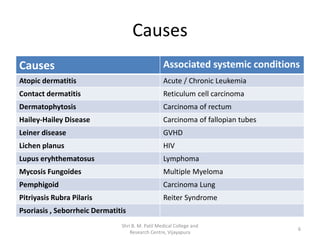
Causes
Causes Associated systemic conditions
Atopic dermatitis Acute / Chronic Leukemia
Contact dermatitis Reticulum cell carcinoma
Dermatophytosis Carcinoma of rectum
Hailey-Hailey Disease Carcinoma of fallopian tubes
Leiner disease GVHD
Lichen planus HIV
Lupus eryhthematosus Lymphoma
Mycosis Fungoides Multiple Myeloma
Pemphigoid Carcinoma Lung
Pitriyasis Rubra Pilaris Reiter Syndrome
Psoriasis , Seborrheic Dermatitis
Shri B. M. Patil Medical College and
Research Centre, Vijayapura
6
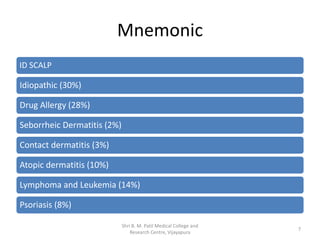
Mnemonic
ID SCALP
Idiopathic (30%)
Drug Allergy (28%)
Seborrheic Dermatitis (2%)
Contact dermatitis (3%)
Atopic dermatitis (10%)
Lymphoma and Leukemia (14%)
Psoriasis (8%)
Shri B. M. Patil Medical College and
Research Centre, Vijayapura
7
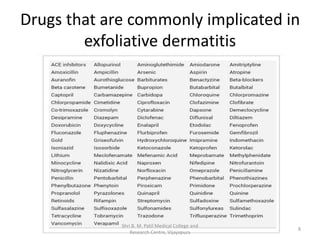
Drugs that are commonly implicated in
exfoliative dermatitis
Shri B. M. Patil Medical College and
Research Centre, Vijayapura
8
Clinical Features
• History of primary diease like psoriasis, atopic
dermatitis may be present.
• Drug history has to elicited in detail, including
OTC drugs
• Progression
– Rapid – Drug induced , lymphoma, leukemia, SSSS.
– Gradual – Psoriasis, Atopic Dermatitis.
• Pruritis is a predominant symptom
• Fever and Chills may occur.
Shri B. M. Patil Medical College and
Research Centre, Vijayapura
9
Clinical Features
• It often begns with generalized erythema.
• Scaling appears after 2-6 d.
• Scaling usually starts from flexural areas.
• Pruritis begins.
• Skin excoriations occur due to scratching.
• If it persists for weeks , hairs may shed, naiks may
become ridged.
• Periorbital skin may be inflamed and edematous,
result in ectropion.
Shri B. M. Patil Medical College and
Research Centre, Vijayapura
10
Clinical Features
• In Chronic cases , loss of pigment may occur
with patchy/widespread. Similar to vitiligo.
• Dermatopathic lymphadenopathy can occur,
– Lymph node is enlarged and rubbery in
consistency.
– Lymph node biopsy is advised.
Shri B. M. Patil Medical College and
Research Centre, Vijayapura
11
Diferential Diagnosis
Acanthosis Nigricans Atopic Dermatitis
Bullous Pemphigoid Allergic Contact Dermatitis
Irritan Contact Dermatitis Cutaneous T cell Lymphoma
Familial Benign Pemphigus (HH Disease) GVHD
Lichen Planus Pemphigus Foilaceous
Pitriyasis Rubra Pilaris Psoriasis – plaque
Reactive arthritis Sarcoidosis
Seborrheic Dermatitis
Stasis Dermatitis
Shri B. M. Patil Medical College and
Research Centre, Vijayapura
12
Investigations
• CBC and LFT - ↑ESR, ↓Hb, ↓Sr.Albumin, ↑Sr. Globulin.
• IgE ↑ - Atopic dermatitis.
• Peripheral Blood Smears and bone marrow examinations. –
leukemia workup
• Immunophentyping and flow cytometry – for lymphoma
workup.
• Skin scraping , may show hyphae or scabies mites
• CD4 t cells are decreased in exfoliative dermatitis (in
absence of HIV), studied by Griffiths et al.
• HIV test – PCR better than ELISA,
• Chest X ray done.
• Extensive work up for suspected cause.
Shri B. M. Patil Medical College and
Research Centre, Vijayapura
13
Investigations
• Patch test – for contact allergens and drugs
that were used by patient prior to remission.
• Skin biopsy may show spongiotic dermatitis.
– Subacute / Chronic Dermatitis
Shri B. M. Patil Medical College and
Research Centre, Vijayapura
14
Treatment
• Strict Intake Output monitoring.
• Monitor BP and temperature , risk of hypotension and
hypothermia.
• Maintain skn moisture, Avoid scratching, Avoid
precipitating factors.
• Topical steroids.
• Treat underlying cause and complications.
• For psoriasis , Phototherapy and systemic medications are
given.
• For idiopathic EF , prolonged glucocorticoids may be
required , usually disease has multiple exacerbations .
• Avoid the causative Drug.
Shri B. M. Patil Medical College and
Research Centre, Vijayapura
15
• Apply tap water gauze dressings. Change every 2-
3 hrs. Topical steroids 0.025-0.5% triamcilone.
Tepid bath once or twice /day
• As the condition improves , start on emolients.
• Antihistamines to decrease pruritis and provide
sedation.
• Systemic Steroids provide some relief (avoided in
psoriasis and SSSS)
• Proper Nutrition, to treat Hypoalbuminemia.
Shri B. M. Patil Medical College and
Research Centre, Vijayapura
16
Thank You
Shri B. M. Patil Medical College and
Research Centre, Vijayapura
17

Erythroderma

  • 1.
    ERYTHRODERMA Presenter – Dr.Deepak R. Chinagi Guide – Dr. L. S. Patil Shri B. M. Patil Medical College and Research Centre, Vijayapura 1
  • 2.
    Introduction • Erythroderma isdefined as the scaling erythematous dermatitis involving 90% or more of the cutaneous surface. • Also known as exfoliative dermatitis • Idiopathic exfoliative dermatitis – also known as the “red man syndrome”, is characterized by marked palmoplantar keratoderma, dermatopathic lymphadenopathy,increased IgE. Shri B. M. Patil Medical College and Research Centre, Vijayapura 2
  • 3.
    Shri B. M.Patil Medical College and Research Centre, Vijayapura 3
  • 4.
    Pathophysiology 1. Increased skinperfusion leads to – Temperature dysregulation > – Resulting in skin loss and hypothermia > – High output state > – Cardiac failure 2. BMR raises to compensate for heat loss 3. Increased dehydration due to transpiration (similar to burns) All lead to negative nitrogen balance and characterized by edema, hypoalbuminemia, loss of muscle mass. Shri B. M. Patil Medical College and Research Centre, Vijayapura 4
  • 5.
    • Normal skinloss per day is around 0.3 g/d • Skin exfoliation may reach upto 20 – 30 g/d • Excessive fluid loss through transpiration. • 18 – 20 % mortality is seen. • Male preponderance is seen .. Nearly 2-4 times.. • Age ≥ 40 years Shri B. M. Patil Medical College and Research Centre, Vijayapura 5
  • 6.
    Causes Causes Associated systemicconditions Atopic dermatitis Acute / Chronic Leukemia Contact dermatitis Reticulum cell carcinoma Dermatophytosis Carcinoma of rectum Hailey-Hailey Disease Carcinoma of fallopian tubes Leiner disease GVHD Lichen planus HIV Lupus eryhthematosus Lymphoma Mycosis Fungoides Multiple Myeloma Pemphigoid Carcinoma Lung Pitriyasis Rubra Pilaris Reiter Syndrome Psoriasis , Seborrheic Dermatitis Shri B. M. Patil Medical College and Research Centre, Vijayapura 6
  • 7.
    Mnemonic ID SCALP Idiopathic (30%) DrugAllergy (28%) Seborrheic Dermatitis (2%) Contact dermatitis (3%) Atopic dermatitis (10%) Lymphoma and Leukemia (14%) Psoriasis (8%) Shri B. M. Patil Medical College and Research Centre, Vijayapura 7
  • 8.
    Drugs that arecommonly implicated in exfoliative dermatitis Shri B. M. Patil Medical College and Research Centre, Vijayapura 8
  • 9.
    Clinical Features • Historyof primary diease like psoriasis, atopic dermatitis may be present. • Drug history has to elicited in detail, including OTC drugs • Progression – Rapid – Drug induced , lymphoma, leukemia, SSSS. – Gradual – Psoriasis, Atopic Dermatitis. • Pruritis is a predominant symptom • Fever and Chills may occur. Shri B. M. Patil Medical College and Research Centre, Vijayapura 9
  • 10.
    Clinical Features • Itoften begns with generalized erythema. • Scaling appears after 2-6 d. • Scaling usually starts from flexural areas. • Pruritis begins. • Skin excoriations occur due to scratching. • If it persists for weeks , hairs may shed, naiks may become ridged. • Periorbital skin may be inflamed and edematous, result in ectropion. Shri B. M. Patil Medical College and Research Centre, Vijayapura 10
  • 11.
    Clinical Features • InChronic cases , loss of pigment may occur with patchy/widespread. Similar to vitiligo. • Dermatopathic lymphadenopathy can occur, – Lymph node is enlarged and rubbery in consistency. – Lymph node biopsy is advised. Shri B. M. Patil Medical College and Research Centre, Vijayapura 11
  • 12.
    Diferential Diagnosis Acanthosis NigricansAtopic Dermatitis Bullous Pemphigoid Allergic Contact Dermatitis Irritan Contact Dermatitis Cutaneous T cell Lymphoma Familial Benign Pemphigus (HH Disease) GVHD Lichen Planus Pemphigus Foilaceous Pitriyasis Rubra Pilaris Psoriasis – plaque Reactive arthritis Sarcoidosis Seborrheic Dermatitis Stasis Dermatitis Shri B. M. Patil Medical College and Research Centre, Vijayapura 12
  • 13.
    Investigations • CBC andLFT - ↑ESR, ↓Hb, ↓Sr.Albumin, ↑Sr. Globulin. • IgE ↑ - Atopic dermatitis. • Peripheral Blood Smears and bone marrow examinations. – leukemia workup • Immunophentyping and flow cytometry – for lymphoma workup. • Skin scraping , may show hyphae or scabies mites • CD4 t cells are decreased in exfoliative dermatitis (in absence of HIV), studied by Griffiths et al. • HIV test – PCR better than ELISA, • Chest X ray done. • Extensive work up for suspected cause. Shri B. M. Patil Medical College and Research Centre, Vijayapura 13
  • 14.
    Investigations • Patch test– for contact allergens and drugs that were used by patient prior to remission. • Skin biopsy may show spongiotic dermatitis. – Subacute / Chronic Dermatitis Shri B. M. Patil Medical College and Research Centre, Vijayapura 14
  • 15.
    Treatment • Strict IntakeOutput monitoring. • Monitor BP and temperature , risk of hypotension and hypothermia. • Maintain skn moisture, Avoid scratching, Avoid precipitating factors. • Topical steroids. • Treat underlying cause and complications. • For psoriasis , Phototherapy and systemic medications are given. • For idiopathic EF , prolonged glucocorticoids may be required , usually disease has multiple exacerbations . • Avoid the causative Drug. Shri B. M. Patil Medical College and Research Centre, Vijayapura 15
  • 16.
    • Apply tapwater gauze dressings. Change every 2- 3 hrs. Topical steroids 0.025-0.5% triamcilone. Tepid bath once or twice /day • As the condition improves , start on emolients. • Antihistamines to decrease pruritis and provide sedation. • Systemic Steroids provide some relief (avoided in psoriasis and SSSS) • Proper Nutrition, to treat Hypoalbuminemia. Shri B. M. Patil Medical College and Research Centre, Vijayapura 16
  • 17.
    Thank You Shri B.M. Patil Medical College and Research Centre, Vijayapura 17