Dr. Angelo Smith M D
WHPL
Alternative Names
Rectal Lump
Piles
Lump in the Rectum
Definition:
Dilated or enlarged veins in the
lower portion of the rectum or
anus.
10 million
Peak ages: 45-65 years
½ of adults experience
hemorrhoids by age 50
Common among pregnant
women
Temporary
Right anterior, Right posterior and Left
lateral positions
Those originating above the dentate line
which are termed internal
Those originating below the dentate line
which are termed external
Internal Hemorrhoids Disease
 Manifested by two main symptoms
- Painless Bleeding
- Protrusion
(Pain is rare as they originate above dentate
line)
 Most popular etiologic theory states that
Hemorrhoids result from chronic straining at
defecation
 Continued straining causes engorgement
and bleeding, as well as hemorrhoidal
prolapse
Grades:
I- Hemorrhoids only bleed
II- Prolapse and reduce spontaneously
III- Require replacement
IV- Permanently Prolapsed
Pressure
 Constipation
 Diarrhea
 Sitting or standing for long periods of time
 Obesity
 Heavy Lifting
 Pregnancy
 Rectal Bleeding
 Bright red blood in stool
 Dripping in the toilet
 On wiping after defecation
 Pain during bowel movements
 Anal Itching
 Rectal Prolapse (while walking, lifting weights)
 Thrombus
 Extreme pain, bleeding and occasionally signs
of systemic illness in case of strangulation
 Asymptomatic
 except when secondary thrombosed
 Thrombosis may result from defecatory straining or
extreme physical activity or may be random event
 Patient presents with constant anal pain of acute onset
 Physical examination identifies external thrombosis as
purple mass at anal verge
 Management
- Depends on patients symptoms
- In the first 24 – 72 hours after onset, pain increase and
excision is warranted
- After 72 hours, pain generally diminishes
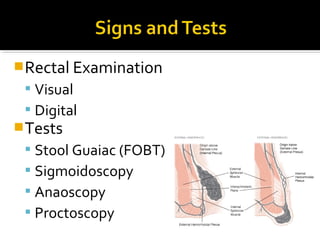
Rectal Examination
 Visual
 Digital
Tests
 Stool Guaiac (FOBT)
 Sigmoidoscopy
 Anaoscopy
 Proctoscopy
Patients should be examined in the
left lateral decubitus position (while
asking the patient to bear down)
 any rashes, condylomata, or eczematous
lesions.
 external sphincter function
 Any abscesses, fissures or fistulae
 lubricated finger should be gently inserted into
the anal canal
 the resting tone of the anal canal should be
ascertained as well as the voluntary contraction
of the puborectalis and external anal sphincter.
 masses should be noted as well as any areas of
tenderness.
 Gastroenterologists
 Seek emergency care if :
 large amounts of rectal bleeding
 Lightheadedness
 Weakness
 Rapid HR < 100 BPM
The blood in the enlarged veins may
form clots and the tissue surrounding
the hemorrhoids can die (Necrosis)
This causes painful lumps in the anal
area.
Severe bleeding can occur causing
iron deficiency anemia.
Varies from simple reassurance to
operative hemorrhoidectomy.
Treatments are classified into three
categories:
1) Dietary and lifestyle modification.
2) Non operative / office procedures.
3) Operative hemorrhoidectomy.
 The main goal of this treatment is to minimize
straining at stool.
 Achieved by increasing fluid and fiber in the diet,
recommending exercise, and perhaps adding fiber
agents to the diet such as psyllium.
 If necessary, stool softeners may be added.
"you don't defecate in the library so
you shouldn't read in the
bathroom".
Apply and OTC cream or
suppository containing
hydrocortisone
Keep anal area clean
Soak in a warm bath
Apply ice packs or compresses x
10min
If prolapses, gently push back into anal
canal
Use a sitz bath with warm water
Use moist towelettes or wet toilet paper
instead of dry toilet paper.
 Grade I or Grade II hemorrhoids
and, in some circumstances,
Grade III hemorrhoids.
 Complications include bleeding,
pain, thrombosis and life
threatening perianal sepsis.
 Successful in two thirds to three
quarters of all individuals with
first and second degree
hemorrhoids.
Generates infrared
radiation which
coagulates tissue
protein and
evaporates water
from cells.
Most beneficial in
Grade I and small
Grade II
hemorrhoids.
Injection of an irritating material into the
sub mucosa in order to decrease
vascularity and increase fibrosis.
Injecting agents have traditionally been
phenol in oil, sodium morrhuate, or
quinine urea.
Manual anal dilatation was first
described by Lord .
Cryotherapy was used in the past with
the belief that freezing the apex of the
anal canal could result in decreased
vascularity and fibrosis of the anal
cushions.
The triangular shaped hemorrhoid is
excised down to the underlying sphincter
muscle.
Wound can be closed or left open
Stapled hemorrhoidectomy has been
developed as an alternative to Standard
hemorrhoidectomy
Eat high fiber diet
Drink Plenty of Liquids
Fiber Supplements
Exercise
Avoid long periods of standing or
sitting
Don’t Strain
Go as soon as you feel the urge

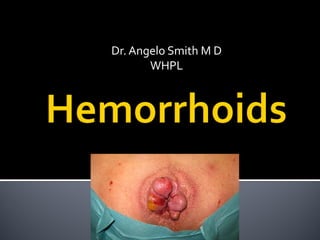
Hemorrhoids

  • 1.
  • 2.
    Alternative Names Rectal Lump Piles Lumpin the Rectum Definition: Dilated or enlarged veins in the lower portion of the rectum or anus.
  • 4.
    10 million Peak ages:45-65 years ½ of adults experience hemorrhoids by age 50 Common among pregnant women Temporary
  • 5.
    Right anterior, Rightposterior and Left lateral positions Those originating above the dentate line which are termed internal Those originating below the dentate line which are termed external
  • 9.
    Internal Hemorrhoids Disease Manifested by two main symptoms - Painless Bleeding - Protrusion (Pain is rare as they originate above dentate line)  Most popular etiologic theory states that Hemorrhoids result from chronic straining at defecation  Continued straining causes engorgement and bleeding, as well as hemorrhoidal prolapse
  • 10.
    Grades: I- Hemorrhoids onlybleed II- Prolapse and reduce spontaneously III- Require replacement IV- Permanently Prolapsed
  • 12.
    Pressure  Constipation  Diarrhea Sitting or standing for long periods of time  Obesity  Heavy Lifting  Pregnancy
  • 14.
     Rectal Bleeding Bright red blood in stool  Dripping in the toilet  On wiping after defecation  Pain during bowel movements  Anal Itching  Rectal Prolapse (while walking, lifting weights)  Thrombus  Extreme pain, bleeding and occasionally signs of systemic illness in case of strangulation
  • 15.
     Asymptomatic  exceptwhen secondary thrombosed  Thrombosis may result from defecatory straining or extreme physical activity or may be random event  Patient presents with constant anal pain of acute onset  Physical examination identifies external thrombosis as purple mass at anal verge  Management - Depends on patients symptoms - In the first 24 – 72 hours after onset, pain increase and excision is warranted - After 72 hours, pain generally diminishes
  • 16.
    Rectal Examination  Visual Digital Tests  Stool Guaiac (FOBT)  Sigmoidoscopy  Anaoscopy  Proctoscopy
  • 17.
    Patients should beexamined in the left lateral decubitus position (while asking the patient to bear down)  any rashes, condylomata, or eczematous lesions.  external sphincter function  Any abscesses, fissures or fistulae
  • 18.
     lubricated fingershould be gently inserted into the anal canal  the resting tone of the anal canal should be ascertained as well as the voluntary contraction of the puborectalis and external anal sphincter.  masses should be noted as well as any areas of tenderness.
  • 19.
     Gastroenterologists  Seekemergency care if :  large amounts of rectal bleeding  Lightheadedness  Weakness  Rapid HR < 100 BPM
  • 20.
    The blood inthe enlarged veins may form clots and the tissue surrounding the hemorrhoids can die (Necrosis) This causes painful lumps in the anal area. Severe bleeding can occur causing iron deficiency anemia.
  • 22.
    Varies from simplereassurance to operative hemorrhoidectomy. Treatments are classified into three categories: 1) Dietary and lifestyle modification. 2) Non operative / office procedures. 3) Operative hemorrhoidectomy.
  • 23.
     The maingoal of this treatment is to minimize straining at stool.  Achieved by increasing fluid and fiber in the diet, recommending exercise, and perhaps adding fiber agents to the diet such as psyllium.  If necessary, stool softeners may be added. "you don't defecate in the library so you shouldn't read in the bathroom".
  • 24.
    Apply and OTCcream or suppository containing hydrocortisone Keep anal area clean Soak in a warm bath Apply ice packs or compresses x 10min
  • 25.
    If prolapses, gentlypush back into anal canal Use a sitz bath with warm water Use moist towelettes or wet toilet paper instead of dry toilet paper.
  • 26.
     Grade Ior Grade II hemorrhoids and, in some circumstances, Grade III hemorrhoids.  Complications include bleeding, pain, thrombosis and life threatening perianal sepsis.  Successful in two thirds to three quarters of all individuals with first and second degree hemorrhoids.
  • 27.
    Generates infrared radiation which coagulatestissue protein and evaporates water from cells. Most beneficial in Grade I and small Grade II hemorrhoids.
  • 28.
    Injection of anirritating material into the sub mucosa in order to decrease vascularity and increase fibrosis. Injecting agents have traditionally been phenol in oil, sodium morrhuate, or quinine urea.
  • 29.
    Manual anal dilatationwas first described by Lord . Cryotherapy was used in the past with the belief that freezing the apex of the anal canal could result in decreased vascularity and fibrosis of the anal cushions.
  • 30.
    The triangular shapedhemorrhoid is excised down to the underlying sphincter muscle. Wound can be closed or left open Stapled hemorrhoidectomy has been developed as an alternative to Standard hemorrhoidectomy
  • 31.
    Eat high fiberdiet Drink Plenty of Liquids Fiber Supplements Exercise Avoid long periods of standing or sitting Don’t Strain Go as soon as you feel the urge