Dr. Angelo Smith M.D
WHPL
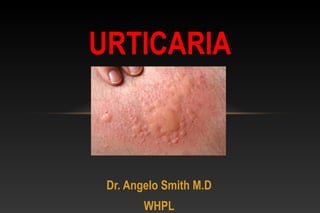
URTICARIA
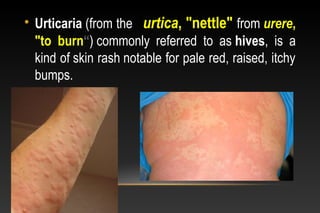
• Urticaria (from the  urtica, "nettle" from urere,
"to burn“) commonly  referred  to  as hives,  is  a 
kind of skin rash notable for pale red, raised, itchy 
bumps.
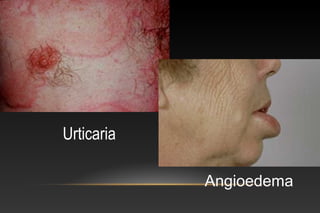
Urticaria
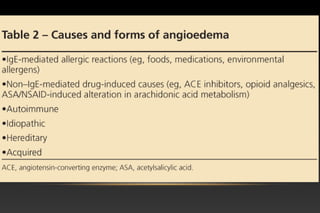
Angioedema
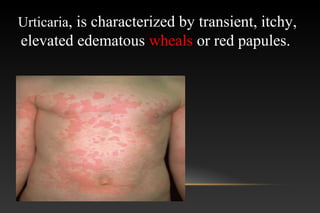
Urticaria, is characterized by transient, itchy,
elevated edematous wheals or red papules.
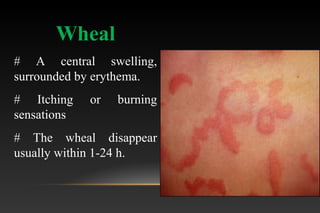
Wheal
# A central swelling,
surrounded by erythema.
# Itching or burning
sensations
# The wheal disappear
usually within 1-24 h.
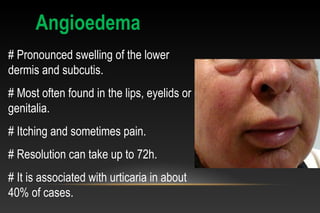
# Pronounced swelling of the lower 
dermis and subcutis.
# Most often found in the lips, eyelids or 
genitalia.
# Itching and sometimes pain.
# Resolution can take up to 72h.
# It is associated with urticaria in about 
40% of cases.
Angioedema
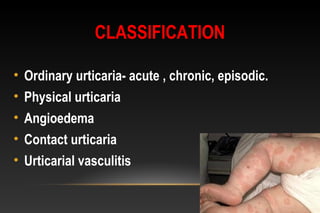
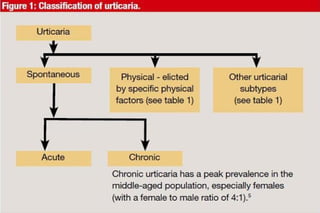
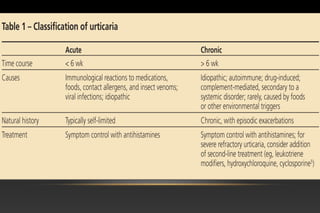
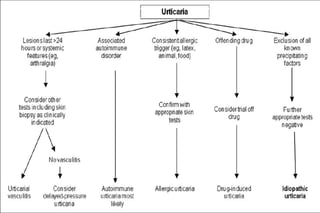
CLASSIFICATION
• Ordinary urticaria- acute , chronic, episodic.
• Physical urticaria
• Angioedema
• Contact urticaria
• Urticarial vasculitis
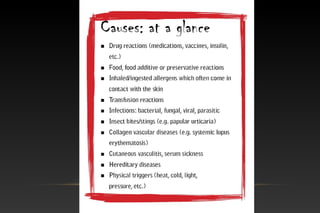
ALLERGIC TRIGGERS
• Acute Urticaria
• Drugs - β-lactam antibiotics,
sulfonamides, aspirin
• Foods - milk, eggs, peanuts, sesame, soy
wheat, shellfish, fish
• Food additives
• Infections
• Insect bites and stings
• Contactants and inhalants
(includes animal dander and latex)
Chronic Urticaria
Physical factors
–cold
–heat
–dermatographic
–pressure
–solar
Idiopathic
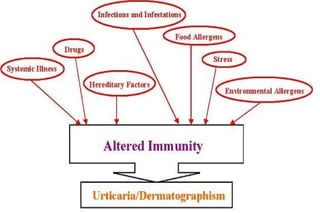
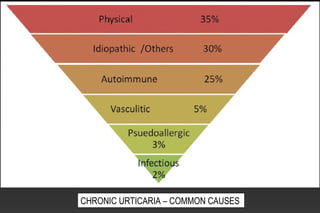
CHRONIC URTICARIA – COMMON CAUSES
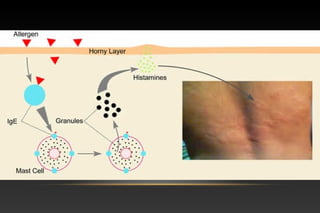
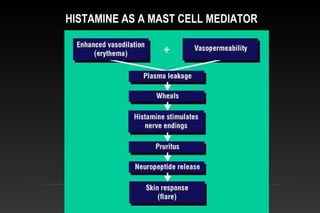
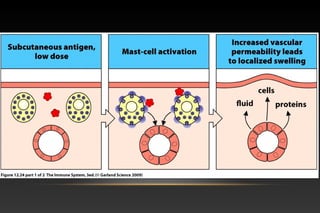
HISTAMINE AS A MAST CELL MEDIATOR
INFECTIONS
• viral : herpes simplex, hepatitis B,
coxsackie A and B, upper respiratory infections.
• Bacterial - associated with certain infectious foci:
dental caries/abscesses, pharyngitis /tonsillitis, otitis
media, occult abscesses, UTI.
• Parasitic : ascaris, strongyloides, echinococcus,
toxocara, fasciola, filaria, schistosoma.
• Fungal? : candida
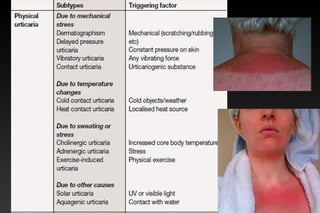
PHYSICAL URTICARIA
The physical urticarias are characterized by the development of wealing
and itching promptly after application of the appropriate physical
stimulus.
Weals typically fade within 30-60 minutes. The exception is
delayed pressure urticaria when the weals take several hours
to appear after sustained pressure and can last up to 48
hours.
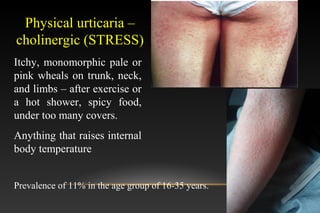
Itchy, monomorphic pale or
pink wheals on trunk, neck,
and limbs – after exercise or
a hot shower, spicy food,
under too many covers.
Anything that raises internal
body temperature
Physical urticaria –
cholinergic (STRESS)
Prevalence of 11% in the age group of 16-35 years.
Physical urticaria-pressure
Large painful or itchy red
swelling at sites of pressure
(soles, palms, or waist)
lasting 24 hours or more -
application of pressure
perpendicular to skin
produces red swelling after a
latent period of 1 to 4 hours.
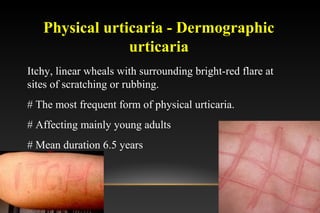
Physical urticaria - Dermographic
urticaria
Itchy, linear wheals with surrounding bright-red flare at
sites of scratching or rubbing.
# The most frequent form of physical urticaria.
# Affecting mainly young adults
# Mean duration 6.5 years
Physical urticaria - Heat
• A rare form of urticaria.
•Induced by direct
contact of the skin with
warm objects or warm
air.
•The eliciting
temperature ranges from
38º C to more than 50 º
C .
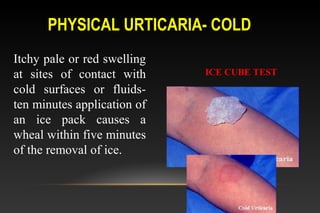
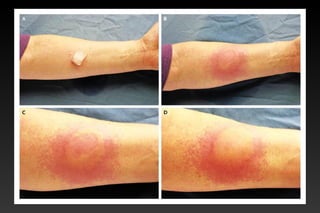
PHYSICAL URTICARIA- COLD
Itchy pale or red swelling
at sites of contact with
cold surfaces or fluids-
ten minutes application of
an ice pack causes a
wheal within five minutes
of the removal of ice.
ICE CUBE TEST
•More frequent in women than men.
•Majority is idiopathic, some can also occur as a result of
infections, neoplasia or autoimmune diseases.
•Infectious: syphilis, measles hepatitis ,mononucleosis, HIV.
Lukewarm water immersion of
forearm for Aquagenic urticaria
urtication in aquagenic urticaria; should
not be performed in patients with a
history of aquagenic angioedema or
anaphylaxis
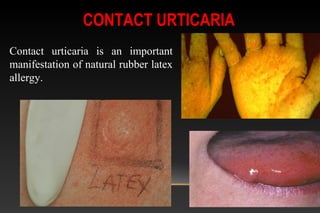
CONTACT URTICARIA
Contact urticaria is an important
manifestation of natural rubber latex
allergy.
Urticarial Vasculitis
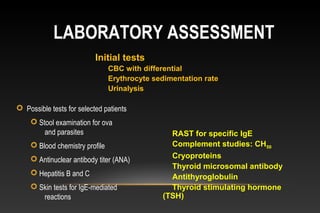
LABORATORY ASSESSMENT
 Possible tests for selected patients
 Stool examination for ova
and parasites
 Blood chemistry profile
 Antinuclear antibody titer (ANA)
 Hepatitis B and C
 Skin tests for IgE-mediated
reactions
Initial tests
CBC with differential
Erythrocyte sedimentation rate
Urinalysis
RAST for specific IgE
Complement studies: CH50
Cryoproteins
Thyroid microsomal antibody
Antithyroglobulin
Thyroid stimulating hormone
(TSH)
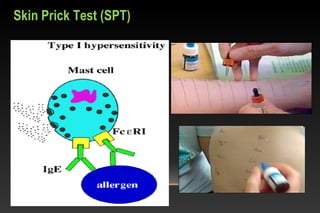
Skin Prick Test (SPT)
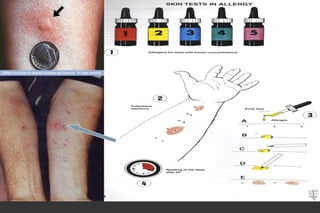
Positive reaction
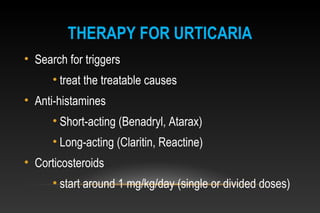
THERAPY FOR URTICARIA
• Search for triggers
• treat the treatable causes
• Anti-histamines
• Short-acting (Benadryl, Atarax)
• Long-acting (Claritin, Reactine)
• Corticosteroids
• start around 1 mg/kg/day (single or divided doses)
ASSOCIATED WITH OTHER CONDITIONS
• Collagen vascular disease (eg, systemic lupus erythematosus)
• Complement deficiency, viral infections (including hepatitis B
and C), serum sickness, and allergic drug eruptions
• Chronic tinea pedis
• Pruritic urticarial papules and plaques of pregnancy (PUPPP)
• Schnitzler’s syndrome
Urticaria

Urticaria

  • 1.
    Dr. Angelo SmithM.D WHPL URTICARIA
  • 2.
    • Urticaria (from the  urtica, "nettle"from urere, "to burn“) commonly  referred  to  as hives,  is  a  kind of skin rash notable for pale red, raised, itchy  bumps.
  • 4.
  • 5.
    Urticaria, is characterizedby transient, itchy, elevated edematous wheals or red papules.
  • 6.
    Wheal # A centralswelling, surrounded by erythema. # Itching or burning sensations # The wheal disappear usually within 1-24 h.
  • 7.
  • 8.
    CLASSIFICATION • Ordinary urticaria-acute , chronic, episodic. • Physical urticaria • Angioedema • Contact urticaria • Urticarial vasculitis
  • 13.
    ALLERGIC TRIGGERS • AcuteUrticaria • Drugs - β-lactam antibiotics, sulfonamides, aspirin • Foods - milk, eggs, peanuts, sesame, soy wheat, shellfish, fish • Food additives • Infections • Insect bites and stings • Contactants and inhalants (includes animal dander and latex) Chronic Urticaria Physical factors –cold –heat –dermatographic –pressure –solar Idiopathic
  • 14.
    CHRONIC URTICARIA –COMMON CAUSES
  • 16.
    HISTAMINE AS AMAST CELL MEDIATOR
  • 18.
    INFECTIONS • viral :herpes simplex, hepatitis B, coxsackie A and B, upper respiratory infections. • Bacterial - associated with certain infectious foci: dental caries/abscesses, pharyngitis /tonsillitis, otitis media, occult abscesses, UTI. • Parasitic : ascaris, strongyloides, echinococcus, toxocara, fasciola, filaria, schistosoma. • Fungal? : candida
  • 20.
    PHYSICAL URTICARIA The physicalurticarias are characterized by the development of wealing and itching promptly after application of the appropriate physical stimulus. Weals typically fade within 30-60 minutes. The exception is delayed pressure urticaria when the weals take several hours to appear after sustained pressure and can last up to 48 hours.
  • 22.
    Itchy, monomorphic paleor pink wheals on trunk, neck, and limbs – after exercise or a hot shower, spicy food, under too many covers. Anything that raises internal body temperature Physical urticaria – cholinergic (STRESS) Prevalence of 11% in the age group of 16-35 years.
  • 23.
    Physical urticaria-pressure Large painfulor itchy red swelling at sites of pressure (soles, palms, or waist) lasting 24 hours or more - application of pressure perpendicular to skin produces red swelling after a latent period of 1 to 4 hours.
  • 24.
    Physical urticaria -Dermographic urticaria Itchy, linear wheals with surrounding bright-red flare at sites of scratching or rubbing. # The most frequent form of physical urticaria. # Affecting mainly young adults # Mean duration 6.5 years
  • 25.
    Physical urticaria -Heat • A rare form of urticaria. •Induced by direct contact of the skin with warm objects or warm air. •The eliciting temperature ranges from 38º C to more than 50 º C .
  • 26.
    PHYSICAL URTICARIA- COLD Itchypale or red swelling at sites of contact with cold surfaces or fluids- ten minutes application of an ice pack causes a wheal within five minutes of the removal of ice. ICE CUBE TEST
  • 27.
    •More frequent inwomen than men. •Majority is idiopathic, some can also occur as a result of infections, neoplasia or autoimmune diseases. •Infectious: syphilis, measles hepatitis ,mononucleosis, HIV.
  • 28.
    Lukewarm water immersionof forearm for Aquagenic urticaria urtication in aquagenic urticaria; should not be performed in patients with a history of aquagenic angioedema or anaphylaxis
  • 29.
    CONTACT URTICARIA Contact urticariais an important manifestation of natural rubber latex allergy.
  • 30.
  • 32.
    LABORATORY ASSESSMENT  Possibletests for selected patients  Stool examination for ova and parasites  Blood chemistry profile  Antinuclear antibody titer (ANA)  Hepatitis B and C  Skin tests for IgE-mediated reactions Initial tests CBC with differential Erythrocyte sedimentation rate Urinalysis RAST for specific IgE Complement studies: CH50 Cryoproteins Thyroid microsomal antibody Antithyroglobulin Thyroid stimulating hormone (TSH)
  • 36.
  • 37.
  • 38.
    THERAPY FOR URTICARIA •Search for triggers • treat the treatable causes • Anti-histamines • Short-acting (Benadryl, Atarax) • Long-acting (Claritin, Reactine) • Corticosteroids • start around 1 mg/kg/day (single or divided doses)
  • 39.
    ASSOCIATED WITH OTHERCONDITIONS • Collagen vascular disease (eg, systemic lupus erythematosus) • Complement deficiency, viral infections (including hepatitis B and C), serum sickness, and allergic drug eruptions • Chronic tinea pedis • Pruritic urticarial papules and plaques of pregnancy (PUPPP) • Schnitzler’s syndrome