
Visual field assessment,Optic
Nerve Changes and Retinal
Changes in relation to
Glaucoma
Bipin Bista
2nd year
Resident – Ophthalmology
National medical College
& Teaching Hospital
What is visual field ?
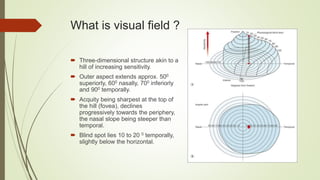
 Three-dimensional structure akin to a
hill of increasing sensitivity.
 Outer aspect extends approx. 500
superiorly, 600 nasally, 700 inferiorly
and 900 temporally.
 Acquity being sharpest at the top of
the hill (fovea), declines
progressively towards the periphery,
the nasal slope being steeper than
temporal.
 Blind spot lies 10 to 20 0 temporally,
slightly below the horizontal.
Other important terms
 Isopter : line connecting points of the same intensity, and on a two-dimensional
isopter plot encloses an area within which a stimulus of a given strength is visible.
It resembles as a contour lines on a map.
 Scotoma : area of reduced (relative) or total (absolute) loss of vision surrounded by
seeing area.
 Luminance : Intensity or brightness of a light stimulus measured in Apostilbs (asb).
Higher intensity has higher asb and vice-versa.
Blind spot
 Nerve fibers, collecting visual information from the retina, come together
approximately 10 to 15 degrees nasally from the fovea.
 This corresponds to optic nerve head, and because there are no photoreceptors in
this area, it creates a deep depression within the boundaries of the normal visual
field.
 As the image is formed, upside down and backward, the blind spot is temporal to
fixation.
Relative & Absolute Scotomas
 Blind spot has 2 portion : relative & absolute scotoma.
 Absolute scotoma means the actual optic nerve head and is seen as vertical oval.
 Relative scotoma surrounds the absolute portion & corresponds to the peripapillary
retina,has reduced retinal sensitivity esp. inferiorly and superiorly.
Visual field loss in Glaucoma
 Peripheral loss
 Localised nerve fiber layer defects (Arcuate defects, nasal steps, vertical step)
 Generalised and central depression of the visual field (Concentric
contraction,enlargement of the blind spot,angioscotomata).
 Temporal sectoral defects
 Advanced glaucomatous defects
Peripheral loss
 Peripheral nasal steps, vertical steps and temporal sector defects.
 Usually only the central 24 to 30 degrees of the visual field is measured.
 However, usually a peripheral field defect,usually a nasal step may be the only
abnormality detected by automated perimetry.
Localised nerve fiber layer defect
 Focal defects d/t loss or impairment of retinal nerve fiber bundles, constitute the
most definitive early evidence of visual field loss .
 In glaucoma, structural damage to ganglion cells and their axons causes partial or
complete functional loss in the area of damaged cells.
Arcuate defects
 Bjerrum described an arcuate visual defect, which he showed is strongly suggestive of
glaucoma.
 Starts from the blind spot and arches above or below fixation, or both to the horizontal
median raphe, corresponding to arcuate nerve fiber layer.
 Early visual loss commonly occur in the superior arcuate area.
 They most often appear as one or more localized defects,or paracentral scotoma.
 Occasionally, early arcuate defect may connect with the blind spot and taper to a point
in a slightly curved course : Siedel scotoma.
 As these defects coalesce, form an arching scotoma which fills the entire arcuate area
from blind spot to the median raphe : Bjerrum scotoma.
 Further progression, double arcuate (or ring) scotoma
 Most reliable early form but is not pathognomonic .
Nasal steps
 Proceeds at the same rate in upper and lower portions.
 Superior nasal step is more commonly seen as superior field is more frequent.
 A central nasal is created at the side of an unequal double arcuate scotoma
closest to fixation.
 Unequal contraction on the peripheral side produces a defect : Peripheral nasal
step of Ronne.
 These defects are commonly seen in acute and early COAG.
Vertical step
 Less common
 Seen along the vertical midline
 Mechanism not fully understood
 Common in nasal side of the vertical midline
Generalised and central depression of the
visual field
 One of the last region to be totally lost.
 Pressure induced damage with diffuse nerve fiber loss has been shown to
accompany diffuse retinal nerve fiber layer (NFL) loss.
 Typically preserved in early onset , but can be affected by observing abnormal VA
& color vision.
Generalised and central depression of the
visual field
 Concentric contraction
 With the decrease in sensitivity for specific retinal locations or as a concentric
constriction of the visual field
 Isopter contraction as an early field defect of glaucoma , more marked in the nasal
field : ‘crowding of the peripheral nasal isopters
Generalised and central depression of the
visual field
 Enlargement of the Blind spot
 It is due to depression of peripapillary retinal sensitivity, considered as early
glaucomatous field change.
 Can also be seen in Acute idiopathic blind spot enlargement related to MEWDS.
 Not pathognomonic.
 Reduced sensitivity in peripapillary retina is greater in the upper and lower poles ,
test object with smaller stimulus value may cause vertical elongation of the blind
spot which can break through the isopter causing true baring of the Blind spot.
Generalised and central depression of the
visual field
 Angioscotomata
• Long branching scotoma above and below the blind spot which are presumed to
be shadows created by the large retinal vessels.
• Although difficult to demonstrate and not highly diagnostic, it represent an early
glaucomatous field defect.
Optic Nerve Head and Visual Field Defects
 40% retinal ganglion cells may be lost in a normal visual field .
 10 % or fewer may remain by the stage of severe field loss.
 20% loss in larger ganglion cells in central 300 correlates with 5-dB sensitivity loss
 40% loss with 10dB decrease.
 Focal or extensive absence of neural rim tissue, especially at the inferior and
superior poles is the most reliable indicator of visual field disturbances. And
associated with field defect in arcuate area.
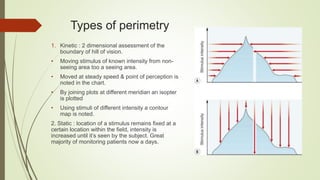
Types of perimetry
1. Kinetic : 2 dimensional assessment of the
boundary of hill of vision.
• Moving stimulus of known intensity from non-
seeing area too a seeing area.
• Moved at steady speed & point of perception is
noted in the chart.
• By joining plots at different meridian an isopter
is plotted
• Using stimuli of different intensity a contour
map is noted.
2. Static : location of a stimulus remains fixed at a
certain location within the field, intensity is
increased until it’s seen by the subject. Great
majority of monitoring patients now a days.
Types of perimetry
3. Suprathreshold :testing with stimuli of
luminance above normal threshold
Enables testing rapidly to know whether
function is grossly normal or not.
4. Threshold : used for detailed
assessment by plotting the threshold
luminance in various locations in the
visual field and compare the results with
age matched ‘N’values
Sources of error
 Poor performance
 Uncorrected refractive error
 Spectacle rim artefact
 Miosis
 Media opacities
 Ptosis
 Inadequate retinal adaptation
Humphrey field analyser
 Consists of a hemisphere bowl onto
which a target can be projected at
any location in the visual field.
 Monitor at side shows menu and
setup modules
 Background luminance is set at 31.5
asb.
 Variation in stimulus intensity can be
achieved by altering either target size
or luminance.
DISPLAYS
1. The numerical display : lies left to grey scale and to the right of the reliability
indices. Gives measured threshold in dB at each point.
2. The grey scale : shows the adjacent numerical display in graphical form and is
simplest to interpret .Darker tone means decreasing sensitivity. Each change in
tone is equivalent to 5 dB.
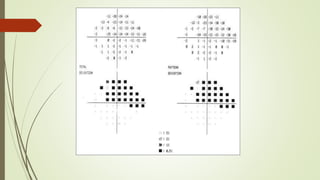
3. Total deviation display :difference between the test-derived threshold at each point
and normal sensitivity at that point in general population. Negative values lower
than normal, positive higher than normal.
4. Pattern deviation : total deviation for normal population for any generalised
decrease in sensitivity. To rule out lens opacity & miosis.
5. Probability displays : graphical representation of the percentage (<5% to 0.5%) in
whom the measured defect at each point would be expected
Testing strategies
1. Suprathreshold : Rapid (6 minutes per eye). Absolute defect is indicated with a
square and full defects with a cross. It is fast and less demanding than other
strategies.
2. Full-threshold strategy : long duration, 15-20 min/eye , initially four points sre
tested for threshold point then the neighbouring then entire.
3. SITA (Swedish Interactive Thresholding Algorithm) :uses an extensive database of
normal and typically glaucomatous visual field to estimate threshold values based
on probability level. Stops testing at the given location, when margin of error is
acceptable & uses response time rather than false positive catch trials. SITA FAST
& SITA Standard.
4. Tendency oriented perimetry (TOP): Fast strategy algorithm based on new
Octopus perimeters. Mean testing for TOP is 2.5 minutes more than SITA FAST.
Reliability indices
1. Fixation losses : steadiness of gaze during the test. Fewer the number of losses
more reliable is the test.
2. False positives : detected when a stimulus is accompanied by a sound. High false
positive shows the grey scale abnormally pale. Fixation losses are high.
3. False negatives : presenting a stimulus much brighter than threshold at location
where threshold has been already been determined. If patients fails , it is
determined. May be d/t short term fluctuations associated with glaucoma and may
be indicator of disease severity. Shows clover leaf-pattern.
4. Interpretations : In cases strategies false positive or false negative above 15%
should be regarded as highly significant & with full threshold strategies, fixation
losses over 20% and false p/n over 33%.
Short wave automated perimetry
 Uses a blue stimulus on yellow background. Sensitivity to blue light (mediated by
blue cone photoreceptors) is adversely affected relatively early in glaucoma.
 More sensitive to early glaucomatous defects.
AGIS & CIGTS Scores
 Advanced Glaucoma Intervention Study has developed a method of interpreting
visual field results on the basis of the number and depth of clusters of adjacent
depressed test site in the upper and lower hemifields and in the nasal area of total
deviation plot.
 The Collaborative Initial Glaucoma Treatment Study (CIGTS) : Investigators used a
similar scoring with modification to evaluate progression in patients with a
modification to evaluate progression in patients with newly diagnosed glaucoma.
 Score for both ranges from 0 (No defect) to 20 (End Stage).
 Progression is worsening of score by 4 in (AGIS) & BY 3 in CIGTS.
Optic nerve,
Retinal &
Choroidal
changes
Anatomy and Histology
 Optic nerve head is defined as the distal portion of the optic nerve that is directly
related to increased IOP.
 Optic nerve head extends anteriorly from the retinal surface to the myelinated
portion of the optic nerve that begins just behind the sclera, posterior to Lamina
Cribrosa.
 ONH compromises the nerve fibers that originate in the ganglion cell layer of the
retina and converge upon the nerve head from all points in the fundus. At the
surface of the nerve head , these RGC axons bend acutely to exit the globe
through a fenestrated scleral canal, called the lamina cribrosa
Divisions of the Optic Nerve Head
 Divided into four portions from anterior to posterior :
1. Surface Nerve Fiber Layer
2. Prelaminar Region
3. Lamina Cribrosa Region
4. Retrolaminar Region
Surface Nerve Fiber Layer
 Acquire progressively more interaxonal glial tissue in the intraocular portion of the
nerve head.
 Arteriolar branches of the central retinal artery which with vessels of the prelaminar
region.
Prelaminar region
 Anterior portion of the lamina cribrosa.
 Nerve axons and astrocytes are present .
 Vascular supply : Short posterior Ciliary artery which forms perineural, circular
arterial anastomosis at the scleral level, called the circle of Zinn-Haller.
Lamina Cribrosa
 Contains fenestrated sheets of
scleral connective tissue and elastic
fibers occasionally.
 Astrocytes separate the sheets and
line the fenestrae.
 Vascular supply : Short posterior
Ciliary artery which forms perineural,
circular arterial anastomosis at the
scleral level, called the circle of Zinn-
Haller.
Retrolaminar Region
 Decrease in astrocytes and acquisition of myelin that is supplied by
Oligodendrocytes.
 Supplied by both the ciliary and retinal circulations, while the former coming from
recurrent pial vessels.
 Medial & lateral perioptic nerve short posterior ciliary arteries anastomose to form
an elliptical arterial circle around optic nerve : Circle of Zinn-Haller.
 Central retinal arteries provide centripetal branch from the pial system.
Venous drainage
 Central retinal vein
 Sometimes the choroidal circulation may enlarge as retinociliary veins which drain
from the retina to the choroidal circulation or cilio-optic vein
Astroglial support
 Provides a continuous layer between the nerve fibers and blood vessels in the
optic nerve head.
 Astrocytes are joined by ‘’gap junctions’’ which resembles like a tight junction but
have a minute gap between their leaflets.
 Nerve fiber layer : thin bodied astrocytes
 Thick bodied : prelaminar to laminar region.
Astroglial support
a) Internal limiting membrane of
Elschnig
b) Continuous with ILM of retina
c) Central meniscus of Kuhnt
d) Intermediary tissue of Kuhnt
e) Border tissue of Jacoby
f) Border tissue of Elschnig
g) Lamina cribrosa
h) Meningeal sheath
Astroglial support
 Internal limiting membrane of Elschnig separates the nerve head from vitreous & is
continuous with ILM.
 Central portion of the ILM is referred as central meniscus of Kuhnt.
 Astrocytes play a major role in the remodelling of the ECM of the Optic Nerve
Head and synthesizing growth factors and other cellular mediators that may affect
the axons of the RGCs.
Connective Tissue Support
 Lamina Cribrosa
 Nerve sheaths
Lamina Cribrosa
 It’s not only a simple porous region of sclera but a specialised ECM that contains
fenestrated sheets of Connective tissue & elastic fibers occasionally lined by
astrocytes.
 Hyauluronate was found surrounding myelin sheaths in retrolaminar portion.
 Important role in hydrodynamics . Also in hydration & rigidity.
 On confocal scanning laser ophthalmoscope : Nearly round pores in physiological
cupping, whereas COAG had compressed pores.
 Also contains ECM of collagen type 1 through 6, laminin and fibronectin.
 Expression of mRNA for collagen type 1 and 4 in both fetal and adult : ECM matrix
are synthesised throughout life.
 Cell adhesive proteins : Vitronectin and thrombospondin.
Nerve Sheaths
 Optic Nerve is surrounded by meningeal sheaths which consist of mesothelium.
 Vascularised connective tissue extends from the under surface of the pia mater to
form longitudinal septa which separates axonal bundles in the intraorbital portion of
Optic nerve.
Axons
 Fibers from the temporal periphery
originate on either side of a
horizontal dividing line, the median
raphe, and arch above or below from
the central retina, the papillomacular
fibers, and the nasal fibers take a
more direct path to the nerve head.
 Approximately 700,000 to1.2 million
fibers are present in Optic Nerve
Head.
 Mean axonal diameter ranges from
0.65 to 1.10 Micrometer .
Embryology of the retina and Optic Nerve
 Develops from the optic cup and the contiguous optic stalk.
 Inner layer of the cup contains the pleuripotent retinal progenitor cells which
differentiate in a specific chronological sequence .
 RGC differentiates first followed by the cone photoreceptors,followed by cone
photoreceptors, amacrine cells, horizontal cells, and finally, the rod photoreceptors,
bipolar cells, and Muller cells.
 Retinal neurogenesis starts in the central optic cup region and then fans out
concentrically in a wave like pattern.
 Optic fissure of the optic stalk closes to convert it into a cylinder, into which the
RGC axons grow.
Embryology of the retina and Optic Nerve
 Optic nerve axon are 3.7 million by fetal week 16/17 which rapidly declines to 1
million by term.
 Mesenchyme give rise to Lamina Cribrosa by the final month of gestation.
 Key regulatory gene : Pax6,Rx1, Six3/6, Lhx2, and certain basic helix-loop-helix
transcription factors.
 ON cross-sectional area reaches 50% of adult by 20 weeks, 75% at birth and 95%
before 1 year of age.
 Myelination of retrolaminar part of ON takes place by the first year of life.
 With increasing age, cores of Cribrosa plate enlarges, elastic fibers become
thicker,tubular and surrounded by densely packed collagen fibers
 Progressive loss of axons with decrease of nerve fiber layer thickness.
Pathophysiology of Glaucomatous Optic
Nerve Damage
 In 1858, Muller proposed that elevated IOP led to direct compression and death of
neurons.
 von Jaeger suggested Vascular abnormality was the underlying cause of OA.
 IN 1892, Schnabel proposed that atrophy of neural elements created empty
spaces, which pulled the nerve head posteriorly.
 In 1968, axoplasmic flow theory was introduced .
Alteration of Lmina cribrosa
 It has been suggested that LC should be the important determinant in the
susceptibility of ON.
 Backward bowing of the Lamina cribrosa has been characteristic of GOA.
 Most of the posterior displacement occurred in the periphery and backward bowing
of the entire lamina occurred later.
 In early stage, a pressure gradient along the axoplasm of exiting ON axons,
compromise the circulation and cause compression of the axons.
 Elastin mRNA expression in human eyes with COAG suggests synthesis of
abnormal elastic fibers.
Axonal alterations
 Early optic nerve head cupping is supposed to be d/t loss of axonal tissue.
 Damage is associated with a posterior and lateral displacement of the lamina
cribrosa which compresses the axons and disrupts axoplasmic flow.
 Damage is involved in inferior and superior poles.
 Histological studies shows that no fiber size is spared from the damage.
 RGC in glaucoma by die d/t to apoptosis , characterised histologically by chromatin
condensation and intracellular fragmentation.
 Histology shows significant decrease in Corpora Amylacea (homogenous oval
bodies ) to correlate with axonal degeneration, in RGCs and the Optic nerve of
human eyes.
Axoplasmic flow
 Movement of axoplasm along the axon the nerve ina predictable, energy-
dependent manner.
 Fast phase moves 410 mm/day, slow phase moves 1-3 mm/day
 Function : supply material to synaptic vessels, the axolemma, and agranular ER of
the axon.
 Flow may be orthograde (Retina—LGB)or retrograde(Vice-versa).
Experimental Models of Axoplasmic flow
 Seen by injecting radioactive amino acids, such as tritiated leucine, into the
vitreous. (Monkeys)
 AA is incorporated into the protein synthesis of RGCs and then moves down the
ganglion cell axon into the ON.
Influence of IOP on Axoplasmic flow
 Obstruction of axoplasmic flow
 Decrease in magnocellular layers of dorsal LGN.
 Obstruction in both fast/slow phases, and the ortho/retro grade components.
 Height and duration of pressure elevation influences onset,distribution , and
degree of axoplasmic obstruction in the optic nerve head.
Theories
 Mechanical
 Vascular
Mechanical
 Physical alteration in the ON.
 Increased IOP leads to axonal blockage despite intact nerve head capillary
circulations.
 A pressure differentials across the ON head whether d/t increase or decrease in
IOP.
 Cytoskeletal changes are seen before disruption of axoplasmic flow, greater in the
periphery.
Vascular
 Ischaemia at least plays a role in the obstruction of axoplasmic flow
 Interruption of SPCA in Monkeys has shown blockade of slow and fast axoplasma
flow.
 CRAO has shown obstruction of rapid orthograde and retrograde axonal
transmission.
 Endothelin-1 which causes vasoconstriction reduces fast axonal transport.
Blood-flow Studies
 Animal models have suggested that autoregulation compensates for changes in
perfusion pressure.
 Laser Doppler in Human Eyes , demonstrate autoregulatory compensation to
reduced perfusion pressure secondary to elevated IOP.
 Glaucomatous eye showed reduced velocity in the nerve head, retrobulbar flow is
decreased with increasing glaucomatous damage.
Fluorecein Angiography
 3 phases :
1. Initial filling or pre-retinal phase : filling of prelaminar and laminar region by PCA.
2. Peak fluorescence or retinal AV phase : filling of the dense surface of nerve head
surface from retinal arterioles.
3. Late phase : 10-15 minutes of delayed staining.
Effect of artificially Elevated IOP
 General delay in entire ocular circulation.
 Delays in peripapillary choroidal filling
 LTG or COAG provided no evidence.
Study in Glaucomatous eye
a) Persisting hypoperfusion
b) Transient hypoperfusion
Persisting hypoperfusion
 Absolute filling defects is more common in glaucomatous eyes.
 Filling defect include decreased blood flow, a smaller vascular bed, narrower
vessels and increased permeability of vessels.
 Focal defects seen in superior and inferior poles of the optic nerve head.
 In LTG, retinal A-V passage time is prolonged d/t increased resistance in the
central retinal and PCA.
CSF Pressure and Glaucomatous Optic
Neuropathy
 Person with COAG have significantly lower CSF pressures than controls.
 Translaminar pressure plays a vital role in the pathogenesis of GON.
Electrophysiological Studies
 Pattern of ERG is believed to be originated from RGC and is expected to be
reduced in Glaucoma but it failed to separate case from controls
 Yet this study may show promising roles in diagnosis and functional assessment.
Morphology of the Normal Optic Nerve
Head
 GENERAL FEATURES :
• Appearance : vertical oval.
• Central portion of the disc contains a depression, the cup, and an area of pallor ,
which represents a partial or complete absence of axons, with exposure of lamina
cribrosa in absence (Partial or complete ) of axons.
• Tissue between cup and disc margin is called neural rim. It refers to location of the
bulk of the axons and normally has an orange-red color because of associated
capillaries.
PHYSIOLOGIC
NEURAL RIM :
 Alteration to this structure lead to change in
the cup and to loss of visual field.
 C/D ratio is an indirect measure.
 Close attention to the appearance of the
neural rim.
 Neural rim is broadest : Inferior—superior—
nasal—temporal rim.(ISNT rule)
 Slate gray crescent in present in temporal or
inf-temporal rim (Confused with peripapillary
pigmented crescent)
 Careful in myopia. Large disc areas.
 Rim area declines with age.
PHYSIOLOGIC PERIPAPILLARY RETINA :
 Striations in RNFL are normal as from light reflex from nerve fibers.
 Visible only at a critical thickness.
 Most visible in inferior temporal arcade.
Peripapillary pigmentary variations
 Scleral lip : thin, even white rim that marks
the entire disc 3600 , represent an anterior
extension of sclera between the choroid and
optic nerve head.
 Chorio-scleral crescent also called zone
beta is a broader but more irregular and
incomplete area of depigmentation which
represents a retraction of RPE from disc
margin.
 Large zone beta area-to disc area was
found to be associated with glaucoma.
 Peripapillary crescent of increased
pigmentation has been called zone alpha ,
lies peripheral to zone beta or may be
adjacent to the disc if the zone beta is
absent.
Physiologic cup
 c/d ratio : 0.0 to 0.3 and only 1 -7 % being greater than 0.7%.
 Hruby lens estimates the ratio at 0.38 in compare to direct ophthalmoscope which
is 0.25.
 Larger disc is seen in African-americans than White.
 Documented progressive cup enlargement is highly s/o glaucoma.
 Horizontal oval in most eyes, vertical cup-disc ratio greater than the horizontal cup-
to-disc ratio should be suspicious.
Morphology of GOA
a) DISC PATTERNS
b) VASCULAR SIGNS
c) PERIPAPILLARY CHANGES
DISC PATTERNS
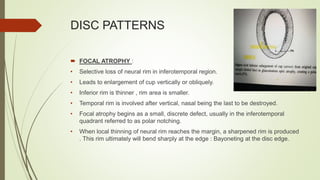
 FOCAL ATROPHY :
• Selective loss of neural rim in inferotemporal region.
• Leads to enlargement of cup vertically or obliquely.
• Inferior rim is thinner , rim area is smaller.
• Temporal rim is involved after vertical, nasal being the last to be destroyed.
• Focal atrophy begins as a small, discrete defect, usually in the inferotemporal
quadrant referred to as polar notching.
• When local thinning of neural rim reaches the margin, a sharpened rim is produced
. This rim ultimately will bend sharply at the edge : Bayoneting at the disc edge.
DISC PATTERNS
 Deepening of cup
• It is presented by grey fenestra of the lamina : Laminar dot sign
DISC PATTERNS
 CONCENTRIC ATROPHY
• Enlargement of cup occurs concentrically in temporal region ( superotemporal or
inferotemporal) : Temporal unfolding
• Important to compare in fellow eye for symmetry.
DISC PATTERNS
 Pallor-Cup Discrepancy :
• Area of pallor is larger than cup.
• Saucerisation is present : diffuse, shallow, cupping extends to the disc margin with
retention of a central pale cup.
• Retention of normal rim in area of saucerisation : tinted hollow.
DISC PATTERNS
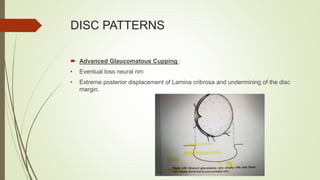
 Advanced Glaucomatous Cupping :
• Eventual loss neural rim
• Extreme posterior displacement of Lamina cribrosa and undermining of the disc
margin.
VASCULAR SIGNS
 Optic disc hemorrhages
• Splinter haemorrhage, usually near the
margin of the optic nerve head – Commonly
seen NTG than in COAG or suspected
glaucoma.
• Tend to come and go
• Localised on within 2 o clock of an RNFL
defect. Typically cross the disc margin, the
papillary portion often disappears first during
resorption, leaving the appearance of an
extrapapillary haemorrhage.
• Early to middle stages and decline in
frequency with advanced damage.
• Significant finding
• Diabetic patient are more common.
VASCULAR SIGNS
 Tortuosity of retinal vessels
• Seen in cases of moderate damage
• Represent loops of collateral vessels in response to chronic central retinal vessel
occlusion.
• Massive flame haemorrhage
Peripapillary changes associated with
GOA
 NERVE FIBER BUNDLE DEFECTS :
• Loss of axonal bundles which leads to neural rim changes also leads to change in
RNFL.
• Diffuse loss is more common in glaucoma than in patient with ocular hypertensive.
• Peripapillary pigmentary disturbance is frequently associated.
• Peripapillary atrophy is more frequent.
• Increases with decreasing neural rim area.
THANK YOU
Reference:
1.Glaucoma – Shield Textbook of Glaucoma 6th edition
2.Curbside Consultation in Glaucoma : Steven J.
Gedde
3.Myron yanoff and jay s duker4th edition

Visual field assessment,optic nerve changes and retinal changes

  • 1.
    Visual field assessment,Optic NerveChanges and Retinal Changes in relation to Glaucoma Bipin Bista 2nd year Resident – Ophthalmology National medical College & Teaching Hospital
  • 2.
    What is visualfield ?  Three-dimensional structure akin to a hill of increasing sensitivity.  Outer aspect extends approx. 500 superiorly, 600 nasally, 700 inferiorly and 900 temporally.  Acquity being sharpest at the top of the hill (fovea), declines progressively towards the periphery, the nasal slope being steeper than temporal.  Blind spot lies 10 to 20 0 temporally, slightly below the horizontal.
  • 3.
    Other important terms Isopter : line connecting points of the same intensity, and on a two-dimensional isopter plot encloses an area within which a stimulus of a given strength is visible. It resembles as a contour lines on a map.  Scotoma : area of reduced (relative) or total (absolute) loss of vision surrounded by seeing area.  Luminance : Intensity or brightness of a light stimulus measured in Apostilbs (asb). Higher intensity has higher asb and vice-versa.
  • 4.
    Blind spot  Nervefibers, collecting visual information from the retina, come together approximately 10 to 15 degrees nasally from the fovea.  This corresponds to optic nerve head, and because there are no photoreceptors in this area, it creates a deep depression within the boundaries of the normal visual field.  As the image is formed, upside down and backward, the blind spot is temporal to fixation.
  • 5.
    Relative & AbsoluteScotomas  Blind spot has 2 portion : relative & absolute scotoma.  Absolute scotoma means the actual optic nerve head and is seen as vertical oval.  Relative scotoma surrounds the absolute portion & corresponds to the peripapillary retina,has reduced retinal sensitivity esp. inferiorly and superiorly.
  • 6.
    Visual field lossin Glaucoma  Peripheral loss  Localised nerve fiber layer defects (Arcuate defects, nasal steps, vertical step)  Generalised and central depression of the visual field (Concentric contraction,enlargement of the blind spot,angioscotomata).  Temporal sectoral defects  Advanced glaucomatous defects
  • 7.
    Peripheral loss  Peripheralnasal steps, vertical steps and temporal sector defects.  Usually only the central 24 to 30 degrees of the visual field is measured.  However, usually a peripheral field defect,usually a nasal step may be the only abnormality detected by automated perimetry.
  • 8.
    Localised nerve fiberlayer defect  Focal defects d/t loss or impairment of retinal nerve fiber bundles, constitute the most definitive early evidence of visual field loss .  In glaucoma, structural damage to ganglion cells and their axons causes partial or complete functional loss in the area of damaged cells.
  • 9.
    Arcuate defects  Bjerrumdescribed an arcuate visual defect, which he showed is strongly suggestive of glaucoma.  Starts from the blind spot and arches above or below fixation, or both to the horizontal median raphe, corresponding to arcuate nerve fiber layer.  Early visual loss commonly occur in the superior arcuate area.  They most often appear as one or more localized defects,or paracentral scotoma.  Occasionally, early arcuate defect may connect with the blind spot and taper to a point in a slightly curved course : Siedel scotoma.  As these defects coalesce, form an arching scotoma which fills the entire arcuate area from blind spot to the median raphe : Bjerrum scotoma.  Further progression, double arcuate (or ring) scotoma  Most reliable early form but is not pathognomonic .
  • 10.
    Nasal steps  Proceedsat the same rate in upper and lower portions.  Superior nasal step is more commonly seen as superior field is more frequent.  A central nasal is created at the side of an unequal double arcuate scotoma closest to fixation.  Unequal contraction on the peripheral side produces a defect : Peripheral nasal step of Ronne.  These defects are commonly seen in acute and early COAG.
  • 11.
    Vertical step  Lesscommon  Seen along the vertical midline  Mechanism not fully understood  Common in nasal side of the vertical midline
  • 12.
    Generalised and centraldepression of the visual field  One of the last region to be totally lost.  Pressure induced damage with diffuse nerve fiber loss has been shown to accompany diffuse retinal nerve fiber layer (NFL) loss.  Typically preserved in early onset , but can be affected by observing abnormal VA & color vision.
  • 13.
    Generalised and centraldepression of the visual field  Concentric contraction  With the decrease in sensitivity for specific retinal locations or as a concentric constriction of the visual field  Isopter contraction as an early field defect of glaucoma , more marked in the nasal field : ‘crowding of the peripheral nasal isopters
  • 14.
    Generalised and centraldepression of the visual field  Enlargement of the Blind spot  It is due to depression of peripapillary retinal sensitivity, considered as early glaucomatous field change.  Can also be seen in Acute idiopathic blind spot enlargement related to MEWDS.  Not pathognomonic.  Reduced sensitivity in peripapillary retina is greater in the upper and lower poles , test object with smaller stimulus value may cause vertical elongation of the blind spot which can break through the isopter causing true baring of the Blind spot.
  • 15.
    Generalised and centraldepression of the visual field  Angioscotomata • Long branching scotoma above and below the blind spot which are presumed to be shadows created by the large retinal vessels. • Although difficult to demonstrate and not highly diagnostic, it represent an early glaucomatous field defect.
  • 16.
    Optic Nerve Headand Visual Field Defects  40% retinal ganglion cells may be lost in a normal visual field .  10 % or fewer may remain by the stage of severe field loss.  20% loss in larger ganglion cells in central 300 correlates with 5-dB sensitivity loss  40% loss with 10dB decrease.  Focal or extensive absence of neural rim tissue, especially at the inferior and superior poles is the most reliable indicator of visual field disturbances. And associated with field defect in arcuate area.
  • 17.
    Types of perimetry 1.Kinetic : 2 dimensional assessment of the boundary of hill of vision. • Moving stimulus of known intensity from non- seeing area too a seeing area. • Moved at steady speed & point of perception is noted in the chart. • By joining plots at different meridian an isopter is plotted • Using stimuli of different intensity a contour map is noted. 2. Static : location of a stimulus remains fixed at a certain location within the field, intensity is increased until it’s seen by the subject. Great majority of monitoring patients now a days.
  • 18.
    Types of perimetry 3.Suprathreshold :testing with stimuli of luminance above normal threshold Enables testing rapidly to know whether function is grossly normal or not. 4. Threshold : used for detailed assessment by plotting the threshold luminance in various locations in the visual field and compare the results with age matched ‘N’values
  • 19.
    Sources of error Poor performance  Uncorrected refractive error  Spectacle rim artefact  Miosis  Media opacities  Ptosis  Inadequate retinal adaptation
  • 20.
    Humphrey field analyser Consists of a hemisphere bowl onto which a target can be projected at any location in the visual field.  Monitor at side shows menu and setup modules  Background luminance is set at 31.5 asb.  Variation in stimulus intensity can be achieved by altering either target size or luminance.
  • 21.
    DISPLAYS 1. The numericaldisplay : lies left to grey scale and to the right of the reliability indices. Gives measured threshold in dB at each point. 2. The grey scale : shows the adjacent numerical display in graphical form and is simplest to interpret .Darker tone means decreasing sensitivity. Each change in tone is equivalent to 5 dB. 3. Total deviation display :difference between the test-derived threshold at each point and normal sensitivity at that point in general population. Negative values lower than normal, positive higher than normal. 4. Pattern deviation : total deviation for normal population for any generalised decrease in sensitivity. To rule out lens opacity & miosis. 5. Probability displays : graphical representation of the percentage (<5% to 0.5%) in whom the measured defect at each point would be expected
  • 23.
    Testing strategies 1. Suprathreshold: Rapid (6 minutes per eye). Absolute defect is indicated with a square and full defects with a cross. It is fast and less demanding than other strategies. 2. Full-threshold strategy : long duration, 15-20 min/eye , initially four points sre tested for threshold point then the neighbouring then entire. 3. SITA (Swedish Interactive Thresholding Algorithm) :uses an extensive database of normal and typically glaucomatous visual field to estimate threshold values based on probability level. Stops testing at the given location, when margin of error is acceptable & uses response time rather than false positive catch trials. SITA FAST & SITA Standard. 4. Tendency oriented perimetry (TOP): Fast strategy algorithm based on new Octopus perimeters. Mean testing for TOP is 2.5 minutes more than SITA FAST.
  • 24.
    Reliability indices 1. Fixationlosses : steadiness of gaze during the test. Fewer the number of losses more reliable is the test. 2. False positives : detected when a stimulus is accompanied by a sound. High false positive shows the grey scale abnormally pale. Fixation losses are high. 3. False negatives : presenting a stimulus much brighter than threshold at location where threshold has been already been determined. If patients fails , it is determined. May be d/t short term fluctuations associated with glaucoma and may be indicator of disease severity. Shows clover leaf-pattern. 4. Interpretations : In cases strategies false positive or false negative above 15% should be regarded as highly significant & with full threshold strategies, fixation losses over 20% and false p/n over 33%.
  • 25.
    Short wave automatedperimetry  Uses a blue stimulus on yellow background. Sensitivity to blue light (mediated by blue cone photoreceptors) is adversely affected relatively early in glaucoma.  More sensitive to early glaucomatous defects.
  • 26.
    AGIS & CIGTSScores  Advanced Glaucoma Intervention Study has developed a method of interpreting visual field results on the basis of the number and depth of clusters of adjacent depressed test site in the upper and lower hemifields and in the nasal area of total deviation plot.  The Collaborative Initial Glaucoma Treatment Study (CIGTS) : Investigators used a similar scoring with modification to evaluate progression in patients with a modification to evaluate progression in patients with newly diagnosed glaucoma.  Score for both ranges from 0 (No defect) to 20 (End Stage).  Progression is worsening of score by 4 in (AGIS) & BY 3 in CIGTS.
  • 27.
  • 28.
    Anatomy and Histology Optic nerve head is defined as the distal portion of the optic nerve that is directly related to increased IOP.  Optic nerve head extends anteriorly from the retinal surface to the myelinated portion of the optic nerve that begins just behind the sclera, posterior to Lamina Cribrosa.  ONH compromises the nerve fibers that originate in the ganglion cell layer of the retina and converge upon the nerve head from all points in the fundus. At the surface of the nerve head , these RGC axons bend acutely to exit the globe through a fenestrated scleral canal, called the lamina cribrosa
  • 29.
    Divisions of theOptic Nerve Head  Divided into four portions from anterior to posterior : 1. Surface Nerve Fiber Layer 2. Prelaminar Region 3. Lamina Cribrosa Region 4. Retrolaminar Region
  • 30.
    Surface Nerve FiberLayer  Acquire progressively more interaxonal glial tissue in the intraocular portion of the nerve head.  Arteriolar branches of the central retinal artery which with vessels of the prelaminar region.
  • 31.
    Prelaminar region  Anteriorportion of the lamina cribrosa.  Nerve axons and astrocytes are present .  Vascular supply : Short posterior Ciliary artery which forms perineural, circular arterial anastomosis at the scleral level, called the circle of Zinn-Haller.
  • 32.
    Lamina Cribrosa  Containsfenestrated sheets of scleral connective tissue and elastic fibers occasionally.  Astrocytes separate the sheets and line the fenestrae.  Vascular supply : Short posterior Ciliary artery which forms perineural, circular arterial anastomosis at the scleral level, called the circle of Zinn- Haller.
  • 33.
    Retrolaminar Region  Decreasein astrocytes and acquisition of myelin that is supplied by Oligodendrocytes.  Supplied by both the ciliary and retinal circulations, while the former coming from recurrent pial vessels.  Medial & lateral perioptic nerve short posterior ciliary arteries anastomose to form an elliptical arterial circle around optic nerve : Circle of Zinn-Haller.  Central retinal arteries provide centripetal branch from the pial system.
  • 34.
    Venous drainage  Centralretinal vein  Sometimes the choroidal circulation may enlarge as retinociliary veins which drain from the retina to the choroidal circulation or cilio-optic vein
  • 35.
    Astroglial support  Providesa continuous layer between the nerve fibers and blood vessels in the optic nerve head.  Astrocytes are joined by ‘’gap junctions’’ which resembles like a tight junction but have a minute gap between their leaflets.  Nerve fiber layer : thin bodied astrocytes  Thick bodied : prelaminar to laminar region.
  • 36.
    Astroglial support a) Internallimiting membrane of Elschnig b) Continuous with ILM of retina c) Central meniscus of Kuhnt d) Intermediary tissue of Kuhnt e) Border tissue of Jacoby f) Border tissue of Elschnig g) Lamina cribrosa h) Meningeal sheath
  • 37.
    Astroglial support  Internallimiting membrane of Elschnig separates the nerve head from vitreous & is continuous with ILM.  Central portion of the ILM is referred as central meniscus of Kuhnt.  Astrocytes play a major role in the remodelling of the ECM of the Optic Nerve Head and synthesizing growth factors and other cellular mediators that may affect the axons of the RGCs.
  • 38.
    Connective Tissue Support Lamina Cribrosa  Nerve sheaths
  • 39.
    Lamina Cribrosa  It’snot only a simple porous region of sclera but a specialised ECM that contains fenestrated sheets of Connective tissue & elastic fibers occasionally lined by astrocytes.  Hyauluronate was found surrounding myelin sheaths in retrolaminar portion.  Important role in hydrodynamics . Also in hydration & rigidity.  On confocal scanning laser ophthalmoscope : Nearly round pores in physiological cupping, whereas COAG had compressed pores.  Also contains ECM of collagen type 1 through 6, laminin and fibronectin.  Expression of mRNA for collagen type 1 and 4 in both fetal and adult : ECM matrix are synthesised throughout life.  Cell adhesive proteins : Vitronectin and thrombospondin.
  • 41.
    Nerve Sheaths  OpticNerve is surrounded by meningeal sheaths which consist of mesothelium.  Vascularised connective tissue extends from the under surface of the pia mater to form longitudinal septa which separates axonal bundles in the intraorbital portion of Optic nerve.
  • 42.
    Axons  Fibers fromthe temporal periphery originate on either side of a horizontal dividing line, the median raphe, and arch above or below from the central retina, the papillomacular fibers, and the nasal fibers take a more direct path to the nerve head.  Approximately 700,000 to1.2 million fibers are present in Optic Nerve Head.  Mean axonal diameter ranges from 0.65 to 1.10 Micrometer .
  • 43.
    Embryology of theretina and Optic Nerve  Develops from the optic cup and the contiguous optic stalk.  Inner layer of the cup contains the pleuripotent retinal progenitor cells which differentiate in a specific chronological sequence .  RGC differentiates first followed by the cone photoreceptors,followed by cone photoreceptors, amacrine cells, horizontal cells, and finally, the rod photoreceptors, bipolar cells, and Muller cells.  Retinal neurogenesis starts in the central optic cup region and then fans out concentrically in a wave like pattern.  Optic fissure of the optic stalk closes to convert it into a cylinder, into which the RGC axons grow.
  • 44.
    Embryology of theretina and Optic Nerve  Optic nerve axon are 3.7 million by fetal week 16/17 which rapidly declines to 1 million by term.  Mesenchyme give rise to Lamina Cribrosa by the final month of gestation.  Key regulatory gene : Pax6,Rx1, Six3/6, Lhx2, and certain basic helix-loop-helix transcription factors.  ON cross-sectional area reaches 50% of adult by 20 weeks, 75% at birth and 95% before 1 year of age.  Myelination of retrolaminar part of ON takes place by the first year of life.  With increasing age, cores of Cribrosa plate enlarges, elastic fibers become thicker,tubular and surrounded by densely packed collagen fibers  Progressive loss of axons with decrease of nerve fiber layer thickness.
  • 45.
    Pathophysiology of GlaucomatousOptic Nerve Damage  In 1858, Muller proposed that elevated IOP led to direct compression and death of neurons.  von Jaeger suggested Vascular abnormality was the underlying cause of OA.  IN 1892, Schnabel proposed that atrophy of neural elements created empty spaces, which pulled the nerve head posteriorly.  In 1968, axoplasmic flow theory was introduced .
  • 46.
    Alteration of Lminacribrosa  It has been suggested that LC should be the important determinant in the susceptibility of ON.  Backward bowing of the Lamina cribrosa has been characteristic of GOA.  Most of the posterior displacement occurred in the periphery and backward bowing of the entire lamina occurred later.  In early stage, a pressure gradient along the axoplasm of exiting ON axons, compromise the circulation and cause compression of the axons.  Elastin mRNA expression in human eyes with COAG suggests synthesis of abnormal elastic fibers.
  • 47.
    Axonal alterations  Earlyoptic nerve head cupping is supposed to be d/t loss of axonal tissue.  Damage is associated with a posterior and lateral displacement of the lamina cribrosa which compresses the axons and disrupts axoplasmic flow.  Damage is involved in inferior and superior poles.  Histological studies shows that no fiber size is spared from the damage.  RGC in glaucoma by die d/t to apoptosis , characterised histologically by chromatin condensation and intracellular fragmentation.  Histology shows significant decrease in Corpora Amylacea (homogenous oval bodies ) to correlate with axonal degeneration, in RGCs and the Optic nerve of human eyes.
  • 48.
    Axoplasmic flow  Movementof axoplasm along the axon the nerve ina predictable, energy- dependent manner.  Fast phase moves 410 mm/day, slow phase moves 1-3 mm/day  Function : supply material to synaptic vessels, the axolemma, and agranular ER of the axon.  Flow may be orthograde (Retina—LGB)or retrograde(Vice-versa).
  • 49.
    Experimental Models ofAxoplasmic flow  Seen by injecting radioactive amino acids, such as tritiated leucine, into the vitreous. (Monkeys)  AA is incorporated into the protein synthesis of RGCs and then moves down the ganglion cell axon into the ON.
  • 50.
    Influence of IOPon Axoplasmic flow  Obstruction of axoplasmic flow  Decrease in magnocellular layers of dorsal LGN.  Obstruction in both fast/slow phases, and the ortho/retro grade components.  Height and duration of pressure elevation influences onset,distribution , and degree of axoplasmic obstruction in the optic nerve head.
  • 51.
  • 52.
    Mechanical  Physical alterationin the ON.  Increased IOP leads to axonal blockage despite intact nerve head capillary circulations.  A pressure differentials across the ON head whether d/t increase or decrease in IOP.  Cytoskeletal changes are seen before disruption of axoplasmic flow, greater in the periphery.
  • 53.
    Vascular  Ischaemia atleast plays a role in the obstruction of axoplasmic flow  Interruption of SPCA in Monkeys has shown blockade of slow and fast axoplasma flow.  CRAO has shown obstruction of rapid orthograde and retrograde axonal transmission.  Endothelin-1 which causes vasoconstriction reduces fast axonal transport.
  • 54.
    Blood-flow Studies  Animalmodels have suggested that autoregulation compensates for changes in perfusion pressure.  Laser Doppler in Human Eyes , demonstrate autoregulatory compensation to reduced perfusion pressure secondary to elevated IOP.  Glaucomatous eye showed reduced velocity in the nerve head, retrobulbar flow is decreased with increasing glaucomatous damage.
  • 55.
    Fluorecein Angiography  3phases : 1. Initial filling or pre-retinal phase : filling of prelaminar and laminar region by PCA. 2. Peak fluorescence or retinal AV phase : filling of the dense surface of nerve head surface from retinal arterioles. 3. Late phase : 10-15 minutes of delayed staining.
  • 56.
    Effect of artificiallyElevated IOP  General delay in entire ocular circulation.  Delays in peripapillary choroidal filling  LTG or COAG provided no evidence.
  • 57.
    Study in Glaucomatouseye a) Persisting hypoperfusion b) Transient hypoperfusion
  • 58.
    Persisting hypoperfusion  Absolutefilling defects is more common in glaucomatous eyes.  Filling defect include decreased blood flow, a smaller vascular bed, narrower vessels and increased permeability of vessels.  Focal defects seen in superior and inferior poles of the optic nerve head.  In LTG, retinal A-V passage time is prolonged d/t increased resistance in the central retinal and PCA.
  • 59.
    CSF Pressure andGlaucomatous Optic Neuropathy  Person with COAG have significantly lower CSF pressures than controls.  Translaminar pressure plays a vital role in the pathogenesis of GON.
  • 60.
    Electrophysiological Studies  Patternof ERG is believed to be originated from RGC and is expected to be reduced in Glaucoma but it failed to separate case from controls  Yet this study may show promising roles in diagnosis and functional assessment.
  • 61.
    Morphology of theNormal Optic Nerve Head  GENERAL FEATURES : • Appearance : vertical oval. • Central portion of the disc contains a depression, the cup, and an area of pallor , which represents a partial or complete absence of axons, with exposure of lamina cribrosa in absence (Partial or complete ) of axons. • Tissue between cup and disc margin is called neural rim. It refers to location of the bulk of the axons and normally has an orange-red color because of associated capillaries.
  • 62.
    PHYSIOLOGIC NEURAL RIM : Alteration to this structure lead to change in the cup and to loss of visual field.  C/D ratio is an indirect measure.  Close attention to the appearance of the neural rim.  Neural rim is broadest : Inferior—superior— nasal—temporal rim.(ISNT rule)  Slate gray crescent in present in temporal or inf-temporal rim (Confused with peripapillary pigmented crescent)  Careful in myopia. Large disc areas.  Rim area declines with age.
  • 63.
    PHYSIOLOGIC PERIPAPILLARY RETINA:  Striations in RNFL are normal as from light reflex from nerve fibers.  Visible only at a critical thickness.  Most visible in inferior temporal arcade.
  • 64.
    Peripapillary pigmentary variations Scleral lip : thin, even white rim that marks the entire disc 3600 , represent an anterior extension of sclera between the choroid and optic nerve head.  Chorio-scleral crescent also called zone beta is a broader but more irregular and incomplete area of depigmentation which represents a retraction of RPE from disc margin.  Large zone beta area-to disc area was found to be associated with glaucoma.  Peripapillary crescent of increased pigmentation has been called zone alpha , lies peripheral to zone beta or may be adjacent to the disc if the zone beta is absent.
  • 65.
    Physiologic cup  c/dratio : 0.0 to 0.3 and only 1 -7 % being greater than 0.7%.  Hruby lens estimates the ratio at 0.38 in compare to direct ophthalmoscope which is 0.25.  Larger disc is seen in African-americans than White.  Documented progressive cup enlargement is highly s/o glaucoma.  Horizontal oval in most eyes, vertical cup-disc ratio greater than the horizontal cup- to-disc ratio should be suspicious.
  • 66.
    Morphology of GOA a)DISC PATTERNS b) VASCULAR SIGNS c) PERIPAPILLARY CHANGES
  • 67.
    DISC PATTERNS  FOCALATROPHY : • Selective loss of neural rim in inferotemporal region. • Leads to enlargement of cup vertically or obliquely. • Inferior rim is thinner , rim area is smaller. • Temporal rim is involved after vertical, nasal being the last to be destroyed. • Focal atrophy begins as a small, discrete defect, usually in the inferotemporal quadrant referred to as polar notching. • When local thinning of neural rim reaches the margin, a sharpened rim is produced . This rim ultimately will bend sharply at the edge : Bayoneting at the disc edge.
  • 68.
    DISC PATTERNS  Deepeningof cup • It is presented by grey fenestra of the lamina : Laminar dot sign
  • 69.
    DISC PATTERNS  CONCENTRICATROPHY • Enlargement of cup occurs concentrically in temporal region ( superotemporal or inferotemporal) : Temporal unfolding • Important to compare in fellow eye for symmetry.
  • 70.
    DISC PATTERNS  Pallor-CupDiscrepancy : • Area of pallor is larger than cup. • Saucerisation is present : diffuse, shallow, cupping extends to the disc margin with retention of a central pale cup. • Retention of normal rim in area of saucerisation : tinted hollow.
  • 71.
    DISC PATTERNS  AdvancedGlaucomatous Cupping : • Eventual loss neural rim • Extreme posterior displacement of Lamina cribrosa and undermining of the disc margin.
  • 72.
    VASCULAR SIGNS  Opticdisc hemorrhages • Splinter haemorrhage, usually near the margin of the optic nerve head – Commonly seen NTG than in COAG or suspected glaucoma. • Tend to come and go • Localised on within 2 o clock of an RNFL defect. Typically cross the disc margin, the papillary portion often disappears first during resorption, leaving the appearance of an extrapapillary haemorrhage. • Early to middle stages and decline in frequency with advanced damage. • Significant finding • Diabetic patient are more common.
  • 73.
    VASCULAR SIGNS  Tortuosityof retinal vessels • Seen in cases of moderate damage • Represent loops of collateral vessels in response to chronic central retinal vessel occlusion. • Massive flame haemorrhage
  • 74.
    Peripapillary changes associatedwith GOA  NERVE FIBER BUNDLE DEFECTS : • Loss of axonal bundles which leads to neural rim changes also leads to change in RNFL. • Diffuse loss is more common in glaucoma than in patient with ocular hypertensive. • Peripapillary pigmentary disturbance is frequently associated. • Peripapillary atrophy is more frequent. • Increases with decreasing neural rim area.
  • 75.
    THANK YOU Reference: 1.Glaucoma –Shield Textbook of Glaucoma 6th edition 2.Curbside Consultation in Glaucoma : Steven J. Gedde 3.Myron yanoff and jay s duker4th edition