

TUBERCULAR UVEITIS
Bipin Bista
Resident
Ophthalmology
National medical College
& Teaching Hospital
HISTORY
 Guyton & Woods (1940) identified as the vast majority of patients
with granulomatous uveitis.
SYSTEMIC DISEASE
 Transmitted predominately in aerosolised droplets.
 Most of them are asymptomatic, self-limited pneumonia which
heals with granuloma formation.
 Sensitization develops after 2-10 weeks of infection & manifested
by positive skin test extract of tuberculous bacilli.
 Granuloma usually calcifies & becomes inactive.
 However, onset of symptoms after breakdown of immune system.
OCULAR DISEASE
 Occurs in 1-2 % of patient with Tuberculosis.
 Involves both anterior as well as posterior segment. Anterior segment
also includes ocular adnexa & orbit.
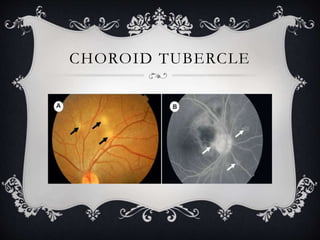
 In miliary tuberculosis, there will be involvement in choroid making an
impression of unifocal/multifocal choroiditis, and in some serpiginous
choroiditis.
 Tubercles associated with development of subretinal
neovascularization.
MANIFESTATION
 Most commonly Granulomatous iritis.
 Suspect tubercular uveitis in granulomatous as well as non-
granulomatous
 Interstitial keratitis & phlyctenular keratoconjunctivis are usually
common – not by direct invasion but an immunological response to
mycobacterium.
 Eales disease
 Optic nerve involvement & cataract are also seen.
CHOROID TUBERCLE
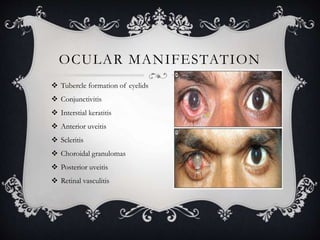
 Tubercle formation of eyelids
 Conjunctivitis
 Interstial keratitis
 Anterior uveitis
 Scleritis
 Choroidal granulomas
 Posterior uveitis
 Retinal vasculitis
OCULAR MANIFESTATION
DIAGNOSIS
 Identification of M.tuberculosis
 Ocular tissues or fluids.
 Samples are difficult to obtain & biopsy are hard to justify.
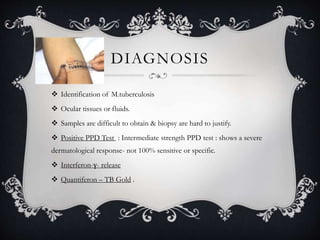
 Positive PPD Test : Intermediate strength PPD test : shows a severe
dermatological response- not 100% sensitive or specific.
 Interferon-γ- release
 Quantiferon – TB Gold .
THERAPY
 Previously, Isoniazid & ethambutol for 1.5 to 2 years.
 Late 1960’s, short-couse regimen – Isoniazid & rifampicin for 9
months.
 Addition of 3rd Drug – Ethambutol, Streptomyci n or
Pyrizinamide – added for first 3 months.
 2 months : Isoniazid, rifampin, pyrizinamide & ethambutol.
 4 months : Isoniazid & rifampin
 Schlaegal & Weber (1969) : Isoniazid Therapeutic Test :
300mg/day, examining every week. If inflammation improves , then
full course therapy.
 Concomitantly treated with corticosteroids : to prevent recurrence.
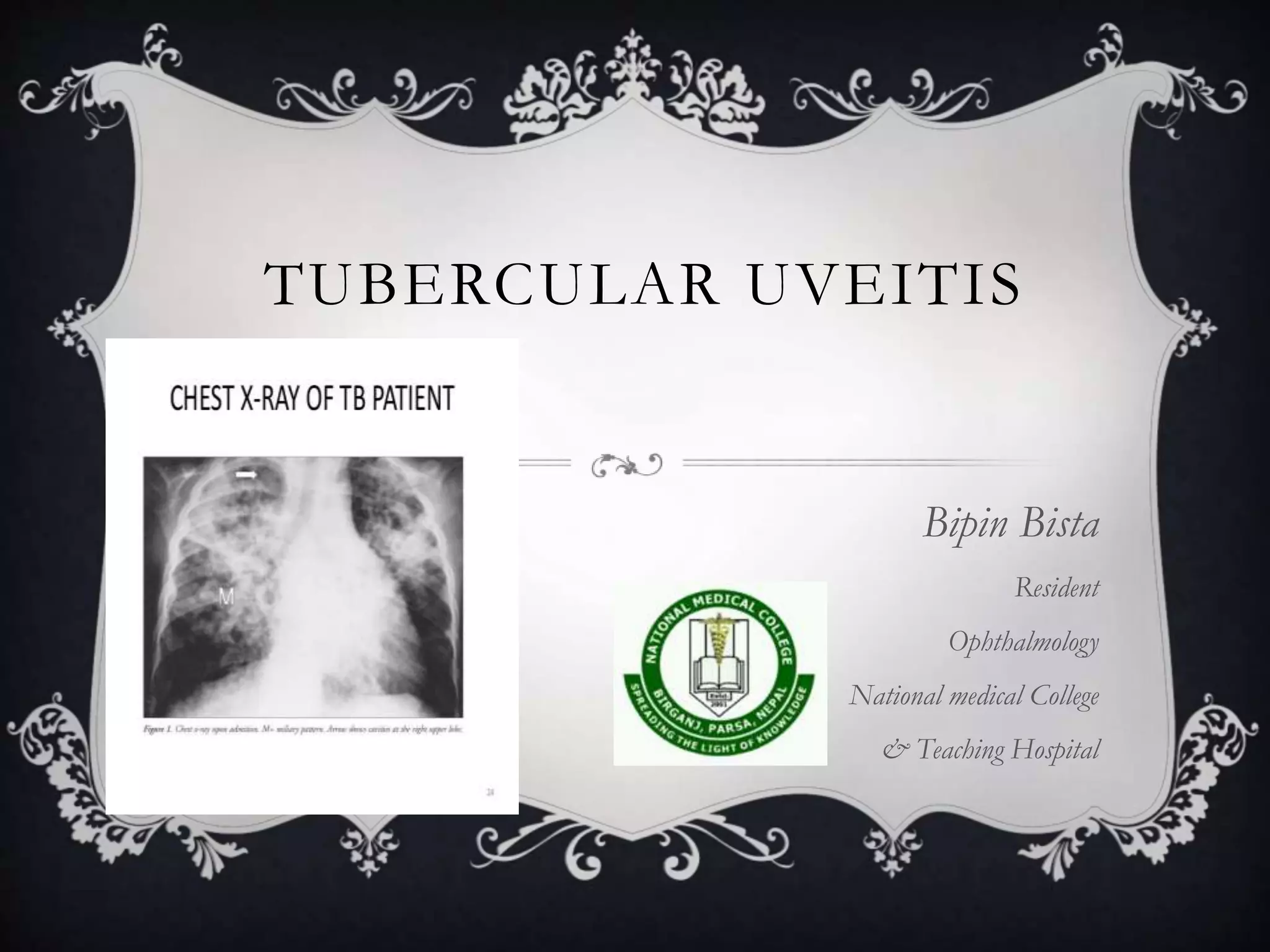
 Chest X-ray : hematogenous seeding of organisms from lung.
 History of TB exposure, Inadequately treated TB, Positive PPD
test.
Reference:
- Nussenblatt and whitecup
4th edition
- Myron yanoff 4th edition

Tubercular uveitis

  • 1.
  • 2.
    HISTORY  Guyton &Woods (1940) identified as the vast majority of patients with granulomatous uveitis.
  • 3.
    SYSTEMIC DISEASE  Transmittedpredominately in aerosolised droplets.  Most of them are asymptomatic, self-limited pneumonia which heals with granuloma formation.  Sensitization develops after 2-10 weeks of infection & manifested by positive skin test extract of tuberculous bacilli.  Granuloma usually calcifies & becomes inactive.  However, onset of symptoms after breakdown of immune system.
  • 4.
    OCULAR DISEASE  Occursin 1-2 % of patient with Tuberculosis.  Involves both anterior as well as posterior segment. Anterior segment also includes ocular adnexa & orbit.  In miliary tuberculosis, there will be involvement in choroid making an impression of unifocal/multifocal choroiditis, and in some serpiginous choroiditis.  Tubercles associated with development of subretinal neovascularization.
  • 5.
    MANIFESTATION  Most commonlyGranulomatous iritis.  Suspect tubercular uveitis in granulomatous as well as non- granulomatous  Interstitial keratitis & phlyctenular keratoconjunctivis are usually common – not by direct invasion but an immunological response to mycobacterium.  Eales disease  Optic nerve involvement & cataract are also seen.
  • 6.
  • 7.
     Tubercle formationof eyelids  Conjunctivitis  Interstial keratitis  Anterior uveitis  Scleritis  Choroidal granulomas  Posterior uveitis  Retinal vasculitis OCULAR MANIFESTATION
  • 8.
    DIAGNOSIS  Identification ofM.tuberculosis  Ocular tissues or fluids.  Samples are difficult to obtain & biopsy are hard to justify.  Positive PPD Test : Intermediate strength PPD test : shows a severe dermatological response- not 100% sensitive or specific.  Interferon-γ- release  Quantiferon – TB Gold .
  • 9.
    THERAPY  Previously, Isoniazid& ethambutol for 1.5 to 2 years.  Late 1960’s, short-couse regimen – Isoniazid & rifampicin for 9 months.  Addition of 3rd Drug – Ethambutol, Streptomyci n or Pyrizinamide – added for first 3 months.  2 months : Isoniazid, rifampin, pyrizinamide & ethambutol.  4 months : Isoniazid & rifampin
  • 10.
     Schlaegal &Weber (1969) : Isoniazid Therapeutic Test : 300mg/day, examining every week. If inflammation improves , then full course therapy.  Concomitantly treated with corticosteroids : to prevent recurrence.  Chest X-ray : hematogenous seeding of organisms from lung.  History of TB exposure, Inadequately treated TB, Positive PPD test.
  • 11.
    Reference: - Nussenblatt andwhitecup 4th edition - Myron yanoff 4th edition