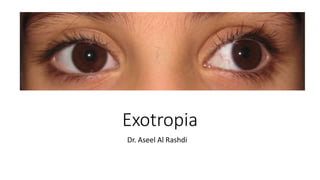
Exotropia
Dr. Aseel Al Rashdi
Definitions
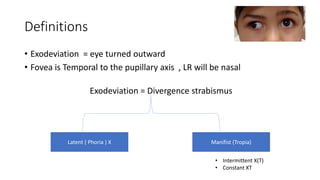
• Exodeviation = eye turned outward
• Fovea is Temporal to the pupillary axis , LR will be nasal
Exodeviation = Divergence strabismus
Latent ( Phoria ) X Manifist (Tropia)
• Intermittent X(T)
• Constant XT
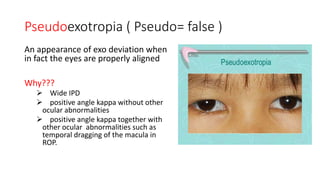
Pseudoexotropia ( Pseudo= false )
An appearance of exo deviation when
in fact the eyes are properly aligned
Why???
 Wide IPD
 positive angle kappa without other
ocular abnormalities
 positive angle kappa together with
other ocular abnormalities such as
temporal dragging of the macula in
ROP.
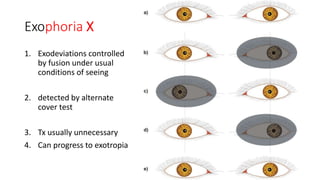
Exophoria X
1. Exodeviations controlled
by fusion under usual
conditions of seeing
2. detected by alternate
cover test
3. Tx usually unnecessary
4. Can progress to exotropia
Intermittent Exotropia X(T)
• Intermittent X(T) / Most common exotropia.
• Eliminated by fusional convergence ( Near 38PD , Distance14PD)
• Manifest with inattention , fatigue , end of the day ( loose ability to
convert ) .
• Exposure to bright light cause reflex closure of 1 eye .
• Good binocular vision , no diplopia .
• Amblyopia is rare.
• 80% progress to constant Exotropia in months to years .
• Phase 1 : occasional exotropia when binocular vision is lost at
distance , ortho at near .
• Phase 2 : increase exotropia at distance , occasional exophoria at
near.
• Phase 3 : constant exotropia at distance and near .
Exotropia Phases :
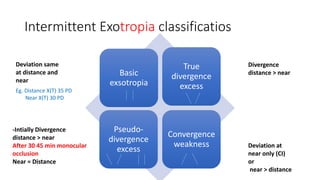
Intermittent Exotropia classificatios
Basic
exsotropia
True
divergence
excess
Pseudo-
divergence
excess
Convergence
weakness
Deviation same
at distance and
near
Deviation at
near only (CI)
or
near > distance
Divergence
distance > near
-Intially Divergence
distance > near
After 30 45 min monocular
occlusion
Near = Distance
Eg. Distance X(T) 35 PD
Near X(T) 30 PD
Patch Test ( monocular occlusion test ) differentiate
btw pseudo and tru divergence excess.
Step 1 ( true or pseud?):
studying tenacious proximal fusion.
Do monocular occlusion for 45 mins.
• If near PD did not change. It is TRUE DXT
• If near PCT (N) gets higher ( diffirence btw N and D > 10
PD) it is pseudo XDT.
Step 2 ( true with high AC/A ratio or true with normal AC/A
ration?):
Bilateral +3.00 lens.
if near PD gets high after +3 then it is true with high AC/A
ratio.
If near PD didn’t change, it is true WITH NORMAL
AC/Aratio.
Conclusion
Change in
findings ?
Monoculr
patch test ( 45
mins )
PCT (N) 20 PD
PCT ( D) 35 PD
remeasure
Yes
PCT ( N) 30PD
PCT ( D) 35 PD
PCT (N) becomes higher
Pesudo divergence
excess
No True Divergent execss
PCT ( N) same afer +3
lens
Normal AC/A ration
PCT ( N) higher after +3
lens
High AC/A ratio
Convergence weakness
• Convergence insufficiency ( CI) : only exodeviation at near .
• Usually older patients and complain of symptoms like asthenopia and
double vision when trying to read .
• Poor near fusional convergence amplitude .
• Tx :
• orthoptic exercise , pencil push-ups .
• Base-in reading prisms
• Surgical intervetion (MR rescess)
repeated 15 to 20 times during each session and repeated 2
to 3 times per day
Management of Intermittent Exotropia
1. Refractive error
• Myopia : correct fully
• Hyperopia : of > +4 D or hyperopic anisomeropia > +1.5 D
2. Add – (2-4) D lens to induce accommodative convergence .( for
some time ).
3. Patching the dominant eye / makes the divergent eye straight .
4. Alternate patching if no visual preference
5. Orthoptic treatment.
6. Prism : Base-in long term
Surgical management of Intermittent
Exotropia
1. Performed if intermittent X( T ) progress or progressing to consant
X(T) .
• Weakening of LR ( LR recession )
• Strengthening MR ( MR resection )
2. Botulinum toxin.
Constant X(T)
1. Infantile
2. Sensory
3. Consecutive
4. Decompensated intermittent X(T)
Infantile
• < 6 months
• Large angle constant deviation (usually > 35PD)
• Possibly associated neurological or craniofacial impairments .
• Tx :
• Amblyopia
• Refractive error
• Surgical correction ( 4m – 1 yr)
Sensory
• Caused by any condition that severely reduces VA in 1 eye
• Eg:
• ansometropia
• corneal/lens/retinal /optic N pathology such as :
• Retinoblastoma
• Unilateral cataract
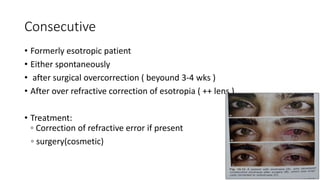
Consecutive
• Formerly esotropic patient
• Either spontaneously
• after surgical overcorrection ( beyound 3-4 wks )
• After over refractive correction of esotropia ( ++ lens )
• Treatment:
◦ Correction of refractive error if present
◦ surgery(cosmetic)
Others : Secondary / Incomitant
 Neuromuscular (3rd nerve palsy , Mysthenia gravis )
 Restrictive
 Musculofascial innervational anomalies (Duane syndrome type 2 )
Duane syndrome
Oculomotor
nerve palsy
Clinical assessment
Brief History
• Presenting ocular ( onset , timing , near or distance , H/O trauma …)
• Presenting medical
• Past ocular
• Past medical
• Birth hx:
• Developmental hx: milestones
• Family hx:
• Treatment hx:
Clinical assessment
Examination :
AHP
VA
Light reflex LR ( Hirschberg LR test )
Steroacuity (check binocularity if possible )
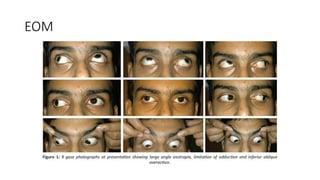
EOM
CT
ACT
PCT
Patch test if needed
Cyclorefraction
Send for anterior and posterior segment examination .
Hirschberg Light reflex test
CT = LE XT
• Primary gaze
• Cover RE
• Uncover RE
Document the control of exotropia
• Good control : resumes fusion rapidly after removing the cover
• Fair control : resumes fusion rapidly after blinking or refixating.
• Poor control : exotropia manifest spontaneously and remain for a
while after cover removal .
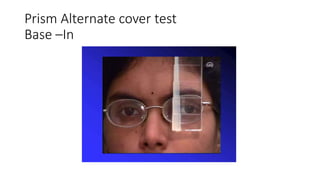
Prism Alternate cover test
Base –In
ACT
Exophoria X
No Exotropia
EOM
Intermittent exotropia may be associated with
V pattern with Inferior oblique over action
A pattern with Superior oblique over action
Q& A
• 7 years old , RE deviated outwards intermittently, but most of the day
.
• Refraction : OD +2.5 , OS + 4 .
• Would you correct the refractive error with spectacles ?
Thank you ..
• Watch CT and ACT:
https://www.youtube.com/watch?v=PRa7mPx2XVs

Exotropia

  • 1.
  • 2.
    Definitions • Exodeviation =eye turned outward • Fovea is Temporal to the pupillary axis , LR will be nasal Exodeviation = Divergence strabismus Latent ( Phoria ) X Manifist (Tropia) • Intermittent X(T) • Constant XT
  • 3.
    Pseudoexotropia ( Pseudo=false ) An appearance of exo deviation when in fact the eyes are properly aligned Why???  Wide IPD  positive angle kappa without other ocular abnormalities  positive angle kappa together with other ocular abnormalities such as temporal dragging of the macula in ROP.
  • 4.
    Exophoria X 1. Exodeviationscontrolled by fusion under usual conditions of seeing 2. detected by alternate cover test 3. Tx usually unnecessary 4. Can progress to exotropia
  • 5.
    Intermittent Exotropia X(T) •Intermittent X(T) / Most common exotropia. • Eliminated by fusional convergence ( Near 38PD , Distance14PD) • Manifest with inattention , fatigue , end of the day ( loose ability to convert ) . • Exposure to bright light cause reflex closure of 1 eye . • Good binocular vision , no diplopia . • Amblyopia is rare. • 80% progress to constant Exotropia in months to years .
  • 6.
    • Phase 1: occasional exotropia when binocular vision is lost at distance , ortho at near . • Phase 2 : increase exotropia at distance , occasional exophoria at near. • Phase 3 : constant exotropia at distance and near . Exotropia Phases :
  • 7.
    Intermittent Exotropia classificatios Basic exsotropia True divergence excess Pseudo- divergence excess Convergence weakness Deviationsame at distance and near Deviation at near only (CI) or near > distance Divergence distance > near -Intially Divergence distance > near After 30 45 min monocular occlusion Near = Distance Eg. Distance X(T) 35 PD Near X(T) 30 PD
  • 8.
    Patch Test (monocular occlusion test ) differentiate btw pseudo and tru divergence excess. Step 1 ( true or pseud?): studying tenacious proximal fusion. Do monocular occlusion for 45 mins. • If near PD did not change. It is TRUE DXT • If near PCT (N) gets higher ( diffirence btw N and D > 10 PD) it is pseudo XDT. Step 2 ( true with high AC/A ratio or true with normal AC/A ration?): Bilateral +3.00 lens. if near PD gets high after +3 then it is true with high AC/A ratio. If near PD didn’t change, it is true WITH NORMAL AC/Aratio.
  • 9.
    Conclusion Change in findings ? Monoculr patchtest ( 45 mins ) PCT (N) 20 PD PCT ( D) 35 PD remeasure Yes PCT ( N) 30PD PCT ( D) 35 PD PCT (N) becomes higher Pesudo divergence excess No True Divergent execss PCT ( N) same afer +3 lens Normal AC/A ration PCT ( N) higher after +3 lens High AC/A ratio
  • 10.
    Convergence weakness • Convergenceinsufficiency ( CI) : only exodeviation at near . • Usually older patients and complain of symptoms like asthenopia and double vision when trying to read . • Poor near fusional convergence amplitude . • Tx : • orthoptic exercise , pencil push-ups . • Base-in reading prisms • Surgical intervetion (MR rescess) repeated 15 to 20 times during each session and repeated 2 to 3 times per day
  • 11.
    Management of IntermittentExotropia 1. Refractive error • Myopia : correct fully • Hyperopia : of > +4 D or hyperopic anisomeropia > +1.5 D 2. Add – (2-4) D lens to induce accommodative convergence .( for some time ). 3. Patching the dominant eye / makes the divergent eye straight . 4. Alternate patching if no visual preference 5. Orthoptic treatment. 6. Prism : Base-in long term
  • 13.
    Surgical management ofIntermittent Exotropia 1. Performed if intermittent X( T ) progress or progressing to consant X(T) . • Weakening of LR ( LR recession ) • Strengthening MR ( MR resection ) 2. Botulinum toxin.
  • 14.
    Constant X(T) 1. Infantile 2.Sensory 3. Consecutive 4. Decompensated intermittent X(T)
  • 15.
    Infantile • < 6months • Large angle constant deviation (usually > 35PD) • Possibly associated neurological or craniofacial impairments . • Tx : • Amblyopia • Refractive error • Surgical correction ( 4m – 1 yr)
  • 16.
    Sensory • Caused byany condition that severely reduces VA in 1 eye • Eg: • ansometropia • corneal/lens/retinal /optic N pathology such as : • Retinoblastoma • Unilateral cataract
  • 17.
    Consecutive • Formerly esotropicpatient • Either spontaneously • after surgical overcorrection ( beyound 3-4 wks ) • After over refractive correction of esotropia ( ++ lens ) • Treatment: ◦ Correction of refractive error if present ◦ surgery(cosmetic)
  • 18.
    Others : Secondary/ Incomitant  Neuromuscular (3rd nerve palsy , Mysthenia gravis )  Restrictive  Musculofascial innervational anomalies (Duane syndrome type 2 ) Duane syndrome Oculomotor nerve palsy
  • 19.
    Clinical assessment Brief History •Presenting ocular ( onset , timing , near or distance , H/O trauma …) • Presenting medical • Past ocular • Past medical • Birth hx: • Developmental hx: milestones • Family hx: • Treatment hx:
  • 20.
    Clinical assessment Examination : AHP VA Lightreflex LR ( Hirschberg LR test ) Steroacuity (check binocularity if possible ) EOM CT ACT PCT Patch test if needed Cyclorefraction Send for anterior and posterior segment examination .
  • 21.
  • 23.
    CT = LEXT • Primary gaze • Cover RE • Uncover RE
  • 24.
    Document the controlof exotropia • Good control : resumes fusion rapidly after removing the cover • Fair control : resumes fusion rapidly after blinking or refixating. • Poor control : exotropia manifest spontaneously and remain for a while after cover removal .
  • 25.
    Prism Alternate covertest Base –In
  • 26.
  • 27.
  • 28.
    Intermittent exotropia maybe associated with V pattern with Inferior oblique over action A pattern with Superior oblique over action
  • 29.
    Q& A • 7years old , RE deviated outwards intermittently, but most of the day . • Refraction : OD +2.5 , OS + 4 . • Would you correct the refractive error with spectacles ?
  • 30.
    Thank you .. •Watch CT and ACT: https://www.youtube.com/watch?v=PRa7mPx2XVs

Editor's Notes

  • #6 Exposure to bright light like the sun, the image will not be clear to concentrate, patient losses patient losses the ability to fuse the 2 images , therefore closes 1 eye to see a single image.
  • #8 -When measuring with prism alternate cover test -similar, within 10 PD. -Prolonged occlusion of one eye suspends tonic fusional convergence and reveals the full exophoria.