

Use of Exophthalmometer
Md.Azizul Islam
Junior Optometrist
Ispahani Islamia Eye Institute & Hospital
IIEI&H
IIEI&H
Declaration
I have no financial interest by
presenting this presentation
IIEI&H
Aims of today,s topic
Will be able….
• General idea @ Measurement Exophthalmos
• To know about various type of Exophthalmometer
• To know the normal value of Exophthalmometer &
• How to documentation Exophthalmos finding
IIEI&H
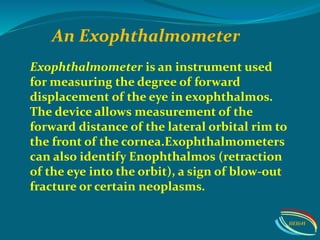
Exophthalmometer is an instrument used
for measuring the degree of forward
displacement of the eye in exophthalmos.
The device allows measurement of the
forward distance of the lateral orbital rim to
the front of the cornea.Exophthalmometers
can also identify Enophthalmos (retraction
of the eye into the orbit), a sign of blow-out
fracture or certain neoplasms.
An Exophthalmometer
IIEI&H
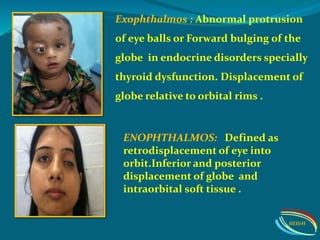
Exophthalmos : Abnormal protrusion
of eye balls or Forward bulging of the
globe in endocrine disorders specially
thyroid dysfunction. Displacement of
globe relative to orbital rims .
ENOPHTHALMOS: Defined as
retrodisplacement of eye into
orbit.Inferior and posterior
displacement of globe and
intraorbital soft tissue .
IIEI&H
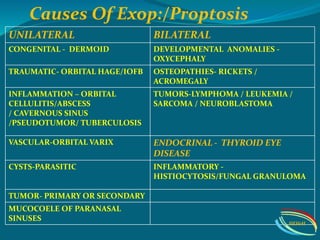
Causes Of Exop:/Proptosis
UNILATERAL BILATERAL
CONGENITAL - DERMOID DEVELOPMENTAL ANOMALIES -
OXYCEPHALY
TRAUMATIC- ORBITAL HAGE/IOFB OSTEOPATHIES- RICKETS /
ACROMEGALY
INFLAMMATION – ORBITAL
CELLULITIS/ABSCESS
/ CAVERNOUS SINUS
/PSEUDOTUMOR/ TUBERCULOSIS
TUMORS-LYMPHOMA / LEUKEMIA /
SARCOMA / NEUROBLASTOMA
VASCULAR-ORBITAL VARIX ENDOCRINAL - THYROID EYE
DISEASE
CYSTS-PARASITIC INFLAMMATORY -
HISTIOCYTOSIS/FUNGAL GRANULOMA
TUMOR- PRIMARY OR SECONDARY
MUCOCOELE OF PARANASAL
SINUSES
IIEI&H
HISTORY
LOCAL
EXAM:
SYSTEM
EXAM:
INVESTI
GATION
IMAGING
Examination of Exo:/proptosis
IIEI&H
HISTORY TAKING
Protrusion of eyeball: Age of Onset , duration ,
progression, Constant or intermittent, Variation
with posture / strain
Decreased vision : preceded, Stationary,
Associated field defects
 H/O: Pain
 H/O :Double vision
 H/O :Trauma
 H/O: fever , systemic symptoms
 H/O :Cancer
 H/O :Thyroid disease
 H/O:Weight loss
IIEI&H
LOCAL EXAMINATION
HB Reflex : Central or Deviation
 Globe Displacement: Downward,Upward or Other
 Lid Retruction: +(ve) or – (ve)
 Lid lag/Lagophtalmos: ..? mm
 PALPATION : Size , shape, surface, margins
consistency , tenderness , thyroid glangds, orbital
rims , regional lymph nodes
IIEI&H
 EOM MOTILITY : Decreased in thyroid
orbitopathy , extensive tum or growths and
neurological defect
 VISUAL ACUITY : Maybe decreased due to
Refractive changes due to pressure on eyeball,
Optic nerve compresssion, Exposure keratopathy
 PUPIL REACTION : RAPD suggests optic nerve
compression
 IOP : Maybe raised
 Rular Test: Horizontal with vertical
measurement
LOCAL EXAMINATION
IIEI&H
SYSTEMIC EXAM
The basis of the measurement for exophthalmos
determination using the Hertel version is the outer
orbital rim (orbital wall) and the apex of the cornea.
All instruments are meant to measure the distance
b2w the apex of cornea and lateral wall of orbit
 OPTICAL:
 Light Weight Hertels exophthalmometer
 Heavy Duty Hertel Exophthalmometer
 Naugle Exophthalmometer
 Luedde Exophthalmometer
 MECHANICAL : Gormaz Exophthalmometer
IIEI&H
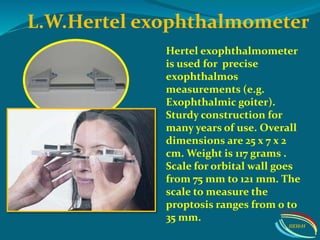
Hertel exophthalmometer
is used for precise
exophthalmos
measurements (e.g.
Exophthalmic goiter).
Sturdy construction for
many years of use. Overall
dimensions are 25 x 7 x 2
cm. Weight is 117 grams .
Scale for orbital wall goes
from 75 mm to 121 mm. The
scale to measure the
proptosis ranges from 0 to
35 mm.
L.W.Hertel exophthalmometer
IIEI&H
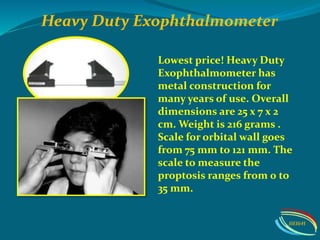
Lowest price! Heavy Duty
Exophthalmometer has
metal construction for
many years of use. Overall
dimensions are 25 x 7 x 2
cm. Weight is 216 grams .
Scale for orbital wall goes
from 75 mm to 121 mm. The
scale to measure the
proptosis ranges from 0 to
35 mm.
Heavy Duty Exophthalmometer
IIEI&H
Naugle exophthalmometer is
superior and inferior orbital rim-
based instrument.
This superior and inferior orbital
rim-based instrument measures
the position of the globe
accurately even after lateral
orbitotomy e.g. post tumor
removal or thyroid
decompression. It delivers fast
reproducible results of highest
precision, provides best patient
comfort, thus increasing patient
cooperation.
Naugle exophthalmometer
IIEI&H
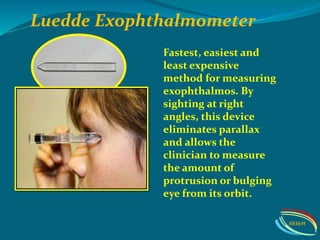
Fastest, easiest and
least expensive
method for measuring
exophthalmos. By
sighting at right
angles, this device
eliminates parallax
and allows the
clinician to measure
the amount of
protrusion or bulging
eye from its orbit.
Luedde Exophthalmometer
IIEI&H
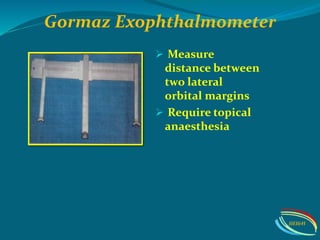
Gormaz Exophthalmometer
 Measure
distance between
two lateral
orbital margins
 Require topical
anaesthesia
IIEI&H
The basis of the measurement for exophthalmos
determination using the Hertel version is the outer
orbital rim (orbital wall) and the apex of the cornea. The
internal refraction mirrors with millimeter scales for the
left-hand and right-hand measuring halves of the
exophthalmometer are calibrated so that the zero mark
on the scale will be located in the plane of the resting
points of the supports. For exophthalmus measurements
the supports are placed against the two temporal orbital
walls so that the orbital rim contacts the deepest point
of the supports. Prisms are clear plastic with easy to read
millimeter lines on both sides. Eye is seen through lower
half of scale and the scale is seen through the upper half,
eliminating parallax and aiding rapid determination of
protrusion.
The Measurement Procedure
IIEI&H
The Measurement Procedure
The examiner sits opposite the patient at eye level. The
exophthalmometer is then positioned with the index
points at the temporal lateral orbital walls. The
instrument hold with both hands and firmly propped
first against the patient’s right orbital wall on the
temporal side(which should be felt against the lowest
part of the support point). The moveable part on the
right side is then set in such as way that the patient’s left
orbital wall lies against the lowest part of the arched
support. The distance between the lateral orbits (on
scale 2) should be noted for future correlation.The
examiner asks the patient to look at right ahead with
eyelids wide open. The examiner measures for proptosis
in each eye.
IIEI&H
The normal range is 12–21 mm. Upper normal limit for
people of African origin is a little higher, about 23–
24 mm. A difference greater than 2 mm between the eyes
is significant.
In children and teenagers mean exophthalmometric
measurements increase with age: Less than 4 years old
(13.2 mm), 5–8 years old (14.4 mm), 9–12 years old
(15.2 mm) and 13–17 years old (16.2 mm). Depending
upon the configuration of the osseous orbit, a value of
15mm might be pathological whereas 21mm might be
normal. Axial Length of the eye affects
exophthalmometer reading. Pseudoproptosis may be
seen in severe myopia.
Normal values Of Exophthalmometer
IIEI&H
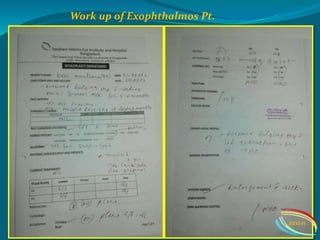
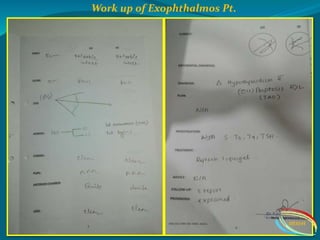
Work up of Exophthalmos Pt.
IIEI&H
Work up of Exophthalmos Pt.
IIEI&H
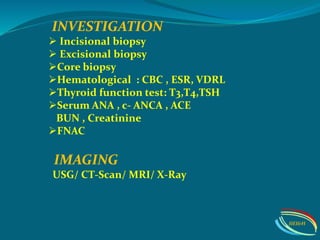
IMAGING
USG/ CT-Scan/ MRI/ X-Ray
INVESTIGATION
 Incisional biopsy
 Excisional biopsy
Core biopsy
Hematological : CBC , ESR, VDRL
Thyroid function test: T3,T4,TSH
Serum ANA , c- ANCA , ACE
BUN , Creatinine
FNAC
IIEI&H
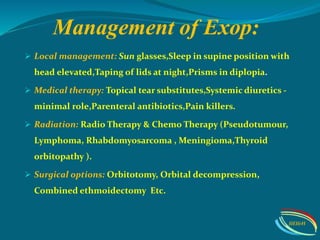
Management of Exop:
 Local management: Sun glasses,Sleep in supine position with
head elevated,Taping of lids at night,Prisms in diplopia.
 Medical therapy: Topical tear substitutes,Systemic diuretics -
minimal role,Parenteral antibiotics,Pain killers.
 Radiation: Radio Therapy & Chemo Therapy (Pseudotumour,
Lymphoma, Rhabdomyosarcoma , Meningioma,Thyroid
orbitopathy ).
 Surgical options: Orbitotomy, Orbital decompression,
Combined ethmoidectomy Etc.
IIEI&H
Take Home Messages
 An Exophthalmos is an important
manifestation of a large number of
orbital diseases. Thorough clinical
examination coupled with appropriate
investigations clinches the diagnosis
and helps in management.
 A difference greater than 2 mm
between the eyes is significant.
IIEI&H
Hertel Measurement
Procedure Video….
IIEI&H
References
 The Orbit and Oculoplasty ,Dr.Agarwal
 www.ophthalmoloyweb.com
 Exophthalmometer in
TheFreeDictionary“.Farlex. Retrieved 13
April 2013.”
 Picture: Me ,Google.
IIEI&H
IIEI&H
IIEI&H
IIEI&H

Exophthalmometer

  • 1.
    Use of Exophthalmometer Md.AzizulIslam Junior Optometrist Ispahani Islamia Eye Institute & Hospital IIEI&H IIEI&H
  • 2.
    Declaration I have nofinancial interest by presenting this presentation IIEI&H
  • 3.
    Aims of today,stopic Will be able…. • General idea @ Measurement Exophthalmos • To know about various type of Exophthalmometer • To know the normal value of Exophthalmometer & • How to documentation Exophthalmos finding IIEI&H
  • 4.
    Exophthalmometer is aninstrument used for measuring the degree of forward displacement of the eye in exophthalmos. The device allows measurement of the forward distance of the lateral orbital rim to the front of the cornea.Exophthalmometers can also identify Enophthalmos (retraction of the eye into the orbit), a sign of blow-out fracture or certain neoplasms. An Exophthalmometer IIEI&H
  • 5.
    Exophthalmos : Abnormalprotrusion of eye balls or Forward bulging of the globe in endocrine disorders specially thyroid dysfunction. Displacement of globe relative to orbital rims . ENOPHTHALMOS: Defined as retrodisplacement of eye into orbit.Inferior and posterior displacement of globe and intraorbital soft tissue . IIEI&H
  • 6.
    Causes Of Exop:/Proptosis UNILATERALBILATERAL CONGENITAL - DERMOID DEVELOPMENTAL ANOMALIES - OXYCEPHALY TRAUMATIC- ORBITAL HAGE/IOFB OSTEOPATHIES- RICKETS / ACROMEGALY INFLAMMATION – ORBITAL CELLULITIS/ABSCESS / CAVERNOUS SINUS /PSEUDOTUMOR/ TUBERCULOSIS TUMORS-LYMPHOMA / LEUKEMIA / SARCOMA / NEUROBLASTOMA VASCULAR-ORBITAL VARIX ENDOCRINAL - THYROID EYE DISEASE CYSTS-PARASITIC INFLAMMATORY - HISTIOCYTOSIS/FUNGAL GRANULOMA TUMOR- PRIMARY OR SECONDARY MUCOCOELE OF PARANASAL SINUSES IIEI&H
  • 7.
  • 8.
    HISTORY TAKING Protrusion ofeyeball: Age of Onset , duration , progression, Constant or intermittent, Variation with posture / strain Decreased vision : preceded, Stationary, Associated field defects  H/O: Pain  H/O :Double vision  H/O :Trauma  H/O: fever , systemic symptoms  H/O :Cancer  H/O :Thyroid disease  H/O:Weight loss IIEI&H
  • 9.
    LOCAL EXAMINATION HB Reflex: Central or Deviation  Globe Displacement: Downward,Upward or Other  Lid Retruction: +(ve) or – (ve)  Lid lag/Lagophtalmos: ..? mm  PALPATION : Size , shape, surface, margins consistency , tenderness , thyroid glangds, orbital rims , regional lymph nodes IIEI&H
  • 10.
     EOM MOTILITY: Decreased in thyroid orbitopathy , extensive tum or growths and neurological defect  VISUAL ACUITY : Maybe decreased due to Refractive changes due to pressure on eyeball, Optic nerve compresssion, Exposure keratopathy  PUPIL REACTION : RAPD suggests optic nerve compression  IOP : Maybe raised  Rular Test: Horizontal with vertical measurement LOCAL EXAMINATION IIEI&H
  • 11.
    SYSTEMIC EXAM The basisof the measurement for exophthalmos determination using the Hertel version is the outer orbital rim (orbital wall) and the apex of the cornea. All instruments are meant to measure the distance b2w the apex of cornea and lateral wall of orbit  OPTICAL:  Light Weight Hertels exophthalmometer  Heavy Duty Hertel Exophthalmometer  Naugle Exophthalmometer  Luedde Exophthalmometer  MECHANICAL : Gormaz Exophthalmometer IIEI&H
  • 12.
    Hertel exophthalmometer is usedfor precise exophthalmos measurements (e.g. Exophthalmic goiter). Sturdy construction for many years of use. Overall dimensions are 25 x 7 x 2 cm. Weight is 117 grams . Scale for orbital wall goes from 75 mm to 121 mm. The scale to measure the proptosis ranges from 0 to 35 mm. L.W.Hertel exophthalmometer IIEI&H
  • 13.
    Lowest price! HeavyDuty Exophthalmometer has metal construction for many years of use. Overall dimensions are 25 x 7 x 2 cm. Weight is 216 grams . Scale for orbital wall goes from 75 mm to 121 mm. The scale to measure the proptosis ranges from 0 to 35 mm. Heavy Duty Exophthalmometer IIEI&H
  • 14.
    Naugle exophthalmometer is superiorand inferior orbital rim- based instrument. This superior and inferior orbital rim-based instrument measures the position of the globe accurately even after lateral orbitotomy e.g. post tumor removal or thyroid decompression. It delivers fast reproducible results of highest precision, provides best patient comfort, thus increasing patient cooperation. Naugle exophthalmometer IIEI&H
  • 15.
    Fastest, easiest and leastexpensive method for measuring exophthalmos. By sighting at right angles, this device eliminates parallax and allows the clinician to measure the amount of protrusion or bulging eye from its orbit. Luedde Exophthalmometer IIEI&H
  • 16.
    Gormaz Exophthalmometer  Measure distancebetween two lateral orbital margins  Require topical anaesthesia IIEI&H
  • 17.
    The basis ofthe measurement for exophthalmos determination using the Hertel version is the outer orbital rim (orbital wall) and the apex of the cornea. The internal refraction mirrors with millimeter scales for the left-hand and right-hand measuring halves of the exophthalmometer are calibrated so that the zero mark on the scale will be located in the plane of the resting points of the supports. For exophthalmus measurements the supports are placed against the two temporal orbital walls so that the orbital rim contacts the deepest point of the supports. Prisms are clear plastic with easy to read millimeter lines on both sides. Eye is seen through lower half of scale and the scale is seen through the upper half, eliminating parallax and aiding rapid determination of protrusion. The Measurement Procedure IIEI&H
  • 18.
    The Measurement Procedure Theexaminer sits opposite the patient at eye level. The exophthalmometer is then positioned with the index points at the temporal lateral orbital walls. The instrument hold with both hands and firmly propped first against the patient’s right orbital wall on the temporal side(which should be felt against the lowest part of the support point). The moveable part on the right side is then set in such as way that the patient’s left orbital wall lies against the lowest part of the arched support. The distance between the lateral orbits (on scale 2) should be noted for future correlation.The examiner asks the patient to look at right ahead with eyelids wide open. The examiner measures for proptosis in each eye. IIEI&H
  • 19.
    The normal rangeis 12–21 mm. Upper normal limit for people of African origin is a little higher, about 23– 24 mm. A difference greater than 2 mm between the eyes is significant. In children and teenagers mean exophthalmometric measurements increase with age: Less than 4 years old (13.2 mm), 5–8 years old (14.4 mm), 9–12 years old (15.2 mm) and 13–17 years old (16.2 mm). Depending upon the configuration of the osseous orbit, a value of 15mm might be pathological whereas 21mm might be normal. Axial Length of the eye affects exophthalmometer reading. Pseudoproptosis may be seen in severe myopia. Normal values Of Exophthalmometer IIEI&H
  • 20.
    Work up ofExophthalmos Pt. IIEI&H
  • 21.
    Work up ofExophthalmos Pt. IIEI&H
  • 22.
    IMAGING USG/ CT-Scan/ MRI/X-Ray INVESTIGATION  Incisional biopsy  Excisional biopsy Core biopsy Hematological : CBC , ESR, VDRL Thyroid function test: T3,T4,TSH Serum ANA , c- ANCA , ACE BUN , Creatinine FNAC IIEI&H
  • 23.
    Management of Exop: Local management: Sun glasses,Sleep in supine position with head elevated,Taping of lids at night,Prisms in diplopia.  Medical therapy: Topical tear substitutes,Systemic diuretics - minimal role,Parenteral antibiotics,Pain killers.  Radiation: Radio Therapy & Chemo Therapy (Pseudotumour, Lymphoma, Rhabdomyosarcoma , Meningioma,Thyroid orbitopathy ).  Surgical options: Orbitotomy, Orbital decompression, Combined ethmoidectomy Etc. IIEI&H
  • 24.
    Take Home Messages An Exophthalmos is an important manifestation of a large number of orbital diseases. Thorough clinical examination coupled with appropriate investigations clinches the diagnosis and helps in management.  A difference greater than 2 mm between the eyes is significant. IIEI&H
  • 25.
  • 26.
    References  The Orbitand Oculoplasty ,Dr.Agarwal  www.ophthalmoloyweb.com  Exophthalmometer in TheFreeDictionary“.Farlex. Retrieved 13 April 2013.”  Picture: Me ,Google. IIEI&H IIEI&H
  • 27.