RHEOLOGY
SUBMITTED BY
Mrs. Uzma Ali
GROUP MEMBER
Swaira Shafique
Neelum Haleema
Zahra Abbas
Maham Ahmad
Hina Shafique
Memoona Nasir
OUTLINE
• Definition
• Viscosity
• Newtonin fluid
• Non-Newtonin fluid
• Determination of flow properties
• Application
Rheology
• “ Rheology is concerned with the flow and
deformation of materials experiencing an
applied force.”
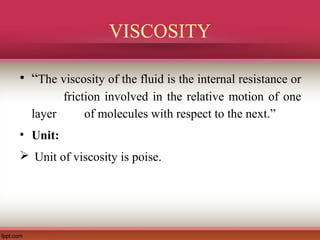
VISCOSITY
• “The viscosity of the fluid is the internal resistance or
friction involved in the relative motion of one
layer of molecules with respect to the next.”
• Unit:
 Unit of viscosity is poise.
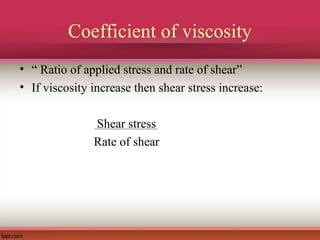
Coefficient of viscosity
• “ Ratio of applied stress and rate of shear”
• If viscosity increase then shear stress increase:
Shear stress
Rate of shear
Classification of Materials According to
Flow and Deformation
• When classifying materials according to the types of
flow and deformation, it is customary to place them
in two categories.
• (i) Newtonian system
• (ii) Non-Newtonian system
Newtonian fluid
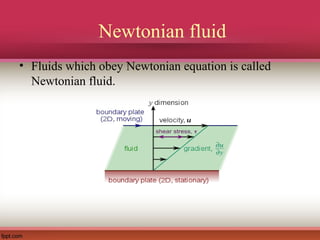
• Fluids which obey Newtonian equation is called
Newtonian fluid.
Shear stress
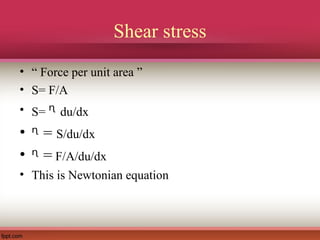
• “ Force per unit area ”
• S= F/A
• S= ᶯ du/dx
• =ᶯ S/du/dx
• =ᶯ F/A/du/dx
• This is Newtonian equation
Non-Newtonian fluid
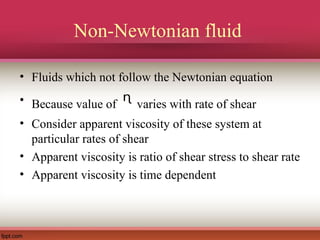
• Fluids which not follow the Newtonian equation
• Because value of ᶯ varies with rate of shear
• Consider apparent viscosity of these system at
particular rates of shear
• Apparent viscosity is ratio of shear stress to shear rate
• Apparent viscosity is time dependent
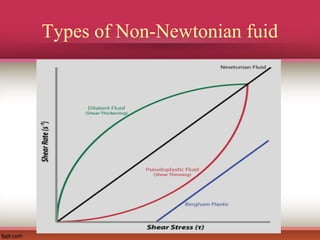
Types of Non-Newtonian fuid
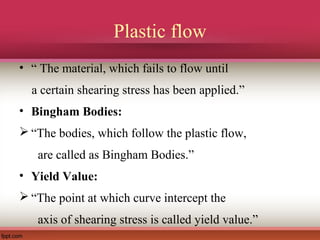
Plastic flow
• “ The material, which fails to flow until
a certain shearing stress has been applied.”
• Bingham Bodies:
 “The bodies, which follow the plastic flow,
are called as Bingham Bodies.”
• Yield Value:
 “The point at which curve intercept the
axis of shearing stress is called yield value.”
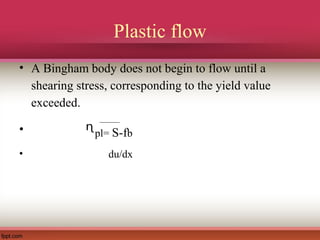
Plastic flow
• A Bingham body does not begin to flow until a
shearing stress, corresponding to the yield value
exceeded.
• ᶯpl= S-fb
• du/dx
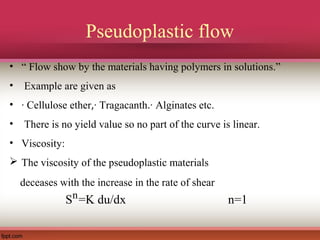
Pseudoplastic flow
• “ Flow show by the materials having polymers in solutions.”
• Example are given as
• · Cellulose ether,· Tragacanth.· Alginates etc.
• There is no yield value so no part of the curve is linear.
• Viscosity:
 The viscosity of the pseudoplastic materials
deceases with the increase in the rate of shear
S =K du/dx n=1n
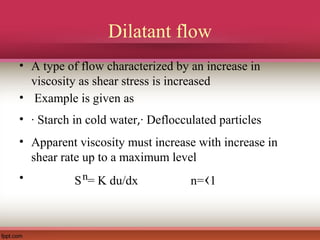
Dilatant flow
• A type of flow characterized by an increase in
viscosity as shear stress is increased
• Example is given as
• · Starch in cold water,· Deflocculated particles
• Apparent viscosity must increase with increase in
shear rate up to a maximum level
• S = K du/dx n=‹1n
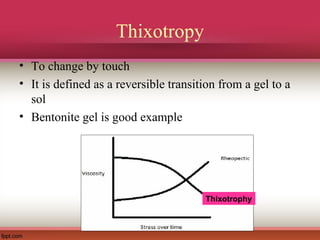
Thixotropy
• To change by touch
• It is defined as a reversible transition from a gel to a
sol
• Bentonite gel is good example
Thixotrophy
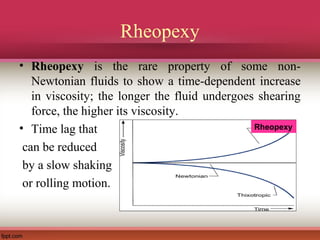
Rheopexy
• Rheopexy is the rare property of some non-
Newtonian fluids to show a time-dependent increase
in viscosity; the longer the fluid undergoes shearing
force, the higher its viscosity.
• Time lag that
can be reduced
by a slow shaking
or rolling motion.
Rheopexy
Negative thixotropy
• Transformation of dilute concentration into viscous
concentration
• Occur due to gradual growth in molecular structures
over the time
Determination of flow properties
1) Capillary viscometer:
 Ostwald U-tube viscometer
 Suspended level viscometer
2) Rational viscometer
 Concentric cylinder viscometer
 Cone plate viscometer
Ostwald viscometer
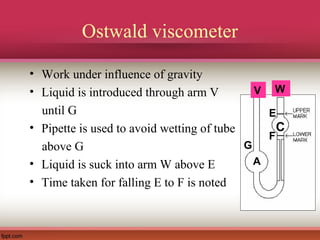
• Work under influence of gravity
• Liquid is introduced through arm V
until G
• Pipette is used to avoid wetting of tube
above G
• Liquid is suck into arm W above E
• Time taken for falling E to F is noted
C
E
F
W
A
V
G
Suspended level viscometer
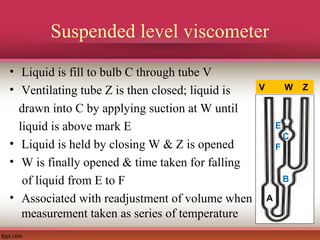
• Liquid is fill to bulb C through tube V
• Ventilating tube Z is then closed; liquid is
drawn into C by applying suction at W until
liquid is above mark E
• Liquid is held by closing W & Z is opened
• W is finally opened & time taken for falling
of liquid from E to F
• Associated with readjustment of volume when
measurement taken as series of temperature
V W Z
E
C
F
B
A
Poiseuille’s equation
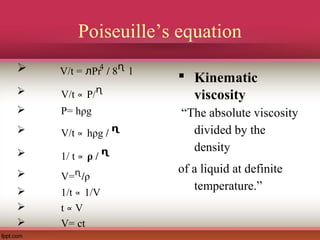
 V/t = ᴫPr / 8ᶯ l
 V/t ∝ P/ᶯ
 P= hρg
 V/t ∝ hρg / ᶯ
 1/ t ∝ ρ / ᶯ
 V=ᶯ/ρ
 1/t ∝ 1/V
 t V∝
 V= ct
4
 Kinematic
viscosity
“The absolute viscosity
divided by the
density
of a liquid at definite
temperature.”
Concentric cylinder viscometer
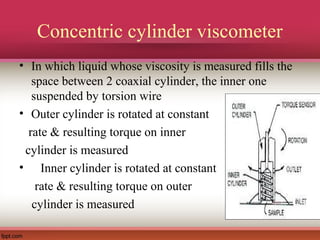
• In which liquid whose viscosity is measured fills the
space between 2 coaxial cylinder, the inner one
suspended by torsion wire
• Outer cylinder is rotated at constant
rate & resulting torque on inner
cylinder is measured
• Inner cylinder is rotated at constant
rate & resulting torque on outer
cylinder is measured
Concentric cylinder viscometer
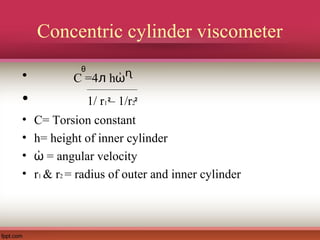
• C =4ᴫ hὠᶯ
• 1/ r1 – 1/r2
• C= Torsion constant
• h= height of inner cylinder
• = angular velocityὠ
• r1 & r2 = radius of outer and inner cylinder
2 2
θ
Disadvantages
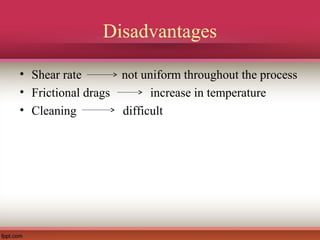
• Shear rate not uniform throughout the process
• Frictional drags increase in temperature
• Cleaning difficult
Cone plate viscometer
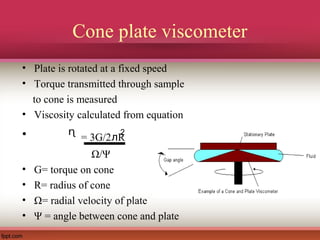
• Plate is rotated at a fixed speed
• Torque transmitted through sample
to cone is measured
• Viscosity calculated from equation
• ᶯ = 3G/2ᴫR
Ω/Ψ
• G= torque on cone
• R= radius of cone
• Ω= radial velocity of plate
• Ψ = angle between cone and plate
2
Falling sphere viscometer
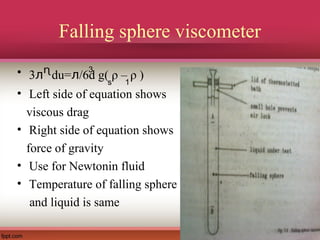
• 3ᴫᶯdu=ᴫ/6d g( ρ – ρ )
• Left side of equation shows
viscous drag
• Right side of equation shows
force of gravity
• Use for Newtonin fluid
• Temperature of falling sphere
and liquid is same
3
s 1
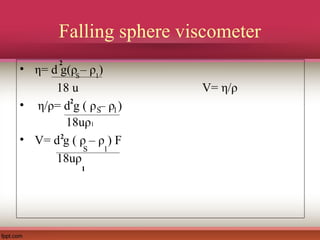
Falling sphere viscometer
• η= d g(ρ – ρ )
18 u V= η/ρ
• η/ρ= d g ( ρ – ρ )
18uρ1
• V= d g ( ρ – ρ ) F
18uρ
2
S 1
2
S 1
S 1
2
1
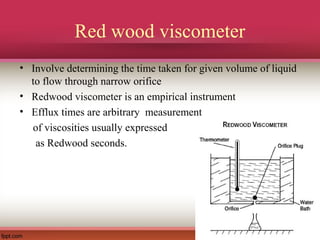
Red wood viscometer
• Involve determining the time taken for given volume of liquid
to flow through narrow orifice
• Redwood viscometer is an empirical instrument
• Efflux times are arbitrary measurement
of viscosities usually expressed
as Redwood seconds.
Application in Pharmacy
• It is involved in formulation and analysis of pharmaceutical
products as emulsions, paste, suppositories and tablet coatings.
• It is involved in manufacture of pastes medicines cream ointments.
• It is also involved in mixing and flow of materials and there
packing in containers.
• The poloxamers are block polymers and are used in dermatologic
bases or topical ophthalmic preparations because of their low
toxicity & ability to form clear water based gels.
• Also used in study of paints, inks, doughs, road building materials,
cosmetics, dairy products & other materials.
Rheology latest

Rheology latest

  • 2.
  • 3.
    GROUP MEMBER Swaira Shafique NeelumHaleema Zahra Abbas Maham Ahmad Hina Shafique Memoona Nasir
  • 4.
    OUTLINE • Definition • Viscosity •Newtonin fluid • Non-Newtonin fluid • Determination of flow properties • Application
  • 5.
    Rheology • “ Rheologyis concerned with the flow and deformation of materials experiencing an applied force.”
  • 6.
    VISCOSITY • “The viscosityof the fluid is the internal resistance or friction involved in the relative motion of one layer of molecules with respect to the next.” • Unit:  Unit of viscosity is poise.
  • 7.
    Coefficient of viscosity •“ Ratio of applied stress and rate of shear” • If viscosity increase then shear stress increase: Shear stress Rate of shear
  • 8.
    Classification of MaterialsAccording to Flow and Deformation • When classifying materials according to the types of flow and deformation, it is customary to place them in two categories. • (i) Newtonian system • (ii) Non-Newtonian system
  • 9.
    Newtonian fluid • Fluidswhich obey Newtonian equation is called Newtonian fluid.
  • 10.
    Shear stress • “Force per unit area ” • S= F/A • S= ᶯ du/dx • =ᶯ S/du/dx • =ᶯ F/A/du/dx • This is Newtonian equation
  • 11.
    Non-Newtonian fluid • Fluidswhich not follow the Newtonian equation • Because value of ᶯ varies with rate of shear • Consider apparent viscosity of these system at particular rates of shear • Apparent viscosity is ratio of shear stress to shear rate • Apparent viscosity is time dependent
  • 12.
  • 13.
    Plastic flow • “The material, which fails to flow until a certain shearing stress has been applied.” • Bingham Bodies:  “The bodies, which follow the plastic flow, are called as Bingham Bodies.” • Yield Value:  “The point at which curve intercept the axis of shearing stress is called yield value.”
  • 14.
    Plastic flow • ABingham body does not begin to flow until a shearing stress, corresponding to the yield value exceeded. • ᶯpl= S-fb • du/dx
  • 15.
    Pseudoplastic flow • “Flow show by the materials having polymers in solutions.” • Example are given as • · Cellulose ether,· Tragacanth.· Alginates etc. • There is no yield value so no part of the curve is linear. • Viscosity:  The viscosity of the pseudoplastic materials deceases with the increase in the rate of shear S =K du/dx n=1n
  • 16.
    Dilatant flow • Atype of flow characterized by an increase in viscosity as shear stress is increased • Example is given as • · Starch in cold water,· Deflocculated particles • Apparent viscosity must increase with increase in shear rate up to a maximum level • S = K du/dx n=‹1n
  • 17.
    Thixotropy • To changeby touch • It is defined as a reversible transition from a gel to a sol • Bentonite gel is good example Thixotrophy
  • 18.
    Rheopexy • Rheopexy isthe rare property of some non- Newtonian fluids to show a time-dependent increase in viscosity; the longer the fluid undergoes shearing force, the higher its viscosity. • Time lag that can be reduced by a slow shaking or rolling motion. Rheopexy
  • 19.
    Negative thixotropy • Transformationof dilute concentration into viscous concentration • Occur due to gradual growth in molecular structures over the time
  • 20.
    Determination of flowproperties 1) Capillary viscometer:  Ostwald U-tube viscometer  Suspended level viscometer 2) Rational viscometer  Concentric cylinder viscometer  Cone plate viscometer
  • 21.
    Ostwald viscometer • Workunder influence of gravity • Liquid is introduced through arm V until G • Pipette is used to avoid wetting of tube above G • Liquid is suck into arm W above E • Time taken for falling E to F is noted C E F W A V G
  • 22.
    Suspended level viscometer •Liquid is fill to bulb C through tube V • Ventilating tube Z is then closed; liquid is drawn into C by applying suction at W until liquid is above mark E • Liquid is held by closing W & Z is opened • W is finally opened & time taken for falling of liquid from E to F • Associated with readjustment of volume when measurement taken as series of temperature V W Z E C F B A
  • 23.
    Poiseuille’s equation  V/t= ᴫPr / 8ᶯ l  V/t ∝ P/ᶯ  P= hρg  V/t ∝ hρg / ᶯ  1/ t ∝ ρ / ᶯ  V=ᶯ/ρ  1/t ∝ 1/V  t V∝  V= ct 4  Kinematic viscosity “The absolute viscosity divided by the density of a liquid at definite temperature.”
  • 24.
    Concentric cylinder viscometer •In which liquid whose viscosity is measured fills the space between 2 coaxial cylinder, the inner one suspended by torsion wire • Outer cylinder is rotated at constant rate & resulting torque on inner cylinder is measured • Inner cylinder is rotated at constant rate & resulting torque on outer cylinder is measured
  • 25.
    Concentric cylinder viscometer •C =4ᴫ hὠᶯ • 1/ r1 – 1/r2 • C= Torsion constant • h= height of inner cylinder • = angular velocityὠ • r1 & r2 = radius of outer and inner cylinder 2 2 θ
  • 26.
    Disadvantages • Shear ratenot uniform throughout the process • Frictional drags increase in temperature • Cleaning difficult
  • 27.
    Cone plate viscometer •Plate is rotated at a fixed speed • Torque transmitted through sample to cone is measured • Viscosity calculated from equation • ᶯ = 3G/2ᴫR Ω/Ψ • G= torque on cone • R= radius of cone • Ω= radial velocity of plate • Ψ = angle between cone and plate 2
  • 28.
    Falling sphere viscometer •3ᴫᶯdu=ᴫ/6d g( ρ – ρ ) • Left side of equation shows viscous drag • Right side of equation shows force of gravity • Use for Newtonin fluid • Temperature of falling sphere and liquid is same 3 s 1
  • 29.
    Falling sphere viscometer •η= d g(ρ – ρ ) 18 u V= η/ρ • η/ρ= d g ( ρ – ρ ) 18uρ1 • V= d g ( ρ – ρ ) F 18uρ 2 S 1 2 S 1 S 1 2 1
  • 30.
    Red wood viscometer •Involve determining the time taken for given volume of liquid to flow through narrow orifice • Redwood viscometer is an empirical instrument • Efflux times are arbitrary measurement of viscosities usually expressed as Redwood seconds.
  • 31.
    Application in Pharmacy •It is involved in formulation and analysis of pharmaceutical products as emulsions, paste, suppositories and tablet coatings. • It is involved in manufacture of pastes medicines cream ointments. • It is also involved in mixing and flow of materials and there packing in containers. • The poloxamers are block polymers and are used in dermatologic bases or topical ophthalmic preparations because of their low toxicity & ability to form clear water based gels. • Also used in study of paints, inks, doughs, road building materials, cosmetics, dairy products & other materials.