Presented to: Sir Sajid Naseem
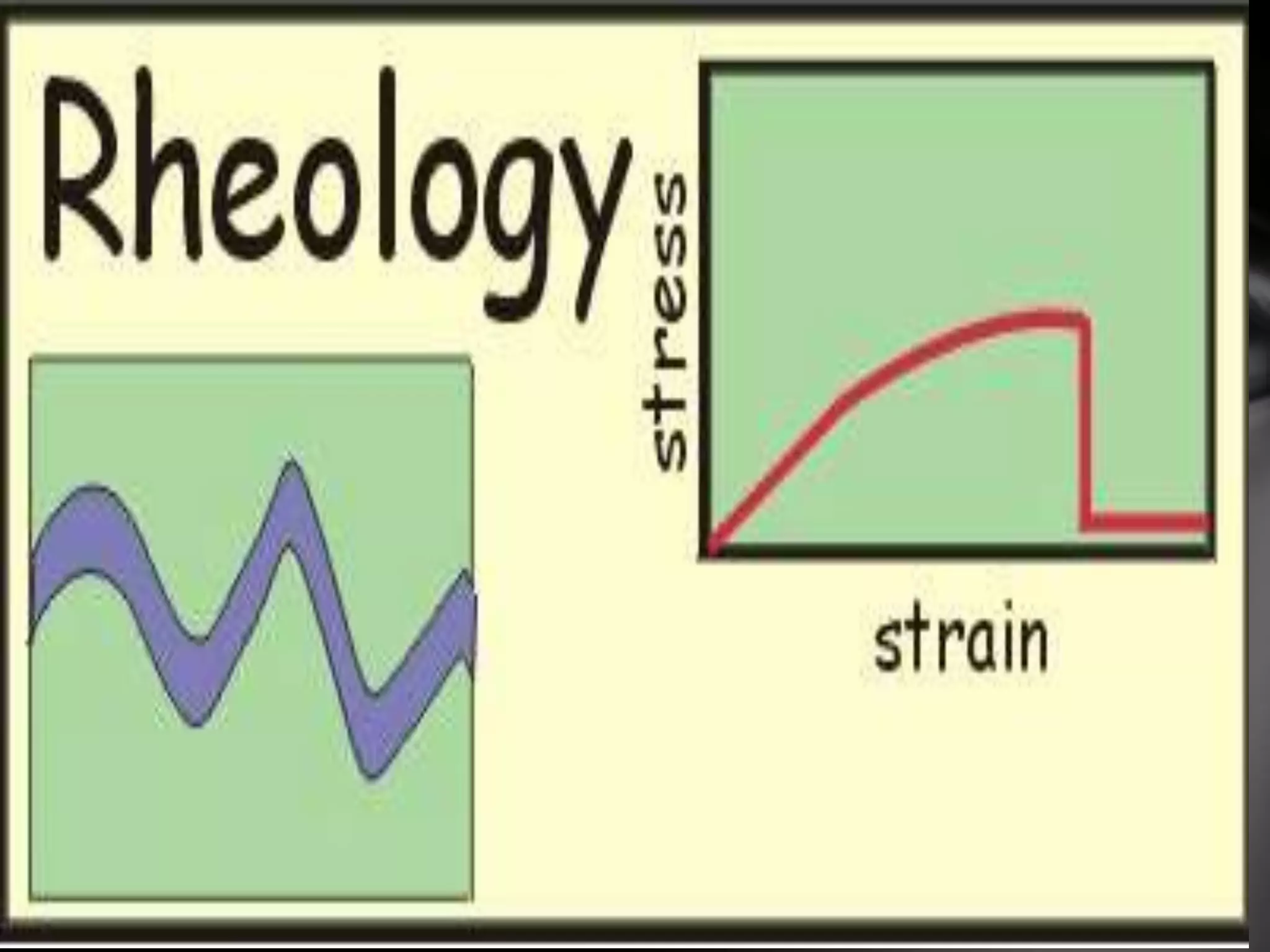
Rheology&
Rheometers
Scientists are still confused
that how to define rheology


                Rheology=study of
                deformation and flow
What is rheology to scientists?

Rheology is


   Yield stresses
   Viscoelastic effects
   Memory effects
   Shear thickening and shear thinning
Rheological measurements

Deformation is the relative displacement of points of a
body. It can be divided into two types: flow and elasticity.
Flow is irreversible deformation; when the stress is
removed, the material does not revert to its original form.
This means that work is converted to heat.
Elasticity is reversible deformation; the deformed body
recovers its original shape, and the applied work is largely
recoverable. Viscoelastic materials show both flow and
elasticity.
Flow classification


Flows are of following main types
 Steady simple shear flow
 Unsteady simple shear flow
 Extensional flow
Steady simple shear flow
Shear flow is a flow which occurs when the fluid is placed
between the two plates and the two plates move at different
velocities
The viscosity function η,the primary and secondary normal
stress coefficients ψ 1 and
  ψ 2 respectively are the three viscometric functions
which completely determine the state of stress in any
rheologically steady shear flow.
Unsteady simple shear flow


Unsteady simple shear flow occurs when the stresses are
time dependent
Small amplitude oscillatory flow, stress growth, stress
relaxation, creep and constrained flow are some examples
of such flows
Extensional Flow

There is no shear flow in this type.
The volume of the fluid remains constant in this type of
flow
It occurs when the material is longitudinally stretched as
for example in fiber spinning
Flow behaviour

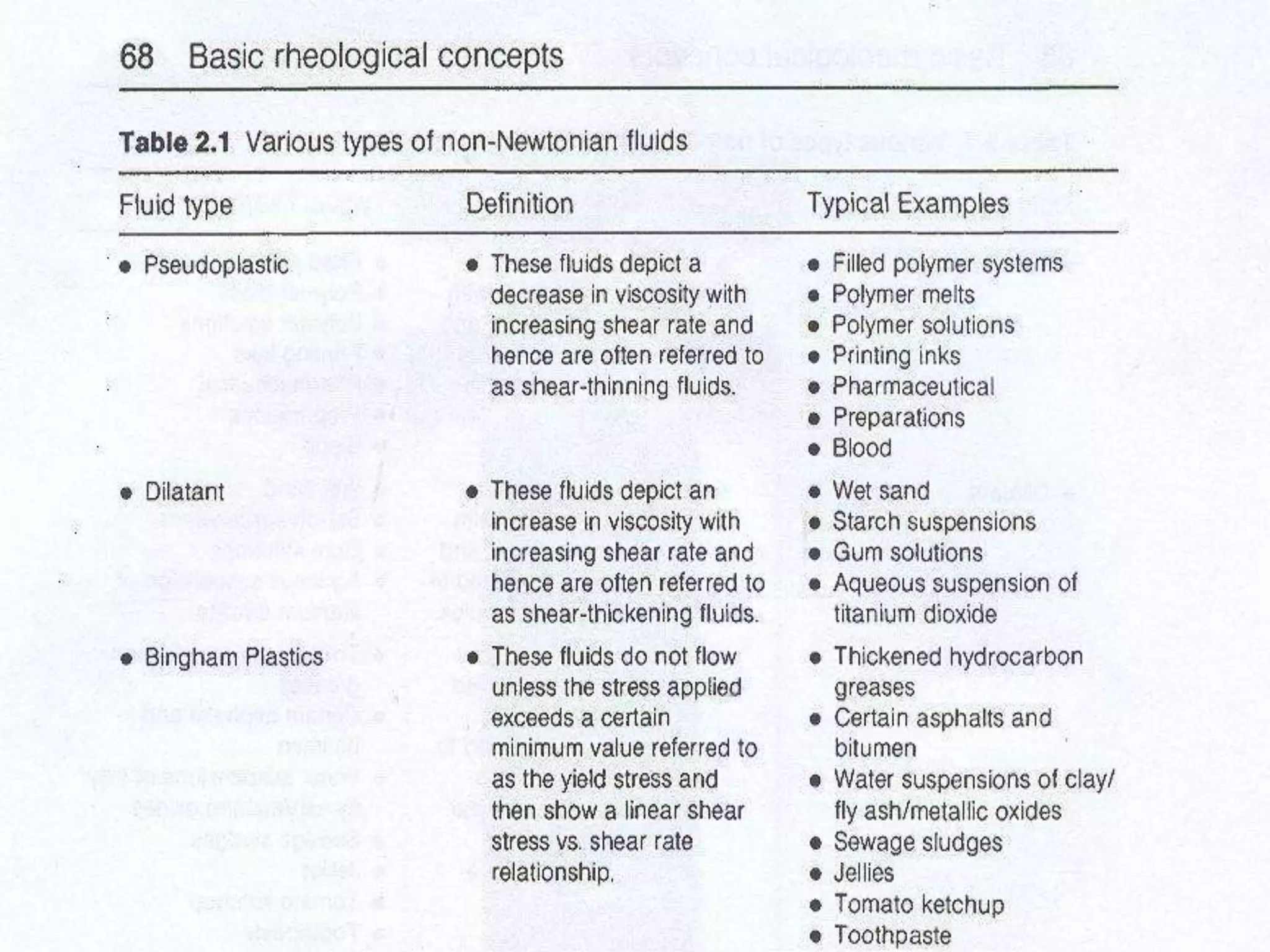
The viscoelastic nature of the polymers whether filled or
unfilled bring them under the category called the non
newtonian fluids
Newtonian fluids as we know are the fluids which obey the
newton’s law of viscosity
The simplest example of newtonian fluid is water
Models for the Shear viscosity

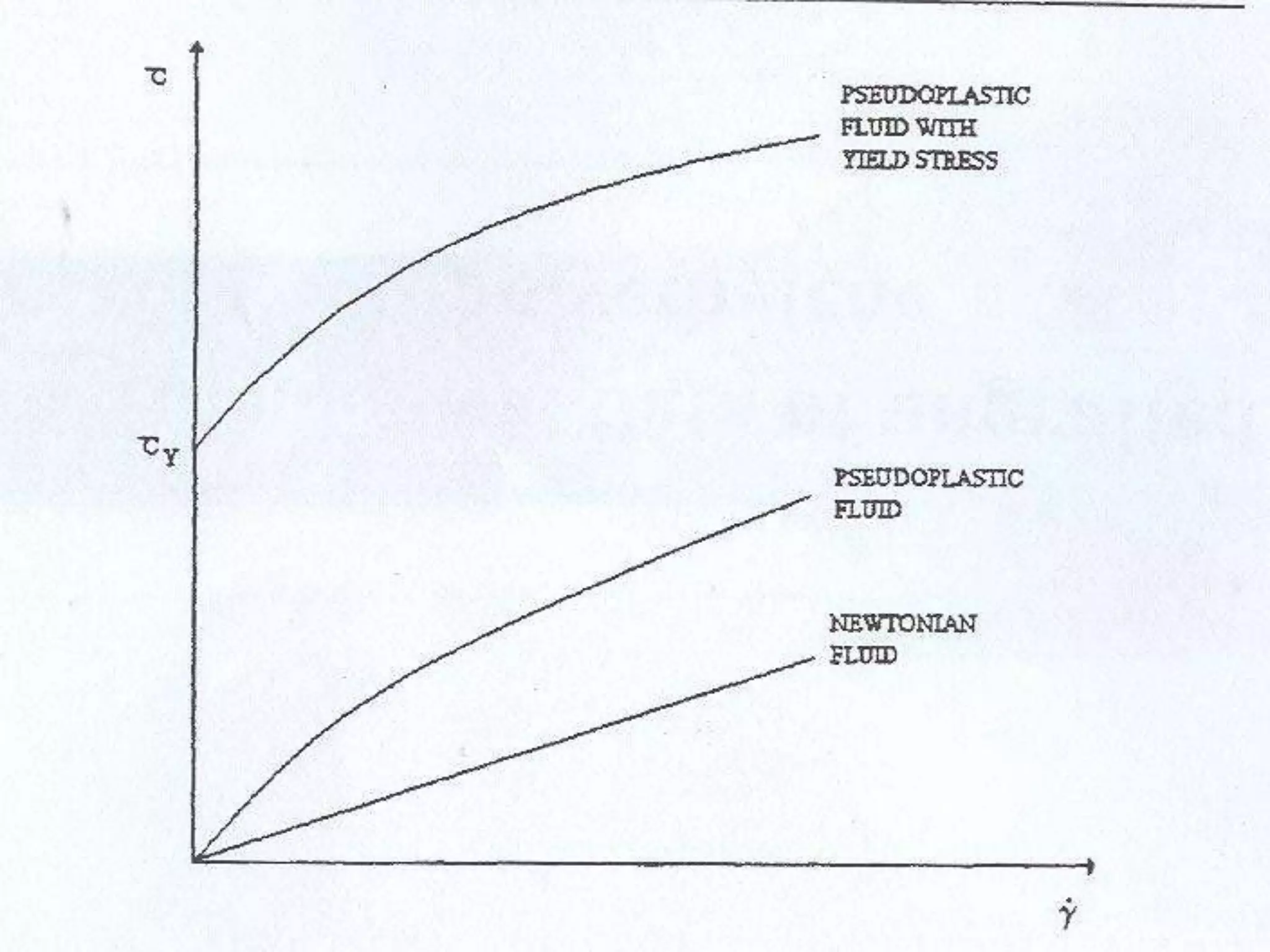
At low shear rate range the unfilled polymer behave as
Newtonian fluids
As shear rate increases the viscosity begins to decrease
showing the pseudo plastic behavior.Under normal
conditions the high shear rate regions are neglected and the
curve of unfilled polymers become similar to the filled
polymers
Polymer applications

Polymer Processing
Polymers are used in the construction and a large number
of other applications so these are now indispensable
In most of the cases the melt processing is been carried out
but there are many examples in which processing of
solution is also taking place such as in the formation of
films and fiber of heat sensitive polymers
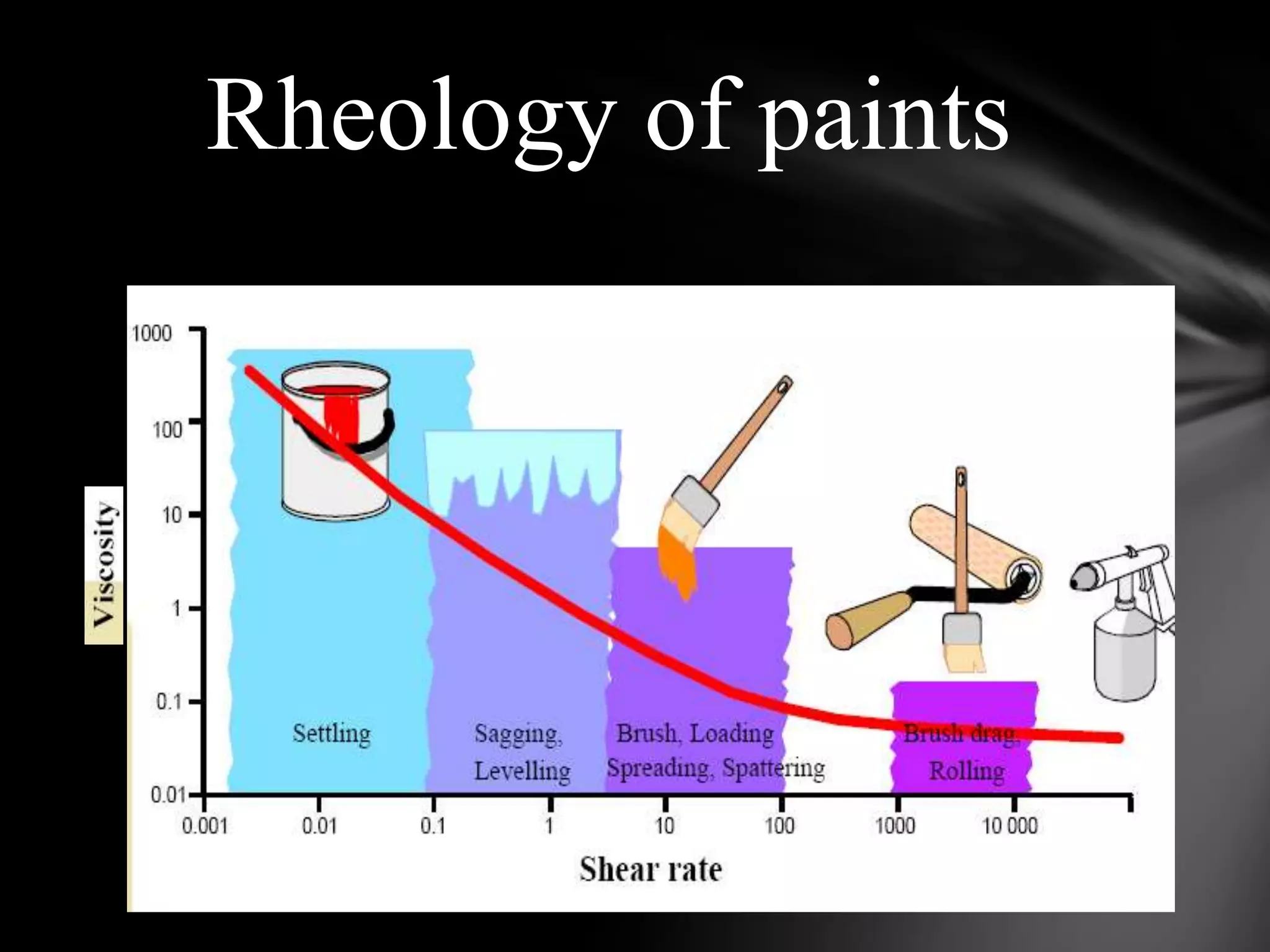
Rheology of paints
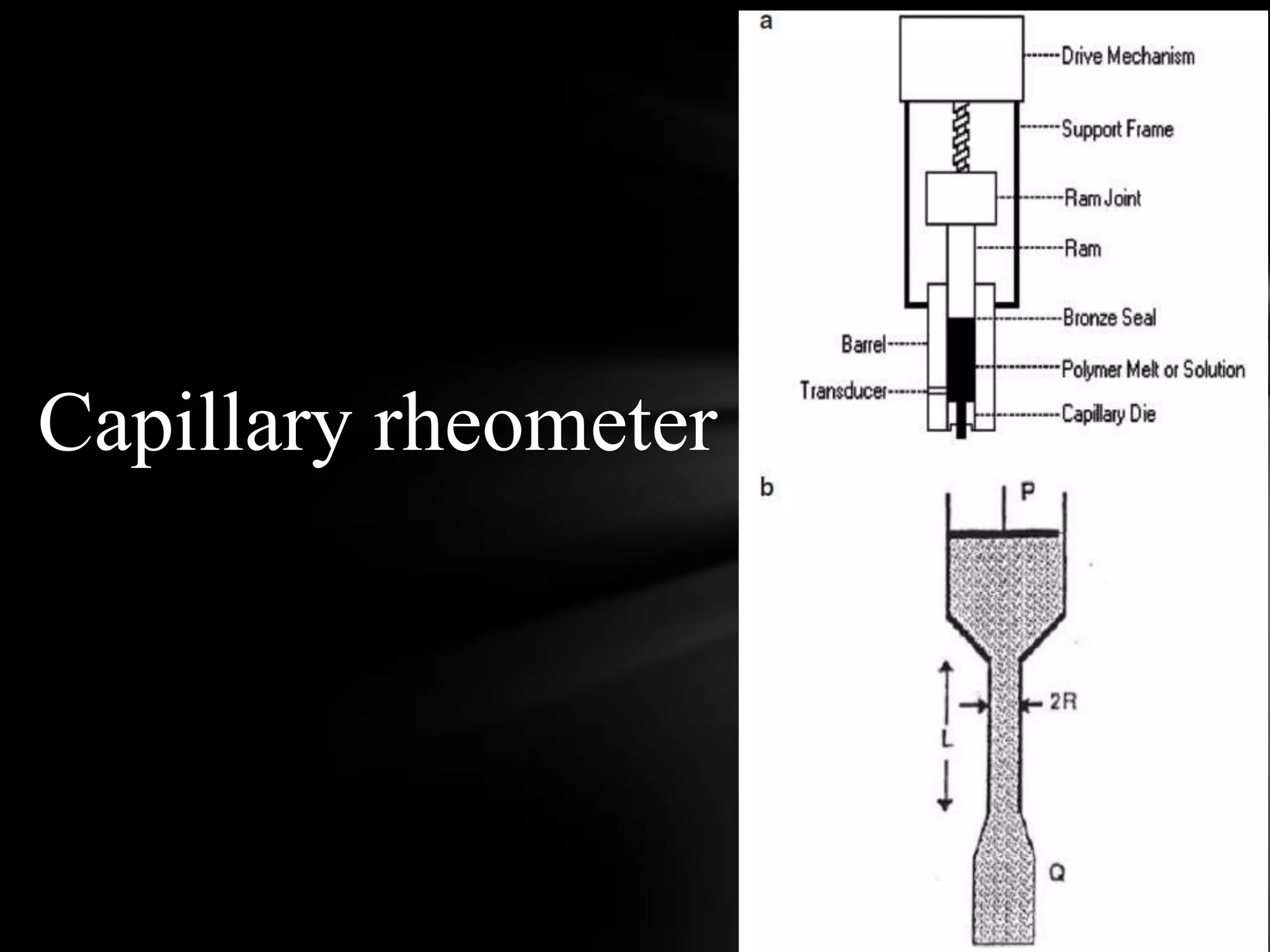
Capillary rheometer
Calculations

Calculation of shear stress
Calculation of shear rate
Calculation of power law parameters
Calculation of viscosity
Correction of results or baggley correction.
 Dilute polymer solution
 Concentrated polymer solution
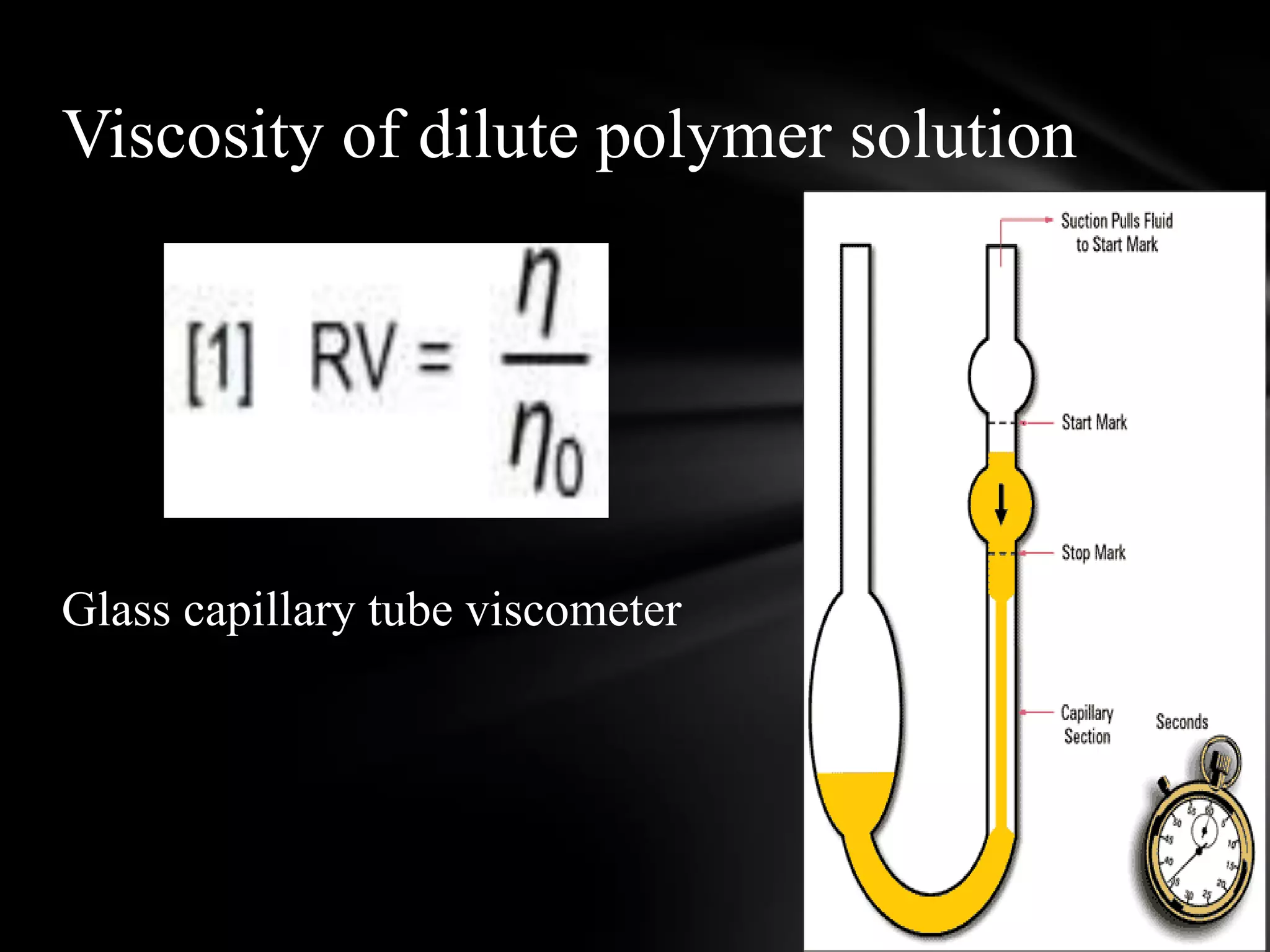
Viscosity of dilute polymer solution


Glass capillary tube viscometer
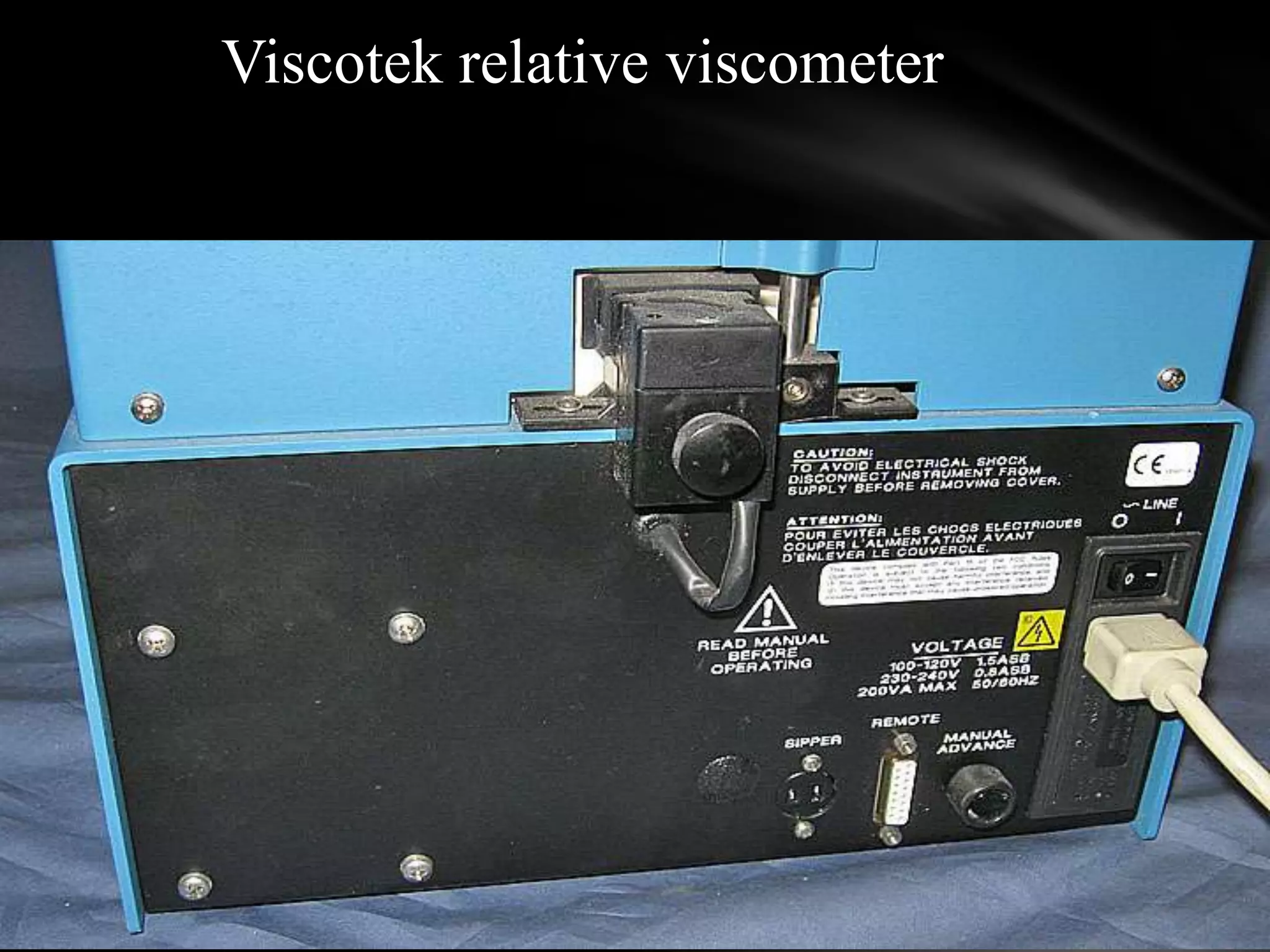
Viscotek relative viscometer
Intrinsic viscosity
Not a viscosity
Unit:dl/g
Inverse of molecular density
Viscosity of concentrated polymer solution
Applications:
Fiber spinning
Film casting
Polymer manufacturing process
Methods:
Capillary viscometer
Extrusion rheometer
Rotational viscometer
Rheological Measurements
Viscometers are used to measure rheological properties

Viscometer is defined as instruments used to measure viscosity

They differ on the basis of geometry and shear rates

There are three main types

Capillary Viscometer

Rotational Viscometer

Moving Body Viscometer
Choice of a Viscometer
There are number of criteria to be kept in mind;

Nature of material to be tested

 Material’s viscosity

Materials elasticity

The dependence of viscosity on temperature

The degree of accuracy required
Capillary Viscometer
It is the most oldest and popular way

follows Hagen_poiseulle equation i.e. η= πr^4pt/8VL

If we are assuming laminar flow and pressure is constant then equation becomes

ν = η/ρ

They are useful for measuring precise viscosities of dilute polymer solutions

They can’t measure absolute viscosities

Always measure viscosity relative to a reference liquid
Design of Capillary viscometer
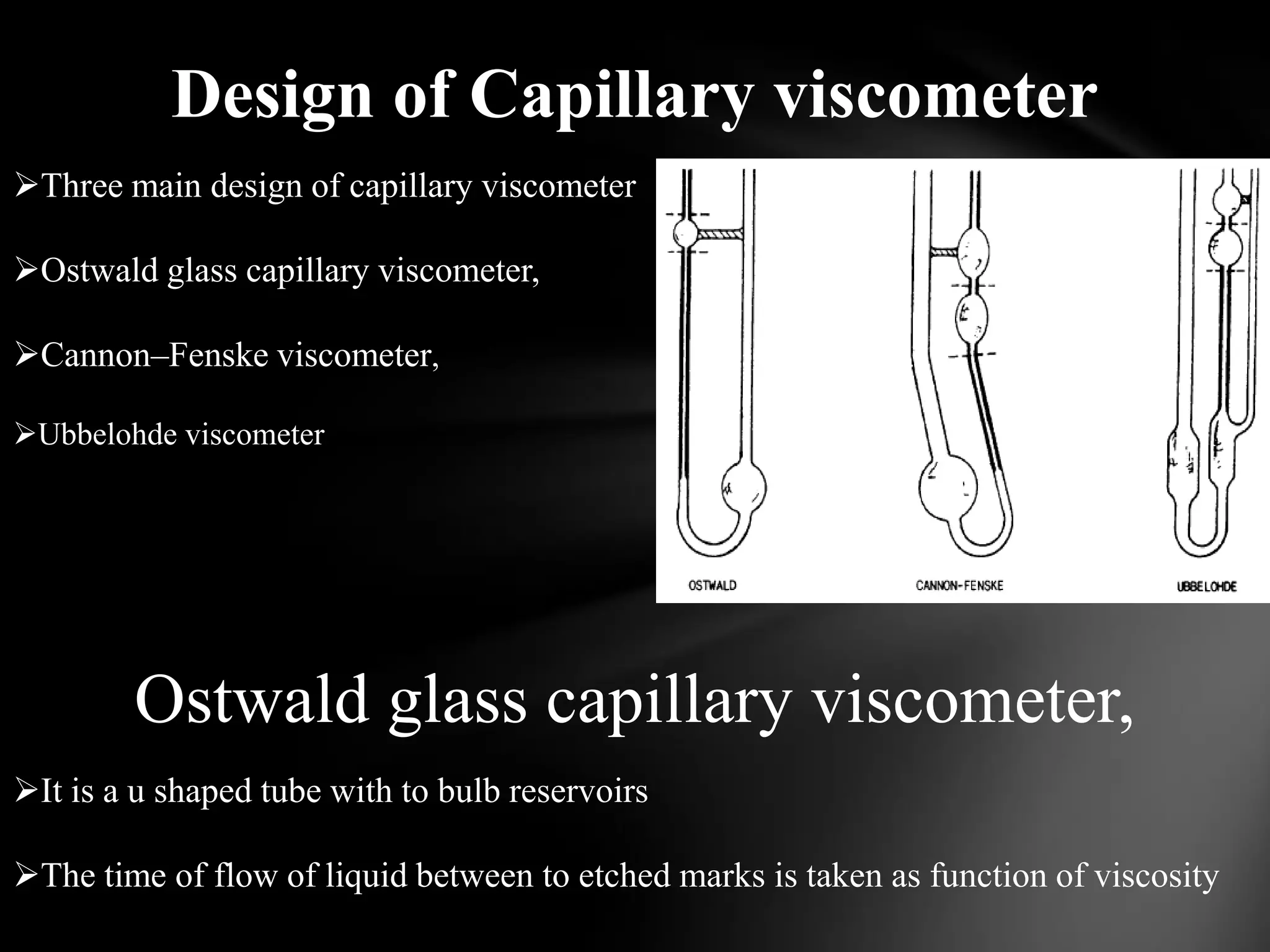
Three main design of capillary viscometer

Ostwald glass capillary viscometer,

Cannon–Fenske viscometer,

Ubbelohde viscometer


        Ostwald glass capillary viscometer,
It is a u shaped tube with to bulb reservoirs

The time of flow of liquid between to etched marks is taken as function of viscosity
Cannon–Fenske viscometer
It is excellent for general use

It consist of long capillary tube

Both reservoirs are present on the same vertical axis


                   Ubbelohde viscometer.
It is particularly useful for measurement at different concentration

It is the modified form of Ostwald viscometer
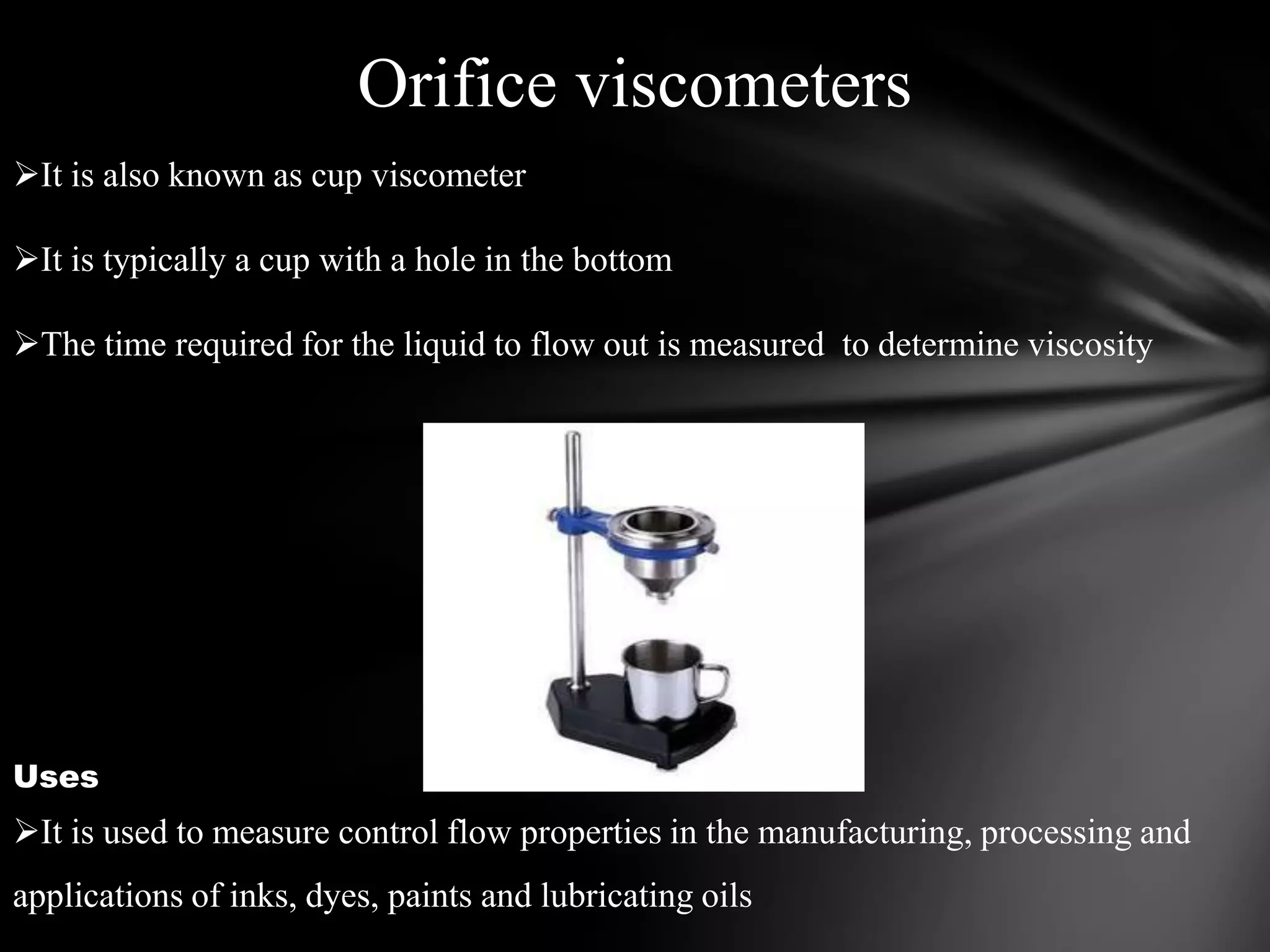
Orifice viscometers
It is also known as cup viscometer

It is typically a cup with a hole in the bottom

The time required for the liquid to flow out is measured to determine viscosity


Uses
It is used to measure control flow properties in the manufacturing, processing and
applications of inks, dyes, paints and lubricating oils
Limitations


It should not be used for setting product specifications

It is only designed for Newtonian fluids

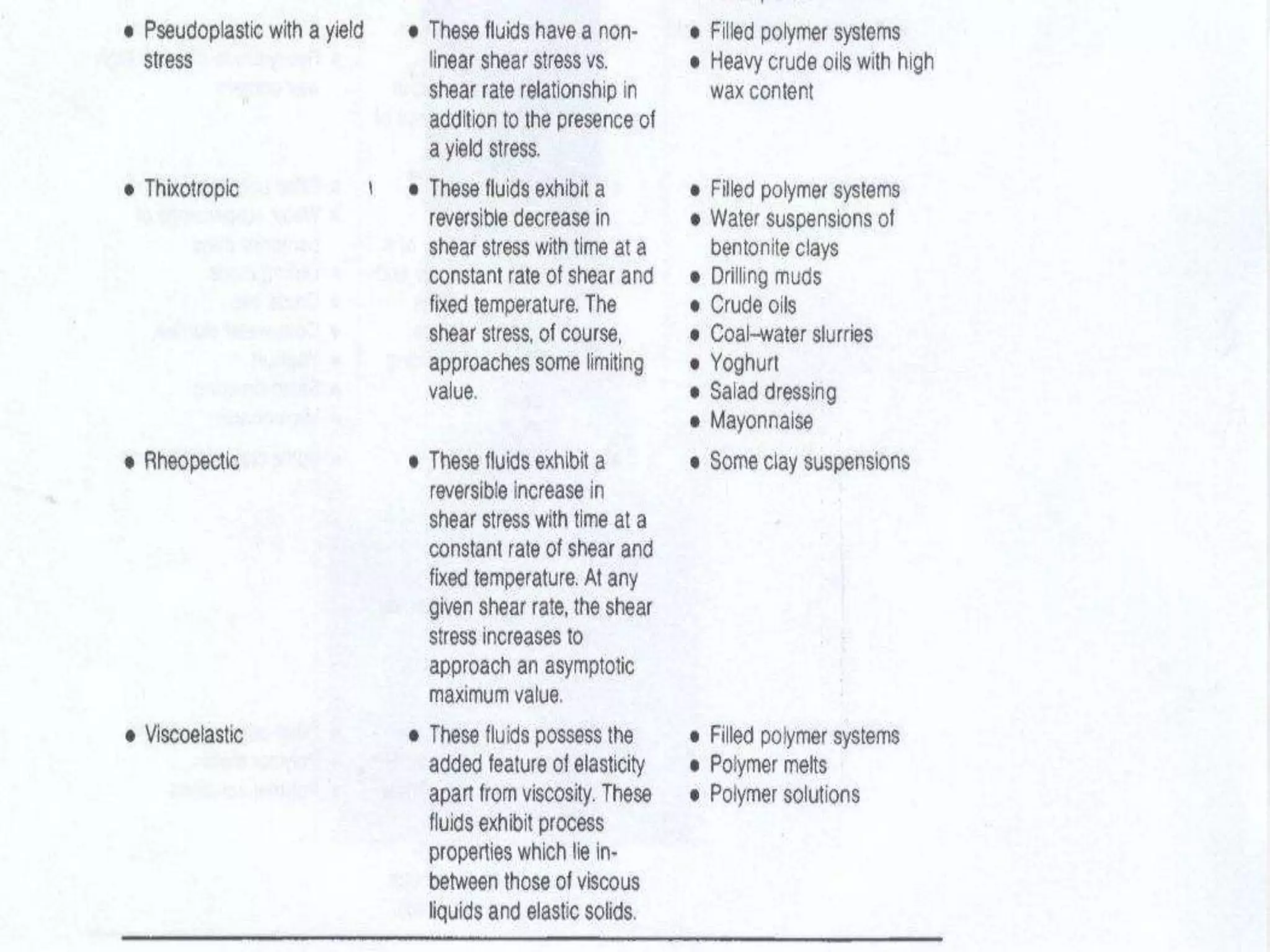
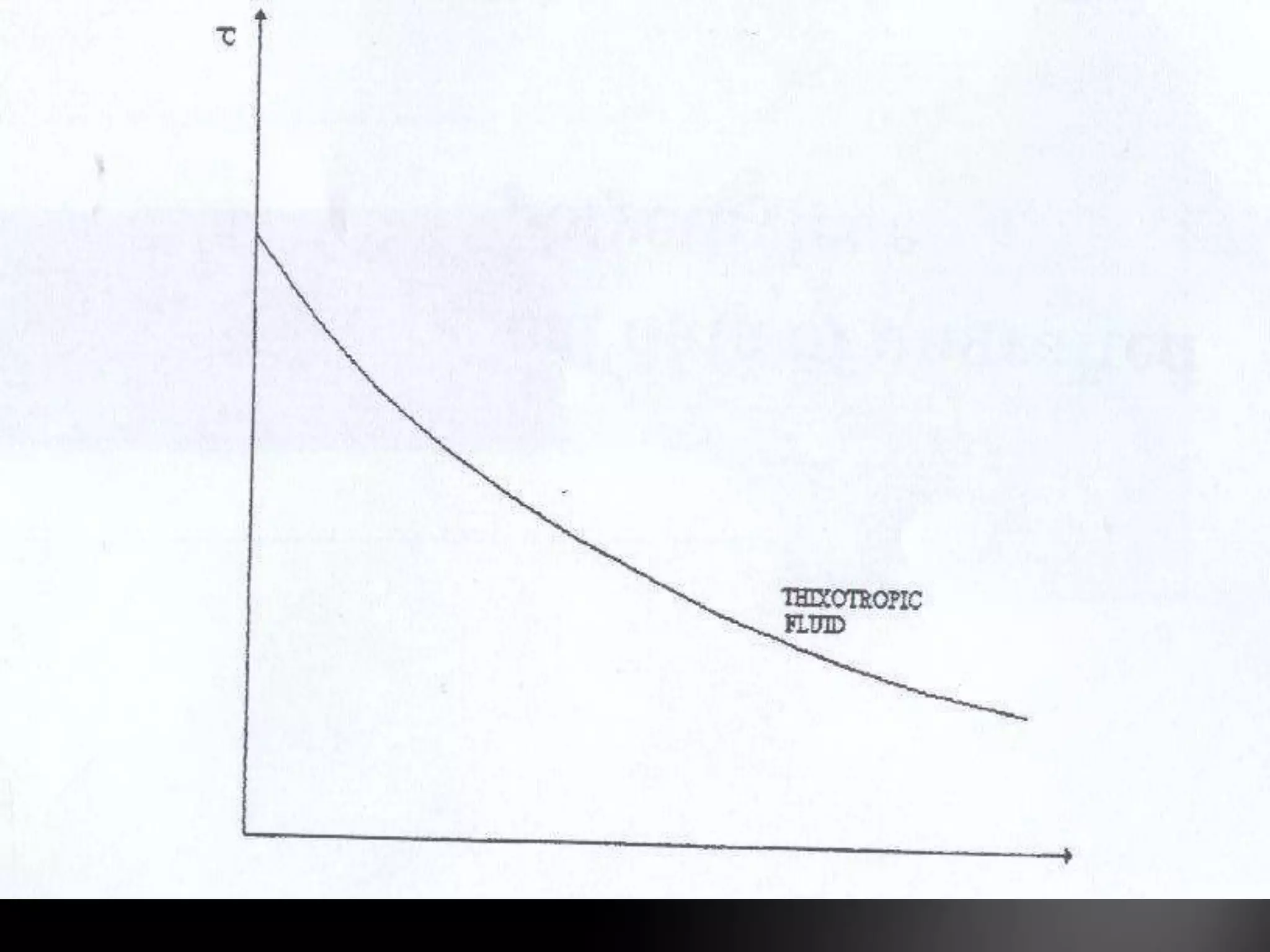
It should not be used for thixotropic materials
CONTENTS
•What is rotational viscometer
•Construction
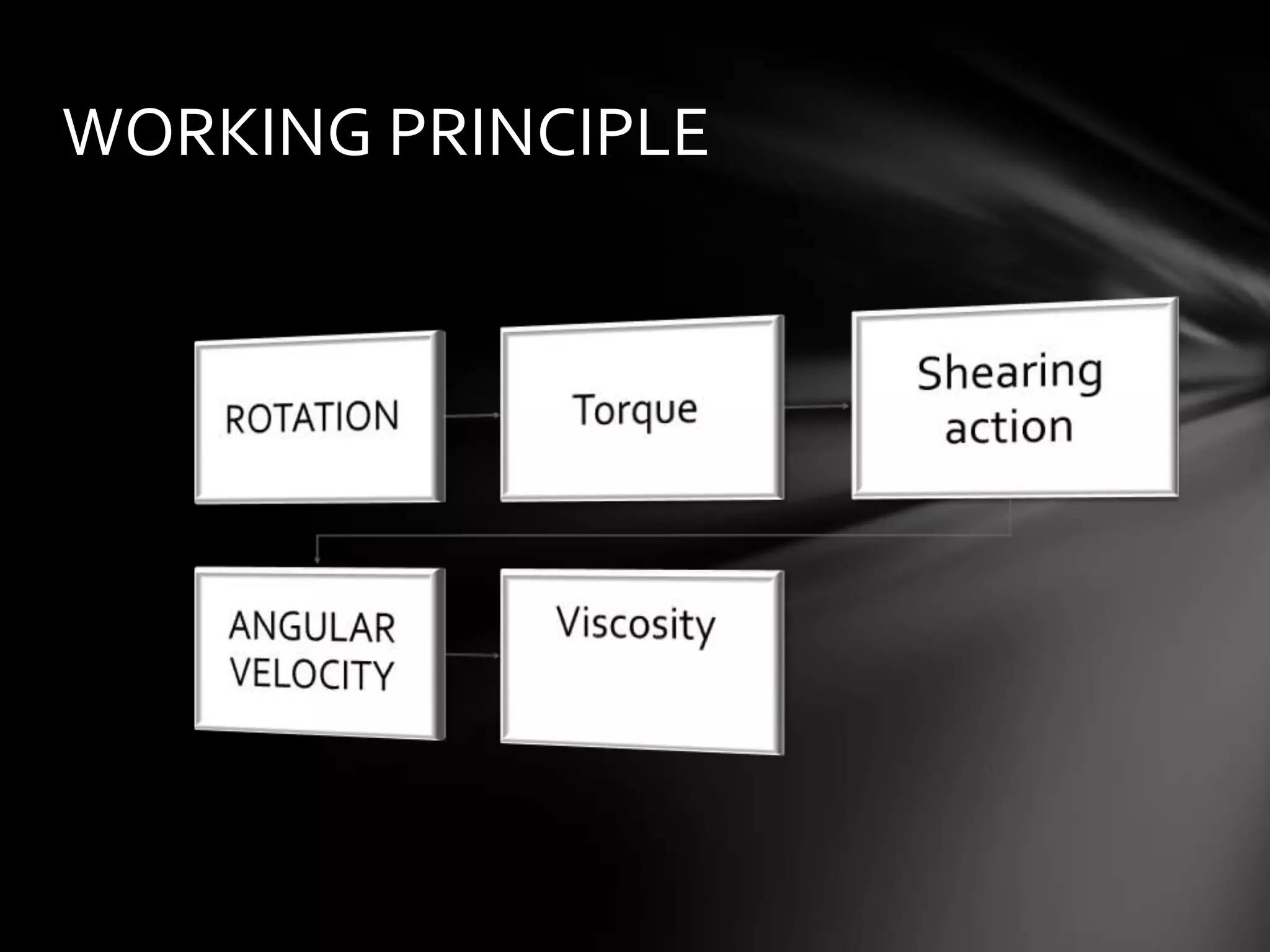
•Working principle
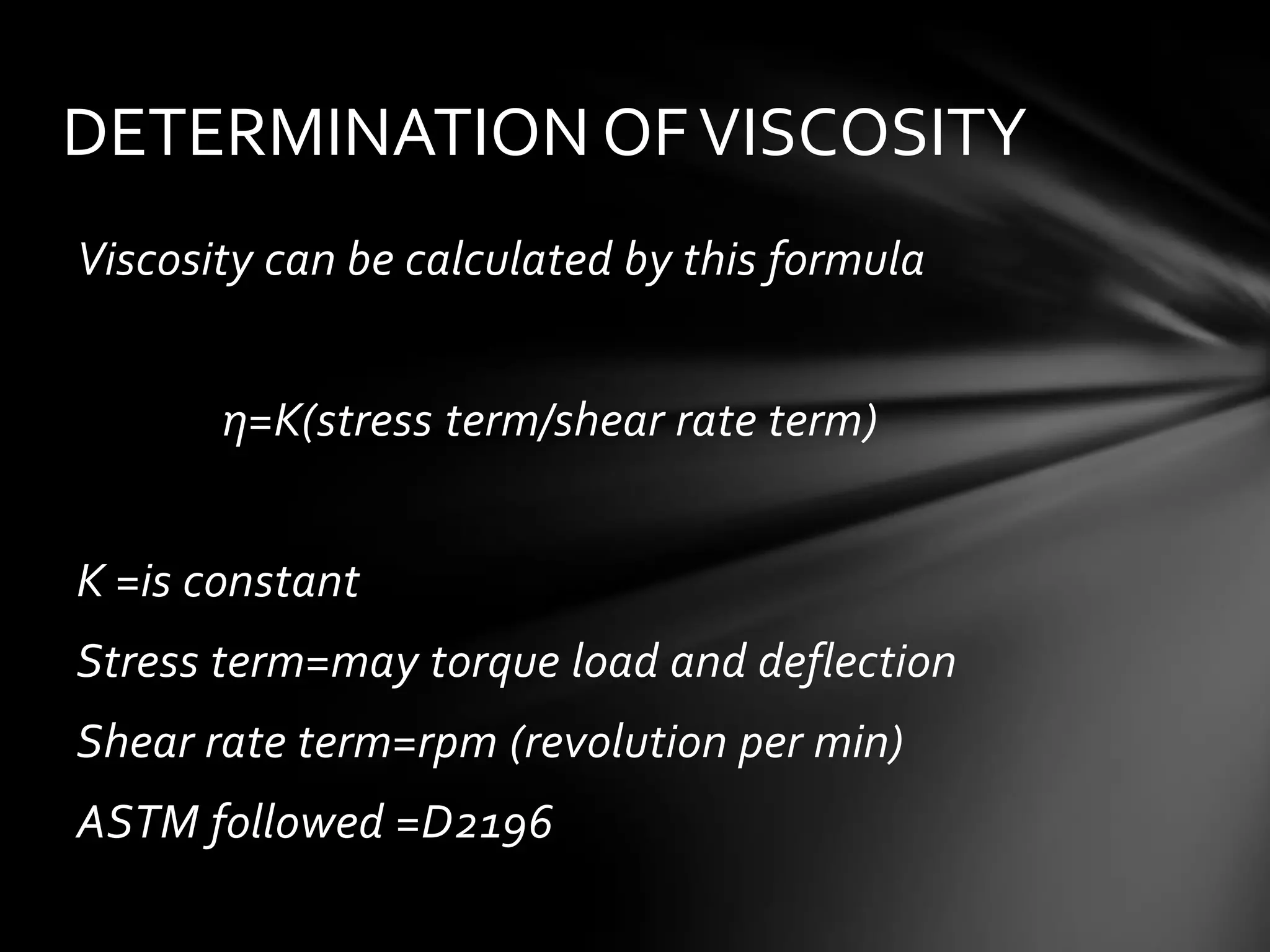
•Determination of viscosity
•Types and their brief introduction and working
•Moving body viscometer
•Types and their brief introduction
Rotational viscometer
What is rotational viscometer?

rotational viscometer is an instrument that is
“

used to find out the viscosity of a fluid by using
action of rotation ”
construction
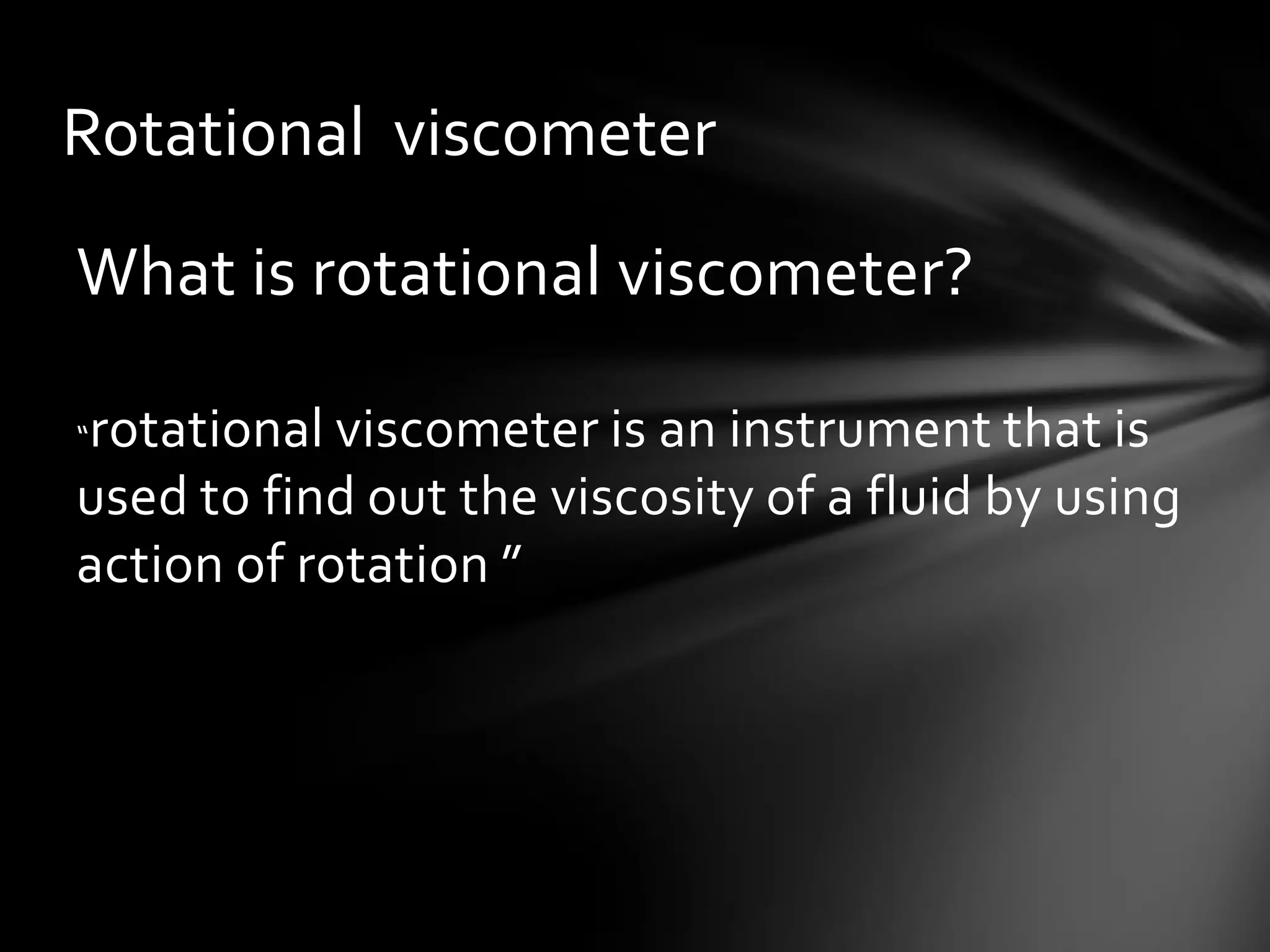
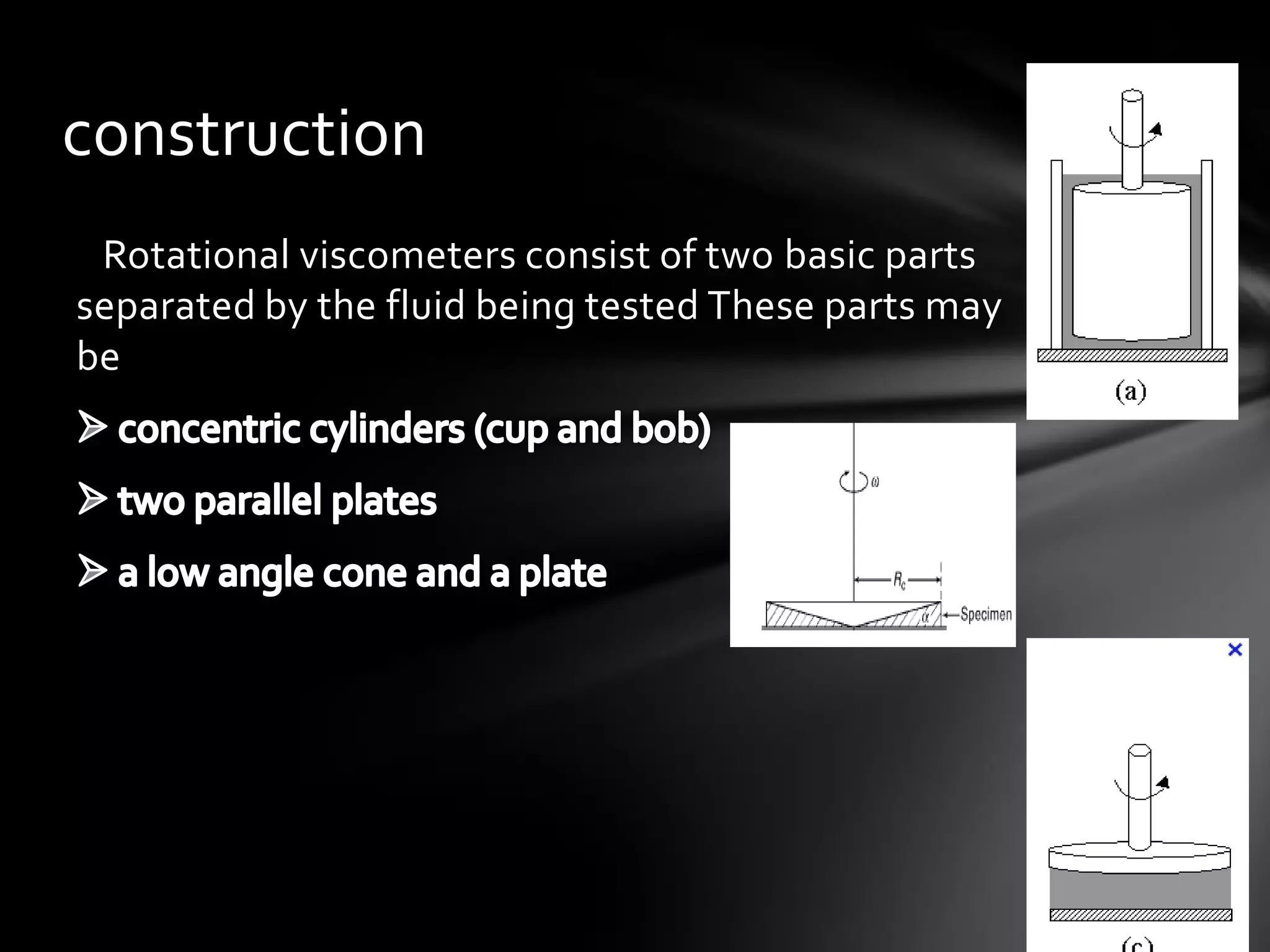
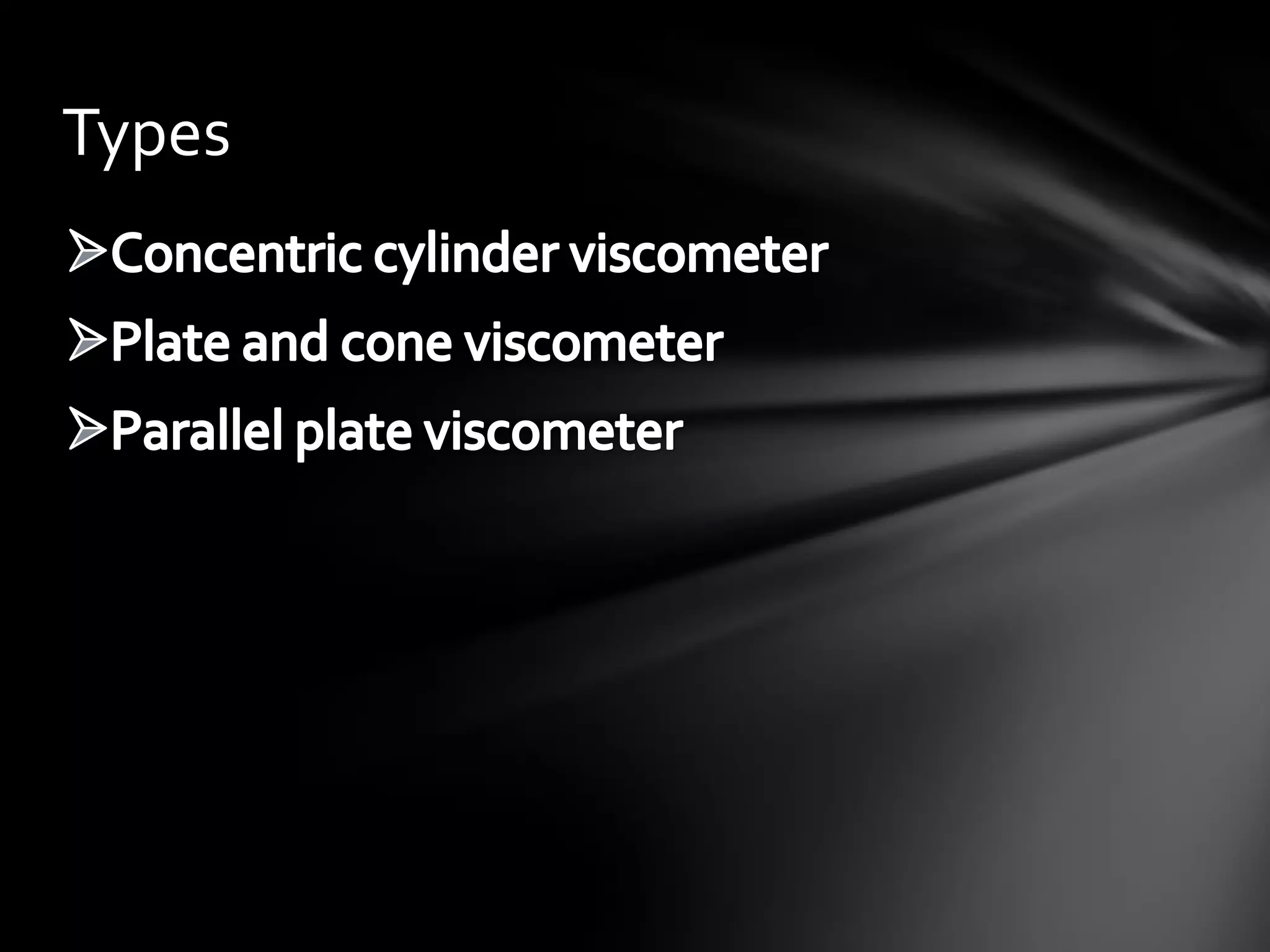
 Rotational viscometers consist of two basic parts
separated by the fluid being tested These parts may
be
WORKING PRINCIPLE
DETERMINATION OF VISCOSITY
Viscosity can be calculated by this formula


       η=K(stress term/shear rate term)


K =is constant
Stress term=may torque load and deflection
Shear rate term=rpm (revolution per min)
ASTM followed =D2196
Types
Concentric cylinder viscometer
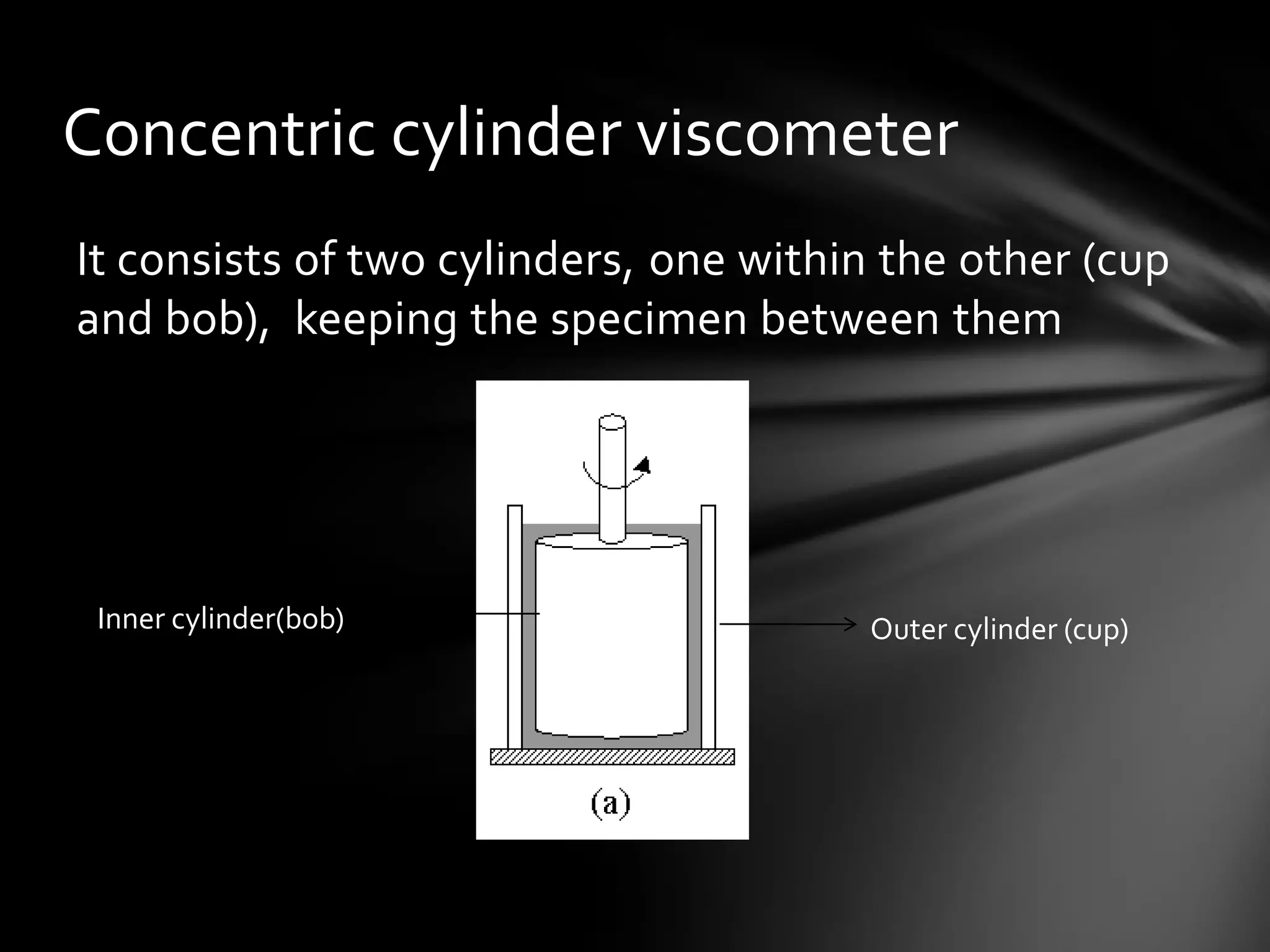
It consists of two cylinders, one within the other (cup
and bob), keeping the specimen between them


 Inner cylinder(bob)                   Outer cylinder (cup)
Concentric cylinder
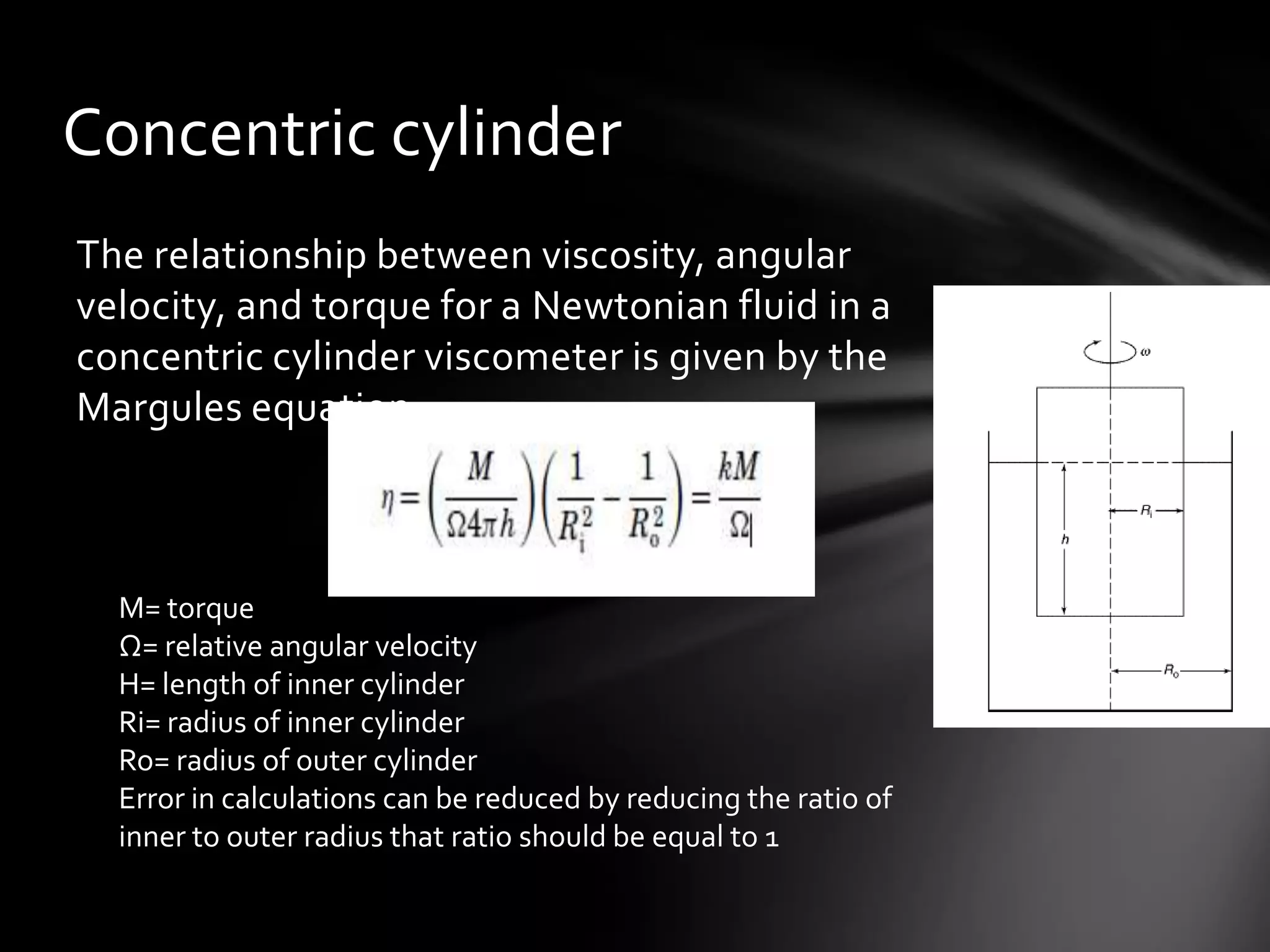
The relationship between viscosity, angular
velocity, and torque for a Newtonian fluid in a
concentric cylinder viscometer is given by the
Margules equation


  M= torque
  Ω= relative angular velocity
  H= length of inner cylinder
  Ri= radius of inner cylinder
  Ro= radius of outer cylinder
  Error in calculations can be reduced by reducing the ratio of
  inner to outer radius that ratio should be equal to 1
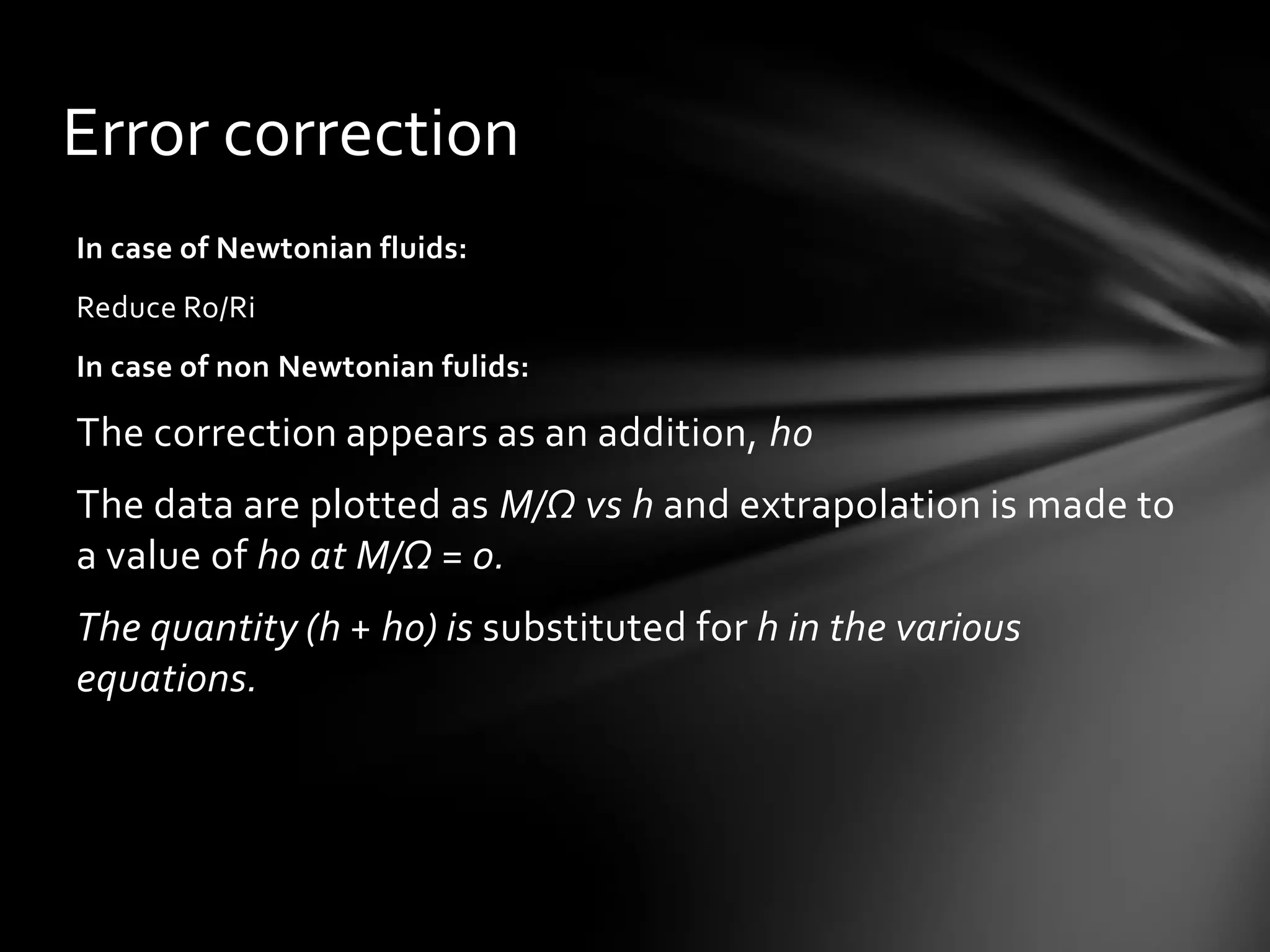
Error correction
In case of Newtonian fluids:
Reduce Ro/Ri
In case of non Newtonian fulids:

The correction appears as an addition, ho
The data are plotted as M/Ω vs h and extrapolation is made to
a value of ho at M/Ω = 0.
The quantity (h + ho) is substituted for h in the various
equations.
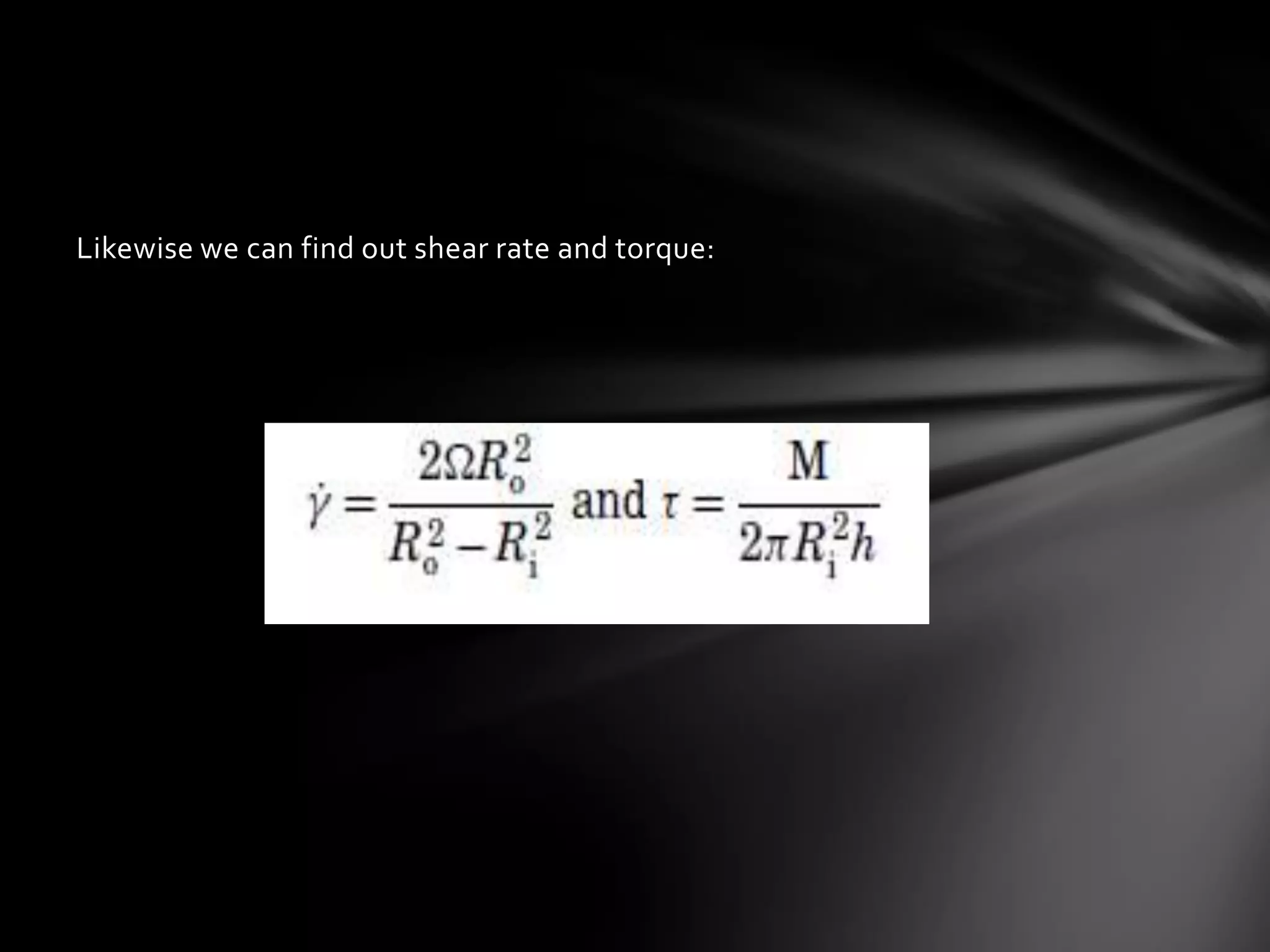
Likewise we can find out shear rate and torque:
Cone-plate viscometer
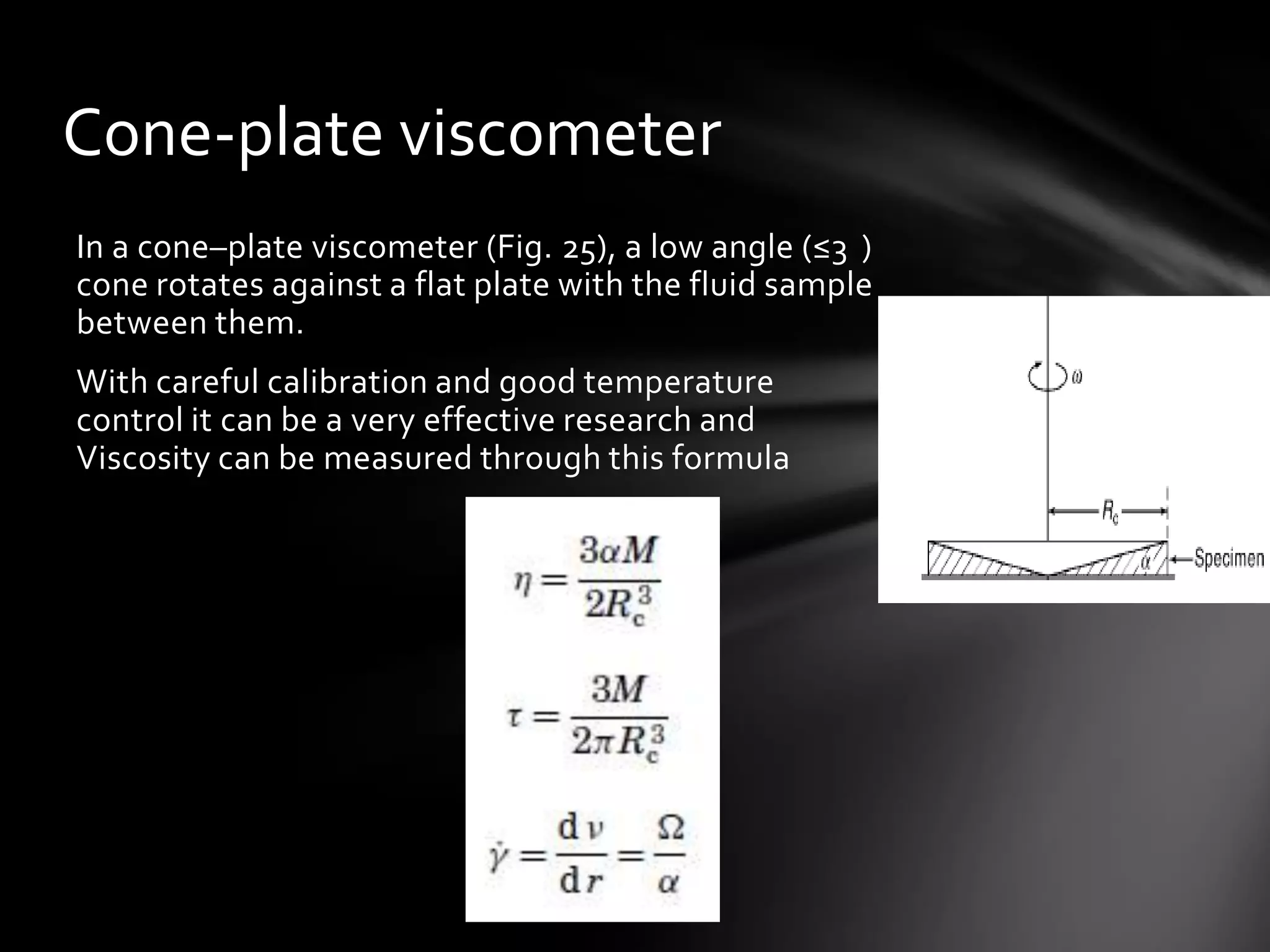
In a cone–plate viscometer (Fig. 25), a low angle (≤3 )
cone rotates against a flat plate with the fluid sample
between them.
With careful calibration and good temperature
control it can be a very effective research and
Viscosity can be measured through this formula
Parallel plate viscometer
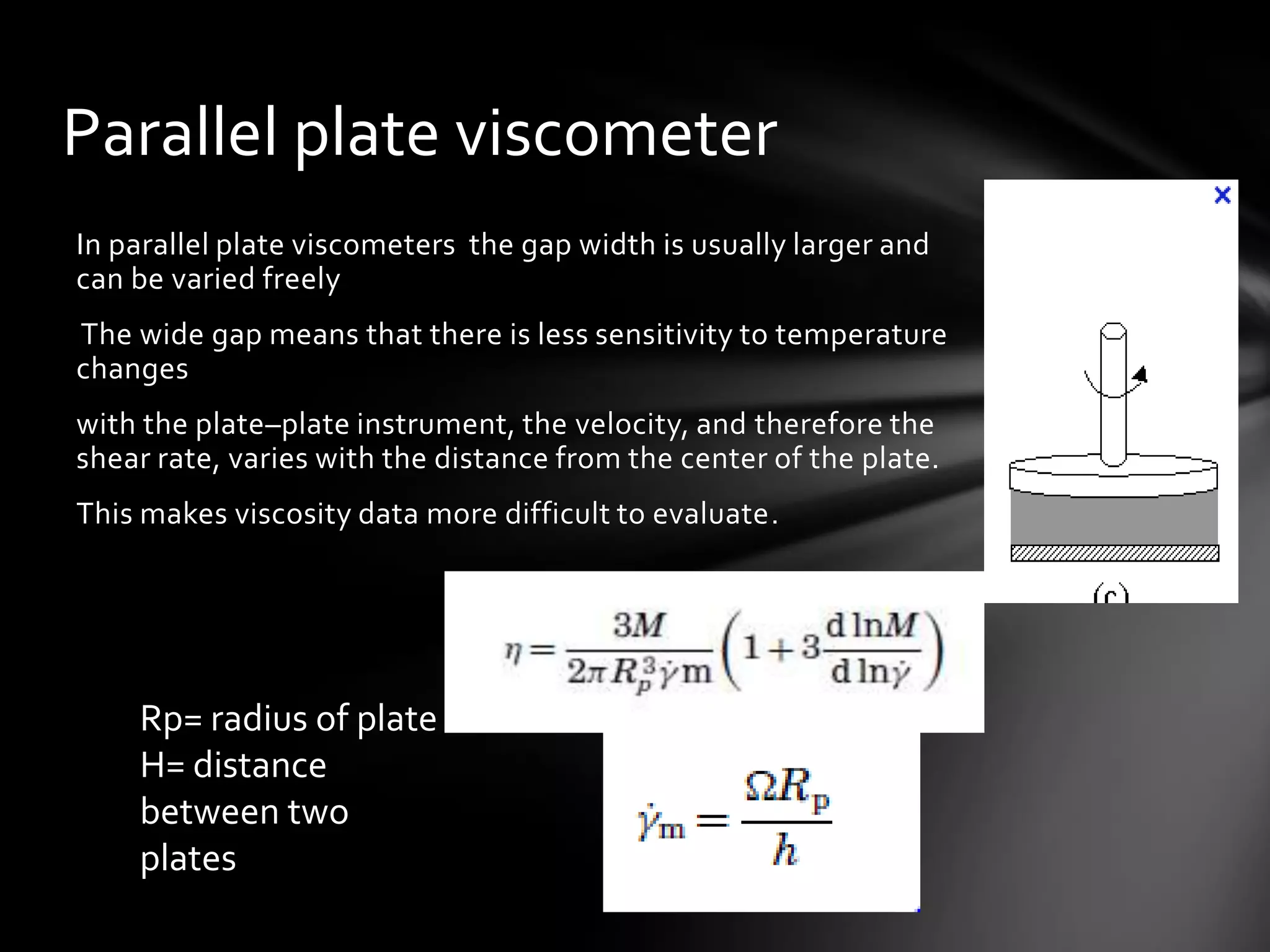
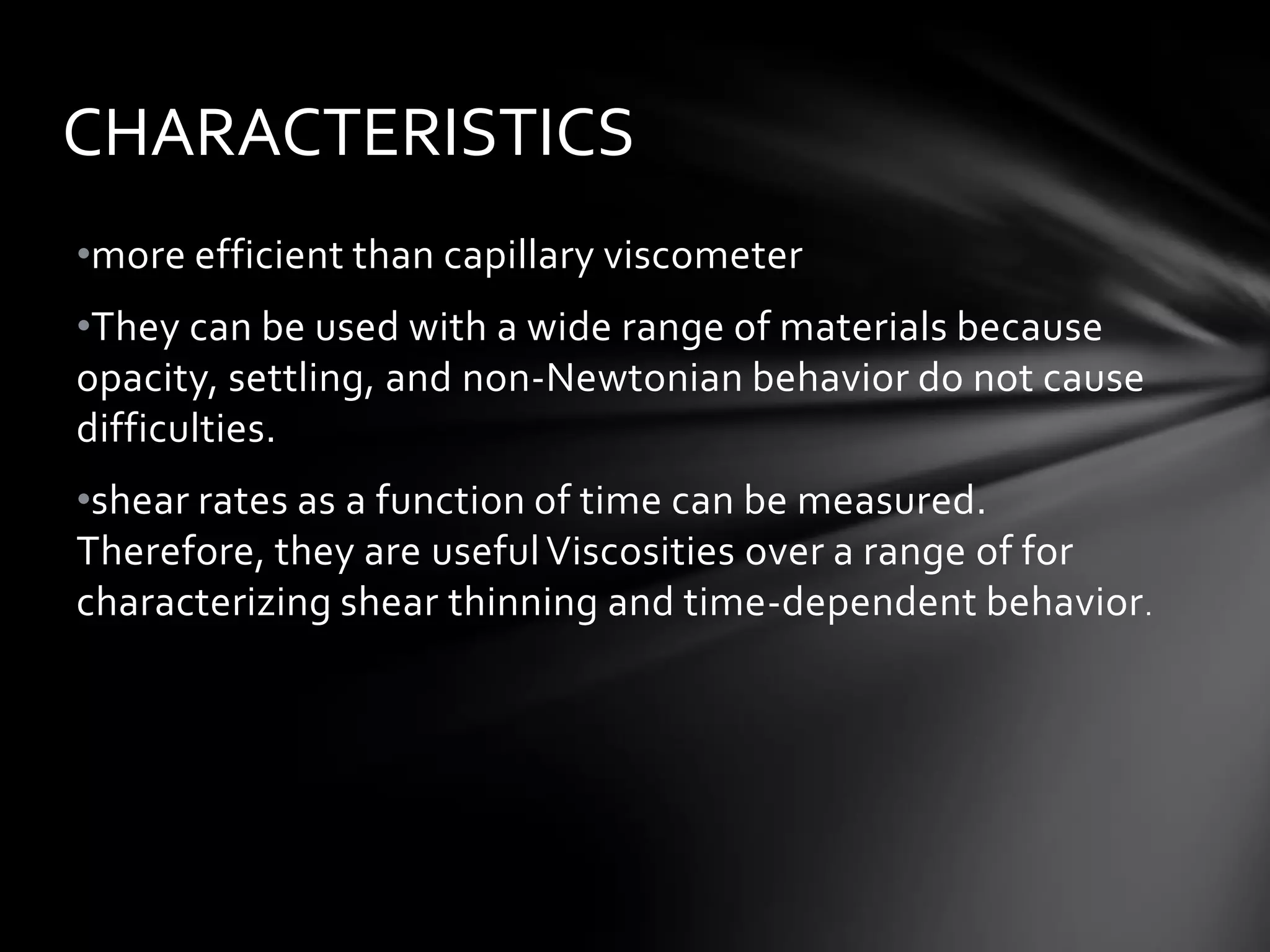
In parallel plate viscometers the gap width is usually larger and
can be varied freely
The wide gap means that there is less sensitivity to temperature
changes
with the plate–plate instrument, the velocity, and therefore the
shear rate, varies with the distance from the center of the plate.
This makes viscosity data more difficult to evaluate.


    Rp= radius of plate
    H= distance
    between two
    plates
CHARACTERISTICS
•more efficient than capillary viscometer
•They can be used with a wide range of materials because
opacity, settling, and non-Newtonian behavior do not cause
difficulties.
•shear rates as a function of time can be measured.
Therefore, they are useful Viscosities over a range of for
characterizing shear thinning and time-dependent behavior .
Moving body viscometer
In moving body viscometers, the motion of a
ball, bubble, plate, needle, or rod through a material is
monitored.
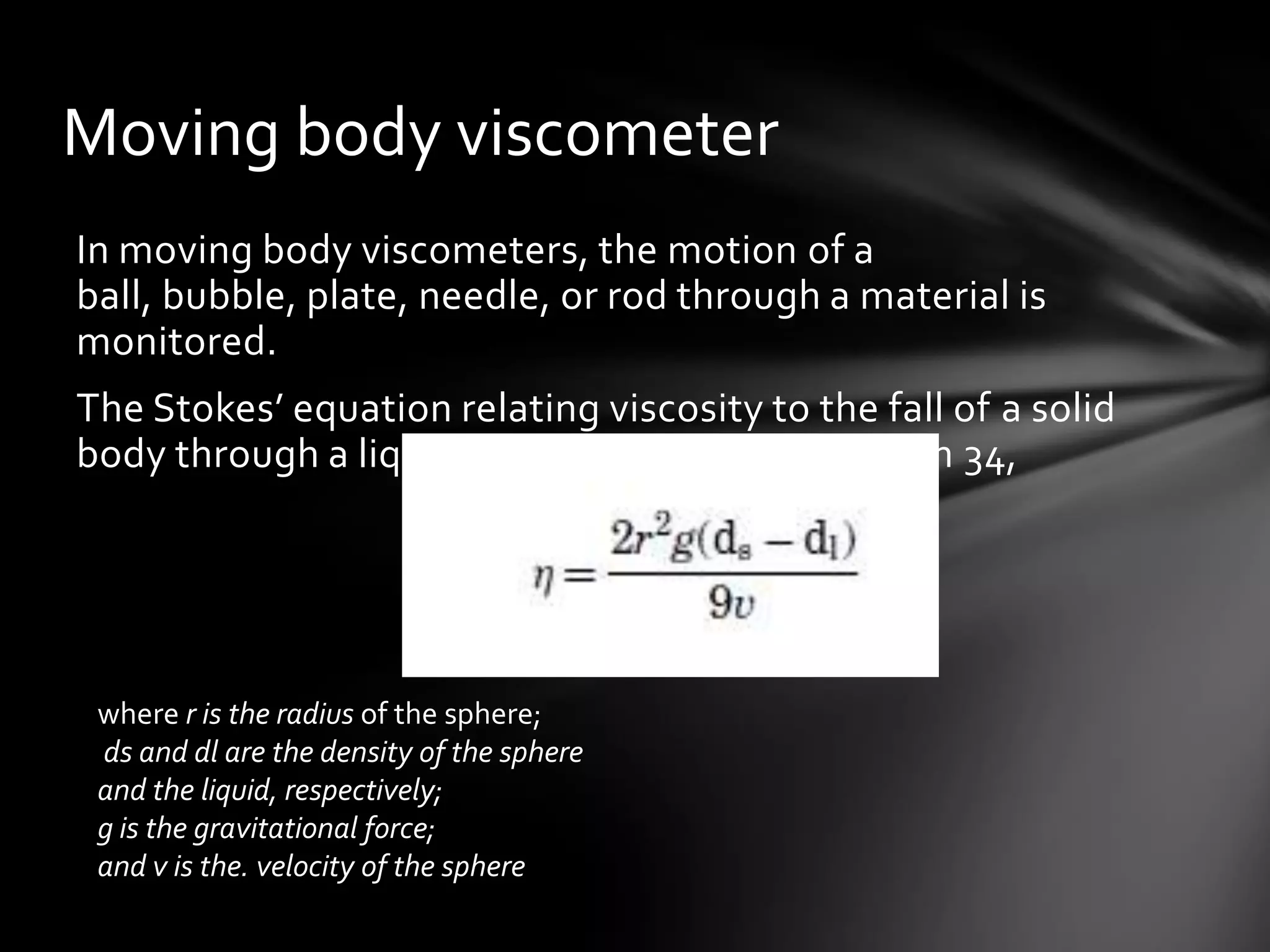
The Stokes’ equation relating viscosity to the fall of a solid
body through a liquid may be written as equation 34,


 where r is the radius of the sphere;
 ds and dl are the density of the sphere
 and the liquid, respectively;
 g is the gravitational force;
 and v is the. velocity of the sphere
Ball viscometer
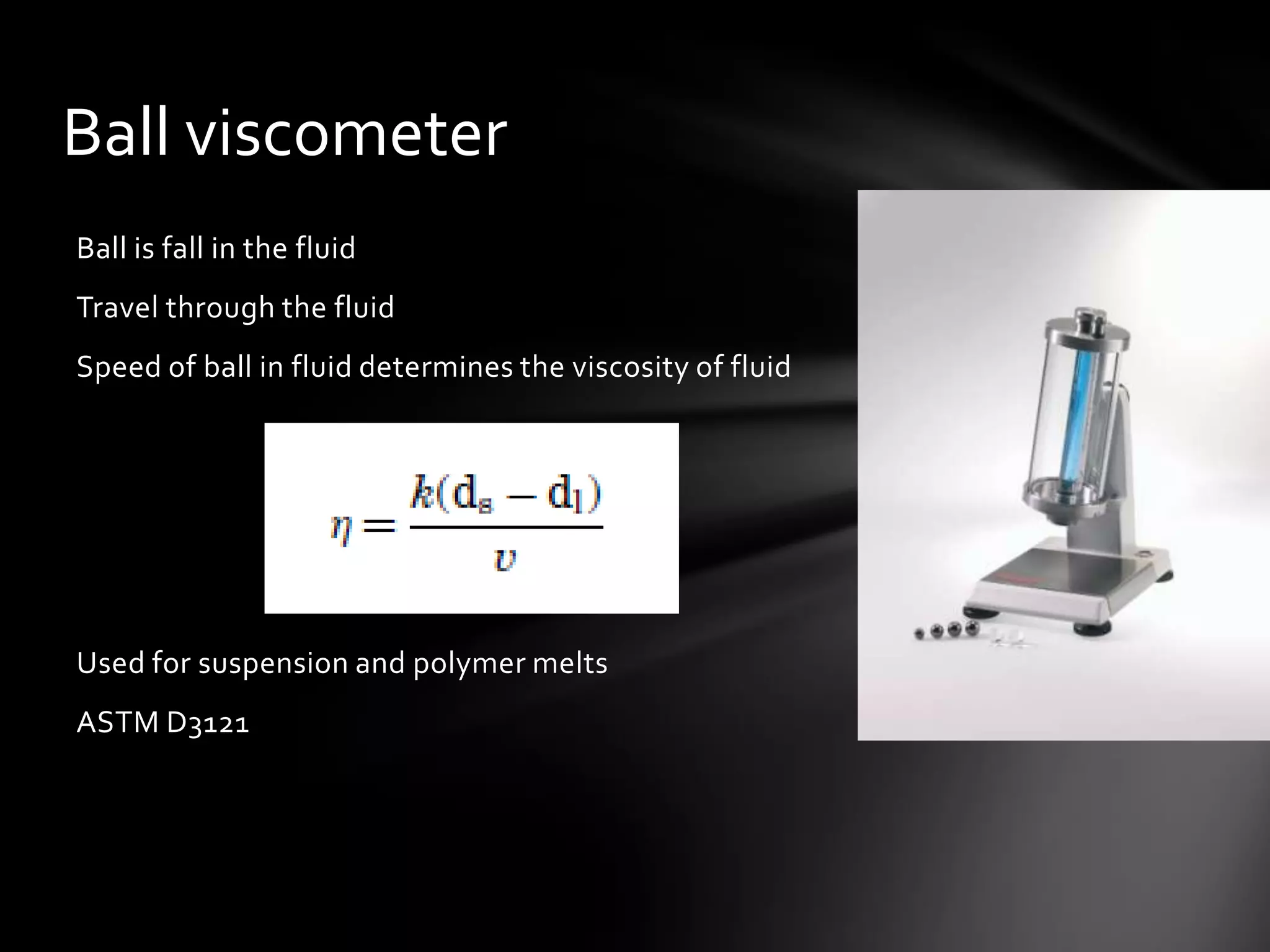
Ball is fall in the fluid
Travel through the fluid
Speed of ball in fluid determines the viscosity of fluid


Used for suspension and polymer melts
ASTM D3121
Rod viscometer
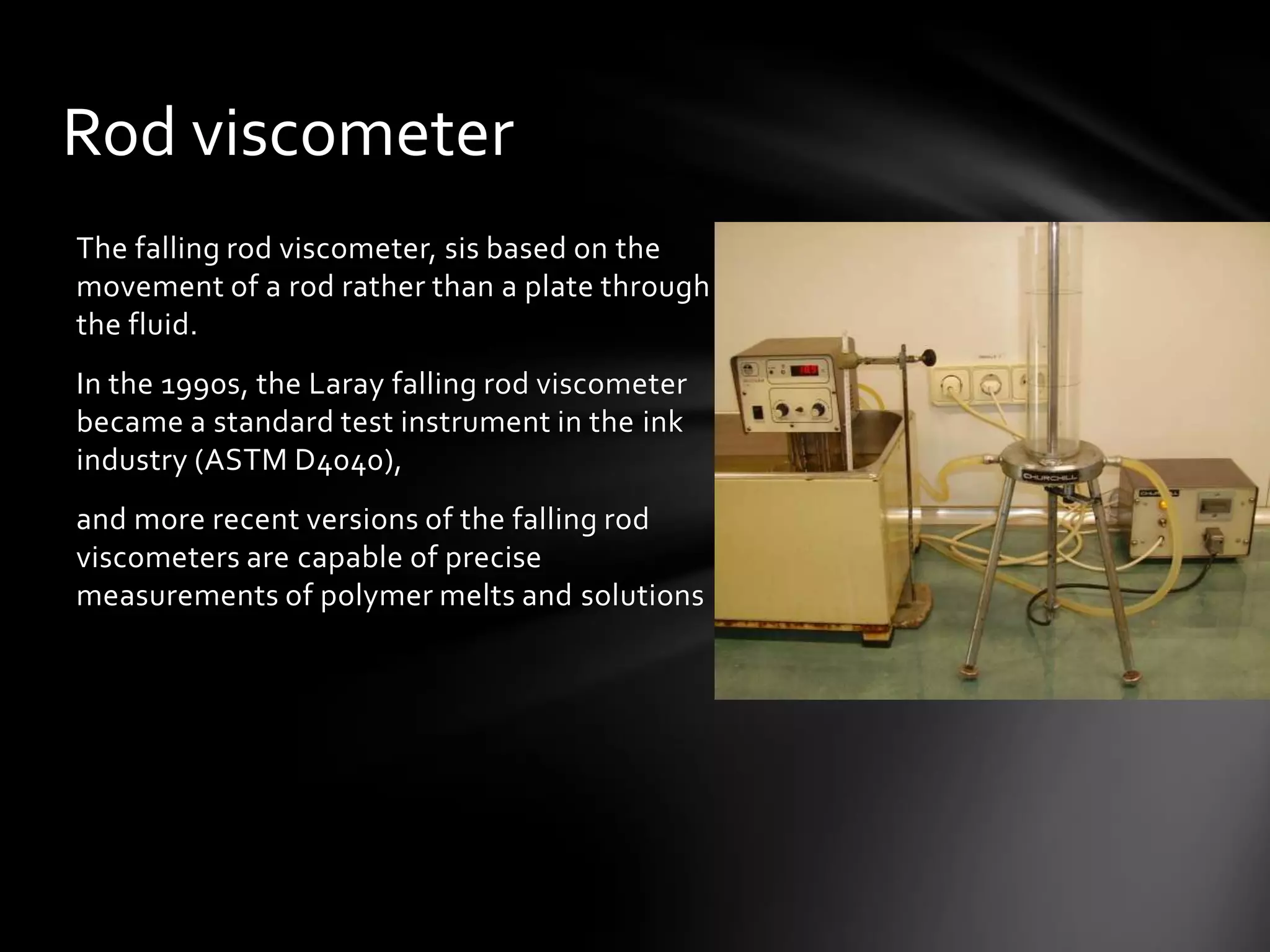
The falling rod viscometer, sis based on the
movement of a rod rather than a plate through
the fluid.
In the 1990s, the Laray falling rod viscometer
became a standard test instrument in the ink
industry (ASTM D4040),
and more recent versions of the falling rod
viscometers are capable of precise
measurements of polymer melts and solutions
Needle viscometer
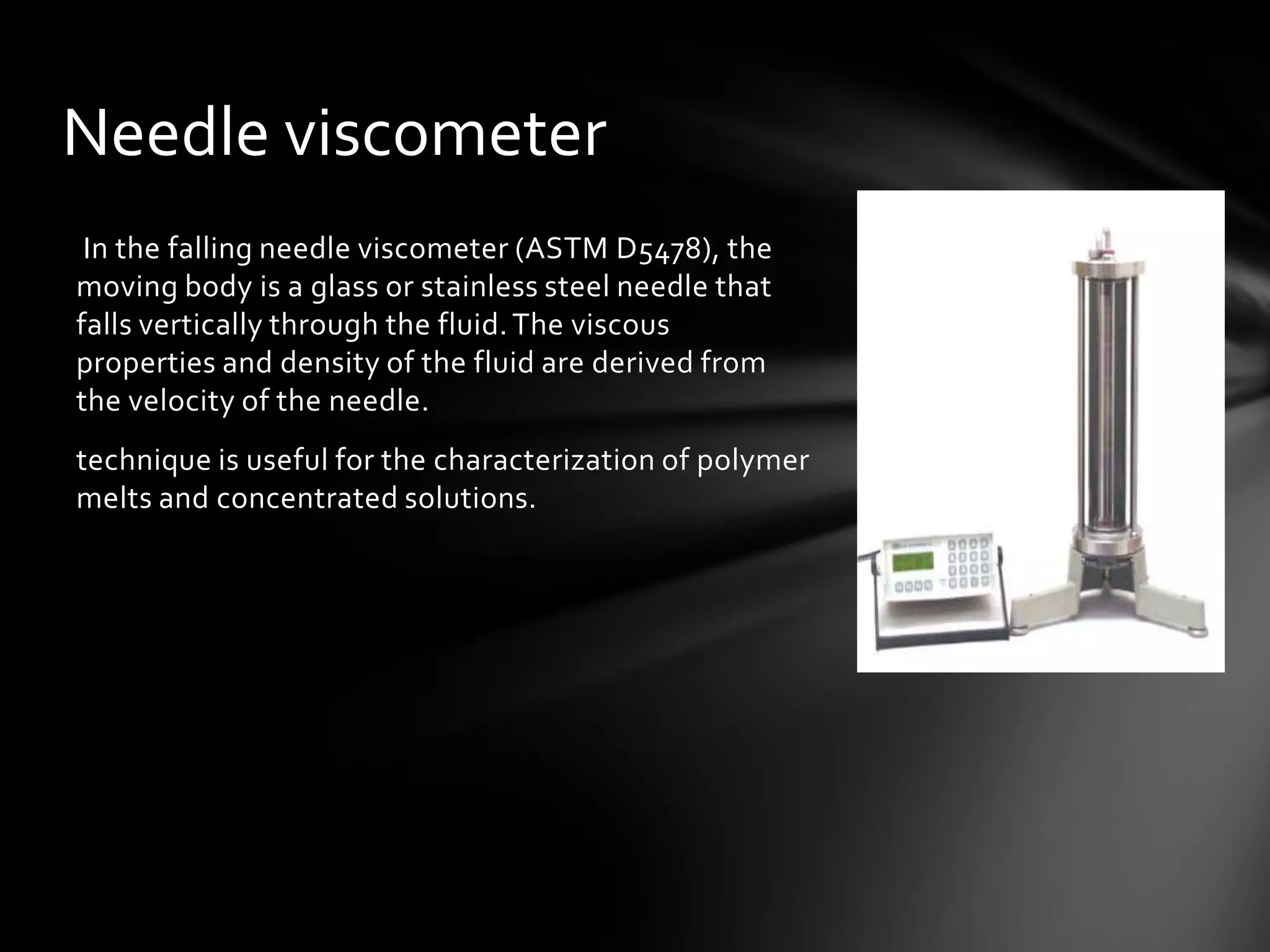
 In the falling needle viscometer (ASTM D5478), the
moving body is a glass or stainless steel needle that
falls vertically through the fluid. The viscous
properties and density of the fluid are derived from
the velocity of the needle.
technique is useful for the characterization of polymer
melts and concentrated solutions.
• A rheometer is an instrument for measuring the
  rheological properties:
1. It can apply a deformation mode to the material and
measure the subsequent force generated.
2. It can apply a force mode to a material and measure
the subsequent deformation.


• Rheometers used for determining the material
  functions of thermoplastic melts can be divided into
  two broad categories: 1. rotational type and
   2. capillary type
ROTATIONAL VISCOMETERS
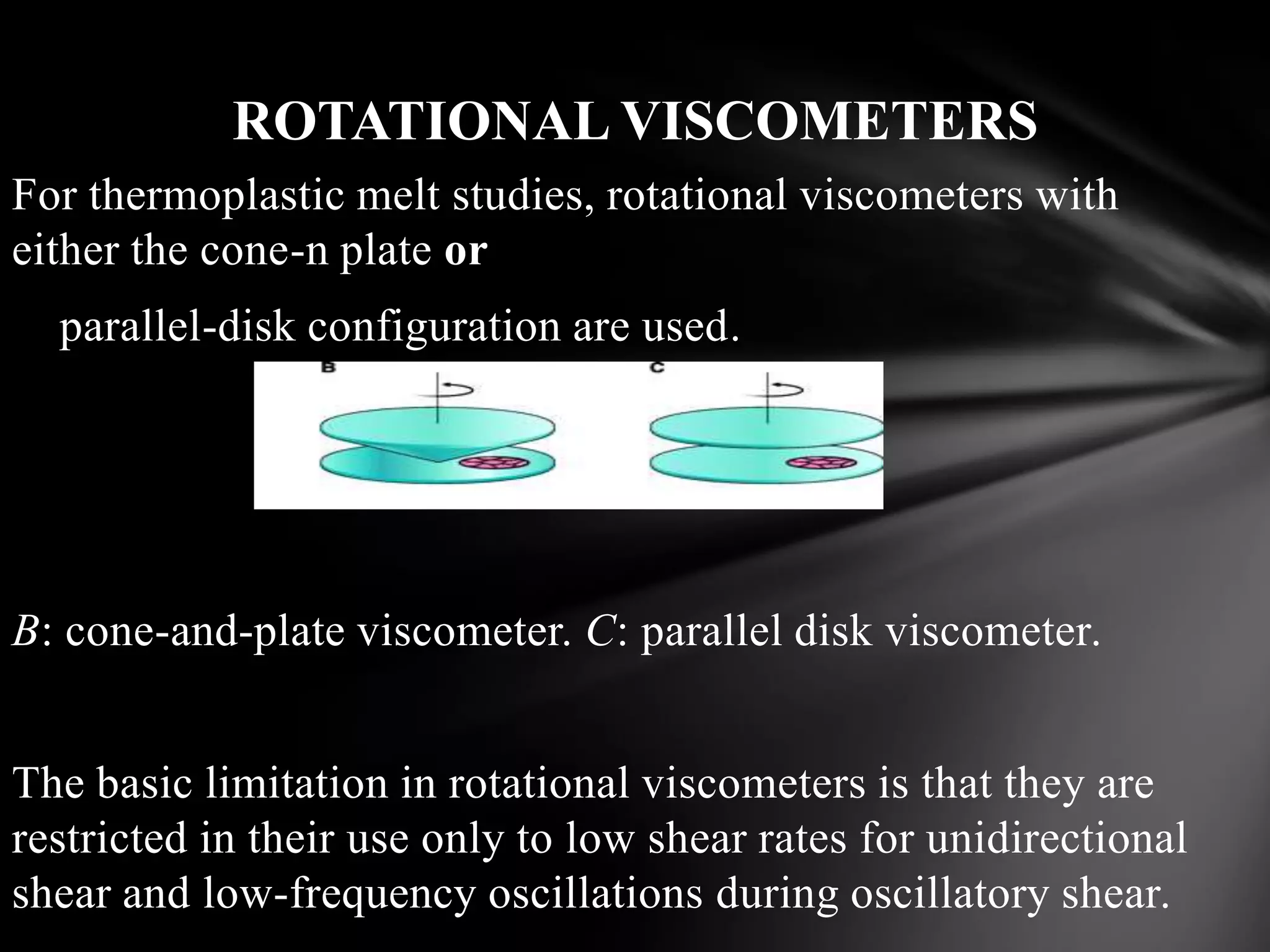
For thermoplastic melt studies, rotational viscometers with
either the cone-n plate or
  parallel-disk configuration are used.


B: cone-and-plate viscometer. C: parallel disk viscometer.


The basic limitation in rotational viscometers is that they are
restricted in their use only to low shear rates for unidirectional
shear and low-frequency oscillations during oscillatory shear.
1. CONE-N-PLATE VISCOMETER
The sample, is trapped between the circular conical disk at the bottom
and the circular horizontal plate at the top. The cone is connected to
the drive motor which rotates the disk at various constant
speeds, whereas the plate is connected to the torque-measuring device
in order to evaluate the resistance of the sample to the motion.


It can be used to measure shear rate, shear stress, normal stress
difference, oscillatory shear .
2. PARALLEL-DISK VISCOMETER
The parallel-disk viscometer used for measuring the shear
stress and normal stress difference of molten
thermoplastics is similar in principle to the cone-n plate
viscometer except that the lower cone is replaced by a
smooth circular disk.


This type of viscometer was initially developed for
measuring the rheological properties of rubber. It can be
used for polymer melts of extremely high viscosity and
elasticity.
CAPILLARY RHEOMETERS
They are used for determining the rheological properties of polymer
melts.

1. Constant Plunger Speed Circular Orifice Capillary
   Rheometer:

It extrudes the polymer melt through a capillary with a circular
orifice using a plunger at constant speeds.

The major advantage of this type of capillary rheometer is that
higher-shear rate levels than those attainable in rotational
viscometers can be achieved.
2. Constant Plunger Speed Slit Orifice Capillary
   Rheometer:


This rheometer has a slit orifice cross section rather than a
circular one.


 It extrudes the polymer melt through a capillary with a slit
orifice using a plunger at constant speeds
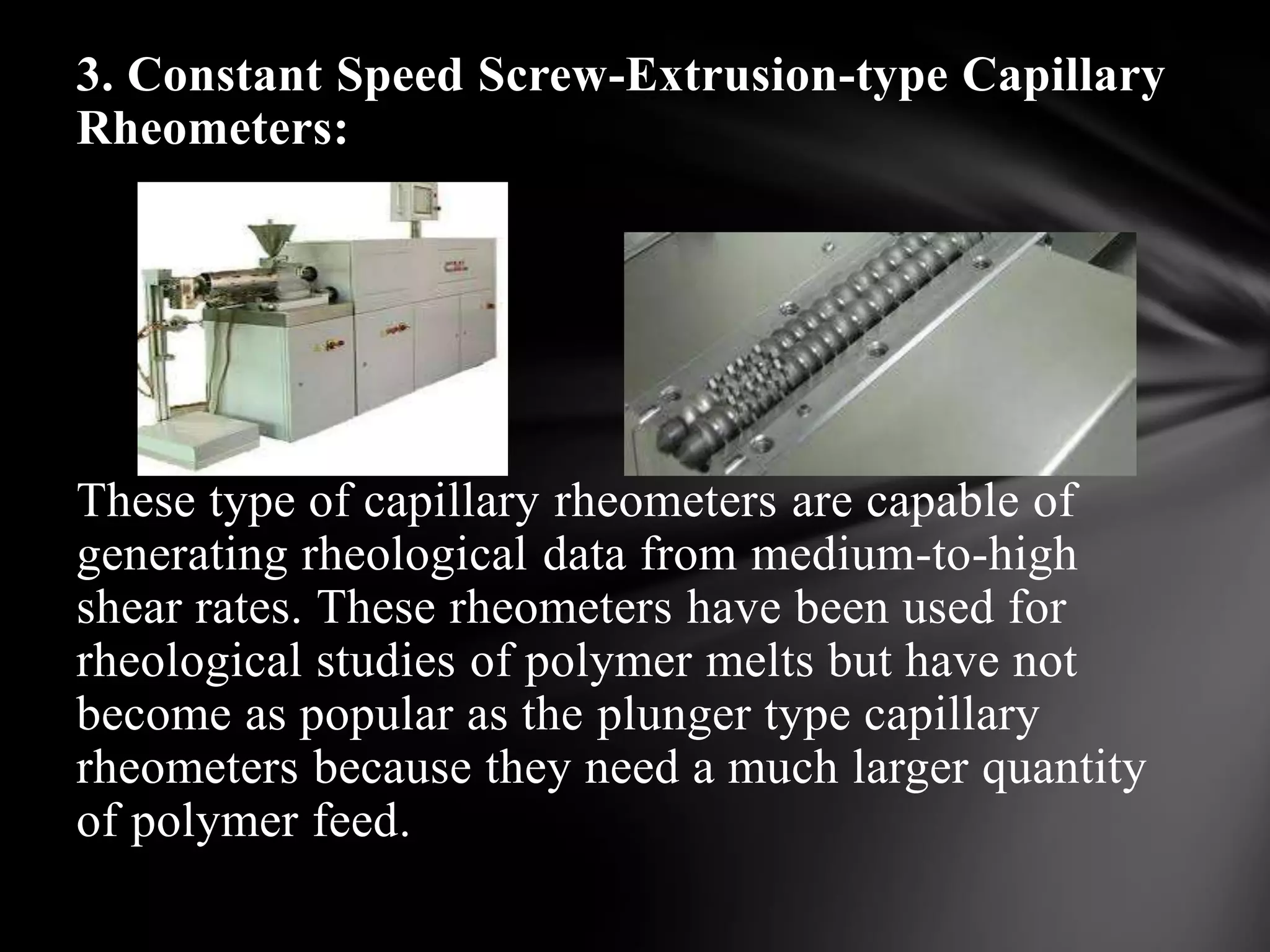
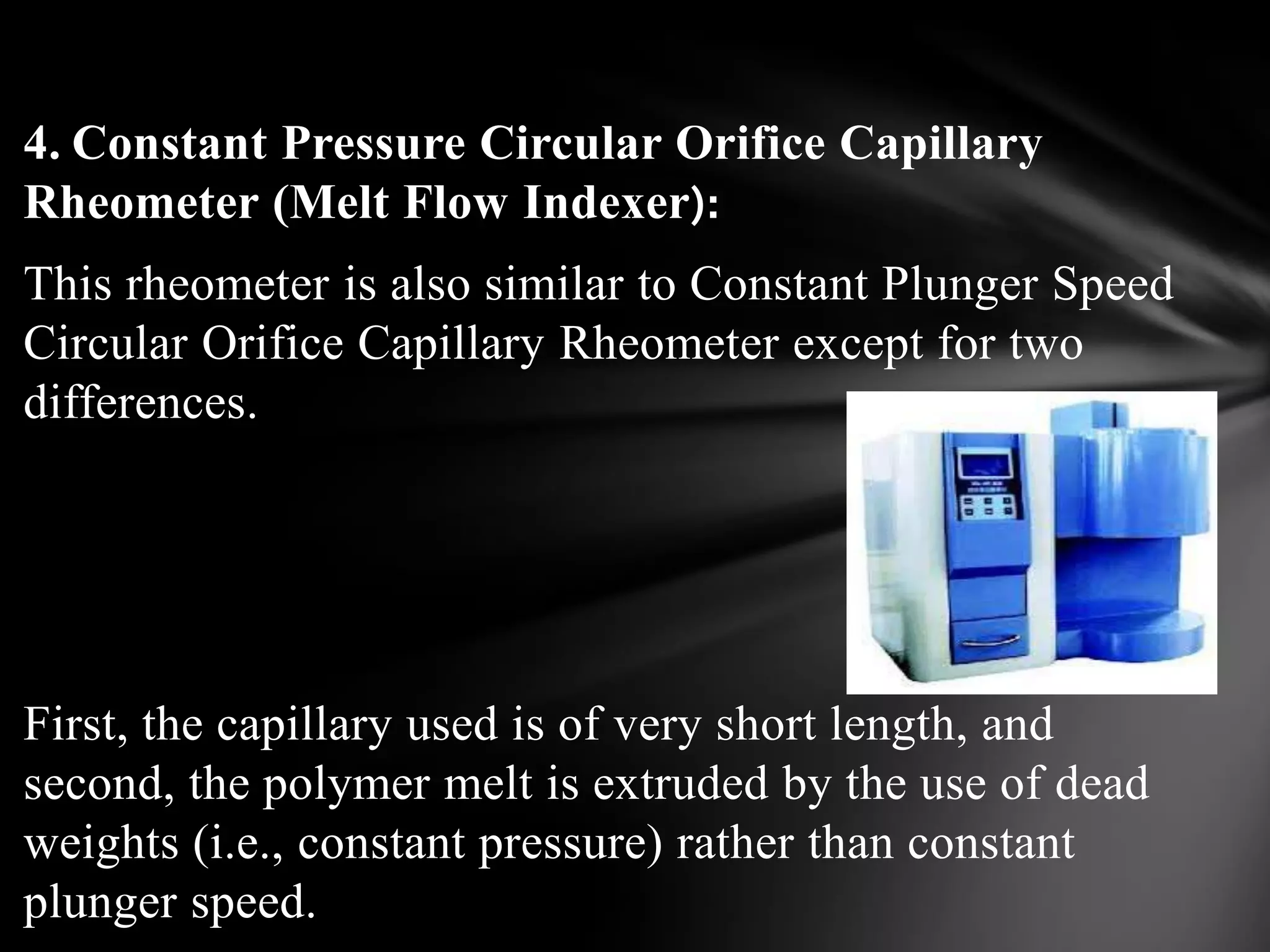
3. Constant Speed Screw-Extrusion-type Capillary
Rheometers:


These type of capillary rheometers are capable of
generating rheological data from medium-to-high
shear rates. These rheometers have been used for
rheological studies of polymer melts but have not
become as popular as the plunger type capillary
rheometers because they need a much larger quantity
of polymer feed.
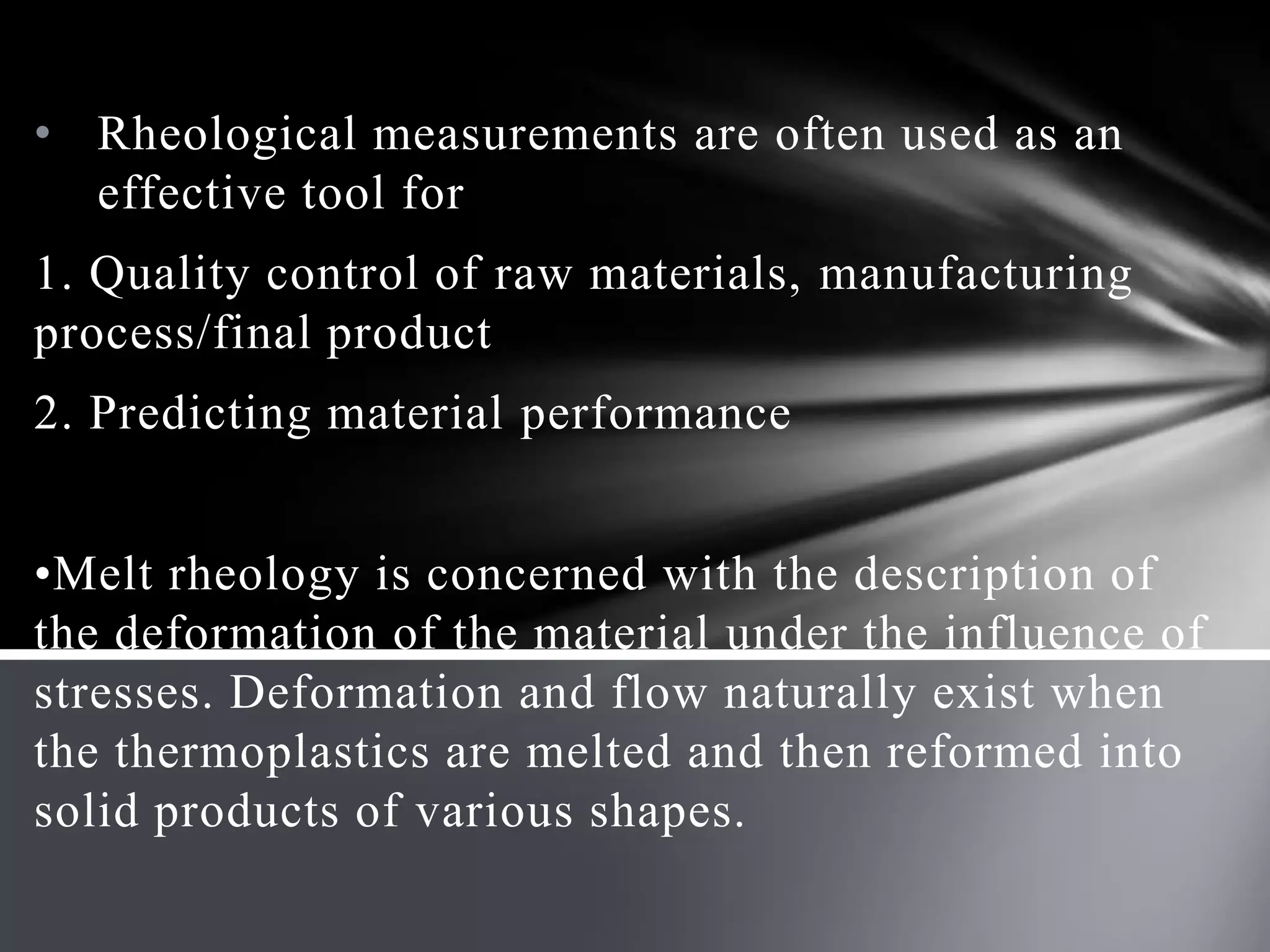
4. Constant Pressure Circular Orifice Capillary
Rheometer (Melt Flow Indexer):
This rheometer is also similar to Constant Plunger Speed
Circular Orifice Capillary Rheometer except for two
differences.


First, the capillary used is of very short length, and
second, the polymer melt is extruded by the use of dead
weights (i.e., constant pressure) rather than constant
plunger speed.
• Rheological measurements are often used as an
  effective tool for
1. Quality control of raw materials, manufacturing
process/final product
2. Predicting material performance


•Melt rheology is concerned with the description of
the deformation of the material under the influence of
stresses. Deformation and flow naturally exist when
the thermoplastics are melted and then reformed into
solid products of various shapes.
• All polymer melts are viscoelastic materials; that is, their
response to external load lies in varying extent between
that of a viscous liquid and an elastic solid.


• A polymer melt represents a cluster of
entangled, flexible strings of varying lengths. It is these
entanglements that provide the resistance to deformation
and, therefore, with increasing molecular weight, the melt
viscosity goes up, processibility worsens although, of
course, mechanical properties improve.

Rheometer

  • 1.
    Presented to: SirSajid Naseem
  • 2.
  • 4.
    Scientists are stillconfused that how to define rheology Rheology=study of deformation and flow
  • 5.
    What is rheologyto scientists? Rheology is Yield stresses Viscoelastic effects Memory effects Shear thickening and shear thinning
  • 6.
    Rheological measurements Deformation isthe relative displacement of points of a body. It can be divided into two types: flow and elasticity. Flow is irreversible deformation; when the stress is removed, the material does not revert to its original form. This means that work is converted to heat. Elasticity is reversible deformation; the deformed body recovers its original shape, and the applied work is largely recoverable. Viscoelastic materials show both flow and elasticity.
  • 7.
    Flow classification Flows areof following main types  Steady simple shear flow  Unsteady simple shear flow  Extensional flow
  • 8.
    Steady simple shearflow Shear flow is a flow which occurs when the fluid is placed between the two plates and the two plates move at different velocities The viscosity function η,the primary and secondary normal stress coefficients ψ 1 and ψ 2 respectively are the three viscometric functions which completely determine the state of stress in any rheologically steady shear flow.
  • 9.
    Unsteady simple shearflow Unsteady simple shear flow occurs when the stresses are time dependent Small amplitude oscillatory flow, stress growth, stress relaxation, creep and constrained flow are some examples of such flows
  • 10.
    Extensional Flow There isno shear flow in this type. The volume of the fluid remains constant in this type of flow It occurs when the material is longitudinally stretched as for example in fiber spinning
  • 11.
    Flow behaviour The viscoelasticnature of the polymers whether filled or unfilled bring them under the category called the non newtonian fluids Newtonian fluids as we know are the fluids which obey the newton’s law of viscosity The simplest example of newtonian fluid is water
  • 16.
    Models for theShear viscosity At low shear rate range the unfilled polymer behave as Newtonian fluids As shear rate increases the viscosity begins to decrease showing the pseudo plastic behavior.Under normal conditions the high shear rate regions are neglected and the curve of unfilled polymers become similar to the filled polymers
  • 17.
    Polymer applications Polymer Processing Polymersare used in the construction and a large number of other applications so these are now indispensable In most of the cases the melt processing is been carried out but there are many examples in which processing of solution is also taking place such as in the formation of films and fiber of heat sensitive polymers
  • 18.
  • 19.
  • 20.
    Calculations Calculation of shearstress Calculation of shear rate Calculation of power law parameters Calculation of viscosity Correction of results or baggley correction.
  • 21.
     Dilute polymersolution  Concentrated polymer solution
  • 22.
    Viscosity of dilutepolymer solution Glass capillary tube viscometer
  • 23.
  • 24.
    Intrinsic viscosity Not aviscosity Unit:dl/g Inverse of molecular density
  • 25.
    Viscosity of concentratedpolymer solution Applications: Fiber spinning Film casting Polymer manufacturing process Methods: Capillary viscometer Extrusion rheometer Rotational viscometer
  • 27.
    Rheological Measurements Viscometers areused to measure rheological properties Viscometer is defined as instruments used to measure viscosity They differ on the basis of geometry and shear rates There are three main types Capillary Viscometer Rotational Viscometer Moving Body Viscometer
  • 28.
    Choice of aViscometer There are number of criteria to be kept in mind; Nature of material to be tested  Material’s viscosity Materials elasticity The dependence of viscosity on temperature The degree of accuracy required
  • 29.
    Capillary Viscometer It isthe most oldest and popular way follows Hagen_poiseulle equation i.e. η= πr^4pt/8VL If we are assuming laminar flow and pressure is constant then equation becomes ν = η/ρ They are useful for measuring precise viscosities of dilute polymer solutions They can’t measure absolute viscosities Always measure viscosity relative to a reference liquid
  • 30.
    Design of Capillaryviscometer Three main design of capillary viscometer Ostwald glass capillary viscometer, Cannon–Fenske viscometer, Ubbelohde viscometer Ostwald glass capillary viscometer, It is a u shaped tube with to bulb reservoirs The time of flow of liquid between to etched marks is taken as function of viscosity
  • 31.
    Cannon–Fenske viscometer It isexcellent for general use It consist of long capillary tube Both reservoirs are present on the same vertical axis Ubbelohde viscometer. It is particularly useful for measurement at different concentration It is the modified form of Ostwald viscometer
  • 32.
    Orifice viscometers It isalso known as cup viscometer It is typically a cup with a hole in the bottom The time required for the liquid to flow out is measured to determine viscosity Uses It is used to measure control flow properties in the manufacturing, processing and applications of inks, dyes, paints and lubricating oils
  • 33.
    Limitations It should notbe used for setting product specifications It is only designed for Newtonian fluids It should not be used for thixotropic materials
  • 35.
    CONTENTS •What is rotationalviscometer •Construction •Working principle •Determination of viscosity •Types and their brief introduction and working •Moving body viscometer •Types and their brief introduction
  • 36.
    Rotational viscometer What isrotational viscometer? rotational viscometer is an instrument that is “ used to find out the viscosity of a fluid by using action of rotation ”
  • 37.
    construction Rotational viscometersconsist of two basic parts separated by the fluid being tested These parts may be
  • 38.
  • 39.
    DETERMINATION OF VISCOSITY Viscositycan be calculated by this formula η=K(stress term/shear rate term) K =is constant Stress term=may torque load and deflection Shear rate term=rpm (revolution per min) ASTM followed =D2196
  • 40.
  • 41.
    Concentric cylinder viscometer Itconsists of two cylinders, one within the other (cup and bob), keeping the specimen between them Inner cylinder(bob) Outer cylinder (cup)
  • 42.
    Concentric cylinder The relationshipbetween viscosity, angular velocity, and torque for a Newtonian fluid in a concentric cylinder viscometer is given by the Margules equation M= torque Ω= relative angular velocity H= length of inner cylinder Ri= radius of inner cylinder Ro= radius of outer cylinder Error in calculations can be reduced by reducing the ratio of inner to outer radius that ratio should be equal to 1
  • 43.
    Error correction In caseof Newtonian fluids: Reduce Ro/Ri In case of non Newtonian fulids: The correction appears as an addition, ho The data are plotted as M/Ω vs h and extrapolation is made to a value of ho at M/Ω = 0. The quantity (h + ho) is substituted for h in the various equations.
  • 44.
    Likewise we canfind out shear rate and torque:
  • 45.
    Cone-plate viscometer In acone–plate viscometer (Fig. 25), a low angle (≤3 ) cone rotates against a flat plate with the fluid sample between them. With careful calibration and good temperature control it can be a very effective research and Viscosity can be measured through this formula
  • 46.
    Parallel plate viscometer Inparallel plate viscometers the gap width is usually larger and can be varied freely The wide gap means that there is less sensitivity to temperature changes with the plate–plate instrument, the velocity, and therefore the shear rate, varies with the distance from the center of the plate. This makes viscosity data more difficult to evaluate. Rp= radius of plate H= distance between two plates
  • 47.
    CHARACTERISTICS •more efficient thancapillary viscometer •They can be used with a wide range of materials because opacity, settling, and non-Newtonian behavior do not cause difficulties. •shear rates as a function of time can be measured. Therefore, they are useful Viscosities over a range of for characterizing shear thinning and time-dependent behavior .
  • 48.
    Moving body viscometer Inmoving body viscometers, the motion of a ball, bubble, plate, needle, or rod through a material is monitored. The Stokes’ equation relating viscosity to the fall of a solid body through a liquid may be written as equation 34, where r is the radius of the sphere; ds and dl are the density of the sphere and the liquid, respectively; g is the gravitational force; and v is the. velocity of the sphere
  • 49.
    Ball viscometer Ball isfall in the fluid Travel through the fluid Speed of ball in fluid determines the viscosity of fluid Used for suspension and polymer melts ASTM D3121
  • 50.
    Rod viscometer The fallingrod viscometer, sis based on the movement of a rod rather than a plate through the fluid. In the 1990s, the Laray falling rod viscometer became a standard test instrument in the ink industry (ASTM D4040), and more recent versions of the falling rod viscometers are capable of precise measurements of polymer melts and solutions
  • 51.
    Needle viscometer Inthe falling needle viscometer (ASTM D5478), the moving body is a glass or stainless steel needle that falls vertically through the fluid. The viscous properties and density of the fluid are derived from the velocity of the needle. technique is useful for the characterization of polymer melts and concentrated solutions.
  • 52.
    • A rheometeris an instrument for measuring the rheological properties: 1. It can apply a deformation mode to the material and measure the subsequent force generated. 2. It can apply a force mode to a material and measure the subsequent deformation. • Rheometers used for determining the material functions of thermoplastic melts can be divided into two broad categories: 1. rotational type and 2. capillary type
  • 53.
    ROTATIONAL VISCOMETERS For thermoplasticmelt studies, rotational viscometers with either the cone-n plate or parallel-disk configuration are used. B: cone-and-plate viscometer. C: parallel disk viscometer. The basic limitation in rotational viscometers is that they are restricted in their use only to low shear rates for unidirectional shear and low-frequency oscillations during oscillatory shear.
  • 54.
    1. CONE-N-PLATE VISCOMETER Thesample, is trapped between the circular conical disk at the bottom and the circular horizontal plate at the top. The cone is connected to the drive motor which rotates the disk at various constant speeds, whereas the plate is connected to the torque-measuring device in order to evaluate the resistance of the sample to the motion. It can be used to measure shear rate, shear stress, normal stress difference, oscillatory shear .
  • 55.
    2. PARALLEL-DISK VISCOMETER Theparallel-disk viscometer used for measuring the shear stress and normal stress difference of molten thermoplastics is similar in principle to the cone-n plate viscometer except that the lower cone is replaced by a smooth circular disk. This type of viscometer was initially developed for measuring the rheological properties of rubber. It can be used for polymer melts of extremely high viscosity and elasticity.
  • 56.
    CAPILLARY RHEOMETERS They areused for determining the rheological properties of polymer melts. 1. Constant Plunger Speed Circular Orifice Capillary Rheometer: It extrudes the polymer melt through a capillary with a circular orifice using a plunger at constant speeds. The major advantage of this type of capillary rheometer is that higher-shear rate levels than those attainable in rotational viscometers can be achieved.
  • 57.
    2. Constant PlungerSpeed Slit Orifice Capillary Rheometer: This rheometer has a slit orifice cross section rather than a circular one. It extrudes the polymer melt through a capillary with a slit orifice using a plunger at constant speeds
  • 58.
    3. Constant SpeedScrew-Extrusion-type Capillary Rheometers: These type of capillary rheometers are capable of generating rheological data from medium-to-high shear rates. These rheometers have been used for rheological studies of polymer melts but have not become as popular as the plunger type capillary rheometers because they need a much larger quantity of polymer feed.
  • 59.
    4. Constant PressureCircular Orifice Capillary Rheometer (Melt Flow Indexer): This rheometer is also similar to Constant Plunger Speed Circular Orifice Capillary Rheometer except for two differences. First, the capillary used is of very short length, and second, the polymer melt is extruded by the use of dead weights (i.e., constant pressure) rather than constant plunger speed.
  • 60.
    • Rheological measurementsare often used as an effective tool for 1. Quality control of raw materials, manufacturing process/final product 2. Predicting material performance •Melt rheology is concerned with the description of the deformation of the material under the influence of stresses. Deformation and flow naturally exist when the thermoplastics are melted and then reformed into solid products of various shapes.
  • 61.
    • All polymermelts are viscoelastic materials; that is, their response to external load lies in varying extent between that of a viscous liquid and an elastic solid. • A polymer melt represents a cluster of entangled, flexible strings of varying lengths. It is these entanglements that provide the resistance to deformation and, therefore, with increasing molecular weight, the melt viscosity goes up, processibility worsens although, of course, mechanical properties improve.

Editor's Notes

  • #3 Rheology is concerned with relating the response of a material to the forces that act upon it. As you have seen from the virtual field trips, the ways in which rocks can respond to forces are highly variable. Not only do different rock types respond in different ways but also the same rock type can show various responses depending on the conditions under which the force is applied. As a general principal however, take it that rocks deform in the easiest way open to them. By that we mean that if it takes less force to break a rock than it does to distort it, the rock will break.