Surface and Interfacial
Phenomena
Venkidesh Rajagopal
Surface is the boundary between a solid/liquid and air/vaccum
Interface is the boundary between two or more distinct phases exist together
Surface tension is defined as the force per unit length parallel to the
surface to counter balance the net downward pull.
Unit: dynes/cm ergs/m N/m
Interfacial tension is defined as the force per unit length parallel
to the interface to counter balance the net inward pull.
In the case of interface the molecules
at the interface will be pulled by both
faces into the bulk
Since COHESIVE FORCE (between like
molecules) are stronger than
ADHESIVE FORCE (between unlike
molecules) the net pull will be into the
bulk of same phase.
INTERFACIAL TENSION always less than SURFACE TENSION
Adhesive force between molecules at the surface and air
molecules is negligible when compared to the adhesive force
between two immiscible liquids.
The inward pull will be opposed by the adhesive force to an extend
in the case of an interface
This is negligible in case of surfaces
So net inward pull will be more in magnitude in the case of surface.
So the counter balancing force also will be high in case of surface
when compared to interface
𝐴 = 𝜋𝑟2𝐴 = 𝜋𝑟2
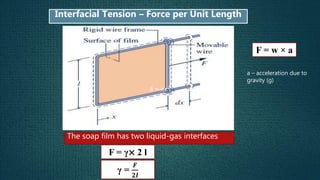
The soap film has two liquid-gas interfaces
F = w × a
a – acceleration due to
gravity (g)
F = γ× 2 l
γ =
𝑭
𝟐𝒍
Interfacial Tension – Force per Unit Length
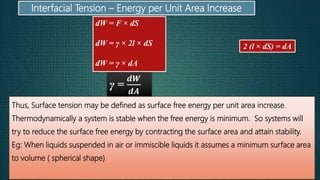
dW = F × dS
dW = γ × 2l × dS
dW = γ × dA
2 (l × dS) = dA
γ =
𝒅𝑾
𝒅𝑨
Thus, Surface tension may be defined as surface free energy per unit area increase.
Thermodynamically a system is stable when the free energy is minimum. So systems will
try to reduce the surface free energy by contracting the surface area and attain stability.
Eg: When liquids suspended in air or immiscible liquids it assumes a minimum surface area
to volume ( spherical shape)
Interfacial Tension – Energy per Unit Area Increase
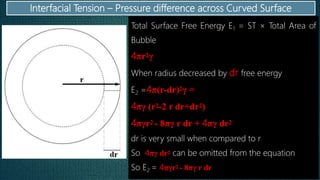
Interfacial Tension – Pressure difference across Curved Surface
Total Surface Free Energy E1 = ST × Total Area of
Bubble
4πr2γ
When radius decreased by dr free energy
E2 =4π(r-dr)2γ =
4πγ (r2-2 r dr+dr2)
4πγr2 - 8πγ r dr + 4πγ dr2
dr is very small when compared to r
So 4πγ dr2 can be omitted from the equation
So E2 = 4πγr2 - 8πγ r dr
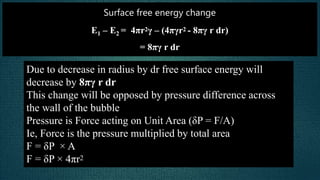
Surface free energy change
E1 – E2 = 4πr2γ – (4πγr2 - 8πγ r dr)
= 8πγ r dr
Due to decrease in radius by dr free surface energy will
decrease by 8πγ r dr
This change will be opposed by pressure difference across
the wall of the bubble
Pressure is Force acting on Unit Area (δP = F/A)
Ie, Force is the pressure multiplied by total area
F = δP × A
F = δP × 4πr2
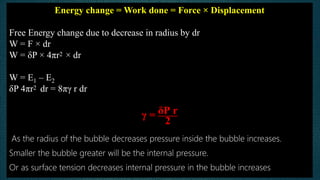
Energy change = Work done = Force × Displacement
Free Energy change due to decrease in radius by dr
W = F × dr
W = δP × 4πr2 × dr
W = E1 – E2
δP 4πr2 dr = 8πγ r dr
γ = δP r
2
As the radius of the bubble decreases pressure inside the bubble increases.
Smaller the bubble greater will be the internal pressure.
Or as surface tension decreases internal pressure in the bubble increases
EFFECT OF TEMPERATURE ON SURFACE
TENSION
Surface tension will be reduced when the temperature of the liquid
increased.
This is due to the thermal expansion of liquids
This continues till the temperature of the liquid reaches the CRITCAL
TEMPERATURE of the liquid
At this point Surface tension becomes zero
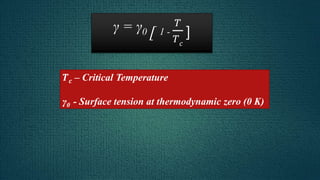
γ = γ0 [ 1 -
𝑇
𝑇 𝑐
]
𝑻 𝒄 – Critical Temperature
γ0 - Surface tension at thermodynamic zero (0 K)
MEASUREMENT OF SURFACE AND INTERFACIAL TENSION
Capillary Rise Method
Maximum Bubble Pressure Method
Drop Method
Wilhelmy Plate Method
Ring Detachment Method (Du - Nuoy Tensiometer)
Capillary Rise Method
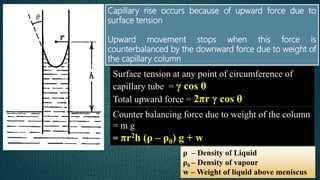
Capillary rise occurs because of upward force due to
surface tension
Upward movement stops when this force is
counterbalanced by the downward force due to weight of
the capillary column
Surface tension at any point of circumference of
capillary tube = γ cos θ
Total upward force = 2πr γ cos θ
Counter balancing force due to weight of the column
= m g
= πr2h (ρ – ρ0) g + w
ρ – Density of Liquid
ρ0 – Density of vapour
w – Weight of liquid above meniscus
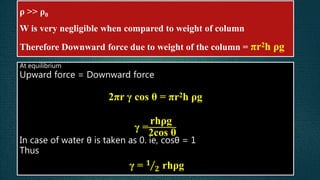
ρ >> ρ0
W is very negligible when compared to weight of column
Therefore Downward force due to weight of the column = πr2h ρg
At equilibrium
Upward force = Downward force
2πr γ cos θ = πr2h ρg
γ =
rhρg
2cos θ
In case of water θ is taken as 0. ie, cosθ = 1
Thus
γ = 𝟏
𝟐 rhρg
Precautions to be taken
Outer vessel should have larger diameter
Capillary tube should have uniform diameter through out its length
Height of the column should measure accurately
Temperature must be maintained uniform
Better to allow meniscus to fall down than allow to rise
Maximum Bubble Pressure Method
Mercury is allowed flow through
each capillaries
Difference in pressure when
bubbles form in sider and narrow
capillaries noted.
When radius of narrow capillary is
less than 0.01cm (r1) and wider is
greater than 0.2cm (r2) surface
tension is given by
𝛾 = 𝐴𝑃[1 + 0.67𝑟2 𝑔 𝐷
𝑃
]
A – Instrument constant
D – Density of the liquid
P – Difference in pressure
Drop Method
When a liquid is allowed to flow through a capillary tube it forms a drop at the tip
of the tube
It increases in size and detaches from the tip when weight of the drop just equals
the surface tension at the circumference of the tube
w = 2πrγ
γ = w
2πr
STALAGMOMETER
Drop Method
Drop Weight
Drop Count
Drop Weight Method
1. Suck the liquid up to the mark A
2. Allow the liquid to drop from tip of the stalagmometer
3. Collect 20 – 30 drops and find out the weight
4. Find average weight of drops
γ = w
2 π r
Generally relative surface tension with respect to water is found out
γ l
γ w
=
w l
w w
Drop Count Method
1. Suck the liquid up to the mark A
2. Allow the liquid to drop from tip of the stalagmometer
3. Count the number of drops formed till the liquid reach mark B
γ = w
2 π r n
W(weight of total number of drops)= mg = vdg
d- density of the liquid
Generally relative surface tension with respect to water is found out
γ l
γ w
=
d l n w
d w n l
Precautions to be taken
 Tip of pipette should have no imperfections in the outer
circumference
 Drops should be formed slowly
About 20 – 30 drops should be collected to find the average weight
 Temperature should be maintained constant
Wilhelmy Plate method
• Consist of a plate made up of platinum suspended vertically
from a beam attached to a torsion balance
• Liquid is taken in a dish and raised until it just touches bottom
of the plate
• When plate touches the surface, the surface force will drag the
plate downward
• Rotate the torsion wire and measure the force required to bring
back the plate to former position
• The force measured in torsion balance will be equal to the
surface tension around the perimeter of the plate
W = 2 (L+T) γ
γ =
W
2 (L+T)
Ring Detachment Method
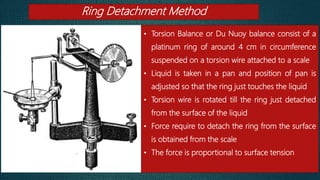
• Torsion Balance or Du Nuoy balance consist of a
platinum ring of around 4 cm in circumference
suspended on a torsion wire attached to a scale
• Liquid is taken in a pan and position of pan is
adjusted so that the ring just touches the liquid
• Torsion wire is rotated till the ring just detached
from the surface of the liquid
• Force require to detach the ring from the surface
is obtained from the scale
• The force is proportional to surface tension
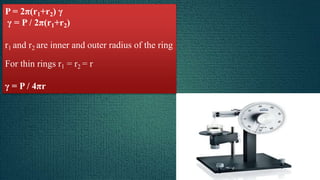
P = 2π(r1+r2) γ
γ = P / 2π(r1+r2)
r1 and r2 are inner and outer radius of the ring
For thin rings r1 = r2 = r
γ = P / 4πr
Precautions to be taken
 The ring should lie in flat plane
 The plane of the ring must be horizontal
 Vessel containing liquid should have wider diameter
 Temperature must be kept constant