11 
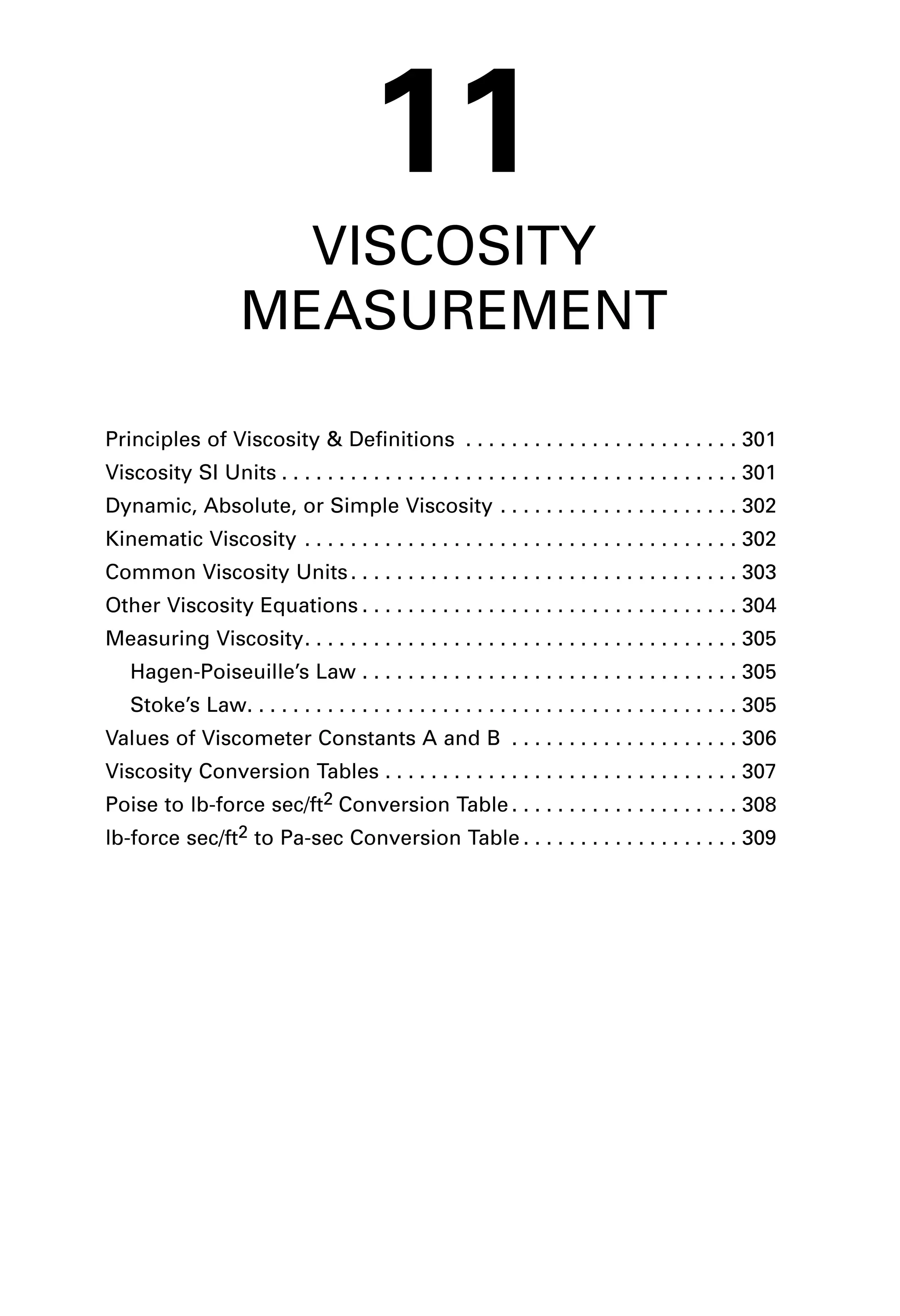
VISCOSITY 
MEASUREMENT 
Principles of Viscosity & Definitions . . . . . . . . . . . . . . . . . . . . . . . . 301 
Viscosity SI Units . . . . . . . . . . . . . . . . . . . . . . . . . . . . . . . . . . . . . . . . 301 
Dynamic, Absolute, or Simple Viscosity . . . . . . . . . . . . . . . . . . . . . 302 
Kinematic Viscosity . . . . . . . . . . . . . . . . . . . . . . . . . . . . . . . . . . . . . . 302 
Common Viscosity Units . . . . . . . . . . . . . . . . . . . . . . . . . . . . . . . . . . 303 
Other Viscosity Equations . . . . . . . . . . . . . . . . . . . . . . . . . . . . . . . . . 304 
Measuring Viscosity. . . . . . . . . . . . . . . . . . . . . . . . . . . . . . . . . . . . . . 305 
Hagen-Poiseuille’s Law . . . . . . . . . . . . . . . . . . . . . . . . . . . . . . . . . 305 
Stoke’s Law. . . . . . . . . . . . . . . . . . . . . . . . . . . . . . . . . . . . . . . . . . . 305 
Values of Viscometer Constants A and B . . . . . . . . . . . . . . . . . . . . 306 
Viscosity Conversion Tables . . . . . . . . . . . . . . . . . . . . . . . . . . . . . . . 307 
Poise to lb-force sec/ft2 Conversion Table . . . . . . . . . . . . . . . . . . . . 308 
lb-force sec/ft2 to Pa-sec Conversion Table . . . . . . . . . . . . . . . . . . . 309
Chapter 11/Viscosity Measurement 301 
Principles of Viscosity & Definitions 
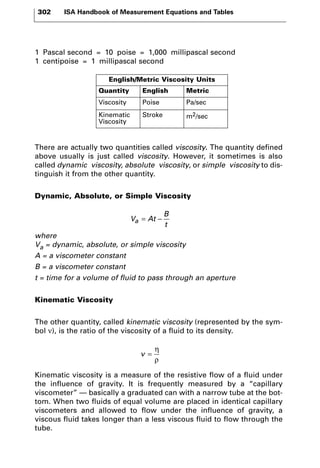
Viscosity is a quantity describing a fluid’s resistance to flow. Fluids 
resist the relative motion of immersed objects through them as well as 
to the motion of layers with differing velocities within them. 
Formally, viscosity (represented by the symbol η) is the ratio of the 
shearing stress (F/A) to the velocity gradient (Δvx/Δz or dvx/dz) in a fluid. 
 
 
÷  
x x Δ 
Δ 
  
F 
A 
v 
z 
η = η 
  
  
=  
  
÷  
  
or 
F 
A 
dv 
dz 
The more usual form of this relationship is called “Newton’s equation.” 
It states the resulting shear of a fluid is directly proportional to the force 
applied and inversely proportional to its viscosity. Note the similarity to 
Newton’s second law of motion (F = ma). 
F 
A 
Δ 
Δ 
v 
z 
F 
A 
dv 
dz 
= x = x 
η η 
or 
  
Δ 
Δ 
= = 
F m 
v 
t 
F m 
dv 
dt 
 
 
 
 
 
 
Viscosity SI Units 
According to NIST’s Guide for the International System of Units (SI), the 
proper SI units for expressing values of viscosity η (also called 
dynamic viscosity) and values of kinematic viscosity ν are, respectively, 
the Pascal second (Pa·s) and the meter squared per second (m2/s) (and 
their decimal multiples and submultiples as appropriate). 
The Pascal second [Pa·s] has no special name. And, although touted as 
an international system, the International System of Units (SI) has had 
very little international impact. The Pascal second is rarely used in sci-entific 
and technical publications today. 
The most common unit of viscosity is the dyne second per square 
centimeter (dyne · s/cm2), which is given the name poise (P) after the 
French physiologist Jean Louis Poiseuille (1799-1869). Ten poise equal 
one Pascal second (Pa·s) making the centipoise (cP) and millipascal 
second (mPa·s) identical.
302 ISA Handbook of Measurement Equations and Tables 
1 Pascal second = 10 poise = 1,000 millipascal second 
1 centipoise = 1 millipascal second 
English/Metric Viscosity Units 
Quantity English Metric 
Viscosity Poise Pa/sec 
Kinematic 
Stroke m2/sec 
Viscosity 
There are actually two quantities called viscosity. The quantity defined 
above usually is just called viscosity. However, it sometimes is also 
called dynamic viscosity, absolute viscosity, or simple viscosity to dis-tinguish 
it from the other quantity. 
Dynamic, Absolute, or Simple Viscosity 
a t = − 
V At 
B 
where 
Va = dynamic, absolute, or simple viscosity 
A = a viscometer constant 
B = a viscometer constant 
t = time for a volume of fluid to pass through an aperture 
Kinematic Viscosity 
The other quantity, called kinematic viscosity (represented by the sym-bol 
ν), is the ratio of the viscosity of a fluid to its density. 
v = 
η 
ρ 
Kinematic viscosity is a measure of the resistive flow of a fluid under 
the influence of gravity. It is frequently measured by a “capillary 
viscometer” — basically a graduated can with a narrow tube at the bot-tom. 
When two fluids of equal volume are placed in identical capillary 
viscometers and allowed to flow under the influence of gravity, a 
viscous fluid takes longer than a less viscous fluid to flow through the 
tube.
where 
Kv = kinematic viscosity 
V = viscosity of fluid 
D = density of fluid 
Chapter 11/Viscosity Measurement 303 
Kv 
The SI unit of kinematic viscosity is the square meter per second (m2/s), 
which also has no special name. This unit is so large it is rarely used. A 
more common unit of kinematic viscosity is the square centimeter per 
second (cm2/s), which has been given the name stoke [St] after the Eng-lish 
scientist George Stoke. Since this unit is also large, the more com-monly 
used unit is the square millimeter per second (mm2/s) or centis-toke 
(cSt). 
According to NIST’s Guide for the International System of Units (SI), the 
CGS units commonly used to express values of these quantities, the 
poise (P) and the stokes (St), respectively [and their decimal submulti-ples 
the centipoise (cP) and the centistoke (cSt)], are not to be used. 
However, since CGS units are, in fact, the most widely used terms, they 
are included in this ISA Handbook. 
2 
mCommon Viscosity Units 
1 m2/s = 10,000 cm2/s (stoke) = 1,000,000 mm2/s (centistokes) 
1 c/s = 1 stoke 
1 mm2 
/s = 1 centistoke 
1 Poise = 1 dyne sec/cm2 
1 Poise = 0.1 Pa sec 
1 Centipoise = 0.001 Pa/sec 
1 Centipoise = 1 cm2/sec 
1 cP = viscosity of water at 68°C 
1 lb-force sec/ft2 = 1 slug/ft sec 
V 
D 
=
304 ISA Handbook of Measurement Equations and Tables 
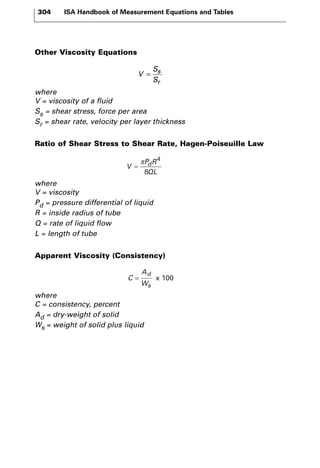
Other Viscosity Equations 
V 
where 
V = viscosity of a fluid 
Ss = shear stress, force per area 
Sr = shear rate, velocity per layer thickness 
Ratio of Shear Stress to Shear Rate, Hagen-Poiseuille Law 
π 4 
8 
where 
V = viscosity 
Pd = pressure differential of liquid 
R = inside radius of tube 
Q = rate of liquid flow 
L = length of tube 
Apparent Viscosity (Consistency) 
C 
A 
W 
where 
C = consistency, percent 
Ad = dry-weight of solid 
Ws = weight of solid plus liquid 
d 
s 
= x 100 
V 
P R 
QL 
= d 
S 
S 
s 
r 
=
Chapter 11/Viscosity Measurement 305 
Measuring Viscosity 
Hagen-Poiseuille’s Law 
French physician and physiologist Jean Poiseuille, while developing an 
improved method for measuring blood pressure, formulated a mathe-matical 
expression for the flow rate for the laminar (nonturbulent) flow 
of fluids in circular tubes. Discovered independently by Gotthilf Hagen, 
a German hydraulic engineer, this relation is also known as the Hagen- 
Poiseuille equation, or Hagen-Poiseuille Law. 
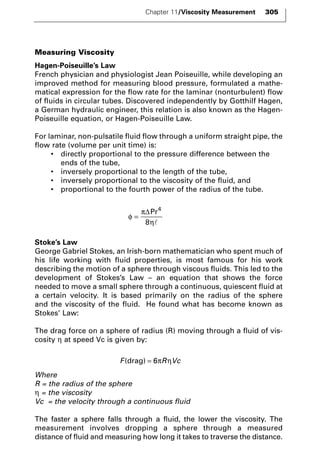
For laminar, non-pulsatile fluid flow through a uniform straight pipe, the 
flow rate (volume per unit time) is: 
• directly proportional to the pressure difference between the 
ends of the tube, 
• inversely proportional to the length of the tube, 
• inversely proportional to the viscosity of the fluid, and 
• proportional to the fourth power of the radius of the tube. 
φ 
ΔPr4 
8  
π 
η 
= 
Stoke’s Law 
George Gabriel Stokes, an Irish-born mathematician who spent much of 
his life working with fluid properties, is most famous for his work 
describing the motion of a sphere through viscous fluids. This led to the 
development of Stokes’s Law – an equation that shows the force 
needed to move a small sphere through a continuous, quiescent fluid at 
a certain velocity. It is based primarily on the radius of the sphere 
and the viscosity of the fluid. He found what has become known as 
Stokes’ Law: 
The drag force on a sphere of radius (R) moving through a fluid of vis-cosity 
η at speed Vc is given by: 
F(drag) = 6πRηVc 
Where 
R = the radius of the sphere 
η = the viscosity 
Vc = the velocity through a continuous fluid 
The faster a sphere falls through a fluid, the lower the viscosity. The 
measurement involves dropping a sphere through a measured 
distance of fluid and measuring how long it takes to traverse the distance.
306 ISA Handbook of Measurement Equations and Tables 
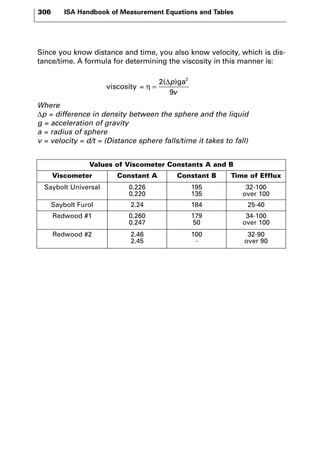
Since you know distance and time, you also know velocity, which is dis-tance/ 
time. A formula for determining the viscosity in this manner is: 
viscosity 
Δp 
9v 
2( )ga2 
= η = 
Where 
Δp = difference in density between the sphere and the liquid 
g = acceleration of gravity 
a = radius of sphere 
v = velocity = d/t = (Distance sphere falls/time it takes to fall) 
Values of Viscometer Constants A and B 
Viscometer Constant A Constant B Time of Efflux 
Saybolt Universal 0.226 
0.220 
195 
135 
32-100 
over 100 
Saybolt Furol 2.24 184 25-40 
Redwood #1 0.260 
0.247 
179 
50 
34-100 
over 100 
Redwood #2 2.46 
2.45 
100 
- 
32-90 
over 90
Chapter 11/Viscosity Measurement 307 
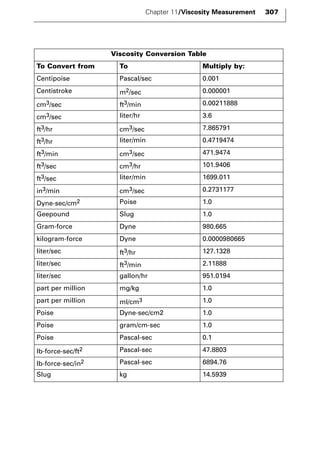
Viscosity Conversion Table 
To Convert from To Multiply by: 
Centipoise Pascal/sec 0.001 
Centistroke m2/sec 0.000001 
cm3/sec ft3/min 0.00211888 
cm3/sec liter/hr 3.6 
ft3/hr cm3/sec 7.865791 
ft3/hr liter/min 0.4719474 
ft3/min cm3/sec 471.9474 
ft3/sec cm3/hr 101.9406 
ft3/sec liter/min 1699.011 
in3/min cm3/sec 0.2731177 
Dyne-sec/cm2 Poise 1.0 
Geepound Slug 1.0 
Gram-force Dyne 980.665 
kilogram-force Dyne 0.0000980665 
liter/sec ft3/hr 127.1328 
liter/sec ft3/min 2.11888 
liter/sec gallon/hr 951.0194 
part per million mg/kg 1.0 
part per million ml/cm3 1.0 
Poise Dyne-sec/cm2 1.0 
Poise gram/cm-sec 1.0 
Poise Pascal-sec 0.1 
lb-force-sec/ft2 Pascal-sec 47.8803 
lb-force-sec/in2 Pascal-sec 6894.76 
Slug kg 14.5939
308 ISA Handbook of Measurement Equations and Tables 
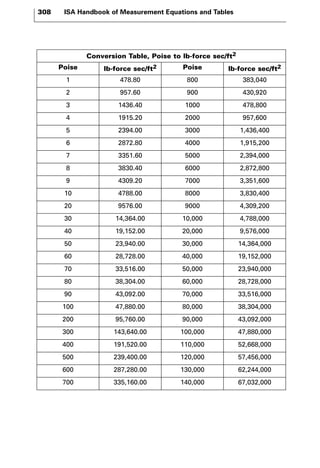
Conversion Table, Poise to lb-force sec/ft2 
Poise lb-force sec/ft2 Poise lb-force sec/ft2 
1 478.80 800 383,040 
2 957.60 900 430,920 
3 1436.40 1000 478,800 
4 1915.20 2000 957,600 
5 2394.00 3000 1,436,400 
6 2872.80 4000 1,915,200 
7 3351.60 5000 2,394,000 
8 3830.40 6000 2,872,800 
9 4309.20 7000 3,351,600 
10 4788.00 8000 3,830,400 
20 9576.00 9000 4,309,200 
30 14,364.00 10,000 4,788,000 
40 19,152.00 20,000 9,576,000 
50 23,940.00 30,000 14,364,000 
60 28,728.00 40,000 19,152,000 
70 33,516.00 50,000 23,940,000 
80 38,304.00 60,000 28,728,000 
90 43,092.00 70,000 33,516,000 
100 47,880.00 80,000 38,304,000 
200 95,760.00 90,000 43,092,000 
300 143,640.00 100,000 47,880,000 
400 191,520.00 110,000 52,668,000 
500 239,400.00 120,000 57,456,000 
600 287,280.00 130,000 62,244,000 
700 335,160.00 140,000 67,032,000
Chapter 11/Viscosity Measurement 309 
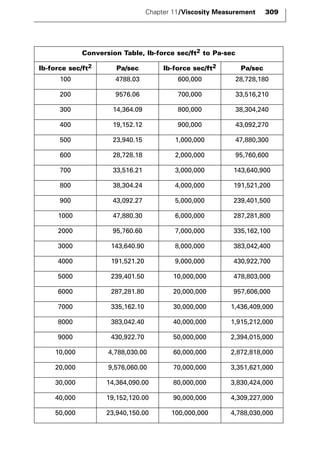
Conversion Table, lb-force sec/ft2 to Pa-sec 
lb-force sec/ft2 Pa/sec lb-force sec/ft2 Pa/sec 
100 4788.03 600,000 28,728,180 
200 9576.06 700,000 33,516,210 
300 14,364.09 800,000 38,304,240 
400 19,152.12 900,000 43,092,270 
500 23,940.15 1,000,000 47,880,300 
600 28,728.18 2,000,000 95,760,600 
700 33,516.21 3,000,000 143,640,900 
800 38,304.24 4,000,000 191,521,200 
900 43,092.27 5,000,000 239,401,500 
1000 47,880.30 6,000,000 287,281,800 
2000 95,760.60 7,000,000 335,162,100 
3000 143,640.90 8,000,000 383,042,400 
4000 191,521.20 9,000,000 430,922,700 
5000 239,401.50 10,000,000 478,803,000 
6000 287,281.80 20,000,000 957,606,000 
7000 335,162.10 30,000,000 1,436,409,000 
8000 383,042.40 40,000,000 1,915,212,000 
9000 430,922.70 50,000,000 2,394,015,000 
10,000 4,788,030.00 60,000,000 2,872,818,000 
20,000 9,576,060.00 70,000,000 3,351,621,000 
30,000 14,364,090.00 80,000,000 3,830,424,000 
40,000 19,152,120.00 90,000,000 4,309,227,000 
50,000 23,940,150.00 100,000,000 4,788,030,000

Instrumentation and control

  • 1.
    11 VISCOSITY MEASUREMENT Principles of Viscosity & Definitions . . . . . . . . . . . . . . . . . . . . . . . . 301 Viscosity SI Units . . . . . . . . . . . . . . . . . . . . . . . . . . . . . . . . . . . . . . . . 301 Dynamic, Absolute, or Simple Viscosity . . . . . . . . . . . . . . . . . . . . . 302 Kinematic Viscosity . . . . . . . . . . . . . . . . . . . . . . . . . . . . . . . . . . . . . . 302 Common Viscosity Units . . . . . . . . . . . . . . . . . . . . . . . . . . . . . . . . . . 303 Other Viscosity Equations . . . . . . . . . . . . . . . . . . . . . . . . . . . . . . . . . 304 Measuring Viscosity. . . . . . . . . . . . . . . . . . . . . . . . . . . . . . . . . . . . . . 305 Hagen-Poiseuille’s Law . . . . . . . . . . . . . . . . . . . . . . . . . . . . . . . . . 305 Stoke’s Law. . . . . . . . . . . . . . . . . . . . . . . . . . . . . . . . . . . . . . . . . . . 305 Values of Viscometer Constants A and B . . . . . . . . . . . . . . . . . . . . 306 Viscosity Conversion Tables . . . . . . . . . . . . . . . . . . . . . . . . . . . . . . . 307 Poise to lb-force sec/ft2 Conversion Table . . . . . . . . . . . . . . . . . . . . 308 lb-force sec/ft2 to Pa-sec Conversion Table . . . . . . . . . . . . . . . . . . . 309
  • 2.
    Chapter 11/Viscosity Measurement301 Principles of Viscosity & Definitions Viscosity is a quantity describing a fluid’s resistance to flow. Fluids resist the relative motion of immersed objects through them as well as to the motion of layers with differing velocities within them. Formally, viscosity (represented by the symbol η) is the ratio of the shearing stress (F/A) to the velocity gradient (Δvx/Δz or dvx/dz) in a fluid.   ÷  x x Δ Δ   F A v z η = η     =    ÷    or F A dv dz The more usual form of this relationship is called “Newton’s equation.” It states the resulting shear of a fluid is directly proportional to the force applied and inversely proportional to its viscosity. Note the similarity to Newton’s second law of motion (F = ma). F A Δ Δ v z F A dv dz = x = x η η or Δ Δ = = F m v t F m dv dt       Viscosity SI Units According to NIST’s Guide for the International System of Units (SI), the proper SI units for expressing values of viscosity η (also called dynamic viscosity) and values of kinematic viscosity ν are, respectively, the Pascal second (Pa·s) and the meter squared per second (m2/s) (and their decimal multiples and submultiples as appropriate). The Pascal second [Pa·s] has no special name. And, although touted as an international system, the International System of Units (SI) has had very little international impact. The Pascal second is rarely used in sci-entific and technical publications today. The most common unit of viscosity is the dyne second per square centimeter (dyne · s/cm2), which is given the name poise (P) after the French physiologist Jean Louis Poiseuille (1799-1869). Ten poise equal one Pascal second (Pa·s) making the centipoise (cP) and millipascal second (mPa·s) identical.
  • 3.
    302 ISA Handbookof Measurement Equations and Tables 1 Pascal second = 10 poise = 1,000 millipascal second 1 centipoise = 1 millipascal second English/Metric Viscosity Units Quantity English Metric Viscosity Poise Pa/sec Kinematic Stroke m2/sec Viscosity There are actually two quantities called viscosity. The quantity defined above usually is just called viscosity. However, it sometimes is also called dynamic viscosity, absolute viscosity, or simple viscosity to dis-tinguish it from the other quantity. Dynamic, Absolute, or Simple Viscosity a t = − V At B where Va = dynamic, absolute, or simple viscosity A = a viscometer constant B = a viscometer constant t = time for a volume of fluid to pass through an aperture Kinematic Viscosity The other quantity, called kinematic viscosity (represented by the sym-bol ν), is the ratio of the viscosity of a fluid to its density. v = η ρ Kinematic viscosity is a measure of the resistive flow of a fluid under the influence of gravity. It is frequently measured by a “capillary viscometer” — basically a graduated can with a narrow tube at the bot-tom. When two fluids of equal volume are placed in identical capillary viscometers and allowed to flow under the influence of gravity, a viscous fluid takes longer than a less viscous fluid to flow through the tube.
  • 4.
    where Kv =kinematic viscosity V = viscosity of fluid D = density of fluid Chapter 11/Viscosity Measurement 303 Kv The SI unit of kinematic viscosity is the square meter per second (m2/s), which also has no special name. This unit is so large it is rarely used. A more common unit of kinematic viscosity is the square centimeter per second (cm2/s), which has been given the name stoke [St] after the Eng-lish scientist George Stoke. Since this unit is also large, the more com-monly used unit is the square millimeter per second (mm2/s) or centis-toke (cSt). According to NIST’s Guide for the International System of Units (SI), the CGS units commonly used to express values of these quantities, the poise (P) and the stokes (St), respectively [and their decimal submulti-ples the centipoise (cP) and the centistoke (cSt)], are not to be used. However, since CGS units are, in fact, the most widely used terms, they are included in this ISA Handbook. 2 mCommon Viscosity Units 1 m2/s = 10,000 cm2/s (stoke) = 1,000,000 mm2/s (centistokes) 1 c/s = 1 stoke 1 mm2 /s = 1 centistoke 1 Poise = 1 dyne sec/cm2 1 Poise = 0.1 Pa sec 1 Centipoise = 0.001 Pa/sec 1 Centipoise = 1 cm2/sec 1 cP = viscosity of water at 68°C 1 lb-force sec/ft2 = 1 slug/ft sec V D =
  • 5.
    304 ISA Handbookof Measurement Equations and Tables Other Viscosity Equations V where V = viscosity of a fluid Ss = shear stress, force per area Sr = shear rate, velocity per layer thickness Ratio of Shear Stress to Shear Rate, Hagen-Poiseuille Law π 4 8 where V = viscosity Pd = pressure differential of liquid R = inside radius of tube Q = rate of liquid flow L = length of tube Apparent Viscosity (Consistency) C A W where C = consistency, percent Ad = dry-weight of solid Ws = weight of solid plus liquid d s = x 100 V P R QL = d S S s r =
  • 6.
    Chapter 11/Viscosity Measurement305 Measuring Viscosity Hagen-Poiseuille’s Law French physician and physiologist Jean Poiseuille, while developing an improved method for measuring blood pressure, formulated a mathe-matical expression for the flow rate for the laminar (nonturbulent) flow of fluids in circular tubes. Discovered independently by Gotthilf Hagen, a German hydraulic engineer, this relation is also known as the Hagen- Poiseuille equation, or Hagen-Poiseuille Law. For laminar, non-pulsatile fluid flow through a uniform straight pipe, the flow rate (volume per unit time) is: • directly proportional to the pressure difference between the ends of the tube, • inversely proportional to the length of the tube, • inversely proportional to the viscosity of the fluid, and • proportional to the fourth power of the radius of the tube. φ ΔPr4 8 π η = Stoke’s Law George Gabriel Stokes, an Irish-born mathematician who spent much of his life working with fluid properties, is most famous for his work describing the motion of a sphere through viscous fluids. This led to the development of Stokes’s Law – an equation that shows the force needed to move a small sphere through a continuous, quiescent fluid at a certain velocity. It is based primarily on the radius of the sphere and the viscosity of the fluid. He found what has become known as Stokes’ Law: The drag force on a sphere of radius (R) moving through a fluid of vis-cosity η at speed Vc is given by: F(drag) = 6πRηVc Where R = the radius of the sphere η = the viscosity Vc = the velocity through a continuous fluid The faster a sphere falls through a fluid, the lower the viscosity. The measurement involves dropping a sphere through a measured distance of fluid and measuring how long it takes to traverse the distance.
  • 7.
    306 ISA Handbookof Measurement Equations and Tables Since you know distance and time, you also know velocity, which is dis-tance/ time. A formula for determining the viscosity in this manner is: viscosity Δp 9v 2( )ga2 = η = Where Δp = difference in density between the sphere and the liquid g = acceleration of gravity a = radius of sphere v = velocity = d/t = (Distance sphere falls/time it takes to fall) Values of Viscometer Constants A and B Viscometer Constant A Constant B Time of Efflux Saybolt Universal 0.226 0.220 195 135 32-100 over 100 Saybolt Furol 2.24 184 25-40 Redwood #1 0.260 0.247 179 50 34-100 over 100 Redwood #2 2.46 2.45 100 - 32-90 over 90
  • 8.
    Chapter 11/Viscosity Measurement307 Viscosity Conversion Table To Convert from To Multiply by: Centipoise Pascal/sec 0.001 Centistroke m2/sec 0.000001 cm3/sec ft3/min 0.00211888 cm3/sec liter/hr 3.6 ft3/hr cm3/sec 7.865791 ft3/hr liter/min 0.4719474 ft3/min cm3/sec 471.9474 ft3/sec cm3/hr 101.9406 ft3/sec liter/min 1699.011 in3/min cm3/sec 0.2731177 Dyne-sec/cm2 Poise 1.0 Geepound Slug 1.0 Gram-force Dyne 980.665 kilogram-force Dyne 0.0000980665 liter/sec ft3/hr 127.1328 liter/sec ft3/min 2.11888 liter/sec gallon/hr 951.0194 part per million mg/kg 1.0 part per million ml/cm3 1.0 Poise Dyne-sec/cm2 1.0 Poise gram/cm-sec 1.0 Poise Pascal-sec 0.1 lb-force-sec/ft2 Pascal-sec 47.8803 lb-force-sec/in2 Pascal-sec 6894.76 Slug kg 14.5939
  • 9.
    308 ISA Handbookof Measurement Equations and Tables Conversion Table, Poise to lb-force sec/ft2 Poise lb-force sec/ft2 Poise lb-force sec/ft2 1 478.80 800 383,040 2 957.60 900 430,920 3 1436.40 1000 478,800 4 1915.20 2000 957,600 5 2394.00 3000 1,436,400 6 2872.80 4000 1,915,200 7 3351.60 5000 2,394,000 8 3830.40 6000 2,872,800 9 4309.20 7000 3,351,600 10 4788.00 8000 3,830,400 20 9576.00 9000 4,309,200 30 14,364.00 10,000 4,788,000 40 19,152.00 20,000 9,576,000 50 23,940.00 30,000 14,364,000 60 28,728.00 40,000 19,152,000 70 33,516.00 50,000 23,940,000 80 38,304.00 60,000 28,728,000 90 43,092.00 70,000 33,516,000 100 47,880.00 80,000 38,304,000 200 95,760.00 90,000 43,092,000 300 143,640.00 100,000 47,880,000 400 191,520.00 110,000 52,668,000 500 239,400.00 120,000 57,456,000 600 287,280.00 130,000 62,244,000 700 335,160.00 140,000 67,032,000
  • 10.
    Chapter 11/Viscosity Measurement309 Conversion Table, lb-force sec/ft2 to Pa-sec lb-force sec/ft2 Pa/sec lb-force sec/ft2 Pa/sec 100 4788.03 600,000 28,728,180 200 9576.06 700,000 33,516,210 300 14,364.09 800,000 38,304,240 400 19,152.12 900,000 43,092,270 500 23,940.15 1,000,000 47,880,300 600 28,728.18 2,000,000 95,760,600 700 33,516.21 3,000,000 143,640,900 800 38,304.24 4,000,000 191,521,200 900 43,092.27 5,000,000 239,401,500 1000 47,880.30 6,000,000 287,281,800 2000 95,760.60 7,000,000 335,162,100 3000 143,640.90 8,000,000 383,042,400 4000 191,521.20 9,000,000 430,922,700 5000 239,401.50 10,000,000 478,803,000 6000 287,281.80 20,000,000 957,606,000 7000 335,162.10 30,000,000 1,436,409,000 8000 383,042.40 40,000,000 1,915,212,000 9000 430,922.70 50,000,000 2,394,015,000 10,000 4,788,030.00 60,000,000 2,872,818,000 20,000 9,576,060.00 70,000,000 3,351,621,000 30,000 14,364,090.00 80,000,000 3,830,424,000 40,000 19,152,120.00 90,000,000 4,309,227,000 50,000 23,940,150.00 100,000,000 4,788,030,000