Presented to: Dr. Misbah Sultana
 Ayesha D19E03
 Sabahat D19E53
 Maha D19E86
 Shama D19E26
 Hafsa D19E81
 Mohadsa D19E07
 Aliza D19E08
 Khadija D19E79
Viscosity
Definition
Types
Formula
Units
Viscometer
Types of viscometers
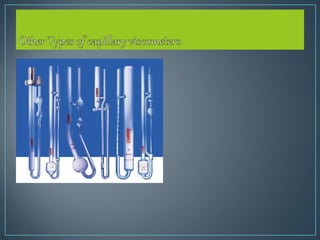
Capillary viscometer
Falling ball viscometer
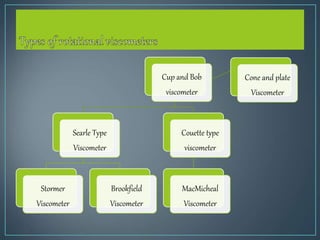
Rotational viscometer
DEFINITION: Measurement of resistance to
flow of liquids.
TYPES:
 Dynamic viscosity unit centipoise
 Kinematic viscosity unit strokes
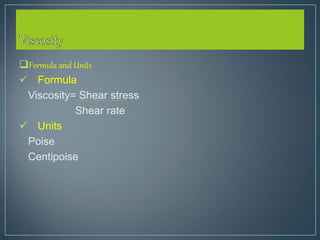
Formula and Units
 Formula
Viscosity= Shear stress
Shear rate
 Units
Poise
Centipoise
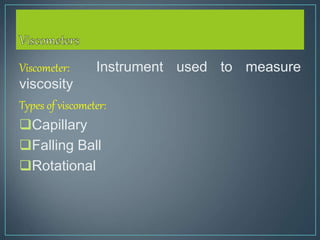
Viscometer: Instrument used to measure
viscosity
Types of viscometer:
Capillary
Falling Ball
Rotational
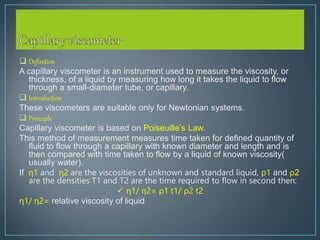
 Definition
A capillary viscometer is an instrument used to measure the viscosity, or
thickness, of a liquid by measuring how long it takes the liquid to flow
through a small-diameter tube, or capillary.
 Introduction
These viscometers are suitable only for Newtonian systems.
 Principle
Capillary viscometer is based on Poiseuille’s Law.
This method of measurement measures time taken for defined quantity of
fluid to flow through a capillary with known diameter and length and is
then compared with time taken to flow by a liquid of known viscosity(
usually water).
If η1 and η2 are the viscosities of unknown and standard liquid, ρ1 and ρ2
are the densities T1 and T2 are the time required to flow in second then:
 η1/ η2= ρ1 t1/ ρ2 t2
η1/ η2= relative viscosity of liquid
There are following types of viscometer:
Ostwald’s Viscometer
Suspended level viscometer
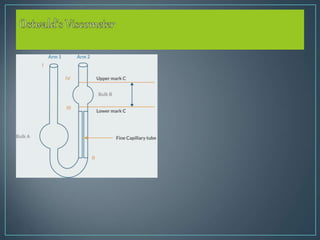
OSTWALD’S VISCOMETER
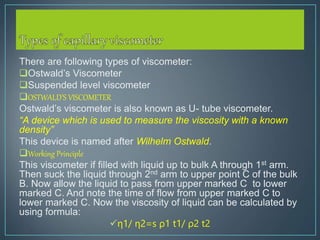
Ostwald’s viscometer is also known as U- tube viscometer.
“A device which is used to measure the viscosity with a known
density”
This device is named after Wilhelm Ostwald.
Working Principle
This viscometer if filled with liquid up to bulk A through 1st arm.
Then suck the liquid through 2nd arm to upper point C of the bulk
B. Now allow the liquid to pass from upper marked C to lower
marked C. And note the time of flow from upper marked C to
lower marked C. Now the viscosity of liquid can be calculated by
using formula:
η1/ η2=s ρ1 t1/ ρ2 t2
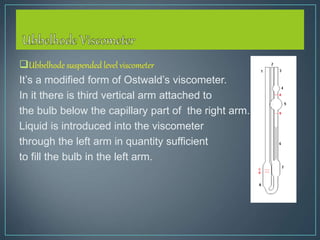
Ubbelhode suspended level viscometer
It’s a modified form of Ostwald’s viscometer.
In it there is third vertical arm attached to
the bulb below the capillary part of the right arm.
Liquid is introduced into the viscometer
through the left arm in quantity sufficient
to fill the bulb in the left arm.
 Advantages
 Measure precise viscosities
for many diverse fluids.
 Small and portable.
 Inexpensive.
 Easy to use.
 Can use a wide variety of
capillary tubes on the same
viscometer.
Disadvantages
 No single tube is suitable for
all viscosities.
 Basic models can only be
used for translucent fluids.
 Difficult to clean the capillary
tubes.
Falling Ball Viscometer
A type of viscometer in which a glass or steel ball rolls down on
almost vertical glass tube containing the test liquid at a known
constant temperature.
It is also known as hoeppler viscometer.
Principle
Hoeppler principle.
Determination of viscosity
The sample and ball are placed in inner glass tube and allowed
to reach temperature equilibrium with the water in the constant
temperature jacket. The tube and jacket are then inverted which
effectively places the ball at the top of the inner glass tube. The
time for the ball to fall between two marks is accurately
measured and repeated several times. The viscosity of a
Newtonian liquid is then calculated from formula.
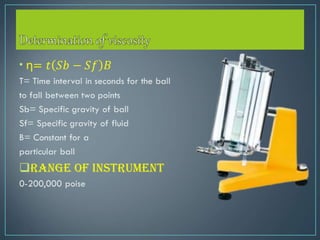
•
For best results
A ball should be used such that t should not be less than 30
seconds.
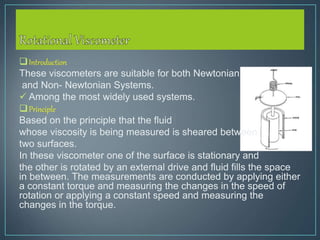
Introduction
These viscometers are suitable for both Newtonian
and Non- Newtonian Systems.
 Among the most widely used systems.
Principle
Based on the principle that the fluid
whose viscosity is being measured is sheared between
two surfaces.
In these viscometer one of the surface is stationary and
the other is rotated by an external drive and fluid fills the space
in between. The measurements are conducted by applying either
a constant torque and measuring the changes in the speed of
rotation or applying a constant speed and measuring the
changes in the torque.
Cup and Bob
viscometer
Searle Type
Viscometer
Stormer
Viscometer
Brookfield
Viscometer
Couette type
viscometer
MacMicheal
Viscometer
Cone and plate
Viscometer
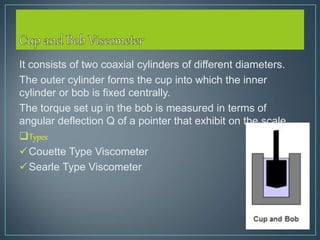
It consists of two coaxial cylinders of different diameters.
The outer cylinder forms the cup into which the inner
cylinder or bob is fixed centrally.
The torque set up in the bob is measured in terms of
angular deflection Q of a pointer that exhibit on the scale.
Types
Couette Type Viscometer
Searle Type Viscometer
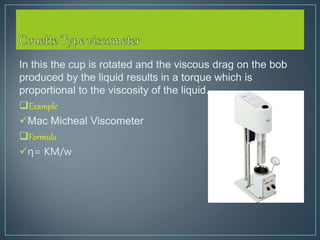
In this the cup is rotated and the viscous drag on the bob
produced by the liquid results in a torque which is
proportional to the viscosity of the liquid.
Example
Mac Micheal Viscometer
Formula
η= KM/w
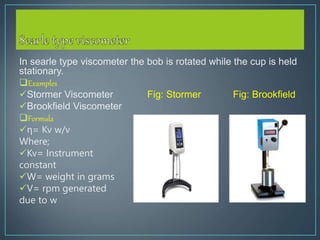
In searle type viscometer the bob is rotated while the cup is held
stationary.
Examples
Stormer Viscometer Fig: Stormer Fig: Brookfield
Brookfield Viscometer
Formula
η= Kv w/v
Where;
Kv= Instrument
constant
W= weight in grams
V= rpm generated
due to w
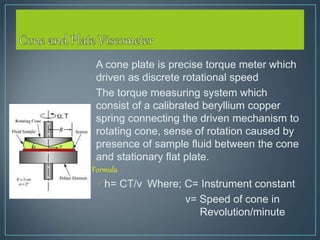
A cone plate is precise torque meter which
driven as discrete rotational speed
The torque measuring system which
consist of a calibrated beryllium copper
spring connecting the driven mechanism to
rotating cone, sense of rotation caused by
presence of sample fluid between the cone
and stationary flat plate.
Formula
h= CT/v Where; C= Instrument constant
v= Speed of cone in
Revolution/minute
 Advantages
 Can measure viscosities
of opaque, settling or non-
newtonian fluids.
 Useful for characterizing
shear thinning and time
dependent behavior.
 Speed of the rotating part
easily adjusted.
 Often linked to computers
for semi automated
measurement.
 Disadvantages
 Can be relatively
expensive.
 Often large an d not
portable.
Physical Pharmacy by Aggarwal and Khanna.
Martin’s Physical Pharmacy and Pharmaceutical
Sciences.
final viscometer presentation.ppt

final viscometer presentation.ppt

  • 2.
    Presented to: Dr.Misbah Sultana
  • 3.
     Ayesha D19E03 Sabahat D19E53  Maha D19E86  Shama D19E26  Hafsa D19E81  Mohadsa D19E07  Aliza D19E08  Khadija D19E79
  • 4.
  • 5.
    DEFINITION: Measurement ofresistance to flow of liquids. TYPES:  Dynamic viscosity unit centipoise  Kinematic viscosity unit strokes
  • 6.
    Formula and Units Formula Viscosity= Shear stress Shear rate  Units Poise Centipoise
  • 7.
    Viscometer: Instrument usedto measure viscosity Types of viscometer: Capillary Falling Ball Rotational
  • 8.
     Definition A capillaryviscometer is an instrument used to measure the viscosity, or thickness, of a liquid by measuring how long it takes the liquid to flow through a small-diameter tube, or capillary.  Introduction These viscometers are suitable only for Newtonian systems.  Principle Capillary viscometer is based on Poiseuille’s Law. This method of measurement measures time taken for defined quantity of fluid to flow through a capillary with known diameter and length and is then compared with time taken to flow by a liquid of known viscosity( usually water). If η1 and η2 are the viscosities of unknown and standard liquid, ρ1 and ρ2 are the densities T1 and T2 are the time required to flow in second then:  η1/ η2= ρ1 t1/ ρ2 t2 η1/ η2= relative viscosity of liquid
  • 9.
    There are followingtypes of viscometer: Ostwald’s Viscometer Suspended level viscometer OSTWALD’S VISCOMETER Ostwald’s viscometer is also known as U- tube viscometer. “A device which is used to measure the viscosity with a known density” This device is named after Wilhelm Ostwald. Working Principle This viscometer if filled with liquid up to bulk A through 1st arm. Then suck the liquid through 2nd arm to upper point C of the bulk B. Now allow the liquid to pass from upper marked C to lower marked C. And note the time of flow from upper marked C to lower marked C. Now the viscosity of liquid can be calculated by using formula: η1/ η2=s ρ1 t1/ ρ2 t2
  • 11.
    Ubbelhode suspended levelviscometer It’s a modified form of Ostwald’s viscometer. In it there is third vertical arm attached to the bulb below the capillary part of the right arm. Liquid is introduced into the viscometer through the left arm in quantity sufficient to fill the bulb in the left arm.
  • 13.
     Advantages  Measureprecise viscosities for many diverse fluids.  Small and portable.  Inexpensive.  Easy to use.  Can use a wide variety of capillary tubes on the same viscometer. Disadvantages  No single tube is suitable for all viscosities.  Basic models can only be used for translucent fluids.  Difficult to clean the capillary tubes.
  • 14.
    Falling Ball Viscometer Atype of viscometer in which a glass or steel ball rolls down on almost vertical glass tube containing the test liquid at a known constant temperature. It is also known as hoeppler viscometer. Principle Hoeppler principle. Determination of viscosity The sample and ball are placed in inner glass tube and allowed to reach temperature equilibrium with the water in the constant temperature jacket. The tube and jacket are then inverted which effectively places the ball at the top of the inner glass tube. The time for the ball to fall between two marks is accurately measured and repeated several times. The viscosity of a Newtonian liquid is then calculated from formula.
  • 15.
  • 16.
    For best results Aball should be used such that t should not be less than 30 seconds.
  • 17.
    Introduction These viscometers aresuitable for both Newtonian and Non- Newtonian Systems.  Among the most widely used systems. Principle Based on the principle that the fluid whose viscosity is being measured is sheared between two surfaces. In these viscometer one of the surface is stationary and the other is rotated by an external drive and fluid fills the space in between. The measurements are conducted by applying either a constant torque and measuring the changes in the speed of rotation or applying a constant speed and measuring the changes in the torque.
  • 18.
    Cup and Bob viscometer SearleType Viscometer Stormer Viscometer Brookfield Viscometer Couette type viscometer MacMicheal Viscometer Cone and plate Viscometer
  • 19.
    It consists oftwo coaxial cylinders of different diameters. The outer cylinder forms the cup into which the inner cylinder or bob is fixed centrally. The torque set up in the bob is measured in terms of angular deflection Q of a pointer that exhibit on the scale. Types Couette Type Viscometer Searle Type Viscometer
  • 20.
    In this thecup is rotated and the viscous drag on the bob produced by the liquid results in a torque which is proportional to the viscosity of the liquid. Example Mac Micheal Viscometer Formula η= KM/w
  • 21.
    In searle typeviscometer the bob is rotated while the cup is held stationary. Examples Stormer Viscometer Fig: Stormer Fig: Brookfield Brookfield Viscometer Formula η= Kv w/v Where; Kv= Instrument constant W= weight in grams V= rpm generated due to w
  • 22.
    A cone plateis precise torque meter which driven as discrete rotational speed The torque measuring system which consist of a calibrated beryllium copper spring connecting the driven mechanism to rotating cone, sense of rotation caused by presence of sample fluid between the cone and stationary flat plate. Formula h= CT/v Where; C= Instrument constant v= Speed of cone in Revolution/minute
  • 23.
     Advantages  Canmeasure viscosities of opaque, settling or non- newtonian fluids.  Useful for characterizing shear thinning and time dependent behavior.  Speed of the rotating part easily adjusted.  Often linked to computers for semi automated measurement.  Disadvantages  Can be relatively expensive.  Often large an d not portable.
  • 24.
    Physical Pharmacy byAggarwal and Khanna. Martin’s Physical Pharmacy and Pharmaceutical Sciences.