◾ Viscosity
Definition
Formula and Units
◾ Viscometer
Introduction
Importance
◾ Types of Viscometer
5
CONTENTS
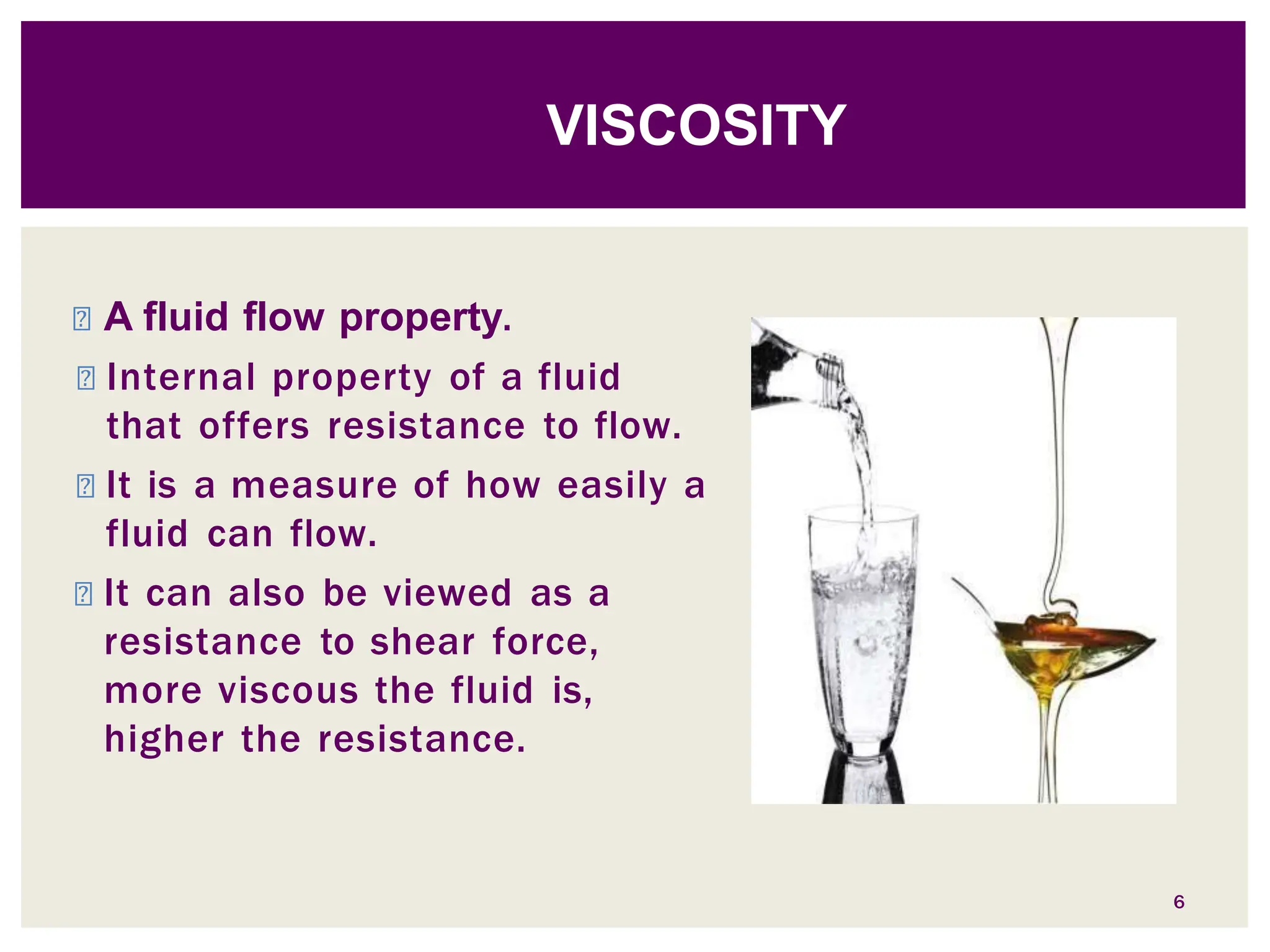
◾ A fluid flow property.
◾ Internal property of a fluid
that offers resistance to flow.
◾ It is a measure of how easily a
fluid can flow.
◾ It can also be viewed as a
resistance to shear force,
more viscous the fluid is,
higher the resistance.
VISCOSITY
6
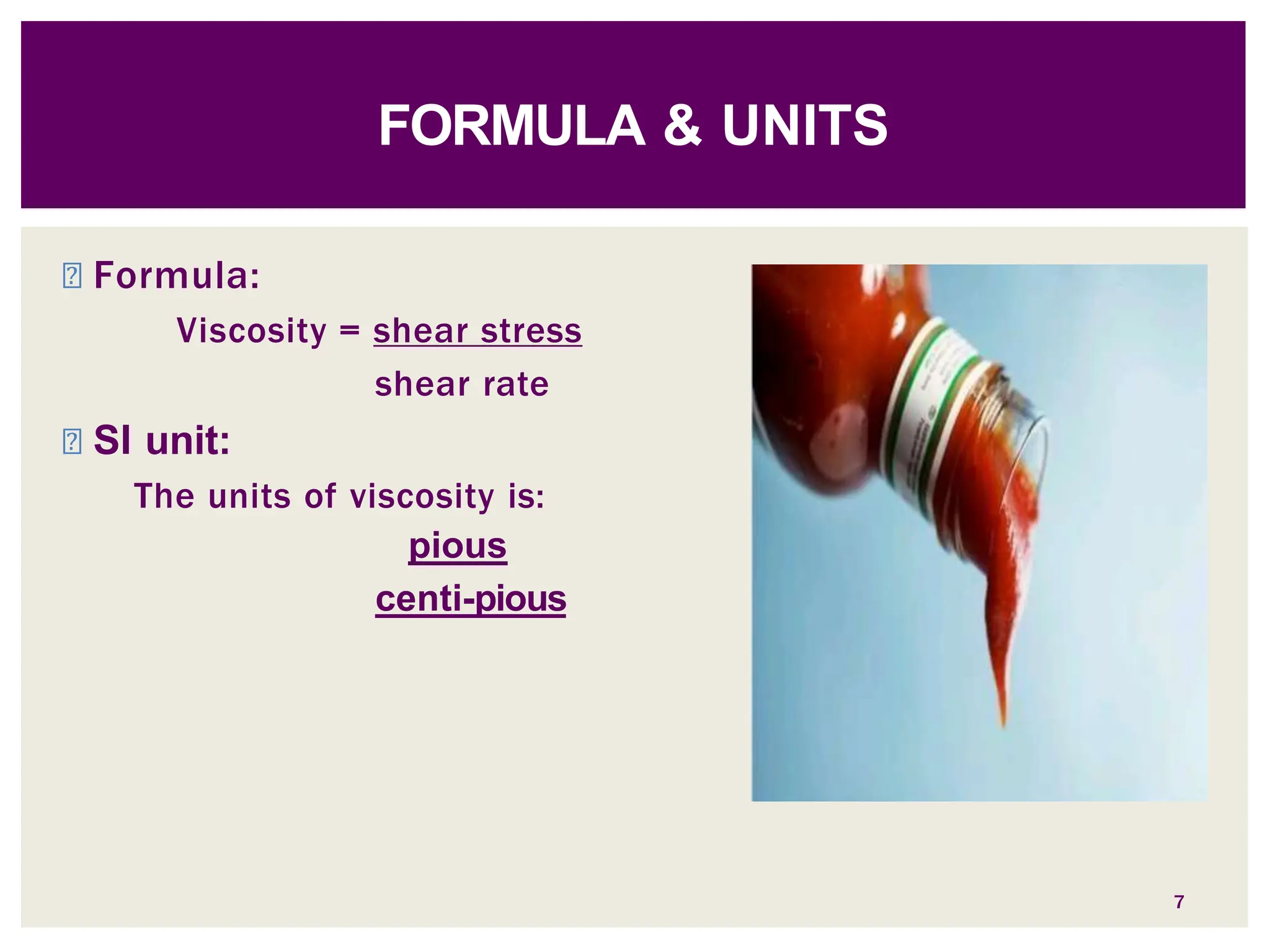
◾ Formula:
Viscosity = shear stress
shear rate
◾ SI unit:
The units of viscosity is:
pious
centi-pious
FORMULA & UNITS
7
◾ Definition:
“A viscometer is an instrument used to measure
the viscosity of a fluid.”
◾ It is also known as “Viscosimeter.”
◾ Viscometer only measures under one flow
condition
◾ The measure of the resistance is taken by
measuring the drag resistance during relative
motion through the fluid.
8
VISCOMETER
◾ Measuring viscosity is important when
considering process conditions for materials
that need to be pumped or piped . It effects
dipping and coating performance , which is
particularly relevant to syrups and lotions.
◾ Viscometer can be used to monitor batch
consistency and quality control.
◾ They are also used to characterize plastics.
9
IMPORTANCE
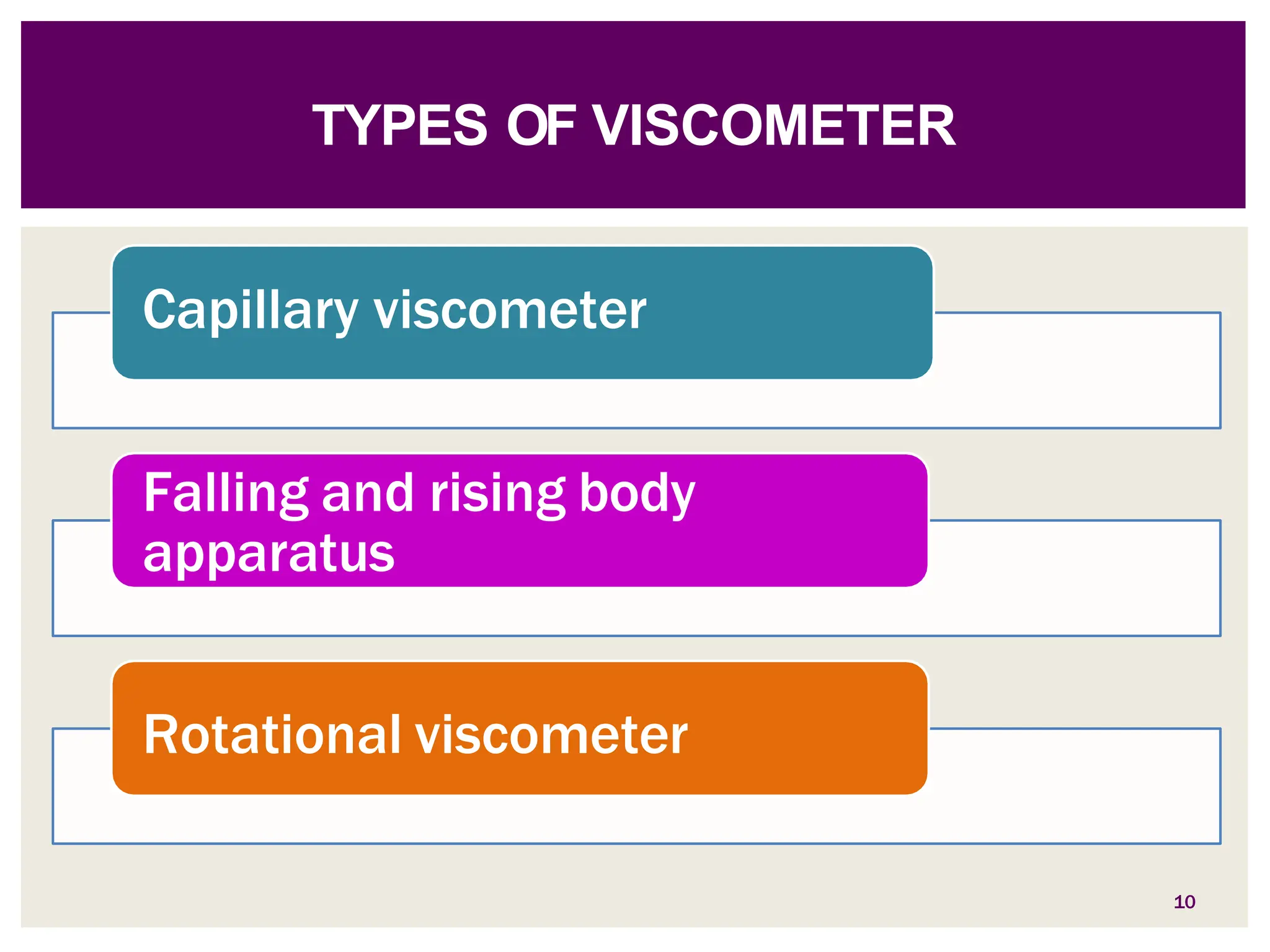
TYPES OF VISCOMETER
Capillary viscometer
Falling and rising body
apparatus
Rotational viscometer
10
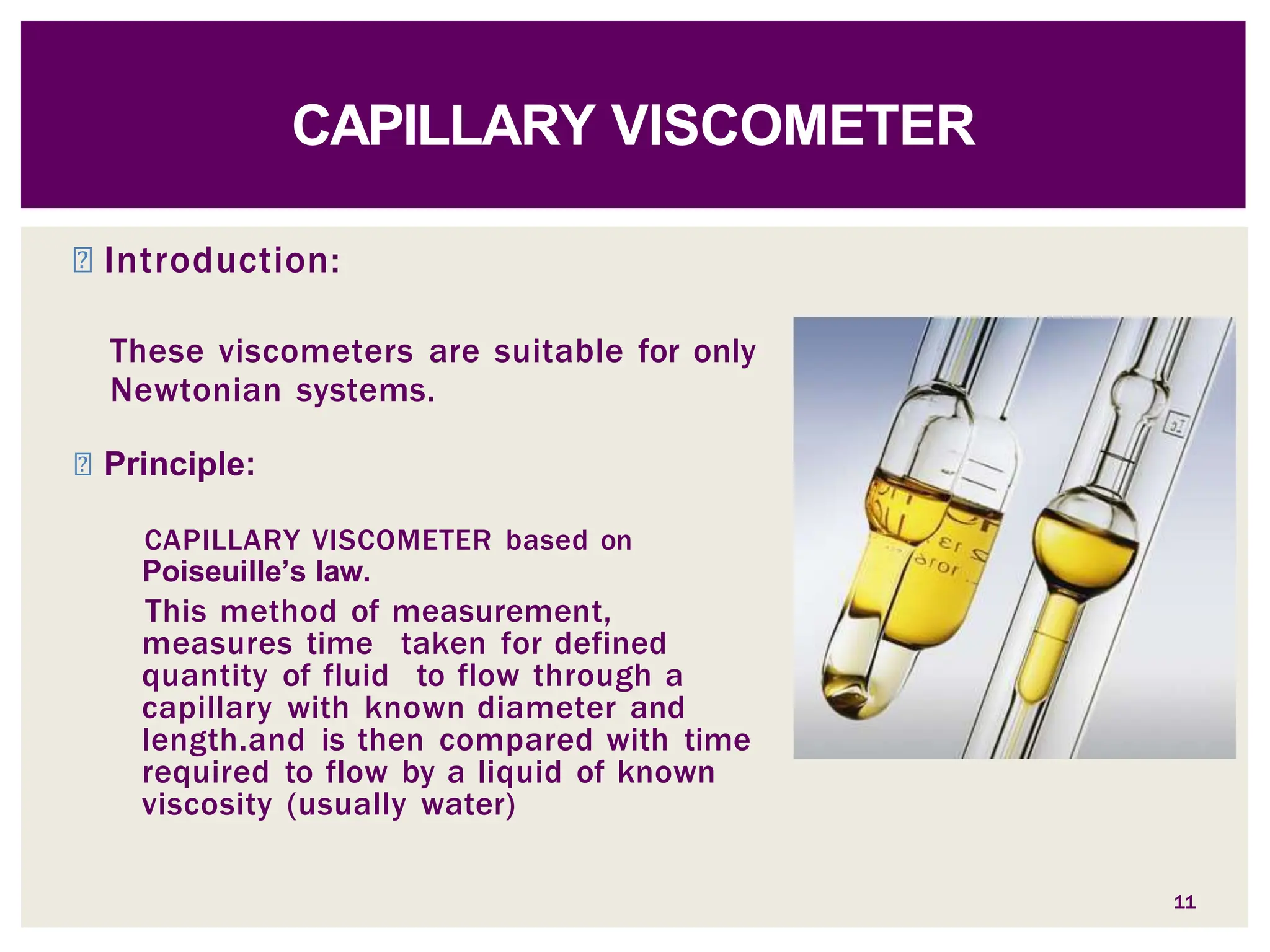
◾ Introduction:
These viscometers are suitable for only
Newtonian systems.
◾ Principle:
CAPILLARY VISCOMETER based on
Poiseuille’s law.
This method of measurement,
measures time taken for defined
quantity of fluid to flow through a
capillary with known diameter and
length.and is then compared with time
required to flow by a liquid of known
viscosity (usually water)
CAPILLARY VISCOMETER
11
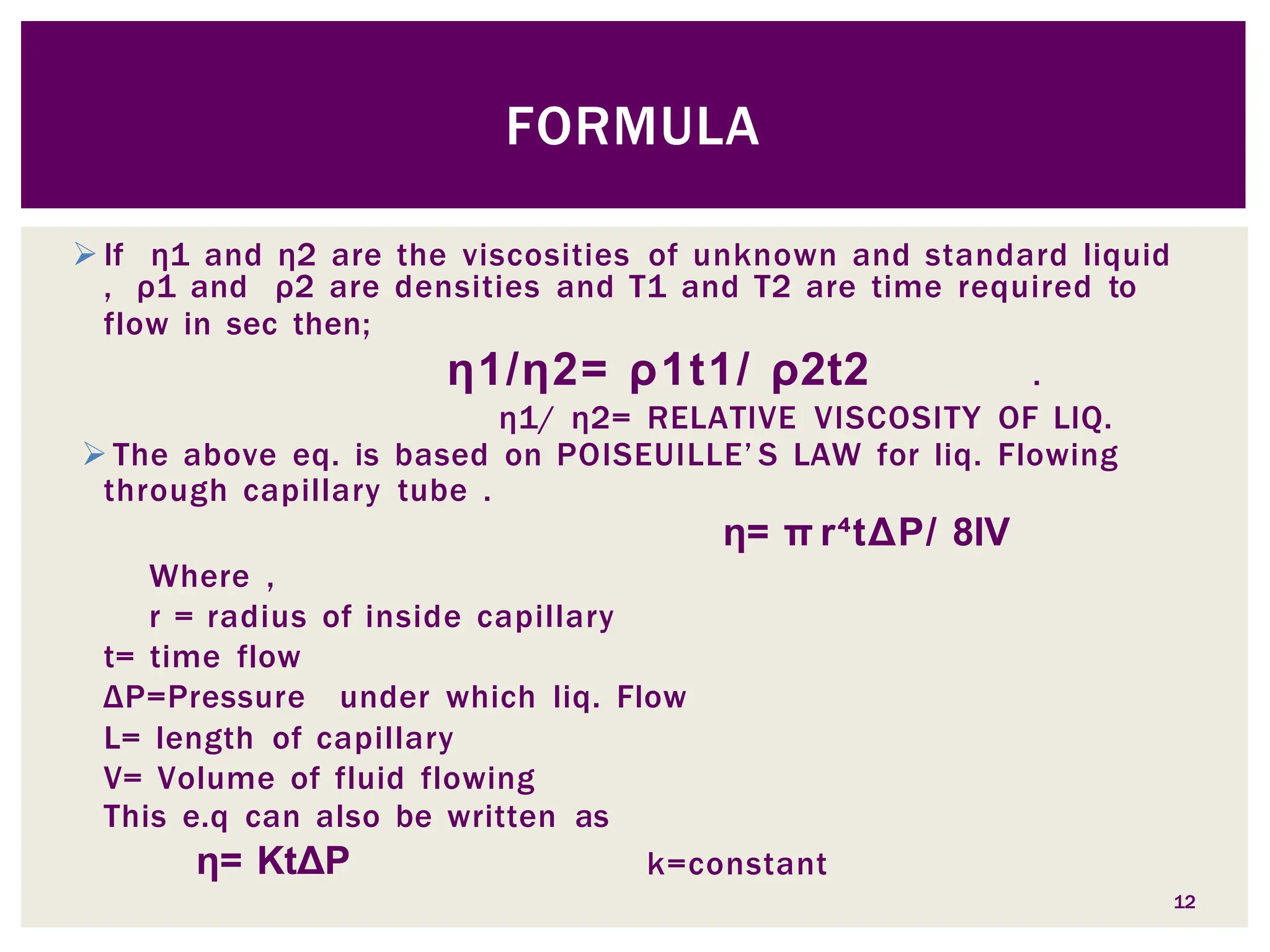
 If η1 and η2 are the viscosities of unknown and standard liquid
, ρ1 and ρ2 are densities and T1 and T2 are time required to
flow in sec then;
12
η1/η2= ρ1t1/ ρ2t2 .
η1/ η2= RELATIVE VISCOSITY OF LIQ.
 The above eq. is based on POISEUILLE’ S LAW for liq. Flowing
through capillary tube .
η= π r⁴tΔP/ 8lV
Where ,
r = radius of inside capillary
t= time flow
ΔP=Pressure under which liq. Flow
L= length of capillary
V= Volume of fluid flowing
This e.q can also be written as
η= KtΔP k=constant
FORMULA
Ostwald’s viscometer
Suspended level
viscometer
13
TYPE OF CAPILLARY VISCOMETER
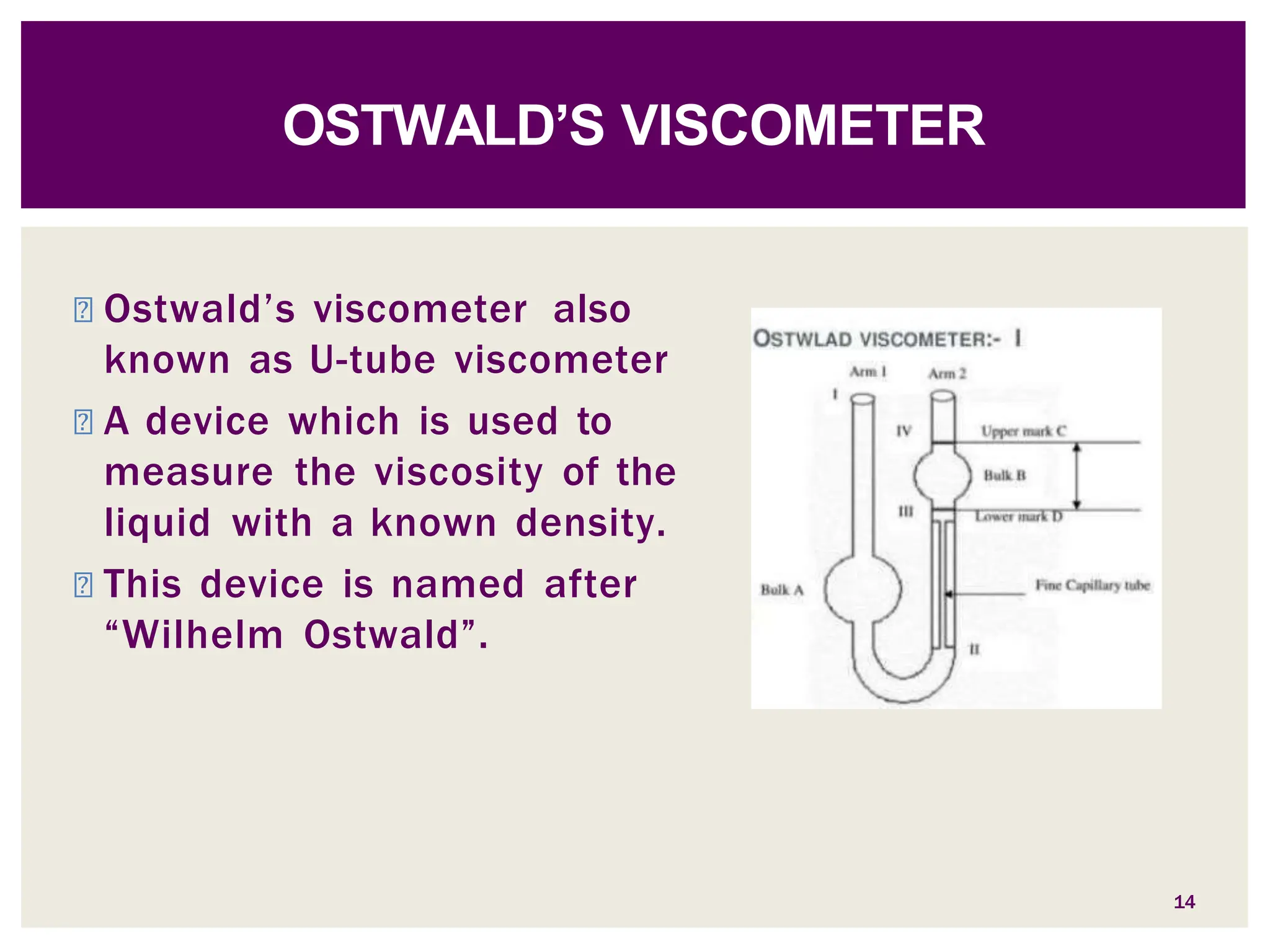
◾ Ostwald’s viscometer also
known as U-tube viscometer
◾ A device which is used to
measure the viscosity of the
liquid with a known density.
◾ This device is named after
“Wilhelm Ostwald”.
OSTWALD’S VISCOMETER
14
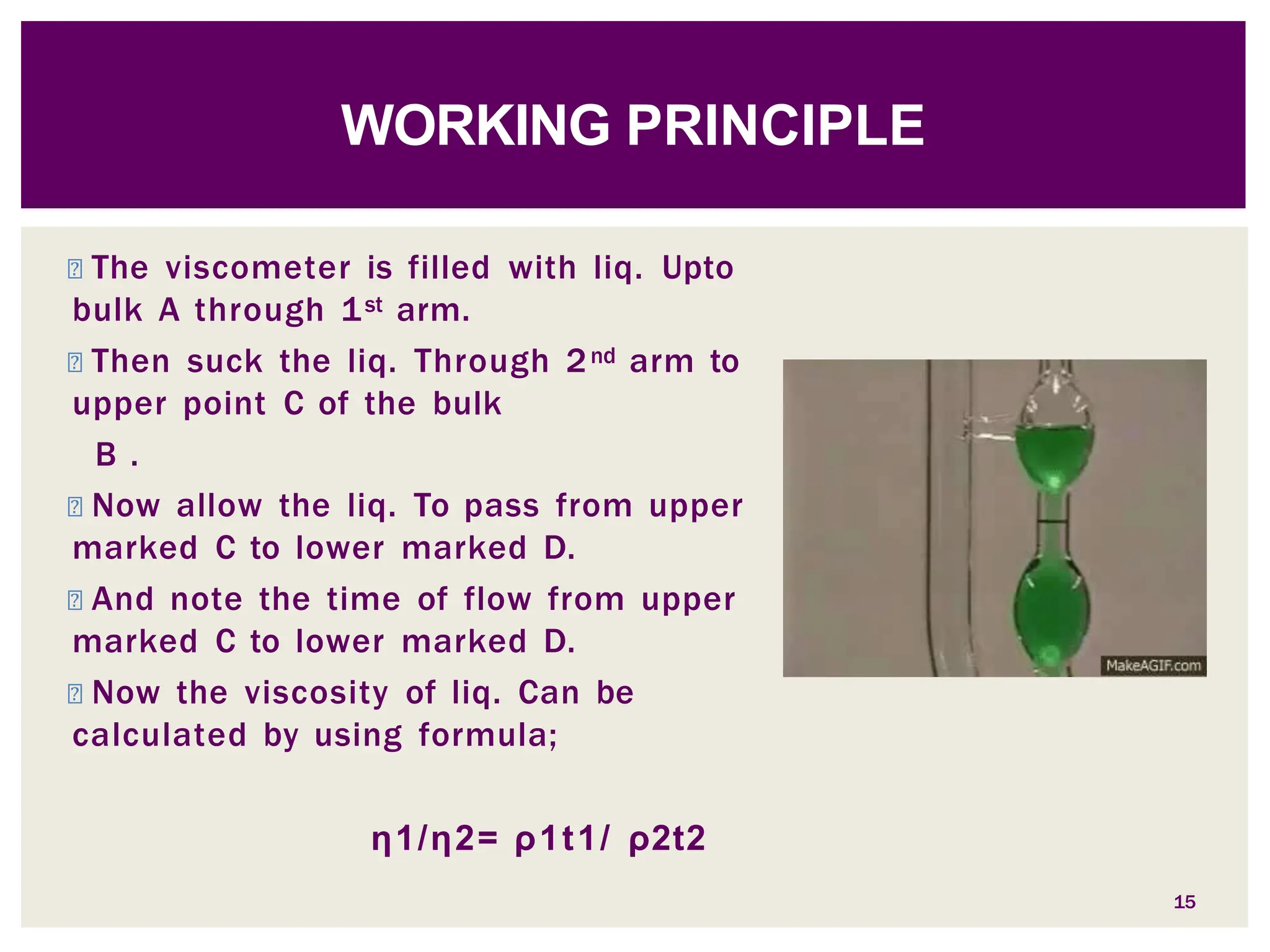
◾ The viscometer is filled with liq. Upto
bulk A through 1st arm.
◾ Then suck the liq. Through 2nd arm to
upper point C of the bulk
B .
◾ Now allow the liq. To pass from upper
marked C to lower marked D.
◾ And note the time of flow from upper
marked C to lower marked D.
◾ Now the viscosity of liq. Can be
calculated by using formula;
η1/η2= ρ1t1/ ρ2t2
WORKING PRINCIPLE
15
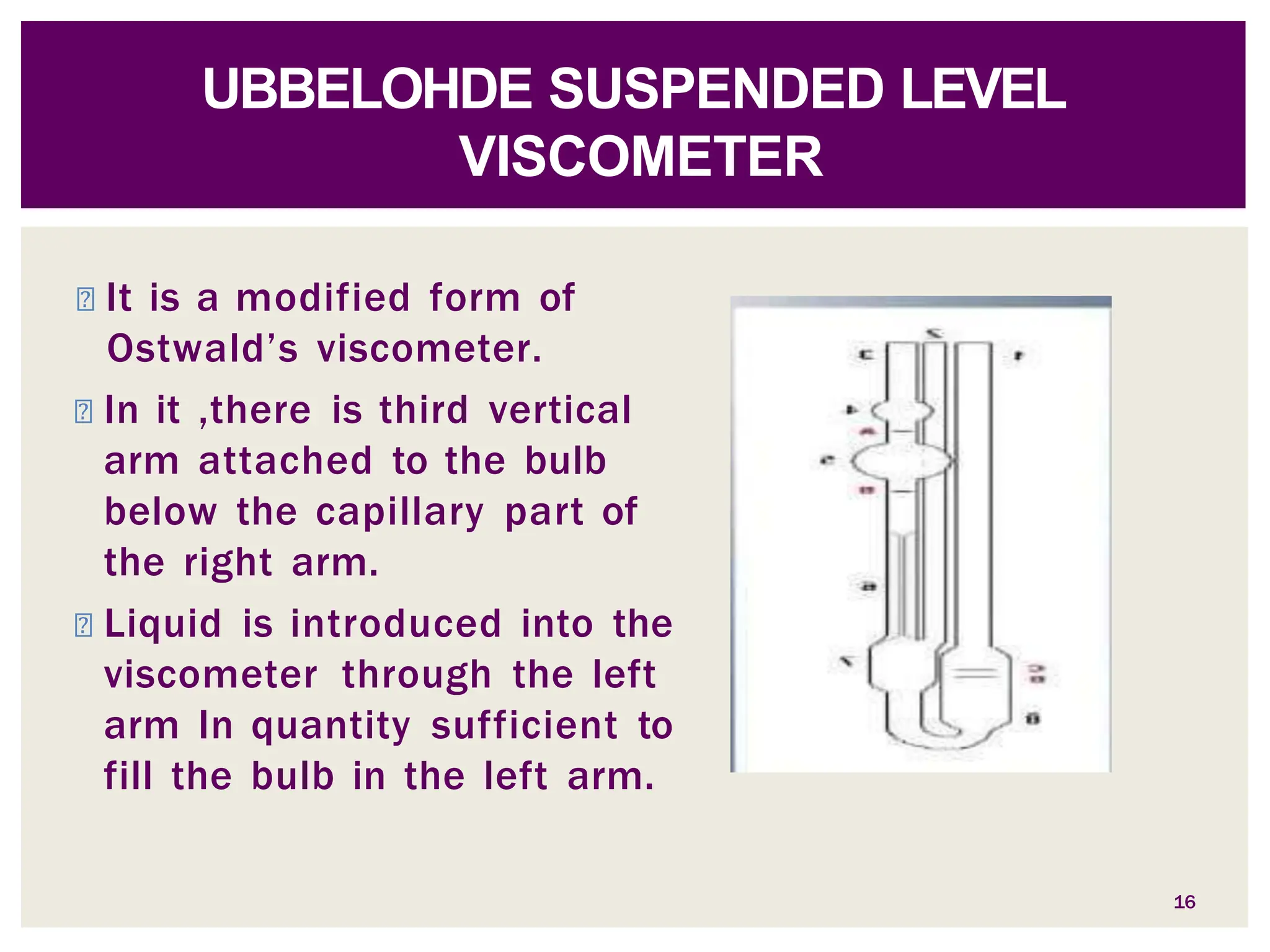
◾ It is a modified form of
Ostwald’s viscometer.
◾ In it ,there is third vertical
arm attached to the bulb
below the capillary part of
the right arm.
◾ Liquid is introduced into the
viscometer through the left
arm In quantity sufficient to
fill the bulb in the left arm.
UBBELOHDE SUSPENDED LEVEL
VISCOMETER
16
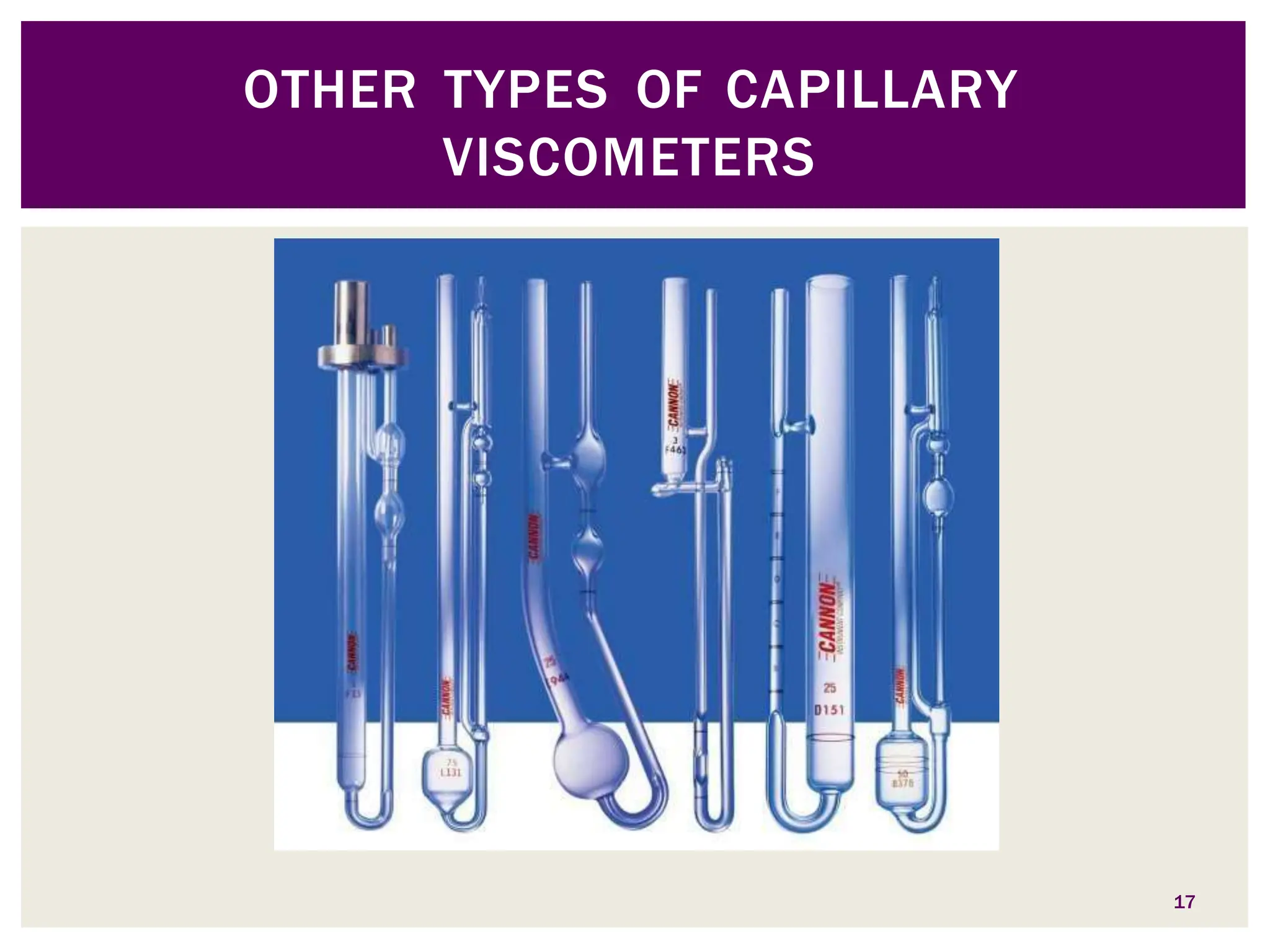
OTHER TYPES OF CAPILLARY
VISCOMETERS
17
Advantages Disadvantages
No single tube is
suitable for all
viscosities
Basic models can only
be used for translucent
fluids
Difficult to clean the
capillary tubes
ADVANTAGES & DISADVANTAGES
Measure precise
viscosities for many
diverse fluids
Small $ Portable
Inexpensive
Easy to use
Can use a wide verity of
capillary tubes on the
same viscometer
18
FALLING SPHERE
VISCOMETER
RISING SPHERE
VISCOMETER
19
FALLING & RISING BODY APPARATUS
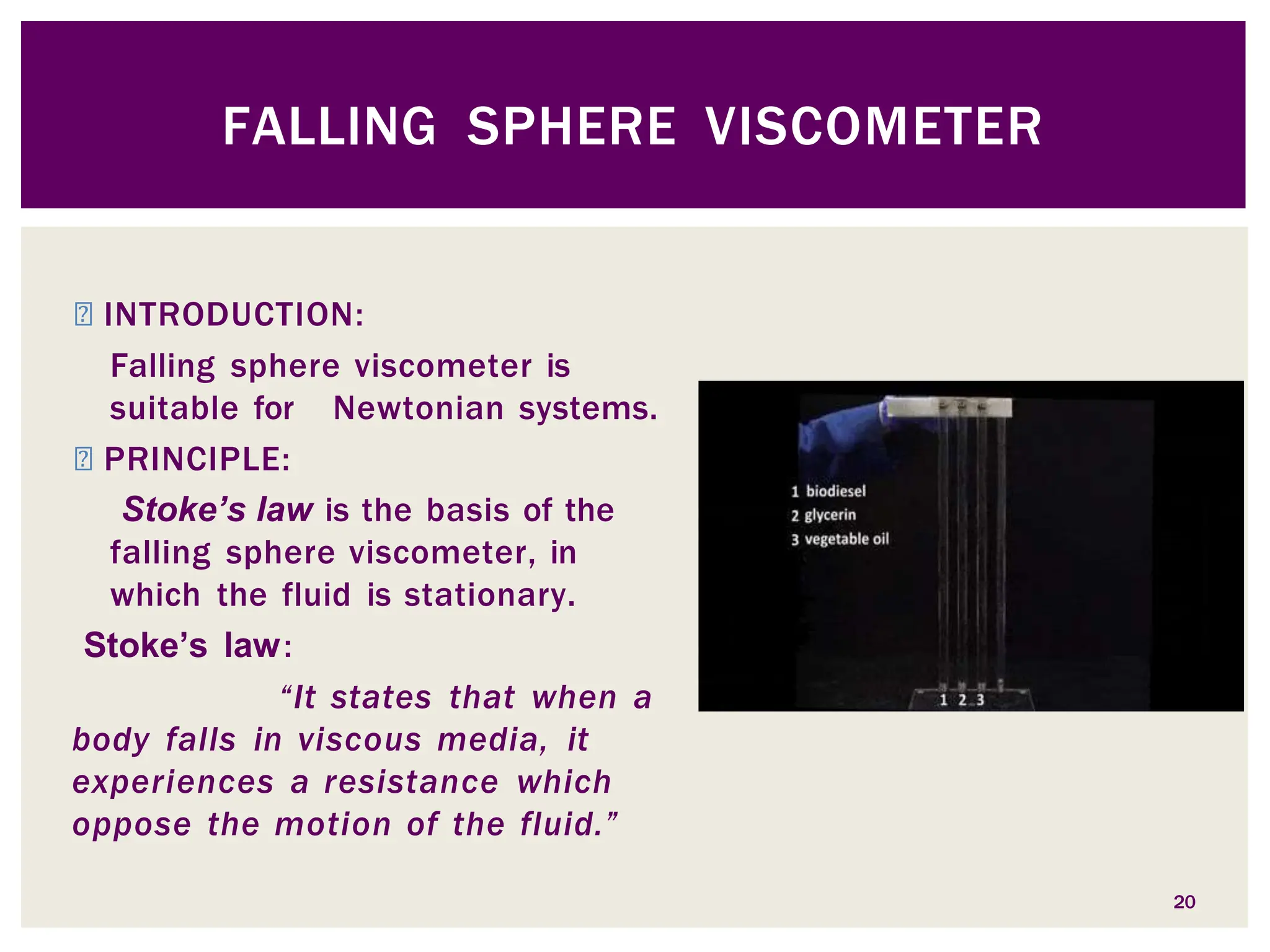
◾ INTRODUCTION:
Falling sphere viscometer is
suitable for Newtonian systems.
◾ PRINCIPLE:
Stoke’s law is the basis of the
falling sphere viscometer, in
which the fluid is stationary.
Stoke’s law:
“It states that when a
body falls in viscous media, it
experiences a resistance which
oppose the motion of the fluid.”
FALLING SPHERE VISCOMETER
20
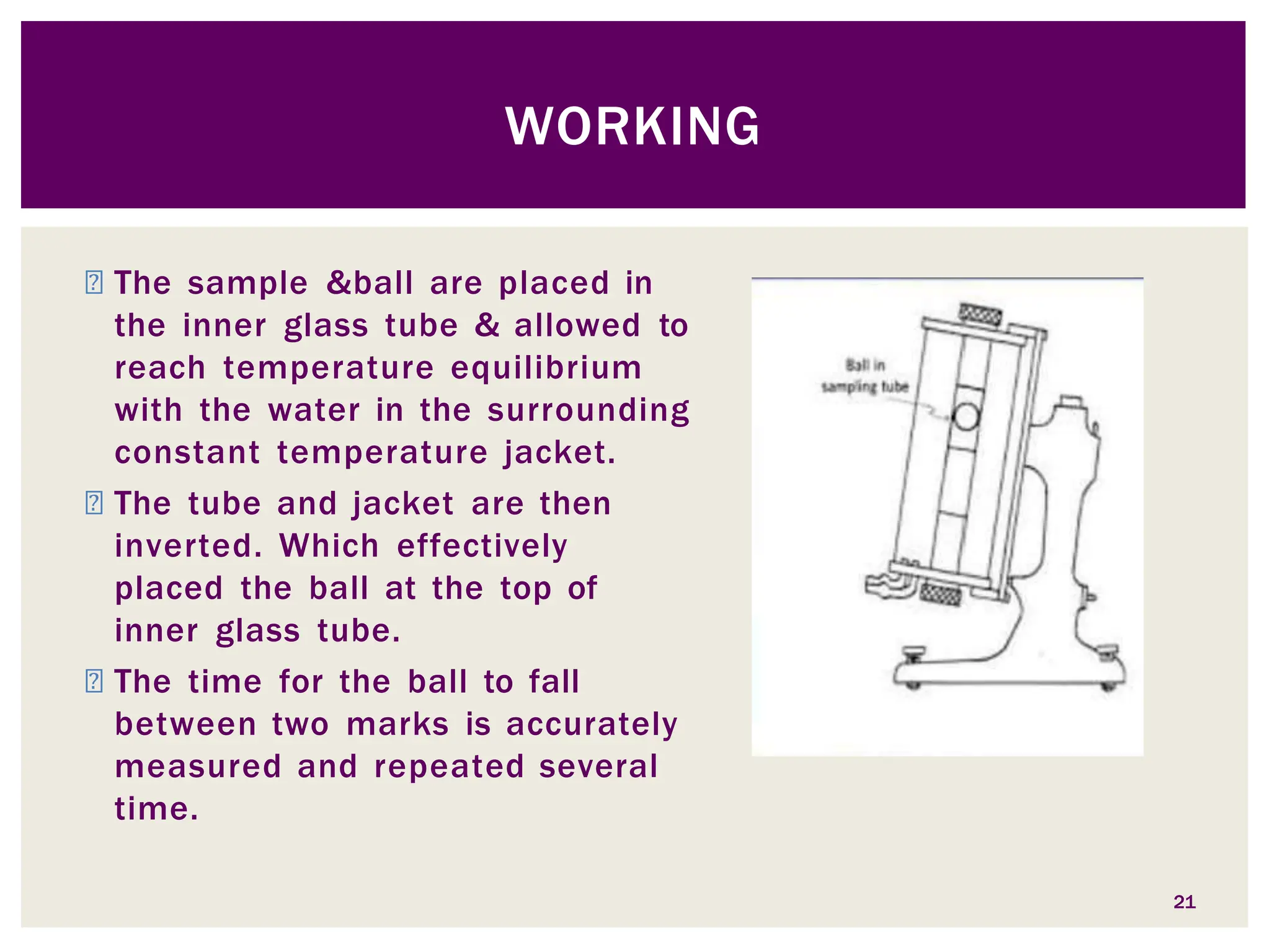
◾ The sample &ball are placed in
the inner glass tube & allowed to
reach temperature equilibrium
with the water in the surrounding
constant temperature jacket.
◾ The tube and jacket are then
inverted. Which effectively
placed the ball at the top of
inner glass tube.
◾ The time for the ball to fall
between two marks is accurately
measured and repeated several
time.
WORKING
21
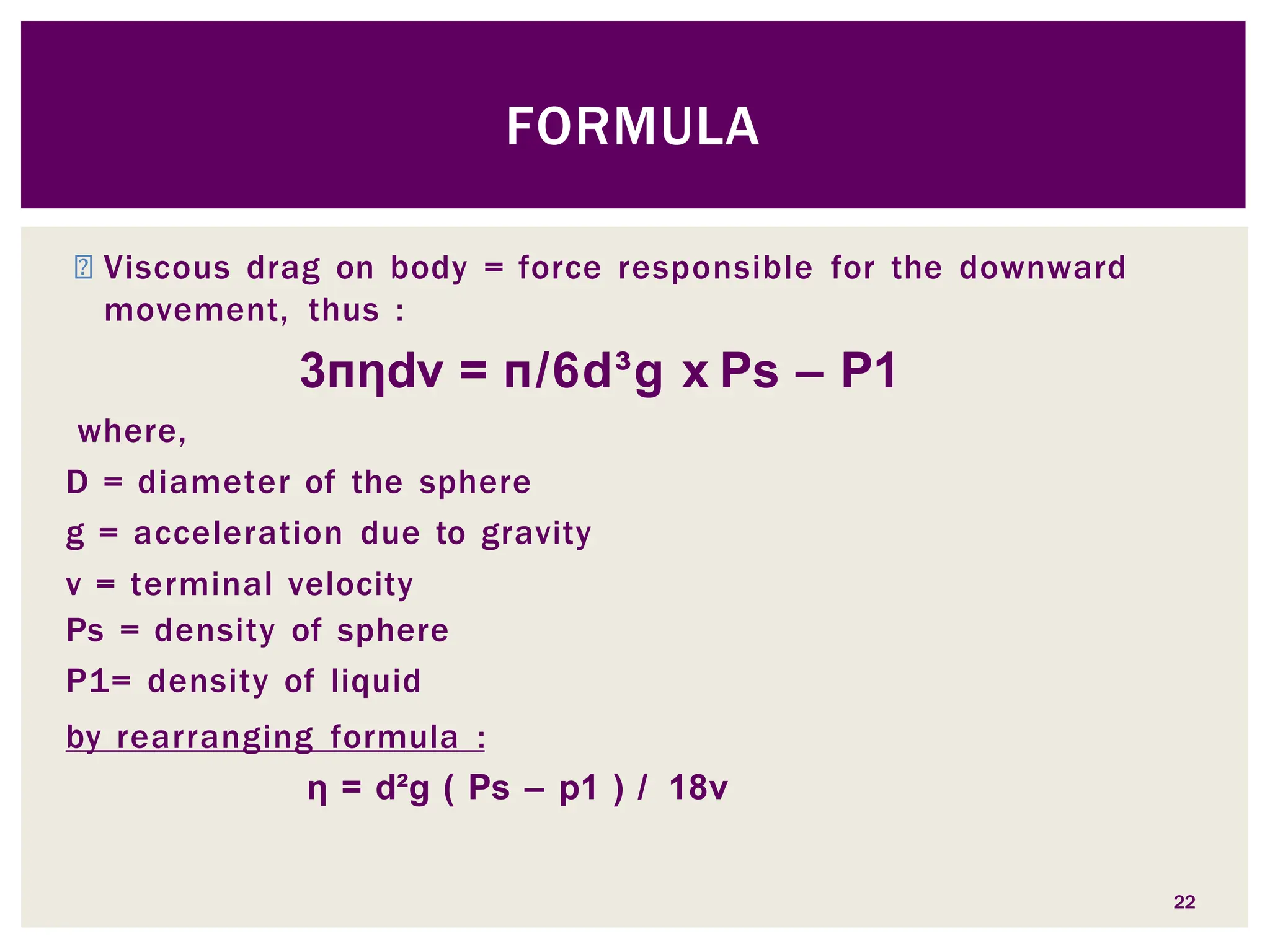
◾ Viscous drag on body = force responsible for the downward
movement, thus :
3пηdv = п/6d³g x Ps – P1
where,
D = diameter of the sphere
g = acceleration due to gravity
v = terminal velocity
Ps = density of sphere
P1= density of liquid
by rearranging formula :
η = d²g ( Ps – p1 ) / 18v
22
FORMULA
◾ HOEPPLER BALL VISCOMETER:
It is a falling ball instrument which uses a short , nearly
vertical glass tube of large diameter and closely fitting ball
of either steel or glass.
The sample and the ball are loaded into the inner cylinder
and brought to the temperature of measurement by means
of a constant temperature outer jacket.
The loading pin is released and the apparatus is inverted to
place the ball in the initial stating position .
The time for the ball to transverse the distance between
two marks is measured
A minimum 30 sec time is used for best result.
23
EXAMPLE
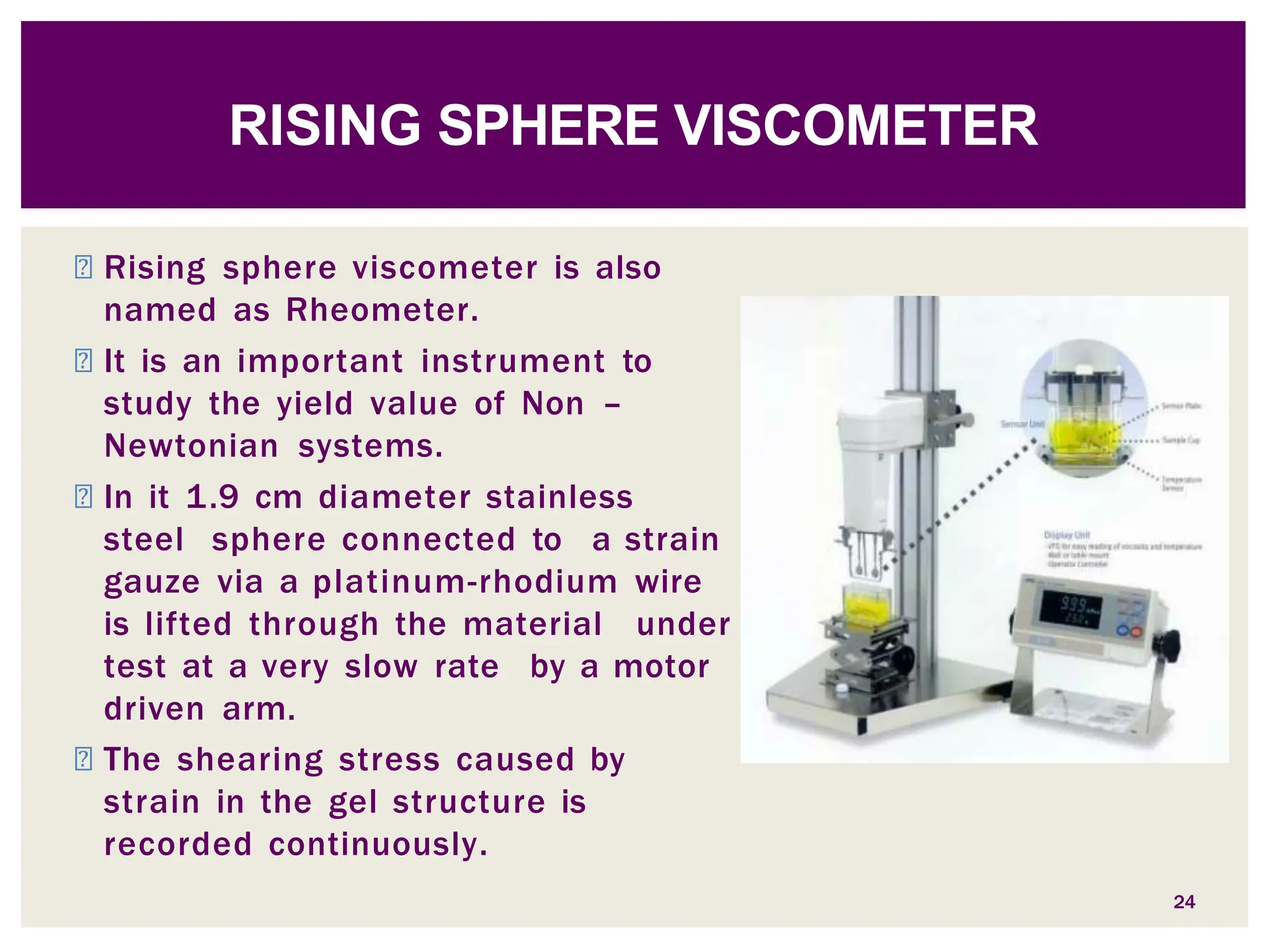
◾ Rising sphere viscometer is also
named as Rheometer.
◾ It is an important instrument to
study the yield value of Non –
Newtonian systems.
◾ In it 1.9 cm diameter stainless
steel sphere connected to a strain
gauze via a platinum-rhodium wire
is lifted through the material under
test at a very slow rate by a motor
driven arm.
◾ The shearing stress caused by
strain in the gel structure is
recorded continuously.
RISING SPHERE VISCOMETER
24
High shear devices,
This is incredibly
important when
dealing with non-
Newtonian fluids
which includes most
of the fluids used in
printing and coating
today.
ADVANTAGES DISADVANTAGES
Can be maintenance
intensive
Can be parts intensive
Replacement parts can
be costly
25
FALLING & RISING BODY APPARATUS
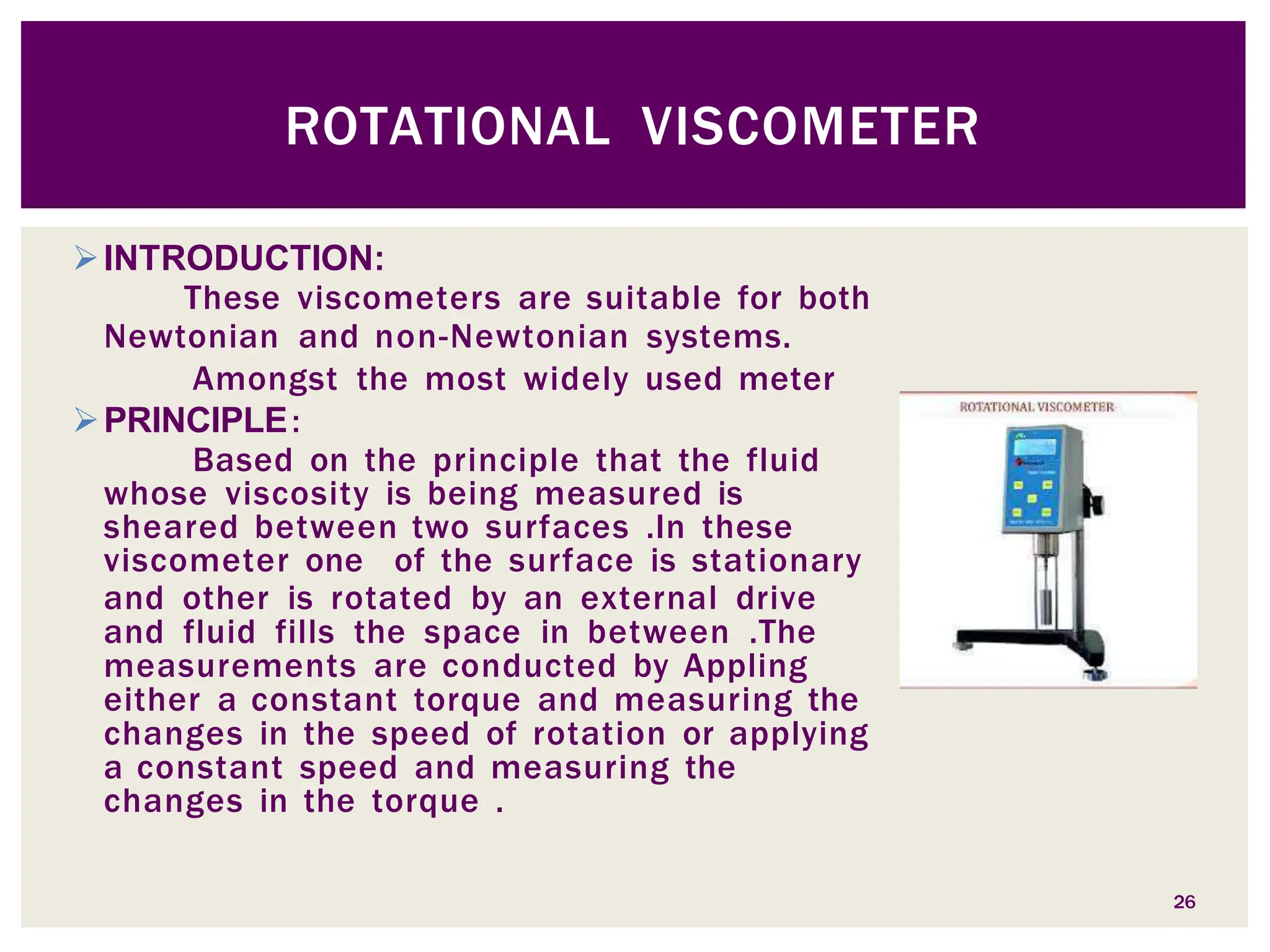
INTRODUCTION:
These viscometers are suitable for both
Newtonian and non-Newtonian systems.
Amongst the most widely used meter
PRINCIPLE:
Based on the principle that the fluid
whose viscosity is being measured is
sheared between two surfaces .In these
viscometer one of the surface is stationary
and other is rotated by an external drive
and fluid fills the space in between .The
measurements are conducted by Appling
either a constant torque and measuring the
changes in the speed of rotation or applying
a constant speed and measuring the
changes in the torque .
ROTATIONAL VISCOMETER
26
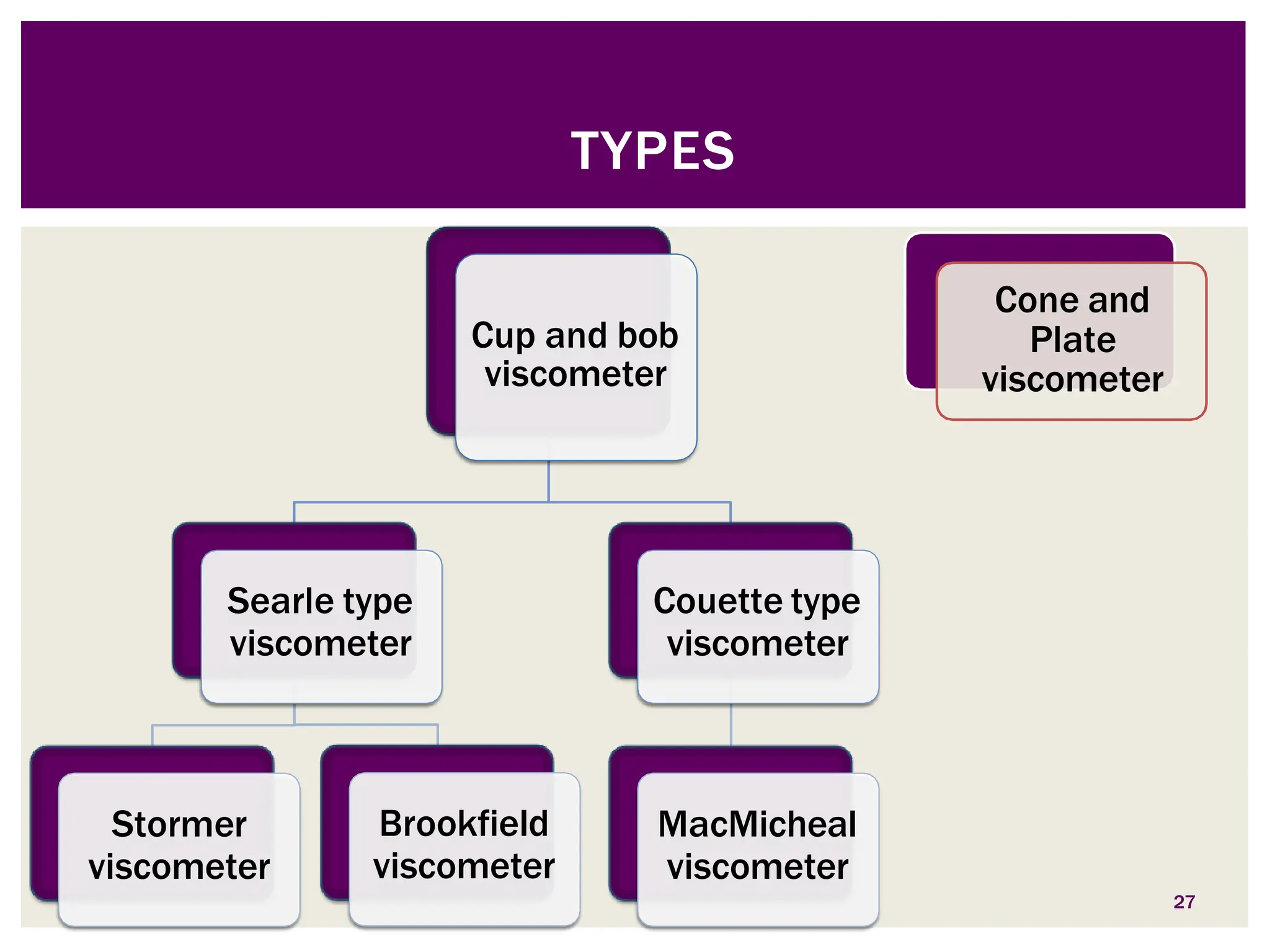
TYPES
Cup and bob
viscometer
Searle type
viscometer
Stormer
viscometer
Brookfield
viscometer
Couette type
viscometer
MacMicheal
viscometer
Cone and
Plate
viscometer
27
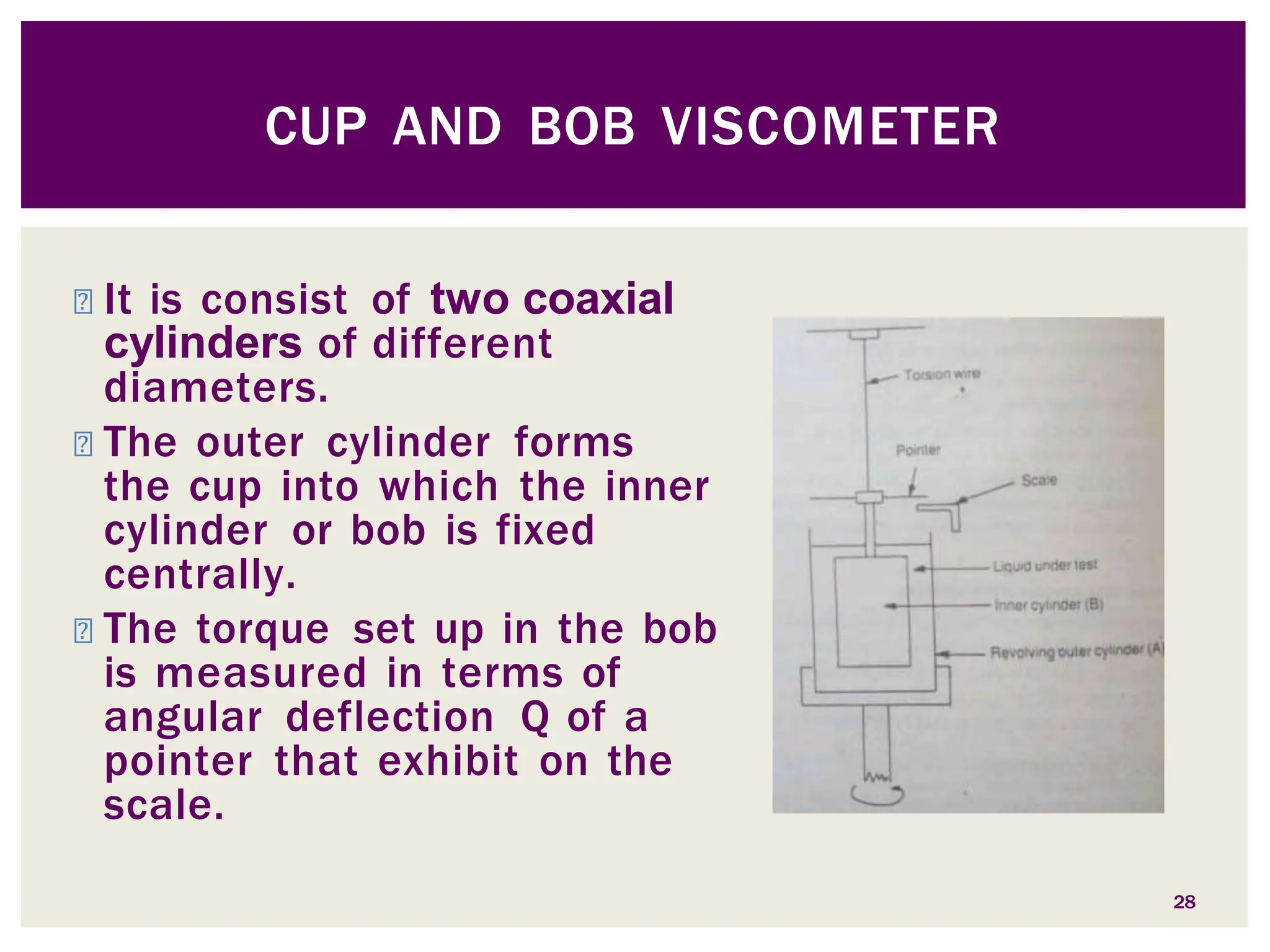
◾ It is consist of two coaxial
cylinders of different
diameters.
◾ The outer cylinder forms
the cup into which the inner
cylinder or bob is fixed
centrally.
◾ The torque set up in the bob
is measured in terms of
angular deflection Q of a
pointer that exhibit on the
scale.
CUP AND BOB VISCOMETER
28
TYPES
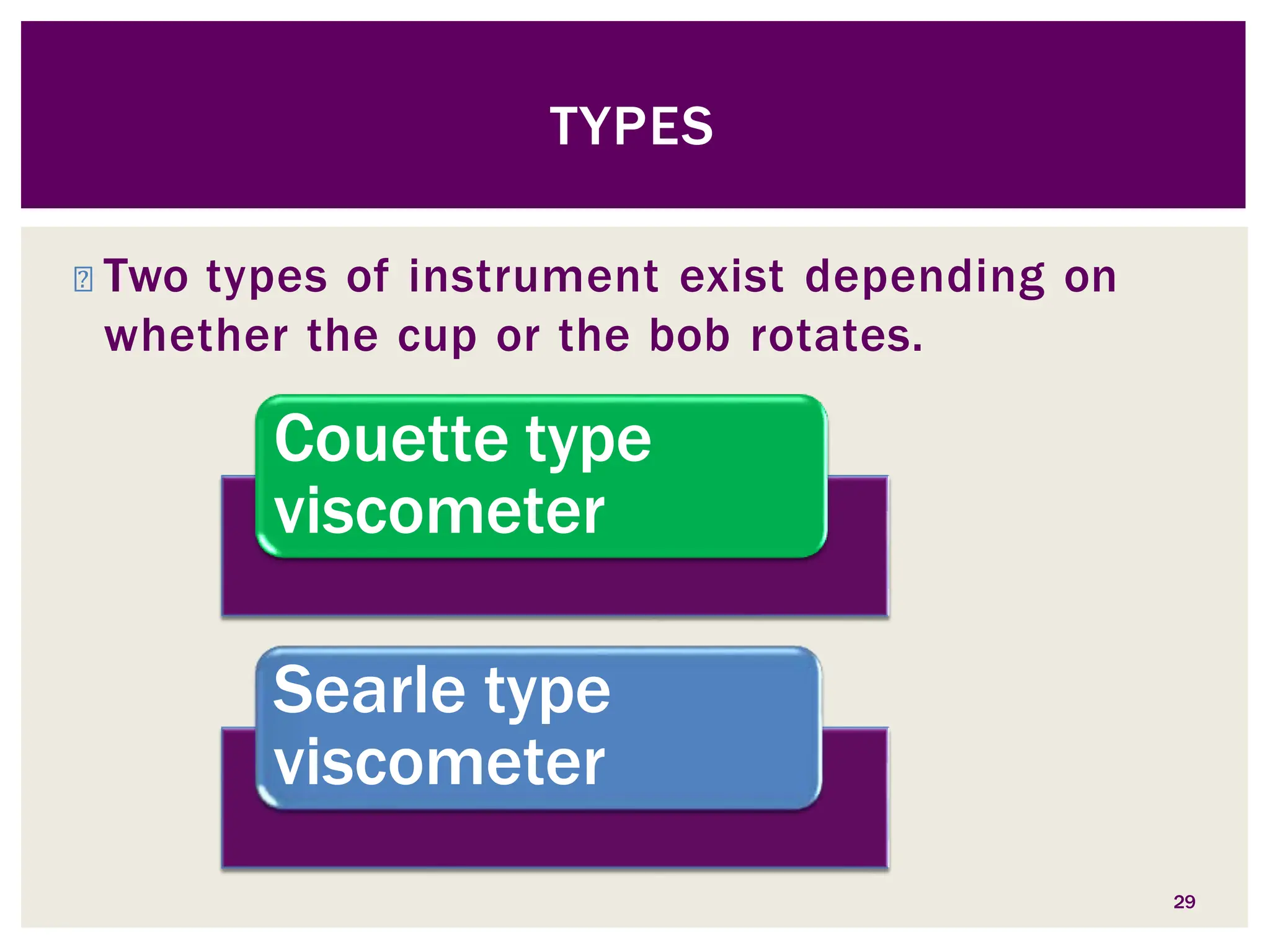
◾ Two types of instrument exist depending on
whether the cup or the bob rotates.
Couette type
viscometer
Searle type
viscometer
29
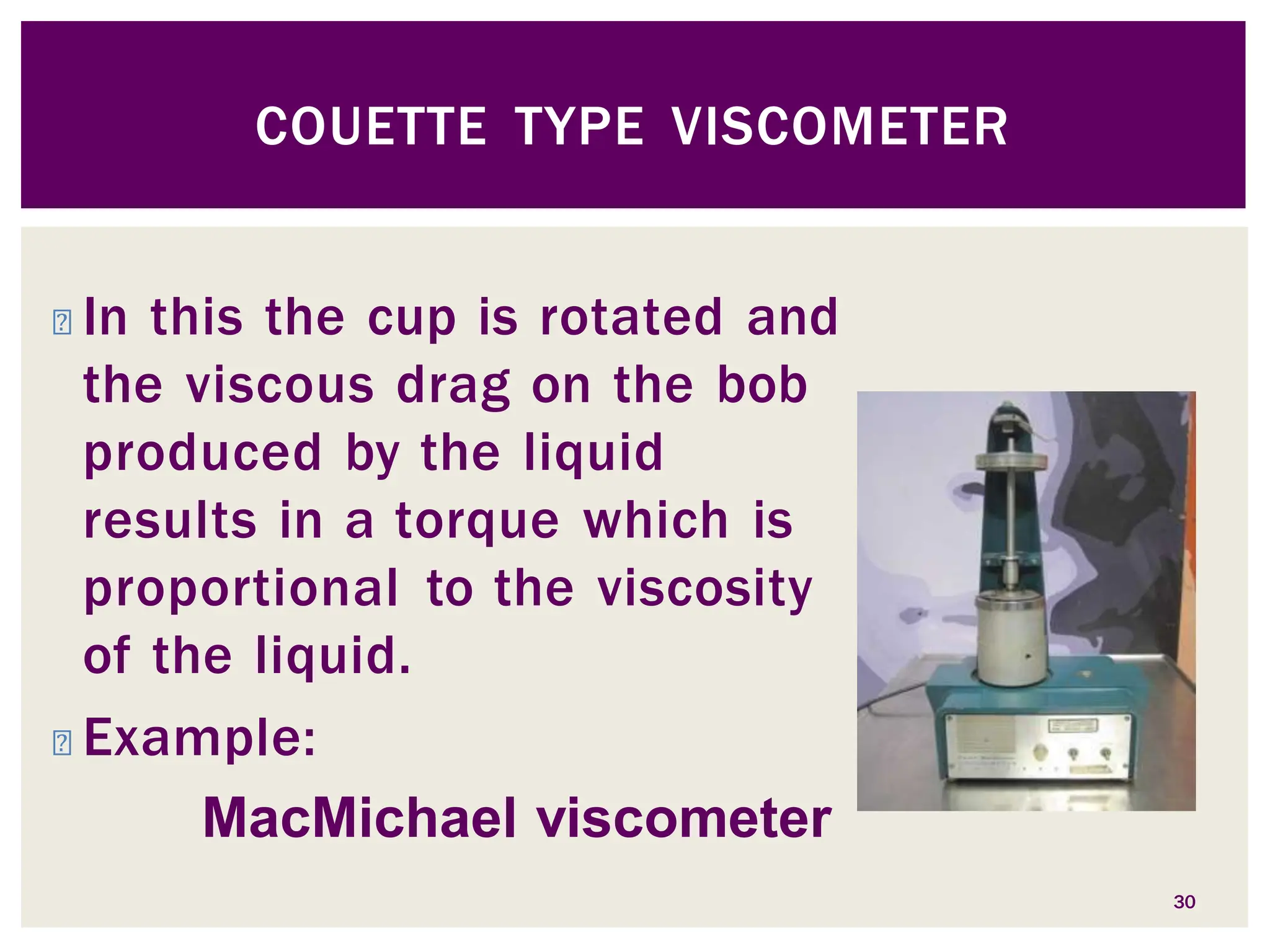
◾ In this the cup is rotated and
the viscous drag on the bob
produced by the liquid
results in a torque which is
proportional to the viscosity
of the liquid.
◾ Example:
MacMichael viscometer
COUETTE TYPE VISCOMETER
30
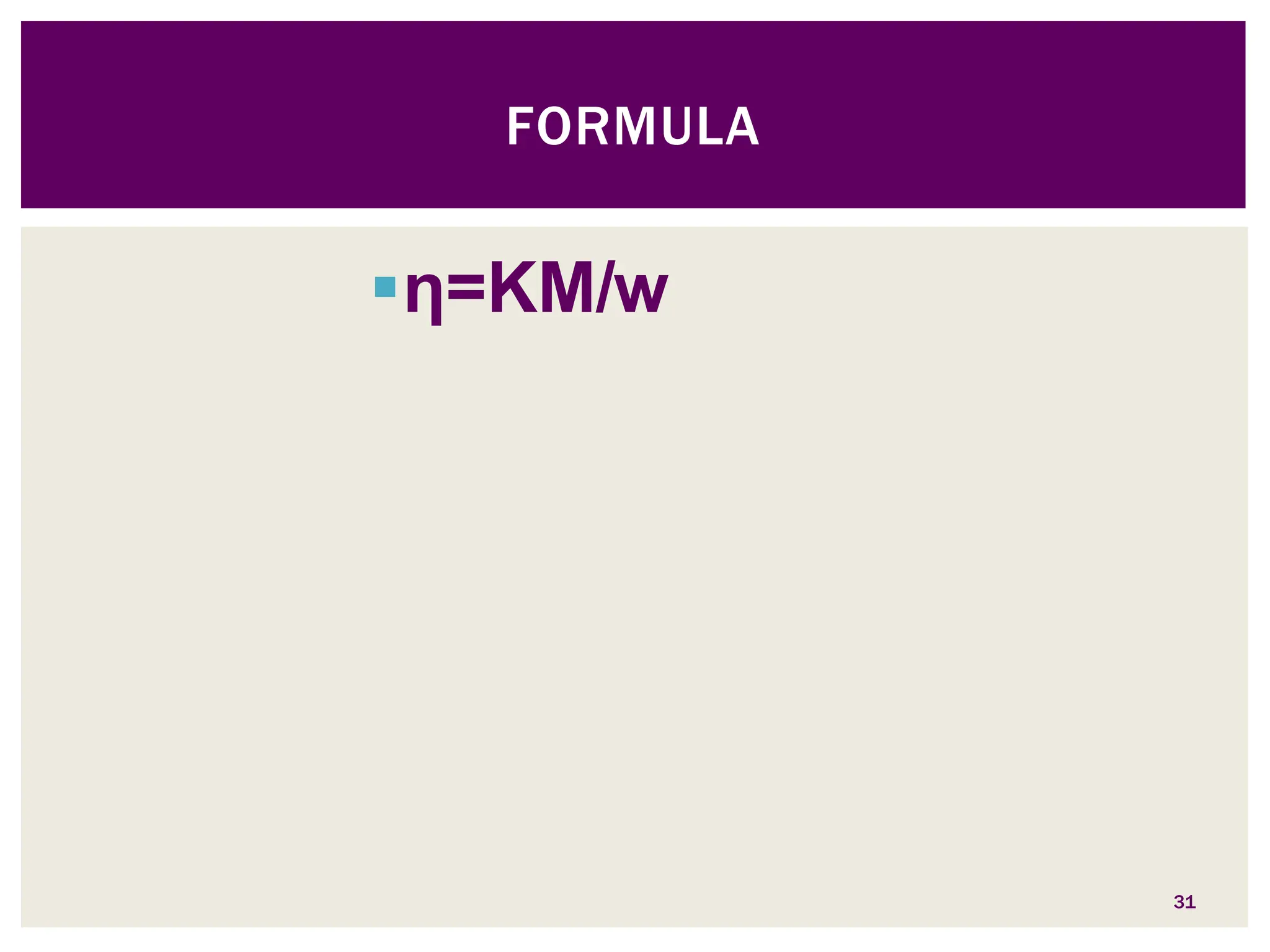
η=KM/w
31
FORMULA
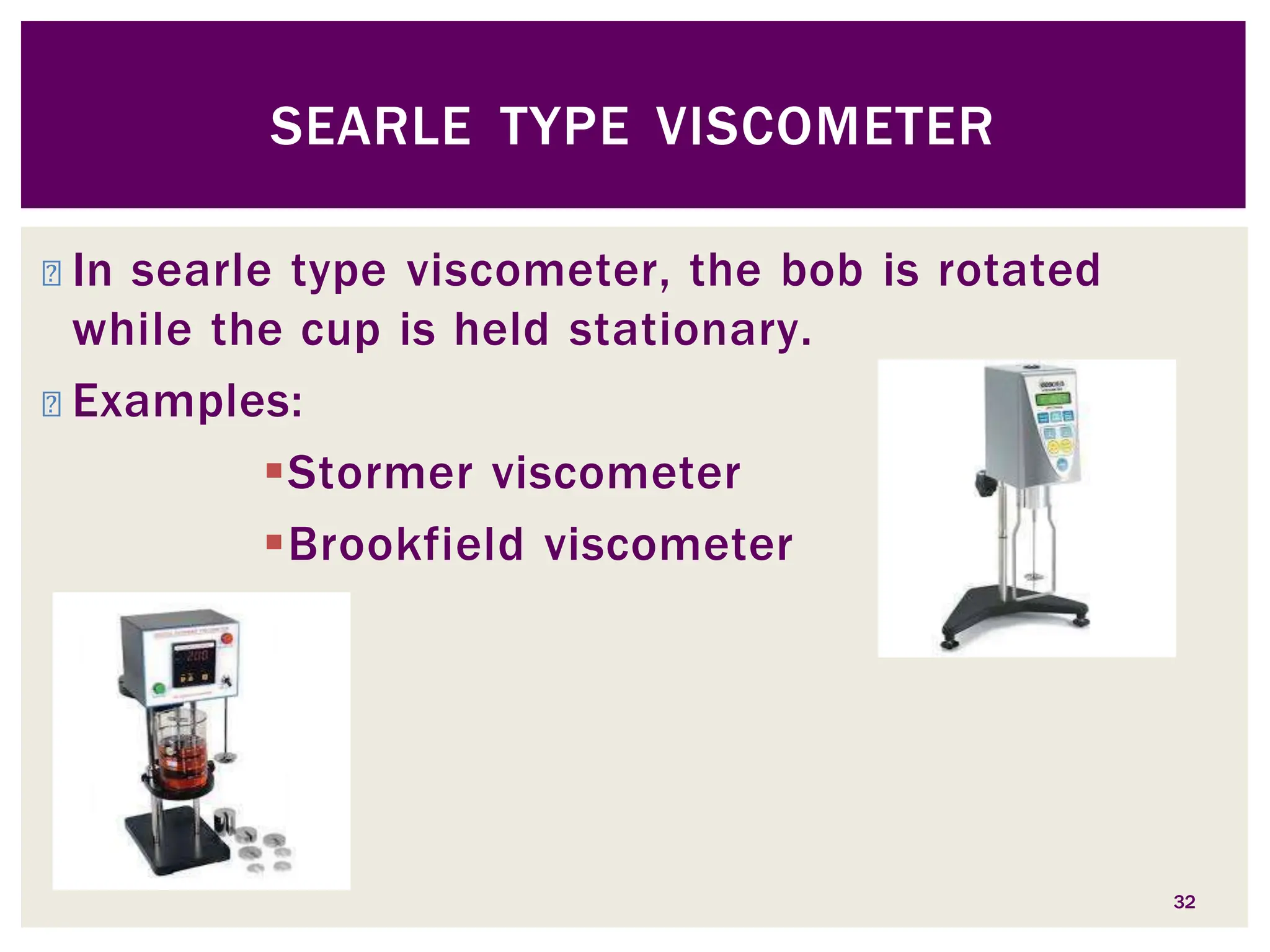
◾ In searle type viscometer, the bob is rotated
while the cup is held stationary.
◾ Examples:
Stormer viscometer
Brookfield viscometer
SEARLE TYPE VISCOMETER
32
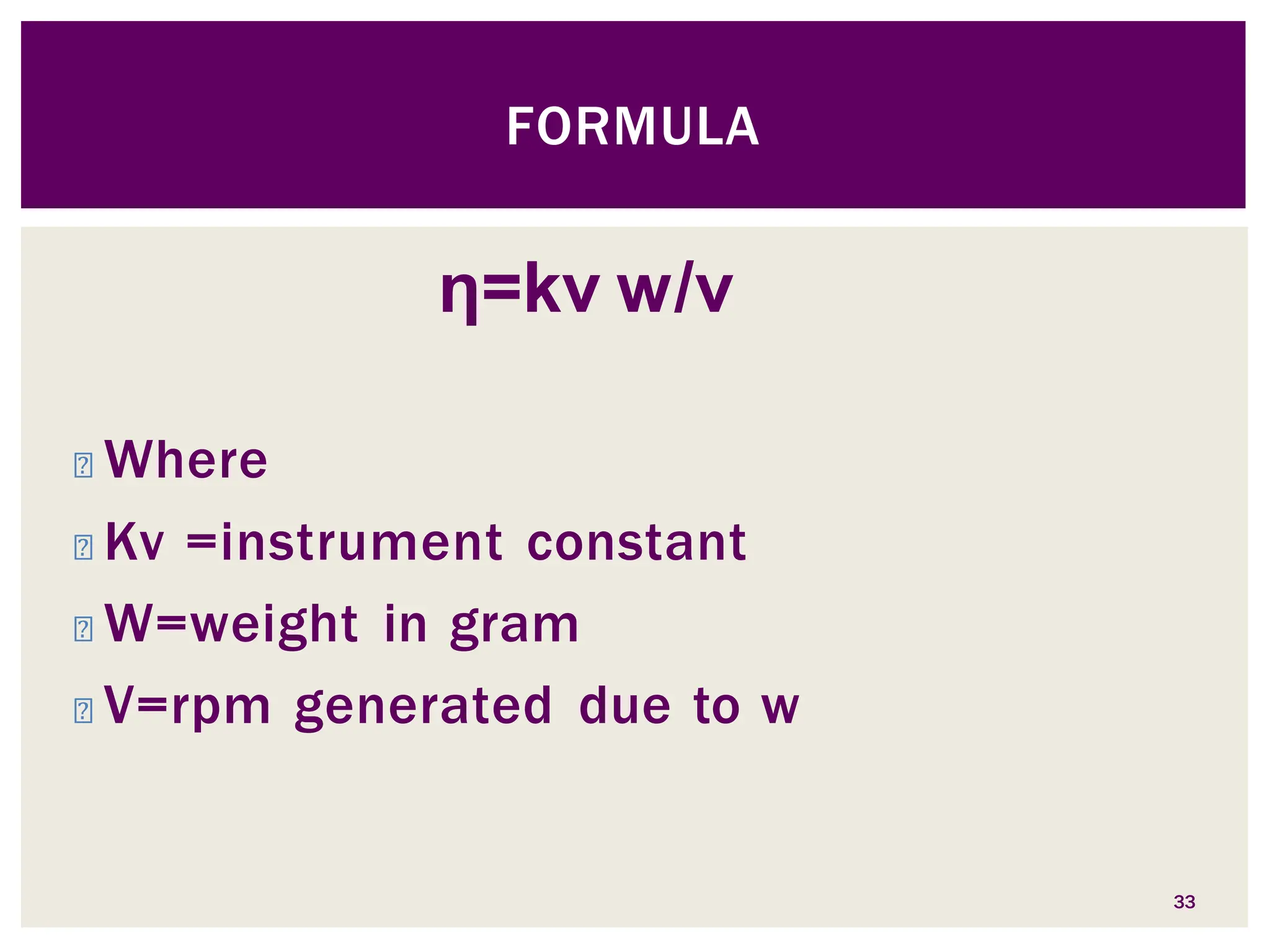
η=kv w/v
33
◾ Where
◾ Kv =instrument constant
◾ W=weight in gram
◾ V=rpm generated due to w
FORMULA
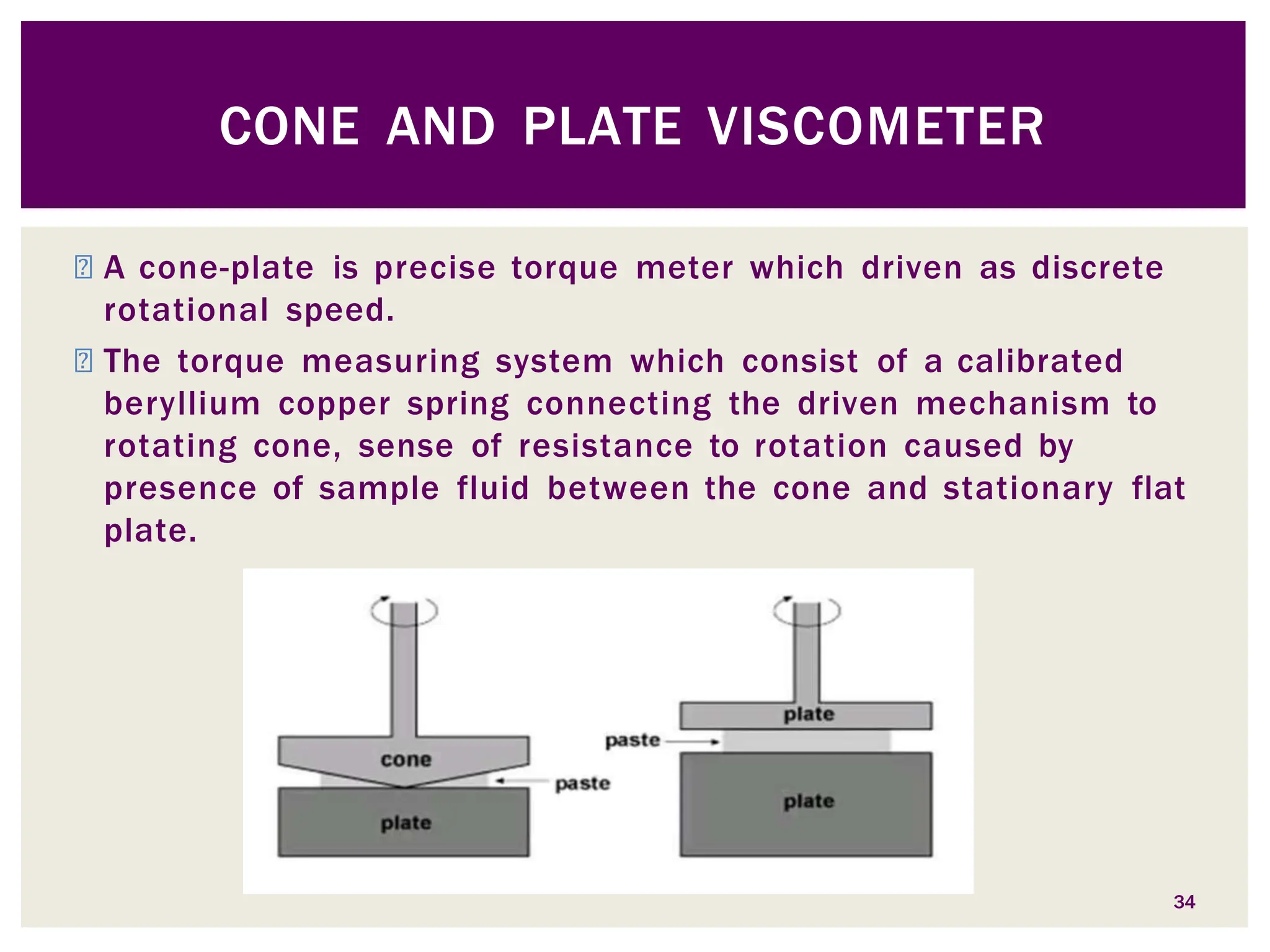
◾ A cone-plate is precise torque meter which driven as discrete
rotational speed.
◾ The torque measuring system which consist of a calibrated
beryllium copper spring connecting the driven mechanism to
rotating cone, sense of resistance to rotation caused by
presence of sample fluid between the cone and stationary flat
plate.
CONE AND PLATE VISCOMETER
34
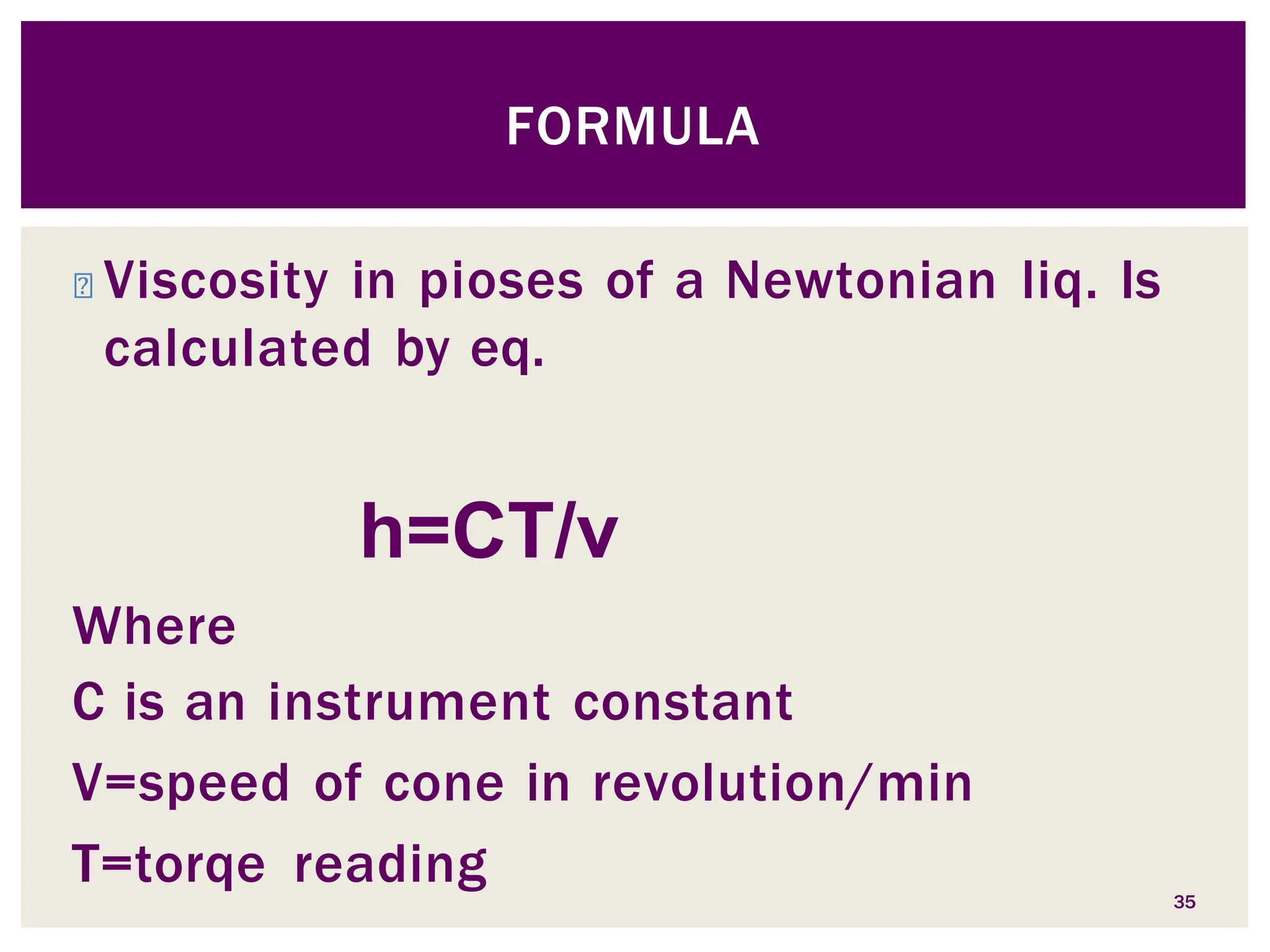
◾ Viscosity in pioses of a Newtonian liq. Is
calculated by eq.
h=CT/v
Where
C is an instrument constant
V=speed of cone in revolution/min
T=torqe reading 35
FORMULA
Can measure viscosities
of opaque, settling, or
non-Newtonian fluids.
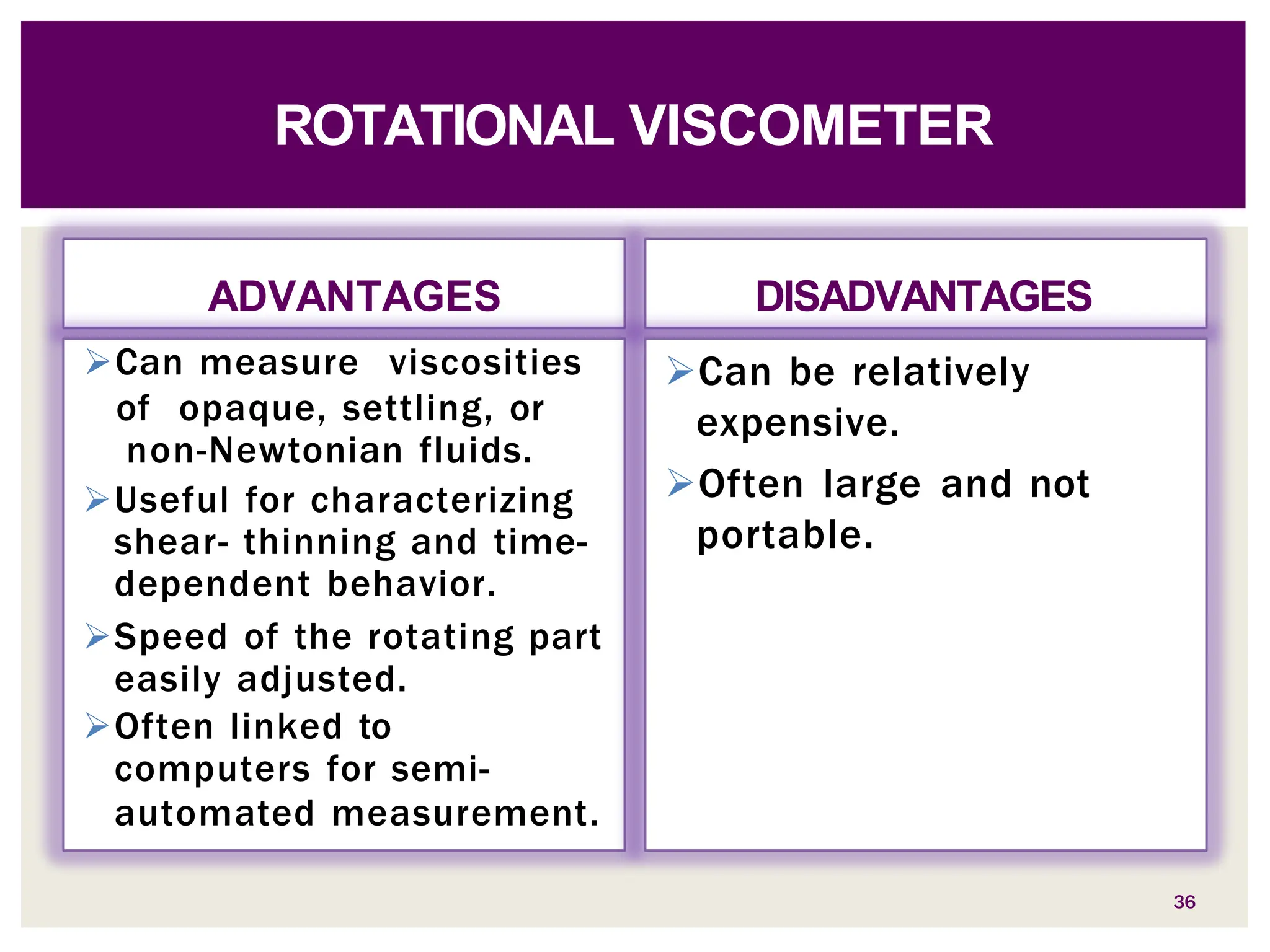
Useful for characterizing
shear- thinning and time-
dependent behavior.
Speed of the rotating part
easily adjusted.
Often linked to
computers for semi-
automated measurement.
ADVANTAGES DISADVANTAGES
Can be relatively
expensive.
Often large and not
portable.
36
ROTATIONAL VISCOMETER
◾ Vibrational viscometers
◾ Bubble viscometers
◾ Oscillating viscometers
◾ Orifice viscometers.
◾ Stabinger Viscometers
◾ Electromagnetically spinning sphere
viscometer (EMSV)
◾ Rectangular-slit viscometers
37
OTHER TYPES OF VISCOMETERS

Viscometry and Types of industrial Viscometers

  • 1.
    ◾ Viscosity Definition Formula andUnits ◾ Viscometer Introduction Importance ◾ Types of Viscometer 5 CONTENTS
  • 2.
    ◾ A fluidflow property. ◾ Internal property of a fluid that offers resistance to flow. ◾ It is a measure of how easily a fluid can flow. ◾ It can also be viewed as a resistance to shear force, more viscous the fluid is, higher the resistance. VISCOSITY 6
  • 3.
    ◾ Formula: Viscosity =shear stress shear rate ◾ SI unit: The units of viscosity is: pious centi-pious FORMULA & UNITS 7
  • 4.
    ◾ Definition: “A viscometeris an instrument used to measure the viscosity of a fluid.” ◾ It is also known as “Viscosimeter.” ◾ Viscometer only measures under one flow condition ◾ The measure of the resistance is taken by measuring the drag resistance during relative motion through the fluid. 8 VISCOMETER
  • 5.
    ◾ Measuring viscosityis important when considering process conditions for materials that need to be pumped or piped . It effects dipping and coating performance , which is particularly relevant to syrups and lotions. ◾ Viscometer can be used to monitor batch consistency and quality control. ◾ They are also used to characterize plastics. 9 IMPORTANCE
  • 6.
    TYPES OF VISCOMETER Capillaryviscometer Falling and rising body apparatus Rotational viscometer 10
  • 7.
    ◾ Introduction: These viscometersare suitable for only Newtonian systems. ◾ Principle: CAPILLARY VISCOMETER based on Poiseuille’s law. This method of measurement, measures time taken for defined quantity of fluid to flow through a capillary with known diameter and length.and is then compared with time required to flow by a liquid of known viscosity (usually water) CAPILLARY VISCOMETER 11
  • 8.
     If η1and η2 are the viscosities of unknown and standard liquid , ρ1 and ρ2 are densities and T1 and T2 are time required to flow in sec then; 12 η1/η2= ρ1t1/ ρ2t2 . η1/ η2= RELATIVE VISCOSITY OF LIQ.  The above eq. is based on POISEUILLE’ S LAW for liq. Flowing through capillary tube . η= π r⁴tΔP/ 8lV Where , r = radius of inside capillary t= time flow ΔP=Pressure under which liq. Flow L= length of capillary V= Volume of fluid flowing This e.q can also be written as η= KtΔP k=constant FORMULA
  • 9.
  • 10.
    ◾ Ostwald’s viscometeralso known as U-tube viscometer ◾ A device which is used to measure the viscosity of the liquid with a known density. ◾ This device is named after “Wilhelm Ostwald”. OSTWALD’S VISCOMETER 14
  • 11.
    ◾ The viscometeris filled with liq. Upto bulk A through 1st arm. ◾ Then suck the liq. Through 2nd arm to upper point C of the bulk B . ◾ Now allow the liq. To pass from upper marked C to lower marked D. ◾ And note the time of flow from upper marked C to lower marked D. ◾ Now the viscosity of liq. Can be calculated by using formula; η1/η2= ρ1t1/ ρ2t2 WORKING PRINCIPLE 15
  • 12.
    ◾ It isa modified form of Ostwald’s viscometer. ◾ In it ,there is third vertical arm attached to the bulb below the capillary part of the right arm. ◾ Liquid is introduced into the viscometer through the left arm In quantity sufficient to fill the bulb in the left arm. UBBELOHDE SUSPENDED LEVEL VISCOMETER 16
  • 13.
    OTHER TYPES OFCAPILLARY VISCOMETERS 17
  • 14.
    Advantages Disadvantages No singletube is suitable for all viscosities Basic models can only be used for translucent fluids Difficult to clean the capillary tubes ADVANTAGES & DISADVANTAGES Measure precise viscosities for many diverse fluids Small $ Portable Inexpensive Easy to use Can use a wide verity of capillary tubes on the same viscometer 18
  • 15.
  • 16.
    ◾ INTRODUCTION: Falling sphereviscometer is suitable for Newtonian systems. ◾ PRINCIPLE: Stoke’s law is the basis of the falling sphere viscometer, in which the fluid is stationary. Stoke’s law: “It states that when a body falls in viscous media, it experiences a resistance which oppose the motion of the fluid.” FALLING SPHERE VISCOMETER 20
  • 17.
    ◾ The sample&ball are placed in the inner glass tube & allowed to reach temperature equilibrium with the water in the surrounding constant temperature jacket. ◾ The tube and jacket are then inverted. Which effectively placed the ball at the top of inner glass tube. ◾ The time for the ball to fall between two marks is accurately measured and repeated several time. WORKING 21
  • 18.
    ◾ Viscous dragon body = force responsible for the downward movement, thus : 3пηdv = п/6d³g x Ps – P1 where, D = diameter of the sphere g = acceleration due to gravity v = terminal velocity Ps = density of sphere P1= density of liquid by rearranging formula : η = d²g ( Ps – p1 ) / 18v 22 FORMULA
  • 19.
    ◾ HOEPPLER BALLVISCOMETER: It is a falling ball instrument which uses a short , nearly vertical glass tube of large diameter and closely fitting ball of either steel or glass. The sample and the ball are loaded into the inner cylinder and brought to the temperature of measurement by means of a constant temperature outer jacket. The loading pin is released and the apparatus is inverted to place the ball in the initial stating position . The time for the ball to transverse the distance between two marks is measured A minimum 30 sec time is used for best result. 23 EXAMPLE
  • 20.
    ◾ Rising sphereviscometer is also named as Rheometer. ◾ It is an important instrument to study the yield value of Non – Newtonian systems. ◾ In it 1.9 cm diameter stainless steel sphere connected to a strain gauze via a platinum-rhodium wire is lifted through the material under test at a very slow rate by a motor driven arm. ◾ The shearing stress caused by strain in the gel structure is recorded continuously. RISING SPHERE VISCOMETER 24
  • 21.
    High shear devices, Thisis incredibly important when dealing with non- Newtonian fluids which includes most of the fluids used in printing and coating today. ADVANTAGES DISADVANTAGES Can be maintenance intensive Can be parts intensive Replacement parts can be costly 25 FALLING & RISING BODY APPARATUS
  • 22.
    INTRODUCTION: These viscometers aresuitable for both Newtonian and non-Newtonian systems. Amongst the most widely used meter PRINCIPLE: Based on the principle that the fluid whose viscosity is being measured is sheared between two surfaces .In these viscometer one of the surface is stationary and other is rotated by an external drive and fluid fills the space in between .The measurements are conducted by Appling either a constant torque and measuring the changes in the speed of rotation or applying a constant speed and measuring the changes in the torque . ROTATIONAL VISCOMETER 26
  • 23.
    TYPES Cup and bob viscometer Searletype viscometer Stormer viscometer Brookfield viscometer Couette type viscometer MacMicheal viscometer Cone and Plate viscometer 27
  • 24.
    ◾ It isconsist of two coaxial cylinders of different diameters. ◾ The outer cylinder forms the cup into which the inner cylinder or bob is fixed centrally. ◾ The torque set up in the bob is measured in terms of angular deflection Q of a pointer that exhibit on the scale. CUP AND BOB VISCOMETER 28
  • 25.
    TYPES ◾ Two typesof instrument exist depending on whether the cup or the bob rotates. Couette type viscometer Searle type viscometer 29
  • 26.
    ◾ In thisthe cup is rotated and the viscous drag on the bob produced by the liquid results in a torque which is proportional to the viscosity of the liquid. ◾ Example: MacMichael viscometer COUETTE TYPE VISCOMETER 30
  • 27.
  • 28.
    ◾ In searletype viscometer, the bob is rotated while the cup is held stationary. ◾ Examples: Stormer viscometer Brookfield viscometer SEARLE TYPE VISCOMETER 32
  • 29.
    η=kv w/v 33 ◾ Where ◾Kv =instrument constant ◾ W=weight in gram ◾ V=rpm generated due to w FORMULA
  • 30.
    ◾ A cone-plateis precise torque meter which driven as discrete rotational speed. ◾ The torque measuring system which consist of a calibrated beryllium copper spring connecting the driven mechanism to rotating cone, sense of resistance to rotation caused by presence of sample fluid between the cone and stationary flat plate. CONE AND PLATE VISCOMETER 34
  • 31.
    ◾ Viscosity inpioses of a Newtonian liq. Is calculated by eq. h=CT/v Where C is an instrument constant V=speed of cone in revolution/min T=torqe reading 35 FORMULA
  • 32.
    Can measure viscosities ofopaque, settling, or non-Newtonian fluids. Useful for characterizing shear- thinning and time- dependent behavior. Speed of the rotating part easily adjusted. Often linked to computers for semi- automated measurement. ADVANTAGES DISADVANTAGES Can be relatively expensive. Often large and not portable. 36 ROTATIONAL VISCOMETER
  • 33.
    ◾ Vibrational viscometers ◾Bubble viscometers ◾ Oscillating viscometers ◾ Orifice viscometers. ◾ Stabinger Viscometers ◾ Electromagnetically spinning sphere viscometer (EMSV) ◾ Rectangular-slit viscometers 37 OTHER TYPES OF VISCOMETERS