FLOW OF FLUID & ITS
MEASUREMENT
(Dr.) Mirza Salman Baig
Assistant Professor (Pharmaceutics)
AIKTC, School of Pharmacy,New Panvel
Affiliated to University of Mumbai, INDIA
Disclaimer
Presentation slides are provided on
student's request for purpose of
quick reference only, hence it
can not be replaced with standard
study material or books that are
mentioned in syllabus of respective
subjects. Students are expected to
refer standard books for study for
examination.
Content
• Fluid properties
• Reynolds experiment
• Manometer
• Orificemeter
• Venturimeter
• Pitot tube
• Rotameter
• Current flow meter
Fluid flow
• Mention fluid properties such as viscosity,
compressibility and surface tension of
fluids.
• Hydrostatics (Fluidststics) influencing
fluid flow.
• Fluid dynamics‐ Bernoulli’s theorem,
flow of fluids in pipes, laminar and
turbulent flow.
THE PROPERTIES OF FLUIDS
u VISCOSITY
u SURFACE TENSION
u COMPRESSIBILITY
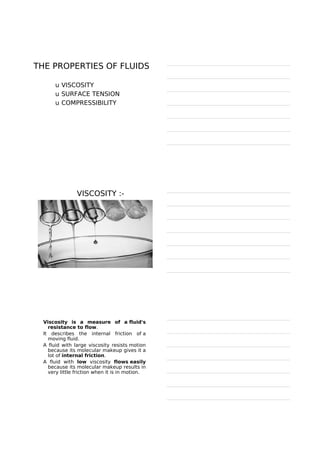
VISCOSITY :-
Viscosity is a measure of a fluid's
resistance to flow.
It describes the internal friction of a
moving fluid.
A fluid with large viscosity resists motion
because its molecular makeup gives it a
lot of internal friction.
A fluid with low viscosity flows easily
because its molecular makeup results in
very little friction when it is in motion.
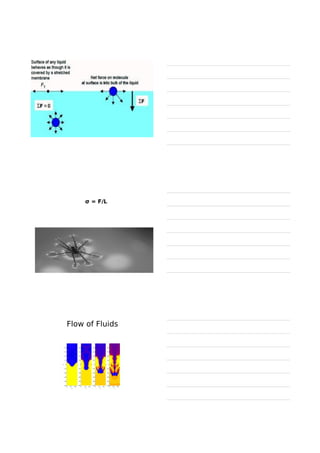
SURFACE TENSION
"Surface tension is a contractive
tendency of the surface of a fluid
that allows it to resist an external
force."
Fluid tends to attend the minimum
surface area as possible.
Why?
The reason behind this is that while
a molecule inside the fluid bulk is
pulled in each and every direction
by the adjacent molecules
But at the surface of the fluid , the
case is different. the adhesive
forces causes downward pull on
the molecule due to cohesent.
So the molecule on the surface
tends to move down.
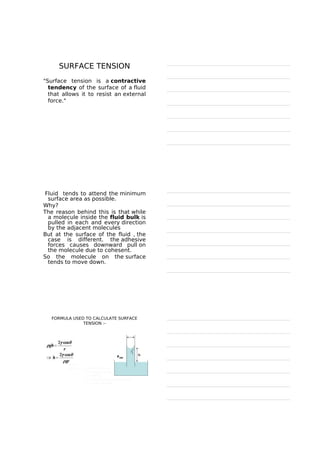
FORMULA USED TO CALCULATE SURFACE
TENSION :-
Where,
Where,  γ = surface tension
 θ = contact angle
 ρ = density
g = acceleration due to gravity
r = radius of tube
 σ = F/L
Flow of Fluids
FLUID FLOW
A fluid is a substance that continually deforms (flows)
under an applied shear stress.
Fluids are a subset of the phases of matter and include
liquids, gases.
Fluid flow may be defined as the flow of substances that
do not permanently resist distortion
The subject of fluid flow can be divided into fluid static's
and fluid dynamics
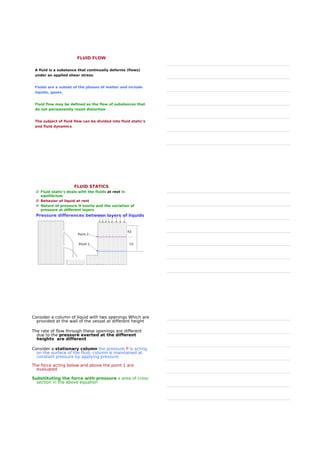
FLUID STATICS
Ø Fluid static's deals with the fluids at rest in
equilibrium
Ø Behavior of liquid at rest
Ø Nature of pressure it exerts and the variation of
pressure at different layers
Pressure differences between layers of liquids
h2
h1
Point 2
Point 1
Consider a column of liquid with two openings Which are
provided at the wall of the vessel at different height
The rate of flow through these openings are different
due to the pressure exerted at the different
heights are different
Consider a stationary column the pressure P is acting
on the surface of the fluid, column is maintained at
constant pressure by applying pressure
The force acting below and above the point 1 are
evaluated
Substituting the force with pressure x area of cross
section in the above equation
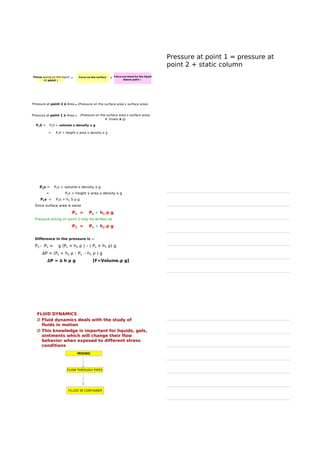
Force acting on the liquid
At point 1
+Force on the surface Force excreted by the liquid
Above point 1
Pressure at point 2 x Area= (Pressure on the surface area x surface area)
=
P1S = P2S + height xvolume x density x g
Pressure at point 1 x Area (Pressure on the surface area x surface area)
+ (mass x g)
=
P1s = P2s + volume x density x g
= P2s + height x area x density x g
P1s = P2s + h1 S ρ g
Since surface area is same
P1 = Ps + h1 ρ g
Pressure acting on point 2 may be written as
P2 = Ps + h2 ρ g
Difference in the pressure is --
P2 - P1 = g (Ps + h2 ρ ) – ( Ps + h1 ρ) g
∆P = (Ps + h2 ρ – Ps - h1 ρ ) g
∆P = ∆ h ρ g [F=Volume.ρ g]
FLUID DYNAMICS
Ø Fluid dynamics deals with the study of
fluids in motion
Ø This knowledge is important for liquids, gels,
ointments which will change their flow
behavior when exposed to different stress
conditions
MIXING
FLOW THROUGH PIPES
FILLED IN CONTAINER
Importance
Identification of type of flow is important in
ü Manufacture of dosage forms
ü Handling of drugs for administration
The flow of fluid through a pipe can be
viscous or turbulent and it can be
determined by Reynolds number
Reynolds number have no unit
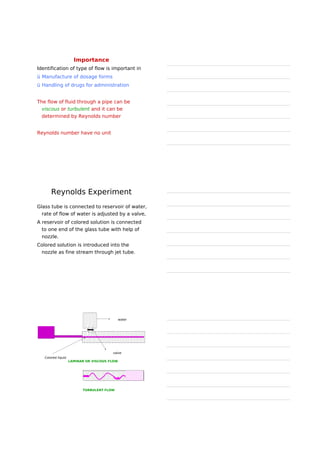
Reynolds Experiment
Glass tube is connected to reservoir of water,
rate of flow of water is adjusted by a valve,
A reservoir of colored solution is connected
to one end of the glass tube with help of
nozzle.
Colored solution is introduced into the
nozzle as fine stream through jet tube.
water
valve
Colored liquid
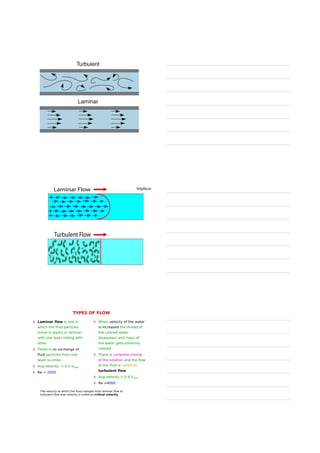
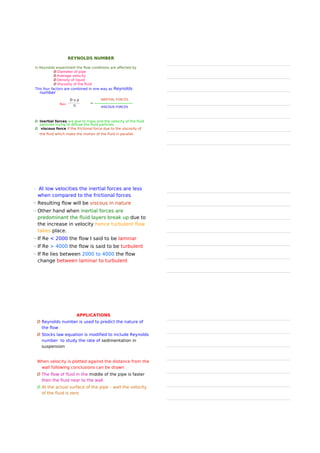
LAMINAR OR VISCOUS FLOW
TURBULENT FLOW
TYPES OF FLOW
è Laminar flow is one in
which the fluid particles
move in layers or laminar
with one layer sliding with
other
è There is no exchange of
fluid particles from one
layer to other
è Avg velocity = 0.5 Vmax
è Re < 2000
è When velocity of the water
is increased the thread of
the colored water
disappears and mass of
the water gets uniformly
colored
è There is complete mixing
of the solution and the flow
of the fluid is called as
turbulent flow
è Avg velocity = 0.8 Vmax
è Re >4000
The velocity at which the fluid changes from laminar flow to
turbulent flow that velocity is called as critical velocity
REYNOLDS NUMBER
In Reynolds experiment the flow conditions are affected by
Ø Diameter of pipe
Ø Average velocity
Ø Density of liquid
Ø Viscosity of the fluid
This four factors are combined in one way as Reynolds
number
Re=
Ø Inertial forces are due to mass and the velocity of the fluid
particles trying to diffuse the fluid particles
Ø viscous force if the frictional force due to the viscosity of
the fluid which make the motion of the fluid in parallel.
D u ρ
η
INERTIAL FORCES
= ------------------------------
VISCOUS FORCES
¬ At low velocities the inertial forces are less
when compared to the frictional forces
¬ Resulting flow will be viscous in nature
¬ Other hand when inertial forces are
predominant the fluid layers break up due to
the increase in velocity hence turbulent flow
takes place.
¬ If Re < 2000 the flow I said to be laminar
¬ If Re > 4000 the flow is said to be turbulent
¬ If Re lies between 2000 to 4000 the flow
change between laminar to turbulent
APPLICATIONS
Ø Reynolds number is used to predict the nature of
the flow
Ø Stocks law equation is modified to include Reynolds
number to study the rate of sedimentation in
suspension
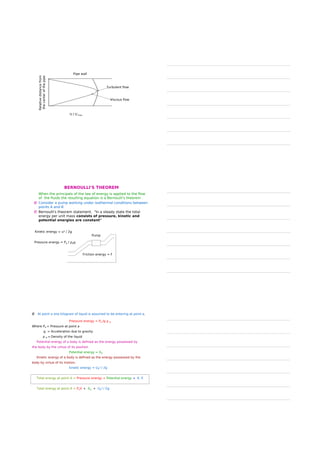
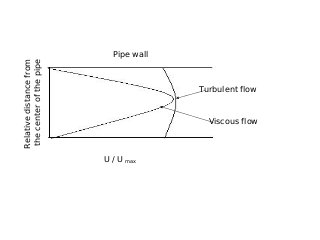
When velocity is plotted against the distance from the
wall following conclusions can be drawn
Ø The flow of fluid in the middle of the pipe is faster
then the fluid near to the wall
Ø At the actual surface of the pipe – wall the velocity
of the fluid is zero
Pipe wall
Relativedistancefrom
thecenterofthepipe
U / U max
Viscous flow
Turbulent flow
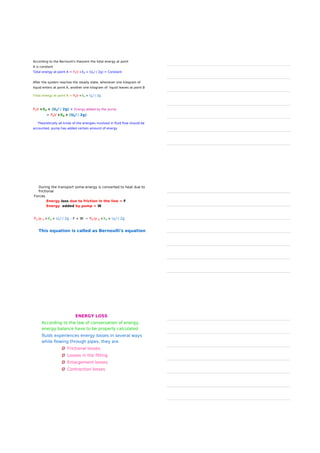
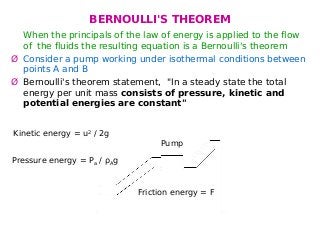
BERNOULLI'S THEOREM
When the principals of the law of energy is applied to the flow
of the fluids the resulting equation is a Bernoulli's theorem
Ø Consider a pump working under isothermal conditions between
points A and B
Ø Bernoulli's theorem statement, "In a steady state the total
energy per unit mass consists of pressure, kinetic and
potential energies are constant"
Pump
Friction energy = F
Kinetic energy = u2 / 2g
Pressure energy = Pa / ρAg
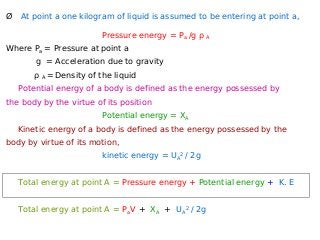
Ø At point a one kilogram of liquid is assumed to be entering at point a,
Pressure energy = Pa /g ρ A
Where Pa = Pressure at point a
g = Acceleration due to gravity
ρ A = Density of the liquid
Potential energy of a body is defined as the energy possessed by
the body by the virtue of its position
Potential energy = XA
Kinetic energy of a body is defined as the energy possessed by the
body by virtue of its motion,
kinetic energy = UA
2 / 2g
Total energy at point A = Pressure energy + Potential energy + K. E
Total energy at point A = PaV + XA + UA
2 / 2g
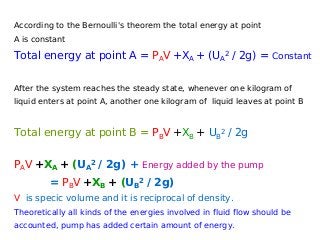
According to the Bernoulli's theorem the total energy at point
A is constant
Total energy at point A = PAV +XA + (UA
2 / 2g) = Constant
After the system reaches the steady state, whenever one kilogram of
liquid enters at point A, another one kilogram of liquid leaves at point B
Total energy at point B = PBV +XB + UB
2 / 2g
PAV +XA + (UA
2 / 2g) + Energy added by the pump
= PBV +XB + (UB
2 / 2g)
V is specic volume and it is reciprocal of density.
Theoretically all kinds of the energies involved in fluid flow should be
accounted, pump has added certain amount of energy.
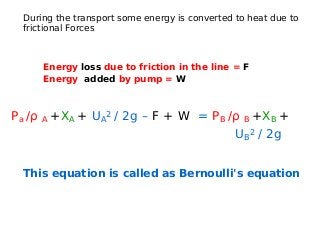
During the transport some energy is converted to heat due to
frictional Forces
Energy loss due to friction in the line = F
Energy added by pump = W
Pa /ρ A +XA + UA
2 / 2g – F + W = PB /ρ B +XB +
UB
2 / 2g
This equation is called as Bernoulli's equation
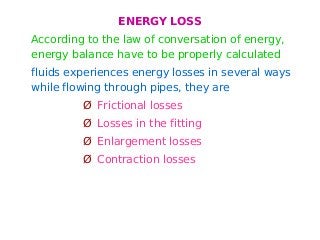
ENERGY LOSS
According to the law of conversation of energy,
energy balance have to be properly calculated
fluids experiences energy losses in several ways
while flowing through pipes, they are
Ø Frictional losses
Ø Losses in the fitting
Ø Enlargement losses
Ø Contraction losses
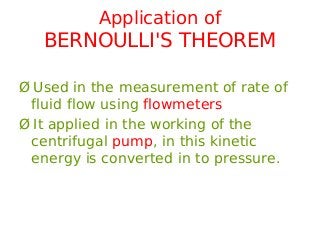
Application of
BERNOULLI'S THEOREM
Ø Used in the measurement of rate of
fluid flow using flowmeters
Ø It applied in the working of the
centrifugal pump, in this kinetic
energy is converted in to pressure.
Chapter 2
Fluid Flow and Pressure measurements
• Measurement of flow‐
– Classification of flow meters,
– venturimeter,
– orificemeter,
– pitot tube,
– rotameter
– current flow meters
• Pressure measurement‐
– Classification of manometers,
– simple manometer/
– U tube manometer and modifications
(Differential/inclined),
– Bourdon gauge
MANOMETERS
Manometers are the devices used for
measuring the pressure difference
Different type of manometers are there they
are
1)Simple manometer
2)Differential manometer
3)Inclined manometer
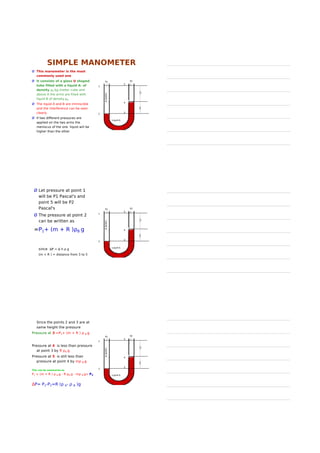
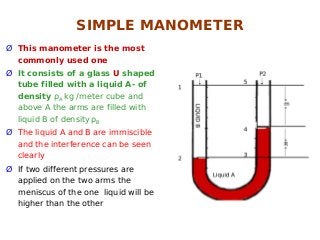
Ø This manometer is the most
commonly used one
Ø It consists of a glass U shaped
tube filled with a liquid A- of
density ρA kg /meter cube and
above A the arms are filled with
liquid B of density ρB
Ø The liquid A and B are immiscible
and the interference can be seen
clearly
Ø If two different pressures are
applied on the two arms the
meniscus of the one liquid will be
higher than the other
SIMPLE MANOMETER
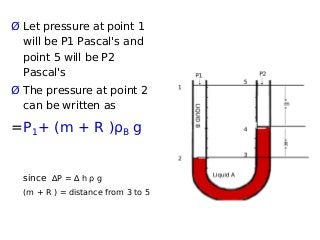
Ø Let pressure at point 1
will be P1 Pascal's and
point 5 will be P2
Pascal's
Ø The pressure at point 2
can be written as
=P1+ (m + R )ρB g
since ∆P = ∆ h ρ g
(m + R ) = distance from 3 to 5
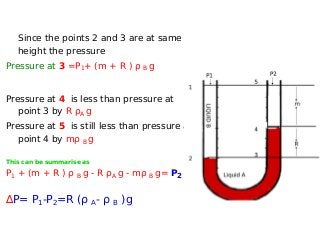
Since the points 2 and 3 are at same
height the pressure
Pressure at 3 =P1+ (m + R ) ρ B g
Pressure at 4 is less than pressure at
point 3 by R ρA g
Pressure at 5 is still less than pressure at
point 4 by mρ B g
This can be summarise as
P1 + (m + R ) ρ B g - R ρA g - mρ B g= P2
∆P= P1-P2=R (ρ A- ρ B )g
Application
• Pressure difference can be
determined by measuring R
• Manometers are use in measuring
flow of fluid.
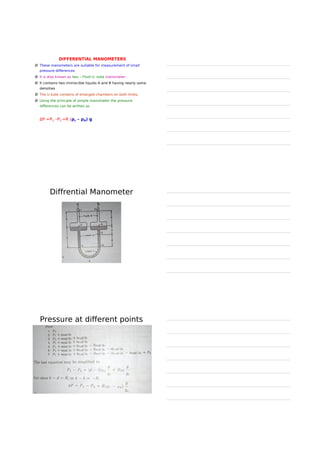
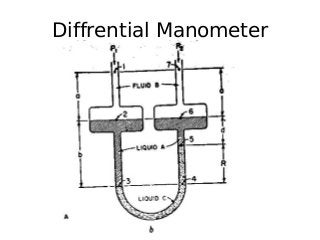
DIFFERENTIAL MANOMETERS
Ø These manometers are suitable for measurement of
small pressure differences
Ø It is also known as two – Fluid U- tube manometer
Ø It contains two immiscible liquids A and B having
nearly same densities
Ø The U tube contains of enlarged chambers on both
limbs,
Ø Using the principle of simple manometer the
pressure differences can be written as
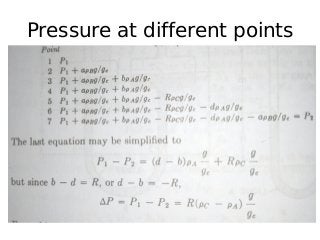
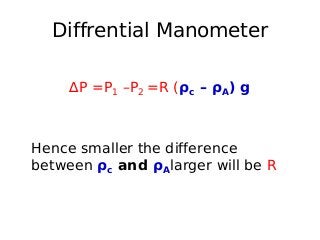
∆P =P1 –P2 =R (ρc – ρA) g
Diffrential Manometer
Pressure at different points
Diffrential Manometer
∆P =P1 –P2 =R (ρc – ρA) g
Hence smaller the difference
between ρc and ρAlarger will be R
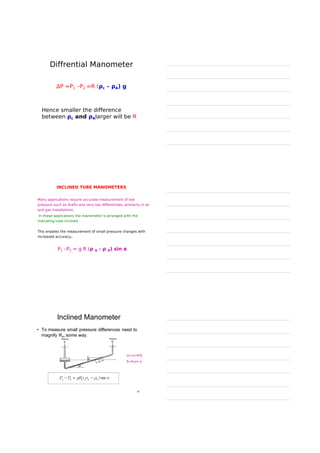
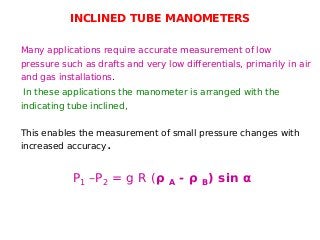
INCLINED TUBE MANOMETERS
Many applications require accurate measurement of low
pressure such as drafts and very low differentials, primarily in air
and gas installations.
In these applications the manometer is arranged with the
indicating tube inclined,
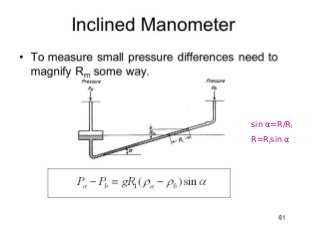
This enables the measurement of small pressure changes with
increased accuracy.
P1 –P2 = g R (ρ A - ρ B) sin α
sin α=R/Ri
R=Risin α
MEASUREMENT OF
RATE OF FLOW OF FLUIDS
Methods of measurement are
Ø Direct weighing or measuring
Ø Hydrodynamic methods
ü Orifice meter
ü Venturi meter
ü Pitot meter
ü Rotameter
Ø Direct displacement meter
Ø Disc meters
Ø Current meter
DIRECT WEIGHING OR
MEASURING
The liquid flowing through a pipe is
collected for specific period at any point
and weighed or measured, and the rate
of flow can be determined.
Gases can not be determined by this method
ORIFICE METER
Variable head meter
Principle
Ø Orifice meter is a thin plate containing a narrow and
sharp aperture.
Ø When a fluid stream is allowed to pass through a
narrow constriction the velocity of the fluid
increase compared to up stream
Ø This results in decrease in pressure head and the
difference in the pressure may be read from a
manometer
CONSTRUCTION
Ø It is consider to be a thin plate containing a sharp aperture
through which fluid flows
Ø Normally it is placed between long straight pipes
Ø For present discussion plate is introduced into pipe and
manometer is connected at points A and B
Working
ü When fluid is allowed to pass through the orifice the velocity
of the fluid at point B increase, as a result at point A
pressure will be increased.
ü Difference in the pressure is measured by manometer
ü Bernoulli's equation is applied to point A and point B for
experimental conditions
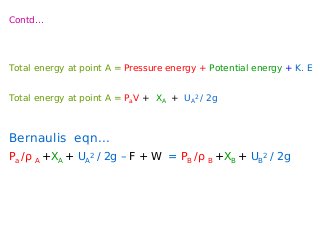
Contd...
Total energy at point A = Pressure energy + Potential energy + K. E
Total energy at point A = PaV + XA + UA
2 / 2g
Bernaulis eqn...
Pa /ρ A +XA + UA
2 / 2g – F + W = PB /ρ B +XB + UB
2 / 2g
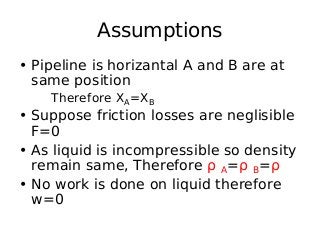
Assumptions
• Pipeline is horizantal A and B are at
same position
Therefore XA=XB
• Suppose friction losses are neglisible
F=0
• As liquid is incompressible so density
remain same, Therefore ρ A=ρ B=ρ
• No work is done on liquid therefore
w=0
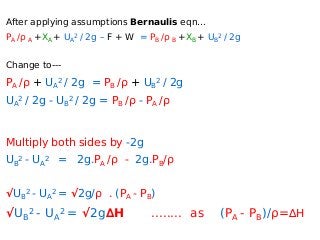
After applying assumptions Bernaulis eqn...
PA /ρ A +XA + UA
2 / 2g – F + W = PB /ρ B +XB + UB
2 / 2g
Change to---
PA /ρ + UA
2 / 2g = PB /ρ + UB
2 / 2g
UA
2 / 2g - UB
2 / 2g = PB /ρ - PA /ρ
Multiply both sides by -2g
UB
2 - UA
2 = 2g.PA /ρ - 2g.PB/ρ
√UB
2 - UA
2 = √2g/ρ . (PA - PB)
√UB
2 - UA
2 = √2g∆H ........ as (PA - PB)/ρ=∆H
√UB
2 - UA
2 = √2g∆H
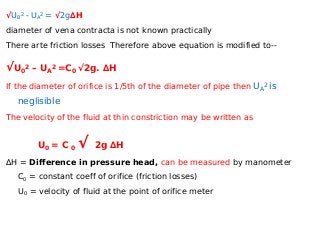
diameter of vena contracta is not known practically
There arte friction losses Therefore above equation is modified to--
√U0
2 – UA
2 =C0 √2g. ∆H
If the diameter of orifice is 1/5th of the diameter of pipe then UA
2 is
neglisible
The velocity of the fluid at thin constriction may be written as
U0 = C 0 √ 2g ∆H
∆H = Difference in pressure head, can be measured by manometer
C0 = constant coeff of orifice (friction losses)
U0 = velocity of fluid at the point of orifice meter
Applications
§ Velocity at either of the point A and B
can be measured
§ Volume of liquid flowing per hour can
be determined by knowing area of
cross section
VENTURI METER
Variable head meter
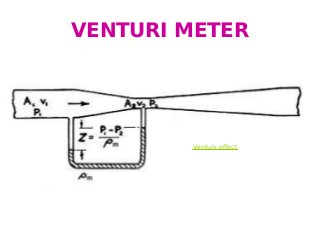
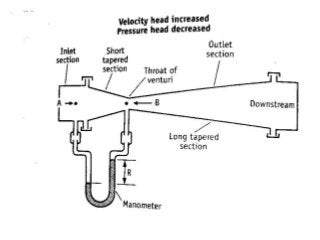
Principle
• When fluid is allowed to pass through
narrow venturi throat then velocity of
fluid increases and pressure
decreases
• Difference in upstream and
downstream pressure head can be
measured by using Manometer
• U v = C v √ 2g . ∆H
VENTURI METER
Ventury effect
Why Venturi meter if Orifice
meter is available?
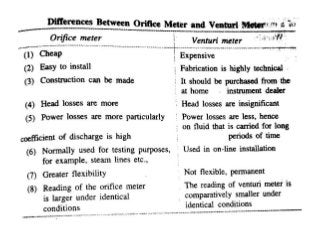
• Main disadvantage of orifice meter is
power loss due to sudden
contraction with consequent eddies
on other side of orifice plate
• We can minimize power loss by
gradual contraction of pipe
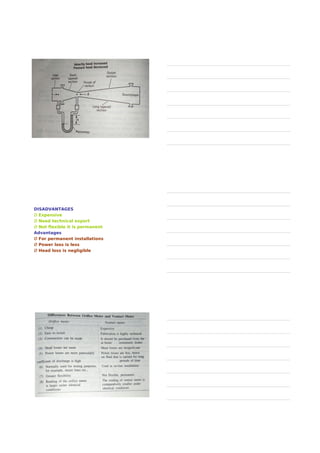
• Ventury meter consist of two tapperd
(conical section) inserted in pipeline
• Friction losses and eddies can be
minimized by this arrangement. Vd Orif Ventury
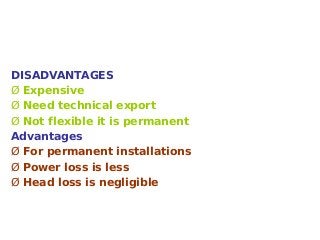
DISADVANTAGES
Ø Expensive
Ø Need technical export
Ø Not flexible it is permanent
Advantages
Ø For permanent installations
Ø Power loss is less
Ø Head loss is negligible
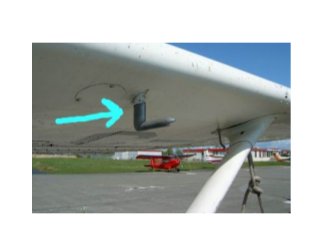
Pitot tube
(Insertion meter)
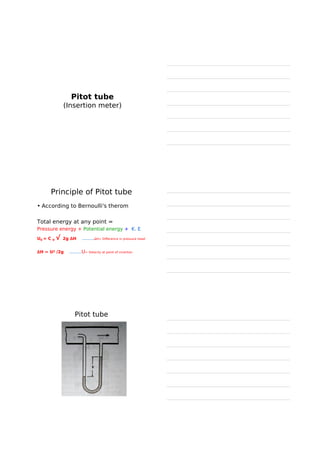
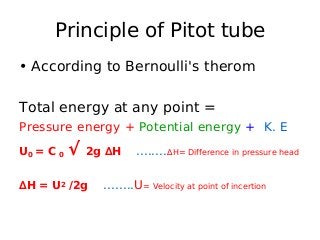
Principle of Pitot tube
• According to Bernoulli's therom
Total energy at any point =
Pressure energy + Potential energy + K. E
U0 = C 0 √ 2g ∆H ........∆H= Difference in pressure head
∆H = U2 /2g ........U= Velocity at point of incertion
Pitot tube
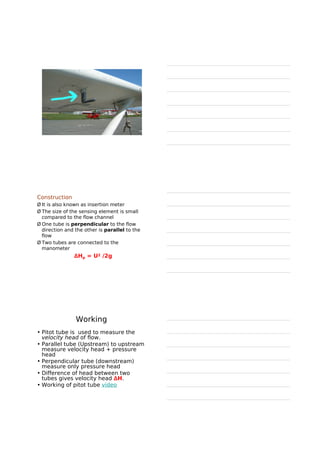
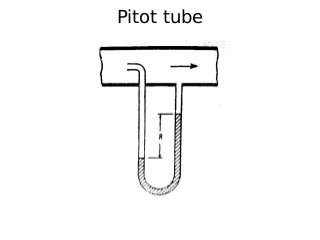
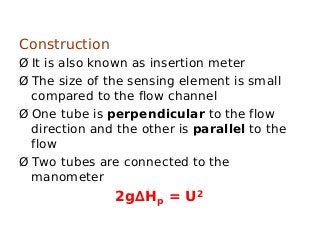
Construction
Ø It is also known as insertion meter
Ø The size of the sensing element is small
compared to the flow channel
Ø One tube is perpendicular to the flow
direction and the other is parallel to the
flow
Ø Two tubes are connected to the
manometer
2g∆Hp = U2
Working
• Pitot tube is used to measure the
velocity head of flow.
• Parallel tube (to Upstream) measure
velocity head + pressure head
• Perpendicular tube (downstream)
measure only pressure head
• Difference of head between two tubes
gives velocity head ∆H.
• Working of pitot tube video
Difference between venturi-
orifice and Pitot tube
• Orifice and venturi
meter measure
average velocity of
whole stream of
fluid
• More pressure drop
• Pitot tube measure
relative fluid
velocity at single
point only
• Less pressure drop
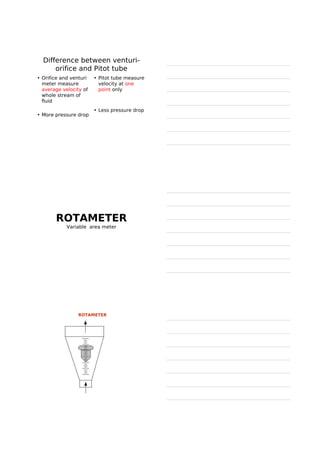
ROTAMETER
Variable area meter
ROTAMETER
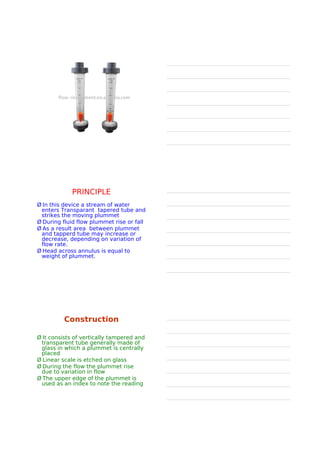
PRINCIPLE
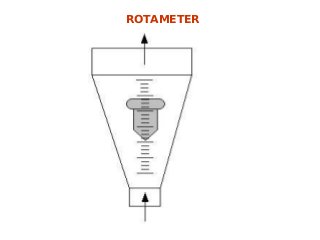
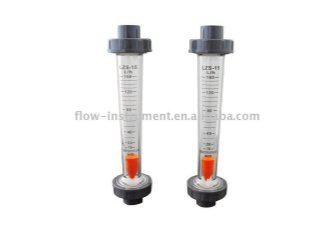
Ø In this device a stream of water
enters Transparent tapered tube and
strikes the moving plummet
Ø During fluid flow plummet rise or fall
Ø As a result, annular space (area)
between plummet and tapperd
tube may increase or decrease,
depending on variation of flow rate.
Ø Head across annulus is equal to
weight of plummet.
Construction
Ø It consists of vertically tapered and
transparent tube generally made of
glass in which a plummet is centrally
placed with guiding wire.
Ø Linear scale is etched on glass
Ø During the flow the plummet rise
due to variation in flow
Ø The upper edge of the plummet is
used as an index to note the reading
Working
Ø As the flow is upward through the tapered
tube the plummet rises and falls depend
on the flow rate
Ø Greater the flow rate higher the rise of
plummet.
Ø Working of rotameter video
Use
• To measure flow rate of gas as well
as liquid
• Easy to use and allow direct visual
inspection
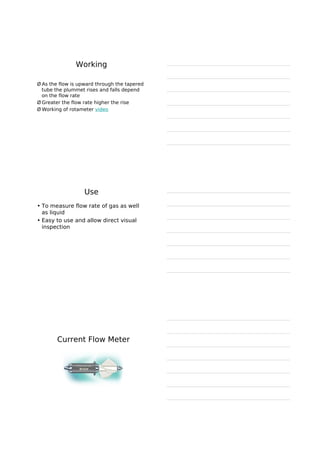
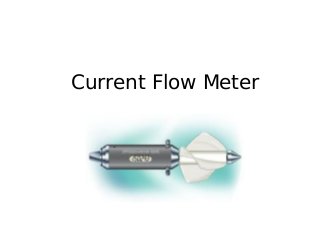
Current Flow Meter
Costruction
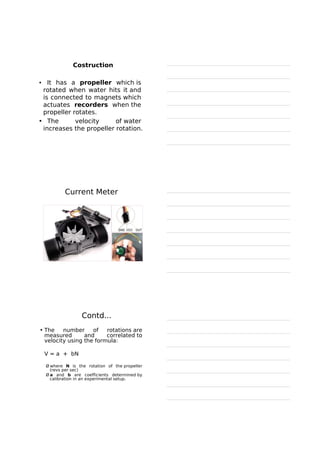
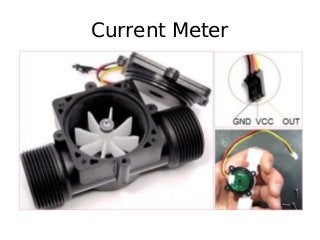
• It has a propeller which is
rotated when water hits it and
is connected to magnets which
actuates recorders when the
propeller rotates.
• The velocity of water
increases the propeller rotation.
Current Meter
Contd...
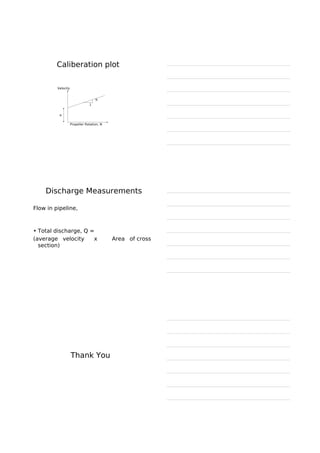
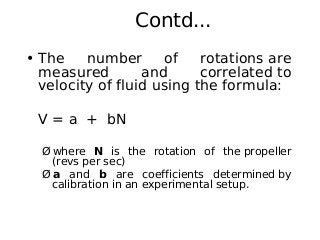
• The number of rotations are
measured and correlated to
velocity of fluid using the formula:
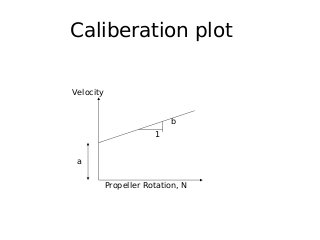
V = a + bN
Ø where N is the rotation of the propeller
(revs per sec)
Ø a and b are coefficients determined by
calibration in an experimental setup.
Caliberation plot
1
b
Propeller Rotation, N
Velocity
a
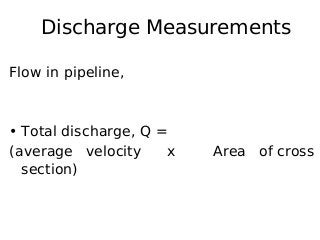
Discharge Measurements
Flow in pipeline,
• Total discharge, Q =
(average velocity x Area of cross
section)
Thank You

Flow of Fluids

  • 1.
    FLOW OF FLUID& ITS MEASUREMENT (Dr.) Mirza Salman Baig Assistant Professor (Pharmaceutics) AIKTC, School of Pharmacy,New Panvel Affiliated to University of Mumbai, INDIA
  • 2.
    Disclaimer Presentation slides areprovided on student's request for purpose of quick reference only, hence it can not be replaced with standard study material or books that are mentioned in syllabus of respective subjects. Students are expected to refer standard books for study for examination.
  • 3.
    Content • Fluid properties •Reynolds experiment • Manometer • Orificemeter • Venturimeter • Pitot tube • Rotameter • Current flow meter
  • 4.
    Fluid flow • Mentionfluid properties such as viscosity, compressibility and surface tension of fluids. • Hydrostatics (Fluidststics) influencing fluid flow. • Fluid dynamics‐ Bernoulli’s theorem, flow of fluids in pipes, laminar and turbulent flow.
  • 5.
    THE PROPERTIES OFFLUIDS u VISCOSITY u SURFACE TENSION u COMPRESSIBILITY
  • 6.
  • 7.
    Viscosity is ameasure of a fluid's resistance to flow. It describes the internal friction of a moving fluid. A fluid with large viscosity resists motion because its molecular makeup gives it a lot of internal friction. A fluid with low viscosity flows easily because its molecular makeup results in very little friction when it is in motion.
  • 8.
    SURFACE TENSION "Surface tensionis a contractive tendency of the surface of a fluid that allows it to resist an external force."
  • 9.
    Fluid tends toattend the minimum surface area as possible. Why? The reason behind this is that while a molecule inside the fluid bulk is pulled in each and every direction by the adjacent molecules But at the surface of the fluid , the case is different. the adhesive forces causes downward pull on the molecule due to cohesent. So the molecule on the surface tends to move down.
  • 10.
    FORMULA USED TOCALCULATE SURFACE TENSION :- Where, Where,  γ = surface tension  θ = contact angle  ρ = density g = acceleration due to gravity r = radius of tube
  • 12.
  • 13.
  • 14.
    FLUID FLOW A fluidis a substance that continually deforms (flows) under an applied shear stress. Fluids are a subset of the phases of matter and include liquids, gases. Fluid flow may be defined as the flow of substances that do not permanently resist distortion The subject of fluid flow can be divided into fluid static's and fluid dynamics
  • 15.
    FLUID STATICS Ø Fluidstatic's deals with the fluids at rest in equilibrium Ø Behavior of liquid at rest Ø Nature of pressure it exerts and the variation of pressure at different layers Pressure differences between layers of liquids h2 h1 Point 2 Point 1
  • 16.
    Consider a columnof liquid with two openings Which are provided at the wall of the vessel at different height The rate of flow through these openings are different due to the pressure exerted at the different heights are different Consider a stationary column the pressure P is acting on the surface of the fluid, column is maintained at constant pressure by applying pressure The force acting below and above the point 1 are evaluated Substituting the force with pressure x area of cross section in the above equation
  • 17.
    Force acting onthe liquid At point 1 +Force on the surface Force excreted by the liquid Above point 1 Pressure at point 2 x Area= (Pressure on the surface area x surface area) = P1S = P2S + height xvolume x density x g Pressure at point 1 x Area (Pressure on the surface area x surface area) + (mass x g) =
  • 18.
    P1s = P2s+ volume x density x g = P2s + height x area x density x g P1s = P2s + h1 S ρ g Since surface area is same P1 = Ps + h1 ρ g Pressure acting on point 2 may be written as P2 = Ps + h2 ρ g Difference in the pressure is -- P2 - P1 = g (Ps + h2 ρ ) – ( Ps + h1 ρ) g ∆P = (Ps + h2 ρ – Ps - h1 ρ ) g ∆P = ∆ h ρ g [F=Volume.ρ g]
  • 19.
    FLUID DYNAMICS Ø Fluiddynamics deals with the study of fluids in motion Ø This knowledge is important for liquids, gels, ointments which will change their flow behavior when exposed to different stress conditions MIXING FLOW THROUGH PIPES FILLED IN CONTAINER
  • 20.
    Importance Identification of typeof flow is important in ü Manufacture of dosage forms ü Handling of drugs for administration The flow of fluid through a pipe can be viscous or turbulent and it can be determined by Reynolds number Reynolds number have no unit
  • 21.
    Reynolds Experiment Glass tubeis connected to reservoir of water, rate of flow of water is adjusted by a valve, A reservoir of colored solution is connected to one end of the glass tube with help of nozzle. Colored solution is introduced into the nozzle as fine stream through jet tube.
  • 22.
    water valve Colored liquid LAMINAR ORVISCOUS FLOW TURBULENT FLOW
  • 25.
    TYPES OF FLOW èLaminar flow is one in which the fluid particles move in layers or laminar with one layer sliding with other è There is no exchange of fluid particles from one layer to other è Avg velocity = 0.5 Vmax è Re < 2000 è When velocity of the water is increased the thread of the colored water disappears and mass of the water gets uniformly colored è There is complete mixing of the solution and the flow of the fluid is called as turbulent flow è Avg velocity = 0.8 Vmax è Re >4000 The velocity at which the fluid changes from laminar flow to turbulent flow that velocity is called as critical velocity
  • 26.
    REYNOLDS NUMBER In Reynoldsexperiment the flow conditions are affected by Ø Diameter of pipe Ø Average velocity Ø Density of liquid Ø Viscosity of the fluid This four factors are combined in one way as Reynolds number Re= Ø Inertial forces are due to mass and the velocity of the fluid particles trying to diffuse the fluid particles Ø viscous force if the frictional force due to the viscosity of the fluid which make the motion of the fluid in parallel. D u ρ η INERTIAL FORCES = ------------------------------ VISCOUS FORCES
  • 27.
    ¬ At lowvelocities the inertial forces are less when compared to the frictional forces ¬ Resulting flow will be viscous in nature ¬ Other hand when inertial forces are predominant the fluid layers break up due to the increase in velocity hence turbulent flow takes place. ¬ If Re < 2000 the flow I said to be laminar ¬ If Re > 4000 the flow is said to be turbulent ¬ If Re lies between 2000 to 4000 the flow change between laminar to turbulent
  • 28.
    APPLICATIONS Ø Reynolds numberis used to predict the nature of the flow Ø Stocks law equation is modified to include Reynolds number to study the rate of sedimentation in suspension When velocity is plotted against the distance from the wall following conclusions can be drawn Ø The flow of fluid in the middle of the pipe is faster then the fluid near to the wall Ø At the actual surface of the pipe – wall the velocity of the fluid is zero
  • 29.
  • 30.
    BERNOULLI'S THEOREM When theprincipals of the law of energy is applied to the flow of the fluids the resulting equation is a Bernoulli's theorem Ø Consider a pump working under isothermal conditions between points A and B Ø Bernoulli's theorem statement, "In a steady state the total energy per unit mass consists of pressure, kinetic and potential energies are constant" Pump Friction energy = F Kinetic energy = u2 / 2g Pressure energy = Pa / ρAg
  • 31.
    Ø At pointa one kilogram of liquid is assumed to be entering at point a, Pressure energy = Pa /g ρ A Where Pa = Pressure at point a g = Acceleration due to gravity ρ A = Density of the liquid Potential energy of a body is defined as the energy possessed by the body by the virtue of its position Potential energy = XA Kinetic energy of a body is defined as the energy possessed by the body by virtue of its motion, kinetic energy = UA 2 / 2g Total energy at point A = Pressure energy + Potential energy + K. E Total energy at point A = PaV + XA + UA 2 / 2g
  • 32.
    According to theBernoulli's theorem the total energy at point A is constant Total energy at point A = PAV +XA + (UA 2 / 2g) = Constant After the system reaches the steady state, whenever one kilogram of liquid enters at point A, another one kilogram of liquid leaves at point B Total energy at point B = PBV +XB + UB 2 / 2g PAV +XA + (UA 2 / 2g) + Energy added by the pump = PBV +XB + (UB 2 / 2g) V is specic volume and it is reciprocal of density. Theoretically all kinds of the energies involved in fluid flow should be accounted, pump has added certain amount of energy.
  • 33.
    During the transportsome energy is converted to heat due to frictional Forces Energy loss due to friction in the line = F Energy added by pump = W Pa /ρ A +XA + UA 2 / 2g – F + W = PB /ρ B +XB + UB 2 / 2g This equation is called as Bernoulli's equation
  • 34.
    ENERGY LOSS According tothe law of conversation of energy, energy balance have to be properly calculated fluids experiences energy losses in several ways while flowing through pipes, they are Ø Frictional losses Ø Losses in the fitting Ø Enlargement losses Ø Contraction losses
  • 35.
    Application of BERNOULLI'S THEOREM ØUsed in the measurement of rate of fluid flow using flowmeters Ø It applied in the working of the centrifugal pump, in this kinetic energy is converted in to pressure.
  • 36.
    Chapter 2 Fluid Flowand Pressure measurements • Measurement of flow‐ – Classification of flow meters, – venturimeter, – orificemeter, – pitot tube, – rotameter – current flow meters • Pressure measurement‐ – Classification of manometers, – simple manometer/ – U tube manometer and modifications (Differential/inclined), – Bourdon gauge
  • 37.
    MANOMETERS Manometers are thedevices used for measuring the pressure difference Different type of manometers are there they are 1)Simple manometer 2)Differential manometer 3)Inclined manometer
  • 38.
    Ø This manometeris the most commonly used one Ø It consists of a glass U shaped tube filled with a liquid A- of density ρA kg /meter cube and above A the arms are filled with liquid B of density ρB Ø The liquid A and B are immiscible and the interference can be seen clearly Ø If two different pressures are applied on the two arms the meniscus of the one liquid will be higher than the other SIMPLE MANOMETER
  • 39.
    Ø Let pressureat point 1 will be P1 Pascal's and point 5 will be P2 Pascal's Ø The pressure at point 2 can be written as =P1+ (m + R )ρB g since ∆P = ∆ h ρ g (m + R ) = distance from 3 to 5
  • 40.
    Since the points2 and 3 are at same height the pressure Pressure at 3 =P1+ (m + R ) ρ B g Pressure at 4 is less than pressure at point 3 by R ρA g Pressure at 5 is still less than pressure at point 4 by mρ B g This can be summarise as P1 + (m + R ) ρ B g - R ρA g - mρ B g= P2 ∆P= P1-P2=R (ρ A- ρ B )g
  • 41.
    Application • Pressure differencecan be determined by measuring R • Manometers are use in measuring flow of fluid.
  • 42.
    DIFFERENTIAL MANOMETERS Ø Thesemanometers are suitable for measurement of small pressure differences Ø It is also known as two – Fluid U- tube manometer Ø It contains two immiscible liquids A and B having nearly same densities Ø The U tube contains of enlarged chambers on both limbs, Ø Using the principle of simple manometer the pressure differences can be written as ∆P =P1 –P2 =R (ρc – ρA) g
  • 43.
  • 44.
  • 45.
    Diffrential Manometer ∆P =P1–P2 =R (ρc – ρA) g Hence smaller the difference between ρc and ρAlarger will be R
  • 46.
    INCLINED TUBE MANOMETERS Manyapplications require accurate measurement of low pressure such as drafts and very low differentials, primarily in air and gas installations. In these applications the manometer is arranged with the indicating tube inclined, This enables the measurement of small pressure changes with increased accuracy. P1 –P2 = g R (ρ A - ρ B) sin α
  • 47.
  • 48.
    MEASUREMENT OF RATE OFFLOW OF FLUIDS Methods of measurement are Ø Direct weighing or measuring Ø Hydrodynamic methods ü Orifice meter ü Venturi meter ü Pitot meter ü Rotameter Ø Direct displacement meter Ø Disc meters Ø Current meter
  • 49.
    DIRECT WEIGHING OR MEASURING Theliquid flowing through a pipe is collected for specific period at any point and weighed or measured, and the rate of flow can be determined. Gases can not be determined by this method
  • 50.
  • 51.
    Principle Ø Orifice meteris a thin plate containing a narrow and sharp aperture. Ø When a fluid stream is allowed to pass through a narrow constriction the velocity of the fluid increase compared to up stream Ø This results in decrease in pressure head and the difference in the pressure may be read from a manometer
  • 53.
    CONSTRUCTION Ø It isconsider to be a thin plate containing a sharp aperture through which fluid flows Ø Normally it is placed between long straight pipes Ø For present discussion plate is introduced into pipe and manometer is connected at points A and B Working ü When fluid is allowed to pass through the orifice the velocity of the fluid at point B increase, as a result at point A pressure will be increased. ü Difference in the pressure is measured by manometer ü Bernoulli's equation is applied to point A and point B for experimental conditions
  • 54.
    Contd... Total energy atpoint A = Pressure energy + Potential energy + K. E Total energy at point A = PaV + XA + UA 2 / 2g Bernaulis eqn... Pa /ρ A +XA + UA 2 / 2g – F + W = PB /ρ B +XB + UB 2 / 2g
  • 55.
    Assumptions • Pipeline ishorizantal A and B are at same position Therefore XA=XB • Suppose friction losses are neglisible F=0 • As liquid is incompressible so density remain same, Therefore ρ A=ρ B=ρ • No work is done on liquid therefore w=0
  • 56.
    After applying assumptionsBernaulis eqn... PA /ρ A +XA + UA 2 / 2g – F + W = PB /ρ B +XB + UB 2 / 2g Change to--- PA /ρ + UA 2 / 2g = PB /ρ + UB 2 / 2g UA 2 / 2g - UB 2 / 2g = PB /ρ - PA /ρ Multiply both sides by -2g UB 2 - UA 2 = 2g.PA /ρ - 2g.PB/ρ √UB 2 - UA 2 = √2g/ρ . (PA - PB) √UB 2 - UA 2 = √2g∆H ........ as (PA - PB)/ρ=∆H
  • 57.
    √UB 2 - UA 2= √2g∆H diameter of vena contracta is not known practically There arte friction losses Therefore above equation is modified to-- √U0 2 – UA 2 =C0 √2g. ∆H If the diameter of orifice is 1/5th of the diameter of pipe then UA 2 is neglisible The velocity of the fluid at thin constriction may be written as U0 = C 0 √ 2g ∆H ∆H = Difference in pressure head, can be measured by manometer C0 = constant coeff of orifice (friction losses) U0 = velocity of fluid at the point of orifice meter
  • 58.
    Applications § Velocity ateither of the point A and B can be measured § Volume of liquid flowing per hour can be determined by knowing area of cross section
  • 59.
  • 60.
    Principle • When fluidis allowed to pass through narrow venturi throat then velocity of fluid increases and pressure decreases • Difference in upstream and downstream pressure head can be measured by using Manometer • U v = C v √ 2g . ∆H
  • 61.
  • 62.
    Why Venturi meterif Orifice meter is available? • Main disadvantage of orifice meter is power loss due to sudden contraction with consequent eddies on other side of orifice plate • We can minimize power loss by gradual contraction of pipe • Ventury meter consist of two tapperd (conical section) inserted in pipeline • Friction losses and eddies can be minimized by this arrangement. Vd Orif Ventury
  • 64.
    DISADVANTAGES Ø Expensive Ø Needtechnical export Ø Not flexible it is permanent Advantages Ø For permanent installations Ø Power loss is less Ø Head loss is negligible
  • 66.
  • 67.
    Principle of Pitottube • According to Bernoulli's therom Total energy at any point = Pressure energy + Potential energy + K. E U0 = C 0 √ 2g ∆H ........∆H= Difference in pressure head ∆H = U2 /2g ........U= Velocity at point of incertion
  • 68.
  • 70.
    Construction Ø It isalso known as insertion meter Ø The size of the sensing element is small compared to the flow channel Ø One tube is perpendicular to the flow direction and the other is parallel to the flow Ø Two tubes are connected to the manometer 2g∆Hp = U2
  • 71.
    Working • Pitot tubeis used to measure the velocity head of flow. • Parallel tube (to Upstream) measure velocity head + pressure head • Perpendicular tube (downstream) measure only pressure head • Difference of head between two tubes gives velocity head ∆H. • Working of pitot tube video
  • 72.
    Difference between venturi- orificeand Pitot tube • Orifice and venturi meter measure average velocity of whole stream of fluid • More pressure drop • Pitot tube measure relative fluid velocity at single point only • Less pressure drop
  • 73.
  • 74.
  • 76.
    PRINCIPLE Ø In thisdevice a stream of water enters Transparent tapered tube and strikes the moving plummet Ø During fluid flow plummet rise or fall Ø As a result, annular space (area) between plummet and tapperd tube may increase or decrease, depending on variation of flow rate. Ø Head across annulus is equal to weight of plummet.
  • 77.
    Construction Ø It consistsof vertically tapered and transparent tube generally made of glass in which a plummet is centrally placed with guiding wire. Ø Linear scale is etched on glass Ø During the flow the plummet rise due to variation in flow Ø The upper edge of the plummet is used as an index to note the reading
  • 78.
    Working Ø As theflow is upward through the tapered tube the plummet rises and falls depend on the flow rate Ø Greater the flow rate higher the rise of plummet. Ø Working of rotameter video
  • 79.
    Use • To measureflow rate of gas as well as liquid • Easy to use and allow direct visual inspection
  • 80.
  • 81.
    Costruction • It hasa propeller which is rotated when water hits it and is connected to magnets which actuates recorders when the propeller rotates. • The velocity of water increases the propeller rotation.
  • 82.
  • 83.
    Contd... • The numberof rotations are measured and correlated to velocity of fluid using the formula: V = a + bN Ø where N is the rotation of the propeller (revs per sec) Ø a and b are coefficients determined by calibration in an experimental setup.
  • 84.
  • 85.
    Discharge Measurements Flow inpipeline, • Total discharge, Q = (average velocity x Area of cross section)
  • 86.