Viscosity
Presented By : BASHAR MD KHAIRUL
Student ID:15595901
Masters Student
Graduate School of Science & Engineering
Saga University
5/13/2016 Advance Lubrication Engineering 1
Outline:
Introduction
Types of Viscosity
Units of Viscosity
Effects of Temperature
Viscosity Index
5/13/2016 Advance Lubrication Engineering 2
Introduction
• Viscosity is a quantitative measure of a fluid’s resistance to
flow.
Dynamic (or Absolute) Viscosity:
• The dynamic viscosity(η) of a fluid is a measure of the
resistance it offers to relative shearing motion.
η= F/ [A×(u/h)]
η= τ /(u/h) N-s/m²
Kinematic Viscosity :
• It is defined as the ratio of absolute viscosity to the density of
fluid.
ν= η/ρ m²/s ; ρ= density of fluid
5/13/2016 Advance Lubrication Engineering 3
dy
dvx
 
Shear Stress
Fluid Velocity
in X Direction
Fluid Viscosity














sms
m
dy
dv
m
N 1
,2

The dimensions:



 
 2
/ m
sN
dydv

&
.10)(1011 3
2
cppoisep
m
sN
sPa 


smPacp 11
5/13/2016 Advance Lubrication Engineering 4
Laminar Flow (Streamline)
• Slow, smooth flow over a surface in which the paths
of individual particles do not cross.
• Fluid speed at the surface is approximately zero.
• Fluid moves in theoretical layers, or laminates, with
increasing speed away from the surface.
• Frictional drag is produced by the friction between
successive layers of fluid.
5/13/2016 Advance Lubrication Engineering 5
Turbulent Flow
• Irregular flow with eddies and whorls causing fluid to move
in different directions.
• Frictional drag and pressure drag both increase as speed
increases.
5/13/2016 Advance Lubrication Engineering 6
Effects of temperature
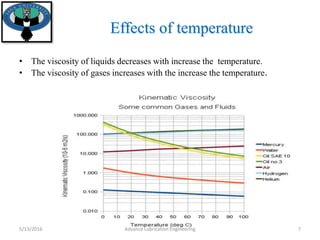
• The viscosity of liquids decreases with increase the temperature.
• The viscosity of gases increases with the increase the temperature.
5/13/2016 Advance Lubrication Engineering 7
Effects of temperature
• The lubricant oil viscosity at a specific temperature can be
either calculated from the viscosity - temperature equation or
obtained from the viscosity-temperature ASTM chart.
Viscosity-Temperature Equations
5/13/2016 Advance Lubrication Engineering 8
Effects of temperature
Fig: Viscosity-temperature characteristics of selected oils
5/13/2016 Advance Lubrication Engineering 9
Typical values of viscosity of some fluids:
2180,2840,17100
2090,3570,3080
2000,4690,8060
1900,6562,3140
1811,0059,8620
1711,79253,000
Viscosity Air,
Micro Poise[ p]
Viscosity Water,
centiPoise[cp]
Viscosity Castor
Oil, Poise[p]
Temperature
Celsius

5/13/2016 Advance Lubrication Engineering 10
Viscosity index
Viscosity Index Classification
..35 Low
35..80 Medium
80..110 High
110.. Very High
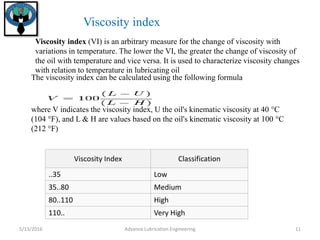
Viscosity index (VI) is an arbitrary measure for the change of viscosity with
variations in temperature. The lower the VI, the greater the change of viscosity of
the oil with temperature and vice versa. It is used to characterize viscosity changes
with relation to temperature in lubricating oil
The viscosity index can be calculated using the following formula
where V indicates the viscosity index, U the oil's kinematic viscosity at 40 °C
(104 °F), and L & H are values based on the oil's kinematic viscosity at 100 °C
(212 °F)
5/13/2016 Advance Lubrication Engineering 11
5/13/2016 Advance Lubrication Engineering 12

Presentation on viscosity By Khairul Bashar

  • 1.
    Viscosity Presented By :BASHAR MD KHAIRUL Student ID:15595901 Masters Student Graduate School of Science & Engineering Saga University 5/13/2016 Advance Lubrication Engineering 1
  • 2.
    Outline: Introduction Types of Viscosity Unitsof Viscosity Effects of Temperature Viscosity Index 5/13/2016 Advance Lubrication Engineering 2
  • 3.
    Introduction • Viscosity isa quantitative measure of a fluid’s resistance to flow. Dynamic (or Absolute) Viscosity: • The dynamic viscosity(η) of a fluid is a measure of the resistance it offers to relative shearing motion. η= F/ [A×(u/h)] η= τ /(u/h) N-s/m² Kinematic Viscosity : • It is defined as the ratio of absolute viscosity to the density of fluid. ν= η/ρ m²/s ; ρ= density of fluid 5/13/2016 Advance Lubrication Engineering 3
  • 4.
    dy dvx   Shear Stress FluidVelocity in X Direction Fluid Viscosity               sms m dy dv m N 1 ,2  The dimensions:       2 / m sN dydv  & .10)(1011 3 2 cppoisep m sN sPa    smPacp 11 5/13/2016 Advance Lubrication Engineering 4
  • 5.
    Laminar Flow (Streamline) •Slow, smooth flow over a surface in which the paths of individual particles do not cross. • Fluid speed at the surface is approximately zero. • Fluid moves in theoretical layers, or laminates, with increasing speed away from the surface. • Frictional drag is produced by the friction between successive layers of fluid. 5/13/2016 Advance Lubrication Engineering 5
  • 6.
    Turbulent Flow • Irregularflow with eddies and whorls causing fluid to move in different directions. • Frictional drag and pressure drag both increase as speed increases. 5/13/2016 Advance Lubrication Engineering 6
  • 7.
    Effects of temperature •The viscosity of liquids decreases with increase the temperature. • The viscosity of gases increases with the increase the temperature. 5/13/2016 Advance Lubrication Engineering 7
  • 8.
    Effects of temperature •The lubricant oil viscosity at a specific temperature can be either calculated from the viscosity - temperature equation or obtained from the viscosity-temperature ASTM chart. Viscosity-Temperature Equations 5/13/2016 Advance Lubrication Engineering 8
  • 9.
    Effects of temperature Fig:Viscosity-temperature characteristics of selected oils 5/13/2016 Advance Lubrication Engineering 9
  • 10.
    Typical values ofviscosity of some fluids: 2180,2840,17100 2090,3570,3080 2000,4690,8060 1900,6562,3140 1811,0059,8620 1711,79253,000 Viscosity Air, Micro Poise[ p] Viscosity Water, centiPoise[cp] Viscosity Castor Oil, Poise[p] Temperature Celsius  5/13/2016 Advance Lubrication Engineering 10
  • 11.
    Viscosity index Viscosity IndexClassification ..35 Low 35..80 Medium 80..110 High 110.. Very High Viscosity index (VI) is an arbitrary measure for the change of viscosity with variations in temperature. The lower the VI, the greater the change of viscosity of the oil with temperature and vice versa. It is used to characterize viscosity changes with relation to temperature in lubricating oil The viscosity index can be calculated using the following formula where V indicates the viscosity index, U the oil's kinematic viscosity at 40 °C (104 °F), and L & H are values based on the oil's kinematic viscosity at 100 °C (212 °F) 5/13/2016 Advance Lubrication Engineering 11
  • 12.