VIRUSES
It’s a Small World
• Virus: a microscopic particle that gets inside
a cell and often destroys the cell
• Viruses are tiny
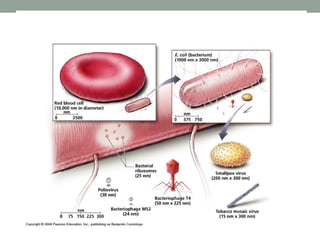
• Smaller than the smallest bacteria
• Change rapidly
• So small and change so often that
scientists don’t know exactly how many
types exist
• These properties make viruses difficult to
fight
Are Viruses Living?
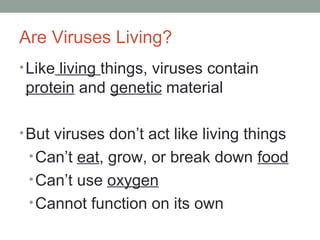
•Like living things, viruses contain
protein and genetic material
•But viruses don’t act like living things
•Can’t eat, grow, or break down food
•Can’t use oxygen
•Cannot function on its own
• Can only reproduce
inside a living cell
that serves as a host
• Host: an organism
from which a parasite
takes food or shelter
• Virus uses host’s cell
as a tiny factory, and
forces host to make
viruses rather than
healthy new cells
Classifying Viruses• Can be grouped
together by:
• Their shape
• Type of disease
they cause
• Life cycle
• Kind of genetic
material they
contain
• There are 4 main
shapes of viruses:
Cylinders: The tobacco mosaic virus
Is shaped like a cylinder and attacks
tobacco plants.
Crystals: The polio virus is shaped like
the crystal shown here.
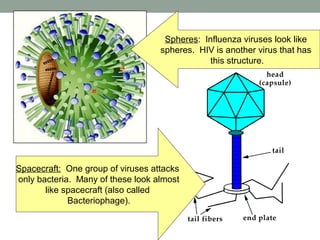
Spacecraft: One group of viruses attacks
only bacteria. Many of these look almost
like spacecraft (also called
Bacteriophage).
Spheres: Influenza viruses look like
spheres. HIV is another virus that has
this structure.
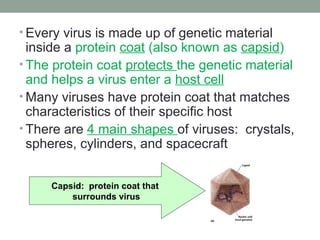
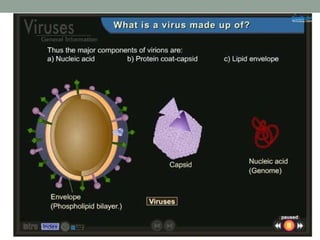
• Every virus is made up of genetic material
inside a protein coat (also known as capsid)
• The protein coat protects the genetic material
and helps a virus enter a host cell
• Many viruses have protein coat that matches
characteristics of their specific host
• There are 4 main shapes of viruses: crystals,
spheres, cylinders, and spacecraft
Capsid: protein coat that
surrounds virus
Genetic Material
• Genetic material either DNA or RNA
• Most RNA is made up of one strand of nucleotides,
most DNA is two strands of nucleotides
• Both DNA and RNA contain info for making
proteins
• Example: viruses that cause chickenpox & warts
contain DNA
• Example: viruses that cause flu, HIV, and common
cold contain RNA
• One strain of virus cannot infect both plants and
animals
VirusVirus AffectsAffects
What?What?
Which organisms?Which organisms?
Tobacco mosaicTobacco mosaic PlantsPlants Tobacco, tomato,Tobacco, tomato,
pepperspeppers
Potato XPotato X PlantsPlants Potatoes, tomatoes,Potatoes, tomatoes,
pepperspeppers
AdenovirusAdenovirus AnimalsAnimals Humans & otherHumans & other
vertebratesvertebrates
HIVHIV AnimalsAnimals Humans & otherHumans & other
primatesprimates
BacteriophageBacteriophage BacteriaBacteria E.Coli & otherE.Coli & other
bacteriabacteria
Different Kinds of Viruses
& their sizes
Chicken pox (Varisella zoster virus
(VZV)
Flu (Influenza virus)
Rabies virus
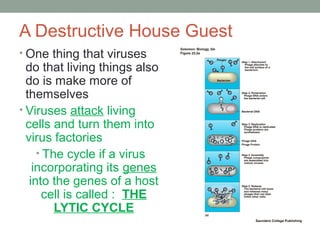
A Destructive House Guest
• One thing that viruses
do that living things also
do is make more of
themselves
• Viruses attack living
cells and turn them into
virus factories
• The cycle if a virus
incorporating its genes
into the genes of a host
cell is called : THE
LYTIC CYCLE
A Time Bomb
• Some viruses don’t go straight into lytic
cycle—they put genetic material in host
cells, but don’t make new viruses right
away
• In the lysogenic cycle, each new cells gets
a copy of the virus’s genes when the host
cell divides
• The genes stay inactive for a long time
• When they do become active, they begin
the lytic cycle and make copies of the virus
Treating a Virus
• Antibiotics don’t kill
viruses
• Scientists have
developed antiviral
medications
• Because many viral
diseases do not have a
cure, it is best to
prevent a viral infection
from happening in the
first place
• Childhood
vaccinations give
your immune
system a “head
start” on fighting
viruses
• Vaccinations need
to be kept current
• Also a good
practice to always
wash your hands

Viruses notes

  • 1.
  • 2.
    It’s a SmallWorld • Virus: a microscopic particle that gets inside a cell and often destroys the cell • Viruses are tiny • Smaller than the smallest bacteria • Change rapidly • So small and change so often that scientists don’t know exactly how many types exist • These properties make viruses difficult to fight
  • 4.
    Are Viruses Living? •Likeliving things, viruses contain protein and genetic material •But viruses don’t act like living things •Can’t eat, grow, or break down food •Can’t use oxygen •Cannot function on its own
  • 5.
    • Can onlyreproduce inside a living cell that serves as a host • Host: an organism from which a parasite takes food or shelter • Virus uses host’s cell as a tiny factory, and forces host to make viruses rather than healthy new cells
  • 6.
    Classifying Viruses• Canbe grouped together by: • Their shape • Type of disease they cause • Life cycle • Kind of genetic material they contain • There are 4 main shapes of viruses:
  • 7.
    Cylinders: The tobaccomosaic virus Is shaped like a cylinder and attacks tobacco plants. Crystals: The polio virus is shaped like the crystal shown here.
  • 8.
    Spacecraft: One groupof viruses attacks only bacteria. Many of these look almost like spacecraft (also called Bacteriophage). Spheres: Influenza viruses look like spheres. HIV is another virus that has this structure.
  • 9.
    • Every virusis made up of genetic material inside a protein coat (also known as capsid) • The protein coat protects the genetic material and helps a virus enter a host cell • Many viruses have protein coat that matches characteristics of their specific host • There are 4 main shapes of viruses: crystals, spheres, cylinders, and spacecraft Capsid: protein coat that surrounds virus
  • 12.
    Genetic Material • Geneticmaterial either DNA or RNA • Most RNA is made up of one strand of nucleotides, most DNA is two strands of nucleotides • Both DNA and RNA contain info for making proteins • Example: viruses that cause chickenpox & warts contain DNA • Example: viruses that cause flu, HIV, and common cold contain RNA
  • 13.
    • One strainof virus cannot infect both plants and animals VirusVirus AffectsAffects What?What? Which organisms?Which organisms? Tobacco mosaicTobacco mosaic PlantsPlants Tobacco, tomato,Tobacco, tomato, pepperspeppers Potato XPotato X PlantsPlants Potatoes, tomatoes,Potatoes, tomatoes, pepperspeppers AdenovirusAdenovirus AnimalsAnimals Humans & otherHumans & other vertebratesvertebrates HIVHIV AnimalsAnimals Humans & otherHumans & other primatesprimates BacteriophageBacteriophage BacteriaBacteria E.Coli & otherE.Coli & other bacteriabacteria
  • 14.
    Different Kinds ofViruses & their sizes
  • 15.
    Chicken pox (Varisellazoster virus (VZV) Flu (Influenza virus) Rabies virus
  • 16.
    A Destructive HouseGuest • One thing that viruses do that living things also do is make more of themselves • Viruses attack living cells and turn them into virus factories • The cycle if a virus incorporating its genes into the genes of a host cell is called : THE LYTIC CYCLE
  • 18.
    A Time Bomb •Some viruses don’t go straight into lytic cycle—they put genetic material in host cells, but don’t make new viruses right away • In the lysogenic cycle, each new cells gets a copy of the virus’s genes when the host cell divides • The genes stay inactive for a long time • When they do become active, they begin the lytic cycle and make copies of the virus
  • 20.
    Treating a Virus •Antibiotics don’t kill viruses • Scientists have developed antiviral medications • Because many viral diseases do not have a cure, it is best to prevent a viral infection from happening in the first place
  • 21.
    • Childhood vaccinations give yourimmune system a “head start” on fighting viruses • Vaccinations need to be kept current • Also a good practice to always wash your hands