





EMERGING
VIRUSES
Group Members
• Momina Aamir
• Nimra Zafar
• Maria Jameel
• Enam Ullah
• Muhammad Mubashar Noor
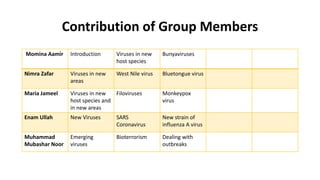
Contribution of Group Members
Momina Aamir Introduction Viruses in new
host species
Bunyaviruses
Nimra Zafar Viruses in new
areas
West Nile virus Bluetongue virus
Maria Jameel Viruses in new
host species and
in new areas
Filoviruses Monkeypox
virus
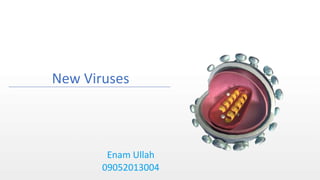
Enam Ullah New Viruses SARS
Coronavirus
New strain of
influenza A virus
Muhammad
Mubashar Noor
Emerging
viruses
Bioterrorism Dealing with
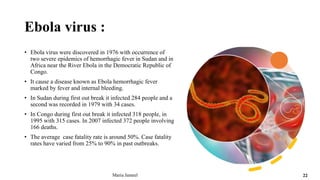
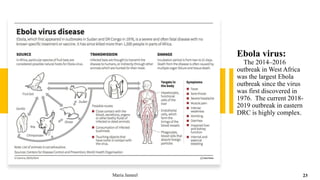
outbreaks
Duration: 95 min Middle School Grade: 6 - 8 CCSS, NGSS
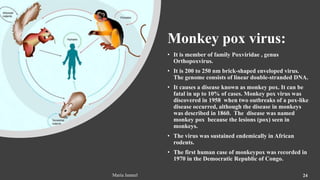
Momina Aamir
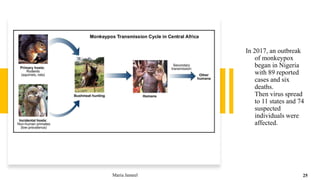
04051813020
Emerging Viruses
Emerging viruses
• Emerging virus - causative agent of
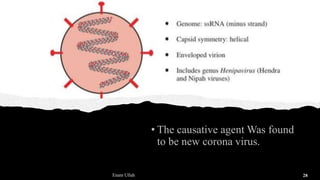
a new or previously unrecognized
infection
• A virus that has recently appeared
within a population or whose
incidence or geographic range is
rapidly increasing or threatens to
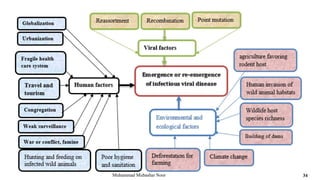
increase in the near future.
• It causes new diseases, new
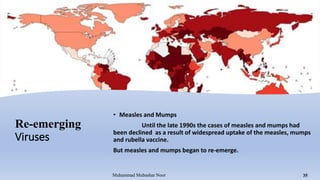
problems and new threats
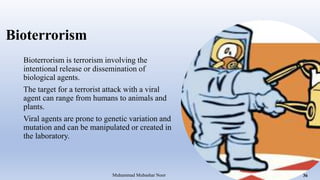
• e.g., Ebola, corona viruses
Momina Aamir 1
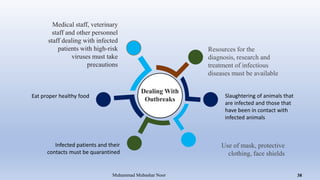
Emerging infections:
For an emerging virus to become established
at least two events must occur
• Introduction of the virus into new
vulnerable population by emerging from
environment , another host species or
variants of existing human infections.
• Establishment and dissemination within the
new host population. the agent must have
the ability to spread readily from person-to-
person and cause disease, sustain itself
within the population.
Momina Aamir 2
Viruses in new host species
Bunyaviruses
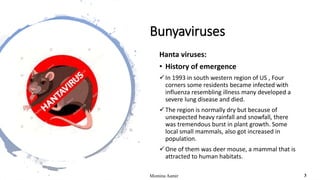
Hanta viruses:
• History of emergence
In 1993 in south western region of US , Four
corners some residents became infected with
influenza resembling illness many developed a
severe lung disease and died.
The region is normally dry but because of
unexpected heavy rainfall and snowfall, there
was tremendous burst in plant growth. Some
local small mammals, also got increased in
population.
One of them was deer mouse, a mammal that is
attracted to human habitats.
Momina Aamir 3
Bunyaviruses
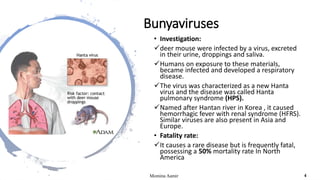
• Investigation:
deer mouse were infected by a virus, excreted
in their urine, droppings and saliva.
Humans on exposure to these materials,
became infected and developed a respiratory
disease.
The virus was characterized as a new Hanta
virus and the disease was called Hanta
pulmonary syndrome (HPS).
Named after Hantan river in Korea , it caused
hemorrhagic fever with renal syndrome (HFRS).
Similar viruses are also present in Asia and
Europe.
• Fatality rate:
It causes a rare disease but is frequently fatal,
possessing a 50% mortality rate In North
America
Momina Aamir 4
Hanta virus
• Nomenclature
Local people didn’t want to name it after
four corners as it would affect their tourism.
So, it was named Sin Nombre virus (SNV),
(the virus with no name) Spanish
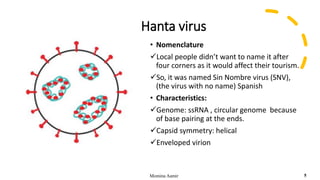
• Characteristics:
Genome: ssRNA , circular genome because
of base pairing at the ends.
Capsid symmetry: helical
Enveloped virion
Momina Aamir 5
Paramyxoviruses
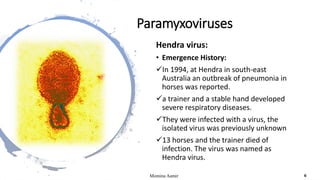
Hendra virus:
• Emergence History:
In 1994, at Hendra in south-east
Australia an outbreak of pneumonia in
horses was reported.
a trainer and a stable hand developed
severe respiratory diseases.
They were infected with a virus, the
isolated virus was previously unknown
13 horses and the trainer died of
infection. The virus was named as
Hendra virus.
Momina Aamir 6
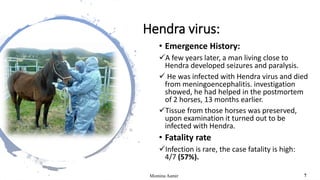
Hendra virus:
• Emergence History:
A few years later, a man living close to
Hendra developed seizures and paralysis.
 He was infected with Hendra virus and died
from meningoencephalitis. investigation
showed, he had helped in the postmortem
of 2 horses, 13 months earlier.
Tissue from those horses was preserved,
upon examination it turned out to be
infected with Hendra.
• Fatality rate
Infection is rare, the case fatality is high:
4/7 (57%).
Momina Aamir 7
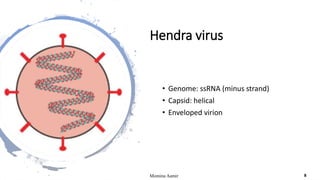
Hendra virus
• Genome: ssRNA (minus strand)
• Capsid: helical
• Enveloped virion
Momina Aamir 8
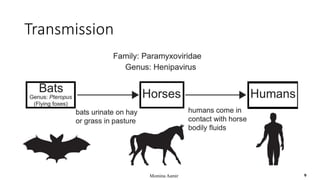
Transmission
Momina Aamir 9
Duration: 95 min Middle School Grade: 6 - 8 CCSS, NGSS
Nimra Zafar
04051813004
Viruses in new areas
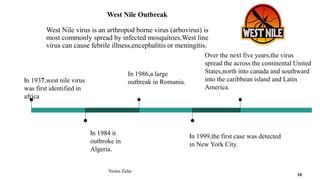
West Nile Outbreak
West Nile virus is an arthropod borne virus (arbovirus) is
most commonly spread by infected mosquitoes.West line
virus can cause febrile illness,encephalitis or meningitis.
In 1937,west nile virus
was first identified in
africa
In 1984 it
outbroke in
Algeria.
In 1986,a large
outbreak in Romania.
In 1999,the first case was detected
in New York City.
Over the next five years,the virus
spread the across the continental United
States,north into canada and southward
into the caribbean island and Latin
America.
Nimra Zafar
10
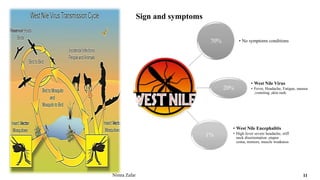
70% • No symptoms conditions
20%
• West Nile Virus
• Fever, Headache, Fatigue, nausea
,vomiting ,skin rash.
1%
• West Nile Encephalitis
• High fever severe headache, stiff
neck disorientation ,stupor
coma, tremors, muscle weakness
Sign and symptoms
Nimra Zafar 11
West Nile virus
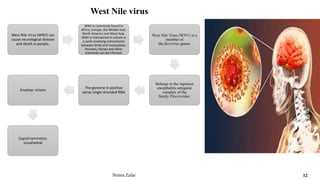
West Nile Virus (WNV) can
cause neurological disease
and death in people.
WNV is commonly found in
Africa, Europe, the Middle East,
North America and West Asia.
WNV is maintained in nature in
a cycle involving transmission
between birds and mosquitoes.
Humans, horses and other
mammals can be infected.
West Nile Virus (WNV) is a
member of
the flavivirus genus.
Belongs to the Japanese
encephalitis antigenic
complex of the
family Flaviviridae.
The genome in positive
sense single stranded RNA
Envelop: virions
Capsid symmetry:
icosahedral
Nimra Zafar 12
Bluetongue virus
Bluetongue is a non-contagious, insect-borne,
viral disease of ruminants. Bluetongue virus
(BTV) belongs to the genus Orbivirus in the
family Reoviridae. There are 24 serotypes
identified worldwide, six of which have been
isolated in the U.S. Bluetongue primarily affects
sheep and wild ruminants, with asymptomatic
infections occurring in cattle, goats, deer, and
carnivores. This disease can result in significant
morbidity.
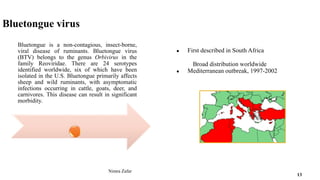
● First described in South Africa
Broad distribution worldwide
● Mediterranean outbreak, 1997-2002
Nimra Zafar
13
BTV Virus Spread
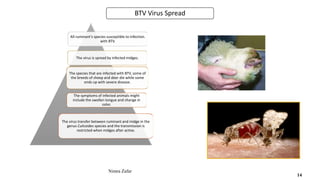
All ruminant's species susceptible to infection.
with BTV.
The virus is spread by infected midges.
The species that are infected with BTV, some of
the breeds of sheep and deer die while some
ends up with severe disease.
The symptoms of infected animals might
include the swollen tongue and change in
color.
The virus transfer between ruminant and midge in the
genus Culicoides species and the transmission is
restricted when midges after active.
Nimra Zafar
14
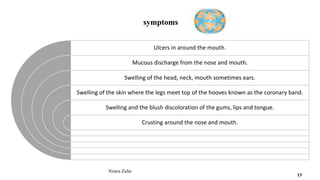
symptoms
Ulcers in around the mouth.
Mucous discharge from the nose and mouth.
Swelling of the head, neck, mouth sometimes ears.
Swelling of the skin where the legs meet top of the hooves known as the coronary band.
Swelling and the blush discoloration of the gums, lips and tongue.
Crusting around the nose and mouth.
Nimra Zafar
15
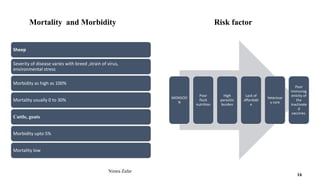
Mortality and Morbidity Risk factor
Sheep
Severity of disease varies with breed ,strain of virus,
environmental stress
Morbidity as high as 100%
Mortality usually 0 to 30%
Cattle, goats
Morbidity upto 5%
Mortality low
MONSOO
N
Poor
flock
nutrition
High
parasitic
burden
Lack of
affordabl
e
Veterinar
y care
Poor
immunog
enicity of
the
inactivate
d
vaccines.
Nimra Zafar
16
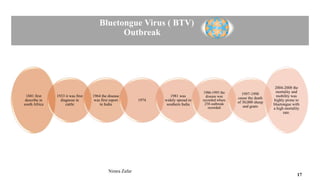
Bluetongue Virus ( BTV)
Outbreak
1881 first
describe in
south Africa
1933 it was first
diagnose in
cattle
1964 the disease
was first report
in India
1974
1981 was
widely spread in
southern India
1986-1995 the
disease was
recorded where
258 outbreak
recorded
1997-1998
cause the death
of 30,000 sheep
and goats
2004-2008 the
mortality and
mobility was
highly prone to
bluetongue with
a high mortality
rate.
Nimra Zafar
17
Duration: 95 min Middle School Grade: 6 - 8 CCSS, NGSS
Viruses in new host
species and in new areas
Maria Jameel
04051813032
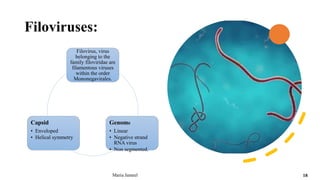
Filoviruses:
Maria Jameel 18
Filovirus, virus
belonging to the
family filoviridae are
filamentous viruses
within the order
Mononegavirales.
Genome
• Linear
• Negative strand
RNA virus
• Non segmented.
Capsid
• Enveloped
• Helical symmetry
• Filoviridae consists of two genera :
1). Marburg virus
2). Ebola virus
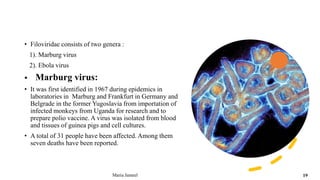
 Marburg virus:
• It was first identified in 1967 during epidemics in
laboratories in Marburg and Frankfurt in Germany and
Belgrade in the former Yugoslavia from importation of
infected monkeys from Uganda for research and to
prepare polio vaccine. A virus was isolated from blood
and tissues of guinea pigs and cell cultures.
• A total of 31 people have been affected. Among them
seven deaths have been reported.
Maria Jameel 19
Marburg virus:
Maria Jameel 20
The virus was
named Marburg
virus after the
city in which it
was first
characterized
Out breaks and
sporadic cases
have been
reported in
Angola, Kenya,
South Africa,
Democratic
Republic of the
Congo.
The largest
outbreak
occurred in 2005
in Angola, and
involved 374
cases, including
329 deaths.
It causes a severe
and highly fatal
hemorrhagic
fever in humans.
It affects both
humans and
nonhuman
primates. It is
zoonotic virus.
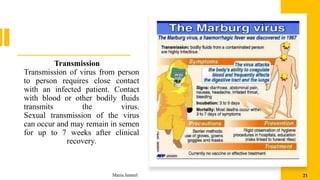
Transmission
Transmission of virus from person
to person requires close contact
with an infected patient. Contact
with blood or other bodily fluids
transmits the virus.
Sexual transmission of the virus
can occur and may remain in semen
for up to 7 weeks after clinical
recovery.
Maria Jameel 21
Ebola virus :
• Ebola virus were discovered in 1976 with occurrence of
two severe epidemics of hemorrhagic fever in Sudan and in
Africa near the River Ebola in the Democratic Republic of
Congo.
• It cause a disease known as Ebola hemorrhagic fever
marked by fever and internal bleeding.
• In Sudan during first out break it infected 284 people and a
second was recorded in 1979 with 34 cases.
• In Congo during first out break it infected 318 people, in
1995 with 315 cases. In 2007 infected 372 people involving
166 deaths.
• The average case fatality rate is around 50%. Case fatality
rates have varied from 25% to 90% in past outbreaks.
Maria Jameel 22
Ebola virus:
The 2014–2016
outbreak in West Africa
was the largest Ebola
outbreak since the virus
was first discovered in
1976. The current 2018-
2019 outbreak in eastern
DRC is highly complex.
Maria Jameel 23
Monkey pox virus:
• It is member of family Poxviridae , genus
Orthopoxvirus.
• It is 200 to 250 nm brick-shaped enveloped virus.
The genome consists of linear double-stranded DNA.
• It causes a disease known as monkey pox. It can be
fatal in up to 10% of cases. Monkey pox virus was
discovered in 1958 when two outbreaks of a pox-like
disease occurred, although the disease in monkeys
was described in 1860. The disease was named
monkey pox because the lesions (pox) seen in
monkeys.
• The virus was sustained endemically in African
rodents.
• The first human case of monkeypox was recorded in
1970 in the Democratic Republic of Congo.
Maria Jameel 24
In 2017, an outbreak
of monkeypox
began in Nigeria
with 89 reported
cases and six
deaths.
Then virus spread
to 11 states and 74
suspected
individuals were
affected.
Maria Jameel 25
Duration: 95 min Middle School Grade: 6 - 8 CCSS, NGSS
New Viruses
Enam Ullah
09052013004
New Viruses
• A new virus is defined as the
appearance, identification of
a new virus for a host.
The example of new viruses
include
• SARS Coronavirus
• New strain of Influenza A virus
Enam Ullah 26
SARS coronavirus
• In 2002 human respiratory disease
emerged in southern China. The
following year one of the doctor who had
been treated patient traveled to Hong
Kong where he became ill and died.
Signs and symptoms
• Fever
• Aching muscles
• Sore throat
• Cough and shortness of breath
• Respiratory disease
• Diarrhoea
Enam Ullah 27
Enam Ullah 28
Spread of SARS
• Mammalian to Human species
It is likely that the corona virus have repeatedly crossed into humans from other
mammalian species.
• Human to human transmission
Weak human to human transmission.
The outbreak was brought Under control by quarantine measure but only after there had
been over 8000 cases with nearly 800 death
Enam Ullah 29
New strain of influenza A virus
• The family Orthomyxoviridae include the influenza A virus. The virion have two species of surface
glycoprotein :a haemagglutinin (H) and neuraminidase (N) . There are 16 types of H antigen and nine type of
N antigen. Time to time a virus emerge with a new combination of H and N gene formed by reassortment.
• The host influenza A virus are principally bird that frequently aquatic habitat.
• Infection with most virus strain few are no sign of disease some strain are highly pathogenic and kill their
avian host. The virus spread to new area when birds migrate.
• Some influenza A virus infect mammalian species including pigs ,horses and human the respiratory tract is
the main site of virus replication. Normally human are infected only with virus have H type 1,2,3 and N type 1
or 2. Patients are commonly very ill and some die either direct result of virus infection or indirectly secondary
pathogens which are able to infect as a result of damage to respiratory epithelium.
Enam Ullah 30
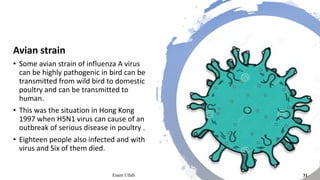
Avian strain
• Some avian strain of influenza A virus
can be highly pathogenic in bird can be
transmitted from wild bird to domestic
poultry and can be transmitted to
human.
• This was the situation in Hong Kong
1997 when H5N1 virus can cause of an
outbreak of serious disease in poultry .
• Eighteen people also infected and with
virus and Six of them died.
Enam Ullah 31
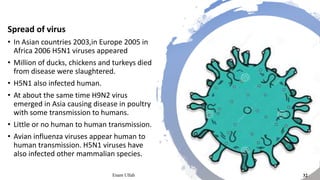
Spread of virus
• In Asian countries 2003,in Europe 2005 in
Africa 2006 H5N1 viruses appeared
• Million of ducks, chickens and turkeys died
from disease were slaughtered.
• H5N1 also infected human.
• At about the same time H9N2 virus
emerged in Asia causing disease in poultry
with some transmission to humans.
• Little or no human to human transmission.
• Avian influenza viruses appear human to
human transmission. H5N1 viruses have
also infected other mammalian species.
Enam Ullah 32
Duration: 95 min Middle School Grade: 6 - 8 CCSS, NGSS
Re-emerging Viruses
Muhammad Mubashar Noor
04051813035
Re-emerging Viruses
• Re-emerging viruses are those that once were major health problems
globally or in a particular country, and then declined, but are again
becoming health problems for a significant proportion of the population.
• There are many complex reasons for the increase in re-emergence.
• The main factors that contribute to the re emergence of viruses are
1. Virus evolution and adaptation
2. Human factors
3. Ecological changes.
Muhammad Mubashar Noor 33
Muhammad Mubashar Noor 34
Re-emerging
Viruses
• Measles and Mumps
Until the late 1990s the cases of measles and mumps had
been declined as a result of widespread uptake of the measles, mumps
and rubella vaccine.
But measles and mumps began to re-emerge.
Muhammad Mubashar Noor 35
Bioterrorism
Bioterrorism is terrorism involving the
intentional release or dissemination of
biological agents.
The target for a terrorist attack with a viral
agent can range from humans to animals and
plants.
Viral agents are prone to genetic variation and
mutation and can be manipulated or created in
the laboratory.
Muhammad Mubashar Noor 36
History of Bioterrorism
• The use of viral agents for biological warfare has a long history.
In the 16th century, the Spanish explorer presented the indigenous peoples of South
America with variola-contaminated clothing, which resulted in widespread epidemics of
smallpox.
During the French and Indian War (1745–67), the commander of the British forces in
North America, suggested the deliberate use of smallpox to “reduce” Native American
tribes hostile to the British.
In 1775, during the Revolutionary War, the British attempted to spread smallpox among
the Continental forces by inoculating (variolation) civilians fleeing Boston.
Muhammad Mubashar Noor 37
Resources for the
diagnosis, research and
treatment of infectious
diseases must be available
Slaughtering of animals that
are infected and those that
have been in contact with
infected animals
Use of mask, protective
clothing, face shields
Medical staff, veterinary
staff and other personnel
staff dealing with infected
patients with high-risk
viruses must take
precautions
Eat proper healthy food
Infected patients and their
contacts must be quarantined
Dealing With
Outbreaks
Muhammad Mubashar Noor 38
References
• CDC - Hantavirus. (2020, september 9). Retrieved from Cdc.gov:
https://www.cdc.gov/hantavirus/index.html
• Hendra Virus Disease (HeV) . (n.d.). Retrieved from Cdc.gov:
https://www.cdc.gov/vhf/hendra/pdf/factsheet.pdf
• McManimen, S. L. (2017). https://clinmedjournals.org/articles/ijnn/international-journal-of-neurology-and-
neurotherapy-ijnn-4-066.php?jid=ijnn. International Journal of Neurology and Neurotherapy, 4(1).
• Viruses and Bioterrorism, Centers for Disease Control and Prevention, Atlanta, GA, United States, S.A.
Morse,Centers for Disease Control and Prevention, Atlanta, GA, United States R.F. Meyer
• Reasons for the increase in emerging and re-emerging viral infectious diseases, Eric Ka-Wai Hui Published
online 2006 Jan 6
• Measles: An Overview of a Re-Emerging Disease in Children and Immunocompromised Patients , Andrea
Misin, Roberta Maria Antonello, Stefano Di Bella, Giuseppina Campisciano, Nunzia Zanotta, Daniele Roberto
Giacobbe Manola Comar, and Roberto Luzzati ,Published online 2020 Feb 18
Emerging viruses

Emerging viruses

  • 1.
  • 2.
    Group Members • MominaAamir • Nimra Zafar • Maria Jameel • Enam Ullah • Muhammad Mubashar Noor
  • 3.
    Contribution of GroupMembers Momina Aamir Introduction Viruses in new host species Bunyaviruses Nimra Zafar Viruses in new areas West Nile virus Bluetongue virus Maria Jameel Viruses in new host species and in new areas Filoviruses Monkeypox virus Enam Ullah New Viruses SARS Coronavirus New strain of influenza A virus Muhammad Mubashar Noor Emerging viruses Bioterrorism Dealing with outbreaks
  • 4.
    Duration: 95 minMiddle School Grade: 6 - 8 CCSS, NGSS Momina Aamir 04051813020 Emerging Viruses
  • 5.
    Emerging viruses • Emergingvirus - causative agent of a new or previously unrecognized infection • A virus that has recently appeared within a population or whose incidence or geographic range is rapidly increasing or threatens to increase in the near future. • It causes new diseases, new problems and new threats • e.g., Ebola, corona viruses Momina Aamir 1
  • 6.
    Emerging infections: For anemerging virus to become established at least two events must occur • Introduction of the virus into new vulnerable population by emerging from environment , another host species or variants of existing human infections. • Establishment and dissemination within the new host population. the agent must have the ability to spread readily from person-to- person and cause disease, sustain itself within the population. Momina Aamir 2
  • 7.
    Viruses in newhost species
  • 8.
    Bunyaviruses Hanta viruses: • Historyof emergence In 1993 in south western region of US , Four corners some residents became infected with influenza resembling illness many developed a severe lung disease and died. The region is normally dry but because of unexpected heavy rainfall and snowfall, there was tremendous burst in plant growth. Some local small mammals, also got increased in population. One of them was deer mouse, a mammal that is attracted to human habitats. Momina Aamir 3
  • 9.
    Bunyaviruses • Investigation: deer mousewere infected by a virus, excreted in their urine, droppings and saliva. Humans on exposure to these materials, became infected and developed a respiratory disease. The virus was characterized as a new Hanta virus and the disease was called Hanta pulmonary syndrome (HPS). Named after Hantan river in Korea , it caused hemorrhagic fever with renal syndrome (HFRS). Similar viruses are also present in Asia and Europe. • Fatality rate: It causes a rare disease but is frequently fatal, possessing a 50% mortality rate In North America Momina Aamir 4
  • 10.
    Hanta virus • Nomenclature Localpeople didn’t want to name it after four corners as it would affect their tourism. So, it was named Sin Nombre virus (SNV), (the virus with no name) Spanish • Characteristics: Genome: ssRNA , circular genome because of base pairing at the ends. Capsid symmetry: helical Enveloped virion Momina Aamir 5
  • 11.
    Paramyxoviruses Hendra virus: • EmergenceHistory: In 1994, at Hendra in south-east Australia an outbreak of pneumonia in horses was reported. a trainer and a stable hand developed severe respiratory diseases. They were infected with a virus, the isolated virus was previously unknown 13 horses and the trainer died of infection. The virus was named as Hendra virus. Momina Aamir 6
  • 12.
    Hendra virus: • EmergenceHistory: A few years later, a man living close to Hendra developed seizures and paralysis.  He was infected with Hendra virus and died from meningoencephalitis. investigation showed, he had helped in the postmortem of 2 horses, 13 months earlier. Tissue from those horses was preserved, upon examination it turned out to be infected with Hendra. • Fatality rate Infection is rare, the case fatality is high: 4/7 (57%). Momina Aamir 7
  • 13.
    Hendra virus • Genome:ssRNA (minus strand) • Capsid: helical • Enveloped virion Momina Aamir 8
  • 14.
  • 15.
    Duration: 95 minMiddle School Grade: 6 - 8 CCSS, NGSS Nimra Zafar 04051813004 Viruses in new areas
  • 16.
    West Nile Outbreak WestNile virus is an arthropod borne virus (arbovirus) is most commonly spread by infected mosquitoes.West line virus can cause febrile illness,encephalitis or meningitis. In 1937,west nile virus was first identified in africa In 1984 it outbroke in Algeria. In 1986,a large outbreak in Romania. In 1999,the first case was detected in New York City. Over the next five years,the virus spread the across the continental United States,north into canada and southward into the caribbean island and Latin America. Nimra Zafar 10
  • 17.
    70% • Nosymptoms conditions 20% • West Nile Virus • Fever, Headache, Fatigue, nausea ,vomiting ,skin rash. 1% • West Nile Encephalitis • High fever severe headache, stiff neck disorientation ,stupor coma, tremors, muscle weakness Sign and symptoms Nimra Zafar 11
  • 18.
    West Nile virus WestNile Virus (WNV) can cause neurological disease and death in people. WNV is commonly found in Africa, Europe, the Middle East, North America and West Asia. WNV is maintained in nature in a cycle involving transmission between birds and mosquitoes. Humans, horses and other mammals can be infected. West Nile Virus (WNV) is a member of the flavivirus genus. Belongs to the Japanese encephalitis antigenic complex of the family Flaviviridae. The genome in positive sense single stranded RNA Envelop: virions Capsid symmetry: icosahedral Nimra Zafar 12
  • 19.
    Bluetongue virus Bluetongue isa non-contagious, insect-borne, viral disease of ruminants. Bluetongue virus (BTV) belongs to the genus Orbivirus in the family Reoviridae. There are 24 serotypes identified worldwide, six of which have been isolated in the U.S. Bluetongue primarily affects sheep and wild ruminants, with asymptomatic infections occurring in cattle, goats, deer, and carnivores. This disease can result in significant morbidity. ● First described in South Africa Broad distribution worldwide ● Mediterranean outbreak, 1997-2002 Nimra Zafar 13
  • 20.
    BTV Virus Spread Allruminant's species susceptible to infection. with BTV. The virus is spread by infected midges. The species that are infected with BTV, some of the breeds of sheep and deer die while some ends up with severe disease. The symptoms of infected animals might include the swollen tongue and change in color. The virus transfer between ruminant and midge in the genus Culicoides species and the transmission is restricted when midges after active. Nimra Zafar 14
  • 21.
    symptoms Ulcers in aroundthe mouth. Mucous discharge from the nose and mouth. Swelling of the head, neck, mouth sometimes ears. Swelling of the skin where the legs meet top of the hooves known as the coronary band. Swelling and the blush discoloration of the gums, lips and tongue. Crusting around the nose and mouth. Nimra Zafar 15
  • 22.
    Mortality and MorbidityRisk factor Sheep Severity of disease varies with breed ,strain of virus, environmental stress Morbidity as high as 100% Mortality usually 0 to 30% Cattle, goats Morbidity upto 5% Mortality low MONSOO N Poor flock nutrition High parasitic burden Lack of affordabl e Veterinar y care Poor immunog enicity of the inactivate d vaccines. Nimra Zafar 16
  • 23.
    Bluetongue Virus (BTV) Outbreak 1881 first describe in south Africa 1933 it was first diagnose in cattle 1964 the disease was first report in India 1974 1981 was widely spread in southern India 1986-1995 the disease was recorded where 258 outbreak recorded 1997-1998 cause the death of 30,000 sheep and goats 2004-2008 the mortality and mobility was highly prone to bluetongue with a high mortality rate. Nimra Zafar 17
  • 24.
    Duration: 95 minMiddle School Grade: 6 - 8 CCSS, NGSS Viruses in new host species and in new areas Maria Jameel 04051813032
  • 25.
    Filoviruses: Maria Jameel 18 Filovirus,virus belonging to the family filoviridae are filamentous viruses within the order Mononegavirales. Genome • Linear • Negative strand RNA virus • Non segmented. Capsid • Enveloped • Helical symmetry
  • 26.
    • Filoviridae consistsof two genera : 1). Marburg virus 2). Ebola virus  Marburg virus: • It was first identified in 1967 during epidemics in laboratories in Marburg and Frankfurt in Germany and Belgrade in the former Yugoslavia from importation of infected monkeys from Uganda for research and to prepare polio vaccine. A virus was isolated from blood and tissues of guinea pigs and cell cultures. • A total of 31 people have been affected. Among them seven deaths have been reported. Maria Jameel 19
  • 27.
    Marburg virus: Maria Jameel20 The virus was named Marburg virus after the city in which it was first characterized Out breaks and sporadic cases have been reported in Angola, Kenya, South Africa, Democratic Republic of the Congo. The largest outbreak occurred in 2005 in Angola, and involved 374 cases, including 329 deaths. It causes a severe and highly fatal hemorrhagic fever in humans. It affects both humans and nonhuman primates. It is zoonotic virus.
  • 28.
    Transmission Transmission of virusfrom person to person requires close contact with an infected patient. Contact with blood or other bodily fluids transmits the virus. Sexual transmission of the virus can occur and may remain in semen for up to 7 weeks after clinical recovery. Maria Jameel 21
  • 29.
    Ebola virus : •Ebola virus were discovered in 1976 with occurrence of two severe epidemics of hemorrhagic fever in Sudan and in Africa near the River Ebola in the Democratic Republic of Congo. • It cause a disease known as Ebola hemorrhagic fever marked by fever and internal bleeding. • In Sudan during first out break it infected 284 people and a second was recorded in 1979 with 34 cases. • In Congo during first out break it infected 318 people, in 1995 with 315 cases. In 2007 infected 372 people involving 166 deaths. • The average case fatality rate is around 50%. Case fatality rates have varied from 25% to 90% in past outbreaks. Maria Jameel 22
  • 30.
    Ebola virus: The 2014–2016 outbreakin West Africa was the largest Ebola outbreak since the virus was first discovered in 1976. The current 2018- 2019 outbreak in eastern DRC is highly complex. Maria Jameel 23
  • 31.
    Monkey pox virus: •It is member of family Poxviridae , genus Orthopoxvirus. • It is 200 to 250 nm brick-shaped enveloped virus. The genome consists of linear double-stranded DNA. • It causes a disease known as monkey pox. It can be fatal in up to 10% of cases. Monkey pox virus was discovered in 1958 when two outbreaks of a pox-like disease occurred, although the disease in monkeys was described in 1860. The disease was named monkey pox because the lesions (pox) seen in monkeys. • The virus was sustained endemically in African rodents. • The first human case of monkeypox was recorded in 1970 in the Democratic Republic of Congo. Maria Jameel 24
  • 32.
    In 2017, anoutbreak of monkeypox began in Nigeria with 89 reported cases and six deaths. Then virus spread to 11 states and 74 suspected individuals were affected. Maria Jameel 25
  • 33.
    Duration: 95 minMiddle School Grade: 6 - 8 CCSS, NGSS New Viruses Enam Ullah 09052013004
  • 34.
    New Viruses • Anew virus is defined as the appearance, identification of a new virus for a host. The example of new viruses include • SARS Coronavirus • New strain of Influenza A virus Enam Ullah 26
  • 35.
    SARS coronavirus • In2002 human respiratory disease emerged in southern China. The following year one of the doctor who had been treated patient traveled to Hong Kong where he became ill and died. Signs and symptoms • Fever • Aching muscles • Sore throat • Cough and shortness of breath • Respiratory disease • Diarrhoea Enam Ullah 27
  • 36.
  • 37.
    Spread of SARS •Mammalian to Human species It is likely that the corona virus have repeatedly crossed into humans from other mammalian species. • Human to human transmission Weak human to human transmission. The outbreak was brought Under control by quarantine measure but only after there had been over 8000 cases with nearly 800 death Enam Ullah 29
  • 38.
    New strain ofinfluenza A virus • The family Orthomyxoviridae include the influenza A virus. The virion have two species of surface glycoprotein :a haemagglutinin (H) and neuraminidase (N) . There are 16 types of H antigen and nine type of N antigen. Time to time a virus emerge with a new combination of H and N gene formed by reassortment. • The host influenza A virus are principally bird that frequently aquatic habitat. • Infection with most virus strain few are no sign of disease some strain are highly pathogenic and kill their avian host. The virus spread to new area when birds migrate. • Some influenza A virus infect mammalian species including pigs ,horses and human the respiratory tract is the main site of virus replication. Normally human are infected only with virus have H type 1,2,3 and N type 1 or 2. Patients are commonly very ill and some die either direct result of virus infection or indirectly secondary pathogens which are able to infect as a result of damage to respiratory epithelium. Enam Ullah 30
  • 39.
    Avian strain • Someavian strain of influenza A virus can be highly pathogenic in bird can be transmitted from wild bird to domestic poultry and can be transmitted to human. • This was the situation in Hong Kong 1997 when H5N1 virus can cause of an outbreak of serious disease in poultry . • Eighteen people also infected and with virus and Six of them died. Enam Ullah 31
  • 40.
    Spread of virus •In Asian countries 2003,in Europe 2005 in Africa 2006 H5N1 viruses appeared • Million of ducks, chickens and turkeys died from disease were slaughtered. • H5N1 also infected human. • At about the same time H9N2 virus emerged in Asia causing disease in poultry with some transmission to humans. • Little or no human to human transmission. • Avian influenza viruses appear human to human transmission. H5N1 viruses have also infected other mammalian species. Enam Ullah 32
  • 41.
    Duration: 95 minMiddle School Grade: 6 - 8 CCSS, NGSS Re-emerging Viruses Muhammad Mubashar Noor 04051813035
  • 42.
    Re-emerging Viruses • Re-emergingviruses are those that once were major health problems globally or in a particular country, and then declined, but are again becoming health problems for a significant proportion of the population. • There are many complex reasons for the increase in re-emergence. • The main factors that contribute to the re emergence of viruses are 1. Virus evolution and adaptation 2. Human factors 3. Ecological changes. Muhammad Mubashar Noor 33
  • 43.
  • 44.
    Re-emerging Viruses • Measles andMumps Until the late 1990s the cases of measles and mumps had been declined as a result of widespread uptake of the measles, mumps and rubella vaccine. But measles and mumps began to re-emerge. Muhammad Mubashar Noor 35
  • 45.
    Bioterrorism Bioterrorism is terrorisminvolving the intentional release or dissemination of biological agents. The target for a terrorist attack with a viral agent can range from humans to animals and plants. Viral agents are prone to genetic variation and mutation and can be manipulated or created in the laboratory. Muhammad Mubashar Noor 36
  • 46.
    History of Bioterrorism •The use of viral agents for biological warfare has a long history. In the 16th century, the Spanish explorer presented the indigenous peoples of South America with variola-contaminated clothing, which resulted in widespread epidemics of smallpox. During the French and Indian War (1745–67), the commander of the British forces in North America, suggested the deliberate use of smallpox to “reduce” Native American tribes hostile to the British. In 1775, during the Revolutionary War, the British attempted to spread smallpox among the Continental forces by inoculating (variolation) civilians fleeing Boston. Muhammad Mubashar Noor 37
  • 47.
    Resources for the diagnosis,research and treatment of infectious diseases must be available Slaughtering of animals that are infected and those that have been in contact with infected animals Use of mask, protective clothing, face shields Medical staff, veterinary staff and other personnel staff dealing with infected patients with high-risk viruses must take precautions Eat proper healthy food Infected patients and their contacts must be quarantined Dealing With Outbreaks Muhammad Mubashar Noor 38
  • 48.
    References • CDC -Hantavirus. (2020, september 9). Retrieved from Cdc.gov: https://www.cdc.gov/hantavirus/index.html • Hendra Virus Disease (HeV) . (n.d.). Retrieved from Cdc.gov: https://www.cdc.gov/vhf/hendra/pdf/factsheet.pdf • McManimen, S. L. (2017). https://clinmedjournals.org/articles/ijnn/international-journal-of-neurology-and- neurotherapy-ijnn-4-066.php?jid=ijnn. International Journal of Neurology and Neurotherapy, 4(1). • Viruses and Bioterrorism, Centers for Disease Control and Prevention, Atlanta, GA, United States, S.A. Morse,Centers for Disease Control and Prevention, Atlanta, GA, United States R.F. Meyer • Reasons for the increase in emerging and re-emerging viral infectious diseases, Eric Ka-Wai Hui Published online 2006 Jan 6 • Measles: An Overview of a Re-Emerging Disease in Children and Immunocompromised Patients , Andrea Misin, Roberta Maria Antonello, Stefano Di Bella, Giuseppina Campisciano, Nunzia Zanotta, Daniele Roberto Giacobbe Manola Comar, and Roberto Luzzati ,Published online 2020 Feb 18

Editor's Notes

  • #32 It is discovered in 1896