VIRUSVIRUS
Few definitions
• Virus- obligatory parasite, lacking cell organelles
• Virology- study of viruses
• Virologist- the one who studies viruses
Size – 10-400nm
Exception- pox virus- can be seen under light
microscope
General Properties
• Simple, lacking cell organelles
• Presence of either DNA or RNA
• Obligatory in nature (can not reproduce without
host)
• Exist in two phases-extracellular and intracellular
• Extracellular phase- possess few enzymes
• Intracellular phase- has replicating nucleic acid,
induce host metabolism to synthesize viral
components
Structure
• Nucleocapsid- Either DNA or RNA within protein
coat called capsid
• Capsid has many copies of one or a few types of
proteins
• These proteins are called protomers
Symmetry of virus
Helical symmetry
• Like hollow tubes with protein walls(rigid)
• Eg TMV(tobacco mosaic virus)
• Protomers or capsomers in spiral arrangement
• So becomes a tube like structure(15-18nm in
diameter by 300nm long)
• An RNA as genome, wound in spiral and lies within
groove formed by the protein subunits
Icosahedral symmetry
• Regular polyhedron
• 20 equilateral
triangular faces and
12 vertices
• nature’s favorite
shape
• Efficient way to close
a space
• Capsomers are ring
or knob like
Each capsomer is
made of five or six
protomers (pentamers
or hexamers)
Pentamers are at
vertices
Hexamers are at edges
and triangular faces
Complex virus-eg.pox virus &
bacteriphage
Largest of the animal
virus
400x240x200 nm
Complex
Ovoid to brick shaped
exterior
ds DNA with protein in
nucleoid(biconcave disk
like structure and two
elliptical and lateral
bodies lie between the
nucleoid and its outer
envelope which is a thick
layer covered by an array
of tubules or fibres
Viral envelopes
• An outer membrane
• Made up of lipid and carbohydrate of host
• Viral genes form peplopmes (spikes) on the
surface, important in virus attachment to the host
• Different in different viruses so can be used for the
identification
• Flexible so show variable shapes (also called
pleomorphic)
Viral envelopes and Enzymes
• Neuraminidase from spike in influenza virus. Can
release mature virion from the host cell
• Other spike is called haemagglutinin useful for
attachment
• These peplomers are glycoproteins
• M or matrix protein is non glycosylated protein
present on the inner surface of the envelope and
helps stabilize it
• RNA dependent RNA polymerase
Viral Genome
• ds DNA, ss DNA (double stranded and single
stranded)
• ds RNA, ss RNA
• Plus(+) strand- when RNA identical to viral mRNA
• Minus(-) strand- when RNA complementary to viral
mRNA
• Segmented genome-more than one RNA strands
Structure of phage T4
VIRUS REPRODUCTION
LYTIC CYCLE
Steps in reproduction
Adsorption and penetration-
• Bacteria have receptors for phages
• Eg. LPS, proteins, techoic acid, flagella, pili
• T even phages use CW and proteins as the
receptors
• Attachment starts when the base plates settles
down on the receptor firmly and tail fibrils
facilitate the attachment
• The tail sheath gets rearranged and becomes
shorter and wider
• The central tube or core is pushed through the CW
• The plate has lysozyme like activity
Steps in reproduction-contd.
• So helps in penetration
• Finally the linear DNA is extruded from the head,
through the tail tube and into the host cell through
a pore
Steps in reproduction
Synthesis of phage nucleic acid and proteins-
• Within 2 minutes after injection of T4 DNA into a
host E.coli starts synthesizing T4 mRNA
• Now there is synthesis of viral constituents
Assembly of phage particles-
Three proteins are required-
• Phage structural proteins
• Proteins that help in the assembly
• Proteins that are involved in the cell lysis and
phage release
Steps in reproduction
Release of phage particles-
Two proteins are required- T4 lysozyme, attacks
bacterial cell wall
and holin which creates holes in plasma membrane
Once 150 viral particles have accumulated inside the
host, lysis takes place
VIRUS REPRODUCTION
LYSOGENIC CYCLE by
temperate phages
Few definitions
• Lysogeny-relationship between a temperate phage
and its host
• Prophage- the form of phage in the host
• Lysogen or lysogenic bacteria-infected bacteria
• Lysogenic conversion- Corynebacterium
diphtheriae infected by beta phage and becomes
pathgenic
Cultivation of virus
(Chorioallantoic
membrane)
Tissue Culture
Cultivation of viruses in tissue culture
• Monolayer tissue culture
• Growth medium for cells in the tissue culture
• Antibiotic added to prevent bacterial growth
• Kept in a specialized plate
• Viruses inoculated in to layer of cells
• The cells are covered with a thin layer of agar
to limit virion growth
Detection of viral growth in tissue
culture
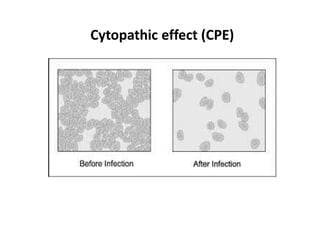
1. Rounding of cell
2. Detachment of cells
3. Formation of giant cells
Cytopathic effect (CPE)
Multinucleate giant cell(measles virus)
Growing Bacteriophages In The Laboratory
Cellular destruction and lysis called plaques
Cultivation of bacterial viruses
• The plaque method:
• Virus, bacteria, and agar mixed, plated and incubated.
• After replication the virus lyses the bacteria, forming
plaques, or clear zones.
• Each plaque is assumed to come from a single viral
particle.
• The titer (concentration of the stock solution) of the
virus is given in plaque forming units.

Virus

  • 1.
  • 2.
    Few definitions • Virus-obligatory parasite, lacking cell organelles • Virology- study of viruses • Virologist- the one who studies viruses Size – 10-400nm Exception- pox virus- can be seen under light microscope
  • 3.
    General Properties • Simple,lacking cell organelles • Presence of either DNA or RNA • Obligatory in nature (can not reproduce without host) • Exist in two phases-extracellular and intracellular • Extracellular phase- possess few enzymes • Intracellular phase- has replicating nucleic acid, induce host metabolism to synthesize viral components
  • 4.
  • 5.
    • Nucleocapsid- EitherDNA or RNA within protein coat called capsid • Capsid has many copies of one or a few types of proteins • These proteins are called protomers
  • 6.
  • 7.
    Helical symmetry • Likehollow tubes with protein walls(rigid) • Eg TMV(tobacco mosaic virus) • Protomers or capsomers in spiral arrangement • So becomes a tube like structure(15-18nm in diameter by 300nm long) • An RNA as genome, wound in spiral and lies within groove formed by the protein subunits
  • 9.
    Icosahedral symmetry • Regularpolyhedron • 20 equilateral triangular faces and 12 vertices • nature’s favorite shape • Efficient way to close a space • Capsomers are ring or knob like
  • 10.
    Each capsomer is madeof five or six protomers (pentamers or hexamers) Pentamers are at vertices Hexamers are at edges and triangular faces
  • 12.
  • 13.
    Largest of theanimal virus 400x240x200 nm Complex Ovoid to brick shaped exterior ds DNA with protein in nucleoid(biconcave disk like structure and two elliptical and lateral bodies lie between the nucleoid and its outer envelope which is a thick layer covered by an array of tubules or fibres
  • 15.
    Viral envelopes • Anouter membrane • Made up of lipid and carbohydrate of host • Viral genes form peplopmes (spikes) on the surface, important in virus attachment to the host • Different in different viruses so can be used for the identification • Flexible so show variable shapes (also called pleomorphic)
  • 16.
  • 17.
    Viral envelopes andEnzymes • Neuraminidase from spike in influenza virus. Can release mature virion from the host cell • Other spike is called haemagglutinin useful for attachment • These peplomers are glycoproteins • M or matrix protein is non glycosylated protein present on the inner surface of the envelope and helps stabilize it • RNA dependent RNA polymerase
  • 18.
    Viral Genome • dsDNA, ss DNA (double stranded and single stranded) • ds RNA, ss RNA • Plus(+) strand- when RNA identical to viral mRNA • Minus(-) strand- when RNA complementary to viral mRNA • Segmented genome-more than one RNA strands
  • 19.
  • 21.
  • 24.
    Steps in reproduction Adsorptionand penetration- • Bacteria have receptors for phages • Eg. LPS, proteins, techoic acid, flagella, pili • T even phages use CW and proteins as the receptors • Attachment starts when the base plates settles down on the receptor firmly and tail fibrils facilitate the attachment • The tail sheath gets rearranged and becomes shorter and wider • The central tube or core is pushed through the CW • The plate has lysozyme like activity
  • 25.
    Steps in reproduction-contd. •So helps in penetration • Finally the linear DNA is extruded from the head, through the tail tube and into the host cell through a pore
  • 27.
    Steps in reproduction Synthesisof phage nucleic acid and proteins- • Within 2 minutes after injection of T4 DNA into a host E.coli starts synthesizing T4 mRNA • Now there is synthesis of viral constituents Assembly of phage particles- Three proteins are required- • Phage structural proteins • Proteins that help in the assembly • Proteins that are involved in the cell lysis and phage release
  • 30.
    Steps in reproduction Releaseof phage particles- Two proteins are required- T4 lysozyme, attacks bacterial cell wall and holin which creates holes in plasma membrane Once 150 viral particles have accumulated inside the host, lysis takes place
  • 31.
  • 33.
    Few definitions • Lysogeny-relationshipbetween a temperate phage and its host • Prophage- the form of phage in the host • Lysogen or lysogenic bacteria-infected bacteria • Lysogenic conversion- Corynebacterium diphtheriae infected by beta phage and becomes pathgenic
  • 34.
  • 37.
  • 39.
    Cultivation of virusesin tissue culture • Monolayer tissue culture • Growth medium for cells in the tissue culture • Antibiotic added to prevent bacterial growth • Kept in a specialized plate • Viruses inoculated in to layer of cells • The cells are covered with a thin layer of agar to limit virion growth
  • 40.
    Detection of viralgrowth in tissue culture 1. Rounding of cell 2. Detachment of cells 3. Formation of giant cells
  • 41.
  • 43.
  • 44.
    Growing Bacteriophages InThe Laboratory Cellular destruction and lysis called plaques
  • 46.
    Cultivation of bacterialviruses • The plaque method: • Virus, bacteria, and agar mixed, plated and incubated. • After replication the virus lyses the bacteria, forming plaques, or clear zones. • Each plaque is assumed to come from a single viral particle. • The titer (concentration of the stock solution) of the virus is given in plaque forming units.