Hepatitis B
By: Sunil Pandey
Nobel College: Medical Microbiology
Email- pandeysunil347@gmail.com
6/29/201
4
Sunil Pandey- Medical Microbiology 1
History
 Ancient disease- described in 5th century B.C.
 Earliest recognized blood-borne outbreak of hepatitis–
Germany in 1883 after receiving smallpox vaccine.
 In 1947 MacCallum and Bauer introduce the term Hepatitis
A for infectious and Hepatitis B for serum hepatitis
 This terminology was adopted by WHO in 1973
6/29/201
4
Sunil Pandey- Medical Microbiology 2
Contd…
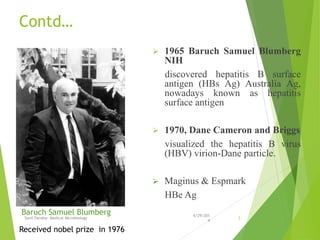
 1965 Baruch Samuel Blumberg
NIH
discovered hepatitis B surface
antigen (HBs Ag) Australia Ag,
nowadays known as hepatitis
surface antigen
 1970, Dane Cameron and Briggs
visualized the hepatitis B virus
(HBV) virion-Dane particle.
 Maginus & Espmark
HBe Ag
Baruch Samuel Blumberg
Received nobel prize in 1976
6/29/201
4
Sunil Pandey- Medical Microbiology 3
Classification
 Family: Hepadnaviridae
 Genus: Orthohepadnavirus
 Species: Hepatitis B virus
6/29/201
4
Sunil Pandey- Medical Microbiology 4
General introduction of virus
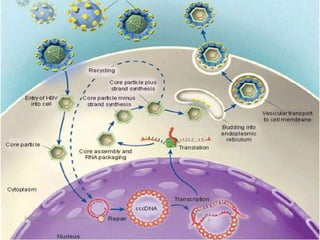
 Hepadnavirus, partially double stranded DNA virus.
 Composed of a 27nm nucleocapsid core(HBcAg)
 Surrounded by an outer lipoprotein coat also called envelop
containing the surface antigen (HBsAg)
 Contain DNA –dependent polymerase which can repair the
gap in DNA template and have reverse transcriptase activity.
 Infected hepatocyte contain an excess of noninfectious viral
lipoprotein particles composed of envelop protein.
 Persistent infections display pronounced hepatotropism.
 Fail to propagate in cell culture.
 Intracellular HBV is non-cytopathic and causes little or no
damage to the cell. 6/29/201
4
Sunil Pandey- Medical Microbiology 5
Morphology of virus
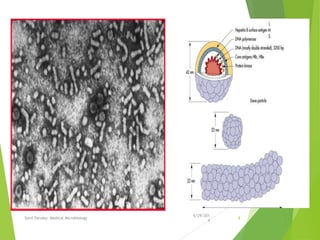
Ultra structure shows three distinct morphology
1. Small, spherical, noninfectious particles, containing HBsAg
that measures 17 to 25nm in diameter. Concentrations of 1013
particles per ml.
2. Tubular, filamentous form of various length. They also
contain HBsAg polypeptides.
6/29/201
4
Sunil Pandey- Medical Microbiology 6
3. Complex, spherical, double shelled particle of 42nm
which is the Hepatitis B virion.
-consist of an outer envelop containing host- derived lipids
and all S gene polypeptides, the large(L), middle(M) and
small(S) surface proteins also known as preS1, preS2 and
HBsAg.
-Within the sphere nucleocapsid of 27nm which contain core
protein HBcAg, 3.2kb circular partially double stranded
viral DNA genome, an endogenous DNA polymerase
enzyme and protein kinase activity.
6/29/201
4
Sunil Pandey- Medical Microbiology 7
6/29/201
4
Sunil Pandey- Medical Microbiology 8
6/29/201
4
Sunil Pandey- Medical Microbiology 9
A
A
A
A
A
A
A
A
A
A
A
A
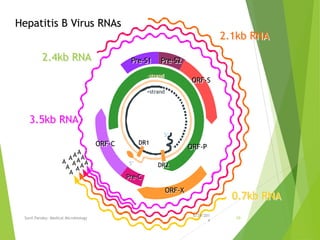
2.1kb RNA
2.4kb RNA
3.5kb RNA
0.7kb RNA
Pre-S1 Pre-S2
ORF-S
ORF-P
ORF-X
ORF-C DR1
5’
5’
+strand
-strand
Pre-C
DR2
Hepatitis B Virus RNAs
6/29/201
4
Sunil Pandey- Medical Microbiology 10
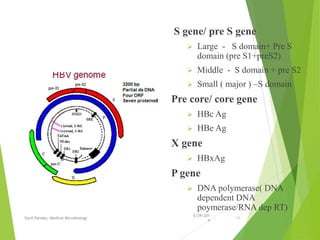
S gene/ pre S gene
 Large - S domain+ Pre S
domain (pre S1+preS2)
 Middle - S domain + pre S2
 Small ( major ) –S domain
Pre core/ core gene
 HBc Ag
 HBe Ag
X gene
 HBxAg
P gene
 DNA polymerase( DNA
dependent DNA
poymerase/RNA dep RT)
6/29/201
4
Sunil Pandey- Medical Microbiology 11
Antigen of Hepatitis B
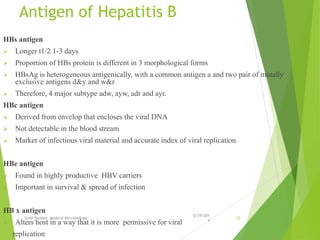
HBs antigen
 Longer t1/2 1-3 days
 Proportion of HBs protein is different in 3 morphological forms
 HBsAg is heterogeneous antigenically, with a common antigen a and two pair of mutally
exclusive antigens d&y and w&r
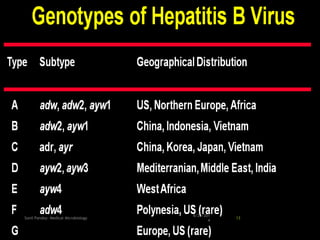
 Therefore, 4 major subtype adw, ayw, adr and ayr.
HBc antigen
 Derived from envelop that encloses the viral DNA
 Not detectable in the blood stream
 Marker of infectious viral material and accurate index of viral replication
HBe antigen
 Found in highly productive HBV carriers
 Important in survival & spread of infection
HB x antigen
 Alters host in a way that it is more permissive for viral
replication
6/29/201
4
Sunil Pandey- Medical Microbiology 12
6/29/201
4
Sunil Pandey- Medical Microbiology 13
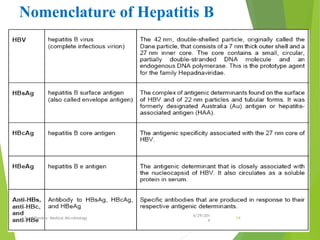
Nomenclature of Hepatitis B
6/29/201
4
Sunil Pandey- Medical Microbiology 14
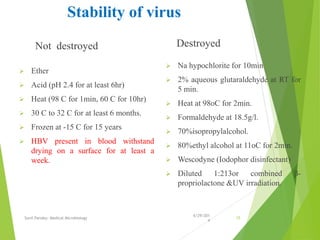
Stability of virus
Not destroyed
 Ether
 Acid (pH 2.4 for at least 6hr)
 Heat (98 C for 1min, 60 C for 10hr)
 30 C to 32 C for at least 6 months.
 Frozen at -15 C for 15 years
 HBV present in blood withstand
drying on a surface for at least a
week.
Destroyed
 Na hypochlorite for 10min
 2% aqueous glutaraldehyde at RT for
5 min.
 Heat at 98oC for 2min.
 Formaldehyde at 18.5g/l.
 70%isopropylalcohol.
 80%ethyl alcohol at 11oC for 2min.
 Wescodyne (Iodophor disinfectant)
 Diluted 1:213or combined β-
propriolactone &UV irradiation.
6/29/201
4
Sunil Pandey- Medical Microbiology 15
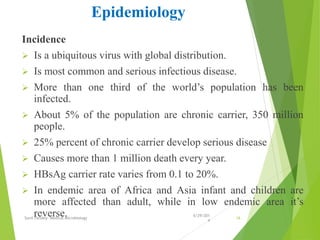
Epidemiology
Incidence
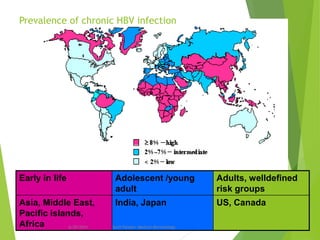
 Is a ubiquitous virus with global distribution.
 Is most common and serious infectious disease.
 More than one third of the world’s population has been
infected.
 About 5% of the population are chronic carrier, 350 million
people.
 25% percent of chronic carrier develop serious disease
 Causes more than 1 million death every year.
 HBsAg carrier rate varies from 0.1 to 20%.
 In endemic area of Africa and Asia infant and children are
more affected than adult, while in low endemic area it’s
reverse. 6/29/201
4
Sunil Pandey- Medical Microbiology 16
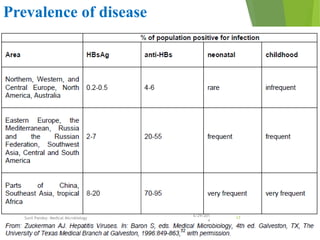
Prevalence of disease
6/29/201
4
Sunil Pandey- Medical Microbiology 17
Prevalence of chronic HBV infection
Early in life Adolescent /young
adult
Adults, welldefined
risk groups
Asia, Middle East,
Pacific islands,
Africa
India, Japan US, Canada
6/29/2014 Sunil Pandey- Medical Microbiology 18
Modes of Transmission
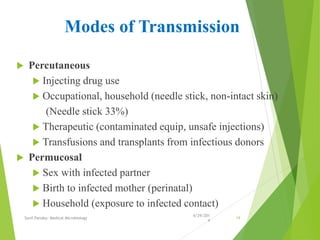
 Percutaneous
 Injecting drug use
 Occupational, household (needle stick, non-intact skin)
(Needle stick 33%)
 Therapeutic (contaminated equip, unsafe injections)
 Transfusions and transplants from infectious donors
 Permucosal
 Sex with infected partner
 Birth to infected mother (perinatal)
 Household (exposure to infected contact)
6/29/201
4
Sunil Pandey- Medical Microbiology 19
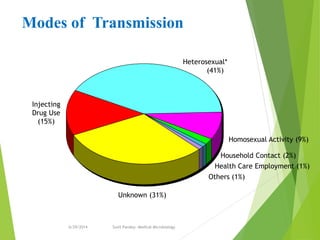
Heterosexual*
(41%)
Homosexual Activity (9%)
Household Contact (2%)
Health Care Employment (1%)
Others (1%)
Unknown (31%)
Injecting
Drug Use
(15%)
Modes of Transmission
6/29/2014 Sunil Pandey- Medical Microbiology 20
Pathology & Pathogenesis
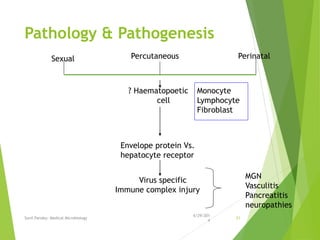
Sexual Percutaneous Perinatal
? Haematopoetic
cell
Envelope protein Vs.
hepatocyte receptor
Virus specific
Immune complex injury
MGN
Vasculitis
Pancreatitis
neuropathies
Monocyte
Lymphocyte
Fibroblast
6/29/201
4
Sunil Pandey- Medical Microbiology 21
Four stages in the disease
 The first stage is immune tolerance.
 The duration of this stage for healthy adults is approximately
2-4 weeks and coincide with the incubation period. For
newborns, the duration of this period often is decades.
 Active viral replication is known to continue despite little or
no elevation in the aminotransferase levels and no symptoms
of illness.
 In the second stage, an inflammatory reaction with a
cytopathic effect occurs.
 HBeAg can be identified in the sera and a decline of the levels
of HBV DNA is seen.
 The duration of this stage for patients with acute infection is
approximately 3-4 weeks (symptomatic period).
 For patients with chronic infection, 10 years or more may
elapse before cirrhosis develops. 6/29/201
4
Sunil Pandey- Medical Microbiology 22
 In the third stage, the host can target the infected hepatocytes
and the HBV Viral replication no longer occurs.
 HBeAb can be detected. The HBV DNA levels are lower or
undetectable, and aminotransferase levels are within the
reference range.
 In this stage, an integration of the viral genome into the host's
hepatocyte genome takes place.
 HBsAg still is present.
6/29/201
4
Sunil Pandey- Medical Microbiology 23
 In the fourth stage, the virus cannot be detected and
antibodies to various viral antigens have been produced.
 Different factors have been postulated to influence the
evolution of these stages, including age, sex,
immunosuppression, and co-infection with other viruses.
6/29/201
4
Sunil Pandey- Medical Microbiology 24
Carriers
 Who don’t progress to stage I and II are the chronic carriers.
 It may be of two types
 Super carrier-high titer of HBsAg, HBeAg, DNA polymerase
with elevated ALT.
 Simple carrier-low titer of HBsAg with negative HBeAg, DNA
polymerase.
6/29/201
4
Sunil Pandey- Medical Microbiology 25
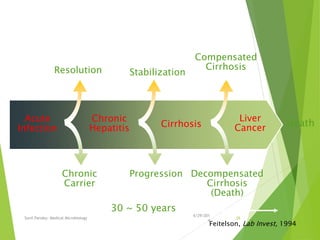
Acute
Infection
Chronic
Carrier
Resolution
30 ~ 50 years
Chronic
Hepatitis
Stabilization
Progression
Cirrhosis
Compensated
Cirrhosis
Liver
Cancer Death
Feitelson, Lab Invest, 1994
Decompensated
Cirrhosis
(Death)
6/29/201
4
Sunil Pandey- Medical Microbiology 26
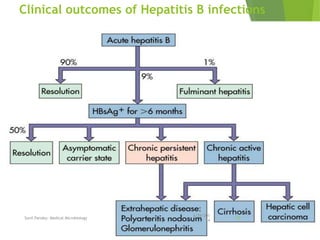
Clinical outcomes of Hepatitis B infections
6/29/201
4
Sunil Pandey- Medical Microbiology 27
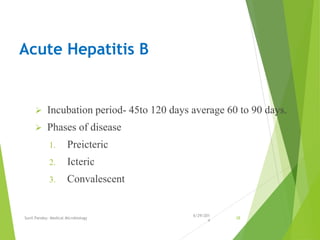
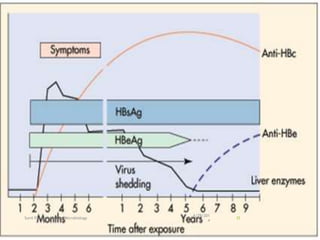
Acute Hepatitis B
 Incubation period- 45to 120 days average 60 to 90 days.
 Phases of disease
1. Preicteric
2. Icteric
3. Convalescent
6/29/201
4
Sunil Pandey- Medical Microbiology 28
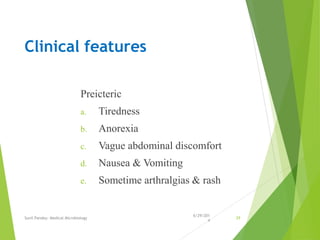
Clinical features
Preicteric
a. Tiredness
b. Anorexia
c. Vague abdominal discomfort
d. Nausea & Vomiting
e. Sometime arthralgias & rash
6/29/201
4
Sunil Pandey- Medical Microbiology 29
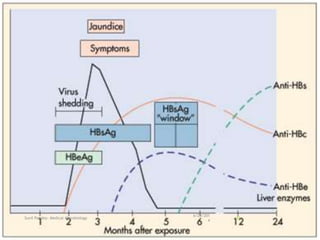
Icteric
a. Within 10days of initial symptoms
b. Dark urine Pale stool Yellowish discoloration of mucous
membranes.
c. Total bilirubin- exceeds 20 to 40 mg/l
d. Hepatospleenomegaly
e. After disappearance of jundice-Anti HBs.
Convalescent
a. Anti HBc IgM to IgG type
b. Transient presence of HBsAg, HBeAg and viral DNA (<6 months)
c. Seroconversion to anti HBsAg and anti HBeAg
6/29/201
4
Sunil Pandey- Medical Microbiology 30
6/29/201
4
Sunil Pandey- Medical Microbiology 31
Chronic Hepatitis B
 After acute infection virus remain in 5 to 10% cases of
adult, even more higher among children upto 70 to 90%.
 350 million of person worldwide are chronic carriers.
Among them 100 million in China.
 Among the persistent carrier 70% will develop Chronic
persistent hepatitis and remaining 30% will develop
Chronic active hepatitis.
6/29/201
4
Sunil Pandey- Medical Microbiology 32
Phases of viral replication in
chronic Hepatitis B
High-replicative(super carrier)
 HBsAg, HBeAg and HBV DNA present and detectable in
sera.
 ALT may increase
 Moderate inflammatory activity
 Histologically apparent
 Risk of developing cirrhosis is high.
6/29/201
4
Sunil Pandey- Medical Microbiology 33
Low-replicative
 Loss of HBeAg
 Decreased HBV DNA concentration
 Appearance of Anti HBeAg
 Decreased inflammatory activity
Non-replicative
 Viral markers are absent or below detectable level.
 Diminished inflammatory activity
 If cirrhrosis already then persist indefinitely.
6/29/201
4
Sunil Pandey- Medical Microbiology 34
6/29/201
4
Sunil Pandey- Medical Microbiology 35
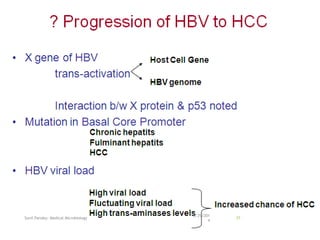
Hepatocellular carcinoma
 Only 5% patient with cirrhosis develop HCC.
 HCC is responsible for 90% of primary malignant tumor
of liver.
 Worldwide 7th most common cancer in male while 9th in
female.
 Causes >500000 deaths annually with male & female
ratio 4:1.
 Appears after a mean duration of about 35 years of HBV
infection.
6/29/201
4
Sunil Pandey- Medical Microbiology 36
6/29/201
4
Sunil Pandey- Medical Microbiology 37
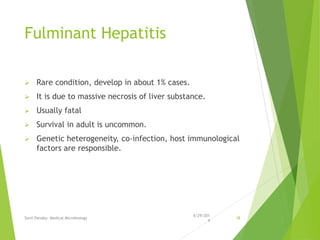
Fulminant Hepatitis
 Rare condition, develop in about 1% cases.
 It is due to massive necrosis of liver substance.
 Usually fatal
 Survival in adult is uncommon.
 Genetic heterogeneity, co-infection, host immunological
factors are responsible.
6/29/201
4
Sunil Pandey- Medical Microbiology 38
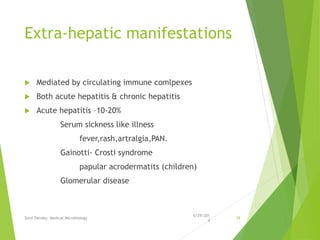
Extra-hepatic manifestations
 Mediated by circulating immune comlpexes
 Both acute hepatitis & chronic hepatitis
 Acute hepatitis –10-20%
Serum sickness like illness
fever,rash,artralgia,PAN.
Gainotti- Crosti syndrome
papular acrodermatits (children)
Glomerular disease
6/29/201
4
Sunil Pandey- Medical Microbiology 39
Laboratory diagnosis
1. SEROLOGICAL METHODS
2. MOLECULAR METHODS
a. Detection in window period
b. Fulminant hepatitis
c. Biochemical/histological suggestive of HBV but HBsAg –ve
d. Pts with chronic HBV to see response
6/29/201
4
Sunil Pandey- Medical Microbiology 40
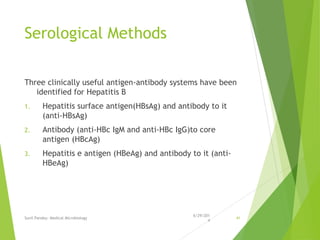
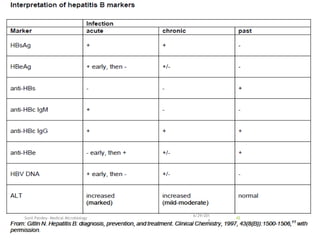
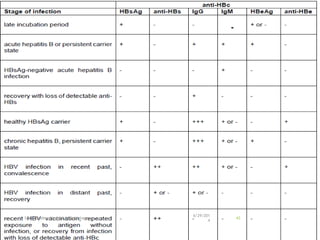
Serological Methods
Three clinically useful antigen-antibody systems have been
identified for Hepatitis B
1. Hepatitis surface antigen(HBsAg) and antibody to it
(anti-HBsAg)
2. Antibody (anti-HBc IgM and anti-HBc IgG)to core
antigen (HBcAg)
3. Hepatitis e antigen (HBeAg) and antibody to it (anti-
HBeAg)
6/29/201
4
Sunil Pandey- Medical Microbiology 41
6/29/201
4
Sunil Pandey- Medical Microbiology 42
6/29/201
4
Sunil Pandey- Medical Microbiology 43
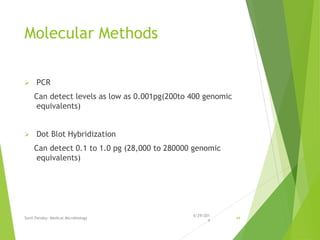
Molecular Methods
 PCR
Can detect levels as low as 0.001pg(200to 400 genomic
equivalents)
 Dot Blot Hybridization
Can detect 0.1 to 1.0 pg (28,000 to 280000 genomic
equivalents)
6/29/201
4
Sunil Pandey- Medical Microbiology 44
Immune prophylaxis
 Introduce in 1974 as HBIG, containg high titer of human hepatitis B IG.
 It protect as passive immunization, if give soon after or shortly before exposure of
HBV. But it lasts only 3to 6 months.
 Maternal-neonatal transmission of HBV and subsequent development of chronic
hepatitis reduced drastically when given in conjugation with HB vaccine. Given
within 24hr after birth, 85 to 95% effective.
 In case of adult given within 48 hour of HBV exposure
6/29/201
4
Sunil Pandey- Medical Microbiology 45
6/29/201
4
Sunil Pandey- Medical Microbiology 46
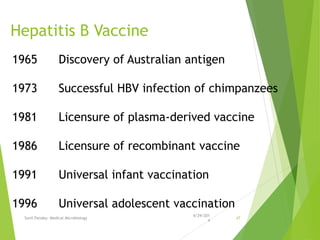
1965 Discovery of Australian antigen
1973 Successful HBV infection of chimpanzees
1981 Licensure of plasma-derived vaccine
1986 Licensure of recombinant vaccine
1991 Universal infant vaccination
1996 Universal adolescent vaccination
Hepatitis B Vaccine
6/29/201
4
Sunil Pandey- Medical Microbiology 47
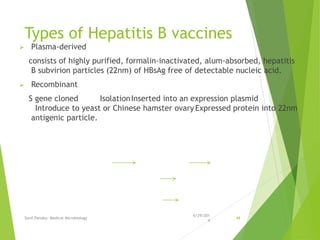
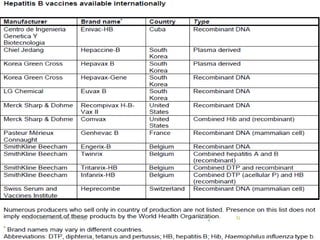
Types of Hepatitis B vaccines
 Plasma-derived
consists of highly purified, formalin-inactivated, alum-absorbed, hepatitis
B subvirion particles (22nm) of HBsAg free of detectable nucleic acid.
 Recombinant
S gene cloned IsolationInserted into an expression plasmid
Introduce to yeast or Chinese hamster ovary Expressed protein into 22nm
antigenic particle.
6/29/201
4
Sunil Pandey- Medical Microbiology 48
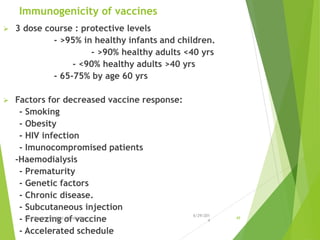
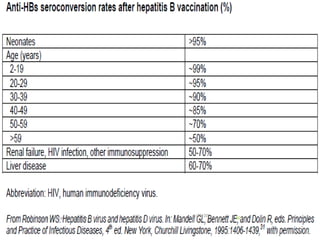
Immunogenicity of vaccines
 3 dose course : protective levels
- >95% in healthy infants and children.
- >90% healthy adults <40 yrs
- <90% healthy adults >40 yrs
- 65-75% by age 60 yrs
 Factors for decreased vaccine response:
- Smoking
- Obesity
- HIV infection
- Imunocompromised patients
-Haemodialysis
- Prematurity
- Genetic factors
- Chronic disease.
- Subcutaneous injection
- Freezing of vaccine
- Accelerated schedule
6/29/201
4
Sunil Pandey- Medical Microbiology 49
6/29/201
4
Sunil Pandey- Medical Microbiology 50
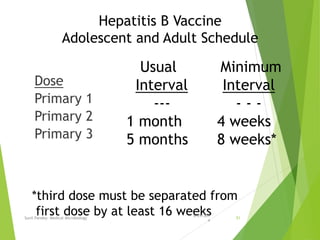
Dose
Primary 1
Primary 2
Primary 3
Minimum
Interval
- - -
4 weeks
8 weeks*
Usual
Interval
---
1 month
5 months
Hepatitis B Vaccine
Adolescent and Adult Schedule
*third dose must be separated from
first dose by at least 16 weeks6/29/201
4
Sunil Pandey- Medical Microbiology 51
6/29/201
4
Sunil Pandey- Medical Microbiology 52
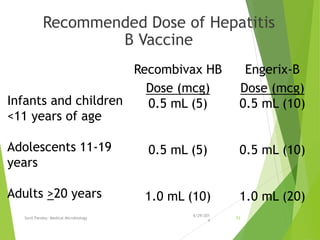
Recommended Dose of Hepatitis
B Vaccine
Infants and children
<11 years of age
Adolescents 11-19
years
Adults >20 years
Recombivax HB
Dose (mcg)
0.5 mL (5)
0.5 mL (5)
1.0 mL (10)
Engerix-B
Dose (mcg)
0.5 mL (10)
0.5 mL (10)
1.0 mL (20)
6/29/201
4
Sunil Pandey- Medical Microbiology 53
6/29/201
4
Sunil Pandey- Medical Microbiology 54
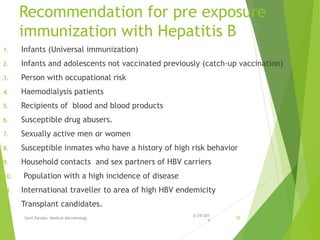
Recommendation for pre exposure
immunization with Hepatitis B
1. Infants (Universal immunization)
2. Infants and adolescents not vaccinated previously (catch-up vaccination)
3. Person with occupational risk
4. Haemodialysis patients
5. Recipients of blood and blood products
6. Susceptible drug abusers.
7. Sexually active men or women
8. Susceptible inmates who have a history of high risk behavior
9. Household contacts and sex partners of HBV carriers
10. Population with a high incidence of disease
11. International traveller to area of high HBV endemicity
12. Transplant candidates.
6/29/201
4
Sunil Pandey- Medical Microbiology 55
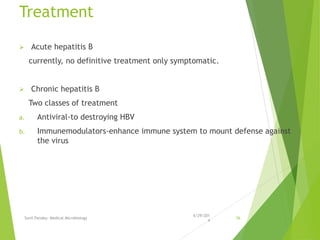
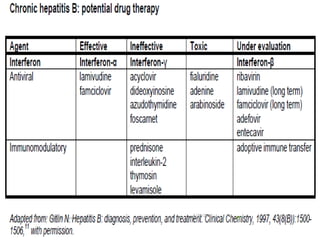
Treatment
 Acute hepatitis B
currently, no definitive treatment only symptomatic.
 Chronic hepatitis B
Two classes of treatment
a. Antiviral-to destroying HBV
b. Immunemodulators-enhance immune system to mount defense against
the virus
6/29/201
4
Sunil Pandey- Medical Microbiology 56
6/29/201
4
Sunil Pandey- Medical Microbiology 57
References
1. Manual of Clinical Microbiology, Patrick R Murray 9th edition.
2. Topely and Wilson’s, Virology volume-1 ,9th edition.
3. Mandell’s, Principle and Practice of Infectious Diseases, 5th edition
4. Documents on Hepatitis A-E published by WHO, Department of
Communicable Diseases Surveillance and Response
5. Textbook of Microbiology, Ananthanarayan and Paniker,7th ediition
6/29/201
4
Sunil Pandey- Medical Microbiology 58

Hepatitis B virus

  • 1.
    Hepatitis B By: SunilPandey Nobel College: Medical Microbiology Email- pandeysunil347@gmail.com 6/29/201 4 Sunil Pandey- Medical Microbiology 1
  • 2.
    History  Ancient disease-described in 5th century B.C.  Earliest recognized blood-borne outbreak of hepatitis– Germany in 1883 after receiving smallpox vaccine.  In 1947 MacCallum and Bauer introduce the term Hepatitis A for infectious and Hepatitis B for serum hepatitis  This terminology was adopted by WHO in 1973 6/29/201 4 Sunil Pandey- Medical Microbiology 2
  • 3.
    Contd…  1965 BaruchSamuel Blumberg NIH discovered hepatitis B surface antigen (HBs Ag) Australia Ag, nowadays known as hepatitis surface antigen  1970, Dane Cameron and Briggs visualized the hepatitis B virus (HBV) virion-Dane particle.  Maginus & Espmark HBe Ag Baruch Samuel Blumberg Received nobel prize in 1976 6/29/201 4 Sunil Pandey- Medical Microbiology 3
  • 4.
    Classification  Family: Hepadnaviridae Genus: Orthohepadnavirus  Species: Hepatitis B virus 6/29/201 4 Sunil Pandey- Medical Microbiology 4
  • 5.
    General introduction ofvirus  Hepadnavirus, partially double stranded DNA virus.  Composed of a 27nm nucleocapsid core(HBcAg)  Surrounded by an outer lipoprotein coat also called envelop containing the surface antigen (HBsAg)  Contain DNA –dependent polymerase which can repair the gap in DNA template and have reverse transcriptase activity.  Infected hepatocyte contain an excess of noninfectious viral lipoprotein particles composed of envelop protein.  Persistent infections display pronounced hepatotropism.  Fail to propagate in cell culture.  Intracellular HBV is non-cytopathic and causes little or no damage to the cell. 6/29/201 4 Sunil Pandey- Medical Microbiology 5
  • 6.
    Morphology of virus Ultrastructure shows three distinct morphology 1. Small, spherical, noninfectious particles, containing HBsAg that measures 17 to 25nm in diameter. Concentrations of 1013 particles per ml. 2. Tubular, filamentous form of various length. They also contain HBsAg polypeptides. 6/29/201 4 Sunil Pandey- Medical Microbiology 6
  • 7.
    3. Complex, spherical,double shelled particle of 42nm which is the Hepatitis B virion. -consist of an outer envelop containing host- derived lipids and all S gene polypeptides, the large(L), middle(M) and small(S) surface proteins also known as preS1, preS2 and HBsAg. -Within the sphere nucleocapsid of 27nm which contain core protein HBcAg, 3.2kb circular partially double stranded viral DNA genome, an endogenous DNA polymerase enzyme and protein kinase activity. 6/29/201 4 Sunil Pandey- Medical Microbiology 7
  • 8.
  • 9.
  • 10.
    A A A A A A A A A A A A 2.1kb RNA 2.4kb RNA 3.5kbRNA 0.7kb RNA Pre-S1 Pre-S2 ORF-S ORF-P ORF-X ORF-C DR1 5’ 5’ +strand -strand Pre-C DR2 Hepatitis B Virus RNAs 6/29/201 4 Sunil Pandey- Medical Microbiology 10
  • 11.
    S gene/ preS gene  Large - S domain+ Pre S domain (pre S1+preS2)  Middle - S domain + pre S2  Small ( major ) –S domain Pre core/ core gene  HBc Ag  HBe Ag X gene  HBxAg P gene  DNA polymerase( DNA dependent DNA poymerase/RNA dep RT) 6/29/201 4 Sunil Pandey- Medical Microbiology 11
  • 12.
    Antigen of HepatitisB HBs antigen  Longer t1/2 1-3 days  Proportion of HBs protein is different in 3 morphological forms  HBsAg is heterogeneous antigenically, with a common antigen a and two pair of mutally exclusive antigens d&y and w&r  Therefore, 4 major subtype adw, ayw, adr and ayr. HBc antigen  Derived from envelop that encloses the viral DNA  Not detectable in the blood stream  Marker of infectious viral material and accurate index of viral replication HBe antigen  Found in highly productive HBV carriers  Important in survival & spread of infection HB x antigen  Alters host in a way that it is more permissive for viral replication 6/29/201 4 Sunil Pandey- Medical Microbiology 12
  • 13.
  • 14.
    Nomenclature of HepatitisB 6/29/201 4 Sunil Pandey- Medical Microbiology 14
  • 15.
    Stability of virus Notdestroyed  Ether  Acid (pH 2.4 for at least 6hr)  Heat (98 C for 1min, 60 C for 10hr)  30 C to 32 C for at least 6 months.  Frozen at -15 C for 15 years  HBV present in blood withstand drying on a surface for at least a week. Destroyed  Na hypochlorite for 10min  2% aqueous glutaraldehyde at RT for 5 min.  Heat at 98oC for 2min.  Formaldehyde at 18.5g/l.  70%isopropylalcohol.  80%ethyl alcohol at 11oC for 2min.  Wescodyne (Iodophor disinfectant)  Diluted 1:213or combined β- propriolactone &UV irradiation. 6/29/201 4 Sunil Pandey- Medical Microbiology 15
  • 16.
    Epidemiology Incidence  Is aubiquitous virus with global distribution.  Is most common and serious infectious disease.  More than one third of the world’s population has been infected.  About 5% of the population are chronic carrier, 350 million people.  25% percent of chronic carrier develop serious disease  Causes more than 1 million death every year.  HBsAg carrier rate varies from 0.1 to 20%.  In endemic area of Africa and Asia infant and children are more affected than adult, while in low endemic area it’s reverse. 6/29/201 4 Sunil Pandey- Medical Microbiology 16
  • 17.
    Prevalence of disease 6/29/201 4 SunilPandey- Medical Microbiology 17
  • 18.
    Prevalence of chronicHBV infection Early in life Adolescent /young adult Adults, welldefined risk groups Asia, Middle East, Pacific islands, Africa India, Japan US, Canada 6/29/2014 Sunil Pandey- Medical Microbiology 18
  • 19.
    Modes of Transmission Percutaneous  Injecting drug use  Occupational, household (needle stick, non-intact skin) (Needle stick 33%)  Therapeutic (contaminated equip, unsafe injections)  Transfusions and transplants from infectious donors  Permucosal  Sex with infected partner  Birth to infected mother (perinatal)  Household (exposure to infected contact) 6/29/201 4 Sunil Pandey- Medical Microbiology 19
  • 20.
    Heterosexual* (41%) Homosexual Activity (9%) HouseholdContact (2%) Health Care Employment (1%) Others (1%) Unknown (31%) Injecting Drug Use (15%) Modes of Transmission 6/29/2014 Sunil Pandey- Medical Microbiology 20
  • 21.
    Pathology & Pathogenesis SexualPercutaneous Perinatal ? Haematopoetic cell Envelope protein Vs. hepatocyte receptor Virus specific Immune complex injury MGN Vasculitis Pancreatitis neuropathies Monocyte Lymphocyte Fibroblast 6/29/201 4 Sunil Pandey- Medical Microbiology 21
  • 22.
    Four stages inthe disease  The first stage is immune tolerance.  The duration of this stage for healthy adults is approximately 2-4 weeks and coincide with the incubation period. For newborns, the duration of this period often is decades.  Active viral replication is known to continue despite little or no elevation in the aminotransferase levels and no symptoms of illness.  In the second stage, an inflammatory reaction with a cytopathic effect occurs.  HBeAg can be identified in the sera and a decline of the levels of HBV DNA is seen.  The duration of this stage for patients with acute infection is approximately 3-4 weeks (symptomatic period).  For patients with chronic infection, 10 years or more may elapse before cirrhosis develops. 6/29/201 4 Sunil Pandey- Medical Microbiology 22
  • 23.
     In thethird stage, the host can target the infected hepatocytes and the HBV Viral replication no longer occurs.  HBeAb can be detected. The HBV DNA levels are lower or undetectable, and aminotransferase levels are within the reference range.  In this stage, an integration of the viral genome into the host's hepatocyte genome takes place.  HBsAg still is present. 6/29/201 4 Sunil Pandey- Medical Microbiology 23
  • 24.
     In thefourth stage, the virus cannot be detected and antibodies to various viral antigens have been produced.  Different factors have been postulated to influence the evolution of these stages, including age, sex, immunosuppression, and co-infection with other viruses. 6/29/201 4 Sunil Pandey- Medical Microbiology 24
  • 25.
    Carriers  Who don’tprogress to stage I and II are the chronic carriers.  It may be of two types  Super carrier-high titer of HBsAg, HBeAg, DNA polymerase with elevated ALT.  Simple carrier-low titer of HBsAg with negative HBeAg, DNA polymerase. 6/29/201 4 Sunil Pandey- Medical Microbiology 25
  • 26.
    Acute Infection Chronic Carrier Resolution 30 ~ 50years Chronic Hepatitis Stabilization Progression Cirrhosis Compensated Cirrhosis Liver Cancer Death Feitelson, Lab Invest, 1994 Decompensated Cirrhosis (Death) 6/29/201 4 Sunil Pandey- Medical Microbiology 26
  • 27.
    Clinical outcomes ofHepatitis B infections 6/29/201 4 Sunil Pandey- Medical Microbiology 27
  • 28.
    Acute Hepatitis B Incubation period- 45to 120 days average 60 to 90 days.  Phases of disease 1. Preicteric 2. Icteric 3. Convalescent 6/29/201 4 Sunil Pandey- Medical Microbiology 28
  • 29.
    Clinical features Preicteric a. Tiredness b.Anorexia c. Vague abdominal discomfort d. Nausea & Vomiting e. Sometime arthralgias & rash 6/29/201 4 Sunil Pandey- Medical Microbiology 29
  • 30.
    Icteric a. Within 10daysof initial symptoms b. Dark urine Pale stool Yellowish discoloration of mucous membranes. c. Total bilirubin- exceeds 20 to 40 mg/l d. Hepatospleenomegaly e. After disappearance of jundice-Anti HBs. Convalescent a. Anti HBc IgM to IgG type b. Transient presence of HBsAg, HBeAg and viral DNA (<6 months) c. Seroconversion to anti HBsAg and anti HBeAg 6/29/201 4 Sunil Pandey- Medical Microbiology 30
  • 31.
  • 32.
    Chronic Hepatitis B After acute infection virus remain in 5 to 10% cases of adult, even more higher among children upto 70 to 90%.  350 million of person worldwide are chronic carriers. Among them 100 million in China.  Among the persistent carrier 70% will develop Chronic persistent hepatitis and remaining 30% will develop Chronic active hepatitis. 6/29/201 4 Sunil Pandey- Medical Microbiology 32
  • 33.
    Phases of viralreplication in chronic Hepatitis B High-replicative(super carrier)  HBsAg, HBeAg and HBV DNA present and detectable in sera.  ALT may increase  Moderate inflammatory activity  Histologically apparent  Risk of developing cirrhosis is high. 6/29/201 4 Sunil Pandey- Medical Microbiology 33
  • 34.
    Low-replicative  Loss ofHBeAg  Decreased HBV DNA concentration  Appearance of Anti HBeAg  Decreased inflammatory activity Non-replicative  Viral markers are absent or below detectable level.  Diminished inflammatory activity  If cirrhrosis already then persist indefinitely. 6/29/201 4 Sunil Pandey- Medical Microbiology 34
  • 35.
  • 36.
    Hepatocellular carcinoma  Only5% patient with cirrhosis develop HCC.  HCC is responsible for 90% of primary malignant tumor of liver.  Worldwide 7th most common cancer in male while 9th in female.  Causes >500000 deaths annually with male & female ratio 4:1.  Appears after a mean duration of about 35 years of HBV infection. 6/29/201 4 Sunil Pandey- Medical Microbiology 36
  • 37.
  • 38.
    Fulminant Hepatitis  Rarecondition, develop in about 1% cases.  It is due to massive necrosis of liver substance.  Usually fatal  Survival in adult is uncommon.  Genetic heterogeneity, co-infection, host immunological factors are responsible. 6/29/201 4 Sunil Pandey- Medical Microbiology 38
  • 39.
    Extra-hepatic manifestations  Mediatedby circulating immune comlpexes  Both acute hepatitis & chronic hepatitis  Acute hepatitis –10-20% Serum sickness like illness fever,rash,artralgia,PAN. Gainotti- Crosti syndrome papular acrodermatits (children) Glomerular disease 6/29/201 4 Sunil Pandey- Medical Microbiology 39
  • 40.
    Laboratory diagnosis 1. SEROLOGICALMETHODS 2. MOLECULAR METHODS a. Detection in window period b. Fulminant hepatitis c. Biochemical/histological suggestive of HBV but HBsAg –ve d. Pts with chronic HBV to see response 6/29/201 4 Sunil Pandey- Medical Microbiology 40
  • 41.
    Serological Methods Three clinicallyuseful antigen-antibody systems have been identified for Hepatitis B 1. Hepatitis surface antigen(HBsAg) and antibody to it (anti-HBsAg) 2. Antibody (anti-HBc IgM and anti-HBc IgG)to core antigen (HBcAg) 3. Hepatitis e antigen (HBeAg) and antibody to it (anti- HBeAg) 6/29/201 4 Sunil Pandey- Medical Microbiology 41
  • 42.
  • 43.
  • 44.
    Molecular Methods  PCR Candetect levels as low as 0.001pg(200to 400 genomic equivalents)  Dot Blot Hybridization Can detect 0.1 to 1.0 pg (28,000 to 280000 genomic equivalents) 6/29/201 4 Sunil Pandey- Medical Microbiology 44
  • 45.
    Immune prophylaxis  Introducein 1974 as HBIG, containg high titer of human hepatitis B IG.  It protect as passive immunization, if give soon after or shortly before exposure of HBV. But it lasts only 3to 6 months.  Maternal-neonatal transmission of HBV and subsequent development of chronic hepatitis reduced drastically when given in conjugation with HB vaccine. Given within 24hr after birth, 85 to 95% effective.  In case of adult given within 48 hour of HBV exposure 6/29/201 4 Sunil Pandey- Medical Microbiology 45
  • 46.
  • 47.
    1965 Discovery ofAustralian antigen 1973 Successful HBV infection of chimpanzees 1981 Licensure of plasma-derived vaccine 1986 Licensure of recombinant vaccine 1991 Universal infant vaccination 1996 Universal adolescent vaccination Hepatitis B Vaccine 6/29/201 4 Sunil Pandey- Medical Microbiology 47
  • 48.
    Types of HepatitisB vaccines  Plasma-derived consists of highly purified, formalin-inactivated, alum-absorbed, hepatitis B subvirion particles (22nm) of HBsAg free of detectable nucleic acid.  Recombinant S gene cloned IsolationInserted into an expression plasmid Introduce to yeast or Chinese hamster ovary Expressed protein into 22nm antigenic particle. 6/29/201 4 Sunil Pandey- Medical Microbiology 48
  • 49.
    Immunogenicity of vaccines 3 dose course : protective levels - >95% in healthy infants and children. - >90% healthy adults <40 yrs - <90% healthy adults >40 yrs - 65-75% by age 60 yrs  Factors for decreased vaccine response: - Smoking - Obesity - HIV infection - Imunocompromised patients -Haemodialysis - Prematurity - Genetic factors - Chronic disease. - Subcutaneous injection - Freezing of vaccine - Accelerated schedule 6/29/201 4 Sunil Pandey- Medical Microbiology 49
  • 50.
  • 51.
    Dose Primary 1 Primary 2 Primary3 Minimum Interval - - - 4 weeks 8 weeks* Usual Interval --- 1 month 5 months Hepatitis B Vaccine Adolescent and Adult Schedule *third dose must be separated from first dose by at least 16 weeks6/29/201 4 Sunil Pandey- Medical Microbiology 51
  • 52.
  • 53.
    Recommended Dose ofHepatitis B Vaccine Infants and children <11 years of age Adolescents 11-19 years Adults >20 years Recombivax HB Dose (mcg) 0.5 mL (5) 0.5 mL (5) 1.0 mL (10) Engerix-B Dose (mcg) 0.5 mL (10) 0.5 mL (10) 1.0 mL (20) 6/29/201 4 Sunil Pandey- Medical Microbiology 53
  • 54.
  • 55.
    Recommendation for preexposure immunization with Hepatitis B 1. Infants (Universal immunization) 2. Infants and adolescents not vaccinated previously (catch-up vaccination) 3. Person with occupational risk 4. Haemodialysis patients 5. Recipients of blood and blood products 6. Susceptible drug abusers. 7. Sexually active men or women 8. Susceptible inmates who have a history of high risk behavior 9. Household contacts and sex partners of HBV carriers 10. Population with a high incidence of disease 11. International traveller to area of high HBV endemicity 12. Transplant candidates. 6/29/201 4 Sunil Pandey- Medical Microbiology 55
  • 56.
    Treatment  Acute hepatitisB currently, no definitive treatment only symptomatic.  Chronic hepatitis B Two classes of treatment a. Antiviral-to destroying HBV b. Immunemodulators-enhance immune system to mount defense against the virus 6/29/201 4 Sunil Pandey- Medical Microbiology 56
  • 57.
  • 58.
    References 1. Manual ofClinical Microbiology, Patrick R Murray 9th edition. 2. Topely and Wilson’s, Virology volume-1 ,9th edition. 3. Mandell’s, Principle and Practice of Infectious Diseases, 5th edition 4. Documents on Hepatitis A-E published by WHO, Department of Communicable Diseases Surveillance and Response 5. Textbook of Microbiology, Ananthanarayan and Paniker,7th ediition 6/29/201 4 Sunil Pandey- Medical Microbiology 58