Middle East Respiratory
Syndrome
Dr Rikin Hasnani
• Middle East respiratory syndrome (MERS) is a respiratory disease caused by
a newly recognized coronavirus MERS-Corona virus (MERS CoV).
• It was first reported in 2012 in Saudi Arabia and is so far linked to countries
in or near the Arabian Peninsula (United Arab Emirates [UAE], Qatar,
Oman, Jordan, Kuwait, Yemen, and Lebanon).
• Till now 688 cases of MERS are reported of which 282 died , a mortality
rate of 40%.
MERS Corona virus
• MERS CoV, like SARS virus is a corona virus. It belongs to C lineage of betacorona
virus.
• MERS-CoV is a newly discovered betacoronavirus lineage C that was first reported
in Saudi Arabia in 2012. The exact origin of this novel coronavirus is still unknown.
• Recent evidence suggests that the virus may be more strongly linked to camels. An
outbreak investigation was performed in camels from a farm in Qatar linked to two
human cases of infection in October 2013. MERS-CoV was virologically confirmed
in nose swabs from 3 camels by 3 independent RT-PCR and sequencing assays
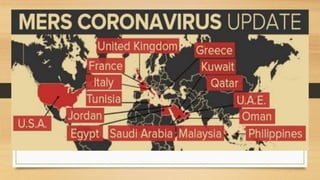
Prevalence of disease
• Nine countries have now reported cases of human infection with MERS-
CoV.
• Cases have been reported in France, Germany, Italy Jordan, Qatar, Saudi
Arabia, Tunisia, the United Arab Emirates, and the United Kingdom.
• All cases have had some connection (whether direct or indirect) with the
Middle East.
Transmission
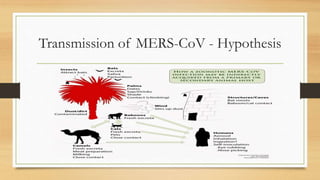
Virus is transmitted from human to human by
direct contact
fomites
aerosalisation of virus
Human to human transmission is not sustained and hence doesn’t cause pandemic
Reservoirs – bat and Omani camel acts as reservoir of virus.
MERS Virus is more stable than H1N1.
It remains stable as an aerosol at 20*C for as long as 48 hours.
Transmission of MERS-CoV - Hypothesis
Pathogenesis
• In humans, the virus has a strong tropism for non ciliated bronchial epithelial
cells, and it effectively antagonize interferon (IFN) production in these cells. This
tropism is unique in that most respiratory viruses target ciliated cells.
• Due to the clinical similarity between MERS-CoV and SARS-CoV, it was proposed
that they may use the same cellular receptor; the exopeptidase, angiotensin
converting enzyme 2 (ACE2).
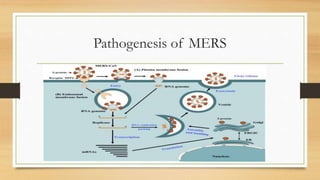
• However, it is now known that dipeptyl peptidase 4 (DPP4; also known as
CD26) acts as functional cellular receptor for MERS-CoV. Unlike other known
coronavirus receptors, the enzymatic activity of DPP4 is not required for infection.
Pathogenesis
• MERS Co-V infects alveolar epithelial cells , capillary endothelial cells and
macrophages.
• MERS virus binds to MERS Co-V receptors DPP4 present on different cells and
tissue resulting in dissemination of infection.
• Lymphopenia has been noted in most patients infected with MERS-CoV, as is also
seen in SARS infections. This is due to cytokine-induced immune cell sequestration
and release of monocyte chemotactic protein-1 (MCP-1) and interferon-gamma-
inducible protein-10 (IP-10), which suppress proliferation of human myeloid
progenitor cells
Pathogenesis of MERS
Clinical features
• Incubation period 5-10 days.
• Initial symptoms include flu like symptoms including rhinorrhea, fever, chills,
fatigue, and myalgias.
• Respiratory symptoms, including shortness of breath and dyspnea, may
become predominant later in the course.
• If not treated, patient may present with ARDS, Acute kidney injury, MODS.
• Few present with Gastrointestinal symptom like diarrhea , pain abdomen .
Case definitions
• Patient under investigation
• Probable Case of MERS-CoV
• Confirmed Case of MERS-CoV
Patient under investigation
• Fever AND pneumonia or acute respiratory distress syndrome (based on clinical or
radiologic evidence) AND EITHER:
• history of travel from countries in or near the Arabian Peninsula within 14 days before
symptom onset, OR
• close contact with a such a patient
• a member of a cluster of patients with severe acute respiratory illness (e.g., fever and
pneumonia requiring hospitalization) of unknown etiology in which MERS-CoV is being
evaluated, in consultation with state and local health departments,
Patient under investigation(cont)
OR
• Fever AND symptoms of respiratory illness AND being in a healthcare
facility (as a patient, worker, or visitor) within 14 days where recent
healthcare-associated cases of MERS have been identified.
OR
• Fever OR symptoms of respiratory illness AND close contact with a
confirmed MERS case while the case was ill.
• Close contact is defined as
• a) being within approximately 6 feet (2 meters) or within the room or care
area for a prolonged period of time (e.g., healthcare personnel, household
members) while not wearing recommended personal protective equipment
(i.e., gowns, gloves, respirator, eye protection or
• b) having direct contact with infectious secretions (e.g., being coughed on)
while not wearing recommended personal protective equipment.
Probable Case of MERS-CoV
• A probable case is a PUI with absent or inconclusive laboratory results for
MERS-CoV infection who is a close contact of a laboratory-confirmed
MERS-CoV case.
• Examples of laboratory results that may be considered inconclusive include
a positive test on a single PCR target, or a negative test on an inadequate
specimen.
Confirmed Case of MERS-CoV
• A confirmed case is a person with laboratory confirmation of MERS-CoV
infection. Confirmatory laboratory testing requires a positive PCR on at least
two specific genomic targets or a single positive target with sequencing on a
second.
Diagnosis
• Lower respiratory tract specimens is preferred for PCR testing.
• Priority for sample is BAL>SPUTUM>Nasopharyngeal = oropharyngeal>serum >stool.
• Real time PCR assay is used to diagnose MERS virus infection.
• Three assays are currently available for diagnosis.
1. Assay targeting upstream of the E protein gene (upE) is recommended for screening.
2. Assay targeting open reading frame 1b (ORF 1b) and
3 . Assay targeting open reading frame 1a (ORF 1a).
The ORF 1a is more sensitive than the ORF 1b assay.
Treatment
• No affective antiviral available.
• Supportive care , oxygenation and maintaining hemodynamic stability is the
priority .
Agent that can be used
• Convalescent plasma
• Interferon alfa2b
• Protease Inhibitors
• Intravenous Immunoglobulin
• Nitazoxanide
• Cyclosporin A
• Ribavirin
• Corticosteroids
• Interferon plus ribavirin
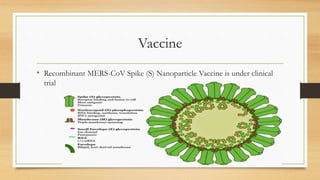
Vaccine
• Recombinant MERS-CoV Spike (S) Nanoparticle Vaccine is under clinical
trial
Travelers guidelines
• CDC recommends that travellers to countries in or near the Arabian Peninsula pay
attention to their health during and after their trip.
• Travellers should see a doctor right away if they develop fever and symptoms of
lower respiratory illness, such as cough or shortness of breath, within 14 days after
travelling from countries in or near the Arabian Peninsula.
• CDC does not recommend that most travelers change their plans because of
MERS.
• However, the Saudi Arabia Ministry of Health has made special recommendations
for travelers to Hajj and Umrah.
Thank you

Mers

  • 1.
  • 2.
    • Middle Eastrespiratory syndrome (MERS) is a respiratory disease caused by a newly recognized coronavirus MERS-Corona virus (MERS CoV). • It was first reported in 2012 in Saudi Arabia and is so far linked to countries in or near the Arabian Peninsula (United Arab Emirates [UAE], Qatar, Oman, Jordan, Kuwait, Yemen, and Lebanon). • Till now 688 cases of MERS are reported of which 282 died , a mortality rate of 40%.
  • 3.
    MERS Corona virus •MERS CoV, like SARS virus is a corona virus. It belongs to C lineage of betacorona virus. • MERS-CoV is a newly discovered betacoronavirus lineage C that was first reported in Saudi Arabia in 2012. The exact origin of this novel coronavirus is still unknown. • Recent evidence suggests that the virus may be more strongly linked to camels. An outbreak investigation was performed in camels from a farm in Qatar linked to two human cases of infection in October 2013. MERS-CoV was virologically confirmed in nose swabs from 3 camels by 3 independent RT-PCR and sequencing assays
  • 4.
    Prevalence of disease •Nine countries have now reported cases of human infection with MERS- CoV. • Cases have been reported in France, Germany, Italy Jordan, Qatar, Saudi Arabia, Tunisia, the United Arab Emirates, and the United Kingdom. • All cases have had some connection (whether direct or indirect) with the Middle East.
  • 6.
    Transmission Virus is transmittedfrom human to human by direct contact fomites aerosalisation of virus Human to human transmission is not sustained and hence doesn’t cause pandemic Reservoirs – bat and Omani camel acts as reservoir of virus. MERS Virus is more stable than H1N1. It remains stable as an aerosol at 20*C for as long as 48 hours.
  • 7.
  • 8.
    Pathogenesis • In humans,the virus has a strong tropism for non ciliated bronchial epithelial cells, and it effectively antagonize interferon (IFN) production in these cells. This tropism is unique in that most respiratory viruses target ciliated cells. • Due to the clinical similarity between MERS-CoV and SARS-CoV, it was proposed that they may use the same cellular receptor; the exopeptidase, angiotensin converting enzyme 2 (ACE2). • However, it is now known that dipeptyl peptidase 4 (DPP4; also known as CD26) acts as functional cellular receptor for MERS-CoV. Unlike other known coronavirus receptors, the enzymatic activity of DPP4 is not required for infection.
  • 9.
    Pathogenesis • MERS Co-Vinfects alveolar epithelial cells , capillary endothelial cells and macrophages. • MERS virus binds to MERS Co-V receptors DPP4 present on different cells and tissue resulting in dissemination of infection. • Lymphopenia has been noted in most patients infected with MERS-CoV, as is also seen in SARS infections. This is due to cytokine-induced immune cell sequestration and release of monocyte chemotactic protein-1 (MCP-1) and interferon-gamma- inducible protein-10 (IP-10), which suppress proliferation of human myeloid progenitor cells
  • 10.
  • 11.
    Clinical features • Incubationperiod 5-10 days. • Initial symptoms include flu like symptoms including rhinorrhea, fever, chills, fatigue, and myalgias. • Respiratory symptoms, including shortness of breath and dyspnea, may become predominant later in the course. • If not treated, patient may present with ARDS, Acute kidney injury, MODS. • Few present with Gastrointestinal symptom like diarrhea , pain abdomen .
  • 12.
    Case definitions • Patientunder investigation • Probable Case of MERS-CoV • Confirmed Case of MERS-CoV
  • 13.
    Patient under investigation •Fever AND pneumonia or acute respiratory distress syndrome (based on clinical or radiologic evidence) AND EITHER: • history of travel from countries in or near the Arabian Peninsula within 14 days before symptom onset, OR • close contact with a such a patient • a member of a cluster of patients with severe acute respiratory illness (e.g., fever and pneumonia requiring hospitalization) of unknown etiology in which MERS-CoV is being evaluated, in consultation with state and local health departments,
  • 14.
    Patient under investigation(cont) OR •Fever AND symptoms of respiratory illness AND being in a healthcare facility (as a patient, worker, or visitor) within 14 days where recent healthcare-associated cases of MERS have been identified. OR • Fever OR symptoms of respiratory illness AND close contact with a confirmed MERS case while the case was ill.
  • 15.
    • Close contactis defined as • a) being within approximately 6 feet (2 meters) or within the room or care area for a prolonged period of time (e.g., healthcare personnel, household members) while not wearing recommended personal protective equipment (i.e., gowns, gloves, respirator, eye protection or • b) having direct contact with infectious secretions (e.g., being coughed on) while not wearing recommended personal protective equipment.
  • 16.
    Probable Case ofMERS-CoV • A probable case is a PUI with absent or inconclusive laboratory results for MERS-CoV infection who is a close contact of a laboratory-confirmed MERS-CoV case. • Examples of laboratory results that may be considered inconclusive include a positive test on a single PCR target, or a negative test on an inadequate specimen.
  • 17.
    Confirmed Case ofMERS-CoV • A confirmed case is a person with laboratory confirmation of MERS-CoV infection. Confirmatory laboratory testing requires a positive PCR on at least two specific genomic targets or a single positive target with sequencing on a second.
  • 18.
    Diagnosis • Lower respiratorytract specimens is preferred for PCR testing. • Priority for sample is BAL>SPUTUM>Nasopharyngeal = oropharyngeal>serum >stool. • Real time PCR assay is used to diagnose MERS virus infection. • Three assays are currently available for diagnosis. 1. Assay targeting upstream of the E protein gene (upE) is recommended for screening. 2. Assay targeting open reading frame 1b (ORF 1b) and 3 . Assay targeting open reading frame 1a (ORF 1a). The ORF 1a is more sensitive than the ORF 1b assay.
  • 19.
    Treatment • No affectiveantiviral available. • Supportive care , oxygenation and maintaining hemodynamic stability is the priority .
  • 20.
    Agent that canbe used • Convalescent plasma • Interferon alfa2b • Protease Inhibitors • Intravenous Immunoglobulin • Nitazoxanide • Cyclosporin A • Ribavirin • Corticosteroids • Interferon plus ribavirin
  • 21.
    Vaccine • Recombinant MERS-CoVSpike (S) Nanoparticle Vaccine is under clinical trial
  • 22.
    Travelers guidelines • CDCrecommends that travellers to countries in or near the Arabian Peninsula pay attention to their health during and after their trip. • Travellers should see a doctor right away if they develop fever and symptoms of lower respiratory illness, such as cough or shortness of breath, within 14 days after travelling from countries in or near the Arabian Peninsula. • CDC does not recommend that most travelers change their plans because of MERS. • However, the Saudi Arabia Ministry of Health has made special recommendations for travelers to Hajj and Umrah.
  • 23.