PROTOZOA
PROTOS-FIRST
ZOON-ANIMAL
Eucaryotic, unicellular microorganism
Occurrence
• Almost all habitat
• Sea, soil, fresh water, polar regions and very high
altitude
Ecology
• Free living
• Symbiotic –
parasitic-
mutualistic
Free living-
Factors affecting the distribution and the no.-
1. light- photosynthetic protozoa have
chromatophore. Some are present in absence of
light.
2. pH- 3.2-8.7 (6-8 is optimal for metabolism)
Factors affecting the distribution and the
number of protozoa
3.a. Nutrients-water rich in oxygen and low in organic
matter (mountain springs, ponds)
b. some require water rich in minerals
c. some grow well in water where there is active
oxidation and degradation of organic matter (eg.
Ciliates)
d. Salt water
e. fresh water
f. in less oxygen
g. presence of bacteria, protozoa for holozoic protozoa
The nutrient supply is a major determining factor in
the distribution and number of protozoa
Factors affecting the distribution and the
number of protozoa
4. Temperature – 16-250 c (optimum), 36-400c
(maximum)
The encysted stage will thrive high temperature. So
their no will be more in warm environment
Symbiotic protozoa
• Commensalism-the host is neither harmed nor
benefitted-
1.Ectocommensalism- protozoa attaches themselves
to a host’s body
2.Endocommensalism- when protozoan is inside the
host eg. The protozoa inside the gut of the host
• Mutualism- both the parasite and the host are
benefitted. Eg, the flagellates in the gut of termite
digest woody materials consumed by termites.
These are converted into glycogenous substances
used by the host. In absence of each other both
perish
Symbiotic protozoa
• Parasitism- the parasite lives at the expense of
other. The parasite feeds on others with the help
of pseudopodia or cytosome.
• Hyperparasitism- parasitic protozoa parasitizes
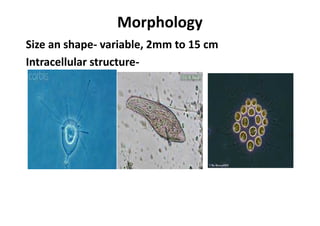
Morphology
Size an shape- variable, 2mm to 15 cm
Intracellular structure-
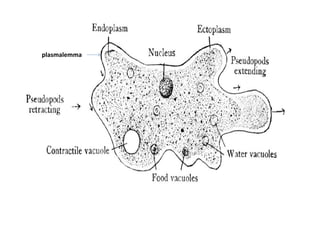
Cytoplasm
• Homogeneous, show colours (green, brown, blue ,
purple due to pigment
• Has submicroscopic protein fibrils (myonemes,
microtubules)
• Arranged in parallel
• Divided in two portions- ectoplasm & endoplasm
• Ectoplasm- more gel like and endoplasm is
voluminous and fluid
• Cell organelles are present (ER, ribosomes, golgi
complex, mitochondria, food vacuole, contractile
vacuole, kinetosome)
plasmalemma
Nucleus
• Eucaryotic nucleus- has chromosomes, the
nucleolar substance, the nuclear membrane,
nucleoplasm
• one or many
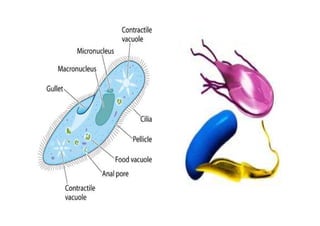
• Some have two-
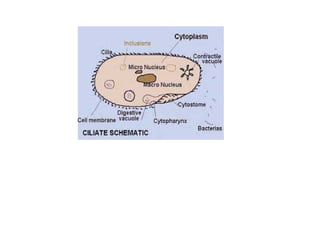
a. Macronucleus- large in size, controls the metabolic
the metabolic activities and regeneration
processes
b. Micronucleus- small in size concerned with
reproductive activity
Plasmalemma & other coverings
Cell membrane or plasmalemma- outermost layer,
semi permeable
Functions-
a. protection
b. site of perception of chemical and mechanical
stimuli
c. transport
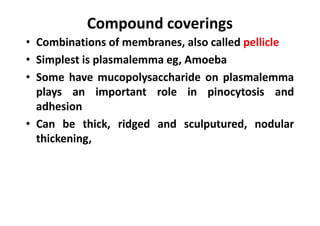
Compound coverings
• Combinations of membranes, also called pellicle
• Simplest is plasmalemma eg, Amoeba
• Some have mucopolysaccharide on plasmalemma
plays an important role in pinocytosis and
adhesion
• Can be thick, ridged and sculputured, nodular
thickening,
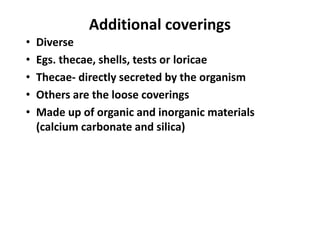
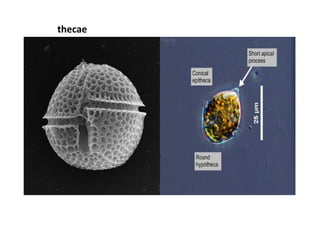
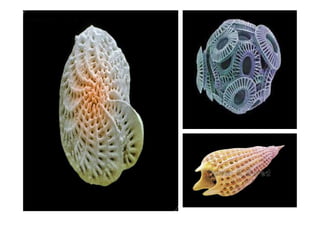
Additional coverings
• Diverse
• Egs. thecae, shells, tests or loricae
• Thecae- directly secreted by the organism
• Others are the loose coverings
• Made up of organic and inorganic materials
(calcium carbonate and silica)
thecae
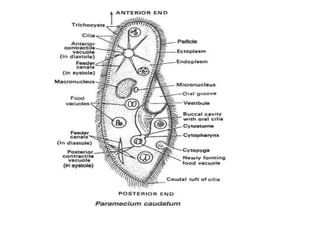
Feeding structures
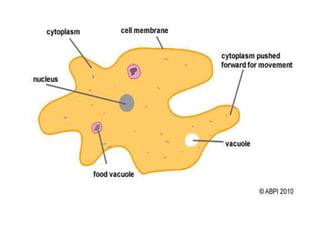
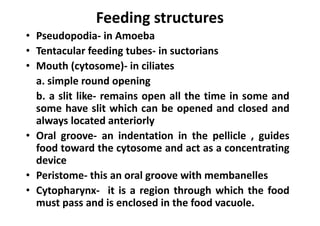
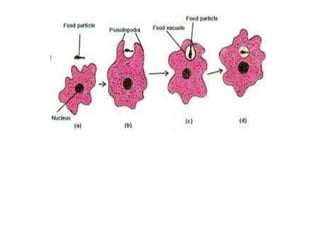
• Pseudopodia- in Amoeba
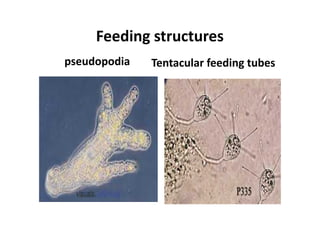
• Tentacular feeding tubes- in suctorians
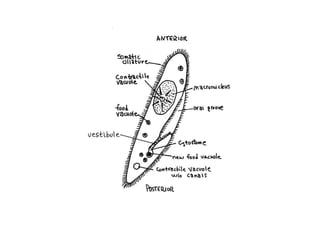
• Mouth (cytosome)- in ciliates
a. simple round opening
b. a slit like- remains open all the time in some and
some have slit which can be opened and closed and
always located anteriorly
• Oral groove- an indentation in the pellicle , guides
food toward the cytosome and act as a concentrating
device
• Peristome- this an oral groove with membanelles
• Cytopharynx- it is a region through which the food
must pass and is enclosed in the food vacuole.
Feeding structures
pseudopodia Tentacular feeding tubes
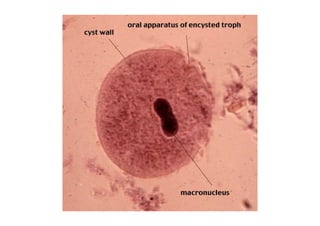
cysts
• Resistant structure
• Able to survive an adverse conditions like
dessication, low nutrient supply, lack of oxygen
etc.
• Cyst stage is an infective stage for intestinal
pathogens
• Cyst is important mean of asexual reproduction
Other protective structures
• Mucocyst- membrane bound vesicle secrete
mucilage
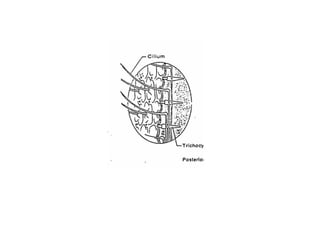
• Trichocyst- harpoon like weapon used by some
protozoa to defend
• Toxicyst- tubular thread like structure, secrets
toxin to paralyze and capture prey
• Haptocyst- used to contact and immobilize prey.
They are present in the tentacles of suctorian.
Locomotor organelles
Pseudopodia- it is a temporary projection of part of
the cytoplasm of some protozoa not having rigid
pellicle
• It is the characteristic of amoebas
• Used for capturing and engulfment of food
Flagella -
• fine filamentous extension of the cell, 9+2
arrangement
• 1-8 per cell
Locomotor organelles
cilia-
• thinner and shorter than flagella
• Apart from locomotion helps in ingestion of food
• Tactile organelle
• Arranged in longitudinal, oblique, or spiral rows
Undulating membrane-
Reproduction (Asexual reproduction)
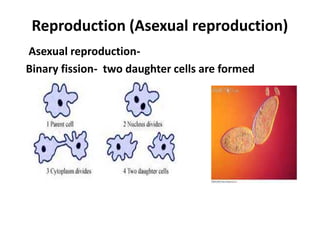
Asexual reproduction-
Binary fission- two daughter cells are formed
Reproduction (Asexual reproduction)
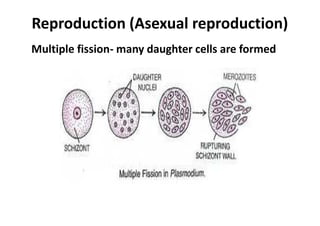
Multiple fission- many daughter cells are formed
Reproduction (Asexual reproduction)
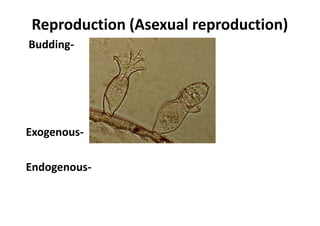
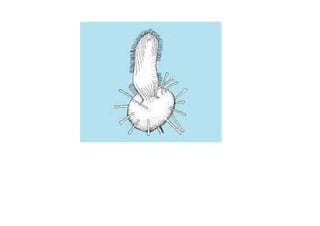
Budding-
Exogenous-
Endogenous-
Sexual reproduction-
• Syngamy or gametogamy
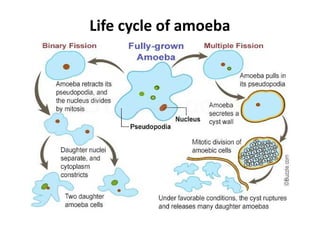
Life cycle of amoeba
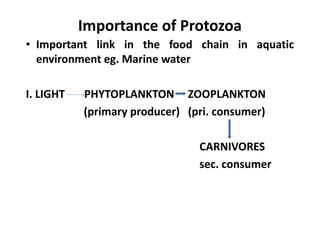
Importance of Protozoa
• Important link in the food chain in aquatic
environment eg. Marine water
I. LIGHT PHYTOPLANKTON ZOOPLANKTON
(primary producer) (pri. consumer)
CARNIVORES
sec. consumer
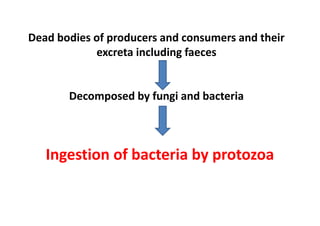
Dead bodies of producers and consumers and their
excreta including faeces
Decomposed by fungi and bacteria
Ingestion of bacteria by protozoa
Importance of Protozoa
1. Sewage treatment (biological)-aerobic and
anaerobic protozoa
2. Industrial waste treatment- rich in nitrates and
phosphates. In the settling tank illumination is
done to increase the growth of algae and
protozoa.

Protozoa

  • 4.
  • 5.
    Occurrence • Almost allhabitat • Sea, soil, fresh water, polar regions and very high altitude
  • 6.
    Ecology • Free living •Symbiotic – parasitic- mutualistic Free living- Factors affecting the distribution and the no.- 1. light- photosynthetic protozoa have chromatophore. Some are present in absence of light. 2. pH- 3.2-8.7 (6-8 is optimal for metabolism)
  • 7.
    Factors affecting thedistribution and the number of protozoa 3.a. Nutrients-water rich in oxygen and low in organic matter (mountain springs, ponds) b. some require water rich in minerals c. some grow well in water where there is active oxidation and degradation of organic matter (eg. Ciliates) d. Salt water e. fresh water f. in less oxygen g. presence of bacteria, protozoa for holozoic protozoa The nutrient supply is a major determining factor in the distribution and number of protozoa
  • 8.
    Factors affecting thedistribution and the number of protozoa 4. Temperature – 16-250 c (optimum), 36-400c (maximum) The encysted stage will thrive high temperature. So their no will be more in warm environment
  • 9.
    Symbiotic protozoa • Commensalism-thehost is neither harmed nor benefitted- 1.Ectocommensalism- protozoa attaches themselves to a host’s body 2.Endocommensalism- when protozoan is inside the host eg. The protozoa inside the gut of the host • Mutualism- both the parasite and the host are benefitted. Eg, the flagellates in the gut of termite digest woody materials consumed by termites. These are converted into glycogenous substances used by the host. In absence of each other both perish
  • 10.
    Symbiotic protozoa • Parasitism-the parasite lives at the expense of other. The parasite feeds on others with the help of pseudopodia or cytosome. • Hyperparasitism- parasitic protozoa parasitizes
  • 11.
    Morphology Size an shape-variable, 2mm to 15 cm Intracellular structure-
  • 12.
    Cytoplasm • Homogeneous, showcolours (green, brown, blue , purple due to pigment • Has submicroscopic protein fibrils (myonemes, microtubules) • Arranged in parallel • Divided in two portions- ectoplasm & endoplasm • Ectoplasm- more gel like and endoplasm is voluminous and fluid • Cell organelles are present (ER, ribosomes, golgi complex, mitochondria, food vacuole, contractile vacuole, kinetosome)
  • 13.
  • 14.
    Nucleus • Eucaryotic nucleus-has chromosomes, the nucleolar substance, the nuclear membrane, nucleoplasm • one or many • Some have two- a. Macronucleus- large in size, controls the metabolic the metabolic activities and regeneration processes b. Micronucleus- small in size concerned with reproductive activity
  • 16.
    Plasmalemma & othercoverings Cell membrane or plasmalemma- outermost layer, semi permeable Functions- a. protection b. site of perception of chemical and mechanical stimuli c. transport
  • 17.
    Compound coverings • Combinationsof membranes, also called pellicle • Simplest is plasmalemma eg, Amoeba • Some have mucopolysaccharide on plasmalemma plays an important role in pinocytosis and adhesion • Can be thick, ridged and sculputured, nodular thickening,
  • 18.
    Additional coverings • Diverse •Egs. thecae, shells, tests or loricae • Thecae- directly secreted by the organism • Others are the loose coverings • Made up of organic and inorganic materials (calcium carbonate and silica)
  • 19.
  • 21.
    Feeding structures • Pseudopodia-in Amoeba • Tentacular feeding tubes- in suctorians • Mouth (cytosome)- in ciliates a. simple round opening b. a slit like- remains open all the time in some and some have slit which can be opened and closed and always located anteriorly • Oral groove- an indentation in the pellicle , guides food toward the cytosome and act as a concentrating device • Peristome- this an oral groove with membanelles • Cytopharynx- it is a region through which the food must pass and is enclosed in the food vacuole.
  • 22.
  • 27.
    cysts • Resistant structure •Able to survive an adverse conditions like dessication, low nutrient supply, lack of oxygen etc. • Cyst stage is an infective stage for intestinal pathogens • Cyst is important mean of asexual reproduction
  • 29.
    Other protective structures •Mucocyst- membrane bound vesicle secrete mucilage • Trichocyst- harpoon like weapon used by some protozoa to defend • Toxicyst- tubular thread like structure, secrets toxin to paralyze and capture prey • Haptocyst- used to contact and immobilize prey. They are present in the tentacles of suctorian.
  • 31.
    Locomotor organelles Pseudopodia- itis a temporary projection of part of the cytoplasm of some protozoa not having rigid pellicle • It is the characteristic of amoebas • Used for capturing and engulfment of food Flagella - • fine filamentous extension of the cell, 9+2 arrangement • 1-8 per cell
  • 32.
    Locomotor organelles cilia- • thinnerand shorter than flagella • Apart from locomotion helps in ingestion of food • Tactile organelle • Arranged in longitudinal, oblique, or spiral rows Undulating membrane-
  • 33.
    Reproduction (Asexual reproduction) Asexualreproduction- Binary fission- two daughter cells are formed
  • 34.
    Reproduction (Asexual reproduction) Multiplefission- many daughter cells are formed
  • 35.
  • 37.
  • 38.
  • 39.
    Importance of Protozoa •Important link in the food chain in aquatic environment eg. Marine water I. LIGHT PHYTOPLANKTON ZOOPLANKTON (primary producer) (pri. consumer) CARNIVORES sec. consumer
  • 40.
    Dead bodies ofproducers and consumers and their excreta including faeces Decomposed by fungi and bacteria Ingestion of bacteria by protozoa
  • 41.
    Importance of Protozoa 1.Sewage treatment (biological)-aerobic and anaerobic protozoa 2. Industrial waste treatment- rich in nitrates and phosphates. In the settling tank illumination is done to increase the growth of algae and protozoa.