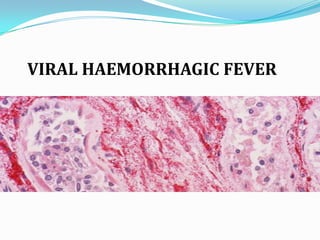
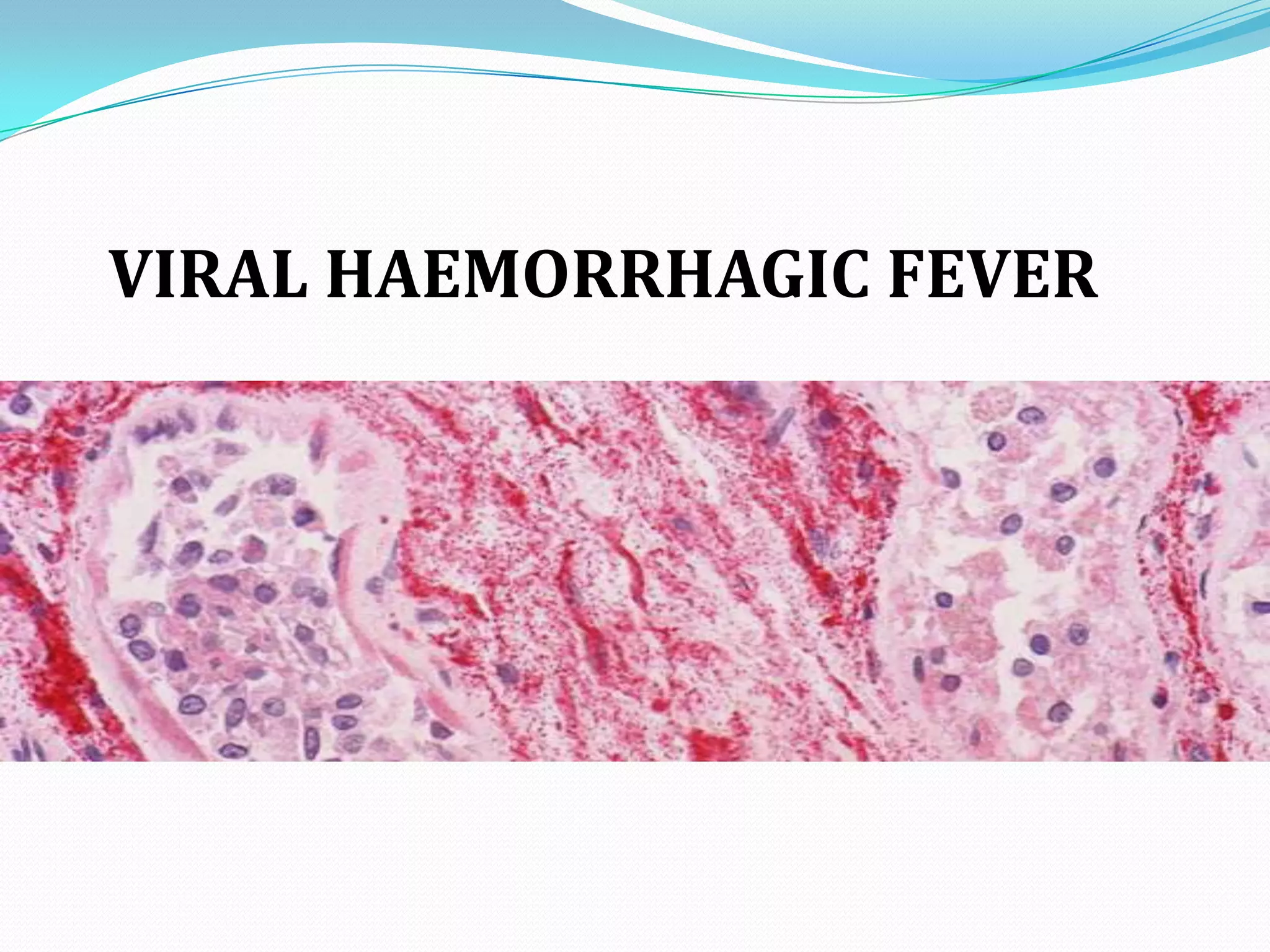
VIRAL HAEMORRHAGIC FEVER
•Viral hemorrhagic fevers (VHFs) are a group of
febrile illnesses caused by RNA viruses from
several viral families.
•These highly infectious viruses lead to a
potentially lethal disease syndrome
characterized by fever, malaise, vomiting,
mucosal and gastrointestinal (GI) bleeding,
edema, and hypotension.
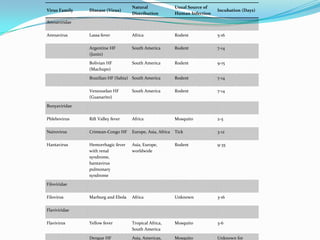
Virus Family Disease (Virus) Natural Distribution
Usual Source of
Human Infection
Incubation (Days)
Arenaviridae
Arenavirus Lassa fever Africa Rodent 5-16
Argentine HF (Junin) South America Rodent 7-14
Bolivian HF
(Machupo)
South America Rodent 9-15
Brazilian HF (Sabia) South America Rodent 7-14
Venezuelan HF
(Guanarito)
South America Rodent 7-14
Bunyaviridae
Phlebovirus Rift Valley fever Africa Mosquito 2-5
Nairovirus Crimean-Congo HF Europe, Asia, Africa Tick 3-12
Hantavirus Hemorrhagic fever
with renal syndrome,
hantavirus pulmonary
syndrome
Asia, Europe,
worldwide
Rodent 9-35
Filoviridae
Filovirus Marburg and Ebola Africa Unknown 3-16
Flaviviridae
Flavivirus Yellow fever Tropical Africa, South
America
Mosquito 3-6
Dengue HF Asia, Americas, Africa Mosquito Unknown for dengue
HF, 3-5 for dengue
Virus Family Disease (Virus)
Natural
Distribution
Usual Source of
Human Infection
Incubation (Days)
Arenaviridae
Arenavirus Lassa fever Africa Rodent 5-16
Argentine HF
(Junin)
South America Rodent 7-14
Bolivian HF
(Machupo)
South America Rodent 9-15
Brazilian HF (Sabia) South America Rodent 7-14
Venezuelan HF
(Guanarito)
South America Rodent 7-14
Bunyaviridae
Phlebovirus Rift Valley fever Africa Mosquito 2-5
Nairovirus Crimean-Congo HF Europe, Asia, Africa Tick 3-12
Hantavirus Hemorrhagic fever
with renal
syndrome,
hantavirus
pulmonary
syndrome
Asia, Europe,
worldwide
Rodent 9-35
Filoviridae
Filovirus Marburg and Ebola Africa Unknown 3-16
Flaviviridae
Flavivirus Yellow fever Tropical Africa,
South America
Mosquito 3-6
Dengue HF Asia, Americas, Mosquito Unknown for
Junin virus
Machupo virus
Guanarito virus
Lassa virus
Sabia virus
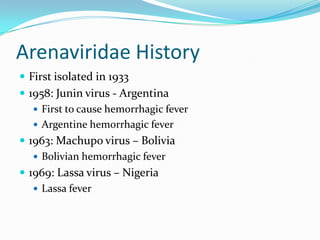
Arenaviridae History
 First isolated in 1933
 1958: Junin virus - Argentina
 First to cause hemorrhagic fever
 Argentine hemorrhagic fever
 1963: Machupo virus – Bolivia
 Bolivian hemorrhagic fever
 1969: Lassa virus – Nigeria
 Lassa fever
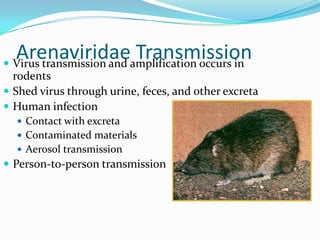
Arenaviridae Transmission Virus transmission and amplification occurs in
rodents
 Shed virus through urine, feces, and other excreta
 Human infection
 Contact with excreta
 Contaminated materials
 Aerosol transmission
 Person-to-person transmission
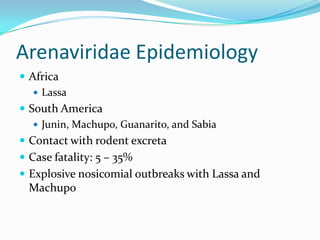
Arenaviridae Epidemiology
 Africa
 Lassa
 South America
 Junin, Machupo, Guanarito, and Sabia
 Contact with rodent excreta
 Case fatality: 5 – 35%
 Explosive nosicomial outbreaks with Lassa and
Machupo
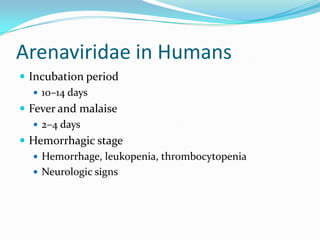
Arenaviridae in Humans
 Incubation period
 10–14 days
 Fever and malaise
 2–4 days
 Hemorrhagic stage
 Hemorrhage, leukopenia, thrombocytopenia
 Neurologic signs
Rift Valley Fever virus
Crimean-Congo Hemorrhagic Fever
virus
Hantavirus
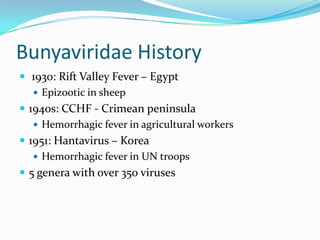
Bunyaviridae History
 1930: Rift Valley Fever – Egypt
 Epizootic in sheep
 1940s: CCHF - Crimean peninsula
 Hemorrhagic fever in agricultural workers
 1951: Hantavirus – Korea
 Hemorrhagic fever in UN troops
 5 genera with over 350 viruses
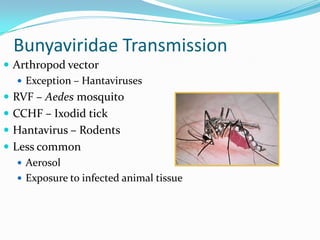
Bunyaviridae Transmission
 Arthropod vector
 Exception – Hantaviruses
 RVF – Aedes mosquito
 CCHF – Ixodid tick
 Hantavirus – Rodents
 Less common
 Aerosol
 Exposure to infected animal tissue
Bunyaviridae Epidemiology
 RVF - Africa and Arabian Peninsula
 1% case fatality rate
 CCHF - Africa, Eastern Europe, Asia
 30% case fatality rate
 Hantavirus - North and South America, Eastern
Europe, and Eastern Asia
 1-50% case fatality rate
Bunyaviridae Humans
 RVF
 Incubation period – 2-5 days
 0.5% - Hemorrhagic Fever
 CCHF
 Incubation period – 3-7 days
 Hemorrhagic Fever - 3–6 days
following clinical signs
 Hantavirus
 Incubation period – 7–21 days
 HPS and HFRS
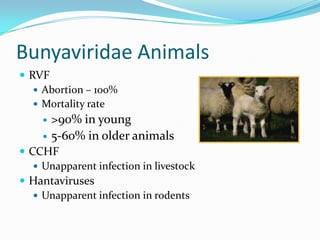
Bunyaviridae Animals
 RVF
 Abortion – 100%
 Mortality rate
 >90% in young
 5-60% in older animals
 CCHF
 Unapparent infection in livestock
 Hantaviruses
 Unapparent infection in rodents
Marburg virus
Ebola virus
Filoviridae History
 1967: Marburg virus
 European laboratory workers
 1976: Ebola virus
 Ebola Zaire
 Ebola Sudan
 1989 and 1992: Ebola Reston
 USA and Italy
 Imported macaques from Philippines
 1994: Ebola Côte d'Ivoire
Filoviridae Transmission
 Reservoir is UNKNOWN
 Bats implicated with Marburg
 Intimate contact
 Nosicomial transmission
 Reuse of needles and syringes
 Exposure to infectious tissues, excretions, and hospital
wastes
 Aerosol transmission
 Primates
Filoviridae Epidemiology
 Marburg – Africa
 Case fatality – 23-33%
 Ebola - Sudan, Zaire and Côte d'Ivoire – Africa
 Case fatality – 53-88%
 Ebola – Reston – Philippines
 Pattern of disease is UNKOWN
Filoviridae Humans
 Most severe hemorrhagic fever
 Incubation period: 4–10 days
 Abrupt onset
 Fever, chills, malaise, and myalgia
 Hemorrhage and DIC
 Death around day 7–11
 Painful recovery
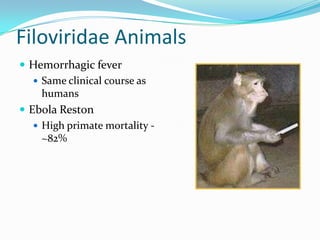
Filoviridae Animals
 Hemorrhagic fever
 Same clinical course as
humans
 Ebola Reston
 High primate mortality -
~82%
Dengue virus
Yellow Fever virus
Omsk Hemorrhagic Fever virus
Kyassnur Forest Disease virus
Flaviviridae History
 1648 : Yellow Fever described
 17th–20th century
 Yellow Fever and Dengue outbreaks
 1927: Yellow Fever virus isolated
 1943: Dengue virus isolated
 1947
 Omsk Hemorrhagic Fever virus isolated
 1957: Kyasanur Forest virus isolated
Flaviviridae Transmission
 Arthropod vector
 Yellow Fever and Dengue viruses
 Aedes aegypti
 Sylvatic cycle
 Urban cycle
 Kasanur Forest Virus
 Ixodid tick
 Omsk Hemorrhagic Fever virus
 Muskrat urine, feces, or blood
Flaviviridae Epidemiology
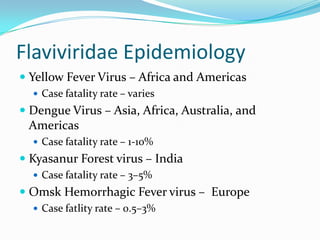
 Yellow Fever Virus – Africa and Americas
 Case fatality rate – varies
 Dengue Virus – Asia, Africa, Australia, and
Americas
 Case fatality rate – 1-10%
 Kyasanur Forest virus – India
 Case fatality rate – 3–5%
 Omsk Hemorrhagic Fever virus – Europe
 Case fatlity rate – 0.5–3%
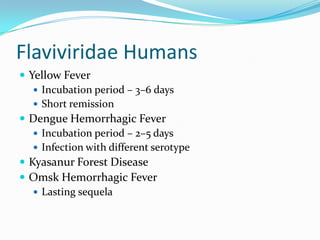
Flaviviridae Humans
 Yellow Fever
 Incubation period – 3–6 days
 Short remission
 Dengue Hemorrhagic Fever
 Incubation period – 2–5 days
 Infection with different serotype
 Kyasanur Forest Disease
 Omsk Hemorrhagic Fever
 Lasting sequela
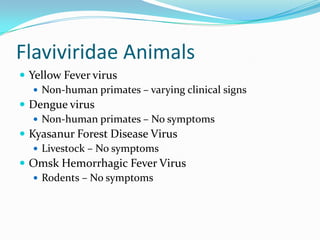
Flaviviridae Animals
 Yellow Fever virus
 Non-human primates – varying clinical signs
 Dengue virus
 Non-human primates – No symptoms
 Kyasanur Forest Disease Virus
 Livestock – No symptoms
 Omsk Hemorrhagic Fever Virus
 Rodents – No symptoms
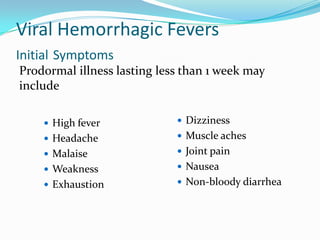
Viral Hemorrhagic Fevers
Initial Symptoms
 High fever
 Headache
 Malaise
 Weakness
 Exhaustion
 Dizziness
 Muscle aches
 Joint pain
 Nausea
 Non-bloody diarrhea
Prodormal illness lasting less than 1 week may
include
Viral Hemorrhagic Fevers
Clinical Signs
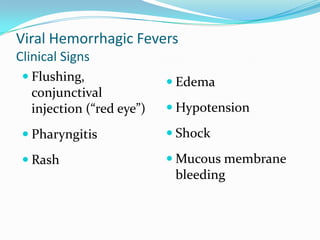
 Flushing,
conjunctival
injection (“red eye”)
 Pharyngitis
 Rash
 Edema
 Hypotension
 Shock
 Mucous membrane
bleeding
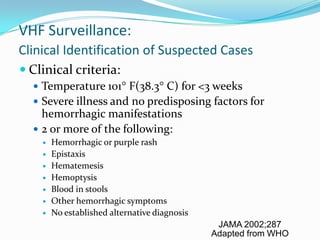
VHF Surveillance:
Clinical Identification of Suspected Cases
 Clinical criteria:
 Temperature 101 F(38.3 C) for <3 weeks
 Severe illness and no predisposing factors for
hemorrhagic manifestations
 2 or more of the following:
 Hemorrhagic or purple rash
 Epistaxis
 Hematemesis
 Hemoptysis
 Blood in stools
 Other hemorrhagic symptoms
 No established alternative diagnosis
JAMA 2002;287
Adapted from WHO
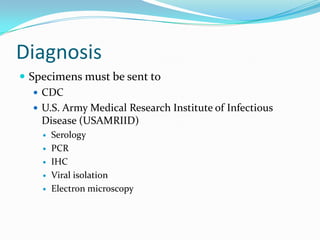
Diagnosis
 Specimens must be sent to
 CDC
 U.S. Army Medical Research Institute of Infectious
Disease (USAMRIID)
 Serology
 PCR
 IHC
 Viral isolation
 Electron microscopy
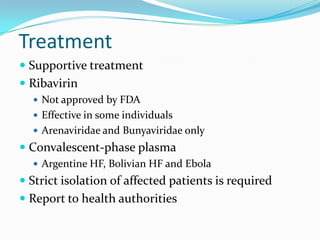
Treatment
 Supportive treatment
 Ribavirin
 Not approved by FDA
 Effective in some individuals
 Arenaviridae and Bunyaviridae only
 Convalescent-phase plasma
 Argentine HF, Bolivian HF and Ebola
 Strict isolation of affected patients is required
 Report to health authorities

Vhf1

  • 1.
  • 2.
    •Viral hemorrhagic fevers(VHFs) are a group of febrile illnesses caused by RNA viruses from several viral families. •These highly infectious viruses lead to a potentially lethal disease syndrome characterized by fever, malaise, vomiting, mucosal and gastrointestinal (GI) bleeding, edema, and hypotension.
  • 3.
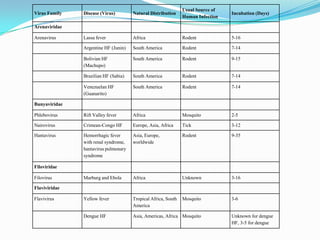
    Virus Family Disease(Virus) Natural Distribution Usual Source of Human Infection Incubation (Days) Arenaviridae Arenavirus Lassa fever Africa Rodent 5-16 Argentine HF (Junin) South America Rodent 7-14 Bolivian HF (Machupo) South America Rodent 9-15 Brazilian HF (Sabia) South America Rodent 7-14 Venezuelan HF (Guanarito) South America Rodent 7-14 Bunyaviridae Phlebovirus Rift Valley fever Africa Mosquito 2-5 Nairovirus Crimean-Congo HF Europe, Asia, Africa Tick 3-12 Hantavirus Hemorrhagic fever with renal syndrome, hantavirus pulmonary syndrome Asia, Europe, worldwide Rodent 9-35 Filoviridae Filovirus Marburg and Ebola Africa Unknown 3-16 Flaviviridae Flavivirus Yellow fever Tropical Africa, South America Mosquito 3-6 Dengue HF Asia, Americas, Africa Mosquito Unknown for dengue HF, 3-5 for dengue
  • 4.
    Virus Family Disease(Virus) Natural Distribution Usual Source of Human Infection Incubation (Days) Arenaviridae Arenavirus Lassa fever Africa Rodent 5-16 Argentine HF (Junin) South America Rodent 7-14 Bolivian HF (Machupo) South America Rodent 9-15 Brazilian HF (Sabia) South America Rodent 7-14 Venezuelan HF (Guanarito) South America Rodent 7-14 Bunyaviridae Phlebovirus Rift Valley fever Africa Mosquito 2-5 Nairovirus Crimean-Congo HF Europe, Asia, Africa Tick 3-12 Hantavirus Hemorrhagic fever with renal syndrome, hantavirus pulmonary syndrome Asia, Europe, worldwide Rodent 9-35 Filoviridae Filovirus Marburg and Ebola Africa Unknown 3-16 Flaviviridae Flavivirus Yellow fever Tropical Africa, South America Mosquito 3-6 Dengue HF Asia, Americas, Mosquito Unknown for
  • 5.
    Junin virus Machupo virus Guanaritovirus Lassa virus Sabia virus
  • 6.
    Arenaviridae History  Firstisolated in 1933  1958: Junin virus - Argentina  First to cause hemorrhagic fever  Argentine hemorrhagic fever  1963: Machupo virus – Bolivia  Bolivian hemorrhagic fever  1969: Lassa virus – Nigeria  Lassa fever
  • 7.
    Arenaviridae Transmission Virustransmission and amplification occurs in rodents  Shed virus through urine, feces, and other excreta  Human infection  Contact with excreta  Contaminated materials  Aerosol transmission  Person-to-person transmission
  • 8.
    Arenaviridae Epidemiology  Africa Lassa  South America  Junin, Machupo, Guanarito, and Sabia  Contact with rodent excreta  Case fatality: 5 – 35%  Explosive nosicomial outbreaks with Lassa and Machupo
  • 9.
    Arenaviridae in Humans Incubation period  10–14 days  Fever and malaise  2–4 days  Hemorrhagic stage  Hemorrhage, leukopenia, thrombocytopenia  Neurologic signs
  • 10.
    Rift Valley Fevervirus Crimean-Congo Hemorrhagic Fever virus Hantavirus
  • 11.
    Bunyaviridae History  1930:Rift Valley Fever – Egypt  Epizootic in sheep  1940s: CCHF - Crimean peninsula  Hemorrhagic fever in agricultural workers  1951: Hantavirus – Korea  Hemorrhagic fever in UN troops  5 genera with over 350 viruses
  • 12.
    Bunyaviridae Transmission  Arthropodvector  Exception – Hantaviruses  RVF – Aedes mosquito  CCHF – Ixodid tick  Hantavirus – Rodents  Less common  Aerosol  Exposure to infected animal tissue
  • 13.
    Bunyaviridae Epidemiology  RVF- Africa and Arabian Peninsula  1% case fatality rate  CCHF - Africa, Eastern Europe, Asia  30% case fatality rate  Hantavirus - North and South America, Eastern Europe, and Eastern Asia  1-50% case fatality rate
  • 14.
    Bunyaviridae Humans  RVF Incubation period – 2-5 days  0.5% - Hemorrhagic Fever  CCHF  Incubation period – 3-7 days  Hemorrhagic Fever - 3–6 days following clinical signs  Hantavirus  Incubation period – 7–21 days  HPS and HFRS
  • 15.
    Bunyaviridae Animals  RVF Abortion – 100%  Mortality rate  >90% in young  5-60% in older animals  CCHF  Unapparent infection in livestock  Hantaviruses  Unapparent infection in rodents
  • 16.
  • 17.
    Filoviridae History  1967:Marburg virus  European laboratory workers  1976: Ebola virus  Ebola Zaire  Ebola Sudan  1989 and 1992: Ebola Reston  USA and Italy  Imported macaques from Philippines  1994: Ebola Côte d'Ivoire
  • 18.
    Filoviridae Transmission  Reservoiris UNKNOWN  Bats implicated with Marburg  Intimate contact  Nosicomial transmission  Reuse of needles and syringes  Exposure to infectious tissues, excretions, and hospital wastes  Aerosol transmission  Primates
  • 19.
    Filoviridae Epidemiology  Marburg– Africa  Case fatality – 23-33%  Ebola - Sudan, Zaire and Côte d'Ivoire – Africa  Case fatality – 53-88%  Ebola – Reston – Philippines  Pattern of disease is UNKOWN
  • 20.
    Filoviridae Humans  Mostsevere hemorrhagic fever  Incubation period: 4–10 days  Abrupt onset  Fever, chills, malaise, and myalgia  Hemorrhage and DIC  Death around day 7–11  Painful recovery
  • 21.
    Filoviridae Animals  Hemorrhagicfever  Same clinical course as humans  Ebola Reston  High primate mortality - ~82%
  • 22.
    Dengue virus Yellow Fevervirus Omsk Hemorrhagic Fever virus Kyassnur Forest Disease virus
  • 23.
    Flaviviridae History  1648: Yellow Fever described  17th–20th century  Yellow Fever and Dengue outbreaks  1927: Yellow Fever virus isolated  1943: Dengue virus isolated  1947  Omsk Hemorrhagic Fever virus isolated  1957: Kyasanur Forest virus isolated
  • 24.
    Flaviviridae Transmission  Arthropodvector  Yellow Fever and Dengue viruses  Aedes aegypti  Sylvatic cycle  Urban cycle  Kasanur Forest Virus  Ixodid tick  Omsk Hemorrhagic Fever virus  Muskrat urine, feces, or blood
  • 25.
    Flaviviridae Epidemiology  YellowFever Virus – Africa and Americas  Case fatality rate – varies  Dengue Virus – Asia, Africa, Australia, and Americas  Case fatality rate – 1-10%  Kyasanur Forest virus – India  Case fatality rate – 3–5%  Omsk Hemorrhagic Fever virus – Europe  Case fatlity rate – 0.5–3%
  • 26.
    Flaviviridae Humans  YellowFever  Incubation period – 3–6 days  Short remission  Dengue Hemorrhagic Fever  Incubation period – 2–5 days  Infection with different serotype  Kyasanur Forest Disease  Omsk Hemorrhagic Fever  Lasting sequela
  • 27.
    Flaviviridae Animals  YellowFever virus  Non-human primates – varying clinical signs  Dengue virus  Non-human primates – No symptoms  Kyasanur Forest Disease Virus  Livestock – No symptoms  Omsk Hemorrhagic Fever Virus  Rodents – No symptoms
  • 29.
    Viral Hemorrhagic Fevers InitialSymptoms  High fever  Headache  Malaise  Weakness  Exhaustion  Dizziness  Muscle aches  Joint pain  Nausea  Non-bloody diarrhea Prodormal illness lasting less than 1 week may include
  • 30.
    Viral Hemorrhagic Fevers ClinicalSigns  Flushing, conjunctival injection (“red eye”)  Pharyngitis  Rash  Edema  Hypotension  Shock  Mucous membrane bleeding
  • 31.
    VHF Surveillance: Clinical Identificationof Suspected Cases  Clinical criteria:  Temperature 101 F(38.3 C) for <3 weeks  Severe illness and no predisposing factors for hemorrhagic manifestations  2 or more of the following:  Hemorrhagic or purple rash  Epistaxis  Hematemesis  Hemoptysis  Blood in stools  Other hemorrhagic symptoms  No established alternative diagnosis JAMA 2002;287 Adapted from WHO
  • 32.
    Diagnosis  Specimens mustbe sent to  CDC  U.S. Army Medical Research Institute of Infectious Disease (USAMRIID)  Serology  PCR  IHC  Viral isolation  Electron microscopy
  • 33.
    Treatment  Supportive treatment Ribavirin  Not approved by FDA  Effective in some individuals  Arenaviridae and Bunyaviridae only  Convalescent-phase plasma  Argentine HF, Bolivian HF and Ebola  Strict isolation of affected patients is required  Report to health authorities