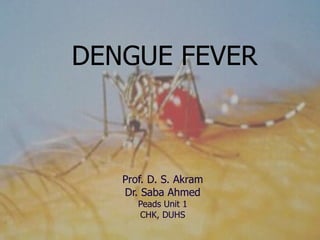
DENGUE FEVER Prof. D. S. Akram Dr. Saba Ahmed Peads Unit 1 CHK, DUHS
INTRODUCTION Dengue fever (DF) and Dengue  hemorrhagic fever (DHF) rank high  among infectious diseases and are considered to be most important of  arthropod born viral diseases
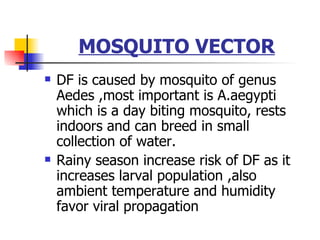
MOSQUITO VECTOR DF is caused by mosquito of genus Aedes ,most important is A.aegypti which is a day biting mosquito, rests indoors and can breed in small collection of water. Rainy season increase risk of DF as it increases larval population ,also ambient temperature and humidity favor viral propagation
MOSQUITO VECTOR Improper arrangements for disposal of  solid wastes and  water which are mainly consequences of unplanned  urbanization play a major role in  propagation of mosquitoes
DENGUE VIRUS It is an RNA virus belonging to Flaviviridae group Consists of 4 serotypes,DEN-1—DEN-4 All are capable of causing disease in humans Recent trends show increase prevalence of DEN-3serotype
EPIDEMIOLOGY DHFwas first recognized in Manila in 1953.Major epidemics since then in India,China,Thailand ,Malaysia. In 1998 major pandemic in 56 countries Recent epidemics in Bangladesh and India. In Karachi one outbreak was reported in 1994 and two occurred recently in 2005 and 2006
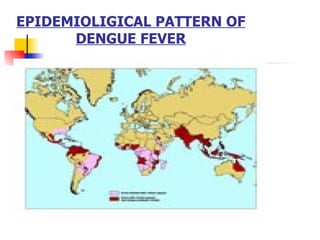
EPIDEMIOLIGICAL PATTERN OF DENGUE FEVER
CLINICAL FEATURES Dengue infection ranges from DF  to more severe Dengue hemorrhagic fever (DHF) Or Dengue shock syndrome (DSS). DF usually occurs after primary infection whereas DHF and DSS follow secondary Infections.
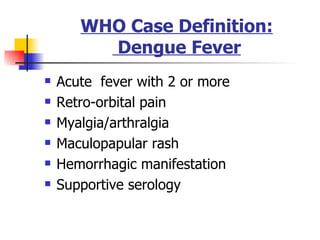
WHO Case Definition:  Dengue Fever Acute  fever with 2 or more Retro-orbital pain Myalgia/arthralgia Maculopapular rash  Hemorrhagic manifestation Supportive serology
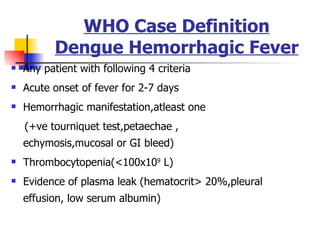
WHO Case Definition Dengue Hemorrhagic Fever Any patient with following 4 criteria Acute onset of fever for 2-7 days Hemorrhagic manifestation,atleast one (+ve tourniquet test,petaechae , echymosis,mucosal or GI bleed) Thrombocytopenia(<100x10 9  L) Evidence of plasma leak (hematocrit> 20%,pleural effusion, low serum albumin)
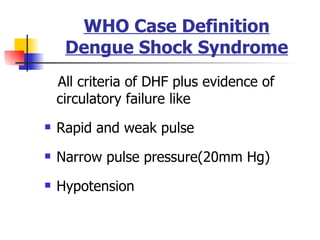
WHO Case Definition Dengue Shock Syndrome All criteria of DHF plus evidence of circulatory failure like Rapid and weak pulse Narrow pulse pressure(20mm Hg) Hypotension
WHO Grading of DHF This is especially useful in epidemics GRADE I: No shock only +ve tourniquet GRADE II: No shock, spontaneous bleeding GRADE III:Shock GRADE IV: Profound shock
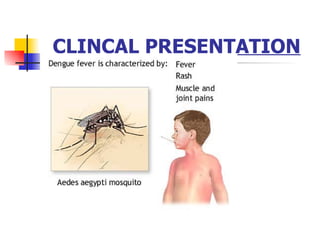
CLINCAL PRESENTATION
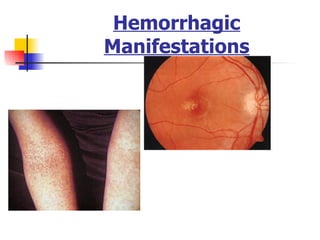
Hemorrhagic Manifestations
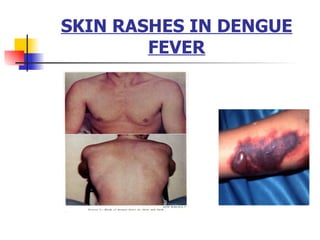
SKIN RASHES IN DENGUE FEVER
Difference between children and adults Children:  primary infections in 2 age peaks, infancy and 3-5 years Common presentation: fever ,rash, coryza,  hepatosplenomegaly, abdominal pain, rapid progression to shock and encephalopathy. Adults : secondary infections Common presentation:headache,arthralgia myalgia, bleeding
Dengue Cases in 1980 In 1980, in a study done by Prof.D.S.Akram on virus encephalitis. 30 cases of encephalitis were investigated by  Haemmagglutinition Inhibition (HI) for flaviviruses. 8 out of 30 had positive HI for DEN-2. Therefore DF was present in our population even in 1980’s.
Dengue Virus Infection Karachi (1994) A study conducted in Karachi by Prof.D.S.Akram in 1994 comprising of 122 children found 26% children with  undifferentiated fever to be sero-positive for Dengue fever, they also had higher incidence of hepato-splenomegaly and anemia. Indian j pediatr 1998, 65: 735-740
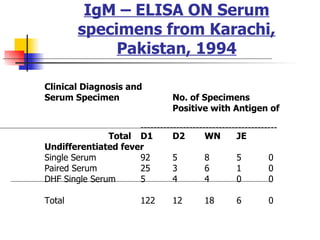
IgM – ELISA ON Serum specimens from Karachi, Pakistan, 1994 Clinical Diagnosis and  Serum Specimen  No. of Specimens Positive with Antigen of  ------------------------------------------ Total D1 D2 WN JE Undifferentiated fever Single Serum 92 5 8 5 0 Paired Serum 25 3 6 1 0 DHF Single Serum 5 4 4 0 0 Total 122 12 18 6 0
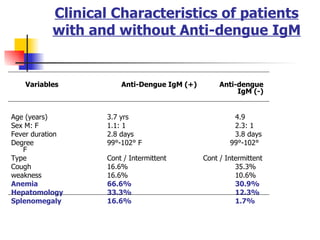
Clinical Characteristics of patients with and without Anti-dengue IgM Variables Anti-Dengue IgM (+)  Anti-dengue IgM (-) Age (years) 3.7 yrs 4.9 Sex M: F 1.1: 1 2.3: 1 Fever duration  2.8 days 3.8 days Degree  99°-102° F   99°-102° F Type  Cont / Intermittent Cont / Intermittent Cough 16.6% 35.3% weakness 16.6% 10.6% Anemia 66.6% 30.9% Hepatomology 33.3% 12.3% Splenomegaly 16.6% 1.7%
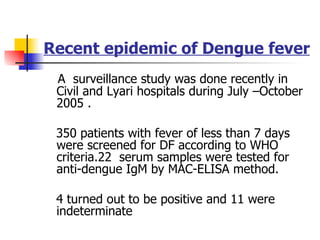
Recent epidemic of Dengue fever A  surveillance study was done recently in Civil and Lyari hospitals during July –October 2005 . 350 patients with fever of less than 7 days were screened for DF according to WHO criteria.22  serum samples were tested for anti-dengue IgM by MAC-ELISA method. 4 turned out to be positive and 11 were indeterminate
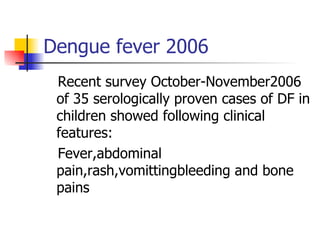
Dengue fever 2006 Recent survey October-November2006 of 35 serologically proven cases of DF in children showed following clinical features: Fever,abdominal pain,rash,vomittingbleeding and bone pains
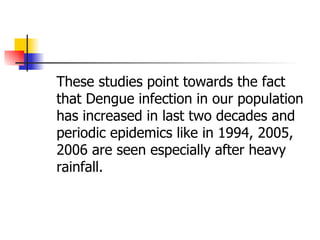
These studies point towards the fact that Dengue infection in our population has increased in last two decades and periodic epidemics like in 1994, 2005, 2006 are seen especially after heavy rainfall.
All patients don’t need admission WHAT TO DO? In a child with undifferentiated fever>38 o c and <7 days acute serum collected Platelets and hematocrit checked  Tourniquet test done Outpatient management of DF
Outpatient management of DF(cont) Child should be given  ORS Paracetamol for fever Counselling done to watch for: restlesness,lethergy,cold extremeties,low  volume pulse,oliguria
Outpatient management of DF(cont) Daily monitoring for upto 2 days after defervescence of fever of following: Hematocrit Platelets Evidence of bleeding: epistaxis,hematemesis,gum bleed,malena etc
Indications of hospitalization Patient has signs of dehydration: tachycardia,capillary refill>2 secs,cold  extremeties,oliguria Increase in hematocrit>20% Narrowing of pulsepressure<20mmHg Bleeding Thrombocytopenia
Volume replacement in DHF with >20%hematocrit Assume 5% isotonic dehydration PLAN OF REHYDRATION 1/5 dextrose saline or Ringolactate should be used Amount of fluid= maintenance+5%deficit+daily output
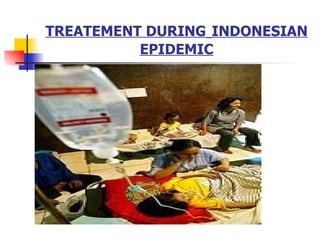
TREATEMENT DURING   INDONESIAN EPIDEMIC
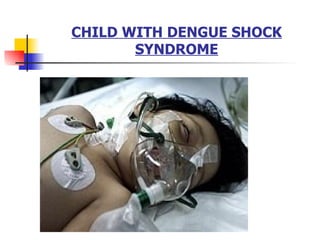
CHILD WITH DENGUE SHOCK SYNDROME
Volume replacement in DHF with >20%hematocrit (cont) If child shows improvement maintenance fluid  continued for 24-48 hours Increase in  monitoring intervals
Management of Thrombocytopenia Platelets should be given in following condition: Platelet count<20,000/mm Thrombocytopenia with active bleeding  Over use of platelets should be avoided as it is not necessary and causes shortage of stores in blood banks
Criteria for discharging inpatients Absence of fever for at least 24 hours Good urine output Stable hematocrit Passing of at least 2 days after recovery from shock  Platelet count>50,000/mm
PREVENTION Vaccination: Live attenuated tetra-valent vaccine against all sero types is under trial. Recombinant vaccines are also being tried
PREVENTION Many strategies like Environmental control  : Reducing vector breeding site, solid waste management, proper water drainage, personal protection and public education Chemical control: Space spraying of insecticide Regular monitoring of mosquito resistance pattern
Conclusion In light of these findings it can be recommended:  Children having no focus of infection and with negative investigations for malaria and UTI should be investigated Dengue fever
Conclusion……….. Cont. In surveillance studies for children under 2 years of age WHO surveillance should also be modified  to include all children with fever < 7 days without any focus of infection
Surveillance of Dengue fever: Formulation of surveillance programmes in endemic areas require monitoring of suspected cases ,case reporting, epidemiological and entomological investigation
Thank You Prof. D. S. Akram Dr Saba Ahmed Peads Unit 1 CHK, DUHS

DENGUE FEVER

  • 1.
    DENGUE FEVER Prof.D. S. Akram Dr. Saba Ahmed Peads Unit 1 CHK, DUHS
  • 2.
    INTRODUCTION Dengue fever(DF) and Dengue hemorrhagic fever (DHF) rank high among infectious diseases and are considered to be most important of arthropod born viral diseases
  • 3.
    MOSQUITO VECTOR DFis caused by mosquito of genus Aedes ,most important is A.aegypti which is a day biting mosquito, rests indoors and can breed in small collection of water. Rainy season increase risk of DF as it increases larval population ,also ambient temperature and humidity favor viral propagation
  • 4.
    MOSQUITO VECTOR Improperarrangements for disposal of solid wastes and water which are mainly consequences of unplanned urbanization play a major role in propagation of mosquitoes
  • 5.
    DENGUE VIRUS Itis an RNA virus belonging to Flaviviridae group Consists of 4 serotypes,DEN-1—DEN-4 All are capable of causing disease in humans Recent trends show increase prevalence of DEN-3serotype
  • 6.
    EPIDEMIOLOGY DHFwas firstrecognized in Manila in 1953.Major epidemics since then in India,China,Thailand ,Malaysia. In 1998 major pandemic in 56 countries Recent epidemics in Bangladesh and India. In Karachi one outbreak was reported in 1994 and two occurred recently in 2005 and 2006
  • 7.
  • 8.
    CLINICAL FEATURES Dengueinfection ranges from DF to more severe Dengue hemorrhagic fever (DHF) Or Dengue shock syndrome (DSS). DF usually occurs after primary infection whereas DHF and DSS follow secondary Infections.
  • 9.
    WHO Case Definition: Dengue Fever Acute fever with 2 or more Retro-orbital pain Myalgia/arthralgia Maculopapular rash Hemorrhagic manifestation Supportive serology
  • 10.
    WHO Case DefinitionDengue Hemorrhagic Fever Any patient with following 4 criteria Acute onset of fever for 2-7 days Hemorrhagic manifestation,atleast one (+ve tourniquet test,petaechae , echymosis,mucosal or GI bleed) Thrombocytopenia(<100x10 9 L) Evidence of plasma leak (hematocrit> 20%,pleural effusion, low serum albumin)
  • 11.
    WHO Case DefinitionDengue Shock Syndrome All criteria of DHF plus evidence of circulatory failure like Rapid and weak pulse Narrow pulse pressure(20mm Hg) Hypotension
  • 12.
    WHO Grading ofDHF This is especially useful in epidemics GRADE I: No shock only +ve tourniquet GRADE II: No shock, spontaneous bleeding GRADE III:Shock GRADE IV: Profound shock
  • 13.
  • 14.
  • 15.
    SKIN RASHES INDENGUE FEVER
  • 16.
    Difference between childrenand adults Children: primary infections in 2 age peaks, infancy and 3-5 years Common presentation: fever ,rash, coryza, hepatosplenomegaly, abdominal pain, rapid progression to shock and encephalopathy. Adults : secondary infections Common presentation:headache,arthralgia myalgia, bleeding
  • 17.
    Dengue Cases in1980 In 1980, in a study done by Prof.D.S.Akram on virus encephalitis. 30 cases of encephalitis were investigated by Haemmagglutinition Inhibition (HI) for flaviviruses. 8 out of 30 had positive HI for DEN-2. Therefore DF was present in our population even in 1980’s.
  • 18.
    Dengue Virus InfectionKarachi (1994) A study conducted in Karachi by Prof.D.S.Akram in 1994 comprising of 122 children found 26% children with undifferentiated fever to be sero-positive for Dengue fever, they also had higher incidence of hepato-splenomegaly and anemia. Indian j pediatr 1998, 65: 735-740
  • 19.
    IgM – ELISAON Serum specimens from Karachi, Pakistan, 1994 Clinical Diagnosis and Serum Specimen No. of Specimens Positive with Antigen of ------------------------------------------ Total D1 D2 WN JE Undifferentiated fever Single Serum 92 5 8 5 0 Paired Serum 25 3 6 1 0 DHF Single Serum 5 4 4 0 0 Total 122 12 18 6 0
  • 20.
    Clinical Characteristics ofpatients with and without Anti-dengue IgM Variables Anti-Dengue IgM (+) Anti-dengue IgM (-) Age (years) 3.7 yrs 4.9 Sex M: F 1.1: 1 2.3: 1 Fever duration 2.8 days 3.8 days Degree 99°-102° F 99°-102° F Type Cont / Intermittent Cont / Intermittent Cough 16.6% 35.3% weakness 16.6% 10.6% Anemia 66.6% 30.9% Hepatomology 33.3% 12.3% Splenomegaly 16.6% 1.7%
  • 21.
    Recent epidemic ofDengue fever A surveillance study was done recently in Civil and Lyari hospitals during July –October 2005 . 350 patients with fever of less than 7 days were screened for DF according to WHO criteria.22 serum samples were tested for anti-dengue IgM by MAC-ELISA method. 4 turned out to be positive and 11 were indeterminate
  • 22.
    Dengue fever 2006Recent survey October-November2006 of 35 serologically proven cases of DF in children showed following clinical features: Fever,abdominal pain,rash,vomittingbleeding and bone pains
  • 23.
    These studies pointtowards the fact that Dengue infection in our population has increased in last two decades and periodic epidemics like in 1994, 2005, 2006 are seen especially after heavy rainfall.
  • 24.
    All patients don’tneed admission WHAT TO DO? In a child with undifferentiated fever>38 o c and <7 days acute serum collected Platelets and hematocrit checked Tourniquet test done Outpatient management of DF
  • 25.
    Outpatient management ofDF(cont) Child should be given ORS Paracetamol for fever Counselling done to watch for: restlesness,lethergy,cold extremeties,low volume pulse,oliguria
  • 26.
    Outpatient management ofDF(cont) Daily monitoring for upto 2 days after defervescence of fever of following: Hematocrit Platelets Evidence of bleeding: epistaxis,hematemesis,gum bleed,malena etc
  • 27.
    Indications of hospitalizationPatient has signs of dehydration: tachycardia,capillary refill>2 secs,cold extremeties,oliguria Increase in hematocrit>20% Narrowing of pulsepressure<20mmHg Bleeding Thrombocytopenia
  • 28.
    Volume replacement inDHF with >20%hematocrit Assume 5% isotonic dehydration PLAN OF REHYDRATION 1/5 dextrose saline or Ringolactate should be used Amount of fluid= maintenance+5%deficit+daily output
  • 29.
    TREATEMENT DURING INDONESIAN EPIDEMIC
  • 30.
    CHILD WITH DENGUESHOCK SYNDROME
  • 31.
    Volume replacement inDHF with >20%hematocrit (cont) If child shows improvement maintenance fluid continued for 24-48 hours Increase in monitoring intervals
  • 32.
    Management of ThrombocytopeniaPlatelets should be given in following condition: Platelet count<20,000/mm Thrombocytopenia with active bleeding Over use of platelets should be avoided as it is not necessary and causes shortage of stores in blood banks
  • 33.
    Criteria for discharginginpatients Absence of fever for at least 24 hours Good urine output Stable hematocrit Passing of at least 2 days after recovery from shock Platelet count>50,000/mm
  • 34.
    PREVENTION Vaccination: Liveattenuated tetra-valent vaccine against all sero types is under trial. Recombinant vaccines are also being tried
  • 35.
    PREVENTION Many strategieslike Environmental control : Reducing vector breeding site, solid waste management, proper water drainage, personal protection and public education Chemical control: Space spraying of insecticide Regular monitoring of mosquito resistance pattern
  • 36.
    Conclusion In lightof these findings it can be recommended: Children having no focus of infection and with negative investigations for malaria and UTI should be investigated Dengue fever
  • 37.
    Conclusion……….. Cont. Insurveillance studies for children under 2 years of age WHO surveillance should also be modified to include all children with fever < 7 days without any focus of infection
  • 38.
    Surveillance of Denguefever: Formulation of surveillance programmes in endemic areas require monitoring of suspected cases ,case reporting, epidemiological and entomological investigation
  • 39.
    Thank You Prof.D. S. Akram Dr Saba Ahmed Peads Unit 1 CHK, DUHS