Overview of seminar
Introduction
Aetiology
Epidemiology.
Dengue hemorrhagic fever .
Ebola fever .
Crimean-Congo hemorrhagic fever .
Yellow fever .
Marburg hemorrhagic fever .
Lassa fever .
Rift valley hemorrhagic fever .
Prevention and control.
Definition:Haemorrhagic disease is term with a very wide
spectrum .
It comprise the disease caused by organisms and
Those due to the other causes (any cause other than
organisms ).
Here we are going to deal with infectious haemorrhagic
disease , which are caused mainly by viruses and
rarely by bacteria.
The viral haemorrhagic fevers:Is a term refers to a group of illnesses caused
by several distinct families of viruses that
effect humans and non -humans primates.
What is Viral
Hemorrhagic Fever?

• Severe multisystem syndrome
• Damage to overall vascular system
• Symptoms often accompanied by
hemorrhage
– Rarely life threatening in itself
– Includes conjunctivitis, petechia, echymosis
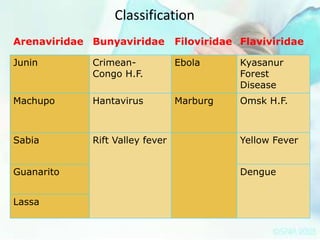
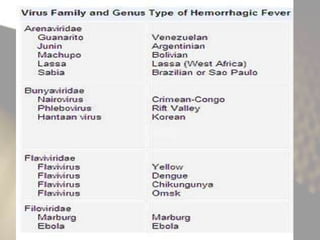
Classification
Arenaviridae Bunyaviridae

Filoviridae Flaviviridae

Junin

CrimeanCongo H.F.

Ebola

Kyasanur
Forest
Disease

Machupo

Hantavirus

Marburg

Omsk H.F.

Sabia

Rift Valley fever

Guanarito
Lassa

Yellow Fever
Dengue
• Hemorrhagic Fevers viruses .
• RNA viruses covered in a lipid coating
– Viruses are geographically restricted to areas
where host species live
– Humans are not natural reservoirs for these
viruses .
– With few noteworthy exception, there is no
cure or established treatment .
History :The term hemorrhagic fever was first used in
the 1930s by Soviet and Japanese scientists .to
describe an acute febrile disease encountered
in eastern Siberia and northern Manchuria.
This syndrome subsequently reported from
Korea, Bulgaria, Hungary, European Russia
and Northern Scandinavia under several
labels including.
epidemic hemorrhagic fever, hemorrhagic
fever with renal syndrome and
hemorrhagic fever nephrosonephritis
(HNN).
Since 1940s ,,,,,,,
1-Omsk hemorrhagic fever occurs in Western Siberia.
2-KFD in Mysore state and India .
3-DHF in several large cities in southeast Asia .
4-AFHF in portions of central , eastern and southern
Africa.
5-RVF in southern eastern Africa .
6-CrHF.
7-BHF.
8-LF.
9-AHF.
Arenaviridae History
• First isolated in 1933
• 1958: Junin virus - Argentina
– First to cause hemorrhagic fever
– Argentine hemorrhagic fever

• 1963: Machupo virus – Bolivia
– Bolivian hemorrhagic fever

• 1969: Lassa virus – Nigeria
– Lassa fever
Bunyaviridae History
• 1930: Rift Valley Fever – Kenya
– Epizootic in sheep

• 1940s: CCHF - Crimean peninsula
– Hemorrhagic fever in agricultural workers

• 1951: Hantavirus – Korea
– Hemorrhagic fever in UN troops

• 5 genera with over 350 viruses
Filoviridae History
• 1967: Marburg virus
– European laboratory workers

• 1976: Ebola virus
– Ebola Zaire
– Ebola Sudan

• 1989 and 1992: Ebola Reston
– USA and Italy
– Imported macaques from Philippines

• 1994: Ebola Côte d'Ivoire
Marburg in 1967
Flaviviridae History
• 1648 : Yellow Fever described
• 17th–20th century
– Yellow Fever and Dengue outbreaks

• 1927: Yellow Fever virus isolated
• 1943: Dengue virus isolated
• 1947
– Omsk Hemorrhagic Fever virus isolated

• 1957: Kyasanur Forest virus

isolated
Why do VHFs make good Bioweapons?
•
•
•
•
•
•
•

Disseminate through aerosols
Low infectious dose
High morbidity and mortality
Cause fear and panic in the public
No effective vaccine
Available and can be produced in large quantity
Research on weaponization has been
conducted
Why do VHFs make good Bioweapons?
•
•
•
•
•
•
•

Disseminate through aerosols
Low infectious dose
High morbidity and mortality
Cause fear and panic in the public
No effective vaccine
Available and can be produced in large quantity
Research on weaponization has been conducted
VHF Agents as
Biological Weapons

• Outbreak of undifferentiated febrile
illness 2-21 days following attack
– Could include
• Rash, hemorrhagic diathesis and shock

• Diagnosis could be delayed
– Unfamiliarity
– Lack of diagnostic tests

• Ribavirin treatment may be beneficial
etiology
Major causes of haemorrhagi fever

1)
2)
3)
4)
5)

1)
2)
3)

Arenaviridae family:
Guanarito virus.
Junin virus.
Machupo virus.
Lassa virus.
Sabia virus.
Bunyaviridae family:
Nairo virus.
Phlebo virus.
Hantaan virus.


1)
2)
3)

1)
2)

Flaviviridae family:
Yellow fever virus.
Dengue virus.
Omsk H.f virus.
Filoviridae family:
Ebola virus.
Marburg virus.
Minor causes of haemorrhagic fever
1)
2)
A.
B.

Rickettsia .
Spirochaetes :
Leptospira.
Borrelia .
most serious causes to haemorrhagic
fever
•
•
•
•
•
•
•

1- yellow fever virus.
2- rift valley virus.
3- Ebola virus.
4- Dengue virus.
5- Crimean congo virus.
6- Lassa virus.
7- Marburg virus.
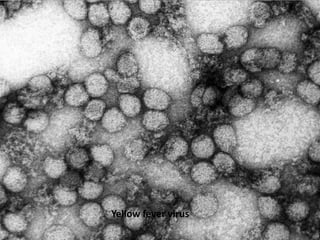
Yellow fever virus
• Is member of the genus Flavivirus of
Flaviviridae family
• Is spherical virus and is 40 to 50 nm in diamter
• Is positive sense single stranded RNA is
approximately 11,000 nucleotides long and
has single open reading frame encoding
polyportein .
Yellow fever virus
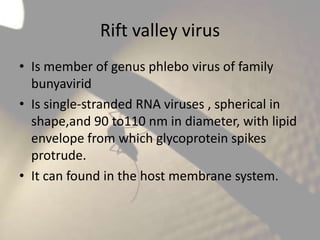
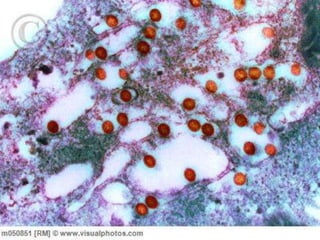
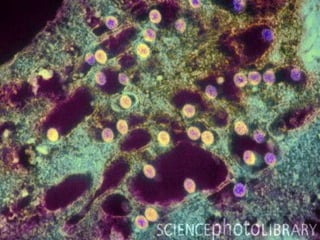
Rift valley virus
• Is member of genus phlebo virus of family
bunyavirid
• Is single-stranded RNA viruses , spherical in
shape,and 90 to110 nm in diameter, with lipid
envelope from which glycoprotein spikes
protrude.
• It can found in the host membrane system.
Rift valley virus
Ebola virus
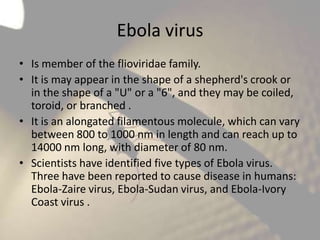
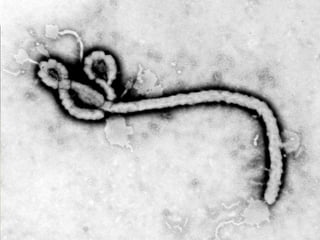
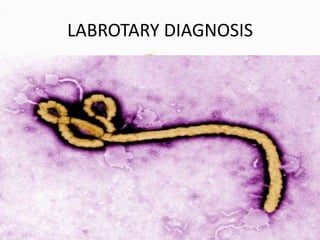
• Is member of the flioviridae family.
• It is may appear in the shape of a shepherd's crook or
in the shape of a "U" or a "6", and they may be coiled,
toroid, or branched .
• It is an alongated filamentous molecule, which can vary
between 800 to 1000 nm in length and can reach up to
14000 nm long, with diameter of 80 nm.
• Scientists have identified five types of Ebola virus.
Three have been reported to cause disease in humans:
Ebola-Zaire virus, Ebola-Sudan virus, and Ebola-Ivory
Coast virus .
Dengue virus
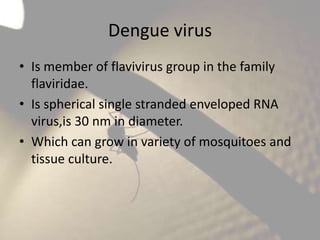
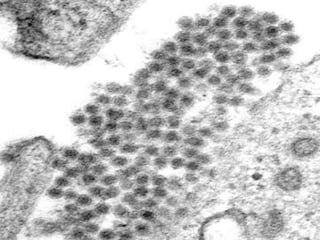
• Is member of flavivirus group in the family
flaviridae.
• Is spherical single stranded enveloped RNA
virus,is 30 nm in diameter.
• Which can grow in variety of mosquitoes and
tissue culture.
Crimean congo virus
• Is belonging to the genus nariovirus of family
bunyaviridae .
• Is triple segmented ,single strand ,negative
sense RNA .
• The virions are spherical ,with 85 to 105 nm in
daimeter.
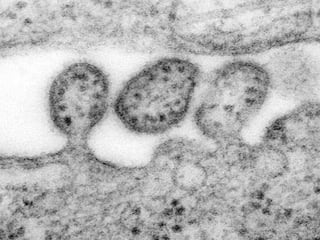
Lassa virus
• Is belonging to the genus Arenavirus , family
Arenaviridae .
• Is Double segmented, single stranded RNA
virus.
• The viral fragment may be in several distinct
shapes (pleomorphic), and is between 80 to
150nm in diameter .
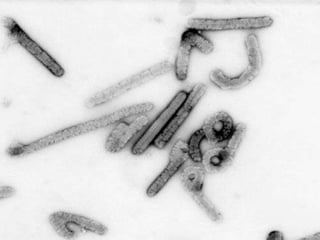
Marburg virus
• is a member of the Filoviridae family.
• is an elongated filamentous molecule, highly
variable in length, but typically around 1000
nm long with a uniform diameter of 80 nm .
• may appear in the shape of a "6", a "U", or a
circle, and it is contained within a lipid
membrane .
• Each virion contains one molecule of single
stranded, negative sense viral genomic RNA .
EPIDEMIOLOGY
1-Dengue hemorrhagic fever .
2-Ebola &Marburg hemorrhagic fever .
3-Crimean-Congo hemorrhagic fever .
4-Yellow fever .
5-Lassa fever .
6-Rift valley hemorrhagic fever .
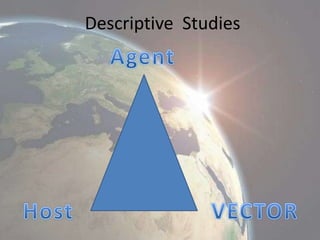
Descriptive Studies
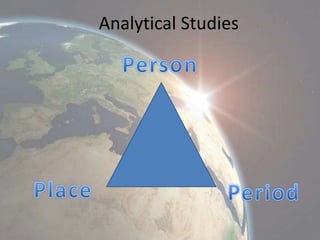
Analytical Studies
Dengue Fever
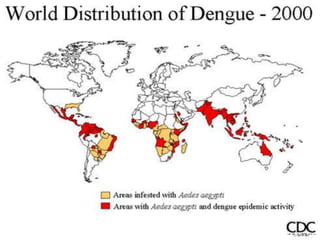
• Each year, an (500,000) cases of dengue
hemorrhagic fever occur worldwide, with
(22,000) deaths (mainly in children).
• In the last 50 years, the incidence of dengue has
increased 30-fold worldwide.
• In Sudan ,there is (168) cases of dengue fever
arise to a hospital Port Sudan during the period
from November to February, with (6) cases of
deaths .
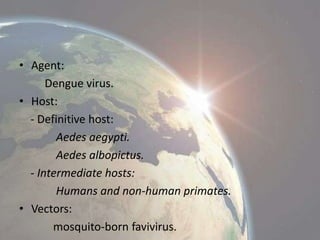
• Agent:
Dengue virus.
• Host:
- Definitive host:
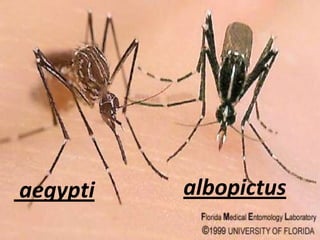
Aedes aegypti.
Aedes albopictus.
- Intermediate hosts:
Humans and non-human primates.
• Vectors:
mosquito-born favivirus.
aegypti

albopictus
• Person:
Both sexes - Child more common affected.
• Period:
Biphasic (May- November)
peak at June -August.
• Place:
Tropical and Subtropical Worldwide.
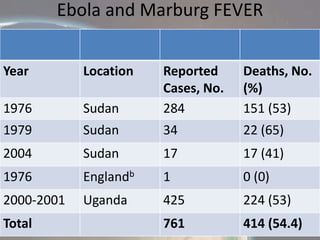
Ebola and Marburg FEVER
Year

Location
Sudan

Reported
Cases, No.
284

Deaths, No.
(%)
151 (53)

1976
1979

Sudan

34

22 (65)

2004

Sudan

17

17 (41)

1976

Englandb

1

0 (0)

2000-2001

Uganda

425

224 (53)

761

414 (54.4)

Total
• Agent:
Ebola virus .
Marburg fever.
• Host and vector:
-research scientists continue to search for the
exact animal host.
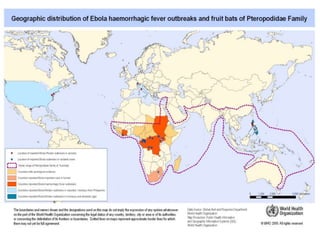
• Person:
Adult more exposure both sexes.
• Period:
DRY SEASONS.
• Place:
Sub-Saharan Africa.
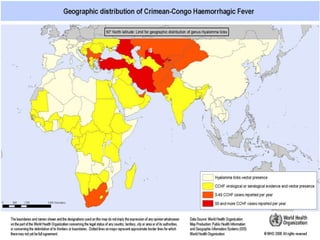
Crimean Congo fever
• Agent:
Criminal Congo virus.
• Host:
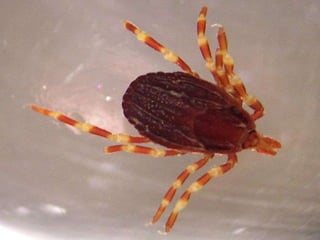
- Definitive host: Adult Tics.
- Intermediate host: human
• Vectors:
Tics of genus Hyalomma.
• Person:
All ages- man more exposed
• Period:
June- August
• Place:
Africa – East china.
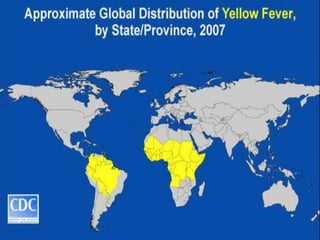
Yellow fever
• The case-fatality rate of yellow fever in Africa
approximates 20%.
• The Federal Ministry of Health reported to WHO an
outbreak of yellow fever in the South Kordofan
State. In16 November 2005, 404 cases and 118
deaths in ( Abu Gebiha , Rashad , Dilling , Kadugli ,
Talodi ).
• Agent:
Yellow fever virus.
• Host:
-Definitive host:
Aedes aegypti.
-Intermediate host:
Human.
• Vectors:
Wild mosquitoes ( Aedes aegypti
,Haemogogus).
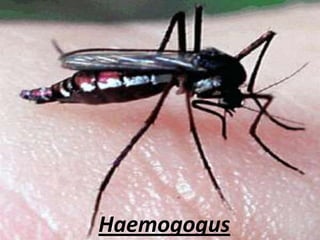
Haemogogus
• Person:
Both sexes affected, Adult more
exposed (and Infants and children are at
highest risk).
• Period:
Rainy season.
• Place:
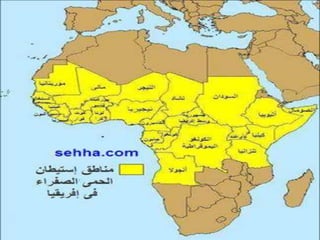
Africa-south America .
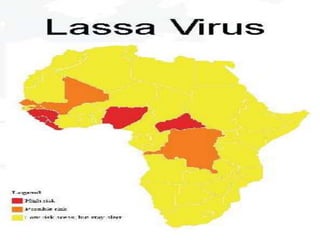
Lassa fever.
• Lassa fever occur yearly (300, 000 )– (500
,000) people and (5000) deaths among those
in the West African region.

• Case-fatality rate of 1% to 15% among
patients treated in hospitals.
• Agent:
Lassa virus.
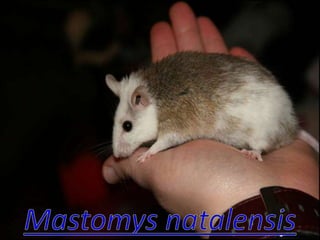
• Host:
- Definitive host:
rodent - ( Mastomys natalensis ).
- Intermediate host:
Human
Vector:
Not proven yet.
• Person:
All ages and Both sexes.
• Period:
No mark peak.
• Place:
west Africa.
Rift valley Fever.
• Until 14 November 2007,WHO reported (329)
human cases of Rift Valley Fever in Sudan has
led to (96) deaths and that in the states of
White Nile, Sennar and Gezira.
• The cases reported in Khartoum State is not
endemic in the state cases, but cases are
coming from one of the other affected States.
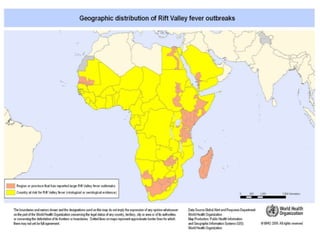
• Countries with endemic disease and outbreaks of
RVF:• South Africa.
• Sudan….
• Zambia.
• Kenya.
• Egypt and Madagascar.
• Saudi Arabia and Yemen.
• Agent:
Rift valley virus.
• Host:
- Definitive host:
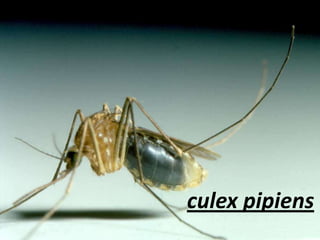
Aedes - culex pipiens.
-Intermediate host:
Human , sheep , cattle .
• Vectors:
Arthropod-blood born.
culex pipiens
• Person:
All ages and Both sexes (man more
affect).
• Period:
In late summer.
• Place:
-sub-Saharan African and
Madagascar - Egypt.
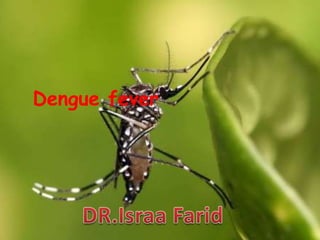
Dengue fever
Contents

1. What is dengue fever
2. Dengue virus
3.Symptoms of dengue fever
4.Characteristics of the Aedes mosquito
5.Life cycle of the Aedes mosquito
6.How the Aedes mosquito transmit diseases

7.What is the lab diagnosis
8.How to prevent the spread of dengue fever
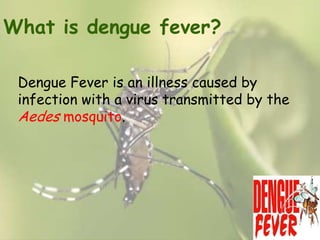
What is dengue fever?
Dengue Fever is an illness caused by
infection with a virus transmitted by the
Aedes mosquito.
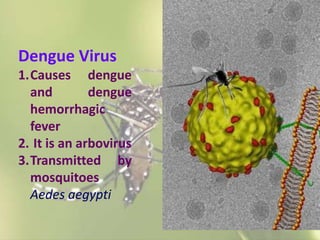
Dengue Virus
1.Causes dengue
and
dengue
hemorrhagic
fever
2. It is an arbovirus
3.Transmitted by
mosquitoes
Aedes aegypti
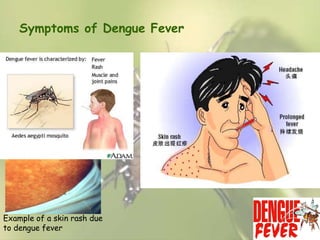
Symptoms of Dengue Fever

Example of a skin rash due
to dengue fever
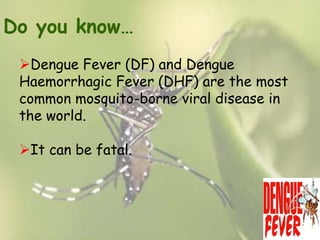
Do you know…
Dengue Fever (DF) and Dengue
Haemorrhagic Fever (DHF) are the most
common mosquito-borne viral disease in
the world.
It can be fatal.
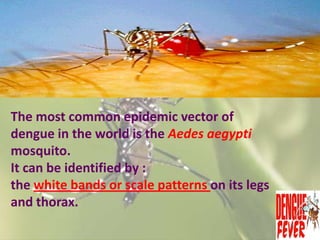
The most common epidemic vector of
dengue in the world is the Aedes aegypti
mosquito.
It can be identified by :
the white bands or scale patterns on its legs
and thorax.
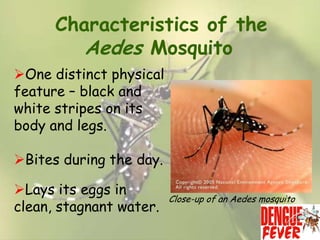
Characteristics of the
Aedes Mosquito
One distinct physical
feature – black and
white stripes on its
body and legs.

Bites during the day.
Lays its eggs in
clean, stagnant water.

Close-up of an Aedes mosquito
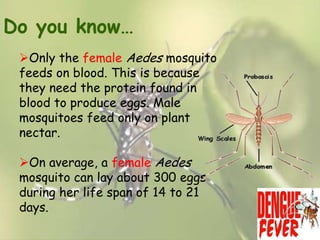
Do you know…
Only the female Aedes mosquito
feeds on blood. This is because
they need the protein found in
blood to produce eggs. Male
mosquitoes feed only on plant
nectar.
On average, a female Aedes
mosquito can lay about 300 eggs
during her life span of 14 to 21
days.
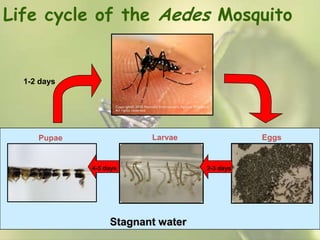
Life cycle of the Aedes Mosquito

1-2 days

Larvae

Pupae

4-5 days

Stagnant water

Eggs

2-3 days
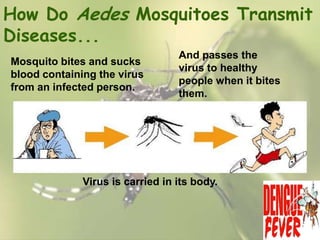
How Do Aedes Mosquitoes Transmit
Diseases...
Mosquito bites and sucks
blood containing the virus
from an infected person.

And passes the
virus to healthy
people when it bites
them.

Virus is carried in its body.
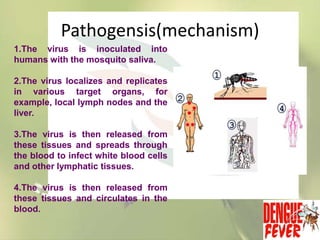
Pathogensis(mechanism)
1.The virus is inoculated into
humans with the mosquito saliva.

2.The virus localizes and replicates
in various target organs, for
example, local lymph nodes and the
liver.
3.The virus is then released from
these tissues and spreads through
the blood to infect white blood cells
and other lymphatic tissues.
4.The virus is then released from
these tissues and circulates in the
blood.
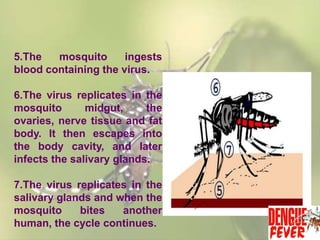
5.The
mosquito
ingests
blood containing the virus.
6.The virus replicates in the
mosquito
midgut,
the
ovaries, nerve tissue and fat
body. It then escapes into
the body cavity, and later
infects the salivary glands.
7.The virus replicates in the
salivary glands and when the
mosquito
bites
another
human, the cycle continues.
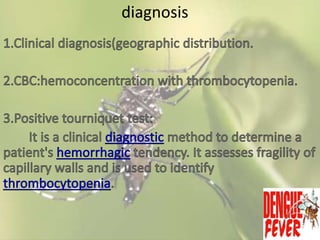
diagnosis
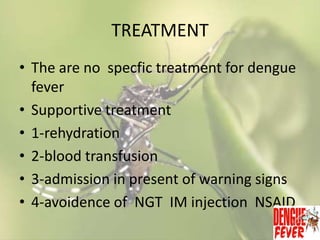
TREATMENT
• The are no specfic treatment for dengue
fever
• Supportive treatment
• 1-rehydration
• 2-blood transfusion
• 3-admission in present of warning signs
• 4-avoidence of NGT IM injection NSAID
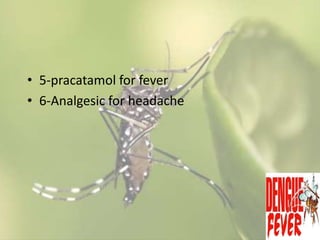
• 5-pracatamol for fever
• 6-Analgesic for headache
Prevent Aedes from Breeding!

Remove ALL sources of stagnant water.
Deny the Aedes mosquito of any chance to breed.
Do the 10-Minute Mozzie Wipe-out everyday.

Change water in vases on alternate days.
Do the 10-Minute Mozzie Wipe-out everyday.

Remove water from flowerpot plates on
alternate days.
Do the 10-Minute Mozzie Wipe-out everyday.

Turn over all pails and water
storage containers.
Do the 10-Minute Mozzie Wipe-out everyday.

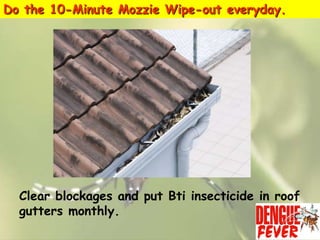
Clear blockages and put Bti insecticide in roof
gutters monthly.
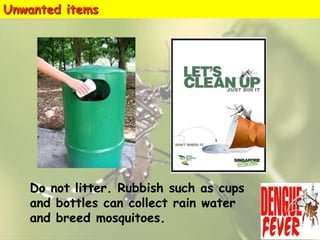
Unwanted items

Do not litter. Rubbish such as cups
and bottles can collect rain water
and breed mosquitoes.
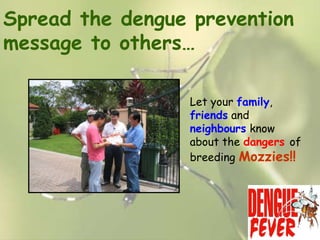
Spread the dengue prevention
message to others…
Let your family,
friends and
neighbours know
about the dangers of
breeding Mozzies!!
Ebola
Ebola
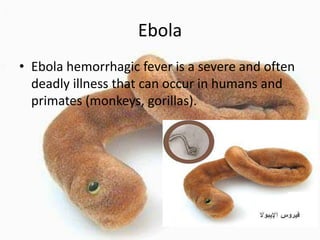
• Ebola hemorrhagic fever is a severe and often
deadly illness that can occur in humans and
primates (monkeys, gorillas).
Cause
Ebola hemorrhagic fever is caused by a virus
belonging to the family called Filoviridae. Scientists
have identified five types of Ebola virus. Three have
been reported to cause disease in humans: EbolaZaire virus, Ebola-Sudan virus, and Ebola-Ivory
Coast virus. The human disease has so far been
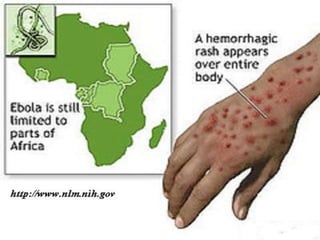
limited to parts of Africa.
The Reston type of Ebola virus has recently been
found in the Philippines.
MODE OF TRANSMTION
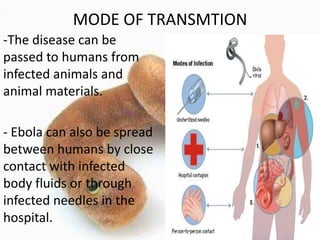
-The disease can be
passed to humans from
infected animals and
animal materials.
- Ebola can also be spread
between humans by close
contact with infected
body fluids or through
infected needles in the
hospital.
PATHOGENESIS
*The specific mechanism of
pathogenicity is poorly
understood due to difficulty
obtaining samples and study
the disease in areas of
outbreaks.
• Endothelial cells, mononuclear phagocytes,
and hepatocytes are the main targets of
infection. After infection, in a secreted
glycoprotein (sGP) the Ebola virus glycoprotein
(GP) is synthesized. Ebola replication
overwhelms protein synthesis of infected cells.
The GP forms a trimetric complex, which binds
the virus to the endothelial cells lining the
interior surface of blood vessels.
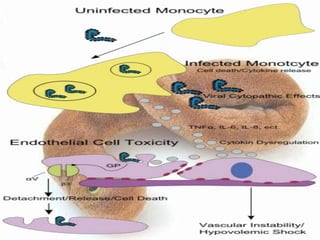
• The sGP forms a dimetric complex which
interferes with the signaling of neutrophils, ,
which allows the virus to evade the immune
system by inhibiting early steps of neutrophil
activation. These white blood cells also serve as
carriers to transport the virus throughout the
entire body to places such as the lymph nodes,
liver, lungs, and spleen.] The presence of viral
particles and cell damage resulting from causes
the release of cytokines (specificallyTNF , IL 6, IL
8, etc.), which are the signaling molecules for
fever and inflammation.
• The CYTOPATHIC effect, from infection in the
endothelial cells, results in a loss of vascular
integrity. This loss in vascular integrity is
furthered with synthesis of GP, which reduces
specific integrins responsible for cell adhesion
to the inter-cellular structure, and damage to
the liver, which leads to coagulopathy.
-During the incubation period, which can last
about one week after infection, symptoms
include:

-Arthritis.
-Chills.
-Fatigue.
-Headache
-Nausea.
-Vomiting.

-Backache.
-Diarrhea.
-Fever.
-Malaise.
- Sore throat
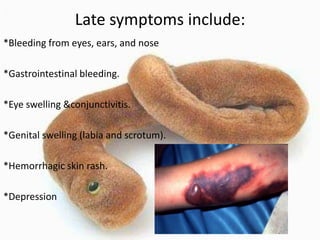
Late symptoms include:
*Bleeding from eyes, ears, and nose
*Gastrointestinal bleeding.
*Eye swelling &conjunctivitis.

*Genital swelling (labia and scrotum).
*Hemorrhagic skin rash.

*Depression
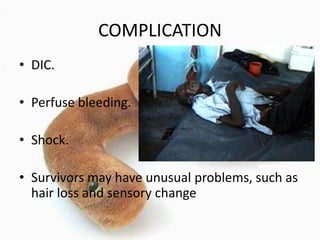
COMPLICATION
• DIC.
• Perfuse bleeding.

• Shock.
• Survivors may have unusual problems, such as
hair loss and sensory change
LABROTARY DIAGNOSIS
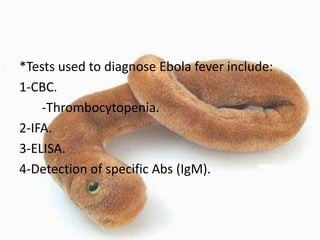
*Tests used to diagnose Ebola fever include:
1-CBC.
-Thrombocytopenia.
2-IFA.
3-ELISA.
4-Detection of specific Abs (IgM).
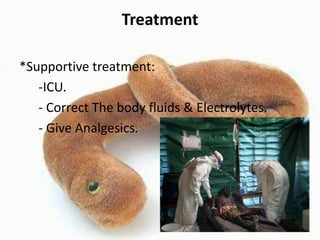
Treatment
*Supportive treatment:
-ICU.
- Correct The body fluids & Electrolytes.
- Give Analgesics.
Prognosis
*Patients usually die from low blood pressure
(shock) rather than from blood loss.
*Completely bad prognosis.
• The disease was first characterized in the
Crimea
• Then occurs in the Central Asia, and
regions of AFRICA.
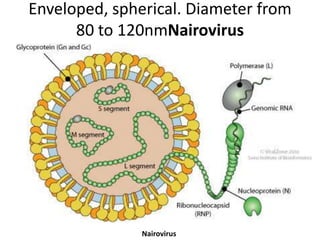
• (CCHF) is caused by:• a tick-borne virus (Nairovirus) in the
family Bunyaviridae .
Enveloped, spherical. Diameter from
80 to 120nmNairovirus

Nairovirus
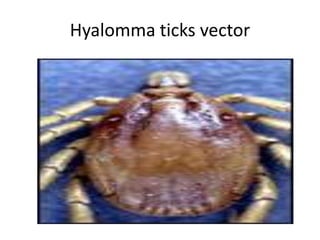
Hyalomma ticks vector
Route of transmition
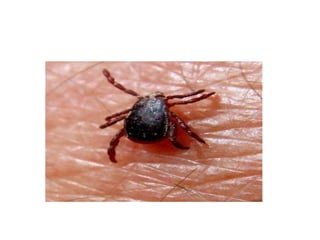
• xodid (hard) ticks, especially those of the
genus, Hyalomma, are both a reservoir and a
vector for the CCHF virus. Numerous wild and
domestic animals, such as cattle, goats, sheep
and hares, serve as amplifying hosts for the
virus.
• Transmission :• Zoonotic
• human to human
• Documented spread of CCHF
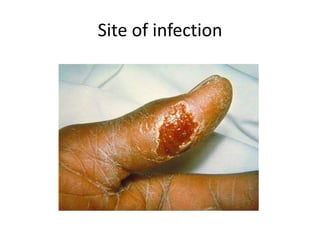
Site of infection
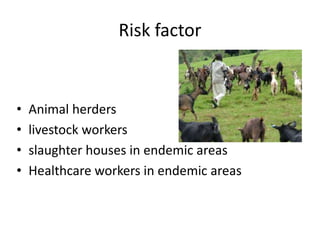
Risk factor

•
•
•
•

Animal herders
livestock workers
slaughter houses in endemic areas
Healthcare workers in endemic areas
Animal herders
Cilinical features
• (a) Incubation:• 1-3 days after ticks bite
• 5-6 days after contact to blood and tissue
Of infected livestock or human patient
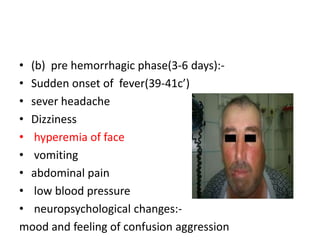
• (b) pre hemorrhagic phase(3-6 days):• Sudden onset of fever(39-41c’)
• sever headache
• Dizziness
• hyperemia of face
• vomiting
• abdominal pain
• low blood pressure
• neuropsychological changes:mood and feeling of confusion aggression
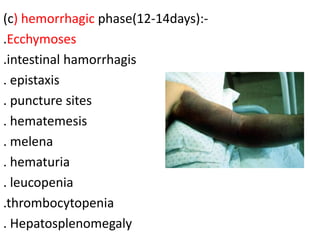
(c) hemorrhagic phase(12-14days):.Ecchymoses
.intestinal hamorrhagis
. epistaxis
. puncture sites
. hematemesis
. melena
. hematuria
. leucopenia
.thrombocytopenia
. Hepatosplenomegaly
Lab diagnosis
• Laboratory tests that are used to diagnose CCHF
include:• antigen-capture enzyme-linked ELISA
• RT-PCR
• virus isolation attempts
• detection of antibody by ELISA (IgG and IgM).
• Immunohistochemical staining can also show
evidence of viral antigen in formalin-fixed tissues.
treatment
.primarily supportive. Care should include
careful attention to fluid balance and
correction of electrolyte abnormalities,
• oxygenation and hemodynamic support
• appropriate treatment of secondary
infections.
• The virus is sensitive in vitro to the antiviral
drug ribavirin.
Complications
•
•
•
•

complications may include:Organic failure
intraabdominal abscess
acute cholecystitis
Yellow fever
Definition:•Yellow fever is an acute viral hemorrhagic
disease transmitted by infected mosquitoes.
The "yellow" in the name refers to the
jaundice that affects some patients.
•The virus is endemic in tropical areas of
Africa and Latin America.
•The number of yellow fever cases has
increased over the past two decades due to
declining population immunity to infection,
deforestation, urbanization, population
movements and climate change.
•There is no cure for yellow fever. Treatment
is symptomatic.
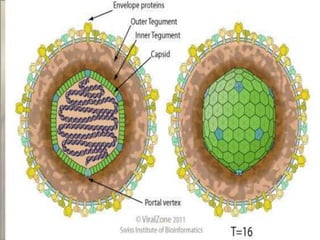
Morphology of the virus
. RNA virus
. Spherical.
. Envelope with spikes.
envelope
Lipoprotein.
spikes
glycoprotein.
. Spherical capsid .
Transmission
The yellow fever virus is an arbovirus of the
flavivirus genus.
The mosquito is the primary vector. It carries
the virus from one host to another, primarily
between monkeys, from monkeys to
humans, and from person to person.
• Several different species of the Aedes and
haemogogus mosquitoes transmit the virus.
• The mosquitoes either breed around
houses (domestic), in the jungle (wild) or in
both habitats (semi-domestic).
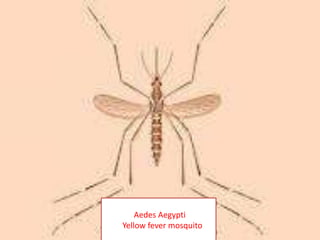
Aedes Aegypti
Yellow fever mosquito
There are three types of transmission
• cycles:-

1 Sylvatic yellow fever: •Take place in tropical rainforests.
•Wild mosquitoes ………bite monkeys
……infected mosquitoes ……….bite human
entering the forest …..resulting in yellow fever.
•The majority of infection occur in young men
working in the forest.
•2 Intermediate yellow fever:

•Take place in humid and semi-humid parts of Africa.
•Semi –domestic mosquitoes ……bite human and
monkey…..resulting in yellow fever …..small out
break.
•Increased contact between people and infected
mesquite lead to transmission.

• 3 Urban yellow fever:

• Large epidemics occur in populated area with a
high number of non-immune people and aedes
mosquitoes.
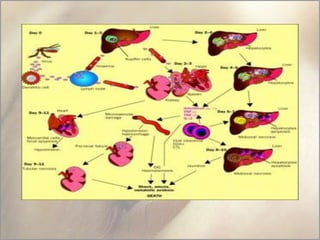
Pathogenesis
•After transmission of the virus from a mosquito
the viruses replicate in the lymph nodes and
infect dendritic cells in particular. From there
they reach the liver and infect hepatocytes
(probably indirectly via Kupffer cells), which
leads to eosinophilic degradation of these cells
and to the release of cytokines. Necrotic
masses (Councilman bodies) appear in the
cytoplasm of hepatocytes.
• When the disease takes a deadly course,
a cardiovascular shock and multi organ
failure with strongly increased cytokine
levels.
Signs and symptoms
• The incubation period (3—6days).
• Acute phase:• Fever.
• Muscle pain.
• Backache.
• Headache.
• Loss of appetite.
• Nausea and vomiting.
• Most patient improve and their symptoms
disappear after(3---4)days.
toxic phase:• Occurred within 24 hours of the initial
remission with:
• High fever.
• jaundice
• abdominal pain with vomiting.
• Bleeding from the mouth, nose, eyes.
blood in the vomits and faeces.
• Kidney function deteriorates.
• Half of the patients who enter the toxic
phase die within 10 to 14 days, the rest
recover without significant organ damage.
Lab diagnosis
virus isolation : - from blood or liver either :- Intra cerebrally in mice.
-Tissue :- culture of chick embryo.
2 Serology :- the best is neutralization test:Plague reduction . if the patient have anti bodies .
In his serum ,the virus will not produce plague in the
serum .
1

3 ELISA : IgM
4 Histology :- is the patient dies
5 P.C.R
Treatment
There is no specific treatment for yellow
fever, only supportive care to treat
dehydration and fever.
Associated bacterial infections can be
treated with antibiotics.
Supportive care may improve outcomes for
seriously ill patients, but it is rarely available
in poorer areas.
MARBURG
hemorrhagic
fever
Definition
*Acute infectious of VHF which effect both
human and non human( primates)
*Marburg virus are bacilliform in morphology
and can be pleomorphic when grown in tissue
culture
*The culture as either long filamentous or
branching
*Marburg virus is enveloped and single
strand
*non segmental negative sense RNA
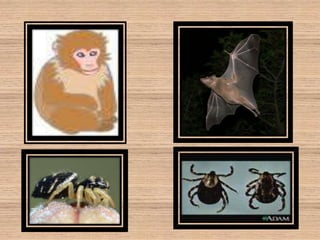
*the reservoir for Marburg virus is still
un know but can be found in bat
,monkey ,spider and ticks
Mode of Transmission:
1zoonotic
Avectors
BWaste products
2Person to person
Afluid excretion
BSexual transmission
3Nosocomial infection
A Reuse of needle
BExposure to infection tissue
CHospital waste
4Aerosol
has been observed in primates
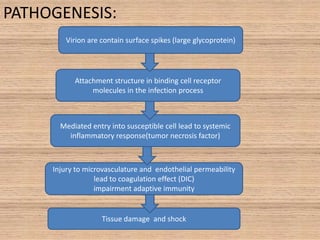
PATHOGENESIS:
Virion are contain surface spikes (large glycoprotein)

Attachment structure in binding cell receptor
molecules in the infection process

Mediated entry into susceptible cell lead to systemic
inflammatory response(tumor necrosis factor)

Injury to microvasculature and endothelial permeability
lead to coagulation effect (DIC)
impairment adaptive immunity

Tissue damage and shock
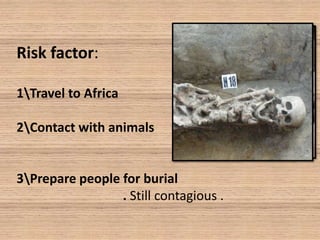
Risk factor:
1Travel to Africa
2Contact with animals

3Prepare people for burial
. Still contagious .
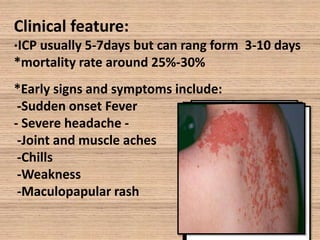
Clinical feature:
ICP usually 5-7days but can rang form 3-10 days
*mortality rate around 25%-30%
*

*Early signs and symptoms include:
-Sudden onset Fever
- Severe headache -Joint and muscle aches
-Chills
-Weakness
-Maculopapular rash
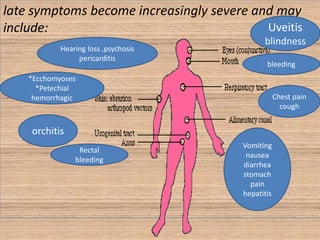
late symptoms become increasingly severe and may
Uveitis
include:
Hearing loss ,psychosis
pericarditis

blindness
bleeding

*Ecchomyoses
*Petechial
hemorrhagic

Chest pain
cough

orchitis
Rectal
bleeding

Vomiting
nausea
diarrhea
stomach
pain
hepatitis
complication:
-Multiple organ failure
-Severe bleeding
-Jaundice
-Delirium
-Seizures
-Coma
-Shock
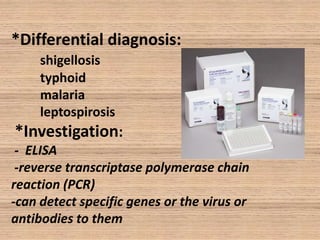
*Differential diagnosis:
shigellosis
typhoid
malaria
leptospirosis

*Investigation:
- ELISA
-reverse transcriptase polymerase chain
reaction (PCR)
-can detect specific genes or the virus or
antibodies to them
-CBC
-liver function test
Management:
*No specific antiviral therapy exists
*isolate patient
*notify local and state community
department
*Supportive hospital care
Lassa Fever
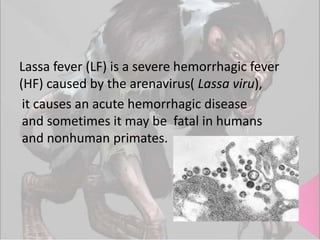
Lassa fever (LF) is a severe hemorrhagic fever
(HF) caused by the arenavirus( Lassa viru),
it causes an acute hemorrhagic disease
and sometimes it may be fatal in humans
and nonhuman primates.
Mode of transmission :
• Lassa virus is zoonotic Which is can be by tow
ways :
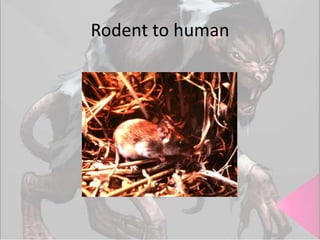
Rodent to human
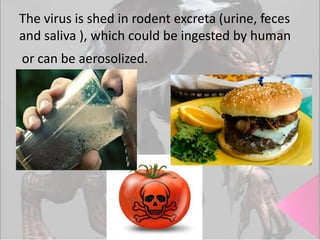
The virus is shed in rodent excreta (urine, feces
and saliva ), which could be ingested by human
or can be aerosolized.
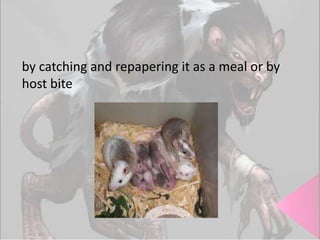
by catching and repapering it as a meal or by
host bite
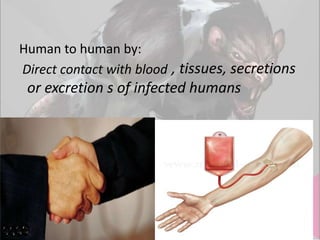
Human to human by:
Direct contact with blood , tissues, secretions

or excretion s of infected humans
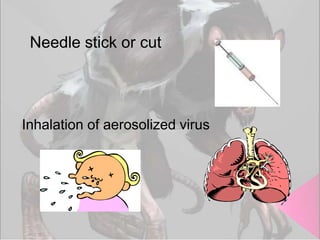
Needle stick or cut

Inhalation of aerosolized virus
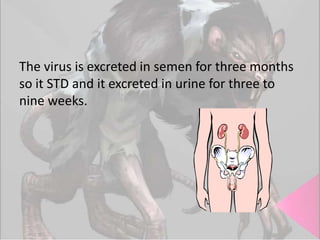
The virus is excreted in semen for three months
so it STD and it excreted in urine for three to
nine weeks.
Pathogenesis
pathologic descriptions of Lassa virus in human
are limited to a few cases .
common gross finding at postmortem
examination include ;
_ petechial hemorrhages in separate parts of the
body
pleural effusion, pericardial effusion and ascites
microscopically :
Congestion and variable degree of necrosis in all
organ systems
hepatocellular necrosis s with cytoplasmic
eosinophilia
inflammatory cell in necrotic area
pneumonitis , myocarditis ,acute renal tubular
necrosis
is not part of pathogenesis of lassa fever
CLINICAL MANIFESTATION
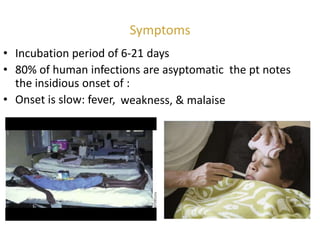
Symptoms
• Incubation period of 6-21 days
• 80% of human infections are asyptomatic the pt notes
the insidious onset of :
• Onset is slow: fever, weakness, & malaise
• Few days: headache, pharyngitis, muscle pain,
retrostinal & abdominal pain, nausea, vomiting,
diarrhea, cough, & proteinuria
– Neurological problems: tremors, encephalitis, hair loss,
gait disturbance, deafness

• 95% deathrate among pregnant women &
spontaneous abortion
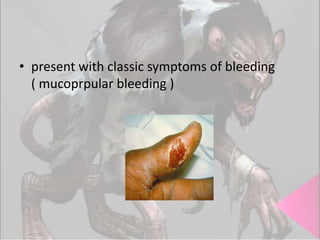
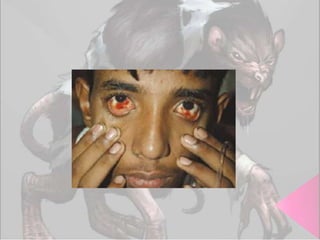
• present with classic symptoms of bleeding
( mucoprpular bleeding )
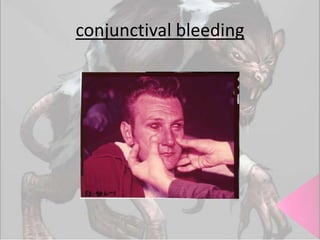
conjunctival bleeding
Sensorineural Hearing Deficit in Lassa
Fever
• Typically appears during early convalescence

• Not related to severity of acute illness
• Occurs in one-third of cases

• May be bilateral or unilateral
• May persist for life in up to one-third of those
affected
Clinically, Lassa fever infections are difficult to
distinguish from other viral hemorrhagic fevers
such as Ebola and Marburg, and from more
common febrile illnesses such as malaria
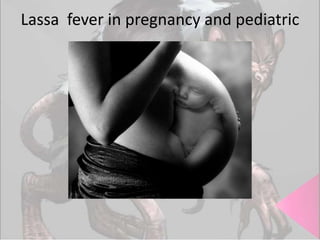
Lassa fever in pregnancy and pediatric
lSV in pregnant woman a significantly elevated
risk for both the mother and the fetus ,maternal
mortality elevated during 3rd trimester fetal
death approaches 100%
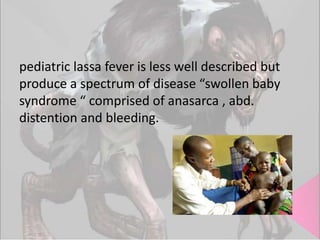
pediatric lassa fever is less well described but
produce a spectrum of disease “swollen baby
syndrome “ comprised of anasarca , abd.
distention and bleeding.
Diagnosis:
There is a range of laboratory investigations that
are performed to diagnose the disease and
assess its course and complications
• . ELISA test for antigen and IgM antibodies
gives 88% sensitivity and 90% specificity for
the presence of the infection. Other
laboratory findings in Lassa fever include
lymphopenia (low white blood cell count),
thrombocytopenia (low platelets), and
elevated aspartate aminotransferase (AST)
levels in the blood
TREATMENT
• 1-supportive treatment
• 2-virus specific therapy
Lassa fever can be treated with the ribavirin
Rift valley fever
• Rift Valley fever (RVF) is An acute febrile viral
zoonosis that affects human and livestock
(such as cattle, buffalo, sheep, goats, and
camels)
• Infection can cause severe disease in both
animals and humans. The disease also results
in significant economic losses due to death
and abortion among RVF-infected livestock…
• Currently RVF is one of the notifiable group
A of Exotic Diseases.
Route of transmission
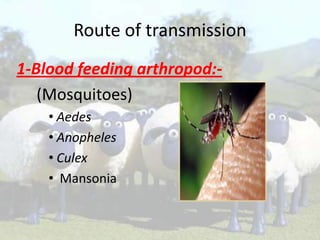
1-Blood feeding arthropod:(Mosquitoes)
• Aedes
• Anopheles
• Culex
• Mansonia
• 2-Contact with blood or other body fluids of
infected animals.
• 3-Consumption of infected milk.

• 4-Airborne transmission.
*Note

No person-to-person transmission.
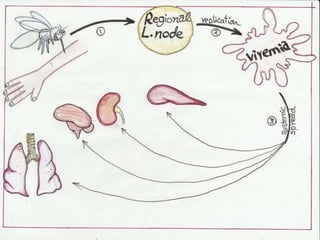
PATHOGENESIS
Clinical features

(I)-In animals:- RVF has been found to infect many
species of animals, however the most
commonly affected are sheep, goats and
cattle….
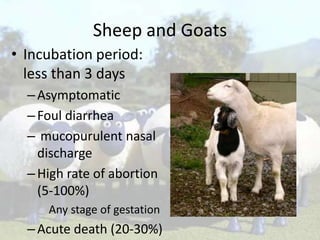
Sheep and Goats
• Incubation period:
less than 3 days
– Asymptomatic
– Foul diarrhea
– mucopurulent nasal
discharge
– High rate of abortion
(5-100%)
Any stage of gestation

– Acute death (20-30%)
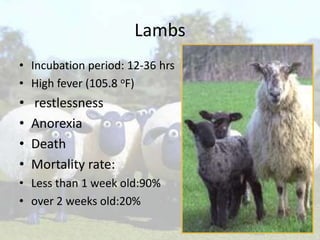
Lambs
• Incubation period: 12-36 hrs
• High fever (105.8 oF)

•
•
•
•

restlessness
Anorexia
Death
Mortality rate:

• Less than 1 week old:90%
• over 2 weeks old:20%
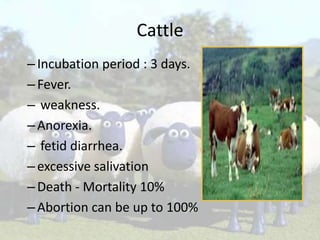
Cattle
– Incubation period : 3 days.
– Fever.
– weakness.
– Anorexia.
– fetid diarrhea.
– excessive salivation
– Death - Mortality 10%
– Abortion can be up to 100%
Clinical features

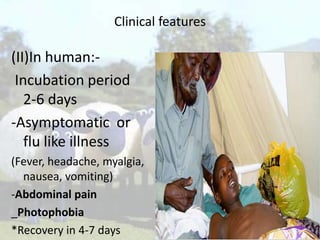
(II)In human:Incubation period
2-6 days
-Asymptomatic or
flu like illness
(Fever, headache, myalgia,
nausea, vomiting)
-Abdominal pain
_Photophobia
*Recovery in 4-7 days
complication
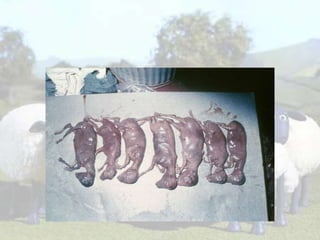
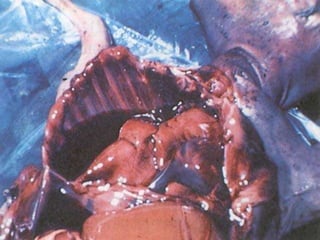
*RVF associated with 3 main complications:(i)-Encephalitis:(1 week after febrile phase
Confusion, vertigo ,stupor, coma).

(ii)-Optic neuropathy:(7-20 days decrease visual acuity, retinitis,
permanent loss of vision).

(iii) )- Hemorrhage (Epistaxis , Hematemsis ,
Melena , Ecchymoses)DIC, Shock.
Diagnosis
• Antibody detection:
Serological test:
ELISA
EIA

virus detection:
» PCR
– Tissue culture

– (the laboratory should be notified that specimens
originate from HF patient !!so appropriate biologic
safety measures can be taken)
Management
• General Supportive Measures:* Isolation in negative airway pressure room.
* Blood transfusion.
*Antiviral drugs( Ribavirin . Interferon).
* Immune Modulators.
* Introduction to ICU if indicated.
• Hospital discharge after:*Improvement in general status.
*Decline in liver symptoms.
*Recovery from DIC.
• Follow-up in ophthalmology and medical clinics for

6 weeks .
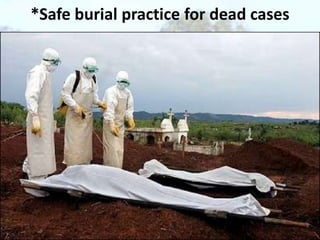
*Safe burial practice for dead cases
Prevention
and Control
That mean any activity
which reduces morbidity
and mortality of diseases .
Levels of Prevention:
Primary Level

Secondary Level
Tertiary Level

education, bed
nets, Vaccines
Levels of Prevention:
Primary Level

Secondary Level
Tertiary Level

Early diagnosis
and adequate
treatment
Levels of Prevention:
Primary Level

Secondary Level
Tertiary Level

Medical,
Occupational,
Social and
Psychological
rehabilitation
Prevention
(I)Avoid contact with host
species

(III) Protective clothing

(II) Vaccine available

(IV) Disinfect and dispose of
instruments
Prevention
(I)Avoid contact with host
species

(II) Vaccine available

1-Rodents

2-Insects

3-cattle

4-in human

(III) Protective clothing

(IV) Disinfect and dispose of
instruments
Prevention
(I)Avoid contact with host
species

1-Rodents

(II) Vaccine available

2-Insects

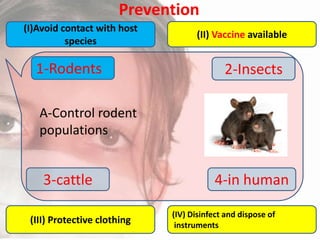
A-Control rodent
populations

3-cattle
(III) Protective clothing

4-in human
(IV) Disinfect and dispose of
instruments
Prevention
(I)Avoid contact with host
species

1-Rodents

(II) Vaccine available

2-Insects

B-prevent the rodents
from enteringor living
in human populations

3-cattle
(III) Protective clothing

4-in human
(IV) Disinfect and dispose of
instruments
Prevention
(I)Avoid contact with host
species

1-Rodents

(II) Vaccine available

2-Insects

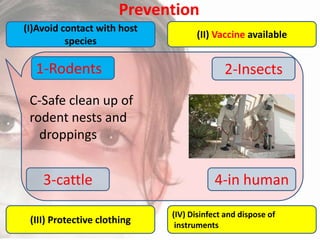
C-Safe clean up of
rodent nests and
droppings

3-cattle
(III) Protective clothing

4-in human
(IV) Disinfect and dispose of
instruments
Prevention
(I)Avoid contact with host
species

1-Rodents

(II) Vaccine available

2-Insects

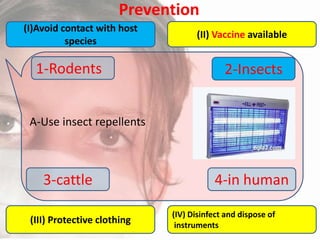
A-Use insect repellents

3-cattle
(III) Protective clothing

4-in human
(IV) Disinfect and dispose of
instruments
Prevention
(I)Avoid contact with host
species

1-Rodents

(II) Vaccine available

2-Insects

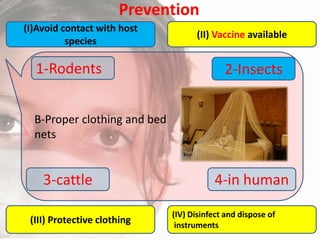
B-Proper clothing and bed
nets

3-cattle
(III) Protective clothing

4-in human
(IV) Disinfect and dispose of
instruments
Prevention
(I)Avoid contact with host
species

1-Rodents

(II) Vaccine available

2-Insects

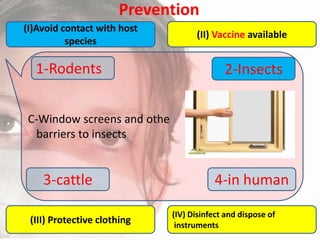
C-Window screens and othe
barriers to insects

3-cattle
(III) Protective clothing

4-in human
(IV) Disinfect and dispose of
instruments
Prevention
(I)Avoid contact with host
species

1-Rodents

(II) Vaccine available

2-Insects

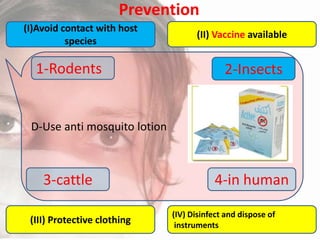
D-Use anti mosquito lotion

3-cattle
(III) Protective clothing

4-in human
(IV) Disinfect and dispose of
instruments
Prevention
(I)Avoid contact with host
species

1-Rodents

(II) Vaccine available

2-Insects

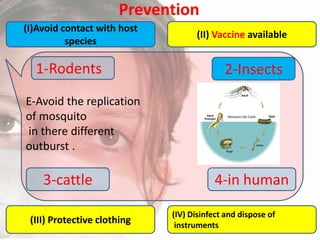
E-Avoid the replication
of mosquito
in there different
outburst .

3-cattle
(III) Protective clothing

4-in human
(IV) Disinfect and dispose of
instruments
Prevention
(I)Avoid contact with host
species

1-Rodents

(II) Vaccine available

2-Insects

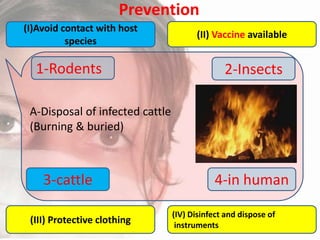
A-Disposal of infected cattle
(Burning & buried)

3-cattle
(III) Protective clothing

4-in human
(IV) Disinfect and dispose of
instruments
Prevention
(I)Avoid contact with host
species

1-Rodents

(II) Vaccine available

2-Insects

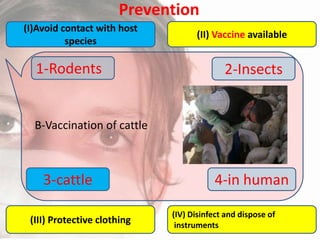
B-Vaccination of cattle

3-cattle
(III) Protective clothing

4-in human
(IV) Disinfect and dispose of
instruments
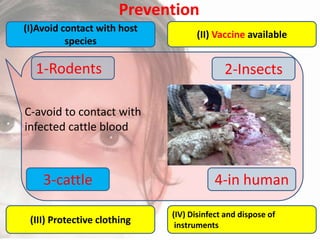
Prevention
(I)Avoid contact with host
species

1-Rodents

(II) Vaccine available

2-Insects

C-avoid to contact with
infected cattle blood

3-cattle
(III) Protective clothing

4-in human
(IV) Disinfect and dispose of
instruments
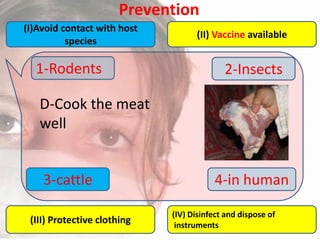
Prevention
(I)Avoid contact with host
species

1-Rodents

(II) Vaccine available

2-Insects

D-Cook the meat
well

3-cattle
(III) Protective clothing

4-in human
(IV) Disinfect and dispose of
instruments
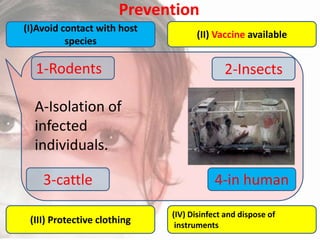
Prevention
(I)Avoid contact with host
species

1-Rodents

(II) Vaccine available

2-Insects

A-Isolation of
infected
individuals.
3-cattle
(III) Protective clothing

4-in human
(IV) Disinfect and dispose of
instruments
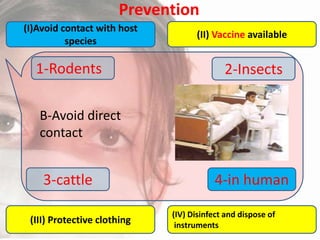
Prevention
(I)Avoid contact with host
species

1-Rodents

(II) Vaccine available

2-Insects

B-Avoid direct
contact

3-cattle
(III) Protective clothing

4-in human
(IV) Disinfect and dispose of
instruments
Prevention
(I)Avoid contact with host
species

1-Rodents

(II) Vaccine available

2-Insects

C-Avoid use the
material of the
infected individuals
3-cattle
(III) Protective clothing

4-in human
(IV) Disinfect and dispose of
instruments
Prevention
(I)Avoid contact with host
species

(II) Vaccine available

1-Rodents

2-Insects

3-cattle

4-in human

(III) Protective clothing

(IV) Disinfect and dispose of
instruments
Prevention
(I)Avoid contact with host
species

(II) Vaccine available

Yellow fever
Which have duration of:

(3 to 9 years)
(III) Protective clothing

(IV) Disinfect and dispose of
instruments
Prevention
(I)Avoid contact with host
species

(II) Vaccine available

Experimental vaccines under
study
Argentine HF
Rift Valley Fever
Dengue HF
(III) Protective clothing

(IV) Disinfect and dispose of
instruments
Prevention
(I)Avoid contact with host
species

(III) Protective clothing

(II) Vaccine available

(IV) Disinfect and dispose of
instruments
Prevention
(I)Avoid contact with host
species

(II) Vaccine available

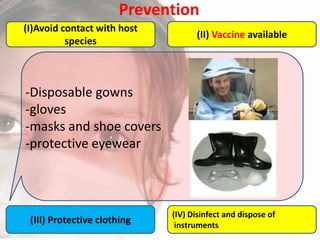
-Disposable gowns
-gloves
-masks and shoe covers
-protective eyewear

(III) Protective clothing

(IV) Disinfect and dispose of
instruments
Prevention
(I)Avoid contact with host
species

(III) Protective clothing

(II) Vaccine available

(IV) Disinfect and dispose of
instruments
Prevention
(I)Avoid contact with host
species

(II) Vaccine available

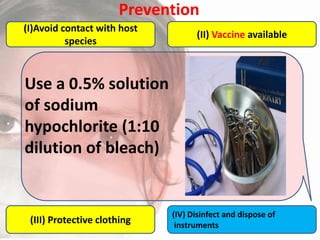
Use a 0.5% solution
of sodium
hypochlorite (1:10
dilution of bleach)

(III) Protective clothing

(IV) Disinfect and dispose of
instruments
Prevention
(I)Avoid contact with host
species

(III) Protective clothing

(II) Vaccine available

(IV) Disinfect and dispose of
instruments
Disease Control
• An ongoing operations aimed at reducing:
– The incidence of disease
– The duration of disease
– Complication of the disease
– The financial burden to the community

• It concentrates on primary and secondary
prevention
Hemorrhagic fever communti

Hemorrhagic fever communti

  • 2.
    Overview of seminar Introduction Aetiology Epidemiology. Denguehemorrhagic fever . Ebola fever . Crimean-Congo hemorrhagic fever . Yellow fever . Marburg hemorrhagic fever . Lassa fever . Rift valley hemorrhagic fever . Prevention and control.
  • 3.
    Definition:Haemorrhagic disease isterm with a very wide spectrum . It comprise the disease caused by organisms and Those due to the other causes (any cause other than organisms ). Here we are going to deal with infectious haemorrhagic disease , which are caused mainly by viruses and rarely by bacteria.
  • 4.
    The viral haemorrhagicfevers:Is a term refers to a group of illnesses caused by several distinct families of viruses that effect humans and non -humans primates.
  • 5.
    What is Viral HemorrhagicFever? • Severe multisystem syndrome • Damage to overall vascular system • Symptoms often accompanied by hemorrhage – Rarely life threatening in itself – Includes conjunctivitis, petechia, echymosis
  • 6.
    Classification Arenaviridae Bunyaviridae Filoviridae Flaviviridae Junin CrimeanCongoH.F. Ebola Kyasanur Forest Disease Machupo Hantavirus Marburg Omsk H.F. Sabia Rift Valley fever Guanarito Lassa Yellow Fever Dengue
  • 7.
    • Hemorrhagic Feversviruses . • RNA viruses covered in a lipid coating – Viruses are geographically restricted to areas where host species live – Humans are not natural reservoirs for these viruses . – With few noteworthy exception, there is no cure or established treatment .
  • 8.
    History :The termhemorrhagic fever was first used in the 1930s by Soviet and Japanese scientists .to describe an acute febrile disease encountered in eastern Siberia and northern Manchuria.
  • 9.
    This syndrome subsequentlyreported from Korea, Bulgaria, Hungary, European Russia and Northern Scandinavia under several labels including. epidemic hemorrhagic fever, hemorrhagic fever with renal syndrome and hemorrhagic fever nephrosonephritis (HNN).
  • 10.
    Since 1940s ,,,,,,, 1-Omskhemorrhagic fever occurs in Western Siberia. 2-KFD in Mysore state and India . 3-DHF in several large cities in southeast Asia . 4-AFHF in portions of central , eastern and southern Africa. 5-RVF in southern eastern Africa . 6-CrHF. 7-BHF. 8-LF. 9-AHF.
  • 11.
    Arenaviridae History • Firstisolated in 1933 • 1958: Junin virus - Argentina – First to cause hemorrhagic fever – Argentine hemorrhagic fever • 1963: Machupo virus – Bolivia – Bolivian hemorrhagic fever • 1969: Lassa virus – Nigeria – Lassa fever
  • 12.
    Bunyaviridae History • 1930:Rift Valley Fever – Kenya – Epizootic in sheep • 1940s: CCHF - Crimean peninsula – Hemorrhagic fever in agricultural workers • 1951: Hantavirus – Korea – Hemorrhagic fever in UN troops • 5 genera with over 350 viruses
  • 14.
    Filoviridae History • 1967:Marburg virus – European laboratory workers • 1976: Ebola virus – Ebola Zaire – Ebola Sudan • 1989 and 1992: Ebola Reston – USA and Italy – Imported macaques from Philippines • 1994: Ebola Côte d'Ivoire
  • 16.
  • 17.
    Flaviviridae History • 1648: Yellow Fever described • 17th–20th century – Yellow Fever and Dengue outbreaks • 1927: Yellow Fever virus isolated • 1943: Dengue virus isolated • 1947 – Omsk Hemorrhagic Fever virus isolated • 1957: Kyasanur Forest virus isolated
  • 18.
    Why do VHFsmake good Bioweapons? • • • • • • • Disseminate through aerosols Low infectious dose High morbidity and mortality Cause fear and panic in the public No effective vaccine Available and can be produced in large quantity Research on weaponization has been conducted
  • 19.
    Why do VHFsmake good Bioweapons? • • • • • • • Disseminate through aerosols Low infectious dose High morbidity and mortality Cause fear and panic in the public No effective vaccine Available and can be produced in large quantity Research on weaponization has been conducted
  • 20.
    VHF Agents as BiologicalWeapons • Outbreak of undifferentiated febrile illness 2-21 days following attack – Could include • Rash, hemorrhagic diathesis and shock • Diagnosis could be delayed – Unfamiliarity – Lack of diagnostic tests • Ribavirin treatment may be beneficial
  • 22.
  • 23.
    Major causes ofhaemorrhagi fever  1) 2) 3) 4) 5)  1) 2) 3) Arenaviridae family: Guanarito virus. Junin virus. Machupo virus. Lassa virus. Sabia virus. Bunyaviridae family: Nairo virus. Phlebo virus. Hantaan virus.  1) 2) 3)  1) 2) Flaviviridae family: Yellow fever virus. Dengue virus. Omsk H.f virus. Filoviridae family: Ebola virus. Marburg virus.
  • 25.
    Minor causes ofhaemorrhagic fever 1) 2) A. B. Rickettsia . Spirochaetes : Leptospira. Borrelia .
  • 26.
    most serious causesto haemorrhagic fever • • • • • • • 1- yellow fever virus. 2- rift valley virus. 3- Ebola virus. 4- Dengue virus. 5- Crimean congo virus. 6- Lassa virus. 7- Marburg virus.
  • 27.
    Yellow fever virus •Is member of the genus Flavivirus of Flaviviridae family • Is spherical virus and is 40 to 50 nm in diamter • Is positive sense single stranded RNA is approximately 11,000 nucleotides long and has single open reading frame encoding polyportein .
  • 28.
  • 29.
    Rift valley virus •Is member of genus phlebo virus of family bunyavirid • Is single-stranded RNA viruses , spherical in shape,and 90 to110 nm in diameter, with lipid envelope from which glycoprotein spikes protrude. • It can found in the host membrane system.
  • 31.
  • 32.
    Ebola virus • Ismember of the flioviridae family. • It is may appear in the shape of a shepherd's crook or in the shape of a "U" or a "6", and they may be coiled, toroid, or branched . • It is an alongated filamentous molecule, which can vary between 800 to 1000 nm in length and can reach up to 14000 nm long, with diameter of 80 nm. • Scientists have identified five types of Ebola virus. Three have been reported to cause disease in humans: Ebola-Zaire virus, Ebola-Sudan virus, and Ebola-Ivory Coast virus .
  • 34.
    Dengue virus • Ismember of flavivirus group in the family flaviridae. • Is spherical single stranded enveloped RNA virus,is 30 nm in diameter. • Which can grow in variety of mosquitoes and tissue culture.
  • 36.
    Crimean congo virus •Is belonging to the genus nariovirus of family bunyaviridae . • Is triple segmented ,single strand ,negative sense RNA . • The virions are spherical ,with 85 to 105 nm in daimeter.
  • 38.
    Lassa virus • Isbelonging to the genus Arenavirus , family Arenaviridae . • Is Double segmented, single stranded RNA virus. • The viral fragment may be in several distinct shapes (pleomorphic), and is between 80 to 150nm in diameter .
  • 40.
    Marburg virus • isa member of the Filoviridae family. • is an elongated filamentous molecule, highly variable in length, but typically around 1000 nm long with a uniform diameter of 80 nm . • may appear in the shape of a "6", a "U", or a circle, and it is contained within a lipid membrane . • Each virion contains one molecule of single stranded, negative sense viral genomic RNA .
  • 43.
    EPIDEMIOLOGY 1-Dengue hemorrhagic fever. 2-Ebola &Marburg hemorrhagic fever . 3-Crimean-Congo hemorrhagic fever . 4-Yellow fever . 5-Lassa fever . 6-Rift valley hemorrhagic fever .
  • 44.
  • 45.
  • 46.
    Dengue Fever • Eachyear, an (500,000) cases of dengue hemorrhagic fever occur worldwide, with (22,000) deaths (mainly in children). • In the last 50 years, the incidence of dengue has increased 30-fold worldwide. • In Sudan ,there is (168) cases of dengue fever arise to a hospital Port Sudan during the period from November to February, with (6) cases of deaths .
  • 47.
    • Agent: Dengue virus. •Host: - Definitive host: Aedes aegypti. Aedes albopictus. - Intermediate hosts: Humans and non-human primates. • Vectors: mosquito-born favivirus.
  • 48.
  • 49.
    • Person: Both sexes- Child more common affected. • Period: Biphasic (May- November) peak at June -August. • Place: Tropical and Subtropical Worldwide.
  • 51.
    Ebola and MarburgFEVER Year Location Sudan Reported Cases, No. 284 Deaths, No. (%) 151 (53) 1976 1979 Sudan 34 22 (65) 2004 Sudan 17 17 (41) 1976 Englandb 1 0 (0) 2000-2001 Uganda 425 224 (53) 761 414 (54.4) Total
  • 52.
    • Agent: Ebola virus. Marburg fever. • Host and vector: -research scientists continue to search for the exact animal host.
  • 53.
    • Person: Adult moreexposure both sexes. • Period: DRY SEASONS. • Place: Sub-Saharan Africa.
  • 55.
    Crimean Congo fever •Agent: Criminal Congo virus. • Host: - Definitive host: Adult Tics. - Intermediate host: human • Vectors: Tics of genus Hyalomma.
  • 57.
    • Person: All ages-man more exposed • Period: June- August • Place: Africa – East china.
  • 59.
    Yellow fever • Thecase-fatality rate of yellow fever in Africa approximates 20%. • The Federal Ministry of Health reported to WHO an outbreak of yellow fever in the South Kordofan State. In16 November 2005, 404 cases and 118 deaths in ( Abu Gebiha , Rashad , Dilling , Kadugli , Talodi ).
  • 60.
    • Agent: Yellow fevervirus. • Host: -Definitive host: Aedes aegypti. -Intermediate host: Human. • Vectors: Wild mosquitoes ( Aedes aegypti ,Haemogogus).
  • 61.
  • 62.
    • Person: Both sexesaffected, Adult more exposed (and Infants and children are at highest risk). • Period: Rainy season. • Place: Africa-south America .
  • 65.
    Lassa fever. • Lassafever occur yearly (300, 000 )– (500 ,000) people and (5000) deaths among those in the West African region. • Case-fatality rate of 1% to 15% among patients treated in hospitals.
  • 66.
    • Agent: Lassa virus. •Host: - Definitive host: rodent - ( Mastomys natalensis ). - Intermediate host: Human Vector: Not proven yet.
  • 68.
    • Person: All agesand Both sexes. • Period: No mark peak. • Place: west Africa.
  • 70.
    Rift valley Fever. •Until 14 November 2007,WHO reported (329) human cases of Rift Valley Fever in Sudan has led to (96) deaths and that in the states of White Nile, Sennar and Gezira. • The cases reported in Khartoum State is not endemic in the state cases, but cases are coming from one of the other affected States.
  • 71.
    • Countries withendemic disease and outbreaks of RVF:• South Africa. • Sudan…. • Zambia. • Kenya. • Egypt and Madagascar. • Saudi Arabia and Yemen.
  • 72.
    • Agent: Rift valleyvirus. • Host: - Definitive host: Aedes - culex pipiens. -Intermediate host: Human , sheep , cattle . • Vectors: Arthropod-blood born.
  • 73.
  • 74.
    • Person: All agesand Both sexes (man more affect). • Period: In late summer. • Place: -sub-Saharan African and Madagascar - Egypt.
  • 77.
  • 79.
    Contents 1. What isdengue fever 2. Dengue virus 3.Symptoms of dengue fever 4.Characteristics of the Aedes mosquito 5.Life cycle of the Aedes mosquito 6.How the Aedes mosquito transmit diseases 7.What is the lab diagnosis 8.How to prevent the spread of dengue fever
  • 80.
    What is denguefever? Dengue Fever is an illness caused by infection with a virus transmitted by the Aedes mosquito.
  • 81.
    Dengue Virus 1.Causes dengue and dengue hemorrhagic fever 2.It is an arbovirus 3.Transmitted by mosquitoes Aedes aegypti
  • 82.
    Symptoms of DengueFever Example of a skin rash due to dengue fever
  • 83.
    Do you know… DengueFever (DF) and Dengue Haemorrhagic Fever (DHF) are the most common mosquito-borne viral disease in the world. It can be fatal.
  • 84.
    The most commonepidemic vector of dengue in the world is the Aedes aegypti mosquito. It can be identified by : the white bands or scale patterns on its legs and thorax.
  • 85.
    Characteristics of the AedesMosquito One distinct physical feature – black and white stripes on its body and legs. Bites during the day. Lays its eggs in clean, stagnant water. Close-up of an Aedes mosquito
  • 86.
    Do you know… Onlythe female Aedes mosquito feeds on blood. This is because they need the protein found in blood to produce eggs. Male mosquitoes feed only on plant nectar. On average, a female Aedes mosquito can lay about 300 eggs during her life span of 14 to 21 days.
  • 87.
    Life cycle ofthe Aedes Mosquito 1-2 days Larvae Pupae 4-5 days Stagnant water Eggs 2-3 days
  • 88.
    How Do AedesMosquitoes Transmit Diseases... Mosquito bites and sucks blood containing the virus from an infected person. And passes the virus to healthy people when it bites them. Virus is carried in its body.
  • 89.
    Pathogensis(mechanism) 1.The virus isinoculated into humans with the mosquito saliva. 2.The virus localizes and replicates in various target organs, for example, local lymph nodes and the liver. 3.The virus is then released from these tissues and spreads through the blood to infect white blood cells and other lymphatic tissues. 4.The virus is then released from these tissues and circulates in the blood.
  • 90.
    5.The mosquito ingests blood containing thevirus. 6.The virus replicates in the mosquito midgut, the ovaries, nerve tissue and fat body. It then escapes into the body cavity, and later infects the salivary glands. 7.The virus replicates in the salivary glands and when the mosquito bites another human, the cycle continues.
  • 91.
  • 92.
    TREATMENT • The areno specfic treatment for dengue fever • Supportive treatment • 1-rehydration • 2-blood transfusion • 3-admission in present of warning signs • 4-avoidence of NGT IM injection NSAID
  • 93.
    • 5-pracatamol forfever • 6-Analgesic for headache
  • 94.
    Prevent Aedes fromBreeding! Remove ALL sources of stagnant water. Deny the Aedes mosquito of any chance to breed.
  • 95.
    Do the 10-MinuteMozzie Wipe-out everyday. Change water in vases on alternate days.
  • 96.
    Do the 10-MinuteMozzie Wipe-out everyday. Remove water from flowerpot plates on alternate days.
  • 97.
    Do the 10-MinuteMozzie Wipe-out everyday. Turn over all pails and water storage containers.
  • 98.
    Do the 10-MinuteMozzie Wipe-out everyday. Clear blockages and put Bti insecticide in roof gutters monthly.
  • 99.
    Unwanted items Do notlitter. Rubbish such as cups and bottles can collect rain water and breed mosquitoes.
  • 100.
    Spread the dengueprevention message to others… Let your family, friends and neighbours know about the dangers of breeding Mozzies!!
  • 102.
  • 103.
    Ebola • Ebola hemorrhagicfever is a severe and often deadly illness that can occur in humans and primates (monkeys, gorillas).
  • 104.
    Cause Ebola hemorrhagic feveris caused by a virus belonging to the family called Filoviridae. Scientists have identified five types of Ebola virus. Three have been reported to cause disease in humans: EbolaZaire virus, Ebola-Sudan virus, and Ebola-Ivory Coast virus. The human disease has so far been limited to parts of Africa. The Reston type of Ebola virus has recently been found in the Philippines.
  • 105.
    MODE OF TRANSMTION -Thedisease can be passed to humans from infected animals and animal materials. - Ebola can also be spread between humans by close contact with infected body fluids or through infected needles in the hospital.
  • 106.
    PATHOGENESIS *The specific mechanismof pathogenicity is poorly understood due to difficulty obtaining samples and study the disease in areas of outbreaks.
  • 107.
    • Endothelial cells,mononuclear phagocytes, and hepatocytes are the main targets of infection. After infection, in a secreted glycoprotein (sGP) the Ebola virus glycoprotein (GP) is synthesized. Ebola replication overwhelms protein synthesis of infected cells. The GP forms a trimetric complex, which binds the virus to the endothelial cells lining the interior surface of blood vessels.
  • 108.
    • The sGPforms a dimetric complex which interferes with the signaling of neutrophils, , which allows the virus to evade the immune system by inhibiting early steps of neutrophil activation. These white blood cells also serve as carriers to transport the virus throughout the entire body to places such as the lymph nodes, liver, lungs, and spleen.] The presence of viral particles and cell damage resulting from causes the release of cytokines (specificallyTNF , IL 6, IL 8, etc.), which are the signaling molecules for fever and inflammation.
  • 109.
    • The CYTOPATHICeffect, from infection in the endothelial cells, results in a loss of vascular integrity. This loss in vascular integrity is furthered with synthesis of GP, which reduces specific integrins responsible for cell adhesion to the inter-cellular structure, and damage to the liver, which leads to coagulopathy.
  • 112.
    -During the incubationperiod, which can last about one week after infection, symptoms include: -Arthritis. -Chills. -Fatigue. -Headache -Nausea. -Vomiting. -Backache. -Diarrhea. -Fever. -Malaise. - Sore throat

  • 113.
    Late symptoms include: *Bleedingfrom eyes, ears, and nose *Gastrointestinal bleeding. *Eye swelling &conjunctivitis. *Genital swelling (labia and scrotum). *Hemorrhagic skin rash. *Depression
  • 115.
    COMPLICATION • DIC. • Perfusebleeding. • Shock. • Survivors may have unusual problems, such as hair loss and sensory change
  • 116.
  • 117.
    *Tests used todiagnose Ebola fever include: 1-CBC. -Thrombocytopenia. 2-IFA. 3-ELISA. 4-Detection of specific Abs (IgM).
  • 118.
    Treatment *Supportive treatment: -ICU. - CorrectThe body fluids & Electrolytes. - Give Analgesics.
  • 119.
    Prognosis *Patients usually diefrom low blood pressure (shock) rather than from blood loss. *Completely bad prognosis.
  • 122.
    • The diseasewas first characterized in the Crimea • Then occurs in the Central Asia, and regions of AFRICA. • (CCHF) is caused by:• a tick-borne virus (Nairovirus) in the family Bunyaviridae .
  • 123.
    Enveloped, spherical. Diameterfrom 80 to 120nmNairovirus Nairovirus
  • 124.
  • 125.
    Route of transmition •xodid (hard) ticks, especially those of the genus, Hyalomma, are both a reservoir and a vector for the CCHF virus. Numerous wild and domestic animals, such as cattle, goats, sheep and hares, serve as amplifying hosts for the virus. • Transmission :• Zoonotic • human to human • Documented spread of CCHF
  • 127.
  • 128.
    Risk factor • • • • Animal herders livestockworkers slaughter houses in endemic areas Healthcare workers in endemic areas
  • 129.
  • 130.
    Cilinical features • (a)Incubation:• 1-3 days after ticks bite • 5-6 days after contact to blood and tissue Of infected livestock or human patient
  • 131.
    • (b) prehemorrhagic phase(3-6 days):• Sudden onset of fever(39-41c’) • sever headache • Dizziness • hyperemia of face • vomiting • abdominal pain • low blood pressure • neuropsychological changes:mood and feeling of confusion aggression
  • 132.
    (c) hemorrhagic phase(12-14days):.Ecchymoses .intestinalhamorrhagis . epistaxis . puncture sites . hematemesis . melena . hematuria . leucopenia .thrombocytopenia . Hepatosplenomegaly
  • 133.
    Lab diagnosis • Laboratorytests that are used to diagnose CCHF include:• antigen-capture enzyme-linked ELISA • RT-PCR • virus isolation attempts • detection of antibody by ELISA (IgG and IgM). • Immunohistochemical staining can also show evidence of viral antigen in formalin-fixed tissues.
  • 134.
    treatment .primarily supportive. Careshould include careful attention to fluid balance and correction of electrolyte abnormalities, • oxygenation and hemodynamic support • appropriate treatment of secondary infections. • The virus is sensitive in vitro to the antiviral drug ribavirin.
  • 135.
    Complications • • • • complications may include:Organicfailure intraabdominal abscess acute cholecystitis
  • 137.
  • 138.
    Definition:•Yellow fever isan acute viral hemorrhagic disease transmitted by infected mosquitoes. The "yellow" in the name refers to the jaundice that affects some patients. •The virus is endemic in tropical areas of Africa and Latin America.
  • 139.
    •The number ofyellow fever cases has increased over the past two decades due to declining population immunity to infection, deforestation, urbanization, population movements and climate change. •There is no cure for yellow fever. Treatment is symptomatic.
  • 140.
    Morphology of thevirus . RNA virus . Spherical. . Envelope with spikes. envelope Lipoprotein. spikes glycoprotein. . Spherical capsid .
  • 142.
    Transmission The yellow fevervirus is an arbovirus of the flavivirus genus. The mosquito is the primary vector. It carries the virus from one host to another, primarily between monkeys, from monkeys to humans, and from person to person.
  • 143.
    • Several differentspecies of the Aedes and haemogogus mosquitoes transmit the virus. • The mosquitoes either breed around houses (domestic), in the jungle (wild) or in both habitats (semi-domestic).
  • 145.
  • 146.
    There are threetypes of transmission • cycles:- 1 Sylvatic yellow fever: •Take place in tropical rainforests. •Wild mosquitoes ………bite monkeys ……infected mosquitoes ……….bite human entering the forest …..resulting in yellow fever. •The majority of infection occur in young men working in the forest.
  • 147.
    •2 Intermediate yellowfever: •Take place in humid and semi-humid parts of Africa. •Semi –domestic mosquitoes ……bite human and monkey…..resulting in yellow fever …..small out break. •Increased contact between people and infected mesquite lead to transmission. • 3 Urban yellow fever: • Large epidemics occur in populated area with a high number of non-immune people and aedes mosquitoes.
  • 148.
    Pathogenesis •After transmission ofthe virus from a mosquito the viruses replicate in the lymph nodes and infect dendritic cells in particular. From there they reach the liver and infect hepatocytes (probably indirectly via Kupffer cells), which leads to eosinophilic degradation of these cells and to the release of cytokines. Necrotic masses (Councilman bodies) appear in the cytoplasm of hepatocytes.
  • 149.
    • When thedisease takes a deadly course, a cardiovascular shock and multi organ failure with strongly increased cytokine levels.
  • 151.
    Signs and symptoms •The incubation period (3—6days). • Acute phase:• Fever. • Muscle pain. • Backache. • Headache. • Loss of appetite. • Nausea and vomiting. • Most patient improve and their symptoms disappear after(3---4)days.
  • 152.
    toxic phase:• Occurredwithin 24 hours of the initial remission with: • High fever. • jaundice • abdominal pain with vomiting. • Bleeding from the mouth, nose, eyes. blood in the vomits and faeces. • Kidney function deteriorates. • Half of the patients who enter the toxic phase die within 10 to 14 days, the rest recover without significant organ damage.
  • 153.
    Lab diagnosis virus isolation: - from blood or liver either :- Intra cerebrally in mice. -Tissue :- culture of chick embryo. 2 Serology :- the best is neutralization test:Plague reduction . if the patient have anti bodies . In his serum ,the virus will not produce plague in the serum . 1 3 ELISA : IgM 4 Histology :- is the patient dies 5 P.C.R
  • 154.
    Treatment There is nospecific treatment for yellow fever, only supportive care to treat dehydration and fever. Associated bacterial infections can be treated with antibiotics. Supportive care may improve outcomes for seriously ill patients, but it is rarely available in poorer areas.
  • 156.
  • 157.
    Definition *Acute infectious ofVHF which effect both human and non human( primates) *Marburg virus are bacilliform in morphology and can be pleomorphic when grown in tissue culture *The culture as either long filamentous or branching
  • 158.
    *Marburg virus isenveloped and single strand *non segmental negative sense RNA *the reservoir for Marburg virus is still un know but can be found in bat ,monkey ,spider and ticks
  • 160.
    Mode of Transmission: 1zoonotic Avectors BWasteproducts 2Person to person Afluid excretion BSexual transmission 3Nosocomial infection A Reuse of needle BExposure to infection tissue CHospital waste 4Aerosol has been observed in primates
  • 161.
    PATHOGENESIS: Virion are containsurface spikes (large glycoprotein) Attachment structure in binding cell receptor molecules in the infection process Mediated entry into susceptible cell lead to systemic inflammatory response(tumor necrosis factor) Injury to microvasculature and endothelial permeability lead to coagulation effect (DIC) impairment adaptive immunity Tissue damage and shock
  • 162.
    Risk factor: 1Travel toAfrica 2Contact with animals 3Prepare people for burial . Still contagious .
  • 163.
    Clinical feature: ICP usually5-7days but can rang form 3-10 days *mortality rate around 25%-30% * *Early signs and symptoms include: -Sudden onset Fever - Severe headache -Joint and muscle aches -Chills -Weakness -Maculopapular rash
  • 164.
    late symptoms becomeincreasingly severe and may Uveitis include: Hearing loss ,psychosis pericarditis blindness bleeding *Ecchomyoses *Petechial hemorrhagic Chest pain cough orchitis Rectal bleeding Vomiting nausea diarrhea stomach pain hepatitis
  • 165.
    complication: -Multiple organ failure -Severebleeding -Jaundice -Delirium -Seizures -Coma -Shock
  • 166.
    *Differential diagnosis: shigellosis typhoid malaria leptospirosis *Investigation: - ELISA -reversetranscriptase polymerase chain reaction (PCR) -can detect specific genes or the virus or antibodies to them
  • 167.
    -CBC -liver function test Management: *Nospecific antiviral therapy exists *isolate patient *notify local and state community department *Supportive hospital care
  • 169.
  • 170.
    Lassa fever (LF)is a severe hemorrhagic fever (HF) caused by the arenavirus( Lassa viru), it causes an acute hemorrhagic disease and sometimes it may be fatal in humans and nonhuman primates.
  • 171.
    Mode of transmission: • Lassa virus is zoonotic Which is can be by tow ways :
  • 172.
  • 173.
    The virus isshed in rodent excreta (urine, feces and saliva ), which could be ingested by human or can be aerosolized.
  • 174.
    by catching andrepapering it as a meal or by host bite
  • 175.
    Human to humanby: Direct contact with blood , tissues, secretions or excretion s of infected humans
  • 176.
    Needle stick orcut Inhalation of aerosolized virus
  • 177.
    The virus isexcreted in semen for three months so it STD and it excreted in urine for three to nine weeks.
  • 178.
    Pathogenesis pathologic descriptions ofLassa virus in human are limited to a few cases . common gross finding at postmortem examination include ; _ petechial hemorrhages in separate parts of the body
  • 179.
    pleural effusion, pericardialeffusion and ascites microscopically : Congestion and variable degree of necrosis in all organ systems hepatocellular necrosis s with cytoplasmic eosinophilia inflammatory cell in necrotic area
  • 180.
    pneumonitis , myocarditis,acute renal tubular necrosis is not part of pathogenesis of lassa fever
  • 181.
  • 182.
    Symptoms • Incubation periodof 6-21 days • 80% of human infections are asyptomatic the pt notes the insidious onset of : • Onset is slow: fever, weakness, & malaise
  • 183.
    • Few days:headache, pharyngitis, muscle pain, retrostinal & abdominal pain, nausea, vomiting, diarrhea, cough, & proteinuria – Neurological problems: tremors, encephalitis, hair loss, gait disturbance, deafness • 95% deathrate among pregnant women & spontaneous abortion
  • 184.
    • present withclassic symptoms of bleeding ( mucoprpular bleeding )
  • 185.
  • 187.
    Sensorineural Hearing Deficitin Lassa Fever • Typically appears during early convalescence • Not related to severity of acute illness • Occurs in one-third of cases • May be bilateral or unilateral • May persist for life in up to one-third of those affected
  • 188.
    Clinically, Lassa feverinfections are difficult to distinguish from other viral hemorrhagic fevers such as Ebola and Marburg, and from more common febrile illnesses such as malaria
  • 189.
    Lassa fever inpregnancy and pediatric
  • 190.
    lSV in pregnantwoman a significantly elevated risk for both the mother and the fetus ,maternal mortality elevated during 3rd trimester fetal death approaches 100%
  • 191.
    pediatric lassa feveris less well described but produce a spectrum of disease “swollen baby syndrome “ comprised of anasarca , abd. distention and bleeding.
  • 192.
    Diagnosis: There is arange of laboratory investigations that are performed to diagnose the disease and assess its course and complications
  • 193.
    • . ELISAtest for antigen and IgM antibodies gives 88% sensitivity and 90% specificity for the presence of the infection. Other laboratory findings in Lassa fever include lymphopenia (low white blood cell count), thrombocytopenia (low platelets), and elevated aspartate aminotransferase (AST) levels in the blood
  • 194.
    TREATMENT • 1-supportive treatment •2-virus specific therapy Lassa fever can be treated with the ribavirin
  • 196.
  • 197.
    • Rift Valleyfever (RVF) is An acute febrile viral zoonosis that affects human and livestock (such as cattle, buffalo, sheep, goats, and camels) • Infection can cause severe disease in both animals and humans. The disease also results in significant economic losses due to death and abortion among RVF-infected livestock… • Currently RVF is one of the notifiable group A of Exotic Diseases.
  • 198.
    Route of transmission 1-Bloodfeeding arthropod:(Mosquitoes) • Aedes • Anopheles • Culex • Mansonia
  • 199.
    • 2-Contact withblood or other body fluids of infected animals. • 3-Consumption of infected milk. • 4-Airborne transmission. *Note No person-to-person transmission.
  • 200.
  • 202.
    Clinical features (I)-In animals:-RVF has been found to infect many species of animals, however the most commonly affected are sheep, goats and cattle….
  • 203.
    Sheep and Goats •Incubation period: less than 3 days – Asymptomatic – Foul diarrhea – mucopurulent nasal discharge – High rate of abortion (5-100%) Any stage of gestation – Acute death (20-30%)
  • 204.
    Lambs • Incubation period:12-36 hrs • High fever (105.8 oF) • • • • restlessness Anorexia Death Mortality rate: • Less than 1 week old:90% • over 2 weeks old:20%
  • 205.
    Cattle – Incubation period: 3 days. – Fever. – weakness. – Anorexia. – fetid diarrhea. – excessive salivation – Death - Mortality 10% – Abortion can be up to 100%
  • 207.
    Clinical features (II)In human:Incubationperiod 2-6 days -Asymptomatic or flu like illness (Fever, headache, myalgia, nausea, vomiting) -Abdominal pain _Photophobia *Recovery in 4-7 days
  • 208.
    complication *RVF associated with3 main complications:(i)-Encephalitis:(1 week after febrile phase Confusion, vertigo ,stupor, coma). (ii)-Optic neuropathy:(7-20 days decrease visual acuity, retinitis, permanent loss of vision). (iii) )- Hemorrhage (Epistaxis , Hematemsis , Melena , Ecchymoses)DIC, Shock.
  • 210.
    Diagnosis • Antibody detection: Serologicaltest: ELISA EIA virus detection: » PCR – Tissue culture – (the laboratory should be notified that specimens originate from HF patient !!so appropriate biologic safety measures can be taken)
  • 211.
    Management • General SupportiveMeasures:* Isolation in negative airway pressure room. * Blood transfusion. *Antiviral drugs( Ribavirin . Interferon). * Immune Modulators. * Introduction to ICU if indicated.
  • 212.
    • Hospital dischargeafter:*Improvement in general status. *Decline in liver symptoms. *Recovery from DIC. • Follow-up in ophthalmology and medical clinics for 6 weeks .
  • 213.
    *Safe burial practicefor dead cases
  • 215.
  • 216.
    That mean anyactivity which reduces morbidity and mortality of diseases .
  • 217.
    Levels of Prevention: PrimaryLevel Secondary Level Tertiary Level education, bed nets, Vaccines
  • 218.
    Levels of Prevention: PrimaryLevel Secondary Level Tertiary Level Early diagnosis and adequate treatment
  • 219.
    Levels of Prevention: PrimaryLevel Secondary Level Tertiary Level Medical, Occupational, Social and Psychological rehabilitation
  • 220.
    Prevention (I)Avoid contact withhost species (III) Protective clothing (II) Vaccine available (IV) Disinfect and dispose of instruments
  • 221.
    Prevention (I)Avoid contact withhost species (II) Vaccine available 1-Rodents 2-Insects 3-cattle 4-in human (III) Protective clothing (IV) Disinfect and dispose of instruments
  • 222.
    Prevention (I)Avoid contact withhost species 1-Rodents (II) Vaccine available 2-Insects A-Control rodent populations 3-cattle (III) Protective clothing 4-in human (IV) Disinfect and dispose of instruments
  • 223.
    Prevention (I)Avoid contact withhost species 1-Rodents (II) Vaccine available 2-Insects B-prevent the rodents from enteringor living in human populations 3-cattle (III) Protective clothing 4-in human (IV) Disinfect and dispose of instruments
  • 224.
    Prevention (I)Avoid contact withhost species 1-Rodents (II) Vaccine available 2-Insects C-Safe clean up of rodent nests and droppings 3-cattle (III) Protective clothing 4-in human (IV) Disinfect and dispose of instruments
  • 225.
    Prevention (I)Avoid contact withhost species 1-Rodents (II) Vaccine available 2-Insects A-Use insect repellents 3-cattle (III) Protective clothing 4-in human (IV) Disinfect and dispose of instruments
  • 226.
    Prevention (I)Avoid contact withhost species 1-Rodents (II) Vaccine available 2-Insects B-Proper clothing and bed nets 3-cattle (III) Protective clothing 4-in human (IV) Disinfect and dispose of instruments
  • 227.
    Prevention (I)Avoid contact withhost species 1-Rodents (II) Vaccine available 2-Insects C-Window screens and othe barriers to insects 3-cattle (III) Protective clothing 4-in human (IV) Disinfect and dispose of instruments
  • 228.
    Prevention (I)Avoid contact withhost species 1-Rodents (II) Vaccine available 2-Insects D-Use anti mosquito lotion 3-cattle (III) Protective clothing 4-in human (IV) Disinfect and dispose of instruments
  • 229.
    Prevention (I)Avoid contact withhost species 1-Rodents (II) Vaccine available 2-Insects E-Avoid the replication of mosquito in there different outburst . 3-cattle (III) Protective clothing 4-in human (IV) Disinfect and dispose of instruments
  • 230.
    Prevention (I)Avoid contact withhost species 1-Rodents (II) Vaccine available 2-Insects A-Disposal of infected cattle (Burning & buried) 3-cattle (III) Protective clothing 4-in human (IV) Disinfect and dispose of instruments
  • 231.
    Prevention (I)Avoid contact withhost species 1-Rodents (II) Vaccine available 2-Insects B-Vaccination of cattle 3-cattle (III) Protective clothing 4-in human (IV) Disinfect and dispose of instruments
  • 232.
    Prevention (I)Avoid contact withhost species 1-Rodents (II) Vaccine available 2-Insects C-avoid to contact with infected cattle blood 3-cattle (III) Protective clothing 4-in human (IV) Disinfect and dispose of instruments
  • 233.
    Prevention (I)Avoid contact withhost species 1-Rodents (II) Vaccine available 2-Insects D-Cook the meat well 3-cattle (III) Protective clothing 4-in human (IV) Disinfect and dispose of instruments
  • 234.
    Prevention (I)Avoid contact withhost species 1-Rodents (II) Vaccine available 2-Insects A-Isolation of infected individuals. 3-cattle (III) Protective clothing 4-in human (IV) Disinfect and dispose of instruments
  • 235.
    Prevention (I)Avoid contact withhost species 1-Rodents (II) Vaccine available 2-Insects B-Avoid direct contact 3-cattle (III) Protective clothing 4-in human (IV) Disinfect and dispose of instruments
  • 236.
    Prevention (I)Avoid contact withhost species 1-Rodents (II) Vaccine available 2-Insects C-Avoid use the material of the infected individuals 3-cattle (III) Protective clothing 4-in human (IV) Disinfect and dispose of instruments
  • 237.
    Prevention (I)Avoid contact withhost species (II) Vaccine available 1-Rodents 2-Insects 3-cattle 4-in human (III) Protective clothing (IV) Disinfect and dispose of instruments
  • 238.
    Prevention (I)Avoid contact withhost species (II) Vaccine available Yellow fever Which have duration of: (3 to 9 years) (III) Protective clothing (IV) Disinfect and dispose of instruments
  • 239.
    Prevention (I)Avoid contact withhost species (II) Vaccine available Experimental vaccines under study Argentine HF Rift Valley Fever Dengue HF (III) Protective clothing (IV) Disinfect and dispose of instruments
  • 240.
    Prevention (I)Avoid contact withhost species (III) Protective clothing (II) Vaccine available (IV) Disinfect and dispose of instruments
  • 241.
    Prevention (I)Avoid contact withhost species (II) Vaccine available -Disposable gowns -gloves -masks and shoe covers -protective eyewear (III) Protective clothing (IV) Disinfect and dispose of instruments
  • 242.
    Prevention (I)Avoid contact withhost species (III) Protective clothing (II) Vaccine available (IV) Disinfect and dispose of instruments
  • 243.
    Prevention (I)Avoid contact withhost species (II) Vaccine available Use a 0.5% solution of sodium hypochlorite (1:10 dilution of bleach) (III) Protective clothing (IV) Disinfect and dispose of instruments
  • 244.
    Prevention (I)Avoid contact withhost species (III) Protective clothing (II) Vaccine available (IV) Disinfect and dispose of instruments
  • 245.
    Disease Control • Anongoing operations aimed at reducing: – The incidence of disease – The duration of disease – Complication of the disease – The financial burden to the community • It concentrates on primary and secondary prevention