Floral Evocation
When to flower?
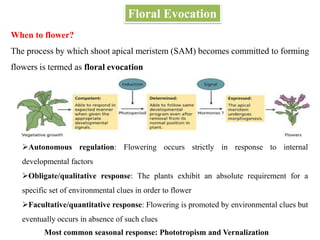
The process by which shoot apical meristem (SAM) becomes committed to forming
flowers is termed as floral evocation
Autonomous regulation: Flowering occurs strictly in response to internal
developmental factors
Obligate/qualitative response: The plants exhibit an absolute requirement for a
specific set of environmental clues in order to flower
Facultative/quantitative response: Flowering is promoted by environmental clues but
eventually occurs in absence of such clues
Most common seasonal response: Phototropism and Vernalization
Regulation of phase change in Arabidopsis by microRNAs
Physiology of Flowering
Circadian Rhythm: Physiological
responses coupled to a specific time
point of the endogenous oscillator;
responses occurs at a particular time of
the day
Plants sense changes in day length as a
reliable seasonal cue to regulate
important developmental transitions
such as flowering.
Photoperiodic flowering mechanisms
can be divided into three parts:
Light input
Circadian clock
Output
Light information is integrated into
innate photoperiodic timing
mechanisms to induce genes that
trigger flowering
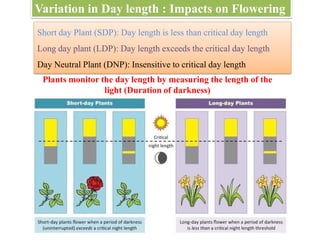
Short day Plant (SDP): Day length is less than critical day length
Long day plant (LDP): Day length exceeds the critical day length
Day Neutral Plant (DNP): Insensitive to critical day length
Variation in Day length : Impacts on Flowering
Plants monitor the day length by measuring the length of the
light (Duration of darkness)
Signal perception and integration
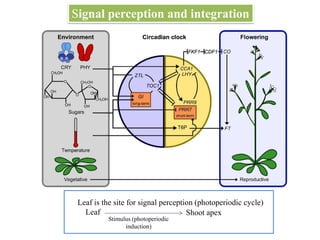
Leaf is the site for signal perception (photoperiodic cycle)
Leaf Shoot apex
Stimulus (photoperiodic
induction)
CoincidenceModel of flowering
Multiple factors regulate flowering in Arabidopsis
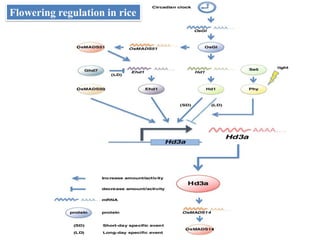
Flowering regulation in rice
ABCE Model of flowering
Higher-order MADS domain complexes likely interact with transcriptional cofactors and
chromatin remodelers to regulate target gene expression. The complexes are predicted to
induce short-range DNA looping by binding adjacent CArG box sequences (black
rectangles) present within cis-regulatory elements
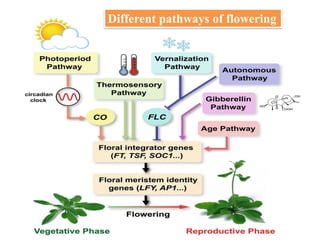
Different pathways of flowering
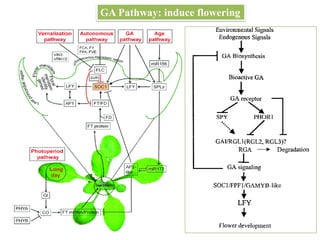
GA Pathway: induce flowering
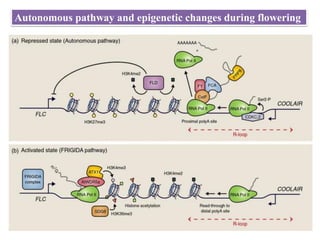
Autonomous pathway and epigenetic changes during flowering
Vernalization and flowering regulation
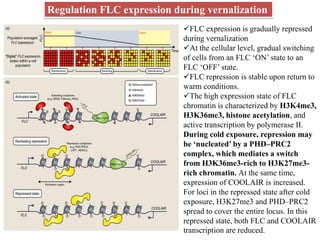
FLC expression is gradually repressed
during vernalization
At the cellular level, gradual switching
of cells from an FLC ‘ON’ state to an
FLC ‘OFF’ state.
FLC repression is stable upon return to
warm conditions.
The high expression state of FLC
chromatin is characterized by H3K4me3,
H3K36me3, histone acetylation, and
active transcription by polymerase II.
During cold exposure, repression may
be ‘nucleated’ by a PHD–PRC2
complex, which mediates a switch
from H3K36me3-rich to H3K27me3-
rich chromatin. At the same time,
expression of COOLAIR is increased.
For loci in the repressed state after cold
exposure, H3K27me3 and PHD–PRC2
spread to cover the entire locus. In this
repressed state, both FLC and COOLAIR
transcription are reduced.
Regulation FLC expression during vernalization
a) Terminator exchange (TEX) lines have the
COOLAIR promoter replaced with the
RUBISCO (RBCS) terminator. FLC-TEX is
not transcriptionally repressed as rapidly as the
control (FLC). While H3K27me3
accumulation at the nucleation region of FLC
appears unaffected in FLC-TEX, H3K36me3
is not removed from FLC chromatin during
cold exposure.
(b) Nucleation of H3K27me3 at FLC during cold
exposure requires a PHD–PRC2 complex
containing VIN3 and VRN5. COOLAIR does
not affect H3K27me3 nucleation, but may act
to stabilize an H3K36me3 demethylase at the
nucleation region
Role of COOLAIR in vernalization

Flowering

  • 1.
    Floral Evocation When toflower? The process by which shoot apical meristem (SAM) becomes committed to forming flowers is termed as floral evocation Autonomous regulation: Flowering occurs strictly in response to internal developmental factors Obligate/qualitative response: The plants exhibit an absolute requirement for a specific set of environmental clues in order to flower Facultative/quantitative response: Flowering is promoted by environmental clues but eventually occurs in absence of such clues Most common seasonal response: Phototropism and Vernalization
  • 2.
    Regulation of phasechange in Arabidopsis by microRNAs
  • 3.
    Physiology of Flowering CircadianRhythm: Physiological responses coupled to a specific time point of the endogenous oscillator; responses occurs at a particular time of the day Plants sense changes in day length as a reliable seasonal cue to regulate important developmental transitions such as flowering. Photoperiodic flowering mechanisms can be divided into three parts: Light input Circadian clock Output Light information is integrated into innate photoperiodic timing mechanisms to induce genes that trigger flowering
  • 4.
    Short day Plant(SDP): Day length is less than critical day length Long day plant (LDP): Day length exceeds the critical day length Day Neutral Plant (DNP): Insensitive to critical day length Variation in Day length : Impacts on Flowering Plants monitor the day length by measuring the length of the light (Duration of darkness)
  • 5.
    Signal perception andintegration Leaf is the site for signal perception (photoperiodic cycle) Leaf Shoot apex Stimulus (photoperiodic induction)
  • 6.
  • 7.
    Multiple factors regulateflowering in Arabidopsis
  • 8.
  • 9.
    ABCE Model offlowering Higher-order MADS domain complexes likely interact with transcriptional cofactors and chromatin remodelers to regulate target gene expression. The complexes are predicted to induce short-range DNA looping by binding adjacent CArG box sequences (black rectangles) present within cis-regulatory elements
  • 10.
  • 11.
  • 12.
    Autonomous pathway andepigenetic changes during flowering
  • 13.
  • 14.
    FLC expression isgradually repressed during vernalization At the cellular level, gradual switching of cells from an FLC ‘ON’ state to an FLC ‘OFF’ state. FLC repression is stable upon return to warm conditions. The high expression state of FLC chromatin is characterized by H3K4me3, H3K36me3, histone acetylation, and active transcription by polymerase II. During cold exposure, repression may be ‘nucleated’ by a PHD–PRC2 complex, which mediates a switch from H3K36me3-rich to H3K27me3- rich chromatin. At the same time, expression of COOLAIR is increased. For loci in the repressed state after cold exposure, H3K27me3 and PHD–PRC2 spread to cover the entire locus. In this repressed state, both FLC and COOLAIR transcription are reduced. Regulation FLC expression during vernalization
  • 15.
    a) Terminator exchange(TEX) lines have the COOLAIR promoter replaced with the RUBISCO (RBCS) terminator. FLC-TEX is not transcriptionally repressed as rapidly as the control (FLC). While H3K27me3 accumulation at the nucleation region of FLC appears unaffected in FLC-TEX, H3K36me3 is not removed from FLC chromatin during cold exposure. (b) Nucleation of H3K27me3 at FLC during cold exposure requires a PHD–PRC2 complex containing VIN3 and VRN5. COOLAIR does not affect H3K27me3 nucleation, but may act to stabilize an H3K36me3 demethylase at the nucleation region Role of COOLAIR in vernalization