ASCENT OF SAP
Dr. K. GANESH KUMARI
ASSISTANT PROFESSOR
DEPARTMENT OF PLANT SCIENCE
SRIMAD ANDAVAN ARTS AND SCIENCE COLLEGE (AUTONOMOUS)
TRICHY - 5
Introduction
• The upward movement of sap from the root system to the
aerial parts of the plant through the xylem is known as
ascent of sap
• It distributes water and minerals to stem and leaves.
• This is also known as water conduction or translocation of
water
• Sap is an aqueous solution of water, dissolved mineral salts
and some organic solutes present in the xylem
• Hence, it is often known as xylem sap.
Rate of movement of Sap
• The rate of movement of sap varies with diameter of the
conducting vessels.
• Wide vessels – radii of 100 to 200 µM
- water rises up to the rate of 16 to 45 mh-1
• Small vessels – radii of 25 to 75 µM
- Water rises up to the rate of 1 to 6 mh-1
Path of Ascent of sap
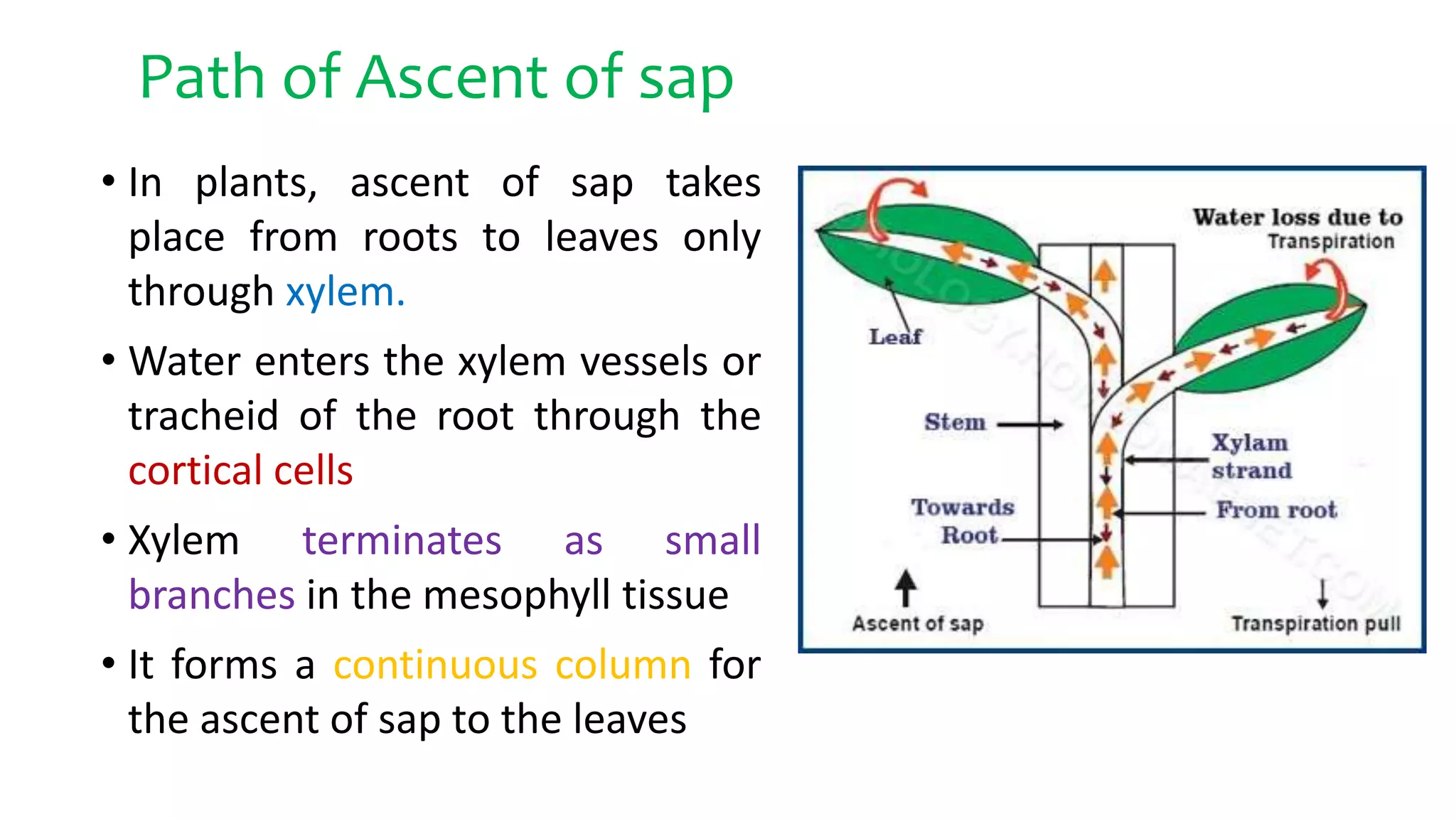
• In plants, ascent of sap takes
place from roots to leaves only
through xylem.
• Water enters the xylem vessels or
tracheid of the root through the
cortical cells
• Xylem terminates as small
branches in the mesophyll tissue
• It forms a continuous column for
the ascent of sap to the leaves
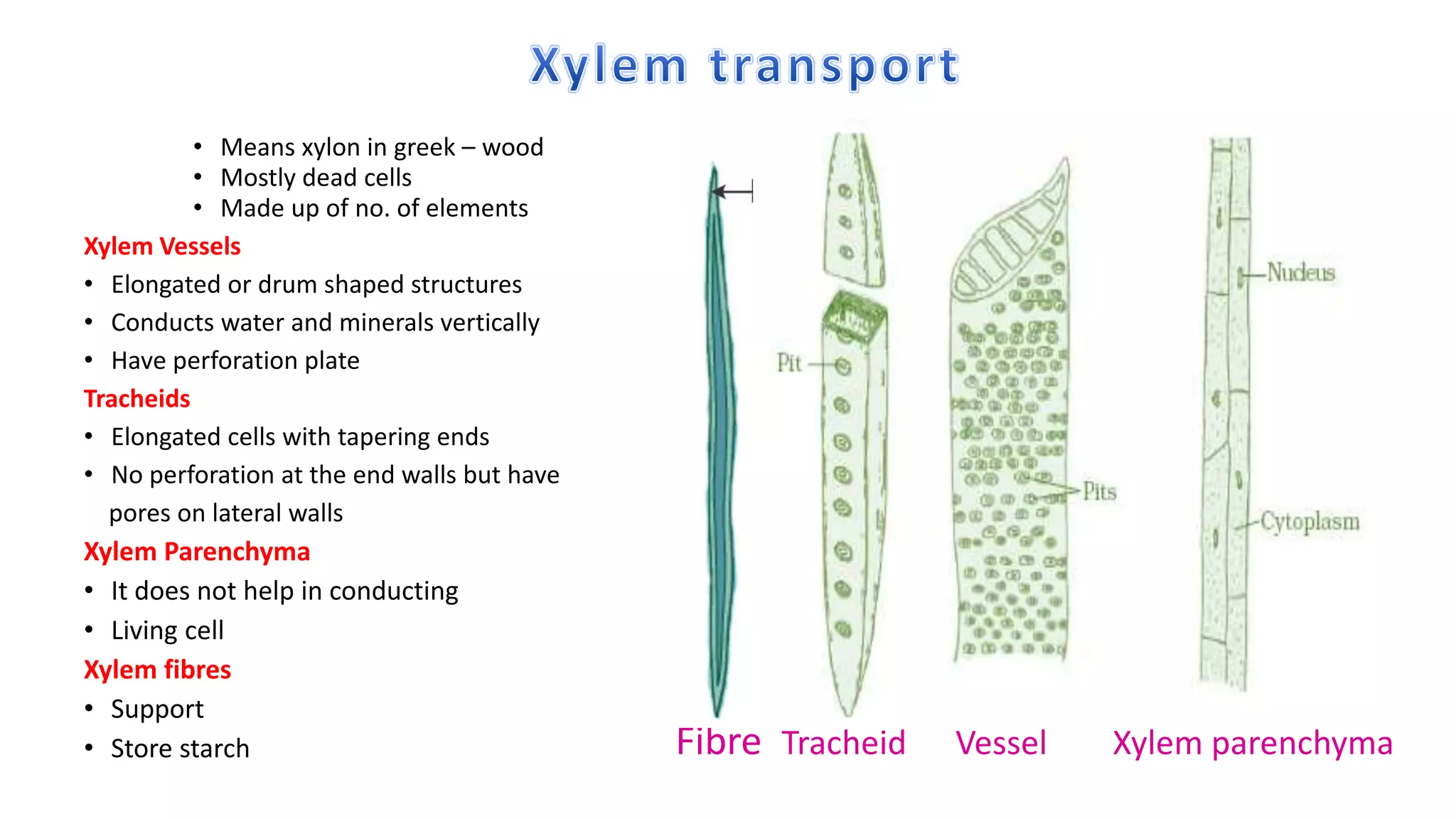
• Means xylon in greek – wood
• Mostly dead cells
• Made up of no. of elements
Xylem Vessels
• Elongated or drum shaped structures
• Conducts water and minerals vertically
• Have perforation plate
Tracheids
• Elongated cells with tapering ends
• No perforation at the end walls but have
pores on lateral walls
Xylem Parenchyma
• It does not help in conducting
• Living cell
Xylem fibres
• Support
• Store starch Fibre Tracheid Vessel Xylem parenchyma
Xylem is the principal water conducting tissue in plant. It can be
shown by an experiment
Experiment 1
Balsam Plant experiment
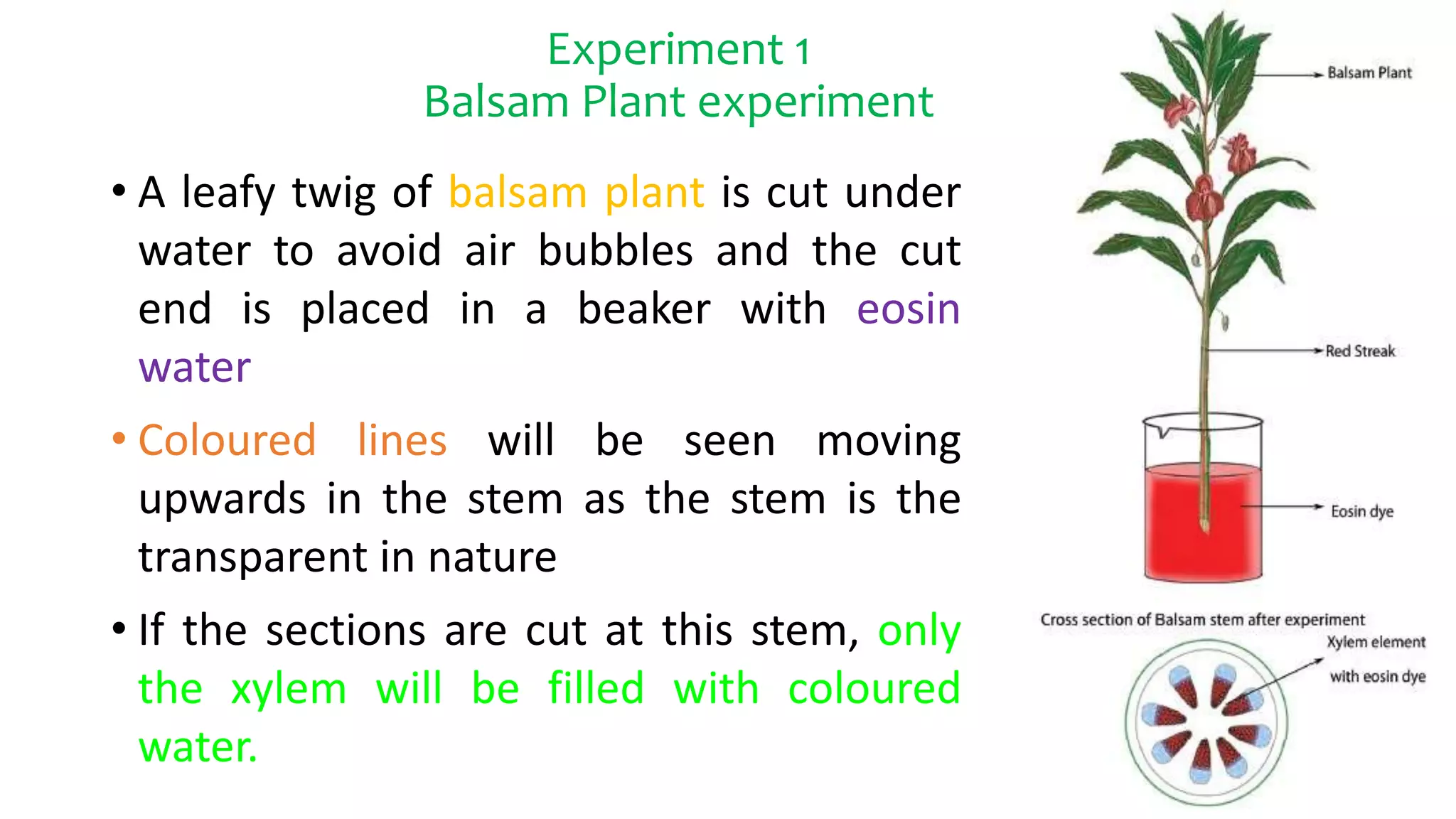
• A leafy twig of balsam plant is cut under
water to avoid air bubbles and the cut
end is placed in a beaker with eosin
water
• Coloured lines will be seen moving
upwards in the stem as the stem is the
transparent in nature
• If the sections are cut at this stem, only
the xylem will be filled with coloured
water.
Experiment 2
Ringing experiment
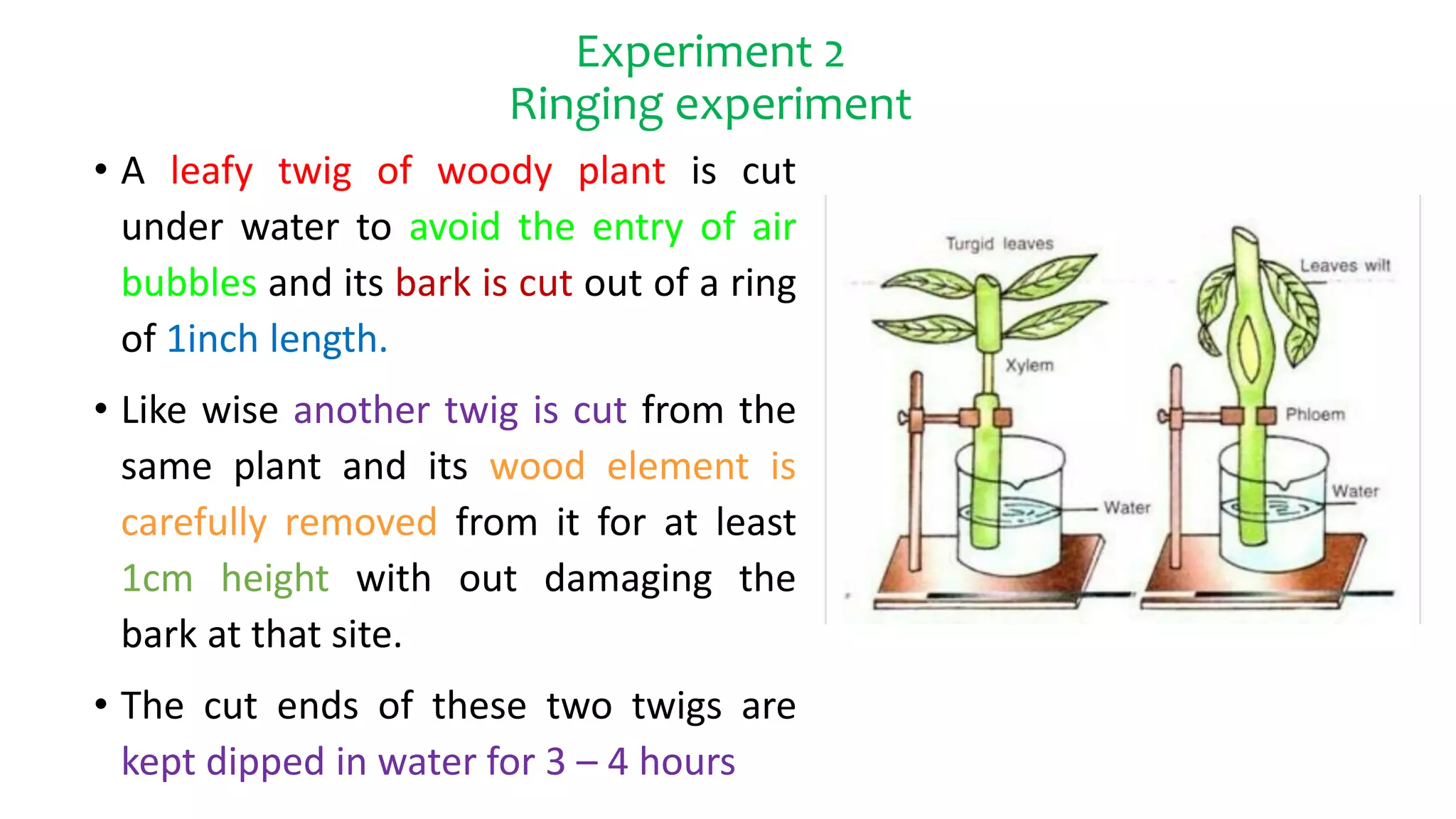
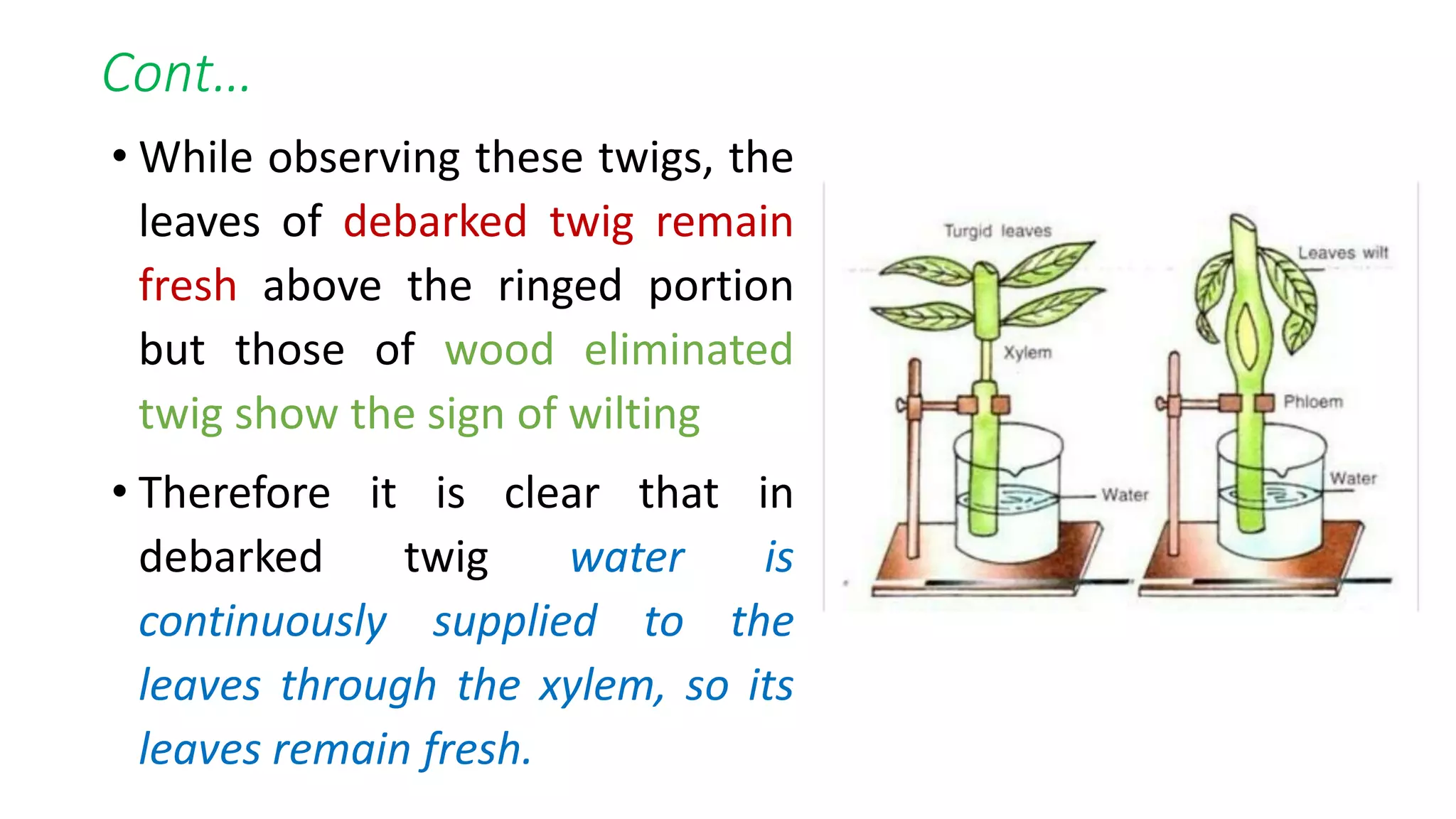
• A leafy twig of woody plant is cut
under water to avoid the entry of air
bubbles and its bark is cut out of a ring
of 1inch length.
• Like wise another twig is cut from the
same plant and its wood element is
carefully removed from it for at least
1cm height with out damaging the
bark at that site.
• The cut ends of these two twigs are
kept dipped in water for 3 – 4 hours
Cont…
• While observing these twigs, the
leaves of debarked twig remain
fresh above the ringed portion
but those of wood eliminated
twig show the sign of wilting
• Therefore it is clear that in
debarked twig water is
continuously supplied to the
leaves through the xylem, so its
leaves remain fresh.
Transpiration pull and Cohesion theory
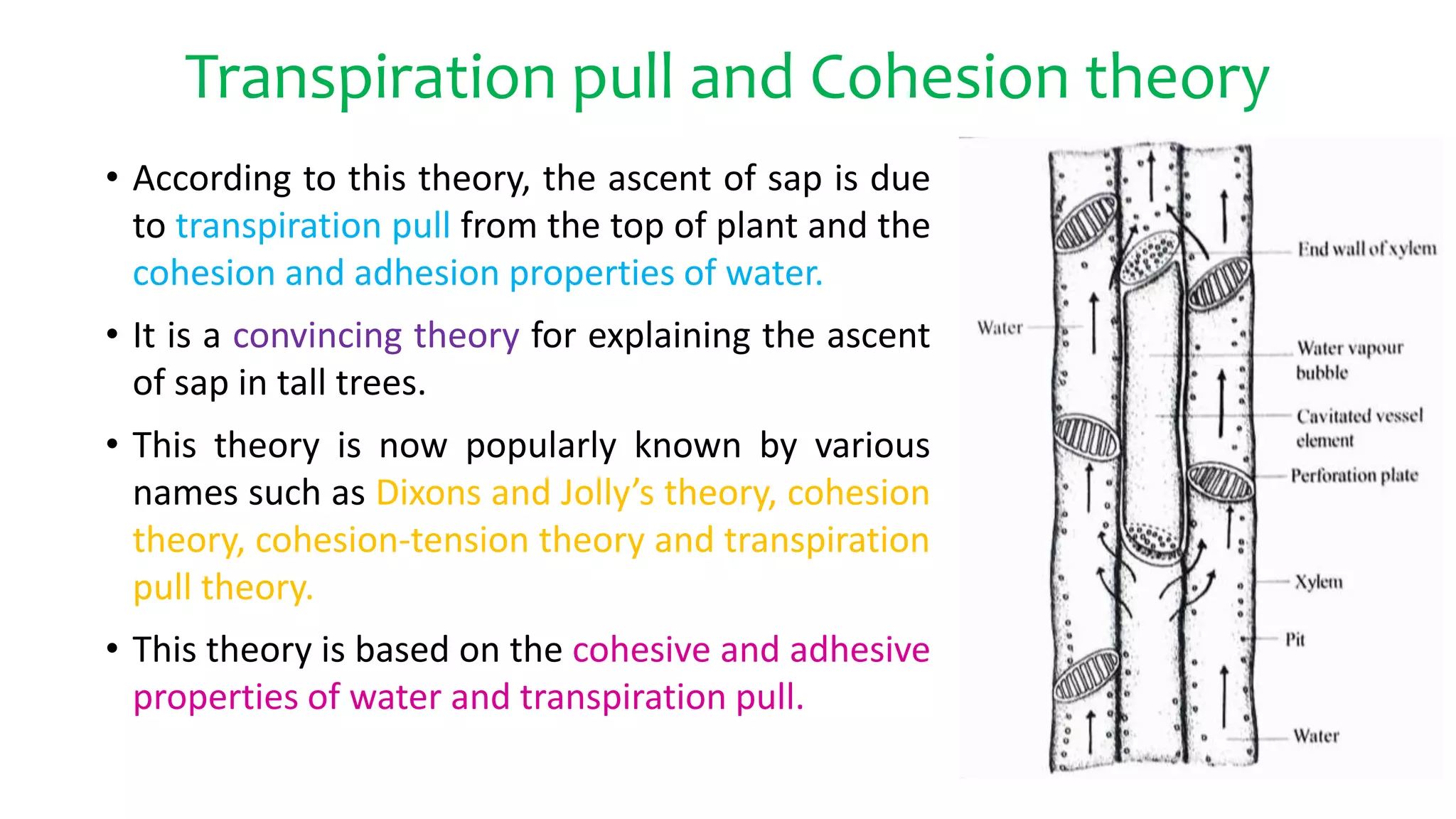
• According to this theory, the ascent of sap is due
to transpiration pull from the top of plant and the
cohesion and adhesion properties of water.
• It is a convincing theory for explaining the ascent
of sap in tall trees.
• This theory is now popularly known by various
names such as Dixons and Jolly’s theory, cohesion
theory, cohesion-tension theory and transpiration
pull theory.
• This theory is based on the cohesive and adhesive
properties of water and transpiration pull.
Cohesion
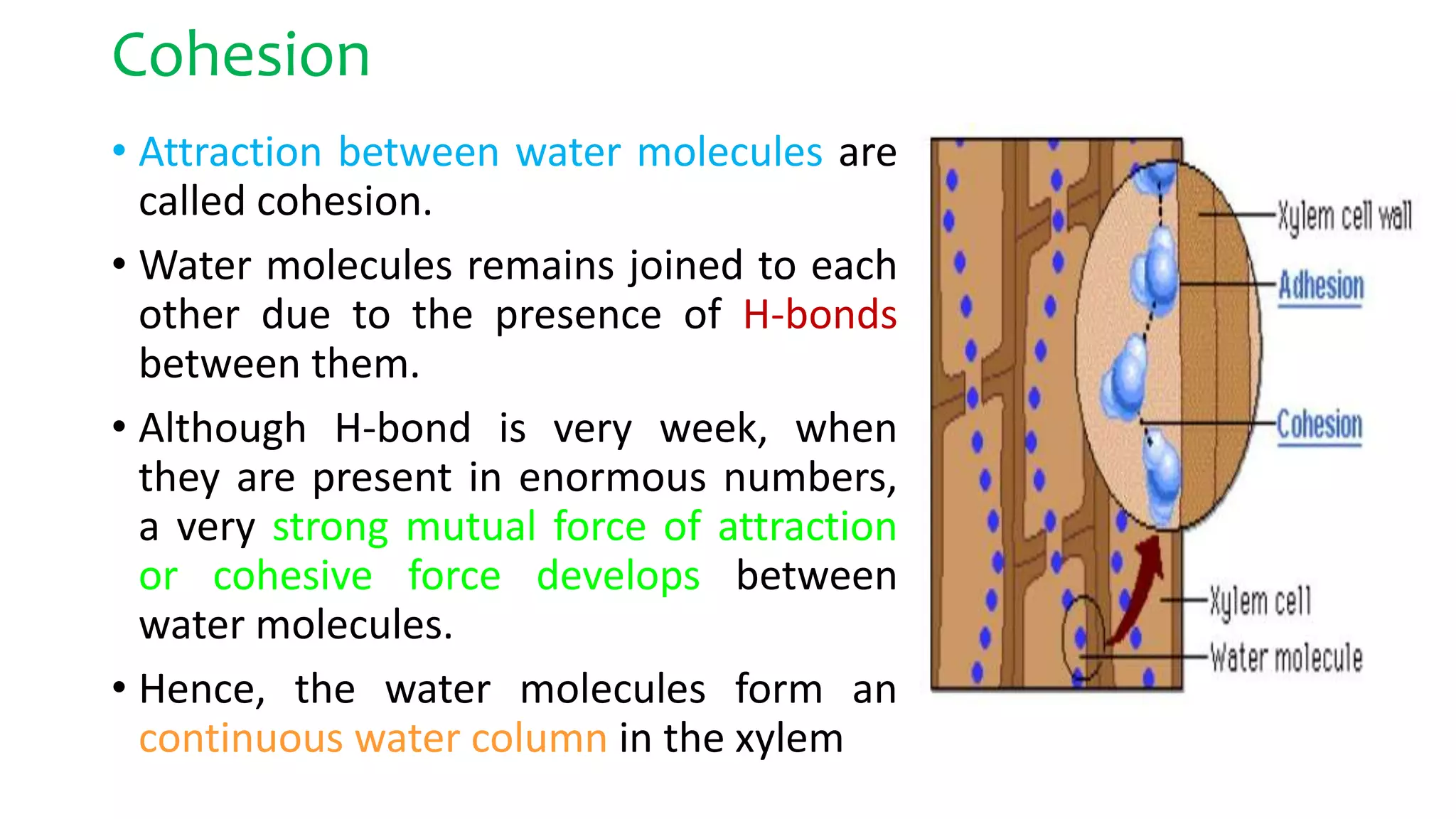
• Attraction between water molecules are
called cohesion.
• Water molecules remains joined to each
other due to the presence of H-bonds
between them.
• Although H-bond is very week, when
they are present in enormous numbers,
a very strong mutual force of attraction
or cohesive force develops between
water molecules.
• Hence, the water molecules form an
continuous water column in the xylem
Cont…
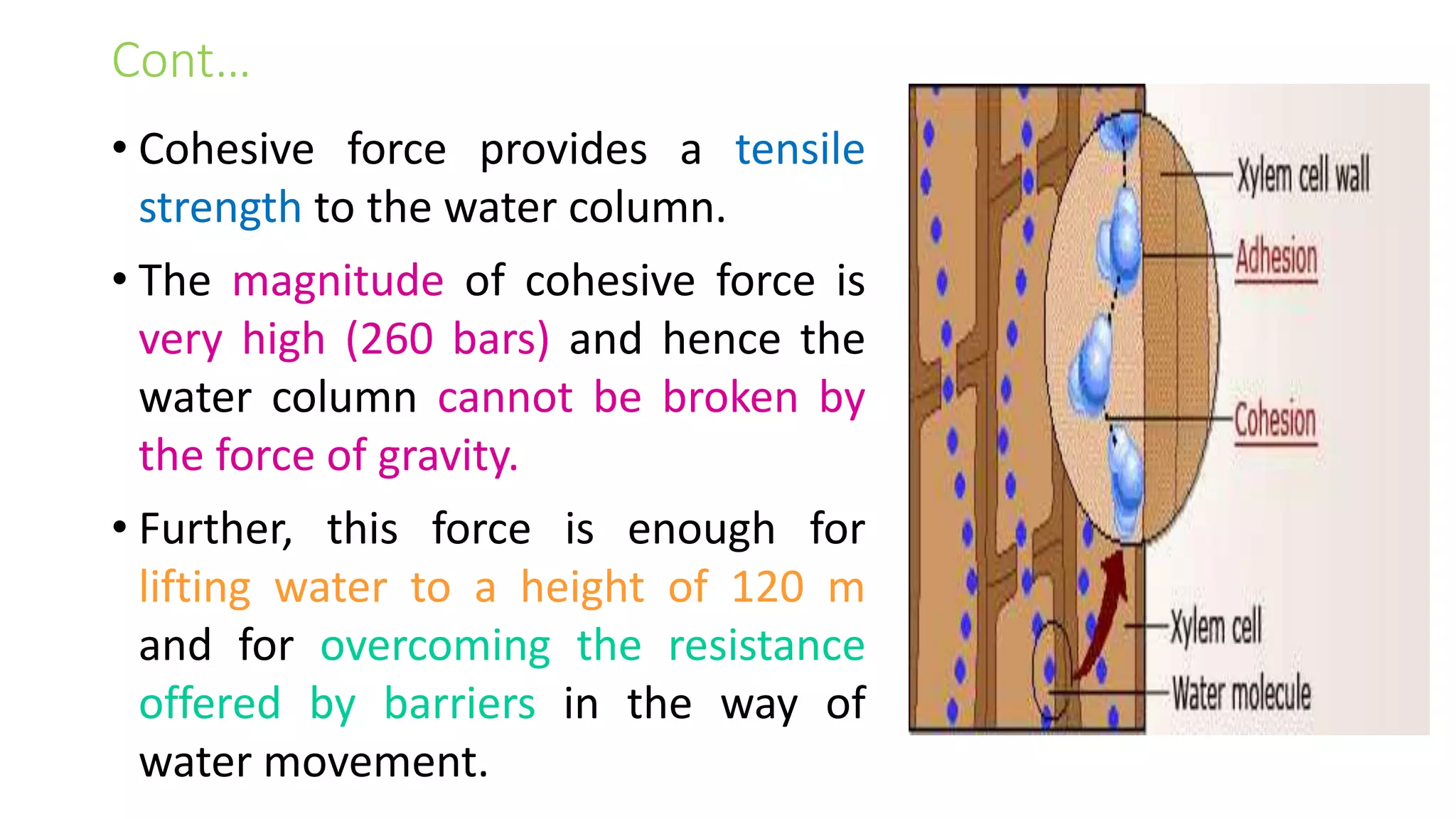
• Cohesive force provides a tensile
strength to the water column.
• The magnitude of cohesive force is
very high (260 bars) and hence the
water column cannot be broken by
the force of gravity.
• Further, this force is enough for
lifting water to a height of 120 m
and for overcoming the resistance
offered by barriers in the way of
water movement.
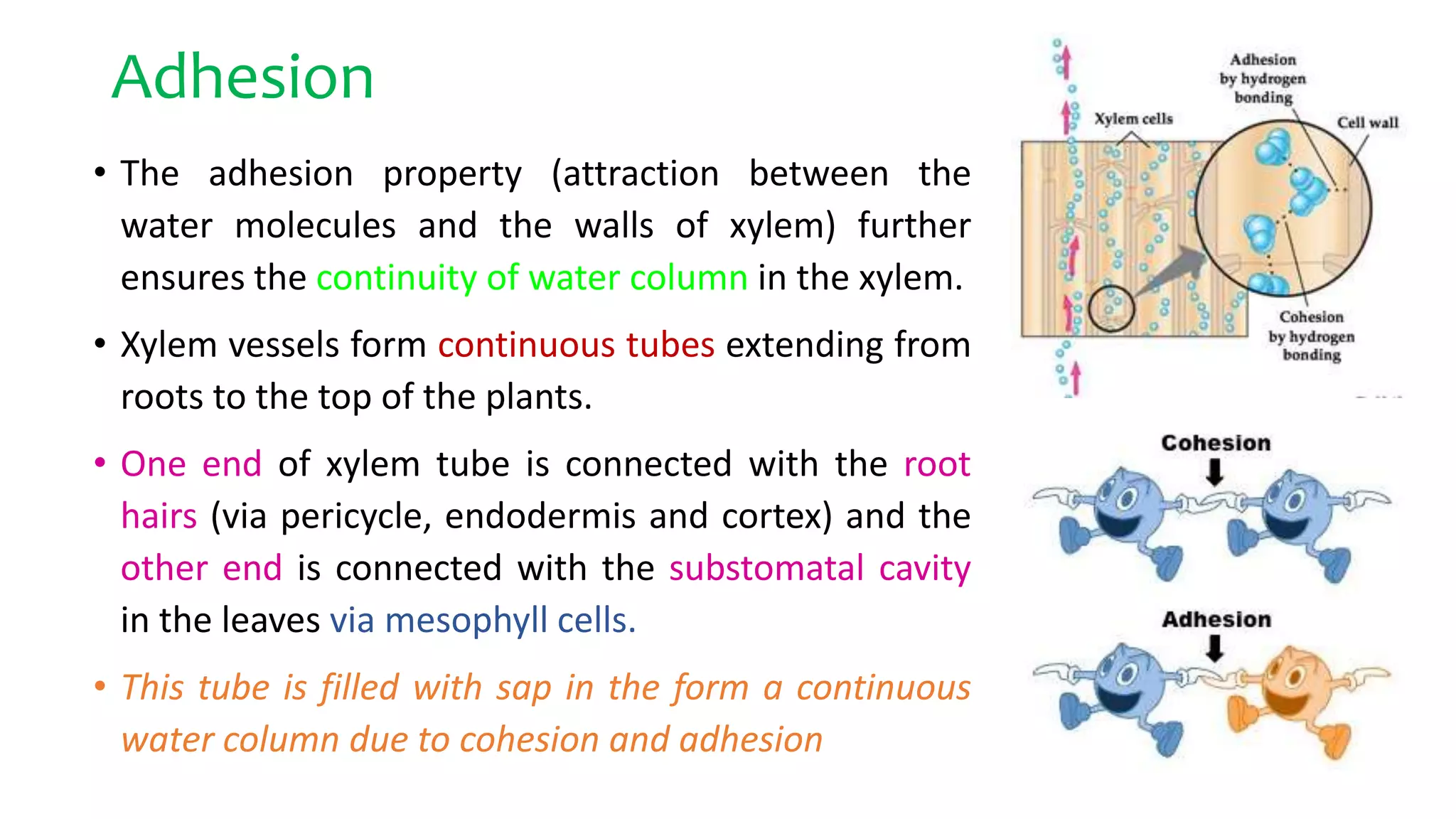
Adhesion
• The adhesion property (attraction between the
water molecules and the walls of xylem) further
ensures the continuity of water column in the xylem.
• Xylem vessels form continuous tubes extending from
roots to the top of the plants.
• One end of xylem tube is connected with the root
hairs (via pericycle, endodermis and cortex) and the
other end is connected with the substomatal cavity
in the leaves via mesophyll cells.
• This tube is filled with sap in the form a continuous
water column due to cohesion and adhesion
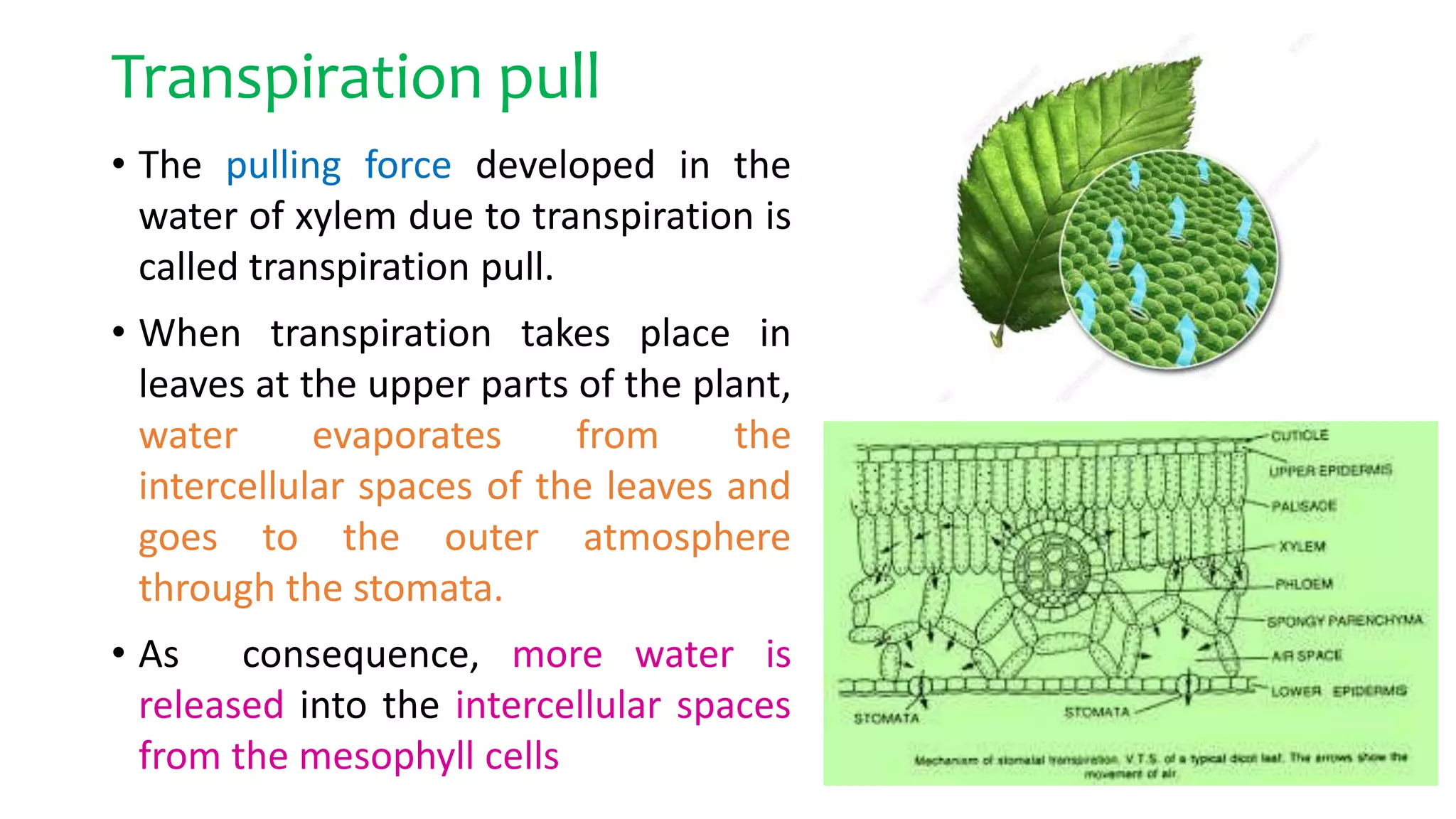
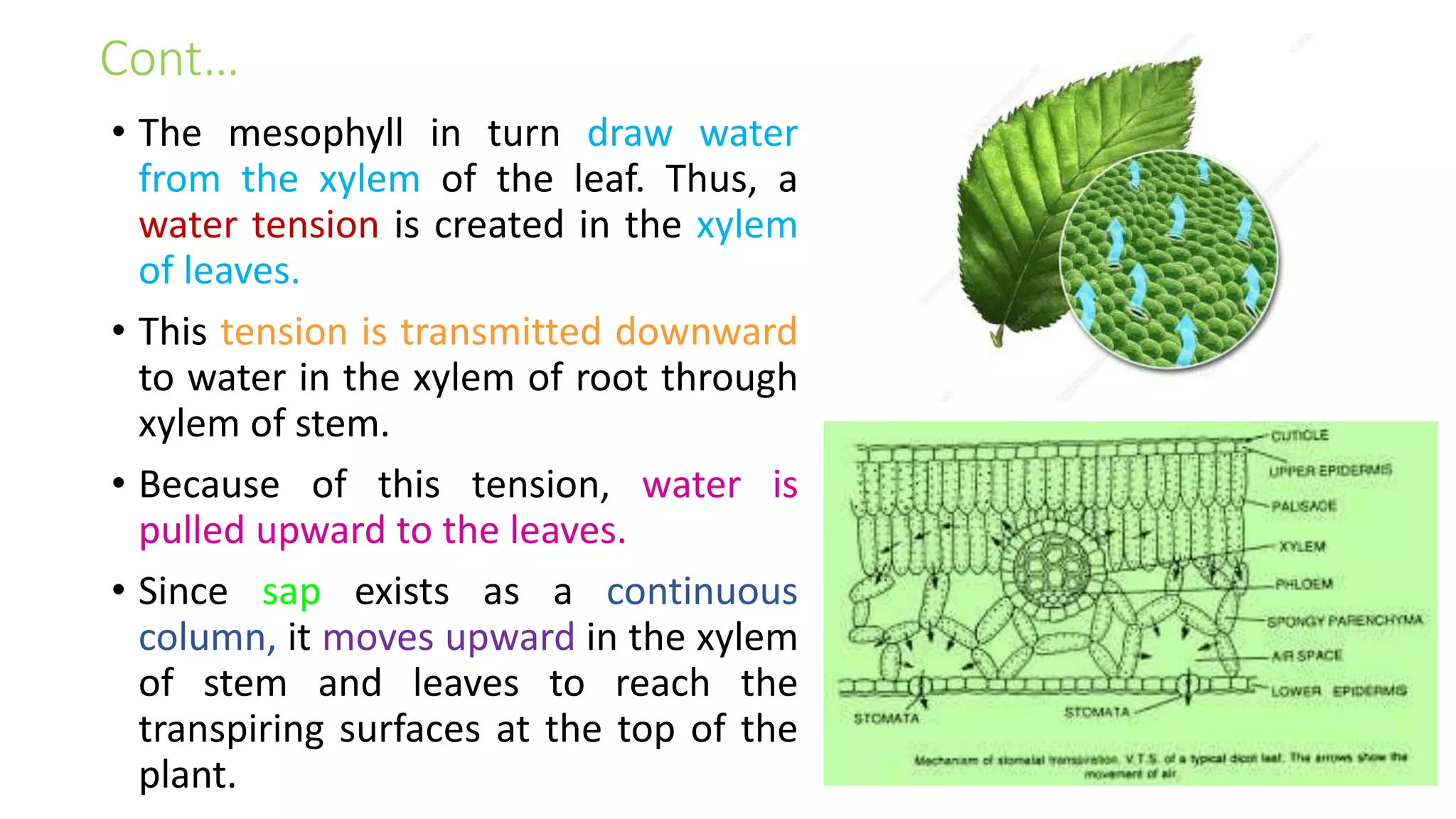
Transpiration pull
• The pulling force developed in the
water of xylem due to transpiration is
called transpiration pull.
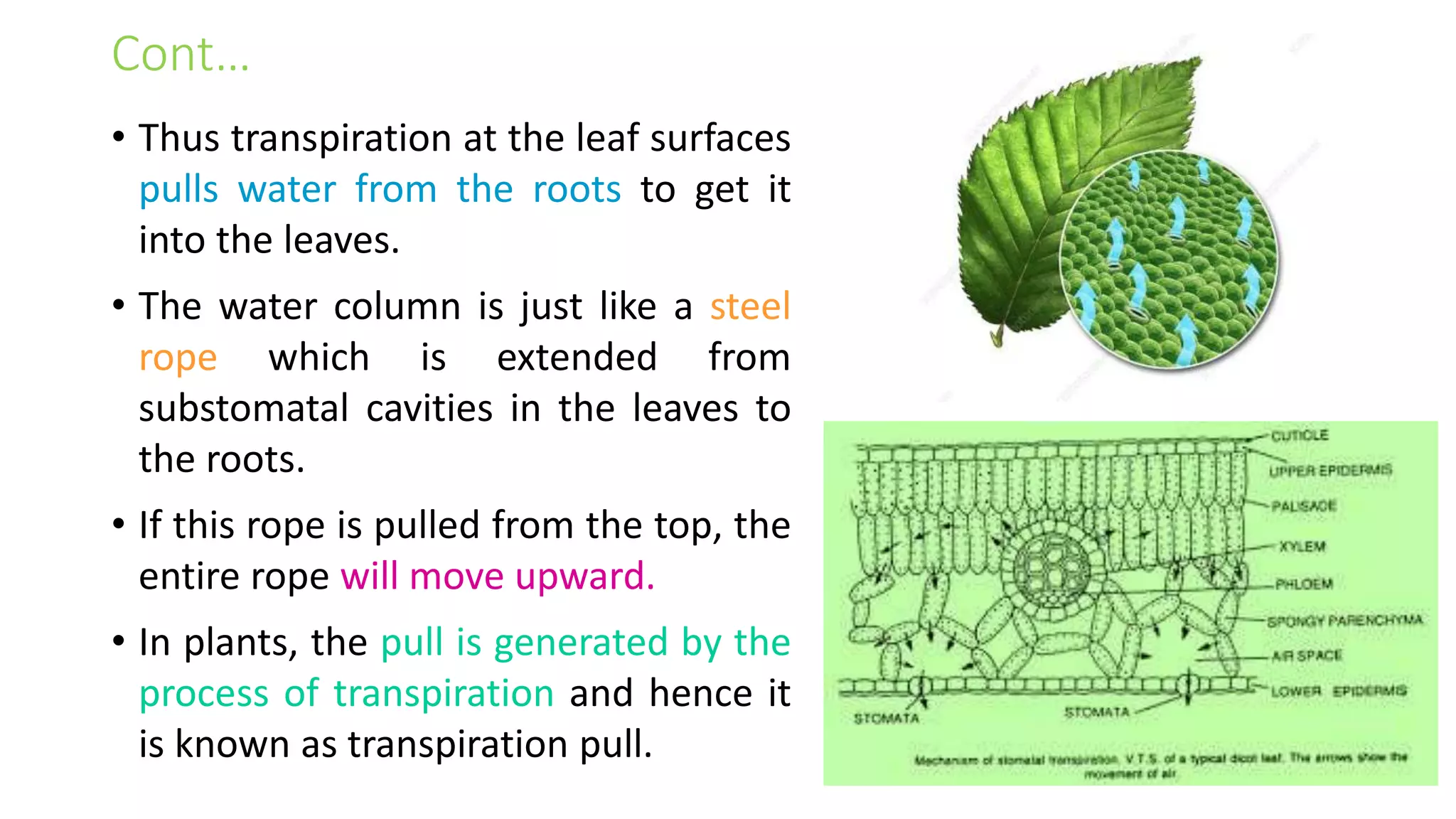
• When transpiration takes place in
leaves at the upper parts of the plant,
water evaporates from the
intercellular spaces of the leaves and
goes to the outer atmosphere
through the stomata.
• As consequence, more water is
released into the intercellular spaces
from the mesophyll cells
Cont…
• The mesophyll in turn draw water
from the xylem of the leaf. Thus, a
water tension is created in the xylem
of leaves.
• This tension is transmitted downward
to water in the xylem of root through
xylem of stem.
• Because of this tension, water is
pulled upward to the leaves.
• Since sap exists as a continuous
column, it moves upward in the xylem
of stem and leaves to reach the
transpiring surfaces at the top of the
plant.
Cont…
• Thus transpiration at the leaf surfaces
pulls water from the roots to get it
into the leaves.
• The water column is just like a steel
rope which is extended from
substomatal cavities in the leaves to
the roots.
• If this rope is pulled from the top, the
entire rope will move upward.
• In plants, the pull is generated by the
process of transpiration and hence it
is known as transpiration pull.
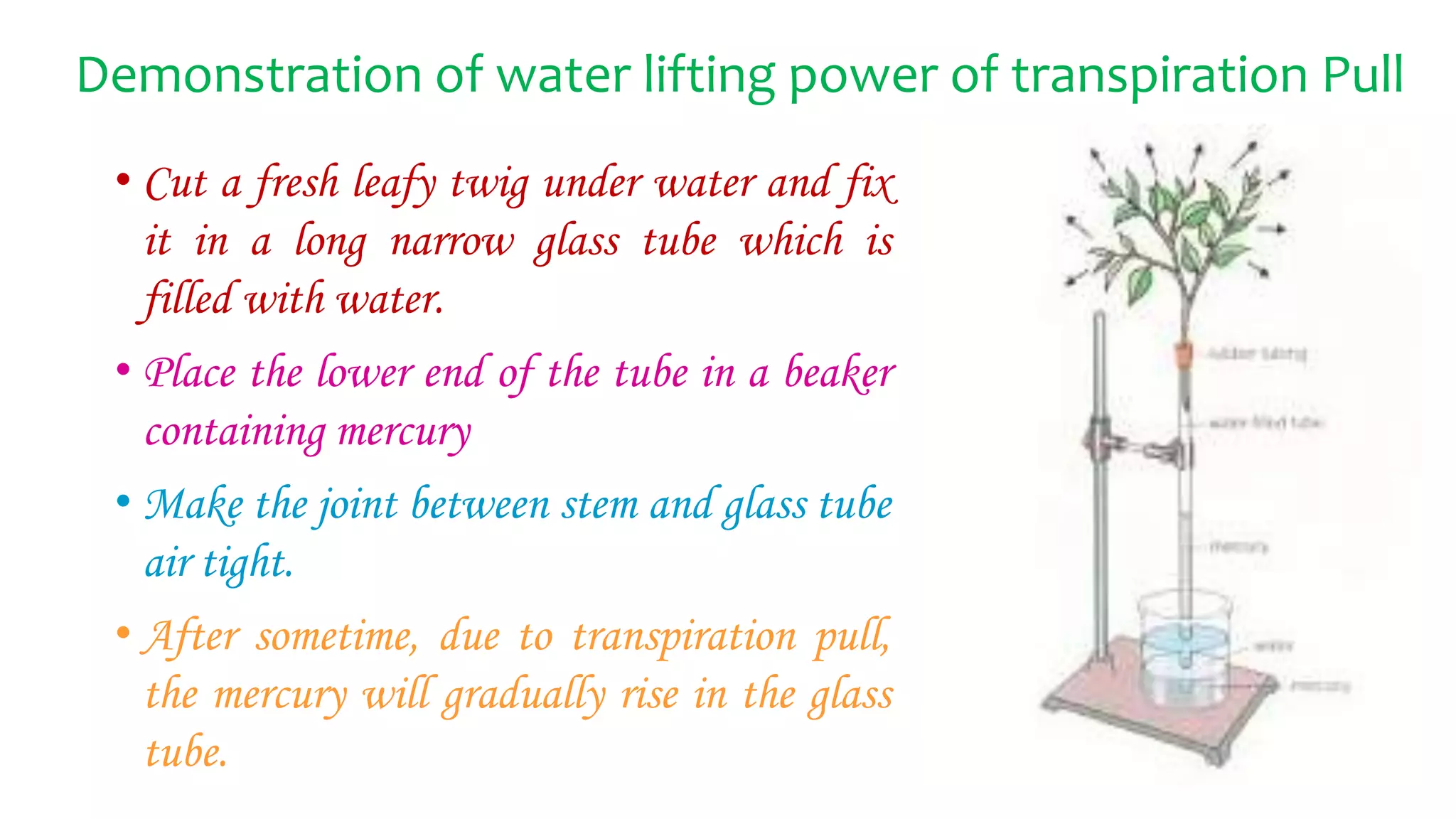
Demonstration of water lifting power of transpiration Pull
• Cut a fresh leafy twig under water and fix
it in a long narrow glass tube which is
filled with water.
• Place the lower end of the tube in a beaker
containing mercury
• Make the joint between stem and glass tube
air tight.
• After sometime, due to transpiration pull,
the mercury will gradually rise in the glass
tube.
Objection to Cohesion theory
• Due to the variation of temperature, the xylem vessels enlarges
during the day time and shrinks in the night.
• While the vessel size is increasing, there are fair chances for the entry
of gas bubbles in the water column.
• The air bubbles in the conducting channels will break the continuity
of the water column.
• This phenomenon is known as Cavitation.
• It was demonstrated by Milburn and Johnson (1966)
Cavitation overcomes
• The impact of cavitation is overcome by the presence of
many columns of vessels side by side; it eliminates the
injurious effect of temporary cavitation.
• When the tension is relieved by rain or simply at night, the
gases are dissolved in the solution forming a continuous
column.
Thank you

Ascent of sap

  • 1.
    ASCENT OF SAP Dr.K. GANESH KUMARI ASSISTANT PROFESSOR DEPARTMENT OF PLANT SCIENCE SRIMAD ANDAVAN ARTS AND SCIENCE COLLEGE (AUTONOMOUS) TRICHY - 5
  • 2.
    Introduction • The upwardmovement of sap from the root system to the aerial parts of the plant through the xylem is known as ascent of sap • It distributes water and minerals to stem and leaves. • This is also known as water conduction or translocation of water • Sap is an aqueous solution of water, dissolved mineral salts and some organic solutes present in the xylem • Hence, it is often known as xylem sap.
  • 3.
    Rate of movementof Sap • The rate of movement of sap varies with diameter of the conducting vessels. • Wide vessels – radii of 100 to 200 µM - water rises up to the rate of 16 to 45 mh-1 • Small vessels – radii of 25 to 75 µM - Water rises up to the rate of 1 to 6 mh-1
  • 4.
    Path of Ascentof sap • In plants, ascent of sap takes place from roots to leaves only through xylem. • Water enters the xylem vessels or tracheid of the root through the cortical cells • Xylem terminates as small branches in the mesophyll tissue • It forms a continuous column for the ascent of sap to the leaves
  • 5.
    • Means xylonin greek – wood • Mostly dead cells • Made up of no. of elements Xylem Vessels • Elongated or drum shaped structures • Conducts water and minerals vertically • Have perforation plate Tracheids • Elongated cells with tapering ends • No perforation at the end walls but have pores on lateral walls Xylem Parenchyma • It does not help in conducting • Living cell Xylem fibres • Support • Store starch Fibre Tracheid Vessel Xylem parenchyma
  • 6.
    Xylem is theprincipal water conducting tissue in plant. It can be shown by an experiment
  • 7.
    Experiment 1 Balsam Plantexperiment • A leafy twig of balsam plant is cut under water to avoid air bubbles and the cut end is placed in a beaker with eosin water • Coloured lines will be seen moving upwards in the stem as the stem is the transparent in nature • If the sections are cut at this stem, only the xylem will be filled with coloured water.
  • 8.
    Experiment 2 Ringing experiment •A leafy twig of woody plant is cut under water to avoid the entry of air bubbles and its bark is cut out of a ring of 1inch length. • Like wise another twig is cut from the same plant and its wood element is carefully removed from it for at least 1cm height with out damaging the bark at that site. • The cut ends of these two twigs are kept dipped in water for 3 – 4 hours
  • 9.
    Cont… • While observingthese twigs, the leaves of debarked twig remain fresh above the ringed portion but those of wood eliminated twig show the sign of wilting • Therefore it is clear that in debarked twig water is continuously supplied to the leaves through the xylem, so its leaves remain fresh.
  • 10.
    Transpiration pull andCohesion theory • According to this theory, the ascent of sap is due to transpiration pull from the top of plant and the cohesion and adhesion properties of water. • It is a convincing theory for explaining the ascent of sap in tall trees. • This theory is now popularly known by various names such as Dixons and Jolly’s theory, cohesion theory, cohesion-tension theory and transpiration pull theory. • This theory is based on the cohesive and adhesive properties of water and transpiration pull.
  • 11.
    Cohesion • Attraction betweenwater molecules are called cohesion. • Water molecules remains joined to each other due to the presence of H-bonds between them. • Although H-bond is very week, when they are present in enormous numbers, a very strong mutual force of attraction or cohesive force develops between water molecules. • Hence, the water molecules form an continuous water column in the xylem
  • 12.
    Cont… • Cohesive forceprovides a tensile strength to the water column. • The magnitude of cohesive force is very high (260 bars) and hence the water column cannot be broken by the force of gravity. • Further, this force is enough for lifting water to a height of 120 m and for overcoming the resistance offered by barriers in the way of water movement.
  • 13.
    Adhesion • The adhesionproperty (attraction between the water molecules and the walls of xylem) further ensures the continuity of water column in the xylem. • Xylem vessels form continuous tubes extending from roots to the top of the plants. • One end of xylem tube is connected with the root hairs (via pericycle, endodermis and cortex) and the other end is connected with the substomatal cavity in the leaves via mesophyll cells. • This tube is filled with sap in the form a continuous water column due to cohesion and adhesion
  • 14.
    Transpiration pull • Thepulling force developed in the water of xylem due to transpiration is called transpiration pull. • When transpiration takes place in leaves at the upper parts of the plant, water evaporates from the intercellular spaces of the leaves and goes to the outer atmosphere through the stomata. • As consequence, more water is released into the intercellular spaces from the mesophyll cells
  • 15.
    Cont… • The mesophyllin turn draw water from the xylem of the leaf. Thus, a water tension is created in the xylem of leaves. • This tension is transmitted downward to water in the xylem of root through xylem of stem. • Because of this tension, water is pulled upward to the leaves. • Since sap exists as a continuous column, it moves upward in the xylem of stem and leaves to reach the transpiring surfaces at the top of the plant.
  • 16.
    Cont… • Thus transpirationat the leaf surfaces pulls water from the roots to get it into the leaves. • The water column is just like a steel rope which is extended from substomatal cavities in the leaves to the roots. • If this rope is pulled from the top, the entire rope will move upward. • In plants, the pull is generated by the process of transpiration and hence it is known as transpiration pull.
  • 17.
    Demonstration of waterlifting power of transpiration Pull • Cut a fresh leafy twig under water and fix it in a long narrow glass tube which is filled with water. • Place the lower end of the tube in a beaker containing mercury • Make the joint between stem and glass tube air tight. • After sometime, due to transpiration pull, the mercury will gradually rise in the glass tube.
  • 18.
    Objection to Cohesiontheory • Due to the variation of temperature, the xylem vessels enlarges during the day time and shrinks in the night. • While the vessel size is increasing, there are fair chances for the entry of gas bubbles in the water column. • The air bubbles in the conducting channels will break the continuity of the water column. • This phenomenon is known as Cavitation. • It was demonstrated by Milburn and Johnson (1966)
  • 19.
    Cavitation overcomes • Theimpact of cavitation is overcome by the presence of many columns of vessels side by side; it eliminates the injurious effect of temporary cavitation. • When the tension is relieved by rain or simply at night, the gases are dissolved in the solution forming a continuous column.
  • 20.