Ventilatory strategy in ARDS
Dr. Chandan Kumar Sheet
MD(Pulmonary Medicine),Fellowship in Interventional Pulmonology
Consultant Pulmonary Medicine, Critical Care & Sleep disorders
Calcutta Heart Clinic & Hospital, Saltlake, Kolkata
Contents
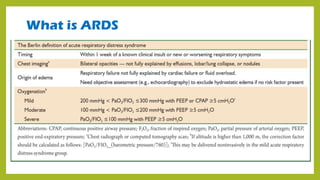
 Berlin Definition
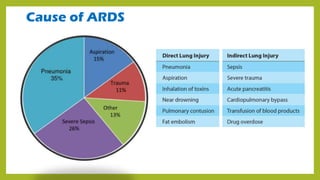
 Cause of ARDS
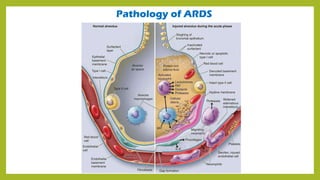
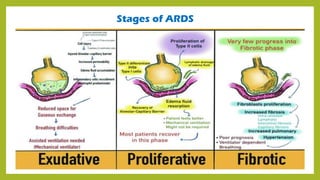
 Stage & Pathophysiology of ARDS
 Ventilatory management
 Rescue maneuver
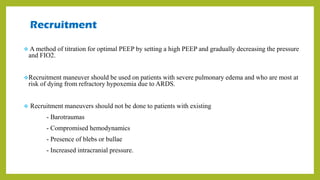
 Recruitment
 Prone Ventilation
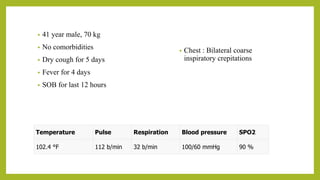
• 41 year male, 70 kg
• No comorbidities
• Dry cough for 5 days
• Fever for 4 days
• SOB for last 12 hours
Temperature Pulse Respiration Blood pressure SPO2
102.4 °F 112 b/min 32 b/min 100/60 mmHg 90 %
• Chest : Bilateral coarse
inspiratory crepitations
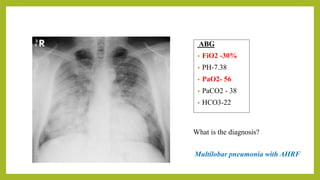
ABG
• FiO2 -30%
• PH-7.38
• PaO2- 56
• PaCO2 - 38
• HCO3-22
What is the diagnosis?
Multilobar pneumonia with AHRF
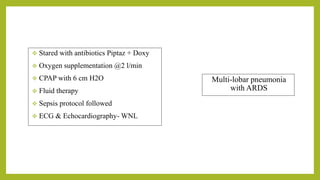
 Stared with antibiotics Piptaz + Doxy
 Oxygen supplementation @2 l/min
 CPAP with 6 cm H2O
 Fluid therapy
 Sepsis protocol followed
 ECG & Echocardiography- WNL
Multi-lobar pneumonia
with ARDS
What is ARDS
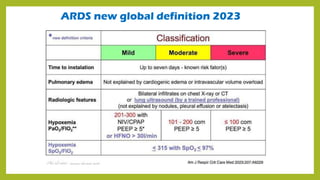
ARDS new global definition 2023
Cause of ARDS
Pathology of ARDS
Stages of ARDS
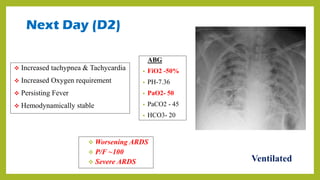
Next Day (D2)
 Worsening ARDS
 P/F ~100
 Severe ARDS
 Increased tachypnea & Tachycardia
 Increased Oxygen requirement
 Persisting Fever
 Hemodynamically stable
ABG
• FiO2 -50%
• PH-7.36
• PaO2- 50
• PaCO2 - 45
• HCO3- 20
Ventilated
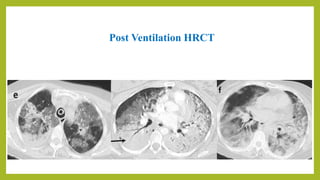
Post Ventilation HRCT
Indications for Mechanical Ventilation in ARDS
 Increased work of breathing
 Oxygenation impairment
 Impending Ventilatory failure
 Acute Ventilatory failure
Ventilation in ARDS – Lung Protective Ventilation
FIRST STAGE
1. Calculate Predicted body weight
Male : PBW = 50 + [2.3 x (Height in inch – 60)]
Female : PBW = 45.5 + [2.3 x (Height in inch – 60)]
2. Mode : VCV
3. Set initial tidal volume (VT) at 8 mL/kg PBW.
4. PEEP at 5 cm H2O ( Recent Guidelines 8-20cm of H2O)
5. Lowest FiO2 that achieves an SpO2 of 88-95%.
6. RR : 20-35/min
7. Inspiratory time: 0.5-0.8 s
8. Reduce VT by 1 mL/kg every 2 hrs. until VT = 6 mL/kg.
Ventilation in ARDS – Lung protective ventilation
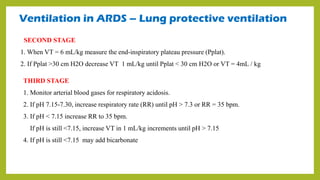
SECOND STAGE
1. When VT = 6 mL/kg measure the end-inspiratory plateau pressure (Pplat).
2. If Pplat >30 cm H2O decrease VT 1 mL/kg until Pplat < 30 cm H2O or VT = 4mL / kg
THIRD STAGE
1. Monitor arterial blood gases for respiratory acidosis.
2. If pH 7.15-7.30, increase respiratory rate (RR) until pH > 7.3 or RR = 35 bpm.
3. If pH < 7.15 increase RR to 35 bpm.
If pH is still <7.15, increase VT in 1 mL/kg increments until pH > 7.15
4. If pH is still <7.15 may add bicarbonate
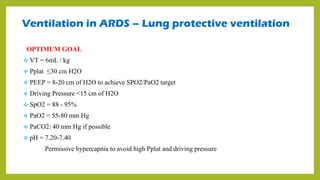
OPTIMUM GOAL
 VT = 6mL / kg
 Pplat ≤30 cm H2O
 PEEP = 8-20 cm of H2O to achieve SPO2/PaO2 target
 Driving Pressure <15 cm of H2O
 SpO2 = 88 - 95%
 PaO2 = 55-80 mm Hg
 PaCO2: 40 mm Hg if possible
 pH = 7.20-7.40
Permissive hypercapnia to avoid high Pplat and driving pressure
Ventilation in ARDS – Lung protective ventilation
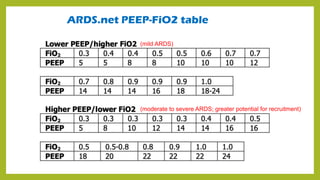
ARDS.net PEEP-FiO2 table
(mild ARDS)
(moderate to severe ARDS; greater potential for recruitment)
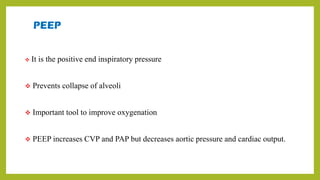
PEEP
 It is the positive end inspiratory pressure
 Prevents collapse of alveoli
 Important tool to improve oxygenation
 PEEP increases CVP and PAP but decreases aortic pressure and cardiac output.
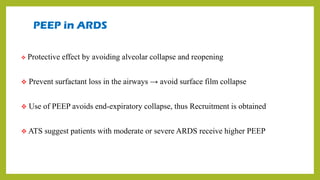
PEEP in ARDS
 Protective effect by avoiding alveolar collapse and reopening
 Prevent surfactant loss in the airways → avoid surface film collapse
 Use of PEEP avoids end-expiratory collapse, thus Recruitment is obtained
 ATS suggest patients with moderate or severe ARDS receive higher PEEP
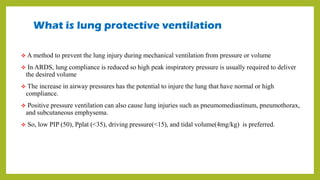
What is lung protective ventilation
 A method to prevent the lung injury during mechanical ventilation from pressure or volume
 In ARDS, lung compliance is reduced so high peak inspiratory pressure is usually required to deliver
the desired volume
 The increase in airway pressures has the potential to injure the lung that have normal or high
compliance.
 Positive pressure ventilation can also cause lung injuries such as pneumomediastinum, pneumothorax,
and subcutaneous emphysema.
 So, low PIP (50), Pplat (<35), driving pressure(<15), and tidal volume(4mg/kg) is preferred.
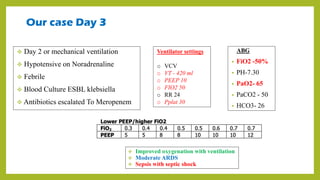
Our case Day 3
 Improved oxygenation with ventilation
 Moderate ARDS
 Sepsis with septic shock
 Day 2 or mechanical ventilation
 Hypotensive on Noradrenaline
 Febrile
 Blood Culture ESBL klebsiella
 Antibiotics escalated To Meropenem
ABG
• FiO2 -50%
• PH-7.30
• PaO2- 65
• PaCO2 - 50
• HCO3- 26
Ventilator settings
o VCV
o VT - 420 ml
o PEEP 10
o FIO2 50
o RR 24
o Pplat 30
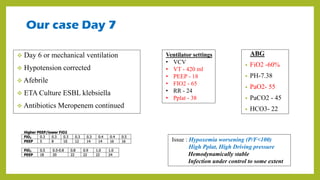
Our case Day 7
 Day 6 or mechanical ventilation
 Hypotension corrected
 Afebrile
 ETA Culture ESBL klebsiella
 Antibiotics Meropenem continued
ABG
• FiO2 -60%
• PH-7.38
• PaO2- 55
• PaCO2 - 45
• HCO3- 22
Ventilator settings
• VCV
• VT - 420 ml
• PEEP - 18
• FIO2 - 65
• RR - 24
• Pplat - 38
Issue : Hypoxemia worsening (P/F<100)
High Pplat, High Driving pressure
Hemodynamically stable
Infection under control to some extent
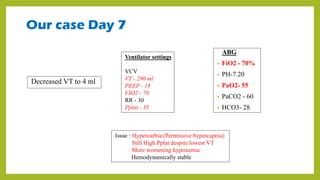
Our case Day 7
Decreased VT to 4 ml
ABG
• FiO2 - 70%
• PH-7.20
• PaO2- 55
• PaCO2 - 60
• HCO3- 28
Ventilator settings
VCV
VT - 280 ml
PEEP - 18
FIO2 - 70
RR - 30
Pplat - 35
Issue : Hypercarbia (Permissive hypercapnia)
Still High Pplat despite lowest VT
More worsening hypoxemia
Hemodynamically stable
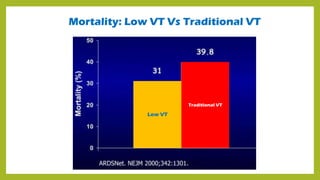
Mortality: Low VT Vs Traditional VT
Low VT
Traditional VT
Thank You
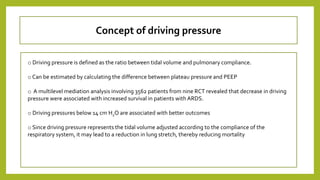
Concept of driving pressure
o Driving pressure is defined as the ratio between tidal volume and pulmonary compliance.
o Can be estimated by calculating the difference between plateau pressure and PEEP
o A multilevel mediation analysis involving 3562 patients from nine RCT revealed that decrease in driving
pressure were associated with increased survival in patients with ARDS.
o Driving pressures below 14 cm H2O are associated with better outcomes
o Since driving pressure represents the tidal volume adjusted according to the compliance of the
respiratory system, it may lead to a reduction in lung stretch, thereby reducing mortality
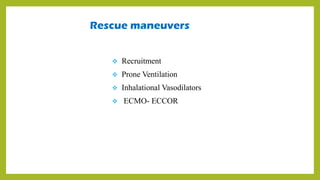
 Recruitment
 Prone Ventilation
 Inhalational Vasodilators
 ECMO- ECCOR
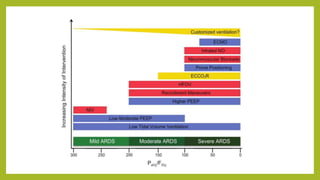
Rescue maneuvers
Recruitment
 A method of titration for optimal PEEP by setting a high PEEP and gradually decreasing the pressure
and FIO2.
Recruitment maneuver should be used on patients with severe pulmonary edema and who are most at
risk of dying from refractory hypoxemia due to ARDS.
 Recruitment maneuvers should not be done to patients with existing
- Barotraumas
- Compromised hemodynamics
- Presence of blebs or bullae
- Increased intracranial pressure.
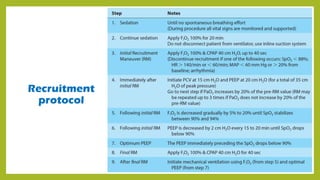
Recruitment
protocol
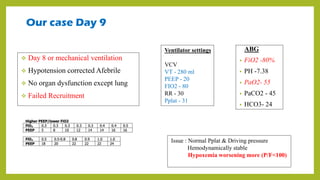
Our case Day 9
 Day 8 or mechanical ventilation
 Hypotension corrected Afebrile
 No organ dysfunction except lung
 Failed Recruitment
ABG
• FiO2 -80%
• PH -7.38
• PaO2- 55
• PaCO2 - 45
• HCO3- 24
Ventilator settings
VCV
VT - 280 ml
PEEP - 20
FIO2 - 80
RR - 30
Pplat - 31
Issue : Normal Pplat & Driving pressure
Hemodynamically stable
Hypoxemia worsening more (P/F<100)
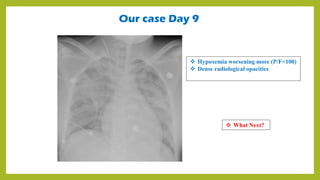
Our case Day 9
 Hypoxemia worsening more (P/F<100)
 Dense radiological opacities
 What Next?
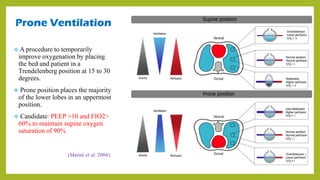
Prone Ventilation
 A procedure to temporarily
improve oxygenation by placing
the bed and patient in a
Trendelenberg position at 15 to 30
degrees.
 Prone position places the majority
of the lower lobes in an uppermost
position.
 Candidate: PEEP >10 and FIO2>
60% to maintain supine oxygen
saturation of 90%
(Marini et al. 2004).
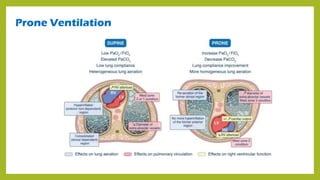
Prone Ventilation
Prone Ventilation: Benefits
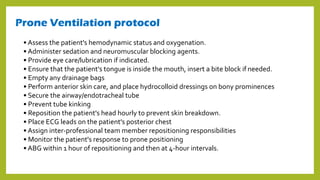
Prone Ventilation protocol
• Assess the patient's hemodynamic status and oxygenation.
• Administer sedation and neuromuscular blocking agents.
• Provide eye care/lubrication if indicated.
• Ensure that the patient's tongue is inside the mouth, insert a bite block if needed.
• Empty any drainage bags
• Perform anterior skin care, and place hydrocolloid dressings on bony prominences
• Secure the airway/endotracheal tube
• Prevent tube kinking
• Reposition the patient's head hourly to prevent skin breakdown.
• Place ECG leads on the patient's posterior chest
• Assign inter-professional team member repositioning responsibilities
• Monitor the patient's response to prone positioning
• ABG within 1 hour of repositioning and then at 4-hour intervals.
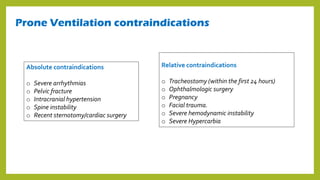
Prone Ventilation contraindications
Relative contraindications
o Tracheostomy (within the first 24 hours)
o Ophthalmologic surgery
o Pregnancy
o Facial trauma.
o Severe hemodynamic instability
o Severe Hypercarbia
Absolute contraindications
o Severe arrhythmias
o Pelvic fracture
o Intracranial hypertension
o Spine instability
o Recent sternotomy/cardiac surgery
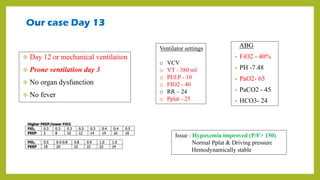
Our case Day 13
 Day 12 or mechanical ventilation
 Prone ventilation day 3
 No organ dysfunction
 No fever
ABG
• FiO2 - 40%
• PH -7.48
• PaO2- 65
• PaCO2 - 45
• HCO3- 24
Ventilator settings
o VCV
o VT - 380 ml
o PEEP - 10
o FIO2 - 40
o RR – 24
o Pplat - 25
Issue : Hypoxemia improved (P/F> 150)
Normal Pplat & Driving pressure
Hemodynamically stable
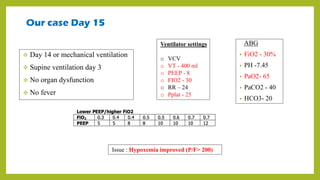
Our case Day 15
 Day 14 or mechanical ventilation
 Supine ventilation day 3
 No organ dysfunction
 No fever
ABG
• FiO2 - 30%
• PH -7.45
• PaO2- 65
• PaCO2 - 40
• HCO3- 20
Ventilator settings
o VCV
o VT - 400 ml
o PEEP - 8
o FIO2 - 30
o RR – 24
o Pplat - 25
Issue : Hypoxemia improved (P/F> 200)
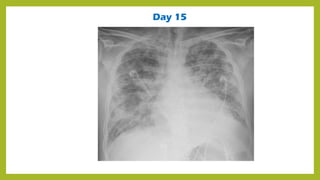
Day 15
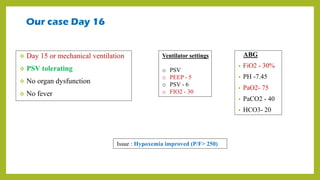
Our case Day 16
 Day 15 or mechanical ventilation
 PSV tolerating
 No organ dysfunction
 No fever
ABG
• FiO2 - 30%
• PH -7.45
• PaO2- 75
• PaCO2 - 40
• HCO3- 20
Ventilator settings
o PSV
o PEEP - 5
o PSV - 6
o FIO2 - 30
Issue : Hypoxemia improved (P/F> 250)
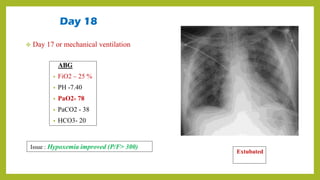
Day 18
 Day 17 or mechanical ventilation
ABG
• FiO2 – 25 %
• PH -7.40
• PaO2- 78
• PaCO2 - 38
• HCO3- 20
Issue : Hypoxemia improved (P/F> 300)
Extubated
Thank You
Thank You

VENTILATORY STRATEGY IN ARDS CHANDAN.pdf

  • 1.
    Ventilatory strategy inARDS Dr. Chandan Kumar Sheet MD(Pulmonary Medicine),Fellowship in Interventional Pulmonology Consultant Pulmonary Medicine, Critical Care & Sleep disorders Calcutta Heart Clinic & Hospital, Saltlake, Kolkata
  • 2.
    Contents  Berlin Definition Cause of ARDS  Stage & Pathophysiology of ARDS  Ventilatory management  Rescue maneuver  Recruitment  Prone Ventilation
  • 3.
    • 41 yearmale, 70 kg • No comorbidities • Dry cough for 5 days • Fever for 4 days • SOB for last 12 hours Temperature Pulse Respiration Blood pressure SPO2 102.4 °F 112 b/min 32 b/min 100/60 mmHg 90 % • Chest : Bilateral coarse inspiratory crepitations
  • 4.
    ABG • FiO2 -30% •PH-7.38 • PaO2- 56 • PaCO2 - 38 • HCO3-22 What is the diagnosis? Multilobar pneumonia with AHRF
  • 5.
     Stared withantibiotics Piptaz + Doxy  Oxygen supplementation @2 l/min  CPAP with 6 cm H2O  Fluid therapy  Sepsis protocol followed  ECG & Echocardiography- WNL Multi-lobar pneumonia with ARDS
  • 6.
  • 7.
    ARDS new globaldefinition 2023
  • 8.
  • 9.
  • 10.
  • 11.
    Next Day (D2) Worsening ARDS  P/F ~100  Severe ARDS  Increased tachypnea & Tachycardia  Increased Oxygen requirement  Persisting Fever  Hemodynamically stable ABG • FiO2 -50% • PH-7.36 • PaO2- 50 • PaCO2 - 45 • HCO3- 20 Ventilated
  • 12.
  • 13.
    Indications for MechanicalVentilation in ARDS  Increased work of breathing  Oxygenation impairment  Impending Ventilatory failure  Acute Ventilatory failure
  • 14.
    Ventilation in ARDS– Lung Protective Ventilation FIRST STAGE 1. Calculate Predicted body weight Male : PBW = 50 + [2.3 x (Height in inch – 60)] Female : PBW = 45.5 + [2.3 x (Height in inch – 60)] 2. Mode : VCV 3. Set initial tidal volume (VT) at 8 mL/kg PBW. 4. PEEP at 5 cm H2O ( Recent Guidelines 8-20cm of H2O) 5. Lowest FiO2 that achieves an SpO2 of 88-95%. 6. RR : 20-35/min 7. Inspiratory time: 0.5-0.8 s 8. Reduce VT by 1 mL/kg every 2 hrs. until VT = 6 mL/kg.
  • 15.
    Ventilation in ARDS– Lung protective ventilation SECOND STAGE 1. When VT = 6 mL/kg measure the end-inspiratory plateau pressure (Pplat). 2. If Pplat >30 cm H2O decrease VT 1 mL/kg until Pplat < 30 cm H2O or VT = 4mL / kg THIRD STAGE 1. Monitor arterial blood gases for respiratory acidosis. 2. If pH 7.15-7.30, increase respiratory rate (RR) until pH > 7.3 or RR = 35 bpm. 3. If pH < 7.15 increase RR to 35 bpm. If pH is still <7.15, increase VT in 1 mL/kg increments until pH > 7.15 4. If pH is still <7.15 may add bicarbonate
  • 16.
    OPTIMUM GOAL  VT= 6mL / kg  Pplat ≤30 cm H2O  PEEP = 8-20 cm of H2O to achieve SPO2/PaO2 target  Driving Pressure <15 cm of H2O  SpO2 = 88 - 95%  PaO2 = 55-80 mm Hg  PaCO2: 40 mm Hg if possible  pH = 7.20-7.40 Permissive hypercapnia to avoid high Pplat and driving pressure Ventilation in ARDS – Lung protective ventilation
  • 17.
    ARDS.net PEEP-FiO2 table (mildARDS) (moderate to severe ARDS; greater potential for recruitment)
  • 18.
    PEEP  It isthe positive end inspiratory pressure  Prevents collapse of alveoli  Important tool to improve oxygenation  PEEP increases CVP and PAP but decreases aortic pressure and cardiac output.
  • 19.
    PEEP in ARDS Protective effect by avoiding alveolar collapse and reopening  Prevent surfactant loss in the airways → avoid surface film collapse  Use of PEEP avoids end-expiratory collapse, thus Recruitment is obtained  ATS suggest patients with moderate or severe ARDS receive higher PEEP
  • 20.
    What is lungprotective ventilation  A method to prevent the lung injury during mechanical ventilation from pressure or volume  In ARDS, lung compliance is reduced so high peak inspiratory pressure is usually required to deliver the desired volume  The increase in airway pressures has the potential to injure the lung that have normal or high compliance.  Positive pressure ventilation can also cause lung injuries such as pneumomediastinum, pneumothorax, and subcutaneous emphysema.  So, low PIP (50), Pplat (<35), driving pressure(<15), and tidal volume(4mg/kg) is preferred.
  • 21.
    Our case Day3  Improved oxygenation with ventilation  Moderate ARDS  Sepsis with septic shock  Day 2 or mechanical ventilation  Hypotensive on Noradrenaline  Febrile  Blood Culture ESBL klebsiella  Antibiotics escalated To Meropenem ABG • FiO2 -50% • PH-7.30 • PaO2- 65 • PaCO2 - 50 • HCO3- 26 Ventilator settings o VCV o VT - 420 ml o PEEP 10 o FIO2 50 o RR 24 o Pplat 30
  • 22.
    Our case Day7  Day 6 or mechanical ventilation  Hypotension corrected  Afebrile  ETA Culture ESBL klebsiella  Antibiotics Meropenem continued ABG • FiO2 -60% • PH-7.38 • PaO2- 55 • PaCO2 - 45 • HCO3- 22 Ventilator settings • VCV • VT - 420 ml • PEEP - 18 • FIO2 - 65 • RR - 24 • Pplat - 38 Issue : Hypoxemia worsening (P/F<100) High Pplat, High Driving pressure Hemodynamically stable Infection under control to some extent
  • 23.
    Our case Day7 Decreased VT to 4 ml ABG • FiO2 - 70% • PH-7.20 • PaO2- 55 • PaCO2 - 60 • HCO3- 28 Ventilator settings VCV VT - 280 ml PEEP - 18 FIO2 - 70 RR - 30 Pplat - 35 Issue : Hypercarbia (Permissive hypercapnia) Still High Pplat despite lowest VT More worsening hypoxemia Hemodynamically stable
  • 24.
    Mortality: Low VTVs Traditional VT Low VT Traditional VT
  • 25.
    Thank You Concept ofdriving pressure o Driving pressure is defined as the ratio between tidal volume and pulmonary compliance. o Can be estimated by calculating the difference between plateau pressure and PEEP o A multilevel mediation analysis involving 3562 patients from nine RCT revealed that decrease in driving pressure were associated with increased survival in patients with ARDS. o Driving pressures below 14 cm H2O are associated with better outcomes o Since driving pressure represents the tidal volume adjusted according to the compliance of the respiratory system, it may lead to a reduction in lung stretch, thereby reducing mortality
  • 26.
     Recruitment  ProneVentilation  Inhalational Vasodilators  ECMO- ECCOR Rescue maneuvers
  • 27.
    Recruitment  A methodof titration for optimal PEEP by setting a high PEEP and gradually decreasing the pressure and FIO2. Recruitment maneuver should be used on patients with severe pulmonary edema and who are most at risk of dying from refractory hypoxemia due to ARDS.  Recruitment maneuvers should not be done to patients with existing - Barotraumas - Compromised hemodynamics - Presence of blebs or bullae - Increased intracranial pressure.
  • 28.
  • 29.
    Our case Day9  Day 8 or mechanical ventilation  Hypotension corrected Afebrile  No organ dysfunction except lung  Failed Recruitment ABG • FiO2 -80% • PH -7.38 • PaO2- 55 • PaCO2 - 45 • HCO3- 24 Ventilator settings VCV VT - 280 ml PEEP - 20 FIO2 - 80 RR - 30 Pplat - 31 Issue : Normal Pplat & Driving pressure Hemodynamically stable Hypoxemia worsening more (P/F<100)
  • 30.
    Our case Day9  Hypoxemia worsening more (P/F<100)  Dense radiological opacities  What Next?
  • 32.
    Prone Ventilation  Aprocedure to temporarily improve oxygenation by placing the bed and patient in a Trendelenberg position at 15 to 30 degrees.  Prone position places the majority of the lower lobes in an uppermost position.  Candidate: PEEP >10 and FIO2> 60% to maintain supine oxygen saturation of 90% (Marini et al. 2004).
  • 33.
  • 34.
  • 35.
    Prone Ventilation protocol •Assess the patient's hemodynamic status and oxygenation. • Administer sedation and neuromuscular blocking agents. • Provide eye care/lubrication if indicated. • Ensure that the patient's tongue is inside the mouth, insert a bite block if needed. • Empty any drainage bags • Perform anterior skin care, and place hydrocolloid dressings on bony prominences • Secure the airway/endotracheal tube • Prevent tube kinking • Reposition the patient's head hourly to prevent skin breakdown. • Place ECG leads on the patient's posterior chest • Assign inter-professional team member repositioning responsibilities • Monitor the patient's response to prone positioning • ABG within 1 hour of repositioning and then at 4-hour intervals.
  • 36.
    Prone Ventilation contraindications Relativecontraindications o Tracheostomy (within the first 24 hours) o Ophthalmologic surgery o Pregnancy o Facial trauma. o Severe hemodynamic instability o Severe Hypercarbia Absolute contraindications o Severe arrhythmias o Pelvic fracture o Intracranial hypertension o Spine instability o Recent sternotomy/cardiac surgery
  • 37.
    Our case Day13  Day 12 or mechanical ventilation  Prone ventilation day 3  No organ dysfunction  No fever ABG • FiO2 - 40% • PH -7.48 • PaO2- 65 • PaCO2 - 45 • HCO3- 24 Ventilator settings o VCV o VT - 380 ml o PEEP - 10 o FIO2 - 40 o RR – 24 o Pplat - 25 Issue : Hypoxemia improved (P/F> 150) Normal Pplat & Driving pressure Hemodynamically stable
  • 38.
    Our case Day15  Day 14 or mechanical ventilation  Supine ventilation day 3  No organ dysfunction  No fever ABG • FiO2 - 30% • PH -7.45 • PaO2- 65 • PaCO2 - 40 • HCO3- 20 Ventilator settings o VCV o VT - 400 ml o PEEP - 8 o FIO2 - 30 o RR – 24 o Pplat - 25 Issue : Hypoxemia improved (P/F> 200)
  • 39.
  • 40.
    Our case Day16  Day 15 or mechanical ventilation  PSV tolerating  No organ dysfunction  No fever ABG • FiO2 - 30% • PH -7.45 • PaO2- 75 • PaCO2 - 40 • HCO3- 20 Ventilator settings o PSV o PEEP - 5 o PSV - 6 o FIO2 - 30 Issue : Hypoxemia improved (P/F> 250)
  • 41.
    Day 18  Day17 or mechanical ventilation ABG • FiO2 – 25 % • PH -7.40 • PaO2- 78 • PaCO2 - 38 • HCO3- 20 Issue : Hypoxemia improved (P/F> 300) Extubated
  • 42.
  • 43.