Ventilatory Strategies
ALI/ARDS
Dr S Manimala Rao
Senior Consultant
Emeritus Professor
Dept. of Anaesthesiology & Critical Care
Nizam’s Institute Of Medical Sciences
Hyderabad, A.P
INDIA
Pathophysiology
How is the lung in ARDS ?
It has 3 components
• Diseased lung not
recruitable
• Diseased lung
recruitable
• Normal lung
20
-5
20
+5
Influence of chest wall compliance
on lung distension and alveolar
pressure
Normal Stiff Chest Wall
Problems in injured lungs
• Over distension
• High peak airway pressures
• Low compliance
• High FiO2 –absorption
atelectasis
• Free radical injury
How & Why various ventilatory
strategies developed
• Basis of supportive therapy
• Mortality decreased
• Quest for ideal strategy
• Understanding the pathophysiology- baby lung
concept , CT scans ,Volutrauma, Atelectrauma, Biotrauma
• To decrease VILI
• Survival  with ventilatory strategy
Deleterious Effects of Mechanical
Ventilation
• Has effect on surfactant
• Increases cytokines
• Migration of neutrophils
• Bacterial /Endotoxin translocation
History of Mechanical Ventilation
• 1774 Hunter Bellows for resuscitation
• 1827 Leroy setback due to barotrauma
• 1934 Freckner : Mech ventilators.
• 1940 Crawford : Commercial Ventilators
• 1945 Blease developed Prototype
• 1952 Isben :Polio epidemic to and fro
• 1967 Ashbaugh defined ARDS
PEEP improves oxygenation
Positive End Expiratory Pressure (PEEP)
and CPAP
• Applied for controlled and spontaneous ventilation
• Used to reduce or prevent atelectasis in ALI/ARDS
• Reduce inspiratory load , work of breathing
• Effects of PEEP and CPAP are similar for lung mechanics
• Different effect on V/Q ratio ,CVS
• CMV +PEEP – pressure gradient by mech ventilation, intrapleural
pressure 
• CPAP - pressure gradient by resp muscle ,intrapleural pressure 
Controlled Mechanical Ventilation (CMV)
Assist Control (AC)
• Use of large tidal volumes
• Square or sine wave flows
• Decreases ventilatory inequalities
• Better distribution of flow
• Keep plateau pressure < 45cmH20
• Assist control is a popular mode
• Retains spontaneous effort with back up
Volume Ventilation
• Constant flow rate
• Guaranteed tidal
volume delivery
• Not affected by lung
impedance
• Variable pressure
Pressure
Flow
Synchronized Mandatory Ventilation
(SIMV)
• Preserves spontaneous
respiratory effort
• Decreases WOB
• Prevents patient and
ventilatory disharmony
• Decreases the need for
sedatives and relaxants
• SIMV volume preset with
decelerating flows
Pressure Support
•Patient spontaneous
breaths supported by the
preset Pressure Support.
• Elevates the inspiratory
pressure above the baseline
•Decelerating, variable
inspiratory flow rate
Flow
A B
Flow Cycled
Time cycled: (A)
• Pressure Control
Flow cycled: (B)
• Pressure Support
Continous Positive Airway Pressure
(CPAP)
• Developed mode for ARDS
 lung volumes
• Popular for weaning & for
spontaneous breaths
• Useful in ALI -  shunting &
WOB
• Non invasive ventilation to
improve oxygenation
PEEP
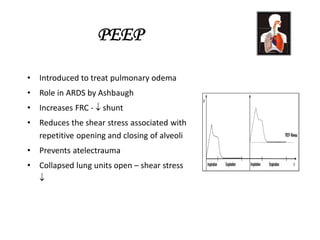
• Introduced to treat pulmonary odema
• Role in ARDS by Ashbaugh
• Increases FRC -  shunt
• Reduces the shear stress associated with
repetitive opening and closing of alveoli
• Prevents atelectrauma
• Collapsed lung units open – shear stress

Strategies to set Ideal PEEP levels
• Should recruit & prevent derecruitment
• Least effect on Cardiac output
• Should not contribute to VILI
• Low levels may not open alveoli
• Commonly used PEEP <20cm H2O
• Observe pressure volume loops
• Set upper and lower inflection points
• Cumbersome ,may not be detectable
• PEEP has become integral part of recruitment maneuvers
Plateau Tidal
Pressure Volume
0 0
11 100
14 200
15 300
17 400
19 500
21 600
23 700
24 800
27 900
37 1000
P-V Curve
0
200
400
600
800
1000
1200
0 10 20 30 40
Plateau Pressure
Tidal
Volumes
Lower Inflection Point
Upper Inflection Point
Pressure Volume Curve
Development of Lung Protective
Ventilatory strategies
• High VT v/s low VT
• volume v/s Pressure
controlled
• Prone position
• Recruitment Maneuvers
BEGINNING OF COLLAPSE OF
UNSTABLE ALVEOLI
MOST UNITS COLLAPSED
(INCLUDING SMALL AIRWAYS)
START OF RECRUITMENT
(ESPECIALLY SMALL AIRWAYS)
END OF RECRUITMENT
Pflex
VOLUME
Goals of Ideal Lung Protective
Strategy
• Keep P plat <35cmH20
• Bring down FiO2 to 0.5-0.6
• Avoid over distension
• Prevent barotrauma, volutrauma, atelectrauma,
biotrauma
• Maintain haemodynamics
• Should maintain adequate end exp volume
While selecting ventilatory strategy
REMEMBER THE CONCEPT
Buy time –Doing least harm
Lower TV vs Conventional TV
• NIH ARDSnet Trial
• VT 6ml/kg vs. 12ml/kg predicted body
weight
• Plateau pressure limit 30cmH20
50cmH20
• Higher PEEP requirement in low VT
group
• Reduced in hospital mortality
• Level I evidence
NEJM 2000 , 342 , 1301-8
0.0
0.1
0.2
0.3
0.4
0.5
0.6
0.7
0.8
0.9
1.0
0 20 40 60 80 100 120 140 160 180
Days after Randomization
ProportionofPatients
Lower VT Survival
Lower VT Discharge
Traditional VT Survival
Traditional VT Discharge
Ventilation with Lower VT vs. Traditional VT for
ALI and ARDS
ARDS network NEJM 2000;342:1301
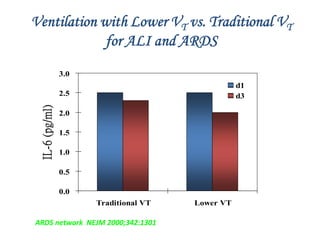
0.0
0.5
1.0
1.5
2.0
2.5
3.0
Traditional VT Lower VT
IL-6(pg/ml)
d1
d3
Ventilation with Lower VT vs. Traditional VT
for ALI and ARDS
ARDS network NEJM 2000;342:1301
Authors/year N Benefit Pplat (cmH2O)
Amato/1998 53 yes 38 vs. 24
Stewart/1998 120 no 28 vs. 20
Brochard/1998 116 no 32 vs. 26
Brower/1999 52 no 31 vs. 25
ARDSNET/2000 861 yes 37 vs. 26
Comparison of Randomized Trials of Lower VT
in ARDS
References: 1.NEJM 338:347 2. NEJM 338:355
3. AJRCCM 158:1831 4. CCM 27:1492 5. NEJM 342:1301
Lessons from ARDS NET Trail
• Correct implementation of recruitment
norms
• How to set the appropriate PEEP
• P plateau to be limited
• Still taken as bench mark study
Slutsky & Ranieri : Resp Res 2001 (2) ;73-77
Revival of Pressure Controlled Ventilation
•Use in NRDS
•limit peak pressure
•PCV: constant square waves of
pressure applied and released
•Pressure & time are constant,
volume variable
•Decelerating flow
Pressure
Flow
A B
Time Cycled
Flow Cycled
Pressure Controlled Ventilation
• PCV-SIMV, PCV-CMV, PCV-IRV
• Peak pressure  , mean pressure  - better
oxygenation
• Pressure selected to deliver adequate VT
• Monitor , VT , compliance ,auto –PEEP, mean
pressures
Pressure Controlled Ventilation
• 101 clinical investigations - 3264 patients reported
•  mortality in PCV v/s VCV
• Lack of power in the studies
• Intervention - PHC and IRV were used
Krafft et al ;An analysis of 101 clinical investigation.
Intensive Care Med 22:519, 1996
Inverse Ratio Ventilation
• First used in neonate
• Prolongation of I time
• Short expiratory time
• Decelerating Insp Flow Pattern
• Use of pressure controlled
ventilation
• Use of sedation and muscle
relaxation 
• Permissive Hypercapnia
FLOW
Pressure
0
Benefits of IRV
• Peak pressure  , mean pressure 
• Prolonged inspiratory time - sustained inflation
• Prevents collapse during short expiration
• Uniform distribution of gases
• V/Q mismatch is 
• FiO2 can be brought down faster
• PEEP is reduced , however intrinsic PEEP 
Permissive Hypercapnia
• All protective strategies ++ PaCO2
• Low VT and short exp times
• Viewed as an unpleasant side effect
• ? plays a major role in lung protection
• Level ideally maintained at 60mmHg
Feihl EF: How permissive should we be?
Am J Resp Crit Care Med 1994:150, 1722-37
Positive Effects of PHC
•   neutrophil function
•  platelet aggregation
•  cell adhesion
•  lipid peroxidation
•  injury with  PaCO2
Prone position in ARDS
Proposed Explanations
• Increased FRC
• Blood Flow Redistribution
• Changes in Diaphragmatic
Motion
• Improved Secretion Removal
Ventral
Dorsal
Dorsal
Ventral
Mechanism of Prone Positioning
Prone Positioning: Procedure
• Appropriate staff to manage patient and
“tubes”.
• Minimize abdominal pressure.
• Maintain pt in Swimming position (one
arm extended over head, head turned to
that side)
• Sedation generally required.
Prone Positioning: How Long?
Fridrich et al, Anesth Analg 1996;83:1206-1211
Prone Position
• Prone-Supine Study Group
• Multicenter randomized clinical trial
• 304 adult patients prospectively
randomized to 10 days of supine vs.
prone ventilation 6 hours/day
• Improved oxygenation in prone position
• No improvement in survival
NEJM 2001;345:568-73
Open lung concept
• Law of Laplace
• Critical opening pressure
• Prevent destabilization
• Open and keep it open
• 30-40cmH2O PEEP with PCV
30-40sec
60cmH2O
40cmH2O
PEEP
5cm H2O
PIP 30 cm
H2O
150 cm H2O
1. Expiration 2. Inspiration
PIP 50
cm H2O
PEEP 12
cm H2O
PEEP 12
cm H2O
3. Opening
procedure
4. Expiration
Recruitment Maneuvers
• Exact mech not understood
• Airway opening move fluid to periphery
overcome shear stress
• Open the collapsed alveoli
• Requires high sustained pressures
Barotrauma Haemodynamic instability
Criteria to apply RMS
• Perform early in disease
• Maintain haemodynamic stability
• Monitor HR, Art press, SpO2
•  FiO2 to 1 , 5 min before each RM
• Use in line suction and aerosol therapy
• Sedation mandatory
• Multiple RMS may be required
• Successful RMS PaO2/ FiO2 >300
Recruitment Manouvres
• Conceptual goal of RM maneuver- use single
breath to provide max recruitment
• Bring lung down on deflation limb on PV curve
• PEEP required is less than opening pressure
• Airway Pressure required for ventilation is less
• Airspaces are open throughout ventilatory cycles
• Improves V/Q and reduces VILI
Approaches
• Four different approaches
• Single breath 1.5 – 2 times the set VT is applied every one or
two minutes
• PEEP is temporarily ++,subsequent end inspiratory volume is

• VT can be raised temporarily
• High levels of CPAP applied for set point of time
• RM can be applied with PCV 20cmH2O and PEEP 30-40cmH20
for 1-2min
Karmarek RM strategies to optimize alveolar recruitment. Curr. Opin. Crit.
Care 2001:7;15-20
Aggressive RMS
• CT images showed improvement in
collapse lung
• Better oxygenation  mortality
Amato MB et al : N Engl J Med 1998:338;
345-54
Unanswered Questions
• Who is the ideal patient for RM?
• Which is the best technique?
• How to set PEEP?
• How to monitor recruitment ?
• Safety of the maneuver
• Their effect on survival
Hess D R : The role of recruitment maneuvers,
Respir Care 2002: 47;308-318
Million Dollar Question
• At the end of RM’s are the lungs happy or
pretty?
• Maximizing O2 tension by aggressive RMS
• May be gratifying - short term effect
• Whether it prevents lung injury and promotes
repair?
Hubmayor RD, A skeptical look at opening and collapse
story :Am J Respir Crit Care Med 2002, 156; 1647-53
High frequency ventilation
• Introduced by Lunkenheimer 1972
• Expiration and Inspiration active process
• VT 1-3ml/kg ,freq 100 - 2400/min
• No gas entrainment
• Better humidification and weaning
• Prevents air trapping,over distension and
CVS depression
High frequency ventilation
• Very low VT equivalent to dead space
• high freq ventilation disappointing
• HFO extensively used in neonates
• Applied for severe ARDS – Rescue therapy
• Mean pressures ++ better oxygenation
• Set the PAW 5cmH2O above that used for conventional
• Early institution may be beneficial
Mehta et al :Prospective trial Crit Care Med 2001: 29(7) 1360-69
High frequency ventilation
• MRCT 148 patients with ARDS
• Randomized to CMV and HFOV
• In hospital mortality no difference
• 30 days ( 87 vs. 52)
Derdak S etal Am J Respir Crit Care Med 2002
15 :166 (6) ;801-808
Airway Pressure Release Ventilation
• Can minimize lung volume
expansion
• Inflation pressure is CPAP level
– Best compliance ,
oxygenation
• APRV supports ventilation at
optimal resting volumes
• Pulmonary volume is
maximized at FRC
Airway Pressure Release Ventilation
• APRV used in patients with lung injury
• Improved haemodynamics
• Reduced peak and mean airway pressures
• Decreased use of sedatives and relaxants
• Improved cardiac index
• Pressor agents usage is reduced
• Shortened the length of mech ventilation
Kaplan et al , Crit Care 2001,5(4) ;221-226
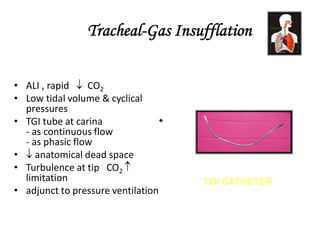
Tracheal-Gas Insufflation
• ALI , rapid  CO2
• Low tidal volume & cyclical
pressures
• TGI tube at carina
- as continuous flow
- as phasic flow
•  anatomical dead space
• Turbulence at tip CO2 
limitation
• adjunct to pressure ventilation
TGI CATHETER
Tracheal-Gas Insufflation
Disadvantages
• Mucosal damage
• Barotrauma
• secretion retention
Partial liquid ventilation
• Perfluorochemicals (PCF) liquids
• Dissolve O2 and CO2
• Evaporates slowly
• Dist . Homogenously
• Low surface tension
• Viscosity like water (Perflubron)
• Both liquid & gas ventilation
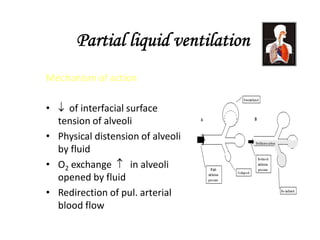
Partial liquid ventilation
Mechanism of action
•  of interfacial surface
tension of alveoli
• Physical distension of alveoli
by fluid
• O2 exchange  in alveoli
opened by fluid
• Redirection of pul. arterial
blood flow
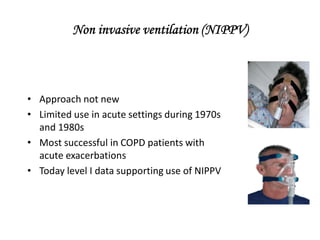
Non invasive ventilation (NIPPV)
• Approach not new
• Limited use in acute settings during 1970s
and 1980s
• Most successful in COPD patients with
acute exacerbations
• Today level I data supporting use of NIPPV
Five randomized controlled trials have been published
Pt type NPPV/
Control
% intubated
NIV/Control
Mortality %
NIV/Control
Bott et al COPD 26/30 0/0 3.8/27
Kramer et al mixed 16/15 31/70 6.3/13
Wysocki et al mixed 11/6 36/100 9/66
Brochard et al COPD 43/42 26/74 9/29
Barbe et al COPD 14/10 0/0 0/0
Nava et al COPD 25/25 88/68 8/23
Antonelli et al Hypoxaemic
Resp failure
32/32 31/100 28/47
Dual modes
• Most modern ventilators offer useful
new modes
• The benefit of pressure limited breaths
• The security of assured VT
• Better synchrony and more comfort
• Low work of breathing
Combined Pressure Volume Targetted Modes
• PCV- Permissive hypercapnia,
++sedation,
VT variability
• VCV- Flow starvation
over distension
• Future –look at combination of both
New modes of assisted ventilation
• Within breath adjustment
- Volume assured pressure support
- Automatic tube compensation
- Proportional assist ventilation
• Between breath adjustment
- Volume support
- Pressure –regulated volume control
- Adaptive support ventilation
What will last for future?
• Noninvasive positive pressure ventilation
• Lung protective ventilatory strategies
• Combined pressure –volume targeted modes
• Prone position ventilation
• Tracheal gas insufflation
Kacmarek RM :chestnet.org/edu/pccu/vol114
RICU Experience -NIMS
Background
• Established in 1990
• Started with minimum infrastructure
• Nurse patient ratio inadequate
• Developed over 13yrs
ARDS and ventilatory strategies
Our Journey
Early half – 1990’s
• CMV/SIMV
• Used 10ml/kg + PEEP 10cmH2O
• Mortality high-70%
• Later use of 8ml/kg with higher PEEP 15cmH2O
• Mortality –58%
Year 1996 onwards
• SIMV / A/C
• Lower VT 5-6ml/kg while titrating PEEP
• Aimed to maintain PaO2 >60 with SaO2 >90%
• Haemodynamics monitored
• Mortality 45%
ARDS and ventilatory strategies
Our Journey
Year 2000
• Lung protective ventilatory strategy using low VT effective
• Good survival rate in pt with mild to moderate lung injury
scores-Mortality of 26.3%
• High mortality seen with LIS >3,66.6%
• Implementation of Pressure control ventilation
• Initial results disappointing
Year 2003
• Improved survival seen with use of pressure control
ventilation especially with early application of PCV in
patients with LIS >2.5. Mortality 22.8%
Our Statistics
INJURY NO. DEATHS %SURVIVAL % DEATHS
Mild 3 - 3 0
Mod 30 8 73.3 26.6%
Sev 15 10 33.3 66.6%
Use of Lung protective ventilatory strategies
NIMS RICU Census Jan 2002 – Dec 2002
ARDS cases – 94
• Age range – 13-68
• M/F ratio – 2.9:1
Causes Total Mortality
Pneumonia 14 9 (64%)
Systemic sepsis 37 21 (56%)
Postop sepsis 18 5 (27%)
Trauma 4 0
Fat embolism 7 0
Aspiration 6 3 (50%)
Drowning 1 0
Snake bite 2 0
Malaria 3 1 (33%)
Pancreatitis 2 1 (50%)
Total 94 40 (42%)
Statistics in Jan 2002 – Dec 2002
• VCV - 77
• PCV - 12
• NIPV - 5
No of
patients
Mode of
ventilation
Survival Mortality
74 LPVS- VCV 61.03% 38.9%
12 PCV 25% 75%
• Total Mortality 42%
• 4-5 organ failure noted
• Survival 58%
Our Experience with Pressure Control
Ventilation
Year 2003
• 35 adult patients with ARDS ,LIS >2.5,
• initially ventilated with LPVS VCV mode subsequently switched over
to PCV.
• The reasons - high peak airway pressures and inability to maintain
oxygenation despite high PEEP.
• Results:.
• The mean PaO2/FiO2 ratio at VCV- 100±13, at 30min of institution of
PCV 136±17
• The mean time for achieving SpO2>90% was 37.28±5min, and for
attaining PaO2/FiO2>200 was 26.89± 14hrs.
• The average number of ventilatory days was 7.05±2days.
• The mortality was 22.85%.
Conclusions
• Magic bullet ventilatory strategy –not yet
• Mr GOOD MODE - still evading
• Absence of definitive proof
• ARDS NET trial bench mark
• Happy lungs or pretty lungs- debate?
• “Buy time – do least harm” - is the
prescription
Conclusions
• Magic bullet ventilatory strategy to an
extent
• Mr GOOD MODE - still evading
• Absence of definitive proof
• ARDS NET trial bench mark
• Happy lungs or pretty lungs- debate?
• “Buy time – do least harm” - is the
prescription
Ventilatory strategies in ARDS

Ventilatory strategies in ARDS

  • 1.
    Ventilatory Strategies ALI/ARDS Dr SManimala Rao Senior Consultant Emeritus Professor Dept. of Anaesthesiology & Critical Care Nizam’s Institute Of Medical Sciences Hyderabad, A.P INDIA
  • 2.
  • 3.
    How is thelung in ARDS ? It has 3 components • Diseased lung not recruitable • Diseased lung recruitable • Normal lung 20 -5 20 +5 Influence of chest wall compliance on lung distension and alveolar pressure Normal Stiff Chest Wall
  • 4.
    Problems in injuredlungs • Over distension • High peak airway pressures • Low compliance • High FiO2 –absorption atelectasis • Free radical injury
  • 5.
    How & Whyvarious ventilatory strategies developed • Basis of supportive therapy • Mortality decreased • Quest for ideal strategy • Understanding the pathophysiology- baby lung concept , CT scans ,Volutrauma, Atelectrauma, Biotrauma • To decrease VILI • Survival  with ventilatory strategy
  • 6.
    Deleterious Effects ofMechanical Ventilation • Has effect on surfactant • Increases cytokines • Migration of neutrophils • Bacterial /Endotoxin translocation
  • 7.
    History of MechanicalVentilation • 1774 Hunter Bellows for resuscitation • 1827 Leroy setback due to barotrauma • 1934 Freckner : Mech ventilators. • 1940 Crawford : Commercial Ventilators • 1945 Blease developed Prototype • 1952 Isben :Polio epidemic to and fro • 1967 Ashbaugh defined ARDS PEEP improves oxygenation
  • 8.
    Positive End ExpiratoryPressure (PEEP) and CPAP • Applied for controlled and spontaneous ventilation • Used to reduce or prevent atelectasis in ALI/ARDS • Reduce inspiratory load , work of breathing • Effects of PEEP and CPAP are similar for lung mechanics • Different effect on V/Q ratio ,CVS • CMV +PEEP – pressure gradient by mech ventilation, intrapleural pressure  • CPAP - pressure gradient by resp muscle ,intrapleural pressure 
  • 9.
    Controlled Mechanical Ventilation(CMV) Assist Control (AC) • Use of large tidal volumes • Square or sine wave flows • Decreases ventilatory inequalities • Better distribution of flow • Keep plateau pressure < 45cmH20 • Assist control is a popular mode • Retains spontaneous effort with back up
  • 10.
    Volume Ventilation • Constantflow rate • Guaranteed tidal volume delivery • Not affected by lung impedance • Variable pressure Pressure Flow
  • 11.
    Synchronized Mandatory Ventilation (SIMV) •Preserves spontaneous respiratory effort • Decreases WOB • Prevents patient and ventilatory disharmony • Decreases the need for sedatives and relaxants • SIMV volume preset with decelerating flows
  • 12.
    Pressure Support •Patient spontaneous breathssupported by the preset Pressure Support. • Elevates the inspiratory pressure above the baseline •Decelerating, variable inspiratory flow rate Flow A B Flow Cycled Time cycled: (A) • Pressure Control Flow cycled: (B) • Pressure Support
  • 13.
    Continous Positive AirwayPressure (CPAP) • Developed mode for ARDS  lung volumes • Popular for weaning & for spontaneous breaths • Useful in ALI -  shunting & WOB • Non invasive ventilation to improve oxygenation
  • 14.
    PEEP • Introduced totreat pulmonary odema • Role in ARDS by Ashbaugh • Increases FRC -  shunt • Reduces the shear stress associated with repetitive opening and closing of alveoli • Prevents atelectrauma • Collapsed lung units open – shear stress 
  • 15.
    Strategies to setIdeal PEEP levels • Should recruit & prevent derecruitment • Least effect on Cardiac output • Should not contribute to VILI • Low levels may not open alveoli • Commonly used PEEP <20cm H2O • Observe pressure volume loops • Set upper and lower inflection points • Cumbersome ,may not be detectable • PEEP has become integral part of recruitment maneuvers
  • 16.
    Plateau Tidal Pressure Volume 00 11 100 14 200 15 300 17 400 19 500 21 600 23 700 24 800 27 900 37 1000 P-V Curve 0 200 400 600 800 1000 1200 0 10 20 30 40 Plateau Pressure Tidal Volumes Lower Inflection Point Upper Inflection Point Pressure Volume Curve
  • 17.
    Development of LungProtective Ventilatory strategies • High VT v/s low VT • volume v/s Pressure controlled • Prone position • Recruitment Maneuvers BEGINNING OF COLLAPSE OF UNSTABLE ALVEOLI MOST UNITS COLLAPSED (INCLUDING SMALL AIRWAYS) START OF RECRUITMENT (ESPECIALLY SMALL AIRWAYS) END OF RECRUITMENT Pflex VOLUME
  • 18.
    Goals of IdealLung Protective Strategy • Keep P plat <35cmH20 • Bring down FiO2 to 0.5-0.6 • Avoid over distension • Prevent barotrauma, volutrauma, atelectrauma, biotrauma • Maintain haemodynamics • Should maintain adequate end exp volume
  • 19.
    While selecting ventilatorystrategy REMEMBER THE CONCEPT Buy time –Doing least harm
  • 20.
    Lower TV vsConventional TV • NIH ARDSnet Trial • VT 6ml/kg vs. 12ml/kg predicted body weight • Plateau pressure limit 30cmH20 50cmH20 • Higher PEEP requirement in low VT group • Reduced in hospital mortality • Level I evidence NEJM 2000 , 342 , 1301-8
  • 21.
    0.0 0.1 0.2 0.3 0.4 0.5 0.6 0.7 0.8 0.9 1.0 0 20 4060 80 100 120 140 160 180 Days after Randomization ProportionofPatients Lower VT Survival Lower VT Discharge Traditional VT Survival Traditional VT Discharge Ventilation with Lower VT vs. Traditional VT for ALI and ARDS ARDS network NEJM 2000;342:1301
  • 22.
    0.0 0.5 1.0 1.5 2.0 2.5 3.0 Traditional VT LowerVT IL-6(pg/ml) d1 d3 Ventilation with Lower VT vs. Traditional VT for ALI and ARDS ARDS network NEJM 2000;342:1301
  • 23.
    Authors/year N BenefitPplat (cmH2O) Amato/1998 53 yes 38 vs. 24 Stewart/1998 120 no 28 vs. 20 Brochard/1998 116 no 32 vs. 26 Brower/1999 52 no 31 vs. 25 ARDSNET/2000 861 yes 37 vs. 26 Comparison of Randomized Trials of Lower VT in ARDS References: 1.NEJM 338:347 2. NEJM 338:355 3. AJRCCM 158:1831 4. CCM 27:1492 5. NEJM 342:1301
  • 24.
    Lessons from ARDSNET Trail • Correct implementation of recruitment norms • How to set the appropriate PEEP • P plateau to be limited • Still taken as bench mark study Slutsky & Ranieri : Resp Res 2001 (2) ;73-77
  • 25.
    Revival of PressureControlled Ventilation •Use in NRDS •limit peak pressure •PCV: constant square waves of pressure applied and released •Pressure & time are constant, volume variable •Decelerating flow Pressure Flow A B Time Cycled Flow Cycled
  • 26.
    Pressure Controlled Ventilation •PCV-SIMV, PCV-CMV, PCV-IRV • Peak pressure  , mean pressure  - better oxygenation • Pressure selected to deliver adequate VT • Monitor , VT , compliance ,auto –PEEP, mean pressures
  • 27.
    Pressure Controlled Ventilation •101 clinical investigations - 3264 patients reported •  mortality in PCV v/s VCV • Lack of power in the studies • Intervention - PHC and IRV were used Krafft et al ;An analysis of 101 clinical investigation. Intensive Care Med 22:519, 1996
  • 28.
    Inverse Ratio Ventilation •First used in neonate • Prolongation of I time • Short expiratory time • Decelerating Insp Flow Pattern • Use of pressure controlled ventilation • Use of sedation and muscle relaxation  • Permissive Hypercapnia FLOW Pressure 0
  • 29.
    Benefits of IRV •Peak pressure  , mean pressure  • Prolonged inspiratory time - sustained inflation • Prevents collapse during short expiration • Uniform distribution of gases • V/Q mismatch is  • FiO2 can be brought down faster • PEEP is reduced , however intrinsic PEEP 
  • 30.
    Permissive Hypercapnia • Allprotective strategies ++ PaCO2 • Low VT and short exp times • Viewed as an unpleasant side effect • ? plays a major role in lung protection • Level ideally maintained at 60mmHg Feihl EF: How permissive should we be? Am J Resp Crit Care Med 1994:150, 1722-37
  • 31.
    Positive Effects ofPHC •   neutrophil function •  platelet aggregation •  cell adhesion •  lipid peroxidation •  injury with  PaCO2
  • 32.
    Prone position inARDS Proposed Explanations • Increased FRC • Blood Flow Redistribution • Changes in Diaphragmatic Motion • Improved Secretion Removal
  • 33.
  • 34.
    Prone Positioning: Procedure •Appropriate staff to manage patient and “tubes”. • Minimize abdominal pressure. • Maintain pt in Swimming position (one arm extended over head, head turned to that side) • Sedation generally required.
  • 35.
    Prone Positioning: HowLong? Fridrich et al, Anesth Analg 1996;83:1206-1211
  • 36.
    Prone Position • Prone-SupineStudy Group • Multicenter randomized clinical trial • 304 adult patients prospectively randomized to 10 days of supine vs. prone ventilation 6 hours/day • Improved oxygenation in prone position • No improvement in survival NEJM 2001;345:568-73
  • 37.
    Open lung concept •Law of Laplace • Critical opening pressure • Prevent destabilization • Open and keep it open • 30-40cmH2O PEEP with PCV 30-40sec 60cmH2O 40cmH2O PEEP 5cm H2O PIP 30 cm H2O 150 cm H2O 1. Expiration 2. Inspiration PIP 50 cm H2O PEEP 12 cm H2O PEEP 12 cm H2O 3. Opening procedure 4. Expiration
  • 38.
    Recruitment Maneuvers • Exactmech not understood • Airway opening move fluid to periphery overcome shear stress • Open the collapsed alveoli • Requires high sustained pressures Barotrauma Haemodynamic instability
  • 39.
    Criteria to applyRMS • Perform early in disease • Maintain haemodynamic stability • Monitor HR, Art press, SpO2 •  FiO2 to 1 , 5 min before each RM • Use in line suction and aerosol therapy • Sedation mandatory • Multiple RMS may be required • Successful RMS PaO2/ FiO2 >300
  • 40.
    Recruitment Manouvres • Conceptualgoal of RM maneuver- use single breath to provide max recruitment • Bring lung down on deflation limb on PV curve • PEEP required is less than opening pressure • Airway Pressure required for ventilation is less • Airspaces are open throughout ventilatory cycles • Improves V/Q and reduces VILI
  • 41.
    Approaches • Four differentapproaches • Single breath 1.5 – 2 times the set VT is applied every one or two minutes • PEEP is temporarily ++,subsequent end inspiratory volume is  • VT can be raised temporarily • High levels of CPAP applied for set point of time • RM can be applied with PCV 20cmH2O and PEEP 30-40cmH20 for 1-2min Karmarek RM strategies to optimize alveolar recruitment. Curr. Opin. Crit. Care 2001:7;15-20
  • 42.
    Aggressive RMS • CTimages showed improvement in collapse lung • Better oxygenation  mortality Amato MB et al : N Engl J Med 1998:338; 345-54
  • 43.
    Unanswered Questions • Whois the ideal patient for RM? • Which is the best technique? • How to set PEEP? • How to monitor recruitment ? • Safety of the maneuver • Their effect on survival Hess D R : The role of recruitment maneuvers, Respir Care 2002: 47;308-318
  • 44.
    Million Dollar Question •At the end of RM’s are the lungs happy or pretty? • Maximizing O2 tension by aggressive RMS • May be gratifying - short term effect • Whether it prevents lung injury and promotes repair? Hubmayor RD, A skeptical look at opening and collapse story :Am J Respir Crit Care Med 2002, 156; 1647-53
  • 45.
    High frequency ventilation •Introduced by Lunkenheimer 1972 • Expiration and Inspiration active process • VT 1-3ml/kg ,freq 100 - 2400/min • No gas entrainment • Better humidification and weaning • Prevents air trapping,over distension and CVS depression
  • 46.
    High frequency ventilation •Very low VT equivalent to dead space • high freq ventilation disappointing • HFO extensively used in neonates • Applied for severe ARDS – Rescue therapy • Mean pressures ++ better oxygenation • Set the PAW 5cmH2O above that used for conventional • Early institution may be beneficial Mehta et al :Prospective trial Crit Care Med 2001: 29(7) 1360-69
  • 47.
    High frequency ventilation •MRCT 148 patients with ARDS • Randomized to CMV and HFOV • In hospital mortality no difference • 30 days ( 87 vs. 52) Derdak S etal Am J Respir Crit Care Med 2002 15 :166 (6) ;801-808
  • 48.
    Airway Pressure ReleaseVentilation • Can minimize lung volume expansion • Inflation pressure is CPAP level – Best compliance , oxygenation • APRV supports ventilation at optimal resting volumes • Pulmonary volume is maximized at FRC
  • 49.
    Airway Pressure ReleaseVentilation • APRV used in patients with lung injury • Improved haemodynamics • Reduced peak and mean airway pressures • Decreased use of sedatives and relaxants • Improved cardiac index • Pressor agents usage is reduced • Shortened the length of mech ventilation Kaplan et al , Crit Care 2001,5(4) ;221-226
  • 50.
    Tracheal-Gas Insufflation • ALI, rapid  CO2 • Low tidal volume & cyclical pressures • TGI tube at carina - as continuous flow - as phasic flow •  anatomical dead space • Turbulence at tip CO2  limitation • adjunct to pressure ventilation TGI CATHETER
  • 51.
    Tracheal-Gas Insufflation Disadvantages • Mucosaldamage • Barotrauma • secretion retention
  • 52.
    Partial liquid ventilation •Perfluorochemicals (PCF) liquids • Dissolve O2 and CO2 • Evaporates slowly • Dist . Homogenously • Low surface tension • Viscosity like water (Perflubron) • Both liquid & gas ventilation
  • 53.
    Partial liquid ventilation Mechanismof action •  of interfacial surface tension of alveoli • Physical distension of alveoli by fluid • O2 exchange  in alveoli opened by fluid • Redirection of pul. arterial blood flow
  • 54.
    Non invasive ventilation(NIPPV) • Approach not new • Limited use in acute settings during 1970s and 1980s • Most successful in COPD patients with acute exacerbations • Today level I data supporting use of NIPPV
  • 55.
    Five randomized controlledtrials have been published Pt type NPPV/ Control % intubated NIV/Control Mortality % NIV/Control Bott et al COPD 26/30 0/0 3.8/27 Kramer et al mixed 16/15 31/70 6.3/13 Wysocki et al mixed 11/6 36/100 9/66 Brochard et al COPD 43/42 26/74 9/29 Barbe et al COPD 14/10 0/0 0/0 Nava et al COPD 25/25 88/68 8/23 Antonelli et al Hypoxaemic Resp failure 32/32 31/100 28/47
  • 56.
    Dual modes • Mostmodern ventilators offer useful new modes • The benefit of pressure limited breaths • The security of assured VT • Better synchrony and more comfort • Low work of breathing
  • 57.
    Combined Pressure VolumeTargetted Modes • PCV- Permissive hypercapnia, ++sedation, VT variability • VCV- Flow starvation over distension • Future –look at combination of both
  • 58.
    New modes ofassisted ventilation • Within breath adjustment - Volume assured pressure support - Automatic tube compensation - Proportional assist ventilation • Between breath adjustment - Volume support - Pressure –regulated volume control - Adaptive support ventilation
  • 59.
    What will lastfor future? • Noninvasive positive pressure ventilation • Lung protective ventilatory strategies • Combined pressure –volume targeted modes • Prone position ventilation • Tracheal gas insufflation Kacmarek RM :chestnet.org/edu/pccu/vol114
  • 60.
    RICU Experience -NIMS Background •Established in 1990 • Started with minimum infrastructure • Nurse patient ratio inadequate • Developed over 13yrs
  • 61.
    ARDS and ventilatorystrategies Our Journey Early half – 1990’s • CMV/SIMV • Used 10ml/kg + PEEP 10cmH2O • Mortality high-70% • Later use of 8ml/kg with higher PEEP 15cmH2O • Mortality –58% Year 1996 onwards • SIMV / A/C • Lower VT 5-6ml/kg while titrating PEEP • Aimed to maintain PaO2 >60 with SaO2 >90% • Haemodynamics monitored • Mortality 45%
  • 62.
    ARDS and ventilatorystrategies Our Journey Year 2000 • Lung protective ventilatory strategy using low VT effective • Good survival rate in pt with mild to moderate lung injury scores-Mortality of 26.3% • High mortality seen with LIS >3,66.6% • Implementation of Pressure control ventilation • Initial results disappointing Year 2003 • Improved survival seen with use of pressure control ventilation especially with early application of PCV in patients with LIS >2.5. Mortality 22.8%
  • 63.
    Our Statistics INJURY NO.DEATHS %SURVIVAL % DEATHS Mild 3 - 3 0 Mod 30 8 73.3 26.6% Sev 15 10 33.3 66.6% Use of Lung protective ventilatory strategies
  • 64.
    NIMS RICU CensusJan 2002 – Dec 2002 ARDS cases – 94 • Age range – 13-68 • M/F ratio – 2.9:1 Causes Total Mortality Pneumonia 14 9 (64%) Systemic sepsis 37 21 (56%) Postop sepsis 18 5 (27%) Trauma 4 0 Fat embolism 7 0 Aspiration 6 3 (50%) Drowning 1 0 Snake bite 2 0 Malaria 3 1 (33%) Pancreatitis 2 1 (50%) Total 94 40 (42%)
  • 65.
    Statistics in Jan2002 – Dec 2002 • VCV - 77 • PCV - 12 • NIPV - 5 No of patients Mode of ventilation Survival Mortality 74 LPVS- VCV 61.03% 38.9% 12 PCV 25% 75% • Total Mortality 42% • 4-5 organ failure noted • Survival 58%
  • 66.
    Our Experience withPressure Control Ventilation Year 2003 • 35 adult patients with ARDS ,LIS >2.5, • initially ventilated with LPVS VCV mode subsequently switched over to PCV. • The reasons - high peak airway pressures and inability to maintain oxygenation despite high PEEP. • Results:. • The mean PaO2/FiO2 ratio at VCV- 100±13, at 30min of institution of PCV 136±17 • The mean time for achieving SpO2>90% was 37.28±5min, and for attaining PaO2/FiO2>200 was 26.89± 14hrs. • The average number of ventilatory days was 7.05±2days. • The mortality was 22.85%.
  • 67.
    Conclusions • Magic bulletventilatory strategy –not yet • Mr GOOD MODE - still evading • Absence of definitive proof • ARDS NET trial bench mark • Happy lungs or pretty lungs- debate? • “Buy time – do least harm” - is the prescription
  • 68.
    Conclusions • Magic bulletventilatory strategy to an extent • Mr GOOD MODE - still evading • Absence of definitive proof • ARDS NET trial bench mark • Happy lungs or pretty lungs- debate? • “Buy time – do least harm” - is the prescription