Dr. Chandan Kumar Sheet
P. G. Student,
Dept. of Pulmonary Medicine
VIMSAR,Burla,Odisha,India
 Definition - Presence of significant amount of blood in the
pleural space
 Causes-
Trauma - Penetrating Medical- Pulmonary embolism
- Non penetrating - Ruptured aortic aneurism
- Iatragenic
- CVC in Subclavian/Jugular vein
- Trans lumber aortography
 Source of blood
- Chest wall
- Lung
- Mediastinum
- Diaphragm
 Blood entering the pleural space coagulate rapidly and defibrinated due
to physiologic movement of heart & lung.
 Loculations occur early
Traumatic hemothorax
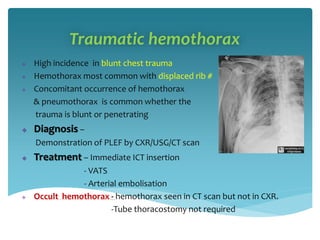
 High incidence in blunt chest trauma
 Hemothorax most common with displaced rib #
 Concomitant occurrence of hemothorax
& pneumothorax is common whether the
trauma is blunt or penetrating
 Diagnosis –
Demonstration of PLEF by CXR/USG/CT scan
 Treatment – Immediate ICT insertion
- VATS
- Arterial embolisation
 Occult hemothorax - hemothorax seen in CT scan but not in CXR.
-Tube thoracostomy not required
Tube thoracostomy
 Indication - diaphragmatic dome is obscured or
- fluid >2cm in thickness in lateral decubitus CXR
 Conditions indicating immediate ICT
- Cardiac temponade
- Continued pleural hemorrhage
- Vascular injury (initial chest drain if >1500 ml )
- Pleural contamination
- Debridement of devitalized tissue
- Sucking chest wound
- Major bronchial air leak
 Size of ICT- Large bore (24 to 36 F)
 Site - high ICS (4th or 5th ) at MAL as diaphragm may be elevated by
trauma
Tube thoracostomy…cont..
 Removal of ICT- as soon as they stop draining or cease to
function as it can cause infection
 Advantages of immediate ICT
- Allow complete evacuation of blood
- Stops bleeding from pleural lacerations (if present)
- Easy to quantitate the amount of bleeding
- Decrease incidence of empyema (blood is a good conductor
of infection )
- Blood may be auto transfused
- Rapid evacuation of blood decreased incidence of fibrothorax
VATS
 Indications- no precise criteria available but
- If Bleeding >200 ml/hr & no signs of slowing bleeding
(bleeding is not from misplaced central line should be ensured)
- Exsanguinating hemorrhage through the chest tube
 VATS is very effective in - Hemodynamically stable patient with
persistent bleeding (villavicencio et al)
- Controlling bleeding from intercostal
vessels with lung lacerations
CT guided arterial embolisation
 Patient with persistent bleeding first CECT thorax is done to detect the
injured vessel (exhibit contrast extravasation) then trans catheter arterial
embolization done
Prophylactic Antibiotics
 Role of prophylactic antibiotics for prevention of empyema in patient of
Tube thoracostomy in hemothorax is unclear.
 A Study done by Maxwell et al showed that
- 1.3% patient with antibiotics developed empyema
- 5.6% patient receiving no antibiotics developed empyema
 Longer duration of ICT & high thoracic trauma score associated with
higher incidence of empyema
Autotransfusion
 Barriot et al showed that pre hospital auto transfusion (in ambulance)
may prevent death in life-threatening hemothorax.
 They developed a system containing a 28-30 F ICT with auto-
transfusion device (750 ml bag with filter).
 The blood drains by gravity to ICT bag then re-transfused without
anticoagulant into a central line.
During transfer to the hospital 18 patient received 4.2 ± 0.6 L of
autotransfusion 13 patient survived with out complications
Complications of Hemothorax
 Clot Retention(3%)
 Pleural infection (3 to 4 %)
 Pleural effusion (13-34%)
 Fibrothorax(<1%)
Clot Retention
 In spite of ICT drainage some amount of blood may retain in
pleural space and leads to complications
 CXR - may misleading hemothorax with suspected clot retention
 CT scan - should be perform before surgical removal of clot
 If clot retention is diagnosed three question need to be asked
1)Clot removal needed or not?
2)When to remove?
3)How to remove?
 Indication of clot removal-
If the clot occupy atleast 1/3 of involved hemithorax 48 to 72 hrs after
initial ICT it should be removed
Clot Retention..cont..
 How to remove-
- Thoracoscopy (best method 48-72 hrs. after initial injury)
- VATS (optimal method)
- 2nd chest tube insertion (failure is high, eventually require
thoracoscopy or thoracotomy)
- Intra pleural fibrinolytics- (not recommended)
- more expensive than thoracoscopy
- longer hospitalization than thoracoscopy
- Hypoxemic respiratory failure
 When to remove-
between 48-72 h0urs (optimal time)
 Complications
- Retained collection - Persistent pleural drainage
- Air leaks - Empyema
- Fibrothorax
Post traumatic empyema
 Prevention - strict sterile technique during ICT
- Ensuring good apposition between both pleura
(no space to accumulate the fluid or blood)
 Risk factor
- Presence of BPF
- Pulmonary contusion
- Residual clotted haemothorax
- Gross contamination of pleural space during injury
- Patient with shock
- Patient with associated abdominal injury
- Prolonged pleural drainage
 Antibiotic administration reduced chance of empyema
Post hemothorax PLEF
 PLEF are common after ICT in hemothorax
 Wilson et al reported that
- 13% patient with out any residual blood developed
PLEF after ICT removal
- 34% patient with residual blood developed PLEF after discharge
 In This situation diagnistic thoracocentesis should be done to rule out
infection.
If no infection present no treatment required
Fibrothorax
 Diffuse pleural thickening producing fibrothorax irrespective of residual
blood in pleural cavity
 Takes weeks to months after the hemothorax
 Occurs in <1% of cases
 More common in - hemopneumothorax
- pleural infection
 Treatment - Decortication (definitive treatment)
Iatragenic Hemothorax
 Causes-
- Central venous catheterization
- Injury during trans lumber aortography
- Thoracocentesis
- Pleural biopsy
- Swan-Ganz catheterization
 Rare cause
- percutaneous lung aspiration or biopsy
- trans bronchial biopsy
- sclerotherapy in esophageal varices
- In ICU- common following invasive procedure in patient with CRF
 Treatment - ICT
Non traumatic hemothorax
Cause
-Malignant pleural disease (most common)
- schwanomma of von recklinghausen disease
- Sarcoma
- angiosarcoma
- HCC
- Anticoagulant therapy in PE
- Catamenial haemothorax
- Bleeding disorder- hemophilia, thrombocytopenia
- Complication of spontaneous pneumothorax
- Rupture thoracic aorta, aneurismal tear, rupture pulmonary AV
fistula, rupture PDA, rupture coaractation of aorta,
-Intrathoracic extramedullary haematopoiesis
-Chicken pox pneumonia
-Bronchopulmonary sequestration
-Unknown cause
Nontraumatic hemothorax..cont..
 Diagnosis- Pleural fluid Haematocrit - > 50% of blood
Or
Pleural fluid RBC > 50% of blood
o [a rough estimation of haematocrit can be obtained by pleural fluid
RBC/1,OO,OOO ]
o [ hematocrit <5 % in pleural fluid may look like blood]
 Treatment
- ICT
- thoracotomy / VATS- [If bleeding >100ml/ hr]
- Angiographic embolization [if bleeding from intercostal artery]
Hemothorax complicatind
anticoagulant therapy
 Occurs mainly in treatment of pulmonary embolism
 Drugs responsible
-heparin
-warfarin
-enoxaparin
 Hemothorax is apperent 4-7 days of initiation of treatment mainly
 Treatment
- Discontinuation of anticoagulant
- Immediate ICT
Catamenial Hemothorax
 Unusual
 Occurs in conjunction with menstruation
 Associated with endometriosis
 Rt hemithorax almost always involved
 Diaphragmatic fenestration and pleuro-peritonial communication
demonstrated in some patient
 Most patient have pleural endometriosis
 Treatment
- Suppression of ovulation by-OCP, progesterone
- Suppression of gonadotrophin by –danazole, GnRH
- Pleurodesis [if hormonal therapy fails]
- THBSO
Spontenious Hemopneumothorax
 Most common cause of non traumatic hemopneumothorax
 Different study shows that 3.8% to 6.6 % patients of spontaneous
pneumothorax have hemopneumothrax
 Sourse of bleeding-
-Aberrant vessels
- Torn parietal pleura
- Torn vascular adhesion band from parietal pleura
- Vascular bleb
 Treatment-
-VATS – if bleeding >100ml/hr or hypotension
THANK YOU….

Hemothorax

  • 1.
    Dr. Chandan KumarSheet P. G. Student, Dept. of Pulmonary Medicine VIMSAR,Burla,Odisha,India
  • 2.
     Definition -Presence of significant amount of blood in the pleural space  Causes- Trauma - Penetrating Medical- Pulmonary embolism - Non penetrating - Ruptured aortic aneurism - Iatragenic - CVC in Subclavian/Jugular vein - Trans lumber aortography  Source of blood - Chest wall - Lung - Mediastinum - Diaphragm  Blood entering the pleural space coagulate rapidly and defibrinated due to physiologic movement of heart & lung.  Loculations occur early
  • 3.
    Traumatic hemothorax  Highincidence in blunt chest trauma  Hemothorax most common with displaced rib #  Concomitant occurrence of hemothorax & pneumothorax is common whether the trauma is blunt or penetrating  Diagnosis – Demonstration of PLEF by CXR/USG/CT scan  Treatment – Immediate ICT insertion - VATS - Arterial embolisation  Occult hemothorax - hemothorax seen in CT scan but not in CXR. -Tube thoracostomy not required
  • 4.
    Tube thoracostomy  Indication- diaphragmatic dome is obscured or - fluid >2cm in thickness in lateral decubitus CXR  Conditions indicating immediate ICT - Cardiac temponade - Continued pleural hemorrhage - Vascular injury (initial chest drain if >1500 ml ) - Pleural contamination - Debridement of devitalized tissue - Sucking chest wound - Major bronchial air leak  Size of ICT- Large bore (24 to 36 F)  Site - high ICS (4th or 5th ) at MAL as diaphragm may be elevated by trauma
  • 5.
    Tube thoracostomy…cont..  Removalof ICT- as soon as they stop draining or cease to function as it can cause infection  Advantages of immediate ICT - Allow complete evacuation of blood - Stops bleeding from pleural lacerations (if present) - Easy to quantitate the amount of bleeding - Decrease incidence of empyema (blood is a good conductor of infection ) - Blood may be auto transfused - Rapid evacuation of blood decreased incidence of fibrothorax
  • 6.
    VATS  Indications- noprecise criteria available but - If Bleeding >200 ml/hr & no signs of slowing bleeding (bleeding is not from misplaced central line should be ensured) - Exsanguinating hemorrhage through the chest tube  VATS is very effective in - Hemodynamically stable patient with persistent bleeding (villavicencio et al) - Controlling bleeding from intercostal vessels with lung lacerations
  • 7.
    CT guided arterialembolisation  Patient with persistent bleeding first CECT thorax is done to detect the injured vessel (exhibit contrast extravasation) then trans catheter arterial embolization done Prophylactic Antibiotics  Role of prophylactic antibiotics for prevention of empyema in patient of Tube thoracostomy in hemothorax is unclear.  A Study done by Maxwell et al showed that - 1.3% patient with antibiotics developed empyema - 5.6% patient receiving no antibiotics developed empyema  Longer duration of ICT & high thoracic trauma score associated with higher incidence of empyema
  • 8.
    Autotransfusion  Barriot etal showed that pre hospital auto transfusion (in ambulance) may prevent death in life-threatening hemothorax.  They developed a system containing a 28-30 F ICT with auto- transfusion device (750 ml bag with filter).  The blood drains by gravity to ICT bag then re-transfused without anticoagulant into a central line. During transfer to the hospital 18 patient received 4.2 ± 0.6 L of autotransfusion 13 patient survived with out complications
  • 9.
    Complications of Hemothorax Clot Retention(3%)  Pleural infection (3 to 4 %)  Pleural effusion (13-34%)  Fibrothorax(<1%)
  • 10.
    Clot Retention  Inspite of ICT drainage some amount of blood may retain in pleural space and leads to complications  CXR - may misleading hemothorax with suspected clot retention  CT scan - should be perform before surgical removal of clot  If clot retention is diagnosed three question need to be asked 1)Clot removal needed or not? 2)When to remove? 3)How to remove?  Indication of clot removal- If the clot occupy atleast 1/3 of involved hemithorax 48 to 72 hrs after initial ICT it should be removed
  • 11.
    Clot Retention..cont..  Howto remove- - Thoracoscopy (best method 48-72 hrs. after initial injury) - VATS (optimal method) - 2nd chest tube insertion (failure is high, eventually require thoracoscopy or thoracotomy) - Intra pleural fibrinolytics- (not recommended) - more expensive than thoracoscopy - longer hospitalization than thoracoscopy - Hypoxemic respiratory failure  When to remove- between 48-72 h0urs (optimal time)  Complications - Retained collection - Persistent pleural drainage - Air leaks - Empyema - Fibrothorax
  • 12.
    Post traumatic empyema Prevention - strict sterile technique during ICT - Ensuring good apposition between both pleura (no space to accumulate the fluid or blood)  Risk factor - Presence of BPF - Pulmonary contusion - Residual clotted haemothorax - Gross contamination of pleural space during injury - Patient with shock - Patient with associated abdominal injury - Prolonged pleural drainage  Antibiotic administration reduced chance of empyema
  • 13.
    Post hemothorax PLEF PLEF are common after ICT in hemothorax  Wilson et al reported that - 13% patient with out any residual blood developed PLEF after ICT removal - 34% patient with residual blood developed PLEF after discharge  In This situation diagnistic thoracocentesis should be done to rule out infection. If no infection present no treatment required
  • 14.
    Fibrothorax  Diffuse pleuralthickening producing fibrothorax irrespective of residual blood in pleural cavity  Takes weeks to months after the hemothorax  Occurs in <1% of cases  More common in - hemopneumothorax - pleural infection  Treatment - Decortication (definitive treatment)
  • 15.
    Iatragenic Hemothorax  Causes- -Central venous catheterization - Injury during trans lumber aortography - Thoracocentesis - Pleural biopsy - Swan-Ganz catheterization  Rare cause - percutaneous lung aspiration or biopsy - trans bronchial biopsy - sclerotherapy in esophageal varices - In ICU- common following invasive procedure in patient with CRF  Treatment - ICT
  • 16.
    Non traumatic hemothorax Cause -Malignantpleural disease (most common) - schwanomma of von recklinghausen disease - Sarcoma - angiosarcoma - HCC - Anticoagulant therapy in PE - Catamenial haemothorax - Bleeding disorder- hemophilia, thrombocytopenia - Complication of spontaneous pneumothorax - Rupture thoracic aorta, aneurismal tear, rupture pulmonary AV fistula, rupture PDA, rupture coaractation of aorta, -Intrathoracic extramedullary haematopoiesis -Chicken pox pneumonia -Bronchopulmonary sequestration -Unknown cause
  • 17.
    Nontraumatic hemothorax..cont..  Diagnosis-Pleural fluid Haematocrit - > 50% of blood Or Pleural fluid RBC > 50% of blood o [a rough estimation of haematocrit can be obtained by pleural fluid RBC/1,OO,OOO ] o [ hematocrit <5 % in pleural fluid may look like blood]  Treatment - ICT - thoracotomy / VATS- [If bleeding >100ml/ hr] - Angiographic embolization [if bleeding from intercostal artery]
  • 18.
    Hemothorax complicatind anticoagulant therapy Occurs mainly in treatment of pulmonary embolism  Drugs responsible -heparin -warfarin -enoxaparin  Hemothorax is apperent 4-7 days of initiation of treatment mainly  Treatment - Discontinuation of anticoagulant - Immediate ICT
  • 19.
    Catamenial Hemothorax  Unusual Occurs in conjunction with menstruation  Associated with endometriosis  Rt hemithorax almost always involved  Diaphragmatic fenestration and pleuro-peritonial communication demonstrated in some patient  Most patient have pleural endometriosis  Treatment - Suppression of ovulation by-OCP, progesterone - Suppression of gonadotrophin by –danazole, GnRH - Pleurodesis [if hormonal therapy fails] - THBSO
  • 20.
    Spontenious Hemopneumothorax  Mostcommon cause of non traumatic hemopneumothorax  Different study shows that 3.8% to 6.6 % patients of spontaneous pneumothorax have hemopneumothrax  Sourse of bleeding- -Aberrant vessels - Torn parietal pleura - Torn vascular adhesion band from parietal pleura - Vascular bleb  Treatment- -VATS – if bleeding >100ml/hr or hypotension
  • 21.