

Oxygenation –
Peri intubation, Apnoeic,
THRIVE
Dr Mahima Lakhanpal
Assistant Professor
Santosh Medical College
PREOXYGENATION
Preoxygenation
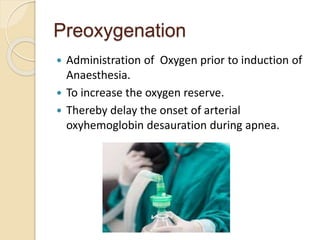
 Administration of Oxygen prior to induction of
Anaesthesia.
 To increase the oxygen reserve.
 Thereby delay the onset of arterial
oxyhemoglobin desauration during apnea.
Preoxygenation Goals
 Achieve 100% oxygenation saturation prior to
procedure.
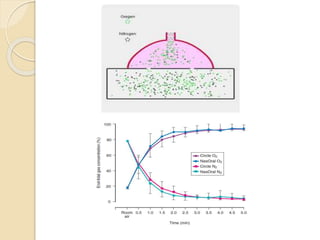
 Denitrogenate the residual capacity of the lung,
maximizing oxygen storage.
 Denitrogenate and maximally oxygenate the
bloodstream.
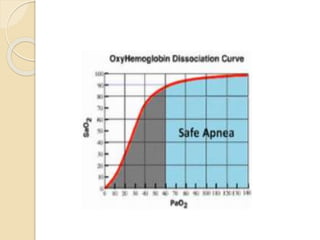
 Thus prolong SAFE APNEA TIME
Whole
body
FRC
Blood
Tissue
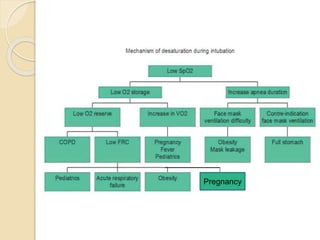
Pregnancy
Pregnancy
 “Preoxygenation before intubating management
of the difficult airway” added by ASA Task Force
on Management of the Difficult Airway in 2003.
 Cannot Intubate Cannot Ventilate largely
unpredictable.
 Routine preoxygenation has become a new
minimum standard of care.
 Preoxygenation before tracheal extubation is vital
- added in 2012 guidelines by Difficult Airway
Society.
Techniques Of
Preoxygenation
 A) Tidal Volume Breathing
- For 3 min
- Flow rate as low as 5L/min is effective.
- Increasing FGF from 5- 10 L/min has little effect.
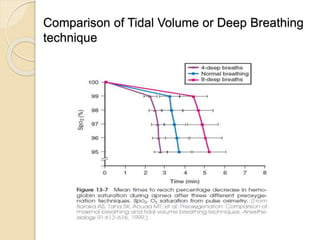
 B) Deep Breathing
- 4 Deep Breaths in 0.5 min
- 8 Deep Breaths in 1 min
- Extended Deep Breathing (12, 16 breaths)
- Single Vital capacity breath.
Comparison of Tidal Volume or Deep Breathing
technique
 C) Preoxygenation and an Additional
Maneuver
- CPAP
- O2 insufflation
- BiPAP
Steps for Proper
Preoxygenation
 Anaesthesia circuit flushed by high O2 flow.
 Non leaking face mask used to avoid air
entrainment.
 An O2 flow of 5L/min for TVB and 10L/min for
deep breathing.
 Can be improved by putting the patient in
30ᴼ - 45ᴼ head up position. (FRC increases)
Clinical End Points of
Preoxygenation
 Movement of reservoir bag in and out with
inhalation and exhalation.
 Presence of normal capnogram and end tidal
CO2.
 End tidal O2 Conc (EtO2) > 90% (lung contain
>2000 ml of O2 i.e 8-10 times VO2).
 End tidal N2 Conc (EtN2) - 5%.
Breathing Systems for
Preoxygenation
 Mapelson A
 Mapelson D
 Circle system
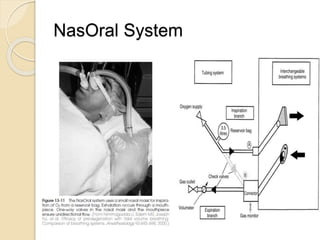
 NasOral system
 Mapelson A & Circle system- O2 flow 5 L/min For TVB.
 Mapelson D – O2 flow 10 L/min for TVB.
 Irrespective of anaesthesia circuit – 10 L/min for DB
NasOral System
Factors Affecting Efficacy Of
Preoxygenation
 Inspired O2 concentration
- Leak
- System used
- FGF, types of breathing (TVB or DB)
 Duration of Breathing
 VA/FRC
Factors Affecting Efficiency Of
Preoxygenation
 Capacity of O2 Loading
- PAO2 and FRC
- Arterial O2 content (CaO2)
- Cardiac Output (CO)
 Oxygen Consumption (Vo2)
APNEIC
OXYGENATION
APNEIC OXYGENATION
 Persistant oxygenation in absence of ventilation.
(Aventilatory Mass Flow – AVMF)
 First described in 1956 Holmdahl during
bronchoscopies.
 Apneic oxygenation in conjunction with traditional
preoxygenation techniques can extend the
SAFE APNEA PERIOD.
Physiology of Apneic
Oxygenation
Physiology of Apneic
Oxygenation
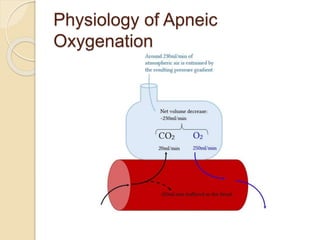
 O2 diffuses to the capillary blood with 250 mL/min rate.
 During apnea, CO2 production does not change, but
elimination is almost paused.
 Diffusion slows down to only 10-20 mL/min .
 As a result of this negative pressure gradient, a mass flow of
gas from pharynx to alveoli occur.
 CO2 levels keep increasing.
 This causes a decrease in pH and respiratory acidosis.
Methods of Apneic Oxygenation
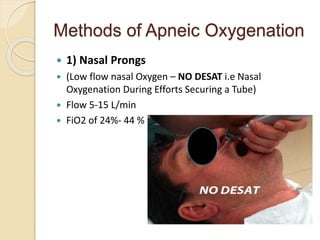
 1) Nasal Prongs
 (Low flow nasal Oxygen – NO DESAT i.e Nasal
Oxygenation During Efforts Securing a Tube)
 Flow 5-15 L/min
 FiO2 of 24%- 44 %
Methods of Apneic Oxygenation
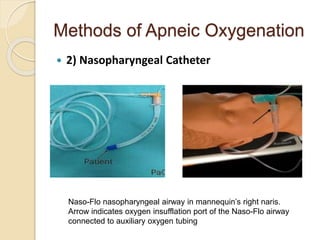
 2) Nasopharyngeal Catheter
Naso-Flo nasopharyngeal airway in mannequin’s right naris.
Arrow indicates oxygen insufflation port of the Naso-Flo airway
connected to auxiliary oxygen tubing
Methods of Apneic Oxygenation
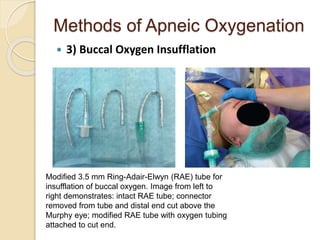
 3) Buccal Oxygen Insufflation
Modified 3.5 mm Ring-Adair-Elwyn (RAE) tube for
insufflation of buccal oxygen. Image from left to
right demonstrates: intact RAE tube; connector
removed from tube and distal end cut above the
Murphy eye; modified RAE tube with oxygen tubing
attached to cut end.
Methods of Apneic Oxygenation
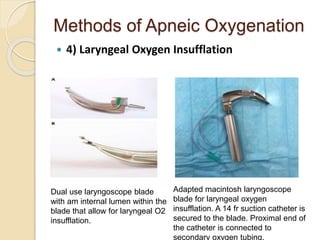
 4) Laryngeal Oxygen Insufflation
Dual use laryngoscope blade
with am internal lumen within the
blade that allow for laryngeal O2
insufflation.
Adapted macintosh laryngoscope
blade for laryngeal oxygen
insufflation. A 14 fr suction catheter is
secured to the blade. Proximal end of
the catheter is connected to
secondary oxygen tubing.
Methods of Apneic Oxygenation
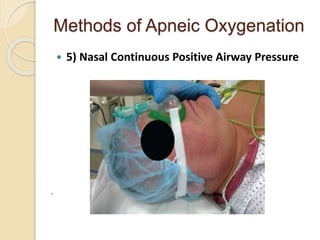
 5) Nasal Continuous Positive Airway Pressure
.
Methods of Apneic Oxygenation
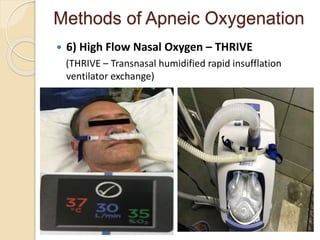
 6) High Flow Nasal Oxygen – THRIVE
(THRIVE – Transnasal humidified rapid insufflation
ventilator exchange)
.
THRIVE
Transnasal humidified rapid
insufflation ventilator exchange
 Technique that uses warmed and humidified
oxygen administrated via high flow nasal cannula
to achieve apneic oxygenation and ventilation.
• Flow rate upto 70 litres per min.
• Heated and Humidified- 100% relative humidity ,
37 degree celsius.
.
THRIVE
Transnasal humidified rapid
insufflation ventilator exchange
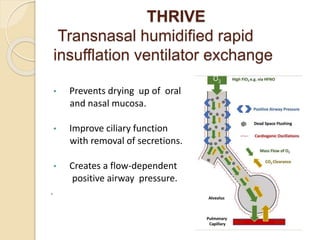
• Prevents drying up of oral
and nasal mucosa.
• Improve ciliary function
with removal of secretions.
• Creates a flow-dependent
positive airway pressure.
.
THRIVE
Transnasal humidified rapid
insufflation ventilator exchange
 Every 10 L/min increase in airflow increases airway
pressure by 0.5-1 cm H2O.
 Continuous positive airway pressure opens upper
airway.
 Possible to obtain FiO2 0.21-1 with 60-70 L/min flow.
 Improved washout of CO2 – Flow dependent dead
space flushing
.
THRIVE
Transnasal humidified rapid
insufflation ventilator exchange
Advantage:
 Continuous flow dependent positive pressure.
 Reduces atelectasis.
 Elimination of CO2
.
Methods of Apneic Oxygenation
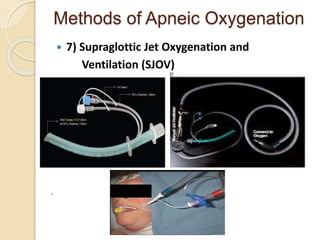
 7) Supraglottic Jet Oxygenation and
Ventilation (SJOV)
.
Methods of Apneic
Oxygenation
 Novel minimally invasive technique of jet ventilation
above the level of vocal cords using a specialised nasal
tube.
 Feasible ventilation technique in both spontaneously
breathing and apnoeic patients.
 Also been used as a rescue oxygenation/ventilation
method in complete ventilation failure scenarios.
Methods of Apneic
Oxygenation
 A jet of High oxygen flow (>30 L/min at high
frequency) is delivered using driving pressures
between10 and 30 psi.
 This ensures rapid delivery of oxygen in a pulsatile
manner into the trachea leading to an exchange of
gases.
 Complications – Barotrauma, Mucosal drying, Nasal
bleed
Key points
 Routine preoxygenation with 100% O2 is considered a
safety measure.
 Essential in patients with decrease O2 loading or
increased VO2 or difficult airway.
 Most common and effective method – TVB for 3-5 min
or deep breathing for 1 – 1.5 min.
 Apneic oxygenation should be considered in anticipated
difficult airway and other special conditions.
Oxygenation – Peri intubation, Apnoeic, THRIVE - Copy.pptx

Oxygenation – Peri intubation, Apnoeic, THRIVE - Copy.pptx

  • 1.
    Oxygenation – Peri intubation,Apnoeic, THRIVE Dr Mahima Lakhanpal Assistant Professor Santosh Medical College
  • 2.
  • 3.
    Preoxygenation  Administration ofOxygen prior to induction of Anaesthesia.  To increase the oxygen reserve.  Thereby delay the onset of arterial oxyhemoglobin desauration during apnea.
  • 4.
    Preoxygenation Goals  Achieve100% oxygenation saturation prior to procedure.  Denitrogenate the residual capacity of the lung, maximizing oxygen storage.  Denitrogenate and maximally oxygenate the bloodstream.  Thus prolong SAFE APNEA TIME
  • 6.
  • 8.
  • 9.
     “Preoxygenation beforeintubating management of the difficult airway” added by ASA Task Force on Management of the Difficult Airway in 2003.  Cannot Intubate Cannot Ventilate largely unpredictable.  Routine preoxygenation has become a new minimum standard of care.  Preoxygenation before tracheal extubation is vital - added in 2012 guidelines by Difficult Airway Society.
  • 10.
    Techniques Of Preoxygenation  A)Tidal Volume Breathing - For 3 min - Flow rate as low as 5L/min is effective. - Increasing FGF from 5- 10 L/min has little effect.  B) Deep Breathing - 4 Deep Breaths in 0.5 min - 8 Deep Breaths in 1 min - Extended Deep Breathing (12, 16 breaths) - Single Vital capacity breath.
  • 11.
    Comparison of TidalVolume or Deep Breathing technique
  • 12.
     C) Preoxygenationand an Additional Maneuver - CPAP - O2 insufflation - BiPAP
  • 13.
    Steps for Proper Preoxygenation Anaesthesia circuit flushed by high O2 flow.  Non leaking face mask used to avoid air entrainment.  An O2 flow of 5L/min for TVB and 10L/min for deep breathing.  Can be improved by putting the patient in 30ᴼ - 45ᴼ head up position. (FRC increases)
  • 14.
    Clinical End Pointsof Preoxygenation  Movement of reservoir bag in and out with inhalation and exhalation.  Presence of normal capnogram and end tidal CO2.  End tidal O2 Conc (EtO2) > 90% (lung contain >2000 ml of O2 i.e 8-10 times VO2).  End tidal N2 Conc (EtN2) - 5%.
  • 16.
    Breathing Systems for Preoxygenation Mapelson A  Mapelson D  Circle system  NasOral system  Mapelson A & Circle system- O2 flow 5 L/min For TVB.  Mapelson D – O2 flow 10 L/min for TVB.  Irrespective of anaesthesia circuit – 10 L/min for DB
  • 17.
  • 18.
    Factors Affecting EfficacyOf Preoxygenation  Inspired O2 concentration - Leak - System used - FGF, types of breathing (TVB or DB)  Duration of Breathing  VA/FRC
  • 19.
    Factors Affecting EfficiencyOf Preoxygenation  Capacity of O2 Loading - PAO2 and FRC - Arterial O2 content (CaO2) - Cardiac Output (CO)  Oxygen Consumption (Vo2)
  • 20.
  • 21.
    APNEIC OXYGENATION  Persistantoxygenation in absence of ventilation. (Aventilatory Mass Flow – AVMF)  First described in 1956 Holmdahl during bronchoscopies.  Apneic oxygenation in conjunction with traditional preoxygenation techniques can extend the SAFE APNEA PERIOD.
  • 22.
  • 23.
    Physiology of Apneic Oxygenation O2 diffuses to the capillary blood with 250 mL/min rate.  During apnea, CO2 production does not change, but elimination is almost paused.  Diffusion slows down to only 10-20 mL/min .  As a result of this negative pressure gradient, a mass flow of gas from pharynx to alveoli occur.  CO2 levels keep increasing.  This causes a decrease in pH and respiratory acidosis.
  • 24.
    Methods of ApneicOxygenation  1) Nasal Prongs  (Low flow nasal Oxygen – NO DESAT i.e Nasal Oxygenation During Efforts Securing a Tube)  Flow 5-15 L/min  FiO2 of 24%- 44 %
  • 25.
    Methods of ApneicOxygenation  2) Nasopharyngeal Catheter Naso-Flo nasopharyngeal airway in mannequin’s right naris. Arrow indicates oxygen insufflation port of the Naso-Flo airway connected to auxiliary oxygen tubing
  • 26.
    Methods of ApneicOxygenation  3) Buccal Oxygen Insufflation Modified 3.5 mm Ring-Adair-Elwyn (RAE) tube for insufflation of buccal oxygen. Image from left to right demonstrates: intact RAE tube; connector removed from tube and distal end cut above the Murphy eye; modified RAE tube with oxygen tubing attached to cut end.
  • 27.
    Methods of ApneicOxygenation  4) Laryngeal Oxygen Insufflation Dual use laryngoscope blade with am internal lumen within the blade that allow for laryngeal O2 insufflation. Adapted macintosh laryngoscope blade for laryngeal oxygen insufflation. A 14 fr suction catheter is secured to the blade. Proximal end of the catheter is connected to secondary oxygen tubing.
  • 28.
    Methods of ApneicOxygenation  5) Nasal Continuous Positive Airway Pressure .
  • 29.
    Methods of ApneicOxygenation  6) High Flow Nasal Oxygen – THRIVE (THRIVE – Transnasal humidified rapid insufflation ventilator exchange) .
  • 30.
    THRIVE Transnasal humidified rapid insufflationventilator exchange  Technique that uses warmed and humidified oxygen administrated via high flow nasal cannula to achieve apneic oxygenation and ventilation. • Flow rate upto 70 litres per min. • Heated and Humidified- 100% relative humidity , 37 degree celsius. .
  • 31.
    THRIVE Transnasal humidified rapid insufflationventilator exchange • Prevents drying up of oral and nasal mucosa. • Improve ciliary function with removal of secretions. • Creates a flow-dependent positive airway pressure. .
  • 32.
    THRIVE Transnasal humidified rapid insufflationventilator exchange  Every 10 L/min increase in airflow increases airway pressure by 0.5-1 cm H2O.  Continuous positive airway pressure opens upper airway.  Possible to obtain FiO2 0.21-1 with 60-70 L/min flow.  Improved washout of CO2 – Flow dependent dead space flushing .
  • 33.
    THRIVE Transnasal humidified rapid insufflationventilator exchange Advantage:  Continuous flow dependent positive pressure.  Reduces atelectasis.  Elimination of CO2 .
  • 34.
    Methods of ApneicOxygenation  7) Supraglottic Jet Oxygenation and Ventilation (SJOV) .
  • 35.
    Methods of Apneic Oxygenation Novel minimally invasive technique of jet ventilation above the level of vocal cords using a specialised nasal tube.  Feasible ventilation technique in both spontaneously breathing and apnoeic patients.  Also been used as a rescue oxygenation/ventilation method in complete ventilation failure scenarios.
  • 36.
    Methods of Apneic Oxygenation A jet of High oxygen flow (>30 L/min at high frequency) is delivered using driving pressures between10 and 30 psi.  This ensures rapid delivery of oxygen in a pulsatile manner into the trachea leading to an exchange of gases.  Complications – Barotrauma, Mucosal drying, Nasal bleed
  • 37.
    Key points  Routinepreoxygenation with 100% O2 is considered a safety measure.  Essential in patients with decrease O2 loading or increased VO2 or difficult airway.  Most common and effective method – TVB for 3-5 min or deep breathing for 1 – 1.5 min.  Apneic oxygenation should be considered in anticipated difficult airway and other special conditions.