05/17/14 1
DIFFICULT AIRWAY MANAGEMENTDIFFICULT AIRWAY MANAGEMENT
Dr . J. EDwarD Johnson. M.D., D.C.h.Dr . J. EDwarD Johnson. M.D., D.C.h.
asst. ProfEssor , DEPt. ofasst. ProfEssor , DEPt. of
anaEsthEsiology,anaEsthEsiology,
KgMCh.KgMCh.
When you canโ€™t breath, nothing else matters
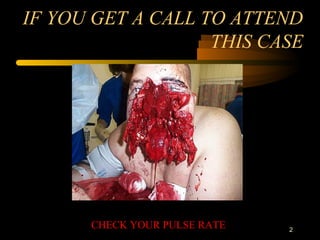
IF YOU GET A CALL TO ATTEND
THIS CASE
2
CHECK YOUR PULSE RATE
DEFINITION
American society of Anesthesiologist (ASA)
suggested (difficult to ventilate) that when sign
of inadequate ventilation could not be reversed
by mask ventilation or oxygen saturation could
not be maintained above 90% or
(difficult to intubate) if a trained Anaesthetist
using conventional laryngoscope takeโ€™s more
than 3 attempts or
more than 10 minute are required to complete
tracheal intubation
PREVALENCE
โ€ข Even with proper evaluation only 15 to 50 %
of difficult airway were picked up
โ€ข While difficult face mask ventilation in
general is about 1:10,000 out of which again
15% proved to be the difficult intubation ,
โ€ข While incidence of extreme difficult or
abandon intubation in general surgery patients
are 1:2000 but in obstetrics is 1:300
05/17/14 5
โ€ข Causes of difficult intubation
โ€ข Basic airway evaluation (Lemon Law )
โ€ข Management plan for Anticipated difficult airway
โ€“ Plan A, Plan B , Plan C
โ€ข Gallery of tools
โ€ข The Unexpected Difficult Airway
โ€ข ASA Difficult airway algorithm
DISCUSSION
CAUSES OF
DIFFICULT INTUBATION
Anaesthetist
1. Inadequate preoperative assessment.
2. Inadequate equipments.
3. Experience not enough.
4. Poor technique.
5. Malfunctioning of equipment.
6. Inexperience assistanance
Patient
1. Congenital causes
2. Acquired causes
Anatomical factors affecting Larangoscopy
1. Short Neck.
2. Protruding incisor teeth.
3. Long high arched palate.
4. Poor mobility of neck.
5. Increase in either anterior depth or Posterior
depth of the mandible decrease in Atlanto
Occipital distance
Basic airway evaluation in all patients
โ€ข Previous anaesthetic problems
โ€ข General appearance of the neck, face,
maxilla and mandibule
โ€ข Jaw movements
โ€ข Head extention and movements
โ€ข The teeth and oro-pharyngx
โ€ข The soft tissues of the neck
โ€ข Recent chest and cervical spine x-rays
05/17/14 8
Dr. Binnions Lemon Law: An easy way to
remember multiple testsโ€ฆ
โ€ข Look externally.
โ€ข Evaluate the 3-3-2 rule.
โ€ข Mallampati.
โ€ข Obstruction?
โ€ข Neck mobility.
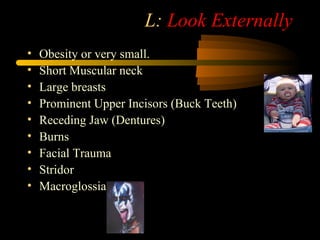
L: Look Externally
โ€ข Obesity or very small.
โ€ข Short Muscular neck
โ€ข Large breasts
โ€ข Prominent Upper Incisors (Buck Teeth)
โ€ข Receding Jaw (Dentures)
โ€ข Burns
โ€ข Facial Trauma
โ€ข Stridor
โ€ข Macroglossia
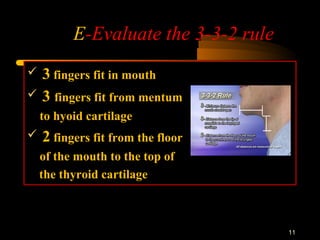
E-Evaluate the 3-3-2 rule
11
๏ƒผ 3 fingers fit in mouth
๏ƒผ 3 fingers fit from mentum
to hyoid cartilage
๏ƒผ 2 fingers fit from the floor
of the mouth to the top of
the thyroid cartilage
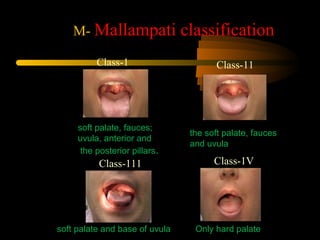
M- Mallampati classification
Class-1 Class-11
Class-111 Class-1V
soft palate, fauces;
uvula, anterior and
the posterior pillars.
the soft palate, fauces
and uvula
soft palate and base of uvula Only hard palate
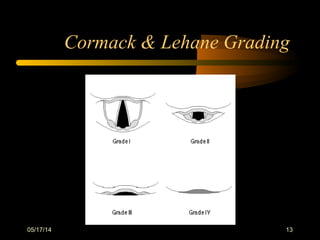
Cormack & Lehane Grading
05/17/14 13
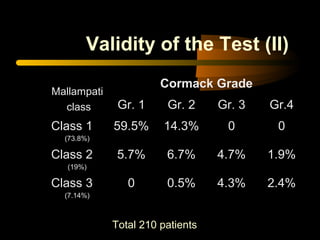
Validity of the Test (II)
Cormack Grade
Gr. 1 Gr. 2 Gr. 3 Gr.4
Class 1
(73.8%)
59.5% 14.3% 0 0
Class 2
(19%)
5.7% 6.7% 4.7% 1.9%
Class 3
(7.14%)
0 0.5% 4.3% 2.4%
Mallampati
class
Total 210 patients
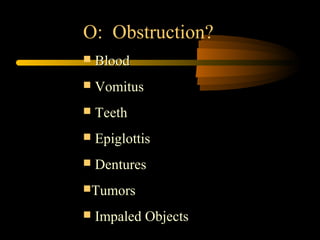
O: Obstruction?
๏ฎ BloodBlood
๏ฎ VomitusVomitus
๏ฎ TeethTeeth
๏ฎ EpiglottisEpiglottis
๏ฎ DenturesDentures
๏ฎTumorsTumors
๏ฎ Impaled ObjectsImpaled Objects
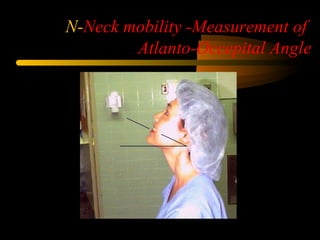
N-Neck mobility -Measurement of
Atlanto-Occepital Angle
ThyroMental Distance
17
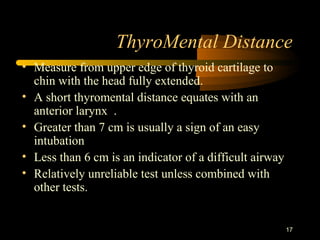
โ€ข Measure from upper edge of thyroid cartilage to
chin with the head fully extended.
โ€ข A short thyromental distance equates with an
anterior larynx .
โ€ข Greater than 7 cm is usually a sign of an easy
intubation
โ€ข Less than 6 cm is an indicator of a difficult airway
โ€ข Relatively unreliable test unless combined with
other tests.
MANAGEMENT PLAN
OF
ANTICIPATED
DIFFICULT AIRWAY
05/17/14 18
MANAGEMENT PLAN OF
ANTICEPATED DIFFICULT AIRWAY
1. Discussion with colleagues in advance.
2. Equipment tested before.
3. Senior help backup.
4. Definite initial plan (A) for ventilation and
intubation.
5. Definite plan (B) than option of awake
intubation.
6. Ideal situation surgery team standby.
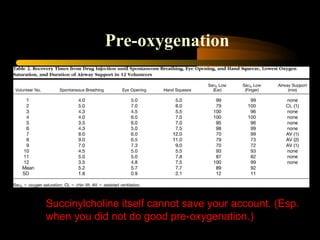
Anesthesiology 2001, 95: 754-759
Succinylcholine itself cannot save your account. (Esp.
when you did not do good pre-oxygenation.)
Pre-oxygenation
Pre-oxygenation: How Much Is Enough?
Two techniques common in use:
1. Tidal volume breathing (TVB) of oxygen
for 3โ€“5 min
2. Deep breaths (DB) 4 times within 0.5 min
Both are equally effective in increasing
arterial oxygen tension (Pao2
).
Anesth Analg 1981; 60: 313โ€“5
Consider the merits and feasibility
Awake Intubation vs Intubation after induction
of GA
Non-Invasive technique vs Invasive technique
for initial approach for initial approach
Preservation of spontaneous vs Ablation of spontaneous
Ventilation ventilation
22
What are we going to do if we donโ€™t get the
Tube?
โ€ข Plans โ€œAโ€, โ€œBโ€ and โ€œCโ€
โ€ข Know this answer before you tube.
Plan โ€œAโ€: (ALTERNATE)
โ€ข Different Length of blade
โ€ข Different Type of Blade
โ€ข Different Position
Plan โ€œBโ€: (BVM and BLIND INTUBATION
Techniques )
โ€ข Can you Ventilate with a BVM? (Consider
two person mask Ventilation)
โ€ข Combi-Tube?
โ€ข LMA an Option?
What do we do when faced with a
Canโ€™t Intubate Canโ€™t Ventilate
situation?
โ€ข Plan โ€œCโ€: (CRIC) Needle, Surgical,
Failure -Why does it happens?
โ€ข No critical discussion with colleagues about
proposed management plan
โ€ข No request for experienced help
โ€ข Exaggerated idea of personal ability
โ€ข Ill-conceived plan A and/or plan B
โ€ข Poorly executed plan A and/or plan B
โ€ข Persisting with plan A too long, starting the
rescue plan too late
โ€ข Not involving, and preparing, surgical
colleagues 27
28
GALLERY
OF
TOOLS
GALLERY OF TOOLS
29
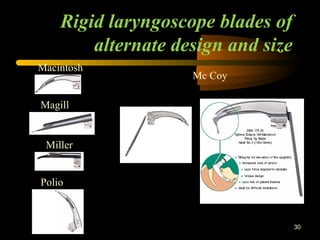
1. Rigid laryngoscope blades of alternate design and size
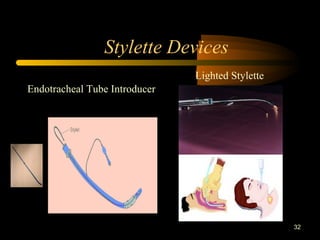
2. Tracheal tube guides. (stylets, ventilating tube changer, light
wands & GEB)
3. Laryngeal mask airways
4. Flexible fiberoptic intubation equipment
5. Retrograde intubation equipment
6. Noninvasive airway ventilation (esophageal tracheal
Combitube, transtracheal jet ventilator)
7. Emergency invasive airways (Needle & surgical
cricothyrotomy)
8. An exhaled CO2 detector
Rigid laryngoscope blades of
alternate design and size
30
Macintosh
Magill
Miller
Polio
Mc Coy
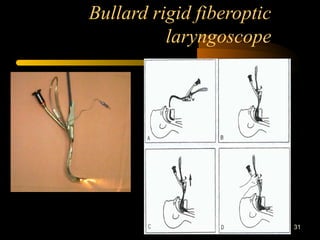
Bullard rigid fiberoptic
laryngoscope
31
Stylette Devices
32
Lighted Stylette
Endotracheal Tube Introducer
33
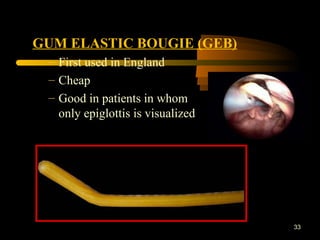
GUM ELASTIC BOUGIE (GEB)
โ€“ First used in England
โ€“ Cheap
โ€“ Good in patients in whom
only epiglottis is visualized
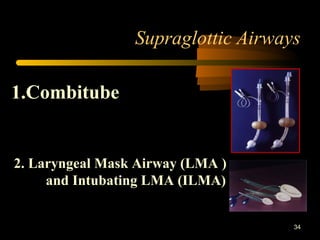
Supraglottic Airways
34
1.Combitube
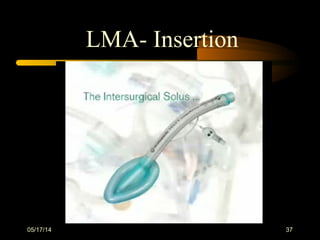
2. Laryngeal Mask Airway (LMA )
and Intubating LMA (ILMA)
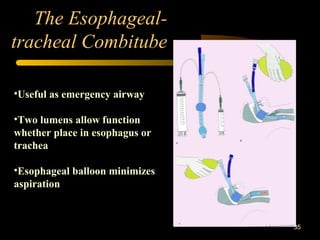
The Esophageal-
tracheal Combitube
35
โ€ขUseful as emergency airway
โ€ขTwo lumens allow function
whether place in esophagus or
trachea
โ€ขEsophageal balloon minimizes
aspiration
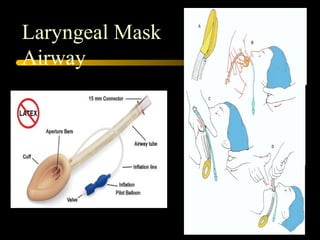
Laryngeal Mask
Airway
05/17/14 37
LMA- Insertion
VARIANTS OF LMA
โ€ข LMA โ€“ classic (standard)
โ€ข LMA โ€“ flexiable (reinforced)
โ€ข LMA โ€“ unique (disposable LMA)
โ€ข LMA โ€“ Fastrach (intubating LMA)
โ€ข LMA โ€“ Proseal (gastric LMA)
05/17/14 38
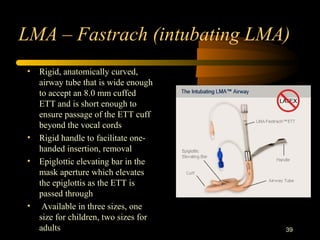
LMA โ€“ Fastrach (intubating LMA)
โ€ข Rigid, anatomically curved,
airway tube that is wide enough
to accept an 8.0 mm cuffed
ETT and is short enough to
ensure passage of the ETT cuff
beyond the vocal cords
โ€ข Rigid handle to facilitate one-
handed insertion, removal
โ€ข Epiglottic elevating bar in the
mask aperture which elevates
the epiglottis as the ETT is
passed through
โ€ข Available in three sizes, one
size for children, two sizes for
adults 39
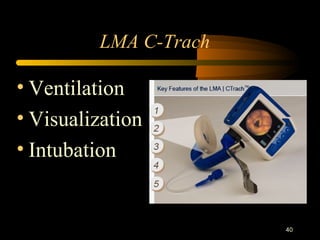
LMA C-Trach
โ€ข Ventilation
โ€ข Visualization
โ€ข Intubation
40
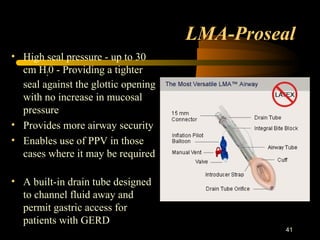
LMA-Proseal
โ€ข High seal pressure - up to 30
cm H20 - Providing a tighter
seal against the glottic opening
with no increase in mucosal
pressure
โ€ข Provides more airway security
โ€ข Enables use of PPV in those
cases where it may be required
โ€ข A built-in drain tube designed
to channel fluid away and
permit gastric access for
patients with GERD
41
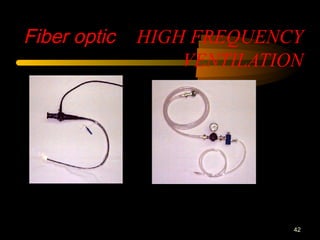
Fiber opticFiber optic HIGH FREQUENCY
VENTILATION
42
43
DIFFICULT AIRWAY MANAGEMENT:DIFFICULT AIRWAY MANAGEMENT:
Canโ€™t IntubateCanโ€™t Intubate
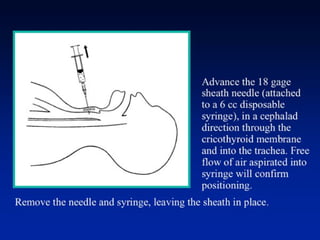
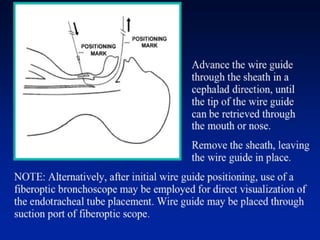
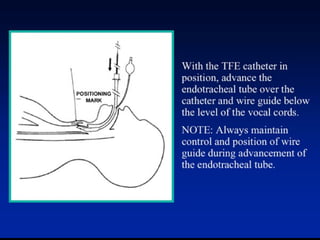
Retrograde Intubation
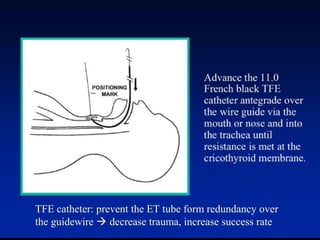
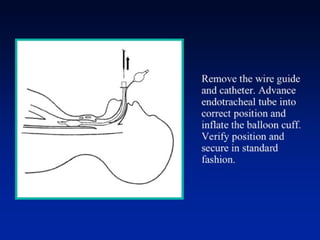
TFE catheter: prevent the ET tube form redundancy over
the guidewire ๏ƒ  decrease trauma, increase success rate
05/17/14 49
The
Unexpected
Difficult Airway
TheUnexpectedDifficultAirway
โ€ข Experienced help may not be
immediately available
โ€ข Special equipment may not be
immediately available
โ€ข A general anaesthetic has usually been
administered
โ€ข A long acting relaxant may have been
given
โ€ข Backup airway management plans may
be poorly thought out 50
Techniques for managing the unexpected
difficult airway include
Manipulation of the patients airway and position e.g. more or less pillows,
laryngeal pressure,
Oral airways, nasal airways in a range of size
Different laryngoscopy blades
e.g. โ€ขMiller
โ€ขMagill
โ€ขRobershaw
โ€ขMackintosh
Bougies and stylettes
Laryngeal mask airways
Combitube
51
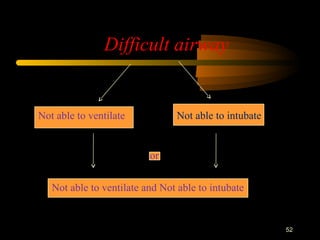
Difficult airway
52
Not able to ventilate Not able to intubate
or
Not able to ventilate and Not able to intubate
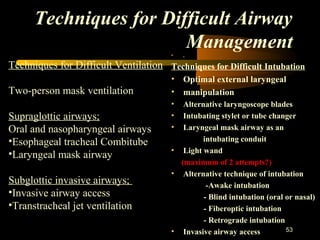
Techniques for Difficult Airway
Managementโ€ข .
Techniques for Difficult Intubation
โ€ข Optimal external laryngeal
โ€ข manipulation
โ€ข Alternative laryngoscope blades
โ€ข Intubating stylet or tube changer
โ€ข Laryngeal mask airway as an
intubating conduit
โ€ข Light wand
(maximum of 2 attempts?)
โ€ข Alternative technique of intubation
-Awake intubation
- Blind intubation (oral or nasal)
- Fiberoptic intubation
- Retrograde intubation
โ€ข Invasive airway access 53
Techniques for Difficult Ventilation
Two-person mask ventilation
Supraglottic airways;
Oral and nasopharyngeal airways
โ€ขEsophageal tracheal Combitube
โ€ขLaryngeal mask airway
Subglottic invasive airways;
โ€ขInvasive airway access
โ€ขTranstracheal jet ventilation
1
alternative
1
alternative
2
alternative
2
alternative
3
alternative
3
alternative
4
alternative
4
alternative
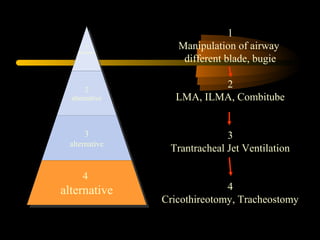
1
Manipulation of airway
different blade, bugie
2
LMA, ILMA, Combitube
3
Trantracheal Jet Ventilation
4
Cricothireotomy, Tracheostomy
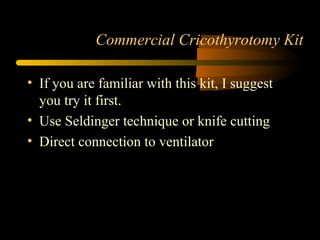
Commercial Cricothyrotomy Kit
โ€ข If you are familiar with this kit, I suggest
you try it first.
โ€ข Use Seldinger technique or knife cutting
โ€ข Direct connection to ventilator
56
DIFFICULT AIRWAY MANAGEMENT:DIFFICULT AIRWAY MANAGEMENT:
Canโ€™t Intubate, canโ€™t ventilateCanโ€™t Intubate, canโ€™t ventilate
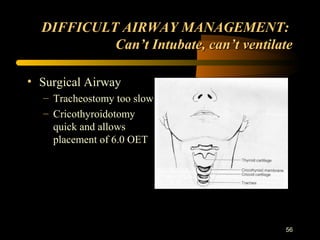
โ€ข Surgical Airway
โ€“ Tracheostomy too slow
โ€“ Cricothyroidotomy
quick and allows
placement of 6.0 OET
Emergency airway
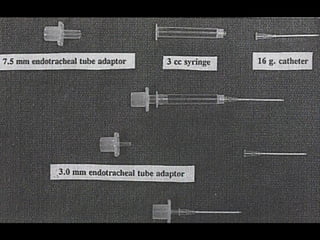
โ€ข Unorthodox method: not generally accepted,
better than nothing
1. Connect the hub of the cath to the ventilator via a
3 mm ET tube adaptor.
2. Connect the hub of the cath to a 5-ml syringe then
insert a 7.0 mm ET tube inside, inflate the cuff,
then connect to the ventilator.
3. Connect the hub of the cath to a 3-ml syringe then
insert an adaptor form a 7.5 mm ET tube inside,
then connect to the ventilator
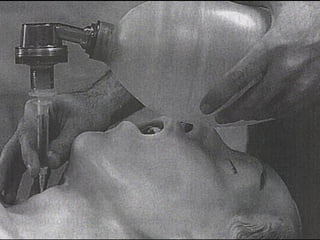
Connect to a Traditional Ventilator
Higher respiratory pressure required
(mimic TTJV).๏ƒ  use O2 flush button.
Self-inflated reservoir bag can be used as
well.
05/17/14 61
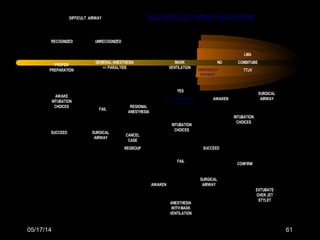
DIFFICULT AIRWAY
GENERAL ANESTHESIA
+/- PARALYSIS
RECOGNIZED
PROPER
PREPARATION
ASA DIFFICULT AIRWAY ALGORITHM
UNRECOGNIZED
AWAKE
INTUBATION
CHOICES
SUCCEED
FAIL
SURGICAL
AIRWAY
MASK
VENTILATION
NO
YES
EMERGENCY
PATHWAY
NON -EMERGENCY
PATHWAY
LMA
COMBITUBE
TTJV
INTUBATION
CHOICES
INTUBATION
CHOICES
SURGICAL
AIRWAY
SUCCEED
FAIL
CONFIRM
ANESTHESIA
WITHMASK
VENTILATION
AWAKEN
SURGICAL
AIRWAY
EXTUBATE
OVER JET
STYLET
REGIONAL
ANESTHESIA
CANCEL
CASE
REGROUP
Intubationchoices include use of different
laryngoscope blades,LMA as an intubation
conduit(with or without fiberoptic guidance),
fiberoptic intubation, intubating stylet or tube
changer,light wand, retrograde intubation,
and blind oral or nasal intubation.
*
*
*
AWAKEN
Take home message
โ€ข Be familiar with two alternative methods of
intubating technique and use it regularly in
your day today practice eg; LMA, GEB,
FOI.
โ€ข So that you wonโ€™t fumble at the time of
crisis
05/17/14 62
Difficult Airway Maxims
โ€œIt is preferable to use superior
judgement โ€“ to avoid having to
use superior skillโ€.
?โ€™s
05/17/14 63
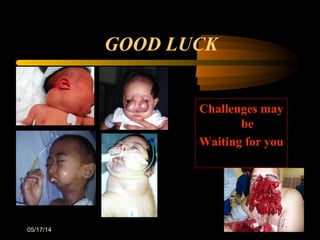
GOOD LUCK
05/17/14 64
Challenges mayChallenges may
bebe
Waiting for youWaiting for you

Difficults airway

  • 1.
    05/17/14 1 DIFFICULT AIRWAYMANAGEMENTDIFFICULT AIRWAY MANAGEMENT Dr . J. EDwarD Johnson. M.D., D.C.h.Dr . J. EDwarD Johnson. M.D., D.C.h. asst. ProfEssor , DEPt. ofasst. ProfEssor , DEPt. of anaEsthEsiology,anaEsthEsiology, KgMCh.KgMCh. When you canโ€™t breath, nothing else matters
  • 2.
    IF YOU GETA CALL TO ATTEND THIS CASE 2 CHECK YOUR PULSE RATE
  • 3.
    DEFINITION American society ofAnesthesiologist (ASA) suggested (difficult to ventilate) that when sign of inadequate ventilation could not be reversed by mask ventilation or oxygen saturation could not be maintained above 90% or (difficult to intubate) if a trained Anaesthetist using conventional laryngoscope takeโ€™s more than 3 attempts or more than 10 minute are required to complete tracheal intubation
  • 4.
    PREVALENCE โ€ข Even withproper evaluation only 15 to 50 % of difficult airway were picked up โ€ข While difficult face mask ventilation in general is about 1:10,000 out of which again 15% proved to be the difficult intubation , โ€ข While incidence of extreme difficult or abandon intubation in general surgery patients are 1:2000 but in obstetrics is 1:300
  • 5.
    05/17/14 5 โ€ข Causesof difficult intubation โ€ข Basic airway evaluation (Lemon Law ) โ€ข Management plan for Anticipated difficult airway โ€“ Plan A, Plan B , Plan C โ€ข Gallery of tools โ€ข The Unexpected Difficult Airway โ€ข ASA Difficult airway algorithm DISCUSSION
  • 6.
    CAUSES OF DIFFICULT INTUBATION Anaesthetist 1.Inadequate preoperative assessment. 2. Inadequate equipments. 3. Experience not enough. 4. Poor technique. 5. Malfunctioning of equipment. 6. Inexperience assistanance Patient 1. Congenital causes 2. Acquired causes
  • 7.
    Anatomical factors affectingLarangoscopy 1. Short Neck. 2. Protruding incisor teeth. 3. Long high arched palate. 4. Poor mobility of neck. 5. Increase in either anterior depth or Posterior depth of the mandible decrease in Atlanto Occipital distance
  • 8.
    Basic airway evaluationin all patients โ€ข Previous anaesthetic problems โ€ข General appearance of the neck, face, maxilla and mandibule โ€ข Jaw movements โ€ข Head extention and movements โ€ข The teeth and oro-pharyngx โ€ข The soft tissues of the neck โ€ข Recent chest and cervical spine x-rays 05/17/14 8
  • 9.
    Dr. Binnions LemonLaw: An easy way to remember multiple testsโ€ฆ โ€ข Look externally. โ€ข Evaluate the 3-3-2 rule. โ€ข Mallampati. โ€ข Obstruction? โ€ข Neck mobility.
  • 10.
    L: Look Externally โ€ขObesity or very small. โ€ข Short Muscular neck โ€ข Large breasts โ€ข Prominent Upper Incisors (Buck Teeth) โ€ข Receding Jaw (Dentures) โ€ข Burns โ€ข Facial Trauma โ€ข Stridor โ€ข Macroglossia
  • 11.
    E-Evaluate the 3-3-2rule 11 ๏ƒผ 3 fingers fit in mouth ๏ƒผ 3 fingers fit from mentum to hyoid cartilage ๏ƒผ 2 fingers fit from the floor of the mouth to the top of the thyroid cartilage
  • 12.
    M- Mallampati classification Class-1Class-11 Class-111 Class-1V soft palate, fauces; uvula, anterior and the posterior pillars. the soft palate, fauces and uvula soft palate and base of uvula Only hard palate
  • 13.
    Cormack & LehaneGrading 05/17/14 13
  • 14.
    Validity of theTest (II) Cormack Grade Gr. 1 Gr. 2 Gr. 3 Gr.4 Class 1 (73.8%) 59.5% 14.3% 0 0 Class 2 (19%) 5.7% 6.7% 4.7% 1.9% Class 3 (7.14%) 0 0.5% 4.3% 2.4% Mallampati class Total 210 patients
  • 15.
    O: Obstruction? ๏ฎ BloodBlood ๏ฎVomitusVomitus ๏ฎ TeethTeeth ๏ฎ EpiglottisEpiglottis ๏ฎ DenturesDentures ๏ฎTumorsTumors ๏ฎ Impaled ObjectsImpaled Objects
  • 16.
    N-Neck mobility -Measurementof Atlanto-Occepital Angle
  • 17.
    ThyroMental Distance 17 โ€ข Measurefrom upper edge of thyroid cartilage to chin with the head fully extended. โ€ข A short thyromental distance equates with an anterior larynx . โ€ข Greater than 7 cm is usually a sign of an easy intubation โ€ข Less than 6 cm is an indicator of a difficult airway โ€ข Relatively unreliable test unless combined with other tests.
  • 18.
  • 19.
    MANAGEMENT PLAN OF ANTICEPATEDDIFFICULT AIRWAY 1. Discussion with colleagues in advance. 2. Equipment tested before. 3. Senior help backup. 4. Definite initial plan (A) for ventilation and intubation. 5. Definite plan (B) than option of awake intubation. 6. Ideal situation surgery team standby.
  • 20.
    Anesthesiology 2001, 95:754-759 Succinylcholine itself cannot save your account. (Esp. when you did not do good pre-oxygenation.) Pre-oxygenation
  • 21.
    Pre-oxygenation: How MuchIs Enough? Two techniques common in use: 1. Tidal volume breathing (TVB) of oxygen for 3โ€“5 min 2. Deep breaths (DB) 4 times within 0.5 min Both are equally effective in increasing arterial oxygen tension (Pao2 ). Anesth Analg 1981; 60: 313โ€“5
  • 22.
    Consider the meritsand feasibility Awake Intubation vs Intubation after induction of GA Non-Invasive technique vs Invasive technique for initial approach for initial approach Preservation of spontaneous vs Ablation of spontaneous Ventilation ventilation 22
  • 23.
    What are wegoing to do if we donโ€™t get the Tube? โ€ข Plans โ€œAโ€, โ€œBโ€ and โ€œCโ€ โ€ข Know this answer before you tube.
  • 24.
    Plan โ€œAโ€: (ALTERNATE) โ€ขDifferent Length of blade โ€ข Different Type of Blade โ€ข Different Position
  • 25.
    Plan โ€œBโ€: (BVMand BLIND INTUBATION Techniques ) โ€ข Can you Ventilate with a BVM? (Consider two person mask Ventilation) โ€ข Combi-Tube? โ€ข LMA an Option?
  • 26.
    What do wedo when faced with a Canโ€™t Intubate Canโ€™t Ventilate situation? โ€ข Plan โ€œCโ€: (CRIC) Needle, Surgical,
  • 27.
    Failure -Why doesit happens? โ€ข No critical discussion with colleagues about proposed management plan โ€ข No request for experienced help โ€ข Exaggerated idea of personal ability โ€ข Ill-conceived plan A and/or plan B โ€ข Poorly executed plan A and/or plan B โ€ข Persisting with plan A too long, starting the rescue plan too late โ€ข Not involving, and preparing, surgical colleagues 27
  • 28.
  • 29.
    GALLERY OF TOOLS 29 1.Rigid laryngoscope blades of alternate design and size 2. Tracheal tube guides. (stylets, ventilating tube changer, light wands & GEB) 3. Laryngeal mask airways 4. Flexible fiberoptic intubation equipment 5. Retrograde intubation equipment 6. Noninvasive airway ventilation (esophageal tracheal Combitube, transtracheal jet ventilator) 7. Emergency invasive airways (Needle & surgical cricothyrotomy) 8. An exhaled CO2 detector
  • 30.
    Rigid laryngoscope bladesof alternate design and size 30 Macintosh Magill Miller Polio Mc Coy
  • 31.
  • 32.
  • 33.
    33 GUM ELASTIC BOUGIE(GEB) โ€“ First used in England โ€“ Cheap โ€“ Good in patients in whom only epiglottis is visualized
  • 34.
    Supraglottic Airways 34 1.Combitube 2. LaryngealMask Airway (LMA ) and Intubating LMA (ILMA)
  • 35.
    The Esophageal- tracheal Combitube 35 โ€ขUsefulas emergency airway โ€ขTwo lumens allow function whether place in esophagus or trachea โ€ขEsophageal balloon minimizes aspiration
  • 36.
  • 37.
  • 38.
    VARIANTS OF LMA โ€ขLMA โ€“ classic (standard) โ€ข LMA โ€“ flexiable (reinforced) โ€ข LMA โ€“ unique (disposable LMA) โ€ข LMA โ€“ Fastrach (intubating LMA) โ€ข LMA โ€“ Proseal (gastric LMA) 05/17/14 38
  • 39.
    LMA โ€“ Fastrach(intubating LMA) โ€ข Rigid, anatomically curved, airway tube that is wide enough to accept an 8.0 mm cuffed ETT and is short enough to ensure passage of the ETT cuff beyond the vocal cords โ€ข Rigid handle to facilitate one- handed insertion, removal โ€ข Epiglottic elevating bar in the mask aperture which elevates the epiglottis as the ETT is passed through โ€ข Available in three sizes, one size for children, two sizes for adults 39
  • 40.
    LMA C-Trach โ€ข Ventilation โ€ขVisualization โ€ข Intubation 40
  • 41.
    LMA-Proseal โ€ข High sealpressure - up to 30 cm H20 - Providing a tighter seal against the glottic opening with no increase in mucosal pressure โ€ข Provides more airway security โ€ข Enables use of PPV in those cases where it may be required โ€ข A built-in drain tube designed to channel fluid away and permit gastric access for patients with GERD 41
  • 42.
    Fiber opticFiber opticHIGH FREQUENCY VENTILATION 42
  • 43.
    43 DIFFICULT AIRWAY MANAGEMENT:DIFFICULTAIRWAY MANAGEMENT: Canโ€™t IntubateCanโ€™t Intubate Retrograde Intubation
  • 46.
    TFE catheter: preventthe ET tube form redundancy over the guidewire ๏ƒ  decrease trauma, increase success rate
  • 49.
  • 50.
    TheUnexpectedDifficultAirway โ€ข Experienced helpmay not be immediately available โ€ข Special equipment may not be immediately available โ€ข A general anaesthetic has usually been administered โ€ข A long acting relaxant may have been given โ€ข Backup airway management plans may be poorly thought out 50
  • 51.
    Techniques for managingthe unexpected difficult airway include Manipulation of the patients airway and position e.g. more or less pillows, laryngeal pressure, Oral airways, nasal airways in a range of size Different laryngoscopy blades e.g. โ€ขMiller โ€ขMagill โ€ขRobershaw โ€ขMackintosh Bougies and stylettes Laryngeal mask airways Combitube 51
  • 52.
    Difficult airway 52 Not ableto ventilate Not able to intubate or Not able to ventilate and Not able to intubate
  • 53.
    Techniques for DifficultAirway Managementโ€ข . Techniques for Difficult Intubation โ€ข Optimal external laryngeal โ€ข manipulation โ€ข Alternative laryngoscope blades โ€ข Intubating stylet or tube changer โ€ข Laryngeal mask airway as an intubating conduit โ€ข Light wand (maximum of 2 attempts?) โ€ข Alternative technique of intubation -Awake intubation - Blind intubation (oral or nasal) - Fiberoptic intubation - Retrograde intubation โ€ข Invasive airway access 53 Techniques for Difficult Ventilation Two-person mask ventilation Supraglottic airways; Oral and nasopharyngeal airways โ€ขEsophageal tracheal Combitube โ€ขLaryngeal mask airway Subglottic invasive airways; โ€ขInvasive airway access โ€ขTranstracheal jet ventilation
  • 54.
    1 alternative 1 alternative 2 alternative 2 alternative 3 alternative 3 alternative 4 alternative 4 alternative 1 Manipulation of airway differentblade, bugie 2 LMA, ILMA, Combitube 3 Trantracheal Jet Ventilation 4 Cricothireotomy, Tracheostomy
  • 55.
    Commercial Cricothyrotomy Kit โ€ขIf you are familiar with this kit, I suggest you try it first. โ€ข Use Seldinger technique or knife cutting โ€ข Direct connection to ventilator
  • 56.
    56 DIFFICULT AIRWAY MANAGEMENT:DIFFICULTAIRWAY MANAGEMENT: Canโ€™t Intubate, canโ€™t ventilateCanโ€™t Intubate, canโ€™t ventilate โ€ข Surgical Airway โ€“ Tracheostomy too slow โ€“ Cricothyroidotomy quick and allows placement of 6.0 OET
  • 57.
    Emergency airway โ€ข Unorthodoxmethod: not generally accepted, better than nothing 1. Connect the hub of the cath to the ventilator via a 3 mm ET tube adaptor. 2. Connect the hub of the cath to a 5-ml syringe then insert a 7.0 mm ET tube inside, inflate the cuff, then connect to the ventilator. 3. Connect the hub of the cath to a 3-ml syringe then insert an adaptor form a 7.5 mm ET tube inside, then connect to the ventilator
  • 60.
    Connect to aTraditional Ventilator Higher respiratory pressure required (mimic TTJV).๏ƒ  use O2 flush button. Self-inflated reservoir bag can be used as well.
  • 61.
    05/17/14 61 DIFFICULT AIRWAY GENERALANESTHESIA +/- PARALYSIS RECOGNIZED PROPER PREPARATION ASA DIFFICULT AIRWAY ALGORITHM UNRECOGNIZED AWAKE INTUBATION CHOICES SUCCEED FAIL SURGICAL AIRWAY MASK VENTILATION NO YES EMERGENCY PATHWAY NON -EMERGENCY PATHWAY LMA COMBITUBE TTJV INTUBATION CHOICES INTUBATION CHOICES SURGICAL AIRWAY SUCCEED FAIL CONFIRM ANESTHESIA WITHMASK VENTILATION AWAKEN SURGICAL AIRWAY EXTUBATE OVER JET STYLET REGIONAL ANESTHESIA CANCEL CASE REGROUP Intubationchoices include use of different laryngoscope blades,LMA as an intubation conduit(with or without fiberoptic guidance), fiberoptic intubation, intubating stylet or tube changer,light wand, retrograde intubation, and blind oral or nasal intubation. * * * AWAKEN
  • 62.
    Take home message โ€ขBe familiar with two alternative methods of intubating technique and use it regularly in your day today practice eg; LMA, GEB, FOI. โ€ข So that you wonโ€™t fumble at the time of crisis 05/17/14 62
  • 63.
    Difficult Airway Maxims โ€œItis preferable to use superior judgement โ€“ to avoid having to use superior skillโ€. ?โ€™s 05/17/14 63
  • 64.
    GOOD LUCK 05/17/14 64 ChallengesmayChallenges may bebe Waiting for youWaiting for you

Editor's Notes