Anesthesia for liver transplantation
History
• 1963 First liver transplant Sir Thomas Starzl
( orthotopic liver transplantation)
• 1967 First long survival
• 1979 Cyclosporine-Sir Roy Calne
• 1987 UWI solution for improved organ preservation
• 1989 FK 506
• 1999 Living donor liver transplantation
History
Introduction
• The treatment of end stage liver disease
underwent dramatic transformation with the
development of LT
• LT is one of the most successful organ transplant
after kidney transplant in terms of survival
Improved survival
• Improvement in preservation techniques
• Advances in Intraoperative management
• Refinement of surgical techniques
• Better immunosuppressive management
Background
• genetic relationship
• the anatomical site of the implantation
• auto graft
• isograft or syngeneic graft
• allograft or homograft
• xenograft or heterograft
Background
• Orthotopic transplantation
• Heterotopic transplantation
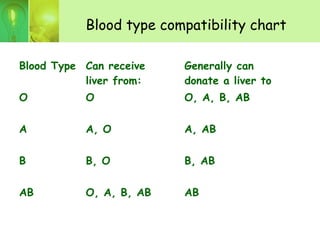
Blood type compatibility chart
Blood Type Can receive
liver from:
Generally can
donate a liver to
O O O, A, B, AB
A A, O A, AB
B B, O B, AB
AB O, A, B, AB AB
Liver transplantation activity in
India
• Estimated 200,000 patients suffer from liver
disease
• No viable long term bridging options exists
• Approximately 60 liver transplants per year
• First attempt at cadaveric LTx in 1994 at AIIMS
• Organ procurement –ORBO and MOHAN
organizations
Transplant team
• Anesthetist
• Hepatologist
• Transplant surgeons
• Transplant coordinator
• Clinical dietician
• Physiotherapists
• Social worker
CVS changes
• “Hyper dynamic circulation”
• Elevated cardiac output
• Decreased peripheral resistance
• Hypotension
• Vascular hypo reactivity
• Splanchnic and systemic arteriolar vasodilatation
• Cardiac dysfunction
• “cirrhotic cardiomyopathy”
Respiratory changes
• Gas exchange alterations
• Hepatopulmonary syndrome
• Porto pulmonary hypertension
• Restrictive lung changes
• Blood gas alteration
Coagulation Abnormalities
• Liver plays a central role in haemostasis
• Coagulopathy parallels the degree of liver failure
• Reduced hepatic synthesis of coagulation factors
• Malabsorption of vitamin K
• Inadequate hepatic clearance of procoagulant
factors
• Platelet:
– impaired aggregation
– increased adhesiveness
Renal system
• HRS
- renal failure in the absence of intrinsic renal
disease
• Intarrenal vasoconstriction
• Renal dysfunction is potentially reversible
• Renal function is regained in 40% to 95%
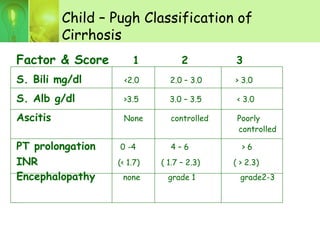
Child – Pugh Classification of
Cirrhosis
Factor & Score 1 2 3
S. Bili mg/dl <2.0 2.0 – 3.0 > 3.0
S. Alb g/dl >3.5 3.0 – 3.5 < 3.0
Ascitis None controlled Poorly
controlled
PT prolongation 0 -4 4 – 6 > 6
INR (< 1.7) ( 1.7 – 2.3) ( > 2.3)
Encephalopathy none grade 1 grade2-3
Physiologic consequences of cirrhosis
• Increased C.O
• Arterial hypotension
• Decreased SVR
• Increased total plasma volume
• Increased activity of vasoconstrictor systems
• Increased renal vascular resistance, decreased
renal perfusion pressure
• Dilutional hyponatremia
Pharmacokinetics & Pharmacodynamics
• Due to changes in - Protein synthesis
-Volume of distribution
-Protein binding
-Hepatic blood flow
-Hepatic drug metabolism
• Resulting in - Altered Serum levels
- Elimination half life
- altered hepatic extraction ratio
- increased free drug levels
Preoperative assessment
• Performed jointly by hepatologist,surgeon and
anesthetist before listing
Indications for Liver
Transplantation in Adults
• Presence of irreversible liver disease and a life expectancy of
less than 12 months with no effective medical or surgical
alternatives to transplantation
• Chronic liver disease that has progressed to the point of
significant interference with the patient's ability to work or
with his/her quality of life
• Progression of liver disease that will predictably result in
mortality exceeding that of transplantation (85% one-year
patient survival and 70% five-year survival)
Indications for Liver
Transplantation in Adults
• Chronic Hepatitis C
• Chronic Hepatitis B
• Cryptogenic cirrhosis
• Hepatocellular carcinoma
• Alcoholic Liver Disease
• Fulminant Hepatic Failure
• Wilson’s disease
• Primary Biliary Cirrhosis
• Metabolic and genetic disorders
Contraindications
• Extra hepatic cancer
• Active sepsis
• Advanced cardiac disease
• Advanced pulmonary disease
• HIV with AIDS and low CD4 count
Goals of evaluation
• Which patients require LT?
• Which patients would benefit?
• When such therapy should be undertaken?
Goals of evaluation
• Understanding the underlying liver disease
• Development of complications
• Remote organ dysfunction (cardiac, pulmonary and
renal)
• Optimization of nutritional and medical therapy
Preoperative assessment
• AIM :identify physiological abnormalities
:attempt to improve and optimize
:preoperative assessment is tailored to
accommodate the clinical needs of the
patient
Liver Transplantation-evaluation
• Medical history–
-Symptoms such as fatigue, itching, swelling,
changes in mental status and GI bleeding
– Other medical problems
– Medications
– Includes alcohol use and drug use history
• Physical examination
• Blood tests
• Determine current functional status of the liver
Liver Transplantation-evaluation
• Concomitant medical problems
– Heart
– Lung
– Kidney
– Bone thinning
Liver Transplantation-evaluation
• Determine cause of liver disease
• Document severity of liver disease
• Determine survival and functional ability
• Concomitant medical problems
• Psychiatric evaluation
• Social Evaluation
Assessment of the patient
• Does the patient need transplant at this time
• Will the patient survive the procedure
• Will the patient meet the 50% 5yr survival
criterion
• Does the patient understand the implications of
transplantation
Cardio respiratory assessment
• CAD – resting 2D echo and DSE
- best strategy unclear
• Respiratory – room air ABG
- PFT’s
- HPS – indication for Tx
- PPS – defer Tx
Liver donation
• Conventional adult deceased donor procurement
• Nonheart beating donors and
• Insitu splitting the deceased donor liver
• Living related organ donors
How Much Liver Do You Need?
• Liver = 2% body weight
• Optimal: > 1% liver weight/body weight ratio
• Liver remnant volume -30-40% of total liver volume
• Minimum graft volume -40% of standard liver mass
Theatre preparation
• Consultant and assistant anesthetists
• Perfusionist
• Lines and physiological monitoring
• Infection control
• Immunosuppression
• Blood loss and replacement
• Biochemical monitoring
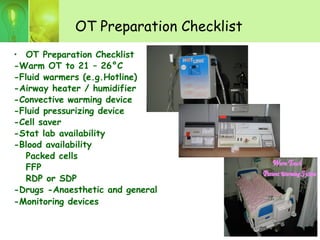
OT Preparation Checklist
• OT Preparation Checklist
-Warm OT to 21 – 26°C
-Fluid warmers (e.g.Hotline)
-Airway heater / humidifier
-Convective warming device
-Fluid pressurizing device
-Cell saver
-Stat lab availability
-Blood availability
Packed cells
FFP
RDP or SDP
-Drugs -Anaesthetic and general
-Monitoring devices
WWarmarm TTouchouch
PPatientatient wwarmingarming SSystemystem
Vascular access
• Large bore IV cannulae
• 8.5F catheters placed in the antecubital fossa
• 8.5F (two) placed in right IJV
• Rapid infusion system
• Veno-venous bypass catheters
• Arterial access
Monitoring
• Complete invasive monitoring is mandatory
• CVS – ECG, direct arterial pressure, CVP and CO
• RS – EtCO2, ABG, pulmonary artery pressure
• Coagulation – platelet count, INR, fibrinogen and
TEG
• Liver – ammonia, lactate, bicarbonate, potassium,
glucose and temperature
• CNS – ICP
• Renal – urine output
Induction of anesthesia
• ECG and arterial pressure monitoring are
commenced
• Invasive cardiovascular monitoring pre/post
induction
• ALF patients – shift with ICP bolt monitoring
• Induction drugs tailored to maintain CVS stability
• Rapid sequence induction technique :
-reflux and ascitis
-short notice
Maintenance of anaesthesia
• Analgesia and muscle relaxants –
Remifentanil/fentanyl
Atracurium/Vecuronium
• Supportive drugs – dextrose infusion,calcium
- sodium bicarbonate
- antifibrinolytics (aprotinin,tranexamic acid)
- N-acetylcysteine (mucomix)
• Vasopressor/inotropes – noradrenalin (adrenor)
- dopamine
Intraoperative management
• Severe coagulopathy
• Metabolic disturbances
• Massive fluid shifts
• Blood loss
• Temperature derangement
• Heamodynamic instability and
• Renal dysfunction
Intraoperative management -
principles
• Surgery falls into three phases –
-Phase I-dissection phase (skeletonization of the
native liver)
-Phase II-an hepatic phase (removal of the liver)
-Phase III- reperfusion phase (graft reperfusion,
haemostasis and completion of arterial anastomosis
and Biliary drainage)
Intraoperative Crisis
• Cardiac rhythm disturbances
• Hyperkalaemia
• Reperfusion syndrome
• Pulmonary hypertension
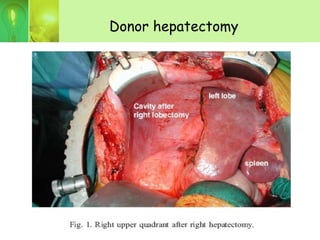
Donor hepatectomy
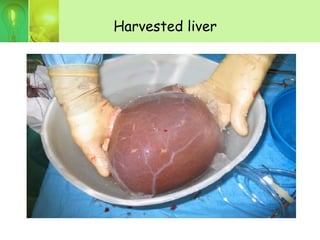
Harvested liver
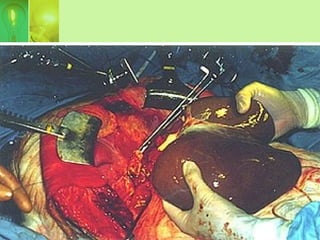
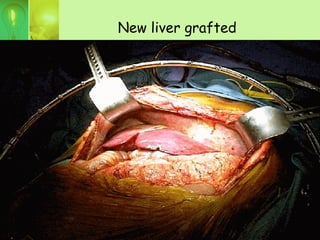
New liver grafted
Ischemic-reperfusion injury
• Decrease in >30% of MAP occurring within 5mins
of graft reperfusion and lasting 1minute
• Heamodynamic changes include:
-reduction in MAP
-reduction in SVR and
-reduction in myocardial contractility
Postoperative management
• Heamodynamic support
• Ventilatory support
• Metabolic support
• Haemostasis support
• Renal support
• Prevention of infections
• Early nutritional therapy
Postoperative care
• Ventilatory support for 6-12hrs
• Sedation and analgesia (propofol and fentanyl)
• Tight glycemic control
• Coagulation and full blood count tests
• Hct between 24-30
• Immunosuppression at the earliest
• Frequent doppler assessment of the graft
Post-operative complications
• Primary nonfunction (5%)
• Right pleural effusion
• Hemorrhage
• Renal failure
• Electrolyte Derangements
• Thrombocytopenia
• Biliary leak
• Hepatic artery thrombosis
Induction of Immunosuppression
• Triple therapy
– Calcineurin inhibitor (tacrolimus, cyclosporine),
anti-proliferative agent (mycophenolate),
corticosteroid
– Initiated immediately following transplantation.
Liver Transplantation-Outcomes
• 1-year survival ~90-94%
• 5-year survival ~75-80%
Anesthesia for non-transplant surgery
• Preserve hepatic blood flow
• Avoid hepatotoxic medications
• Correction of coagulation abnormalities
• Monitor postoperative liver function
• High suspicion of infection at an early stage
• Providers at high risk for hepatitis
•The entire goal of organ transplantation is
to save another human life
Success
Anaesthesia for liver transplantation

Anaesthesia for liver transplantation

  • 1.
    Anesthesia for livertransplantation
  • 2.
    History • 1963 Firstliver transplant Sir Thomas Starzl ( orthotopic liver transplantation) • 1967 First long survival • 1979 Cyclosporine-Sir Roy Calne • 1987 UWI solution for improved organ preservation • 1989 FK 506 • 1999 Living donor liver transplantation
  • 3.
  • 4.
    Introduction • The treatmentof end stage liver disease underwent dramatic transformation with the development of LT • LT is one of the most successful organ transplant after kidney transplant in terms of survival
  • 5.
    Improved survival • Improvementin preservation techniques • Advances in Intraoperative management • Refinement of surgical techniques • Better immunosuppressive management
  • 6.
    Background • genetic relationship •the anatomical site of the implantation • auto graft • isograft or syngeneic graft • allograft or homograft • xenograft or heterograft
  • 7.
  • 8.
    Blood type compatibilitychart Blood Type Can receive liver from: Generally can donate a liver to O O O, A, B, AB A A, O A, AB B B, O B, AB AB O, A, B, AB AB
  • 9.
    Liver transplantation activityin India • Estimated 200,000 patients suffer from liver disease • No viable long term bridging options exists • Approximately 60 liver transplants per year • First attempt at cadaveric LTx in 1994 at AIIMS • Organ procurement –ORBO and MOHAN organizations
  • 10.
    Transplant team • Anesthetist •Hepatologist • Transplant surgeons • Transplant coordinator • Clinical dietician • Physiotherapists • Social worker
  • 11.
    CVS changes • “Hyperdynamic circulation” • Elevated cardiac output • Decreased peripheral resistance • Hypotension • Vascular hypo reactivity • Splanchnic and systemic arteriolar vasodilatation • Cardiac dysfunction • “cirrhotic cardiomyopathy”
  • 12.
    Respiratory changes • Gasexchange alterations • Hepatopulmonary syndrome • Porto pulmonary hypertension • Restrictive lung changes • Blood gas alteration
  • 13.
    Coagulation Abnormalities • Liverplays a central role in haemostasis • Coagulopathy parallels the degree of liver failure • Reduced hepatic synthesis of coagulation factors • Malabsorption of vitamin K • Inadequate hepatic clearance of procoagulant factors • Platelet: – impaired aggregation – increased adhesiveness
  • 14.
    Renal system • HRS -renal failure in the absence of intrinsic renal disease • Intarrenal vasoconstriction • Renal dysfunction is potentially reversible • Renal function is regained in 40% to 95%
  • 15.
    Child – PughClassification of Cirrhosis Factor & Score 1 2 3 S. Bili mg/dl <2.0 2.0 – 3.0 > 3.0 S. Alb g/dl >3.5 3.0 – 3.5 < 3.0 Ascitis None controlled Poorly controlled PT prolongation 0 -4 4 – 6 > 6 INR (< 1.7) ( 1.7 – 2.3) ( > 2.3) Encephalopathy none grade 1 grade2-3
  • 16.
    Physiologic consequences ofcirrhosis • Increased C.O • Arterial hypotension • Decreased SVR • Increased total plasma volume • Increased activity of vasoconstrictor systems • Increased renal vascular resistance, decreased renal perfusion pressure • Dilutional hyponatremia
  • 17.
    Pharmacokinetics & Pharmacodynamics •Due to changes in - Protein synthesis -Volume of distribution -Protein binding -Hepatic blood flow -Hepatic drug metabolism • Resulting in - Altered Serum levels - Elimination half life - altered hepatic extraction ratio - increased free drug levels
  • 18.
    Preoperative assessment • Performedjointly by hepatologist,surgeon and anesthetist before listing
  • 19.
    Indications for Liver Transplantationin Adults • Presence of irreversible liver disease and a life expectancy of less than 12 months with no effective medical or surgical alternatives to transplantation • Chronic liver disease that has progressed to the point of significant interference with the patient's ability to work or with his/her quality of life • Progression of liver disease that will predictably result in mortality exceeding that of transplantation (85% one-year patient survival and 70% five-year survival)
  • 20.
    Indications for Liver Transplantationin Adults • Chronic Hepatitis C • Chronic Hepatitis B • Cryptogenic cirrhosis • Hepatocellular carcinoma • Alcoholic Liver Disease • Fulminant Hepatic Failure • Wilson’s disease • Primary Biliary Cirrhosis • Metabolic and genetic disorders
  • 21.
    Contraindications • Extra hepaticcancer • Active sepsis • Advanced cardiac disease • Advanced pulmonary disease • HIV with AIDS and low CD4 count
  • 22.
    Goals of evaluation •Which patients require LT? • Which patients would benefit? • When such therapy should be undertaken?
  • 23.
    Goals of evaluation •Understanding the underlying liver disease • Development of complications • Remote organ dysfunction (cardiac, pulmonary and renal) • Optimization of nutritional and medical therapy
  • 24.
    Preoperative assessment • AIM:identify physiological abnormalities :attempt to improve and optimize :preoperative assessment is tailored to accommodate the clinical needs of the patient
  • 25.
    Liver Transplantation-evaluation • Medicalhistory– -Symptoms such as fatigue, itching, swelling, changes in mental status and GI bleeding – Other medical problems – Medications – Includes alcohol use and drug use history • Physical examination • Blood tests • Determine current functional status of the liver
  • 26.
    Liver Transplantation-evaluation • Concomitantmedical problems – Heart – Lung – Kidney – Bone thinning
  • 27.
    Liver Transplantation-evaluation • Determinecause of liver disease • Document severity of liver disease • Determine survival and functional ability • Concomitant medical problems • Psychiatric evaluation • Social Evaluation
  • 28.
    Assessment of thepatient • Does the patient need transplant at this time • Will the patient survive the procedure • Will the patient meet the 50% 5yr survival criterion • Does the patient understand the implications of transplantation
  • 29.
    Cardio respiratory assessment •CAD – resting 2D echo and DSE - best strategy unclear • Respiratory – room air ABG - PFT’s - HPS – indication for Tx - PPS – defer Tx
  • 30.
    Liver donation • Conventionaladult deceased donor procurement • Nonheart beating donors and • Insitu splitting the deceased donor liver • Living related organ donors
  • 31.
    How Much LiverDo You Need? • Liver = 2% body weight • Optimal: > 1% liver weight/body weight ratio • Liver remnant volume -30-40% of total liver volume • Minimum graft volume -40% of standard liver mass
  • 32.
    Theatre preparation • Consultantand assistant anesthetists • Perfusionist • Lines and physiological monitoring • Infection control • Immunosuppression • Blood loss and replacement • Biochemical monitoring
  • 33.
    OT Preparation Checklist •OT Preparation Checklist -Warm OT to 21 – 26°C -Fluid warmers (e.g.Hotline) -Airway heater / humidifier -Convective warming device -Fluid pressurizing device -Cell saver -Stat lab availability -Blood availability Packed cells FFP RDP or SDP -Drugs -Anaesthetic and general -Monitoring devices WWarmarm TTouchouch PPatientatient wwarmingarming SSystemystem
  • 34.
    Vascular access • Largebore IV cannulae • 8.5F catheters placed in the antecubital fossa • 8.5F (two) placed in right IJV • Rapid infusion system • Veno-venous bypass catheters • Arterial access
  • 35.
    Monitoring • Complete invasivemonitoring is mandatory • CVS – ECG, direct arterial pressure, CVP and CO • RS – EtCO2, ABG, pulmonary artery pressure • Coagulation – platelet count, INR, fibrinogen and TEG • Liver – ammonia, lactate, bicarbonate, potassium, glucose and temperature • CNS – ICP • Renal – urine output
  • 36.
    Induction of anesthesia •ECG and arterial pressure monitoring are commenced • Invasive cardiovascular monitoring pre/post induction • ALF patients – shift with ICP bolt monitoring • Induction drugs tailored to maintain CVS stability • Rapid sequence induction technique : -reflux and ascitis -short notice
  • 37.
    Maintenance of anaesthesia •Analgesia and muscle relaxants – Remifentanil/fentanyl Atracurium/Vecuronium • Supportive drugs – dextrose infusion,calcium - sodium bicarbonate - antifibrinolytics (aprotinin,tranexamic acid) - N-acetylcysteine (mucomix) • Vasopressor/inotropes – noradrenalin (adrenor) - dopamine
  • 38.
    Intraoperative management • Severecoagulopathy • Metabolic disturbances • Massive fluid shifts • Blood loss • Temperature derangement • Heamodynamic instability and • Renal dysfunction
  • 39.
    Intraoperative management - principles •Surgery falls into three phases – -Phase I-dissection phase (skeletonization of the native liver) -Phase II-an hepatic phase (removal of the liver) -Phase III- reperfusion phase (graft reperfusion, haemostasis and completion of arterial anastomosis and Biliary drainage)
  • 40.
    Intraoperative Crisis • Cardiacrhythm disturbances • Hyperkalaemia • Reperfusion syndrome • Pulmonary hypertension
  • 41.
  • 42.
  • 44.
  • 45.
    Ischemic-reperfusion injury • Decreasein >30% of MAP occurring within 5mins of graft reperfusion and lasting 1minute • Heamodynamic changes include: -reduction in MAP -reduction in SVR and -reduction in myocardial contractility
  • 46.
    Postoperative management • Heamodynamicsupport • Ventilatory support • Metabolic support • Haemostasis support • Renal support • Prevention of infections • Early nutritional therapy
  • 47.
    Postoperative care • Ventilatorysupport for 6-12hrs • Sedation and analgesia (propofol and fentanyl) • Tight glycemic control • Coagulation and full blood count tests • Hct between 24-30 • Immunosuppression at the earliest • Frequent doppler assessment of the graft
  • 48.
    Post-operative complications • Primarynonfunction (5%) • Right pleural effusion • Hemorrhage • Renal failure • Electrolyte Derangements • Thrombocytopenia • Biliary leak • Hepatic artery thrombosis
  • 49.
    Induction of Immunosuppression •Triple therapy – Calcineurin inhibitor (tacrolimus, cyclosporine), anti-proliferative agent (mycophenolate), corticosteroid – Initiated immediately following transplantation.
  • 50.
    Liver Transplantation-Outcomes • 1-yearsurvival ~90-94% • 5-year survival ~75-80%
  • 51.
    Anesthesia for non-transplantsurgery • Preserve hepatic blood flow • Avoid hepatotoxic medications • Correction of coagulation abnormalities • Monitor postoperative liver function • High suspicion of infection at an early stage • Providers at high risk for hepatitis
  • 52.
    •The entire goalof organ transplantation is to save another human life
  • 53.