8 th  Pulmonary Medicine Update February 7, 2008 Prone Ventilation for ARDS:  Does it Do More Than Improve Oxygenation? Richard K. Albert, M.D. Chief of Medicine Denver Health Medical Center Professor of Medicine University of Colorado Adjunct Professor of Engineering and Computer Science University of Denver Denver Health
Colorado Skiing Denver Health
Objectives To describe:    Hx of prone ventilation    Effects on:  -  O 2 -  Regional lung volume and perfusion -  Response to recruitment maneuvers -  VILI  Clinical studies  Unpublished data Denver Health
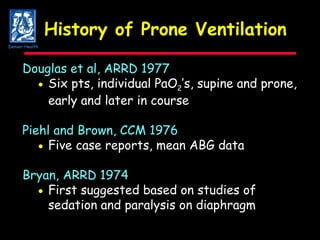
History of Prone Ventilation Douglas et al, ARRD 1977    Six pts, individual PaO 2 ’s, supine and prone, early and later in course  Piehl and Brown, CCM 1976    Five case reports, mean ABG data Bryan, ARRD 1974  First suggested based on studies of sedation and paralysis on diaphragm Denver Health
Collaborators U. Washington U. Colorado   Lisa Embree   Wayne Lamm   Josh Saliman Mike Graham   David Leasa   Sun Jong Kim Bob Guest   Takashi Mutoh   Ivor Douglas Robb Glenny   Tom Robertson     Jae Hwa Cho Jack Hildebrandt  Mary Sanderson  Seok Chan Kim Mike Hlastala     Charlie Wiener  Wayne Kirk  Mayo Clinic   Rolf Hubmayr   U. Barcelona   Johns Hopkins   U. Iowa   Jordi Mancebo     Blaine Easley   Ken Beck Brett Simon Eric Hoffman Denver Health
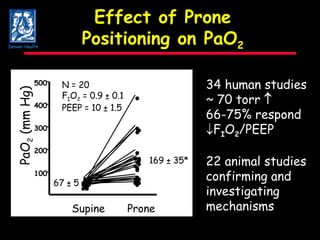
Effect of Prone Positioning on PaO 2 34 human studies ~ 70 torr   66-75% respond F I O 2 /PEEP 22 animal studies confirming and investigating mechanisms 100 200 300 400 500 PaO 2  (mm Hg) N = 20 F I O 2  = 0.9 ± 0.1 PEEP = 10 ± 1.5                Supine Prone                   67 ± 5 169 ± 35*    Denver Health
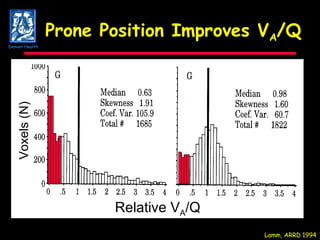
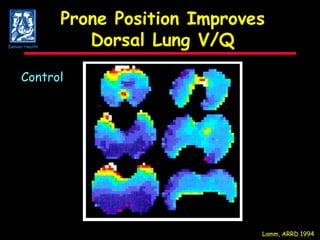
Prone Position Improves V A /Q Lamm, ARRD 1994 Relative V A /Q Voxels (N) Denver Health
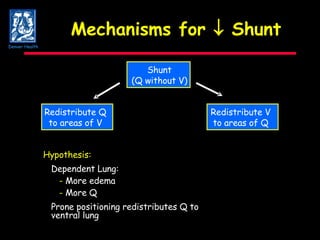
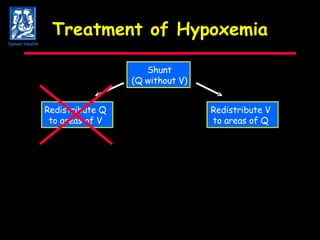
Mechanisms for    Shunt Hypothesis: Dependent Lung: -  More edema -  More Q Prone positioning redistributes Q to  ventral lung Shunt (Q without V) Redistribute Q to areas of V Redistribute V to areas of Q Denver Health
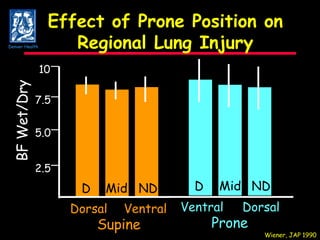
Effect of Prone Position on Regional Lung Injury Supine 10 7.5 5.0 2.5 BF Wet/Dry Dorsal Ventral Wiener, JAP 1990 D Mid ND D Mid ND Prone Dorsal Ventral Denver Health
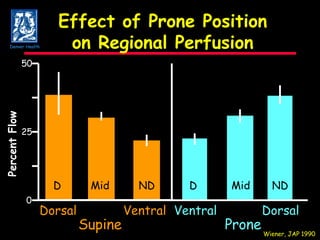
Effect of Prone Position on Regional Perfusion Percent Flow 25 50 0 Supine Dorsal Ventral Wiener, JAP 1990 Mid D ND Prone Ventral Dorsal D Mid ND Denver Health
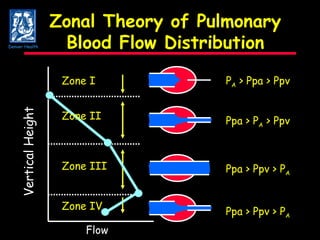
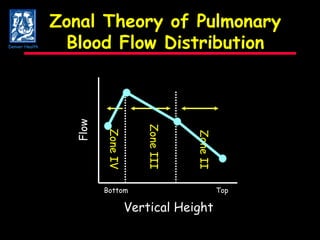
Zonal Theory of Pulmonary Blood Flow Distribution Flow Vertical Height Ppa > Ppv > P A   Zone III Ppa > Ppv > P A   Zone IV P A  > Ppa > Ppv Zone I Ppa > P A  > Ppv Zone II Denver Health
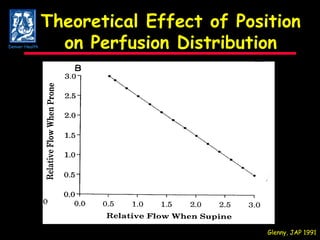
Theoretical Effect of Position on Perfusion Distribution Glenny, JAP 1991 Denver Health
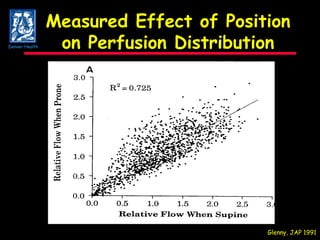
Measured Effect of Position on Perfusion Distribution Glenny, JAP 1991 Denver Health
Zonal Theory of Pulmonary Blood Flow Distribution Flow Vertical Height Zone II Zone III Zone IV Top Bottom Denver Health
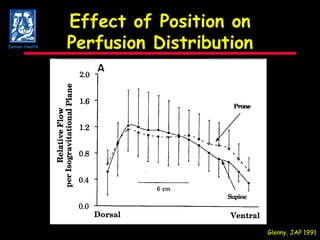
Effect of Position on Perfusion Distribution Glenny, JAP 1991 Denver Health
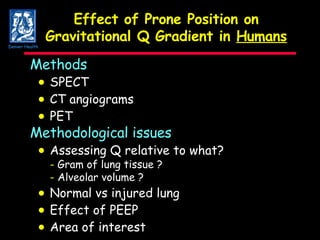
Effect of Prone Position on Gravitational Q Gradient in  Humans Methods  SPECT  CT angiograms  PET Methodological issues  Assessing Q relative to what? -  Gram of lung tissue ? -  Alveolar volume ?  Normal vs injured lung  Effect of PEEP  Area of interest Denver Health
Treatment of Hypoxemia Shunt (Q without V) Redistribute Q to areas of V Redistribute V to areas of Q Denver Health
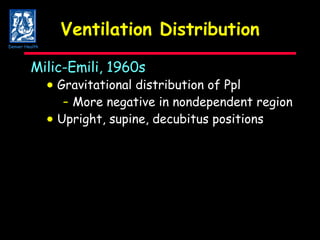
Ventilation Distribution Milic-Emili, 1960s    Gravitational distribution of Ppl -  More negative in nondependent region    Upright, supine, decubitus positions Denver Health
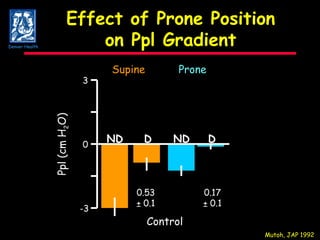
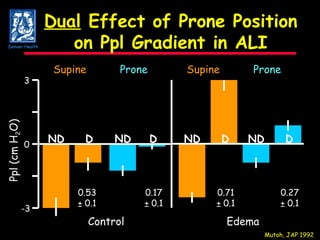
Effect of Prone Position on Ppl Gradient 0 3 -3 Ppl (cm H 2 O) Supine Prone Control Mutoh, JAP 1992 0.53 ± 0.1 D 0.17 ± 0.1 D ND ND Denver Health
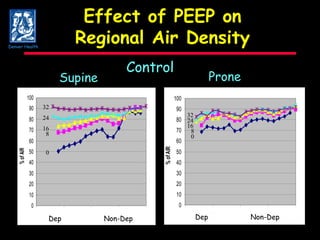
Effect of PEEP on Regional Air Density Control Supine Prone Dep Non-Dep Dep Non-Dep 32 24 16 8 0 32 24 16 8 0 Denver Health
Prone Position Improves Dorsal Lung V/Q Lamm, ARRD 1994 Control Denver Health
Dual  Effect of Prone Position on Ppl Gradient in ALI 0 3 -3 Ppl (cm H 2 O) Supine Supine Prone Prone Control Edema Mutoh, JAP 1992 0.53 ± 0.1 D 0.17 ± 0.1 D 0.71 ± 0.1 D 0.27 ± 0.1 D ND ND ND ND Denver Health
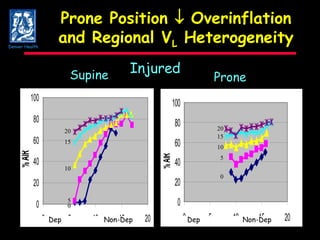
Prone Position    Overinflation and Regional V L  Heterogeneity Supine Prone Injured Dep Non-Dep Dep Non-Dep 0 0 5 5 10 10 15 15 20 20 Denver Health
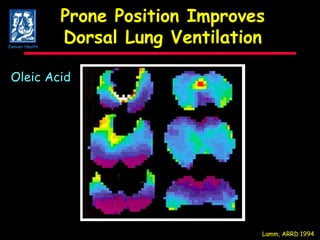
Prone Position Improves Dorsal Lung Ventilation Lamm, ARRD 1994 Oleic Acid Denver Health
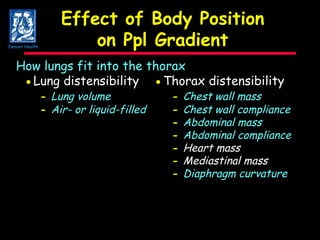
Effect of Body Position on Ppl Gradient How lungs fit into the thorax   Lung distensibility     Thorax distensibility -   Lung volume -   Chest wall mass -   Air- or liquid-filled -   Chest wall compliance -   Abdominal mass -   Abdominal compliance -   Heart mass -   Mediastinal mass -   Diaphragm curvature Denver Health
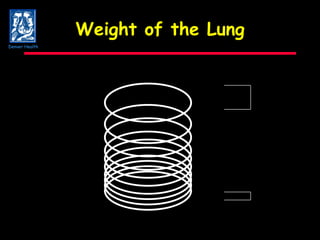
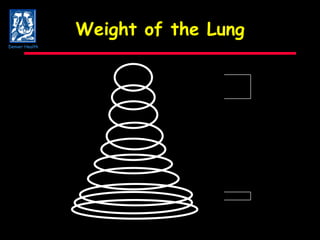
Weight of the Lung Denver Health
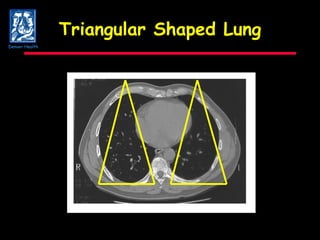
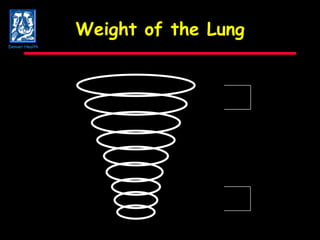
Triangular Shaped Lung Denver Health
Weight of the Lung Denver Health
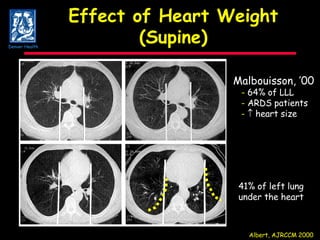
Effect of Heart Weight (Supine) Albert, AJRCCM 2000 41% of left lung under the heart Malbouisson, ’00 -  64% of LLL -  ARDS patients -     heart size Denver Health
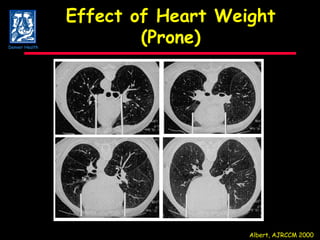
Effect of Heart Weight (Prone) Albert, AJRCCM 2000 Denver Health
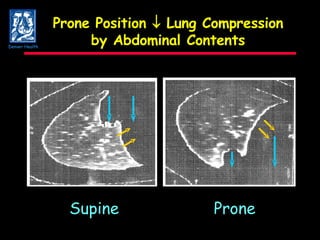
Prone Position    Lung Compression by Abdominal Contents Supine Prone Denver Health
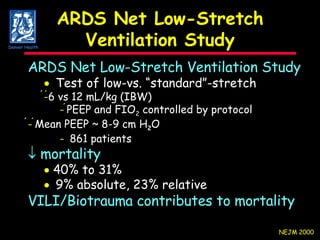
ARDS Net Low-Stretch Ventilation Study ARDS Net Low-Stretch Ventilation Study  Test of low-vs. “standard”-stretch  -  6 vs 12 mL/kg (IBW) -  PEEP and FIO 2  controlled by protocol  -  Mean PEEP  ~  8-9 cm H 2 O - 861 patients    mortality    40% to 31%  9% absolute, 23% relative VILI/Biotrauma contributes to mortality NEJM 2000 Denver Health
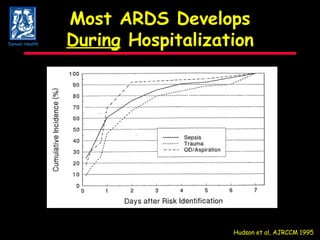
Most ARDS Develops During  Hospitalization Hudson et al, AJRCCM 1995 Denver Health
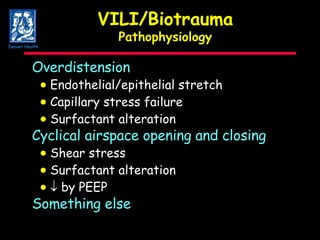
VILI/Biotrauma Pathophysiology Overdistension  Endothelial/epithelial stretch  Capillary stress failure    Surfactant alteration Cyclical airspace opening and closing    Shear stress    Surfactant alteration       by PEEP Something else Denver Health
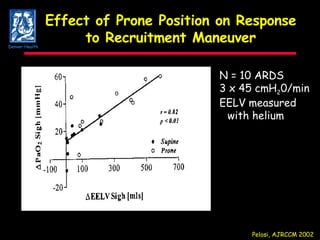
Effect of Prone Position on Response to Recruitment Maneuver Pelosi, AJRCCM 2002 N = 10 ARDS 3 x 45 cmH 2 0/min EELV measured with helium Denver Health
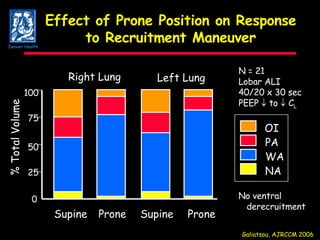
Effect of Prone Position on Response to Recruitment Maneuver % Total Volume Right Lung Left Lung 100 75 50 25 0 Supine Supine Prone Prone OI PA WA NA Galiatsou, AJRCCM 2006 N = 21 Lobar ALI 40/20 x 30 sec PEEP    to    C L No ventral derecruitment Denver Health
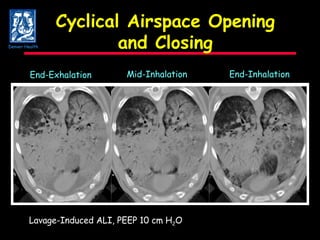
Cyclical Airspace Opening and Closing End-Exhalation Mid-Inhalation End-Inhalation Lavage-Induced ALI, PEEP 10 cm H 2 O Denver Health
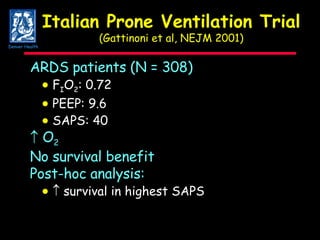
Italian Prone Ventilation Trial (Gattinoni et al, NEJM 2001) ARDS patients (N = 308)    F I O 2 : 0.72    PEEP: 9.6    SAPS: 40 O 2 No survival benefit Post-hoc analysis:        survival in highest SAPS Denver Health
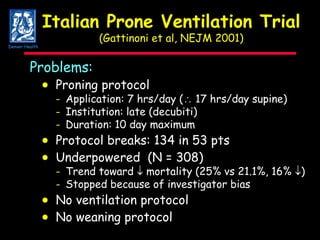
Italian Prone Ventilation Trial (Gattinoni et al, NEJM 2001) Problems:  Proning protocol - Application: 7 hrs/day (   17 hrs/day supine) - Institution: late (decubiti) - Duration: 10 day maximum  Protocol breaks: 134 in 53 pts  Underpowered  (N = 308) - Trend toward    mortality (25% vs 21.1%, 16%   ) - Stopped because of investigator bias  No ventilation protocol    No weaning protocol Denver Health
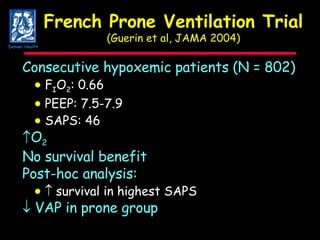
French Prone Ventilation Trial (Guerin et al, JAMA 2004) Consecutive hypoxemic patients (N = 802)    F I O 2 : 0.66    PEEP: 7.5-7.9    SAPS: 46 O 2 No survival benefit Post-hoc analysis:        survival in highest SAPS    VAP in prone group Denver Health
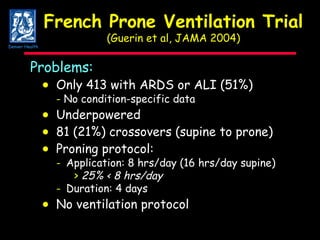
French Prone Ventilation Trial (Guerin et al, JAMA 2004) Problems:  Only 413 with ARDS or ALI (51%) -  No condition-specific data  Underpowered    81 (21%) crossovers (supine to prone)     Proning protocol: - Application: 8 hrs/day (16 hrs/day supine) >   25% < 8 hrs/day  - Duration: 4 days    No ventilation protocol  Denver Health
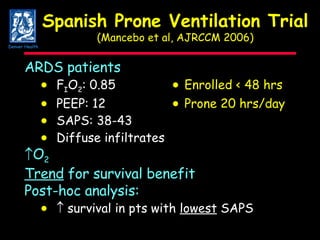
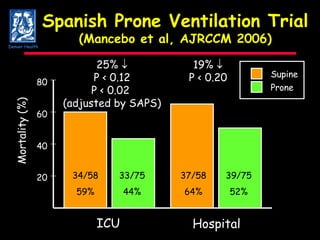
Spanish Prone Ventilation Trial (Mancebo et al, AJRCCM 2006) ARDS patients  F I O 2 : 0.85  Enrolled < 48 hrs  PEEP: 12  Prone 20 hrs/day  SAPS: 38-43    Diffuse infiltrates O 2 Trend  for survival benefit Post-hoc analysis:         survival in pts with  lowest  SAPS Denver Health
Spanish Prone Ventilation Trial (Mancebo et al, AJRCCM 2006) Mortality (%) 20 40 60 80 Hospital 37/58 64% 39/75 52% ICU 34/58 59% 33/75 44% 25%   P < 0.12 P < 0.02  (adjusted by SAPS) 19%   P < 0.20 Denver Health Prone Supine
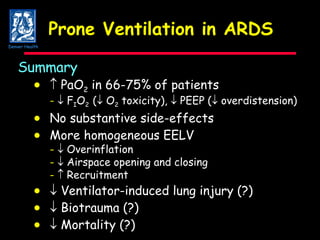
Prone Ventilation in ARDS Summary     PaO 2  in 66-75% of patients -     F I O 2  (   O 2  toxicity),    PEEP (   overdistension)   No substantive side-effects  More homogeneous EELV -     Overinflation -     Airspace opening and closing -     Recruitment     Ventilator-induced lung injury (?)     Biotrauma (?)       Mortality (?) Denver Health
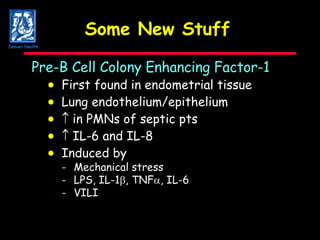
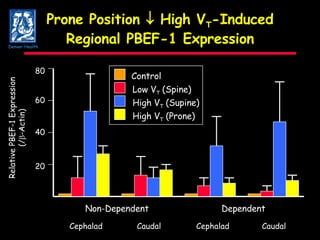
Some New Stuff  Pre-B Cell Colony Enhancing Factor-1  First found in endometrial tissue  Lung endothelium/epithelium     in PMNs of septic pts     IL-6 and IL-8  Induced by - Mechanical stress - LPS, IL-1  , TNF  , IL-6 - VILI Denver Health
Prone Position    High V T -Induced Regional PBEF-1 Expression 40 80 60 20 Relative PBEF-1 Expression (/  -Actin) Control Low V T  (Spine) High V T  (Supine) High V T  (Prone) Cephalad Caudal Cephalad Caudal Non-Dependent Dependent Denver Health
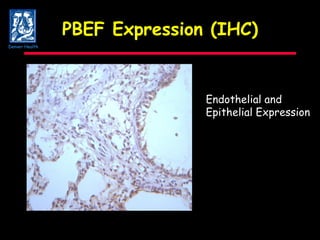
PBEF Expression (IHC) Endothelial and Epithelial Expression Denver Health 20x
Objectives Summarize:    Hx of prone ventilation    Effects on:  -  O 2 -  Regional lung volume and perfusion -  Response to recruitment maneuvers -  VILI  Clinical studies  Unpublished data Denver Health
Prone Ventilation in ARDS Conclusion: Don’t do anything on your back –  You might get ARDS Denver Health

Prone Ventilation In ARDS

  • 1.
    8 th Pulmonary Medicine Update February 7, 2008 Prone Ventilation for ARDS: Does it Do More Than Improve Oxygenation? Richard K. Albert, M.D. Chief of Medicine Denver Health Medical Center Professor of Medicine University of Colorado Adjunct Professor of Engineering and Computer Science University of Denver Denver Health
  • 2.
  • 3.
    Objectives To describe: Hx of prone ventilation  Effects on: - O 2 - Regional lung volume and perfusion - Response to recruitment maneuvers - VILI  Clinical studies  Unpublished data Denver Health
  • 4.
    History of ProneVentilation Douglas et al, ARRD 1977  Six pts, individual PaO 2 ’s, supine and prone, early and later in course Piehl and Brown, CCM 1976  Five case reports, mean ABG data Bryan, ARRD 1974  First suggested based on studies of sedation and paralysis on diaphragm Denver Health
  • 5.
    Collaborators U. WashingtonU. Colorado Lisa Embree Wayne Lamm Josh Saliman Mike Graham David Leasa Sun Jong Kim Bob Guest Takashi Mutoh Ivor Douglas Robb Glenny Tom Robertson Jae Hwa Cho Jack Hildebrandt Mary Sanderson Seok Chan Kim Mike Hlastala Charlie Wiener Wayne Kirk Mayo Clinic Rolf Hubmayr U. Barcelona Johns Hopkins U. Iowa Jordi Mancebo Blaine Easley Ken Beck Brett Simon Eric Hoffman Denver Health
  • 6.
    Effect of PronePositioning on PaO 2 34 human studies ~ 70 torr  66-75% respond F I O 2 /PEEP 22 animal studies confirming and investigating mechanisms 100 200 300 400 500 PaO 2 (mm Hg) N = 20 F I O 2 = 0.9 ± 0.1 PEEP = 10 ± 1.5                Supine Prone                   67 ± 5 169 ± 35*   Denver Health
  • 7.
    Prone Position ImprovesV A /Q Lamm, ARRD 1994 Relative V A /Q Voxels (N) Denver Health
  • 8.
    Mechanisms for  Shunt Hypothesis: Dependent Lung: - More edema - More Q Prone positioning redistributes Q to ventral lung Shunt (Q without V) Redistribute Q to areas of V Redistribute V to areas of Q Denver Health
  • 9.
    Effect of PronePosition on Regional Lung Injury Supine 10 7.5 5.0 2.5 BF Wet/Dry Dorsal Ventral Wiener, JAP 1990 D Mid ND D Mid ND Prone Dorsal Ventral Denver Health
  • 10.
    Effect of PronePosition on Regional Perfusion Percent Flow 25 50 0 Supine Dorsal Ventral Wiener, JAP 1990 Mid D ND Prone Ventral Dorsal D Mid ND Denver Health
  • 11.
    Zonal Theory ofPulmonary Blood Flow Distribution Flow Vertical Height Ppa > Ppv > P A Zone III Ppa > Ppv > P A Zone IV P A > Ppa > Ppv Zone I Ppa > P A > Ppv Zone II Denver Health
  • 12.
    Theoretical Effect ofPosition on Perfusion Distribution Glenny, JAP 1991 Denver Health
  • 13.
    Measured Effect ofPosition on Perfusion Distribution Glenny, JAP 1991 Denver Health
  • 14.
    Zonal Theory ofPulmonary Blood Flow Distribution Flow Vertical Height Zone II Zone III Zone IV Top Bottom Denver Health
  • 15.
    Effect of Positionon Perfusion Distribution Glenny, JAP 1991 Denver Health
  • 16.
    Effect of PronePosition on Gravitational Q Gradient in Humans Methods  SPECT  CT angiograms  PET Methodological issues  Assessing Q relative to what? - Gram of lung tissue ? - Alveolar volume ?  Normal vs injured lung  Effect of PEEP  Area of interest Denver Health
  • 17.
    Treatment of HypoxemiaShunt (Q without V) Redistribute Q to areas of V Redistribute V to areas of Q Denver Health
  • 18.
    Ventilation Distribution Milic-Emili,1960s  Gravitational distribution of Ppl - More negative in nondependent region  Upright, supine, decubitus positions Denver Health
  • 19.
    Effect of PronePosition on Ppl Gradient 0 3 -3 Ppl (cm H 2 O) Supine Prone Control Mutoh, JAP 1992 0.53 ± 0.1 D 0.17 ± 0.1 D ND ND Denver Health
  • 20.
    Effect of PEEPon Regional Air Density Control Supine Prone Dep Non-Dep Dep Non-Dep 32 24 16 8 0 32 24 16 8 0 Denver Health
  • 21.
    Prone Position ImprovesDorsal Lung V/Q Lamm, ARRD 1994 Control Denver Health
  • 22.
    Dual Effectof Prone Position on Ppl Gradient in ALI 0 3 -3 Ppl (cm H 2 O) Supine Supine Prone Prone Control Edema Mutoh, JAP 1992 0.53 ± 0.1 D 0.17 ± 0.1 D 0.71 ± 0.1 D 0.27 ± 0.1 D ND ND ND ND Denver Health
  • 23.
    Prone Position  Overinflation and Regional V L Heterogeneity Supine Prone Injured Dep Non-Dep Dep Non-Dep 0 0 5 5 10 10 15 15 20 20 Denver Health
  • 24.
    Prone Position ImprovesDorsal Lung Ventilation Lamm, ARRD 1994 Oleic Acid Denver Health
  • 25.
    Effect of BodyPosition on Ppl Gradient How lungs fit into the thorax   Lung distensibility   Thorax distensibility - Lung volume - Chest wall mass - Air- or liquid-filled - Chest wall compliance - Abdominal mass - Abdominal compliance - Heart mass - Mediastinal mass - Diaphragm curvature Denver Health
  • 26.
    Weight of theLung Denver Health
  • 27.
  • 28.
    Weight of theLung Denver Health
  • 29.
    Weight of theLung Denver Health
  • 30.
    Effect of HeartWeight (Supine) Albert, AJRCCM 2000 41% of left lung under the heart Malbouisson, ’00 - 64% of LLL - ARDS patients -  heart size Denver Health
  • 31.
    Effect of HeartWeight (Prone) Albert, AJRCCM 2000 Denver Health
  • 32.
    Prone Position  Lung Compression by Abdominal Contents Supine Prone Denver Health
  • 33.
    ARDS Net Low-StretchVentilation Study ARDS Net Low-Stretch Ventilation Study  Test of low-vs. “standard”-stretch  -  6 vs 12 mL/kg (IBW) -  PEEP and FIO 2 controlled by protocol  -  Mean PEEP ~ 8-9 cm H 2 O - 861 patients  mortality  40% to 31%  9% absolute, 23% relative VILI/Biotrauma contributes to mortality NEJM 2000 Denver Health
  • 34.
    Most ARDS DevelopsDuring Hospitalization Hudson et al, AJRCCM 1995 Denver Health
  • 35.
    VILI/Biotrauma Pathophysiology Overdistension Endothelial/epithelial stretch  Capillary stress failure  Surfactant alteration Cyclical airspace opening and closing  Shear stress  Surfactant alteration   by PEEP Something else Denver Health
  • 36.
    Effect of PronePosition on Response to Recruitment Maneuver Pelosi, AJRCCM 2002 N = 10 ARDS 3 x 45 cmH 2 0/min EELV measured with helium Denver Health
  • 37.
    Effect of PronePosition on Response to Recruitment Maneuver % Total Volume Right Lung Left Lung 100 75 50 25 0 Supine Supine Prone Prone OI PA WA NA Galiatsou, AJRCCM 2006 N = 21 Lobar ALI 40/20 x 30 sec PEEP  to  C L No ventral derecruitment Denver Health
  • 38.
    Cyclical Airspace Openingand Closing End-Exhalation Mid-Inhalation End-Inhalation Lavage-Induced ALI, PEEP 10 cm H 2 O Denver Health
  • 39.
    Italian Prone VentilationTrial (Gattinoni et al, NEJM 2001) ARDS patients (N = 308)  F I O 2 : 0.72  PEEP: 9.6  SAPS: 40 O 2 No survival benefit Post-hoc analysis:   survival in highest SAPS Denver Health
  • 40.
    Italian Prone VentilationTrial (Gattinoni et al, NEJM 2001) Problems:  Proning protocol - Application: 7 hrs/day (  17 hrs/day supine) - Institution: late (decubiti) - Duration: 10 day maximum  Protocol breaks: 134 in 53 pts  Underpowered (N = 308) - Trend toward  mortality (25% vs 21.1%, 16%  ) - Stopped because of investigator bias  No ventilation protocol  No weaning protocol Denver Health
  • 41.
    French Prone VentilationTrial (Guerin et al, JAMA 2004) Consecutive hypoxemic patients (N = 802)  F I O 2 : 0.66  PEEP: 7.5-7.9  SAPS: 46 O 2 No survival benefit Post-hoc analysis:   survival in highest SAPS  VAP in prone group Denver Health
  • 42.
    French Prone VentilationTrial (Guerin et al, JAMA 2004) Problems:  Only 413 with ARDS or ALI (51%) - No condition-specific data  Underpowered  81 (21%) crossovers (supine to prone)  Proning protocol: - Application: 8 hrs/day (16 hrs/day supine) > 25% < 8 hrs/day - Duration: 4 days  No ventilation protocol Denver Health
  • 43.
    Spanish Prone VentilationTrial (Mancebo et al, AJRCCM 2006) ARDS patients  F I O 2 : 0.85  Enrolled < 48 hrs  PEEP: 12  Prone 20 hrs/day  SAPS: 38-43  Diffuse infiltrates O 2 Trend for survival benefit Post-hoc analysis:   survival in pts with lowest SAPS Denver Health
  • 44.
    Spanish Prone VentilationTrial (Mancebo et al, AJRCCM 2006) Mortality (%) 20 40 60 80 Hospital 37/58 64% 39/75 52% ICU 34/58 59% 33/75 44% 25%  P < 0.12 P < 0.02 (adjusted by SAPS) 19%  P < 0.20 Denver Health Prone Supine
  • 45.
    Prone Ventilation inARDS Summary   PaO 2 in 66-75% of patients -  F I O 2 (  O 2 toxicity),  PEEP (  overdistension)  No substantive side-effects  More homogeneous EELV -  Overinflation -  Airspace opening and closing -  Recruitment   Ventilator-induced lung injury (?)   Biotrauma (?)   Mortality (?) Denver Health
  • 46.
    Some New Stuff Pre-B Cell Colony Enhancing Factor-1  First found in endometrial tissue  Lung endothelium/epithelium   in PMNs of septic pts   IL-6 and IL-8  Induced by - Mechanical stress - LPS, IL-1  , TNF  , IL-6 - VILI Denver Health
  • 47.
    Prone Position  High V T -Induced Regional PBEF-1 Expression 40 80 60 20 Relative PBEF-1 Expression (/  -Actin) Control Low V T (Spine) High V T (Supine) High V T (Prone) Cephalad Caudal Cephalad Caudal Non-Dependent Dependent Denver Health
  • 48.
    PBEF Expression (IHC)Endothelial and Epithelial Expression Denver Health 20x
  • 49.
    Objectives Summarize:  Hx of prone ventilation  Effects on: - O 2 - Regional lung volume and perfusion - Response to recruitment maneuvers - VILI  Clinical studies  Unpublished data Denver Health
  • 50.
    Prone Ventilation inARDS Conclusion: Don’t do anything on your back – You might get ARDS Denver Health