



















Pathophysiology of
      Mechanical Ventilation
           PJ Papadakos MD FCCM FCCP
                    Director CCM
Professor Anesthesiology, Surgery and Neurosurgery
     University of Rochester School of Medicine
                    Rochester NY
             Professor Respiratory Care
 State University Of New York Genesee Community
                       College
                     Batavia NY
20 year collaboration Rotterdam and now Berlin
Funding over the Years:

Siemens
Erasmus University
European Union
Berlin University
Astra Zeneca
BOC
Lilly
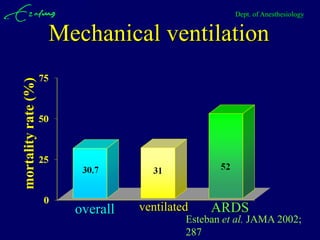
The Facts on Mortality
Dept. of Anesthesiology

mortality rate (%)
                     Mechanical ventilation


                       overall   ventilated    ARDS
                                          Esteban et al. JAMA 2002;
                                          287
Dept. of Anesthesiology


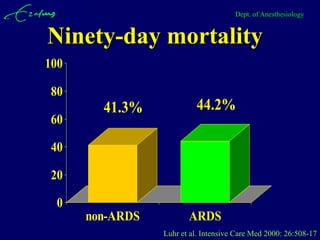
Ninety-day mortality
100

80
        41.3%             44.2%
60

40

20

 0
      non-ARDS          ARDS
                 Luhr et al. Intensive Care Med 2000: 26:508-17
Basic Physiology


The Base of Good Care
 In all trauma patients
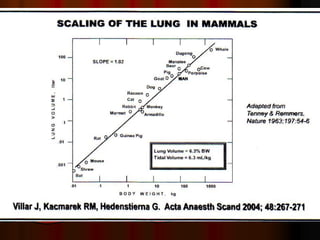
What do these have in common
ARDS Net

Showed that we are mammals!
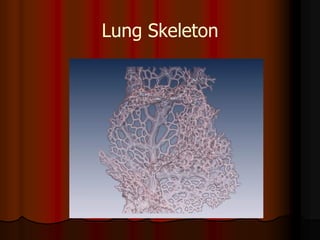
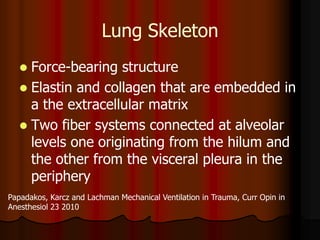
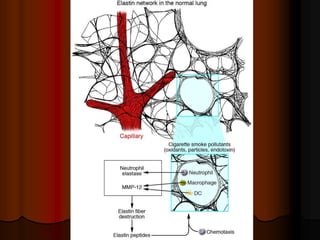
Lung Skeleton
Lung Skeleton
    Force-bearing structure
    Elastin and collagen that are embedded in
     a the extracellular matrix
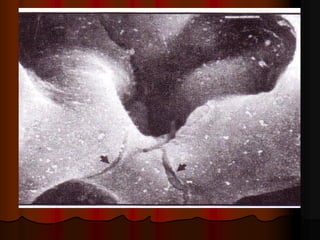
    Two fiber systems connected at alveolar
     levels one originating from the hilum and
     the other from the visceral pleura in the
     periphery
Papadakos, Karcz and Lachman Mechanical Ventilation in Trauma, Curr Opin in
Anesthesiol 23 2010
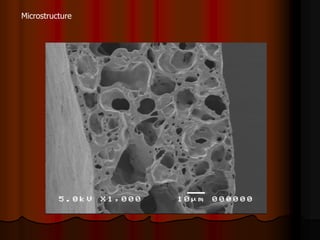
Microstructure
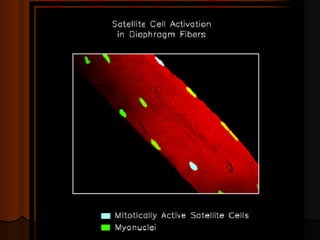
The Breathing Muscle It Goes up and
Down
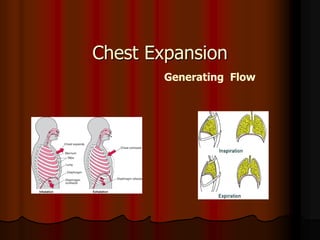
Chest Expansion
       Generating Flow
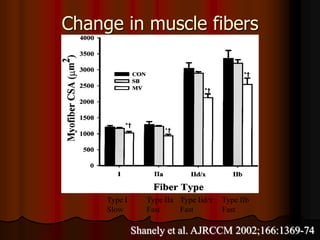
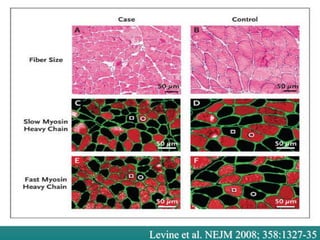
Change in muscle fibers


     Type I      Type IIa Type Iid/x   Type IIb
     Slow        Fast     Fast         Fast

              Shanely et al. AJRCCM 2002;166:1369-74
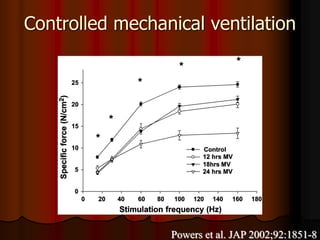
Controlled mechanical ventilation


                 Powers et al. JAP 2002;92:1851-8
St. Michael’s Hospital
            A teaching hospital affiliated with the University of Toronto


Levine et al. NEJM 2008; 358:1327-35
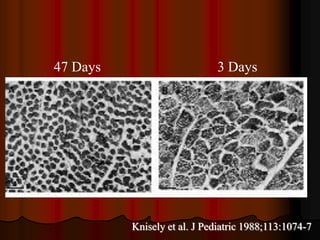
47 Days                       3 Days


          Knisely et al. J Pediatric 1988;113:1074-7
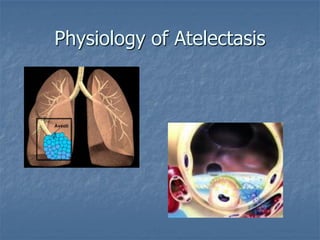
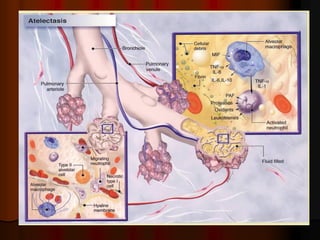
Physiology of Atelectasis
Fact !
Each lung has
a tendency to
   collapse
Decreased Oxgenenation
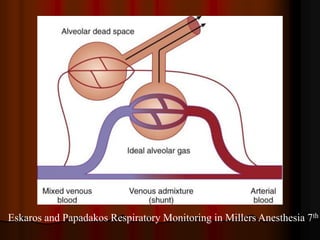
Eskaros and Papadakos Respiratory Monitoring in Millers Anesthesia 7th
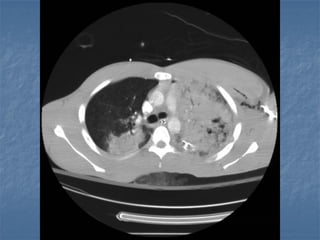
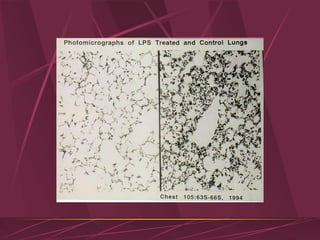
Lung Mechanics change with Lung Collapse
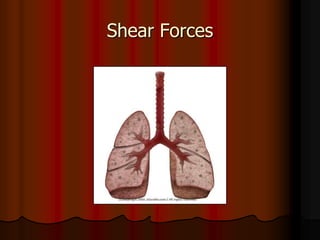
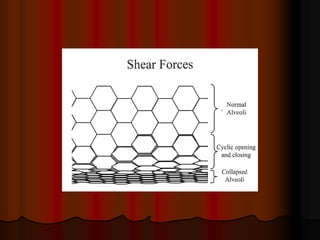
Shear Forces
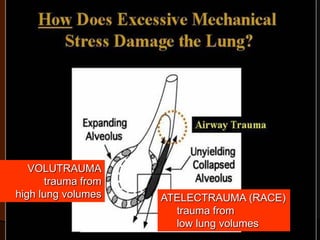
VOLUTRAUMA
       trauma from
high lung volumes    ATELECTRAUMA (RACE)
                       trauma from
                       low lung volumes
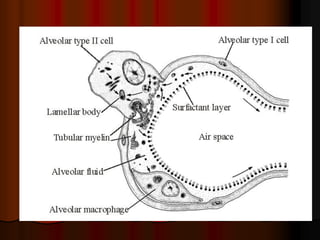
Pulmonary Surfactant
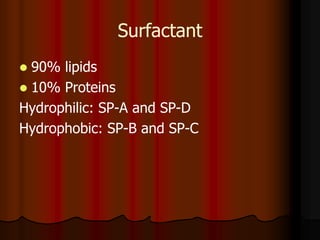
Surfactant
 90% lipids
 10% Proteins
Hydrophilic: SP-A and SP-D
Hydrophobic: SP-B and SP-C
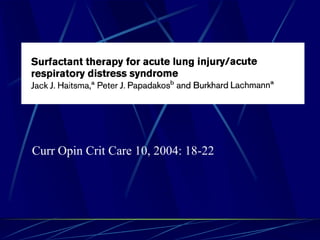
Curr Opin Crit Care 10, 2004: 18-22
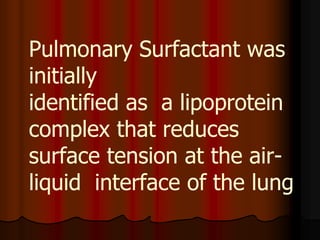
Pulmonary Surfactant was
initially
identified as a lipoprotein
complex that reduces
surface tension at the air-
liquid interface of the lung
Lipids
   Levels of total phospholipids decrease
    over time with cyclic opening and closing
    especially phosphatidylcholine and
    phosphatidylglycerol, which are essential
    for lowering surface tension at the
    alveolar capillary membrane.

Tsangaris l. et al Eur Respir J 2003, 21:495-501
The cycle opening and
closing of Alveolar
Units

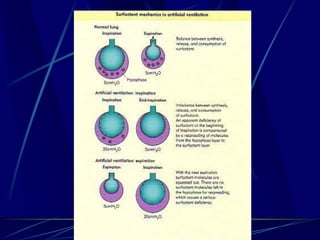
  Deplete Surfactant and lead to
further collapse through clumping.
Key to Immunology
 And host defence
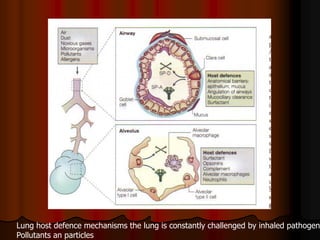
Lung host defence mechanisms the lung is constantly challenged by inhaled pathogen
Pollutants an particles
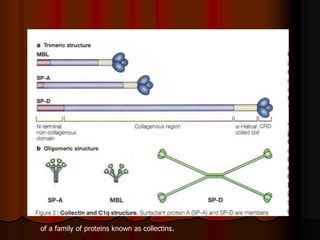
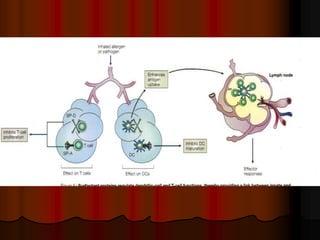
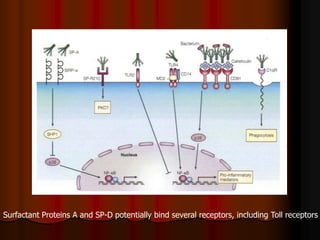
of a family of proteins known as collectins.
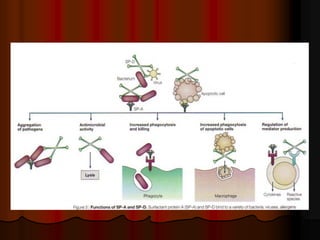
Surfactant Proteins A and SP-D potentially bind several receptors, including Toll receptors
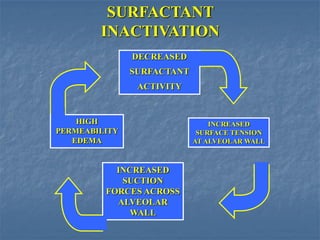
SURFACTANT
        INACTIVATION
               DECREASED
               SURFACTANT
                ACTIVITY


    HIGH                        INCREASED
PERMEABILITY                 SURFACE TENSION
   EDEMA                    AT ALVEOLAR WALL


           INCREASED
            SUCTION
         FORCES ACROSS
           ALVEOLAR
             WALL
Cascade of cytoactive molecules
From our Lab in Rotterdam:
Dept. of Anesthesiology


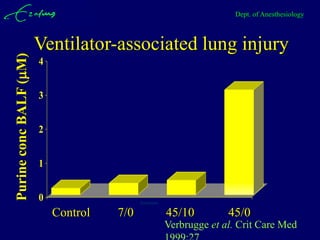
                        Ventilator-associated lung injury
Purine conc BALF (M)

                        4


                        3


                        2


                        1


                        0                   Surfactant

                            Control   7/0                45/10         45/0
                                                         Verbrugge et al. Crit Care Med
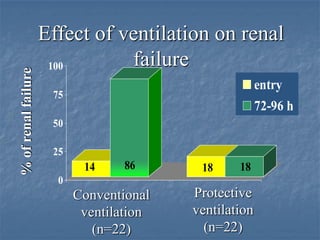
Effect of ventilation on renal
                      100       failure
% of renal failure


                                                                entry
                      75
                                                                72-96 h
                      50                  535.9
                                          507.2
                                          280.1


                      25
                            14     86              18     18
                       0
                           Conventional           Protective
                            ventilation           ventilation
                              (n=22)                (n=22)
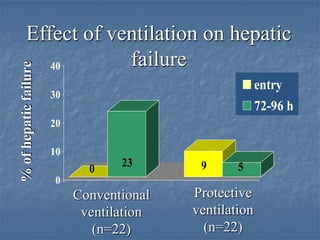
Effect of ventilation on hepatic
                   failure
% of hepatic failure

          40
                                                                 entry
                       30
                                                                 72-96 h
                       20                  535.9
                                           507.2
                                           280.1


                       10
                              0    23               9      5
                        0
                            Conventional           Protective
                             ventilation           ventilation
                               (n=22)                (n=22)
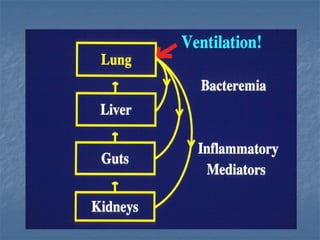
A Systemic Inflammatory Process
Nosocomial Pneumonia
Medicare and Insurance Guidelines
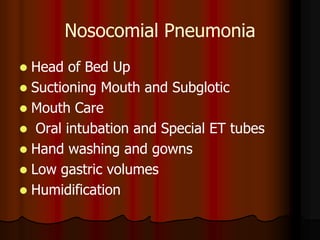
Nosocomial Pneumonia
 Head of Bed Up
 Suctioning Mouth and Subglotic
 Mouth Care
 Oral intubation and Special ET tubes
 Hand washing and gowns
 Low gastric volumes
 Humidification
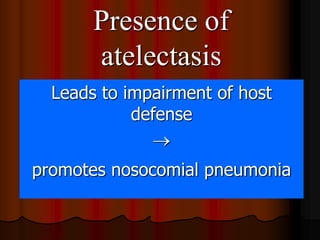
Presence of
       atelectasis
  Leads to impairment of host
            defense
              
promotes nosocomial pneumonia
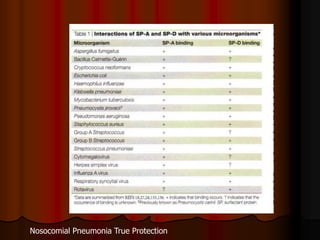
Nosocomial Pneumonia True Protection
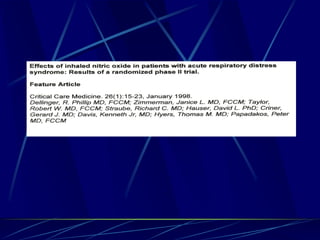
Many Things Do Not
      Work
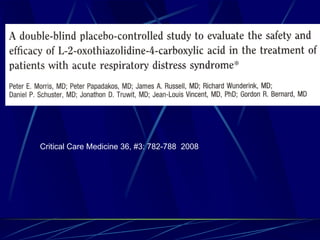
Critical Care Medicine 36, #3: 782-788 2008
Lets Jump into some up coming ideas on ventilation
Dept. of Anesthesiology
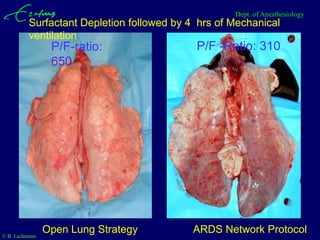
          Surfactant Depletion followed by 4 hrs of Mechanical
          ventilation
                 P/F-ratio:                 P/F -Ratio: 310
                 650


© B. Lachmann
                Open Lung Strategy         ARDS Network Protocol
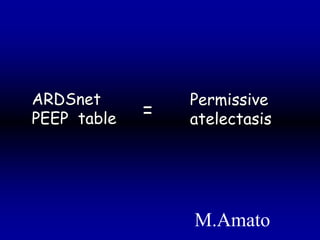
ARDSnet          Permissive
PEEP table   =   atelectasis


                 M.Amato
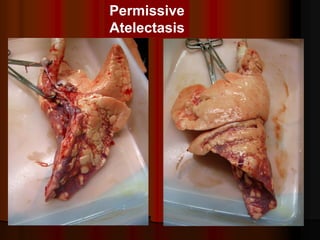
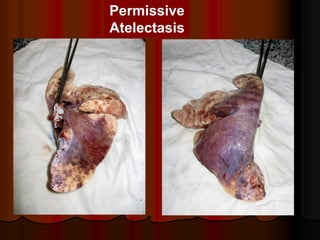
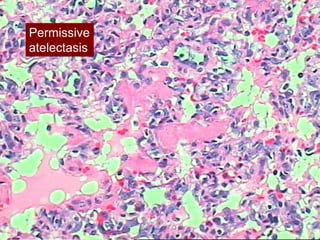
Permissive
Atelectasis
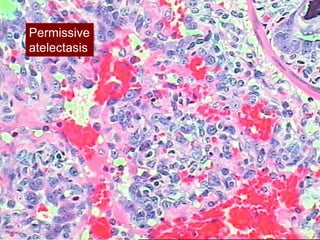
Permissive
ARDSnet
atelectasis
Permissive
Atelectasis
Permissive
ARDSnet
atelectasis
PROTETORA
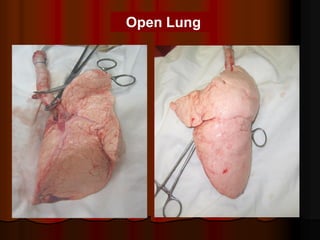
  Open Lung
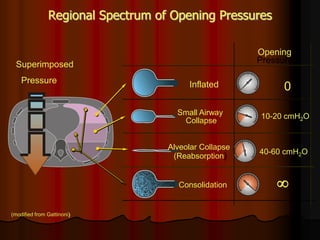
Regional Spectrum of Opening Pressures

                                                       Opening
  Superimposed                                         Pressure

    Pressure                            Inflated             0
                                     Small Airway      10-20 cmH2O
                                      Collapse


                                   Alveolar Collapse
                                                       40-60 cmH2O
                                    (Reabsorption)


                                     Consolidation         
(modified from Gattinoni)
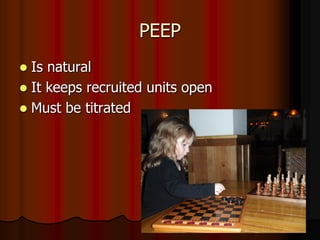
PEEP
 Is natural
 It keeps recruited units open
 Must be titrated
Dept. of Anesthesiology

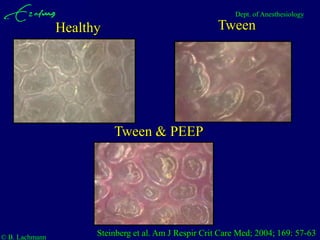
                Healthy                                Tween


                          Tween & PEEP


© B. Lachmann
                      Steinberg et al. Am J Respir Crit Care Med; 2004; 169: 57-63
Dept. of Anesthesiology


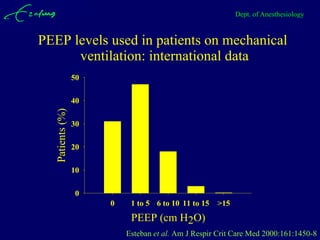
PEEP levels used in patients on mechanical
      ventilation: international data
                  50

                  40
   Patients (%)


                  30

                  20

                  10

                  0
                       0    1 to 5 6 to 10 11 to 15   >15
                            PEEP (cm H2O)
                           Esteban et al. Am J Respir Crit Care Med 2000:161:1450-8
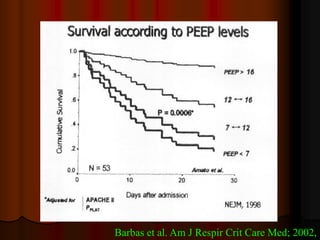
Barbas et al. Am J Respir Crit Care Med; 2002,
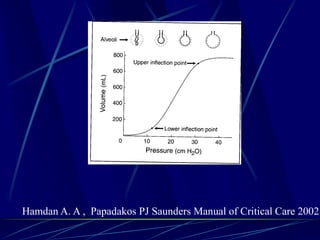
Hamdan A. A , Papadakos PJ Saunders Manual of Critical Care 2002
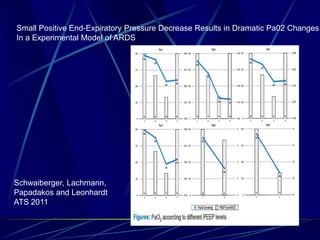
Small Positive End-Expiratory Pressure Decrease Results in Dramatic Pa02 Changes
In a Experimental Model of ARDS


Schwaiberger, Lachmann,
Papadakos and Leonhardt
ATS 2011
1998,

VOLUME 338           February, 5   NUMBER 6


                                   NUMBER 6
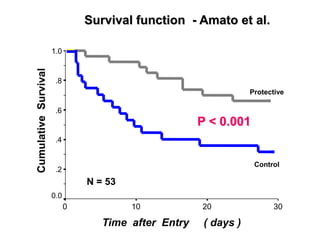
Survival function - Amato et al.

                      1.0
Cumulative Survival


                       .8
                                                                  Protective

                       .6
                                                      P < 0.001
                       .4


                                                                   Control
                       .2
                                N = 53
                      0.0
                            0            10           20                 30

                                   Time after Entry    ( days )
Many Thanks
To my many Friends

Pathophysiology of mechanical ventilation cairo program dec 2011