CAPNOGRAPHY In Emergency Care EDUCATIONAL SERIES Part 3: Intubated
Part 3: The Intubated Patient CAPNOGRAPHY In Emergency Care
Part 3: The Intubated Patient  Learning Objectives List three intubated applications Identify four characteristic patterns  seen in:  Correct ET tube placement ET tube displacement Effective chest compression ROSC
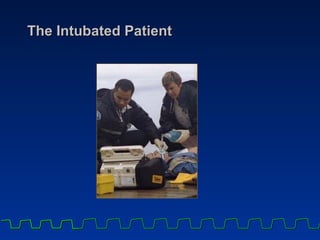
The Intubated Patient
Capnography Applications on Intubated Patients Confirm correct placement of ET tube  Detect changes in ET tube position immediately Resuscitation Assess adequacy of chest compressions Detect ROSC Objective data for decision to cease resuscitation Optimize ventilation of patients  Document, document, document
Confirm ET Tube Placement Traditional methods of confirmation Listen for breath sounds Observe chest movement Auscultate stomach Note ET tube clouding These methods are subjective and unreliable
Confirm ET Tube Placement “ Standard physical examination methods, such as auscultation of lungs and epigastrium, visualization of chest movement, and fogging in the tube,  are not sufficiently reliable to exclude esophageal intubation in all situations.”    Source: Verification of Endotracheal Tube Placement - Approved by the ACEP Board of Directors, October 2001  h t tp ://www.acep.org/1,4923,0.html   (policy statement)
Confirm ET Tube Placement “… emergency responders must confirm tracheal tube position by using nonphysical examination techniques.”  P I-87  Secondary confirmation with an EtCO 2   or esophageal detection is Class IIa recommendation  P I-150   Source: Guidelines 2000 for Cardiovascular Resuscitation and Emergency  Cardiovascular Care,  Circulation  102 (suppl I) 8. August 22,2000
Confirm ET Tube Placement “… end-tidal CO 2  monitors can confirm successful tracheal tube placement within seconds of an intubation attempt”  P I-101   “ The presence of exhaled CO 2  indicates proper tracheal tube placement.”  P I-101 Source: Guidelines 2000 for Cardiovascular Resuscitation and Emergency  Cardiovascular Care,  Circulation  102 (suppl I) 8. August 22,2000
Confirm ET Tube Placement “… devices that use capnographic waveforms are so sensitive that the devices can detect residual CO 2  (during CA) when the tube is in  the trachea”.   P I-383   Source: Guidelines 2000 for Cardiovascular Resuscitation and Emergency  Cardiovascular Care,  Circulation  102 (suppl I) 8. August 22,2000
Confirm ET Tube Placement 108 patients intubated in the field 52 trauma patients 56 medical patients  ET tube placement checked on arrival  at the ED 27 patients (25%) had improperly  placed ET tube 18 were in the esophagus 9 in oropharynx with tip above the cords Source: Falk J., Sayre M.R. 1999. Confirmation of Airway Placement,  Prehospital Emergency Care 3: 273-278
Confirm ET Tube Placement “ Consensus was reached that EtCO 2  evaluation was currently the best method for confirming correct endotracheal tube placement. The group agreed that quantitative capnography was currently the best method for determining endotracheal tube position and strongly recommends its use.”   P 295 Turtle Creek Consensus  Conference on Prehospital Care Source: Wayne M., et al. 1999. Management of Difficult Airways in the Field,  Journal of Emergency Medicine  3: 290-296
Confirm ET Tube Placement “ All endotracheal intubations must be accompanied by an objective confirmation… The optimal method of measurement is quantitative capnography and its use on all intubated patients.”   P 277 Source: Falk J., Sayre M.R. 1999. Confirmation of Airway Placement,  Prehospital Emergency Care  3: 273-278
Confirm ET Tube Placement 108 patients intubated in the field Compared to the Falk study 9% had improperly placed ET tube versus  25% in previous study No unrecognized misplaced ET tubes  in patients with continuous end-tidal  CO 2  monitoring Source: Silvestri S. J., et al. 2003. Improvement in Misplaced Endotracheal Tube Recognition within a Regional Emergency Medical Services System,  Academic Emergency Medicine  10 (5): 445 (Abstract)
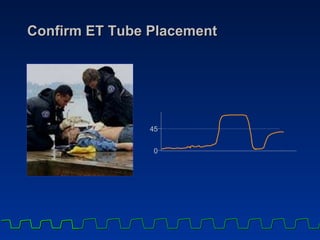
Confirm ET Tube Placement Capnography provides  Objective confirmation of correct  tube placement Documentation of correct placement
Confirm ET Tube Placement 4 5 0
Confirm ET Tube Placement ET tube placement in esophagus may briefly detect CO 2   Following carbonated beverage ingestion  When gastric distention was produced by  mouth to mouth ventilation  Residual CO 2  will be washed out after  6 positive pressure breaths
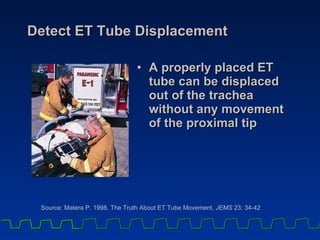
Detect ET Tube Displacement A properly placed ET tube can be displaced out of the trachea without any movement of the proximal tip Source: Matera P. 1998. The Truth About ET Tube Movement,  JEMS  23: 34-42
Detect ET Tube Displacement “…risk from a misplaced tube is unacceptably high and clinical signs confirming tube placement are not completely reliable”  P I-296   “…animal data shows that detection of a displaced or obstructed tube using pulse oximetry or changes in heart rate or blood pressure may be delayed more than  3 minutes”  P I-296 Source: Guidelines 2000 for Cardiovascular Resuscitation and Emergency  Cardiovascular Care,  Circulation  102 (suppl I) 8. August 22,2000
Detect ET Tube Displacement “… use of a device to confirm tracheal tube placement in the field, in the transport vehicle, and on arrival to the hospital is desirable and strongly encouraged.”  P I-296 “ Use of a device to confirm tube placement on arrival at the hospital is especially important because displacement of the tube is most likely to occur when the patient is moved into and out of the transport vehicle.”  P I-296 Source: Guidelines 2000 for Cardiovascular Resuscitation and Emergency Cardiovascular Care,  Circulation  102 (suppl I) 8. August 22,2000
Detect ET Tube Displacement “ Continuous capnography detects acute airway obstruction and hypopharyngeal extubation more rapidly than does pulse oximetry or vital sign monitoring in a hyperoxemic porcine model.” Source: Poirier M. P.,  et al . 1998. Utility of monitoring capnography, pulse oximetry,  and vital signs in the detection of airway mishaps: A hyperoxemic animal model,  Am J Emerg Med  16: 350-352.
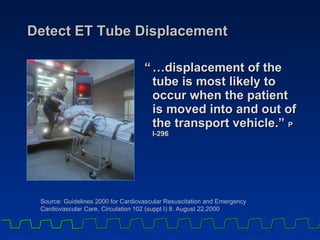
Detect ET Tube Displacement “ … displacement of the tube is most likely to occur when the patient is moved into and out of the transport vehicle.”  P I-296 Source: Guidelines 2000 for Cardiovascular Resuscitation and Emergency Cardiovascular Care,  Circulation  102 (suppl I) 8. August 22,2000
Detect ET Tube Displacement Traditional methods of monitoring  tube position Periodic auscultation of breath sounds Gastric distention Worsening of patient’s color Late sign of tube displacement These methods are subjective and unreliable —and delayed
Detect ET Tube Displacement “ Continuous capnography monitoring devices can identify and signal a fall in exhaled CO 2  consistent with tracheal tube dislodgement. This may be very helpful in emergencies when clinicians have other responsibilities.”  P 140 Source: ACLS-The Reference Textbook, ACLS: Principles and Practice. Ed. 2003 Cummins, R.O. American Heart Association. ISBN 0- 87493-341- 2
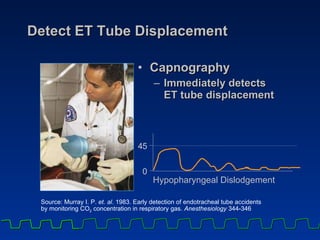
Detect ET Tube Displacement Capnography Immediately detects  ET tube displacement Source: Murray I. P.  et. al . 1983. Early detection of endotracheal tube accidents by monitoring CO 2  concentration in respiratory gas.  Anesthesiology  344-346  4 5 0 Hypopharyngeal Dislodgement
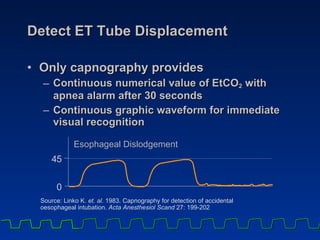
Detect ET Tube Displacement Only capnography provides  Continuous numerical value of EtCO 2  with apnea alarm after 30 seconds Continuous graphic waveform for immediate visual recognition Source: Linko K.  et. al . 1983. Capnography for detection of accidental oesophageal intubation.  Acta Anesthesiol Scand  27: 199-202   4 5 0 Esophageal Dislodgement
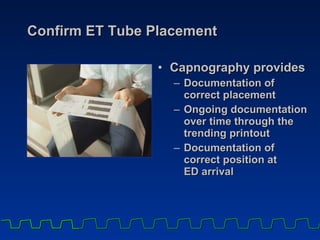
Confirm ET Tube Placement Capnography provides Documentation of correct placement Ongoing documentation over time through the trending printout Documentation of correct position at  ED arrival
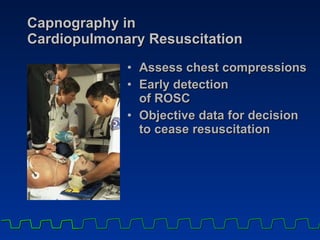
Capnography in  Cardiopulmonary Resuscitation Assess chest compressions Early detection  of ROSC Objective data for decision to cease resuscitation
CPR: Assess Chest Compressions Properly done chest compressions provide  25-30% of normal blood supply to the brain 5%-10% of normal blood supply to the heart Adequate chest compressions promote the elimination of metabolic wastes
CPR: Assess Chest Compressions Airway  - open with ET tube  Breathing  - controlled and stable Circulation  - cardiac output directly related to changes in EtCO 2 Capnography provides noninvasive method for monitoring blood flow generated by  chest compressions
CPR: Assess Chest Compressions 19 minipigs Relationship between EtCO 2   and cardiac output Measured before cardiac arrest  and during CPR Source: Weil M. H. 1985 .  Cardiac Output and end-tidal carbon dioxide,   Critical Care Medicine 13 (11): 907-909
CPR: Assess Chest Compressions Good correlation between EtCO 2  and cardiac output Decrease in EtCO 2  reflects a critical reduction of cardiac output Low cardiac output  Reduces blood flow to the lungs Fails to clear CO 2  from the bloodstream Source: Weil MH. 1985. Cardiac output and end-tidal carbon dioxide,  Critical Care Medicine  13 (11): 907-909
CPR: Assess Chest Compressions Under conditions of constant ventilation, capnography correlates with the circulatory status produced by chest compressions EtCO 2  has potential value in monitoring effectiveness of CPR Source: Weil MH. 1985. Cardiac output and end-tidal carbon dioxide,  Critical Care Medicine  13 (11): 907-909
CPR: Assess Chest Compressions Rescuer fatigue  Ochoa Study Rescuers were not able to maintain adequate chest compressions for more than 1 minute Rescuers did not perceive fatigue even when it was measurably present Source: Ochoa, F. Javier, et al. 1998. The Effect of Rescuer Fatigue on the Quality of Chest Compressions,  Resuscitation  April; 37: 149-52
CPR: Assess Chest Compressions Increase in EtCO 2  has been shown to correlate with A fresh rescuer at a faster compression rate A new rescuer during CPR with no change  in rate Mechanical compressions Source: White R. D. 1994. Out-of-Hospital Monitoring of End-Tidal Carbon Dioxide Pressure During CPR,  Annals of Emergency Medicine  23 (1): 756-761
CPR: Assess Chest Compressions “ …measurement of end-tidal carbon dioxide concentration may be a practical, noninvasive method for monitoring blood flow generated by compression during cardiopulmonary resuscitation and an almost immediate indicator of successful resuscitation.” Source: Falk J. L. 1988. End-tidal carbon dioxide concentration during cardiopulmonary resuscitation,  New England Journal of Medicine  318 (10): 607-611
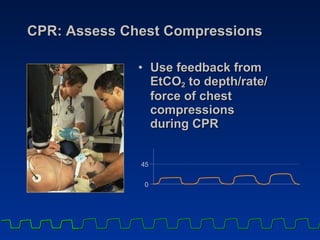
CPR: Assess Chest Compressions Use feedback from EtCO 2  to depth/rate/ force of chest compressions  during CPR 4 5 0
CPR: Detect ROSC 90 prehospital patients intubated  in the field 16 survivors In 13 survivors a rapid rise on CO 2  production was the earliest indicator  of ROSC Before a palpable pulse  Prior to blood pressure Source: Wayne M.A. 1995. Use of End-tidal Carbon Dioxide to Predict Outcome in Prehospital Cardiac Arrest.  Annals of Emergency Medicine  25 (6): 762-767
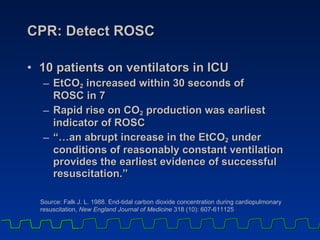
CPR: Detect ROSC 10 patients on ventilators in ICU EtCO 2  increased within 30 seconds of  ROSC in 7  Rapid rise on CO 2  production was earliest  indicator of ROSC “…an abrupt increase in the EtCO 2  under conditions of reasonably constant ventilation provides the earliest evidence of successful resuscitation.” Source: Falk J. L. 1988. End-tidal carbon dioxide concentration during cardiopulmonary resuscitation,  New England Journal of Medicine  318 (10): 607-611125
CPR: Detect ROSC Sudden rise in EtCO 2   Confirm with ECG and capnography Questionable pulse Arterial vasoconstriction may make  pulse difficult to detect
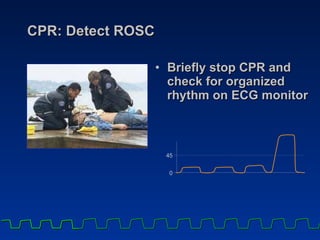
CPR: Detect ROSC Briefly stop CPR and check for organized rhythm on ECG monitor 4 5 0
Decision to Cease Resuscitation Capnography  Has been shown to predict probability of outcome following resuscitation May be used in the decision to cease resuscitation efforts Source: Levine R. L. 1997. End-tidal carbon dioxide and outcome of out-of-hospital cardiac arrest.  New England Journal of Medicine  337 (5): 301-306 .
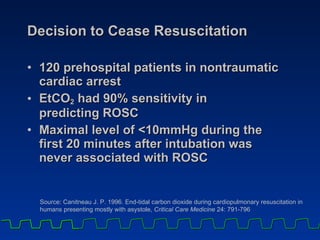
Decision to Cease Resuscitation 120 prehospital patients in nontraumatic  cardiac arrest EtCO 2  had 90% sensitivity in  predicting ROSC  Maximal level of <10mmHg during the  first 20 minutes after intubation was  never associated with ROSC Source: Canitneau J. P. 1996. End-tidal carbon dioxide during cardiopulmonary resuscitation in humans presenting mostly with asystole,  Critical Care Medicine  24: 791-796
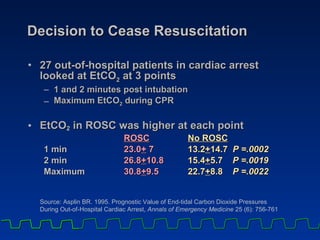
Decision to Cease Resuscitation 27 out-of-hospital patients in cardiac arrest  looked at EtCO 2  at 3 points 1 and 2 minutes post intubation  Maximum EtCO 2  during CPR EtCO 2  in ROSC was higher at each point ROSC No ROSC 1 min 23.0 +  7 13.2 + 14.7  P =.0002 2 min 26.8 + 10.8 15.4 + 5.7  P =.0019 Maximum 30.8 + 9.5 22.7 + 8.8  P =.0022 Source: Asplin BR. 1995. Prognostic Value of End-tidal Carbon Dioxide Pressures During Out-of-Hospital Cardiac Arrest,  Annals of Emergency Medicine  25 (6): 756-761
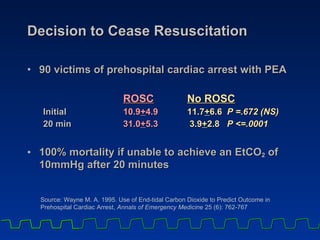
Decision to Cease Resuscitation 90 victims of prehospital cardiac arrest with PEA ROSC No ROSC Initial 10.9 + 4.9 11.7 + 6.6  P =.672 (NS) 20 min 31.0 + 5.3   3.9 + 2.8  P <=.0001 100% mortality if unable to achieve an EtCO 2  of  10mmHg after 20 minutes Source: Wayne M. A. 1995. Use of End-tidal Carbon Dioxide to Predict Outcome in  Prehospital Cardiac Arrest,  Annals of Emergency Medicine  25 (6): 762-767
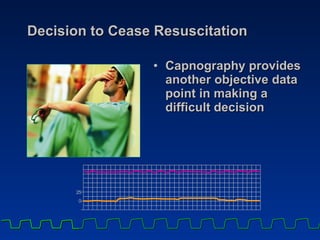
Decision to Cease Resuscitation Capnography provides another objective data point in making a difficult decision 0 2 5
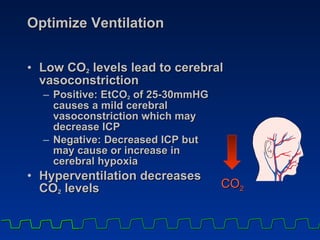
Optimize Ventilation Monitor ventilation efforts and carbon dioxide levels with capnography  Carbon dioxide has a profound affect on cerebral blood flow (CBF) Influences intracranial pressure (ICP)
Optimize Ventilation Use capnography to titrate EtCO 2  levels  in patients sensitive to fluctuations Patients with suspected increased intracranial pressure (ICP) Head trauma Stroke Brain tumors Brain infections
Optimize Ventilation Intracranial pressure Tissue and fluid contained within a  rigid compartment Affected by changes in any component Treatment goal Maintain stability  Avoid raising intracranial pressures
Optimize Ventilation Treatment of patients with head injuries and  ICP Hyperventilate the patient? Do  NOT  hyperventilate the patient?
Optimize Ventilation  Hyperventilation is very effective  at lowering ICP Prophylactic hyperventilation once  mainstay therapy New guidelines recommend against prophylactic hyperventilation  Avoid hypoventilating patients with suspected high ICP Source: Huizenga J.E. 2000. Guidelines for the Management of Severe Head Injury: Are Emergency Physicians Following Them?  Academic Emergency Medicine  9 (8): 806-812
Optimize Ventilation Treatment goals Maintain stability of EtCO 2  levels Maintain adequate blood flow to the brain Avoid secondary injury as a result of inducing or increasing cerebral edema
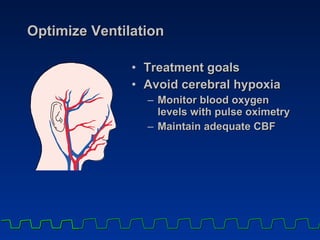
Optimize Ventilation Treatment goals Avoid cerebral hypoxia  Monitor blood oxygen  levels with pulse oximetry  Maintain adequate CBF
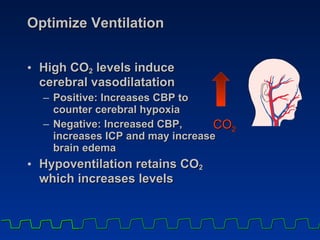
Optimize Ventilation  High CO 2  levels induce  cerebral vasodilatation Positive: Increases CBP to  counter cerebral hypoxia Negative: Increased CBP,  increases ICP and may increase  brain edema  Hypoventilation retains CO 2  which increases levels CO 2
Optimize Ventilation  Low CO 2  levels lead to cerebral vasoconstriction Positive: EtCO 2  of 25-30mmHG causes a mild cerebral vasoconstriction which may decrease ICP Negative: Decreased ICP but  may cause or increase in  cerebral hypoxia   Hyperventilation decreases  CO 2  levels CO 2
Optimize Ventilation “In summary, after either cardiac arrest  or head trauma, ventilate the comatose  patient to achieve normocarbia  (Class IIa).”  P 168 “Routine hyperventilation may be  detrimental and should be avoided  (Class III).”  P 168 Source: Guidelines 2000 for Cardiovascular  Resuscitation and Emergency Cardiovascular Care, C irculation  102 (suppl I) 8. August 22,2000
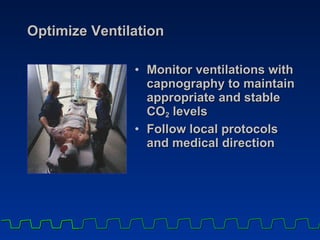
Optimize Ventilation Monitor ventilations with capnography to maintain appropriate and stable CO 2  levels  Follow local protocols and medical direction
Part 3: The Intubated Patient Summary Capnography can be used in  intubated patients for Verification and documentation of  ET tube placement Immediate identification of  ET tube displacement Confirmation of adequate  chest compressions Early indication of ROSC
Part 3: The Intubated Patient Summary Capnography can be used in  intubated patients to Detect cardiac output when no pulse palpable Help in the decision to cease resuscitation Maintain CO 2  levels in patients sensitive  to changes
Part 3: The Intubated Patient Now you’re catching on!

16 capnography part3 intubated

  • 1.
    CAPNOGRAPHY In EmergencyCare EDUCATIONAL SERIES Part 3: Intubated
  • 2.
    Part 3: TheIntubated Patient CAPNOGRAPHY In Emergency Care
  • 3.
    Part 3: TheIntubated Patient Learning Objectives List three intubated applications Identify four characteristic patterns seen in: Correct ET tube placement ET tube displacement Effective chest compression ROSC
  • 4.
  • 5.
    Capnography Applications onIntubated Patients Confirm correct placement of ET tube Detect changes in ET tube position immediately Resuscitation Assess adequacy of chest compressions Detect ROSC Objective data for decision to cease resuscitation Optimize ventilation of patients Document, document, document
  • 6.
    Confirm ET TubePlacement Traditional methods of confirmation Listen for breath sounds Observe chest movement Auscultate stomach Note ET tube clouding These methods are subjective and unreliable
  • 7.
    Confirm ET TubePlacement “ Standard physical examination methods, such as auscultation of lungs and epigastrium, visualization of chest movement, and fogging in the tube, are not sufficiently reliable to exclude esophageal intubation in all situations.”    Source: Verification of Endotracheal Tube Placement - Approved by the ACEP Board of Directors, October 2001 h t tp ://www.acep.org/1,4923,0.html   (policy statement)
  • 8.
    Confirm ET TubePlacement “… emergency responders must confirm tracheal tube position by using nonphysical examination techniques.” P I-87 Secondary confirmation with an EtCO 2 or esophageal detection is Class IIa recommendation P I-150 Source: Guidelines 2000 for Cardiovascular Resuscitation and Emergency Cardiovascular Care, Circulation 102 (suppl I) 8. August 22,2000
  • 9.
    Confirm ET TubePlacement “… end-tidal CO 2 monitors can confirm successful tracheal tube placement within seconds of an intubation attempt” P I-101 “ The presence of exhaled CO 2 indicates proper tracheal tube placement.” P I-101 Source: Guidelines 2000 for Cardiovascular Resuscitation and Emergency Cardiovascular Care, Circulation 102 (suppl I) 8. August 22,2000
  • 10.
    Confirm ET TubePlacement “… devices that use capnographic waveforms are so sensitive that the devices can detect residual CO 2 (during CA) when the tube is in the trachea”. P I-383 Source: Guidelines 2000 for Cardiovascular Resuscitation and Emergency Cardiovascular Care, Circulation 102 (suppl I) 8. August 22,2000
  • 11.
    Confirm ET TubePlacement 108 patients intubated in the field 52 trauma patients 56 medical patients ET tube placement checked on arrival at the ED 27 patients (25%) had improperly placed ET tube 18 were in the esophagus 9 in oropharynx with tip above the cords Source: Falk J., Sayre M.R. 1999. Confirmation of Airway Placement, Prehospital Emergency Care 3: 273-278
  • 12.
    Confirm ET TubePlacement “ Consensus was reached that EtCO 2 evaluation was currently the best method for confirming correct endotracheal tube placement. The group agreed that quantitative capnography was currently the best method for determining endotracheal tube position and strongly recommends its use.” P 295 Turtle Creek Consensus Conference on Prehospital Care Source: Wayne M., et al. 1999. Management of Difficult Airways in the Field, Journal of Emergency Medicine 3: 290-296
  • 13.
    Confirm ET TubePlacement “ All endotracheal intubations must be accompanied by an objective confirmation… The optimal method of measurement is quantitative capnography and its use on all intubated patients.” P 277 Source: Falk J., Sayre M.R. 1999. Confirmation of Airway Placement, Prehospital Emergency Care 3: 273-278
  • 14.
    Confirm ET TubePlacement 108 patients intubated in the field Compared to the Falk study 9% had improperly placed ET tube versus 25% in previous study No unrecognized misplaced ET tubes in patients with continuous end-tidal CO 2 monitoring Source: Silvestri S. J., et al. 2003. Improvement in Misplaced Endotracheal Tube Recognition within a Regional Emergency Medical Services System, Academic Emergency Medicine 10 (5): 445 (Abstract)
  • 15.
    Confirm ET TubePlacement Capnography provides Objective confirmation of correct tube placement Documentation of correct placement
  • 16.
    Confirm ET TubePlacement 4 5 0
  • 17.
    Confirm ET TubePlacement ET tube placement in esophagus may briefly detect CO 2 Following carbonated beverage ingestion When gastric distention was produced by mouth to mouth ventilation Residual CO 2 will be washed out after 6 positive pressure breaths
  • 18.
    Detect ET TubeDisplacement A properly placed ET tube can be displaced out of the trachea without any movement of the proximal tip Source: Matera P. 1998. The Truth About ET Tube Movement, JEMS 23: 34-42
  • 19.
    Detect ET TubeDisplacement “…risk from a misplaced tube is unacceptably high and clinical signs confirming tube placement are not completely reliable” P I-296 “…animal data shows that detection of a displaced or obstructed tube using pulse oximetry or changes in heart rate or blood pressure may be delayed more than 3 minutes” P I-296 Source: Guidelines 2000 for Cardiovascular Resuscitation and Emergency Cardiovascular Care, Circulation 102 (suppl I) 8. August 22,2000
  • 20.
    Detect ET TubeDisplacement “… use of a device to confirm tracheal tube placement in the field, in the transport vehicle, and on arrival to the hospital is desirable and strongly encouraged.” P I-296 “ Use of a device to confirm tube placement on arrival at the hospital is especially important because displacement of the tube is most likely to occur when the patient is moved into and out of the transport vehicle.” P I-296 Source: Guidelines 2000 for Cardiovascular Resuscitation and Emergency Cardiovascular Care, Circulation 102 (suppl I) 8. August 22,2000
  • 21.
    Detect ET TubeDisplacement “ Continuous capnography detects acute airway obstruction and hypopharyngeal extubation more rapidly than does pulse oximetry or vital sign monitoring in a hyperoxemic porcine model.” Source: Poirier M. P., et al . 1998. Utility of monitoring capnography, pulse oximetry, and vital signs in the detection of airway mishaps: A hyperoxemic animal model, Am J Emerg Med 16: 350-352.
  • 22.
    Detect ET TubeDisplacement “ … displacement of the tube is most likely to occur when the patient is moved into and out of the transport vehicle.” P I-296 Source: Guidelines 2000 for Cardiovascular Resuscitation and Emergency Cardiovascular Care, Circulation 102 (suppl I) 8. August 22,2000
  • 23.
    Detect ET TubeDisplacement Traditional methods of monitoring tube position Periodic auscultation of breath sounds Gastric distention Worsening of patient’s color Late sign of tube displacement These methods are subjective and unreliable —and delayed
  • 24.
    Detect ET TubeDisplacement “ Continuous capnography monitoring devices can identify and signal a fall in exhaled CO 2 consistent with tracheal tube dislodgement. This may be very helpful in emergencies when clinicians have other responsibilities.” P 140 Source: ACLS-The Reference Textbook, ACLS: Principles and Practice. Ed. 2003 Cummins, R.O. American Heart Association. ISBN 0- 87493-341- 2
  • 25.
    Detect ET TubeDisplacement Capnography Immediately detects ET tube displacement Source: Murray I. P. et. al . 1983. Early detection of endotracheal tube accidents by monitoring CO 2 concentration in respiratory gas. Anesthesiology 344-346 4 5 0 Hypopharyngeal Dislodgement
  • 26.
    Detect ET TubeDisplacement Only capnography provides Continuous numerical value of EtCO 2 with apnea alarm after 30 seconds Continuous graphic waveform for immediate visual recognition Source: Linko K. et. al . 1983. Capnography for detection of accidental oesophageal intubation. Acta Anesthesiol Scand 27: 199-202 4 5 0 Esophageal Dislodgement
  • 27.
    Confirm ET TubePlacement Capnography provides Documentation of correct placement Ongoing documentation over time through the trending printout Documentation of correct position at ED arrival
  • 28.
    Capnography in Cardiopulmonary Resuscitation Assess chest compressions Early detection of ROSC Objective data for decision to cease resuscitation
  • 29.
    CPR: Assess ChestCompressions Properly done chest compressions provide 25-30% of normal blood supply to the brain 5%-10% of normal blood supply to the heart Adequate chest compressions promote the elimination of metabolic wastes
  • 30.
    CPR: Assess ChestCompressions Airway - open with ET tube Breathing - controlled and stable Circulation - cardiac output directly related to changes in EtCO 2 Capnography provides noninvasive method for monitoring blood flow generated by chest compressions
  • 31.
    CPR: Assess ChestCompressions 19 minipigs Relationship between EtCO 2 and cardiac output Measured before cardiac arrest and during CPR Source: Weil M. H. 1985 . Cardiac Output and end-tidal carbon dioxide, Critical Care Medicine 13 (11): 907-909
  • 32.
    CPR: Assess ChestCompressions Good correlation between EtCO 2 and cardiac output Decrease in EtCO 2 reflects a critical reduction of cardiac output Low cardiac output Reduces blood flow to the lungs Fails to clear CO 2 from the bloodstream Source: Weil MH. 1985. Cardiac output and end-tidal carbon dioxide, Critical Care Medicine 13 (11): 907-909
  • 33.
    CPR: Assess ChestCompressions Under conditions of constant ventilation, capnography correlates with the circulatory status produced by chest compressions EtCO 2 has potential value in monitoring effectiveness of CPR Source: Weil MH. 1985. Cardiac output and end-tidal carbon dioxide, Critical Care Medicine 13 (11): 907-909
  • 34.
    CPR: Assess ChestCompressions Rescuer fatigue Ochoa Study Rescuers were not able to maintain adequate chest compressions for more than 1 minute Rescuers did not perceive fatigue even when it was measurably present Source: Ochoa, F. Javier, et al. 1998. The Effect of Rescuer Fatigue on the Quality of Chest Compressions, Resuscitation April; 37: 149-52
  • 35.
    CPR: Assess ChestCompressions Increase in EtCO 2 has been shown to correlate with A fresh rescuer at a faster compression rate A new rescuer during CPR with no change in rate Mechanical compressions Source: White R. D. 1994. Out-of-Hospital Monitoring of End-Tidal Carbon Dioxide Pressure During CPR, Annals of Emergency Medicine 23 (1): 756-761
  • 36.
    CPR: Assess ChestCompressions “ …measurement of end-tidal carbon dioxide concentration may be a practical, noninvasive method for monitoring blood flow generated by compression during cardiopulmonary resuscitation and an almost immediate indicator of successful resuscitation.” Source: Falk J. L. 1988. End-tidal carbon dioxide concentration during cardiopulmonary resuscitation, New England Journal of Medicine 318 (10): 607-611
  • 37.
    CPR: Assess ChestCompressions Use feedback from EtCO 2 to depth/rate/ force of chest compressions during CPR 4 5 0
  • 38.
    CPR: Detect ROSC90 prehospital patients intubated in the field 16 survivors In 13 survivors a rapid rise on CO 2 production was the earliest indicator of ROSC Before a palpable pulse Prior to blood pressure Source: Wayne M.A. 1995. Use of End-tidal Carbon Dioxide to Predict Outcome in Prehospital Cardiac Arrest. Annals of Emergency Medicine 25 (6): 762-767
  • 39.
    CPR: Detect ROSC10 patients on ventilators in ICU EtCO 2 increased within 30 seconds of ROSC in 7 Rapid rise on CO 2 production was earliest indicator of ROSC “…an abrupt increase in the EtCO 2 under conditions of reasonably constant ventilation provides the earliest evidence of successful resuscitation.” Source: Falk J. L. 1988. End-tidal carbon dioxide concentration during cardiopulmonary resuscitation, New England Journal of Medicine 318 (10): 607-611125
  • 40.
    CPR: Detect ROSCSudden rise in EtCO 2 Confirm with ECG and capnography Questionable pulse Arterial vasoconstriction may make pulse difficult to detect
  • 41.
    CPR: Detect ROSCBriefly stop CPR and check for organized rhythm on ECG monitor 4 5 0
  • 42.
    Decision to CeaseResuscitation Capnography Has been shown to predict probability of outcome following resuscitation May be used in the decision to cease resuscitation efforts Source: Levine R. L. 1997. End-tidal carbon dioxide and outcome of out-of-hospital cardiac arrest. New England Journal of Medicine 337 (5): 301-306 .
  • 43.
    Decision to CeaseResuscitation 120 prehospital patients in nontraumatic cardiac arrest EtCO 2 had 90% sensitivity in predicting ROSC Maximal level of <10mmHg during the first 20 minutes after intubation was never associated with ROSC Source: Canitneau J. P. 1996. End-tidal carbon dioxide during cardiopulmonary resuscitation in humans presenting mostly with asystole, Critical Care Medicine 24: 791-796
  • 44.
    Decision to CeaseResuscitation 27 out-of-hospital patients in cardiac arrest looked at EtCO 2 at 3 points 1 and 2 minutes post intubation Maximum EtCO 2 during CPR EtCO 2 in ROSC was higher at each point ROSC No ROSC 1 min 23.0 + 7 13.2 + 14.7 P =.0002 2 min 26.8 + 10.8 15.4 + 5.7 P =.0019 Maximum 30.8 + 9.5 22.7 + 8.8 P =.0022 Source: Asplin BR. 1995. Prognostic Value of End-tidal Carbon Dioxide Pressures During Out-of-Hospital Cardiac Arrest, Annals of Emergency Medicine 25 (6): 756-761
  • 45.
    Decision to CeaseResuscitation 90 victims of prehospital cardiac arrest with PEA ROSC No ROSC Initial 10.9 + 4.9 11.7 + 6.6 P =.672 (NS) 20 min 31.0 + 5.3 3.9 + 2.8 P <=.0001 100% mortality if unable to achieve an EtCO 2 of 10mmHg after 20 minutes Source: Wayne M. A. 1995. Use of End-tidal Carbon Dioxide to Predict Outcome in Prehospital Cardiac Arrest, Annals of Emergency Medicine 25 (6): 762-767
  • 46.
    Decision to CeaseResuscitation Capnography provides another objective data point in making a difficult decision 0 2 5
  • 47.
    Optimize Ventilation Monitorventilation efforts and carbon dioxide levels with capnography Carbon dioxide has a profound affect on cerebral blood flow (CBF) Influences intracranial pressure (ICP)
  • 48.
    Optimize Ventilation Usecapnography to titrate EtCO 2 levels in patients sensitive to fluctuations Patients with suspected increased intracranial pressure (ICP) Head trauma Stroke Brain tumors Brain infections
  • 49.
    Optimize Ventilation Intracranialpressure Tissue and fluid contained within a rigid compartment Affected by changes in any component Treatment goal Maintain stability Avoid raising intracranial pressures
  • 50.
    Optimize Ventilation Treatmentof patients with head injuries and ICP Hyperventilate the patient? Do NOT hyperventilate the patient?
  • 51.
    Optimize Ventilation Hyperventilation is very effective at lowering ICP Prophylactic hyperventilation once mainstay therapy New guidelines recommend against prophylactic hyperventilation Avoid hypoventilating patients with suspected high ICP Source: Huizenga J.E. 2000. Guidelines for the Management of Severe Head Injury: Are Emergency Physicians Following Them? Academic Emergency Medicine 9 (8): 806-812
  • 52.
    Optimize Ventilation Treatmentgoals Maintain stability of EtCO 2 levels Maintain adequate blood flow to the brain Avoid secondary injury as a result of inducing or increasing cerebral edema
  • 53.
    Optimize Ventilation Treatmentgoals Avoid cerebral hypoxia Monitor blood oxygen levels with pulse oximetry Maintain adequate CBF
  • 54.
    Optimize Ventilation High CO 2 levels induce cerebral vasodilatation Positive: Increases CBP to counter cerebral hypoxia Negative: Increased CBP, increases ICP and may increase brain edema Hypoventilation retains CO 2 which increases levels CO 2
  • 55.
    Optimize Ventilation Low CO 2 levels lead to cerebral vasoconstriction Positive: EtCO 2 of 25-30mmHG causes a mild cerebral vasoconstriction which may decrease ICP Negative: Decreased ICP but may cause or increase in cerebral hypoxia Hyperventilation decreases CO 2 levels CO 2
  • 56.
    Optimize Ventilation “Insummary, after either cardiac arrest or head trauma, ventilate the comatose patient to achieve normocarbia (Class IIa).” P 168 “Routine hyperventilation may be detrimental and should be avoided (Class III).” P 168 Source: Guidelines 2000 for Cardiovascular Resuscitation and Emergency Cardiovascular Care, C irculation 102 (suppl I) 8. August 22,2000
  • 57.
    Optimize Ventilation Monitorventilations with capnography to maintain appropriate and stable CO 2 levels Follow local protocols and medical direction
  • 58.
    Part 3: TheIntubated Patient Summary Capnography can be used in intubated patients for Verification and documentation of ET tube placement Immediate identification of ET tube displacement Confirmation of adequate chest compressions Early indication of ROSC
  • 59.
    Part 3: TheIntubated Patient Summary Capnography can be used in intubated patients to Detect cardiac output when no pulse palpable Help in the decision to cease resuscitation Maintain CO 2 levels in patients sensitive to changes
  • 60.
    Part 3: TheIntubated Patient Now you’re catching on!

Editor's Notes

  • #2 Part 3: Capnography on the intubated patient builds on the information presented in parts one and two. It may be presented as part of the series or as a separate independent class. This PowerPoint program is designed for initial training on capnography in EMS. It is strictly an introduction and all information be adapted to your local protocols. The program is not product specific and qualifies for continuing education credits through individual CE providers and/or the Center for Healthcare Education. Information on the Center for Healthcare Education and the CE process is contained on this CD. You may also contact the Center at 1-800-888-8700 or their website http://www.healthcareeducation.org All contents are under the copyright of Medtronic Physio-Control Corp.
  • #3 Having covered the basics of capnography, Part 3 presents the first and most common application of capnography: assessment and monitoring of the intubated patient.
  • #4 The learning objectives for Part 3 are for you to be able to: • List three intubated applications in which capnography is most useful • Identify four characteristic capnography waveform patterns seen in - Correct ET tube placement - ET tube displacement - Effective chest compression - Return of spontaneous circulation (ROSC)
  • #5 Intubation in the field is a well-recognized challenge. From intubation to transfer of care, capnography is a new tool to assist you in caring for these critical patients.
  • #6 Capnography provides you: • Objective confirmation that you have placed the ET tube in the trachea • It alerts you to changes in ET tube position immediately - you can see by the waveform that it has become displaced In a resuscitation call, capnography can help you to: • Assess adequacy of chest compressions • Detect ROSC This monitoring also provides you objective data for making the decision to cease resuscitation. You can use capnography as a guide to adjust ventilations and optimize ventilation of patients sensitive to CO 2 levels.Examples include head injury, brain infections and neonates. All of these can be documented. Capnography provides objective documentation that the tube was positioned correctly, stayed in place, and was still in place when patient care was transferred to the ED.
  • #7 Common assessment skills to verify ETT placement include: • Listening for breath sounds • Observing chest movement and • Aauscultating the abdomen for any air movement. Some protocols include looking for clouding in the ET tube. All of these techniques have value in the confirmation of tube placement, but they are subjective. Exclusive reliance on these techniques can also be misleading. Teaching Note: Breath sounds may be present but difficult to hear over background noise or diminished due to an underlying respiratory condition. Breath sounds can be transmitted in the body and may be heard when the stethoscope is placed over the abdomen, suggesting tube misplacement when it is indeed correctly positioned. Individual chest compliance, tidal volume and other factors influence the amount of chest movement perceived by the rescuer. If vomiting and aspiration have occurred, stomach contents may be noted in the ET tube, even when properly positioned. Environmental conditions will affect degree to which the tube clouds with each breath.
  • #8 This subjectivity and questionable reliability has been widely recognized and noted in the American College of Emergency Physicians (ACEP) policy on verification of ET tube placement: “ Standard physical examination methods, such as auscultation of lungs and epigastrium, visualization of chest movement, and fogging in the tube, are not sufficiently reliable to exclude esophageal intubation in all situations.” Source: Verification of Endotracheal Tube Placement - Approved by the ACEP Board of Directors, October 2001 http://www.acep.org/1,4923,0.html (policy statement)
  • #9 These challenges are addressed by the American Heart Association in the International Guidelines 2000: “… emergency responders must confirm tracheal tube position by using nonphysical examination techniques.” P I-87 Secondary confirmation with an EtCO2 or esophageal detection has a Class IIa recommendation. P I-150 Source: Guidelines 2000 for Cardiovascular Resuscitation and Emergency Cardiovascular Care, Circulation 102 (suppl I) 8. August 22,2000
  • #10 The AHA guidelines also state: “… end-tidal CO2 monitors can confirm successful tracheal tube placement within seconds of an intubation attempt” P I-101 “ The presence of exhaled CO 2 indicates proper tracheal tube placement.” P I-101 Source: Guidelines 2000 for Cardiovascular Resuscitation and Emergency Cardiovascular Care, Circulation 102 (suppl I) 8. August 22,2000
  • #11 The sensitivity of capnography is addressed on page 383: …“devices that use capnographic waveforms are so sensitive that the devices can detect residual CO 2 (during CA) when the tube is in the trachea”. Source: Guidelines 2000 for Cardiovascular Resuscitation and Emergency Cardiovascular Care, Circulation 102 (suppl I) 8. August 22,2000
  • #12 Several studies have looked at intubations in EMS; most have studied the success of tube placement. Falk and Sayre researched tube position on arrival at the ED. They studied: • 108 consecutive patients intubated in the Field - 52 were trauma patients - 56 were medical patients ET tube placement was checked on arrival at the ED where 27 patients (or 25%) had an improperly placed ET tube on arrival. • 18 were in the esophagus • 9 in oropharynx with tip above the cords Source: Falk J., Sayre M.R. 1999. Confirmation of Airway Placement, Prehospital Emergency Care 3: 273-278
  • #13 The challenge of ET tube placement was a topic at the first prehospital conference of leaders in emergency medicine. Consensus of attendees was: “… EtCO 2 evaluation was currently the best method for confirming correct endotracheal tube placement. The group agreed that quantitative capnography was currently the best method for determining endotracheal tube position and strongly recommends its use.” Source: Wayne M., et al. 1999. Management of Difficult Airways in the Field, Journal of Emergency Medicine 3: 290-296
  • #14 Following the Turtle Creek Proceedings, doctors Falk and Sayre summarized: “ All endotracheal intubations must be accompanied by an objective confirmation…The optimal method of measurement is quantitative capnography and its use on all intubated patients.” Source: Falk J., Sayre M.R. 1999. Confirmation of Airway Placement, Prehospital Emergency Care 3: 273-278
  • #15 Following the implementation of a new airway management protocol, Silvestri and others repeated the Falk study (slide #11) in the same system. The previous study was used as the control. This new study group had a significantly lower rate of unrecognized misplaced ET tubes compared to the control group (9% vs. 25%, p&lt;0.001). Moreover, the rate of unrecognized, misplaced ET tubes was zero for the subset of patients with 100% protocol compliance of continuous EtCO 2 monitoring. Source: Silvestri S. J., et al. 2003. Improvement in Misplaced Endotracheal Tube Recognition within a Regional Emergency Medical Services System, Academic Emergency Medicine 10 (5): 445 (Abstract)
  • #16 These and other studies have shown that capnography provides a rapid means to objectively verify the correct placement of the ET tube. Capnography also provides you documentation of correct placement.
  • #17 This is a typical waveform indicating tube placement. Note the lack of CO 2 and the sudden appearance with the first exhalation.
  • #18 There are circumstances in which the ET tube is placed in the esophagus and CO 2 is briefly detected: • If the patient has recently ingested a carbonated beverage - the CO 2 from the drink will be detected and • When gastric distention has been was produced by mouth to mouth ventilation - remember the “air” from the rescuer contains CO 2 CO 2 in the patient’s upper GI tract can be quickly cleared and will disappear after six positive pressure breaths.
  • #19 Properly placing an ET tube is only half of the challenge. Once the tube is in place, it can easily be displaced. Misplacement of ET tubes has been widely studied. Paul Matera, a physician, professor of emergency services and paramedic, studied tube position in cadavers. This study checked location of ET tubes that had been placed by ALS experienced providers and students. The balloon cuff was marked in five- millimeter increments and the position of the distal tip was observed through an incision in the neck. “..it appears that the position of the tip of an ET tube in an non-immobilized patient constantly changes even though the tube itself remains firmly anchored at the mouth…” P 42 He concluded that a properly placed ET tube can be displaced out of the trachea without any movement of the proximal tip. Source: Matera P. 1998. The Truth About ET Tube Movement, JEMS 23: 34-42
  • #20 The American Heart Association acknowledges the risk of tube displacement. “…risk from a misplaced tube is unacceptably high and clinical signs confirming tube placement are not completely reliable.” P I-296 “…animal data shows that detection of a displaced or obstructed tube using pulse oximetry or changes in heart rate or blood pressure may be delayed more than 3 minutes.” P I-296 Source: Guidelines 2000 for Cardiovascular Resuscitation and Emergency Cardiovascular Care, Circulation 102 (suppl I) 8. August 22,2000
  • #21 “…use of a device to confirm tracheal tube placement in the field, in the transport vehicle, and on arrival to the hospital is desirable and strongly encouraged.” P I-296 “Use of a device to confirm tube placement on arrival at the hospital is especially important because displacement of the tube is most likely to occur when the patient is moved into and out of the transport vehicle.” P I-296 Source: Guidelines 2000 for Cardiovascular Resuscitation and Emergency Cardiovascular Care, Circulation 102 (suppl I) 8. August 22,2000
  • #22 “…use of a device to confirm tracheal tube placement in the field, in the transport vehicle, and on arrival to the hospital is desirable and strongly encouraged.” P I-296 “Use of a device to confirm tube placement on arrival at the hospital is especially important because displacement of the tube is most likely to occur when the patient is moved into and out of the transport vehicle.” P I-296 Source: Poirier M. P., et al . 1998. Utility of monitoring capnography, pulse oximetry, and vital signs in the detection of airway mishaps: A hyperoxemic animal model, Am J Emerg Med 16: 350-352.
  • #23 A critical moment: “displacement of the tube is most likely to occur when the patient is moved into and out of the transport vehicle.” P I-296 Source: Guidelines 2000 for Cardiovascular Resuscitation and Emergency Cardiovascular Care, Circulation 102 (suppl I) 8. August 22,2000
  • #24 Detecting the displacement of a correctly positioned ET tube has been difficult with traditional methods. • Checking breath sounds several times each minute is difficult when caring for a critically ill patient in transport • Gastric distention is an obvious but late sign, as is • A change in the patient&apos;s color Traditional methods are subjective and unreliable as well as providing feedback only several minutes after tube has become displaced.
  • #25 The AHA states: “ Continuous capnography monitoring devices can identify and signal a fall in exhaled CO 2 consistent with tracheal tube dislodgement. This may be very helpful in emergencies when clinicians have other responsibilities.” P 140 Source: ACLS-The Reference Textbook, ACLS: Principles and Practice. Ed. 2003 Cummins, R.O. American Heart Association. ISBN 0-87493-341-2
  • #26 Capnography constantly surveys the respiratory status and provides immediate feedback should the tube become displaced. Source: Murray I. P. et. al . 1983. Early detection of endotracheal tube accidents by monitoring CO 2 concentration in respiratory gas. Anesthesiology 344-346
  • #27 Only capnography provides: • Continuous numerical value of EtCO 2 with apnea alarm after 30 seconds and • Continuous graphic waveform for immediate visual recognition As you can see with this waveform example, there is immediate recognition of a problem. Source: Linko K. et. al . 1983. Capnography for detection of accidental oesophageal intubation. Acta Anesthesiol Scand 27: 199-202
  • #28 In addition to verifying ET tube placement and monitoring tube position, capnography provides you documentation. • Documentation of correct placement • Ongoing documentation over time with the trending printout • Documentation of correct position throughout your care until transferring your patient’s care at the ED
  • #29 You can use capnography in resuscitation: • To assess chest compressions • For the earliest detection of ROSC • For objective data in the decision to cease resuscitation
  • #30 Properly done chest compressions provide: • 25-30% of normal blood supply to the brain • 5%-10% of normal blood supply to the heart Adequate chest compressions promote the elimination of metabolic wastes. The chances of survival increase with adequate cerebral and myocardial perfusion.
  • #31 Airway- open with ET tube - confirmed with EtCO 2 . Breathing - controlled and stable - monitored by capnography. Circulation - cardiac output directly related to changes in EtCO 2 . Capnography provides a non-invasive method for monitoring blood flow generated by CPR.
  • #32 Resuscitation studies are often conducted on pigs due to the similarity between human and pig cardiac physiology. A study on 19 minipigs looked at the relationship between EtCO 2 and cardiac output before cardiac arrest and during CPR. Source: Weil M. H. 1985 . Cardiac Output and end-tidal carbon dioxide, Critical Care Medicine 13 (11): 907-909
  • #33 The research showed a high linear correlation between end-tidal CO 2 and cardiac output. Weil concluded that a decrease in EtCO 2 reflects a critical reduction of cardiac output. This decreased CO reduces alveolar blood flow to the extent that the CO 2 clearance by the lung fails to keep pace with systemic CO 2 production. Source: Weil MH. 1985. Cardiac output and end-tidal carbon dioxide, Critical Care Medicine 13 (11): 907-909
  • #34 This study concluded: • Under conditions of constant ventilation, capnography correlates with the coronary perfusion pressure produced by chest compressions • EtCO 2 has potential value in monitoring effectiveness of CPR Source: Weil MH. 1985. Cardiac output and end-tidal carbon dioxide, Critical Care Medicine 13 (11): 907-909
  • #35 Performing chest compressions is very tiring and CPR performance quickly declines with the fatigue. The OCHOA study ….rescuers ability to properly perform CPR was measured over time. Over 90% of the rescuers were not able to maintain adequate chest compressions for more than one minute. Furthermore, even after 5 minutes, many of the rescuers did not perceive any drop in the quality of chest compressions. This is of course critical because even when done properly, CPR only provide the body with a portion of it normal blood flow. Any reduction in CPR quality further reduces the limited about of blood reaching the heart and brain. Source: Ochoa, F. Javier, et al. 1998. The Effect of Rescuer Fatigue on the Quality of Chest Compressions, Resuscitation April; 37: 149-52
  • #36 There have been several studies on the relationship of EtCO 2 and CPR. Roger White conducted a prospective study measuring EtCO2 during out-of-hospital CPR. In a preliminary pilot of four patients, he looked at several factors affecting resuscitation, compared his findings with other studies and found: Increase in EtCO 2 has been seen to correlate with: • A fresh rescuer at a faster compression rate • A new rescuer during CPR with no change in rate • Mechanical compressions In other words, better compressions lead to higher EtCO 2 levels. Source: White R. D. 1994. Out-of-Hospital Monitoring of End-Tidal Carbon Dioxide Pressure During CPR, Annals of Emergency Medicine 23 (1): 756-761
  • #37 Falk measured EtCO 2 in 13 episodes of cardiac arrest in 10 ICU patients on mechanical ventilation. He concluded: “measurement of end-tidal carbon dioxide concentration may be a practical, noninvasive method for monitoring blood flow generated by compression during cardiopulmonary resuscitation and an almost immediate indicator of successful resuscitation.” Source: Falk J. L. 1988. End-tidal carbon dioxide concentration during cardiopulmonary resuscitation, New England Journal of Medicine 318 (10): 607-611
  • #38 Capnography provides feedback on chest compression during CPR. Use the information to determine effectiveness and monitor rescuer fatigue.
  • #39 Capnography can be the earliest indicator of ROSC. Dr. Marvin Wayne studied 90 patients who were intubated in the field and treated using the standard ALS protocols. There were 16 survivors. In 13 of these 16 survivors, a rapid rise on CO 2 production was the earliest indicator of ROSC. Capnography provided the first sign of ROSC: • Before a palpable pulse • Prior to a blood pressure Source: Wayne M.A. 1995. Use of End-tidal Carbon Dioxide to Predict Outcome in Prehospital Cardiac Arrest. Annals of Emergency Medicine 25 (6): 762-767
  • #40 In the Falk study of the ten patients on ventilators in ICU: • EtCO 2 increased within 30 seconds of ROSC in 7 • Rapid rise on CO 2 production was earliest indicator of ROSC Dr. Falk stated: “an abrupt increase in the EtCO 2 under conditions of reasonably constant ventilation provides the earliest evidence of successful resuscitation.” Source: Falk J. L. 1988. End-tidal carbon dioxide concentration during cardiopulmonary resuscitation, New England Journal of Medicine 318 (10): 607-611125
  • #41 A sudden rise in EtCO 2 indicates increased cardiac output. Cardiac output immediately after ROSC is often low and drugs such as epinephrine can produce peripheral vasoconstriction, so palpating a pulse may be very difficult. The presence of an organized rhythm on the monitor accompanied by a sudden increase in EtCO 2 indicates ROSC has occurred and cardiac output has improved despite questionable pulses.
  • #42 When a sudden increase in EtCO 2 is seen, briefly stop CPR and check for organized rhythm on ECG monitor and check pulses.
  • #43 One of the most difficult decisions is determining when to stop resuscitation efforts. Here again, capnography provides objectivity and documentation. Capnography: • Has been shown to predict probability of outcome following resuscitation and • May be used in the decision to cease resuscitation efforts Source: Levine R. L. 1997. End-tidal carbon dioxide and outcome of out-of-hospital cardiac arrest. New England Journal of Medicine 337 (5): 301-306.
  • #44 The primary objective of an out-of-hospital study conducted in France was to determine if end-tidal CO 2 could provide a highly sensitive predictor of ROSC during CPR. • In 120 prehospital patients in nontraumatic cardiac arrest • EtCO 2 had 90% sensitivity in predicting ROSC • A maximal level of &lt;10mmHg during the first 20 minutes after intubation was never associated with ROSC The researchers’ conclusion: “Such a prognostic indicator could be used for a more rationale approach to prolonged CPR.” Source: Canitneau J. P. 1996. End-tidal carbon dioxide during cardiopulmonary resuscitation in humans presenting mostly with asystole, Critical Care Medicine 24: 791-796
  • #45 In a smaller study of 27 patients, Asplin looked at the end-tidal CO 2 at three points: • at 1 and 2 minutes post intubation • and at thee maximum EtCO 2 during CPR EtCO 2 in patients who had ROSC was higher at each point ROSC No ROSC 1 min 23.0+ 7 13.2+14.7 P=.0002 2 min 26.8+10.8 15.4+5.7 P=.0019 Maximum 30.8+9.5 22.7+8.8 P=.0022 Source: Asplin BR. 1995. Prognostic Value of End-tidal Carbon Dioxide Pressures During Out-of-Hospital Cardiac Arrest, Annals of Emergency Medicine 25 (6): 756-761
  • #46 In a key study conducted in Washington state of 150 out-of-hospital patients Levine and Wayne looked at subset of 90 cardiac arrest patients with PEA. The EtCO 2 in those who had a return of circulation was higher at each point: ROSC No ROSC Initial 10.9+4.9 11.7+6.6 P=.672 (NS) 20 min 31.0+5.3 3.9+2.8 P&lt;=.0001 They concluded: 100% mortality if unable to achieve an EtCO 2 of 10mmHg after 20 minutes. Source: Wayne M. A. 1995. Use of End-tidal Carbon Dioxide to Predict Outcome in Prehospital Cardiac Arrest, Annals of Emergency Medicine 25 (6): 762-767
  • #47 Capnography provides another objective data point in making a difficult decision.
  • #48 Capnography can be used to optimize ventilation efforts. This is particularly useful in patients with in which cerebral pressure is compromised because carbon dioxide has a profound affect on cerebral blood flow (CBF) which, in turn, influences intracranial pressure (ICP).
  • #49 Use capnography to titrate EtCO 2 levels in patients sensitive to fluctuations, especially patients with suspected increased intracranial pressure (ICP). • Head trauma • Stroke • Brain tumors • Brain infections
  • #50 A quick review: Intracranial pressure is created by: • Tissue and fluid contained within a rigid compartment and is • Affected by changes in any component The treatment goal is to: • Maintain stability and • Avoid high intracranial pressures
  • #51 There has been some controversy over the treatment of patients with head injuries and increased ICP. Is it best to: Hyperventilate the patient? or NOT hyperventilate the patient?
  • #52 Hyperventilation is very effective at lowering ICP and prophylactic hyperventilation was once mainstay therapy. However, new guidelines recommend against prophylactic hyperventilation. Source: Huizenga J.E. 2000. Guidelines for the Management of Severe Head Injury: Are Emergency Physicians Following Them? Academic Emergency Medicine 9 (8): 806-812
  • #53 Current treatment goals are: • Maintain stability • Maintain adequate blood flow to the brain and • Avoid secondary injury as a result of inducing or increasing cerebral edema
  • #54 Treatment goals include: Avoid cerebral hypoxia by: • Monitoring blood oxygen levels with pulse oximetry and • Maintaining adequate CBF
  • #55 Low CO 2 levels induce cerebral vasodilatation. Positive result is: Increased CBP to counter cerebral hypoxia. The negative is: Increased CBP, increases ICP and may increase brain edema. Hypoventilation retains CO 2 which, in turn, increases blood CO 2 levels.
  • #56 Low CO 2 levels lead to cerebral vasoconstriction. • EtCO 2 levels of 25-30mmHG cause a mild cerebral vasoconstriction which may be useful in patients with high ICP • However, decrease in ICP may cause or increase cerebral hypoxia Hyperventilation decreases CO 2 levels.
  • #57 The American Heart Association Guidelines state: “In summary, after either cardiac arrest or head trauma, ventilate the comatose patient to achieve normocarbia (Class IIa).” P 168 “Routine hyperventilation may be detrimental and should be avoided (Class III).” P 168 Source: Guidelines 2000 for Cardiovascular Resuscitation and Emergency Cardiovascular Care, C irculation 102 (suppl I) 8. August 22,2000
  • #58 Monitor ventilations with capnography to maintain appropriate and stable CO 2 levels and, as always, follow local protocols and medical direction.
  • #59 In summary, capnography can be used in intubated patients for: • Verification and documentation of ET tube placement • Immediate identification of ET tube displacement • Confirmation of adequate chest compressions • And for the earliest indication of ROSC
  • #60 In addition, capnography can be used in intubated patients to: • Detect cardiac output when no pulse is palpable • Help in the decision to cease resuscitation • And maintain CO 2 levels in patients sensitive to changes