PERIPHERAL ARTERIAL
DISEASES
Under the guidance of –
DR. SHYAM BHUTRA SIR (HOD & Unit Head)
DR. BHAGCHAND KHORWAL SIR (Associate Professor)
DR. DINESH YADAV SIR (Assistant Professor)
BY – DR. GARVIT NANECHA
Introduction
• Peripheral artery disease (PAD) is a circulatory condition in which narrowed blood
vessels reduce blood flow to the limbs. It is a sign of fatty deposits and calcium
building up in the walls of the arteries.
• Over the last decade, the global prevalence of PAD has continued to rise and almost
202 million people suffer from PAD across the globe.
• The prevalence of PAD has been estimated at 14.5% in patients more than 69 years
of age and as high as 20% in patients 80 years of age and older.
• The risk factors causing dramatic rise in PAD prevalence include population aging
(i.e., increased longevity); the global epidemic of diabetes, hypertension and
obesity; and the persistence of tobacco smoking in many parts of the world.
Artery Vein
General
appearance
round
thick wall
Flattened  collapsed
Tunica intima
• Endothelium
• IEM
Ripped due to
vessel constriction
present
Smooth
Absent
Tunica media
• EEM
Thick (smooth
muscle + elastic)
present
Thin (smooth muscle +
collagen fibres)
absent
Tunica externa Collagen + elastic
fibres
Collagen + elastic +
smooth muscle
Pressure High Low
Lumen diameter Narrow Wide
Valves Absent Present
a) Arteries and (b) veins share the same general features,
but the walls of arteries are much thicker because of the
higher pressure of the blood that flows through them.
Arteries of upper limb
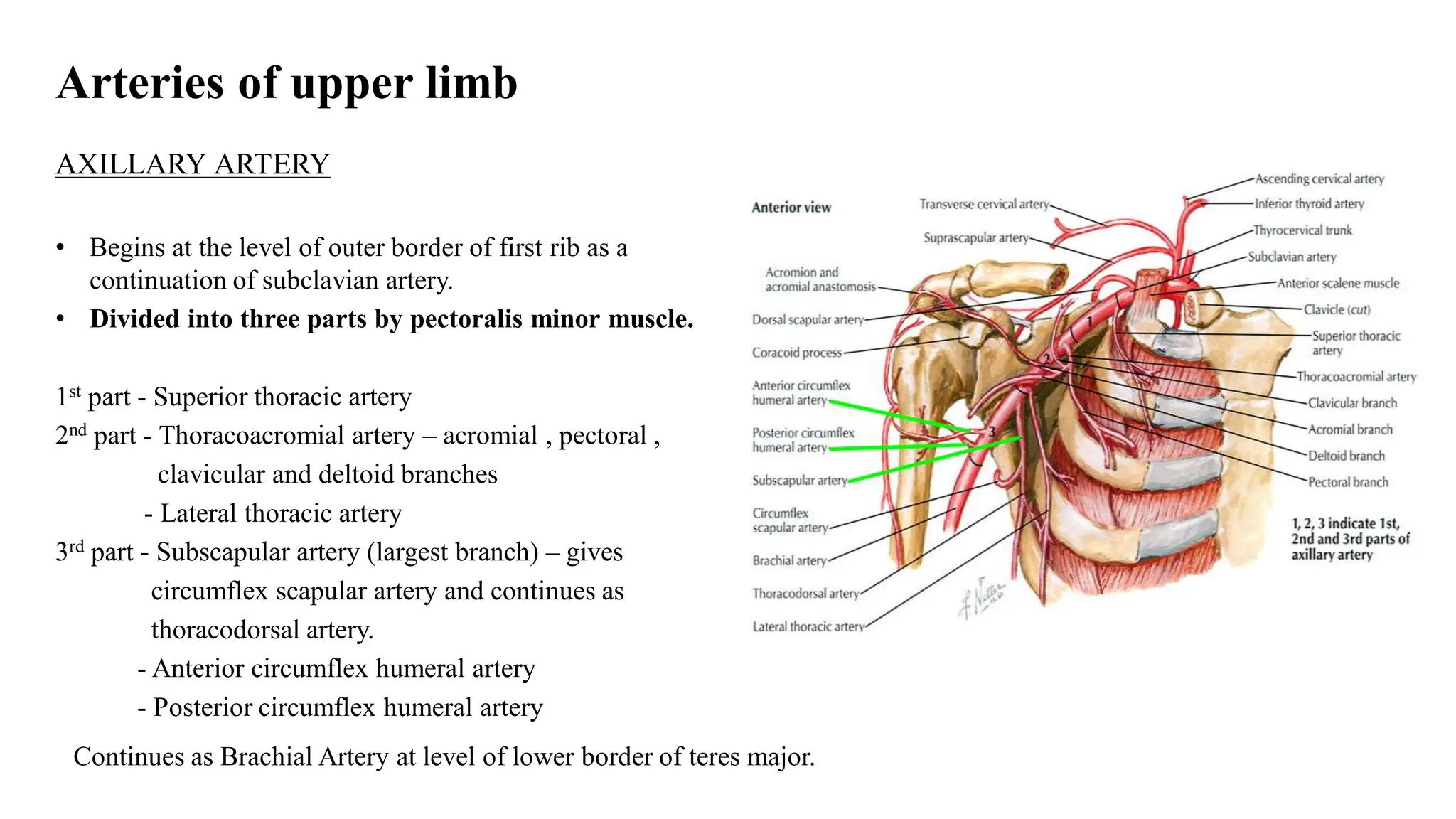
AXILLARY ARTERY
• Begins at the level of outer border of first rib as a
continuation of subclavian artery.
• Divided into three parts by pectoralis minor muscle.
1st part - Superior thoracic artery
2nd part - Thoracoacromial artery – acromial , pectoral ,
clavicular and deltoid branches
- Lateral thoracic artery
3rd part - Subscapular artery (largest branch) – gives
circumflex scapular artery and continues as
thoracodorsal artery.
- Anterior circumflex humeral artery
- Posterior circumflex humeral artery
Continues as Brachial Artery at level of lower border of teres major.
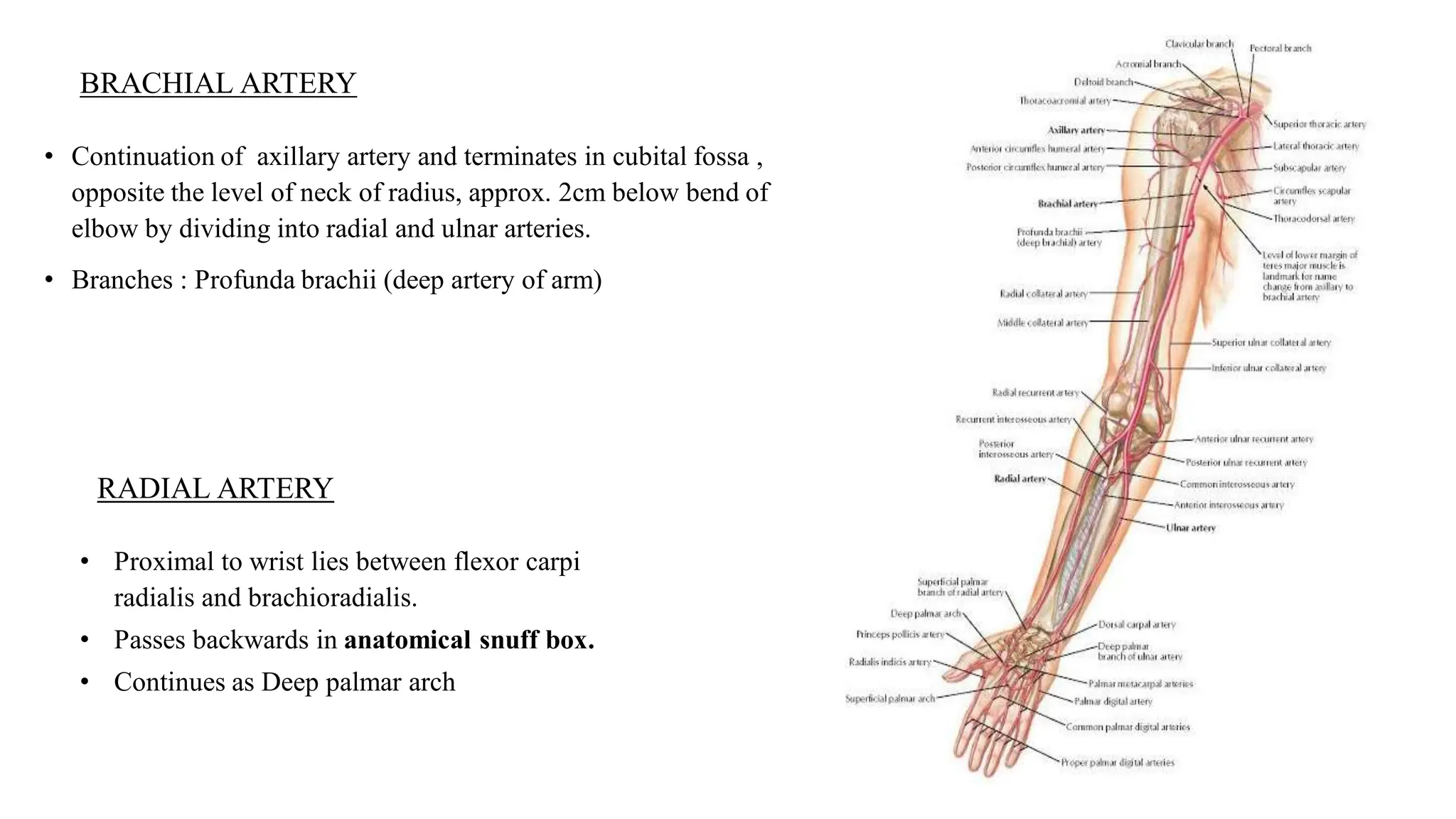
BRACHIAL ARTERY
• Continuation of axillary artery and terminates in cubital fossa ,
opposite the level of neck of radius, approx. 2cm below bend of
elbow by dividing into radial and ulnar arteries.
• Branches : Profunda brachii (deep artery of arm)
RADIAL ARTERY
• Proximal to wrist lies between flexor carpi
radialis and brachioradialis.
• Passes backwards in anatomical snuff box.
• Continues as Deep palmar arch
ULNAR ARTERY
• Larger terminal branch of brachial artery in the cubital fossa.
• Continues as superficial palmar arch
 Superficial palmar does not supply the radial side of index finger and the thumb.
Arteries of lower limb
FEMORAL ARTERY
• Continuation of external iliac artery behind inguinal ligament at the level of
mid inguinal point.
• Branches in femoral triangle
1. Superficial epigastric
2. Superficial circumflex iliac
3. Superficial external pudendal
4. Deep external pudendal
5. Muscular branches
6. Profunda femoris artery (largest branch) : arises 4cm below inguinal
ligament
• Branches in adductor canal : descending genicular artery
POPLITEAL ARTERY
• Begins at level of adductor hiatus as a continuation of
femoral artery ; ends at the level of lower border of popliteal
muscle into Anterior tibial and tibioperoneal trunk.
• In popliteal fossa the popliteal vein and tibial nerve lie
superficial (posterior) to the artery.
Anterior tibial artery
Dorsalis pedis artery
• continuation of ATA from midway between the
two malleoli
• Joins lateral plantar artery completing plantar
arterial arch.
Posterior tibial artery8
• finally ends as Medial plantar artery which is
smaller and Lateral plantar artery is larger .
Palpation of blood vessels
• Dorsalis pedis artery is felt just lateral to the extensor hallucis longus tendon at the proximal end of first web space,
felt against the navicular and middle cuneiform bones.
• Posterior tibial artery is felt against the calcaneum just behind the medial malleolus midway between it and tendo-
Achilles.
• Anterior tibial artery is felt anteriorly in the midway between the two malleoli against the lower end of tibia just
above the ankle joint, lateral to extensor hallucis longus tendon.
• Popliteal artery is difficult to feel. It is palpated better in prone position with knee flexed about 40-50°, to relax the
popliteal fascia. It is felt in the lower part of the fossa over the flat posterior surface of upper end of tibia.
• Femoral artery in the groin is felt just below the inguinal ligament at midinguinal point against femoral head.
• Radial artery : lower end of the front of radius.
• Ulnar artery : lower end of the front of ulna.
• Brachial artery is felt in front of the elbow just medial to biceps brachii tendon medial edge of humerus
• Axillary artery is felt in apex of the axilla against shaft of the humerus.
• Subclavian artery is felt against first rib just above the middle of the clavicle.
• Common carotid artery is felt medial to sternomastoid muscle at the level of thyroid cartilage against carotid
tubercle (Chassaignac tubercle) of transverse process of 6th cervical vertebra (in carotid triangle).
• Superficial temporal artery is felt just in front of the tragus of the ear against zygomatic bone.
Investigations of arterial diseases
General investigations like full blood count , blood glucose , lipid profile , ECG, ABG, pulmonary function test
DOPPLER ultrasound blood flow detection
• Works on a principle of doppler shift / effect i.e. change in
frequency of wave when reflected by a moving object.
• Normal flow is a triphasic
1. Sharp systolic upstroke (forward flow)
2. Reversal of flow in early diastole
3. Late/ low amplitude slow flow in late diastole
Simple hand held doppler
ultrasound probe
A. Triphasic flow
B. Biphasic flow : s/o obstruction.
Absence of late diastolic flow
C. Monophasic flow : s/o severe
obstruction.
Hemodynamic parameters
• ABPI (ankle brachial pressure index)
• Segmental pressures
• Absolute digit pressure / toe systolic pressure : Normal = > 50 mmHg
• Toe brachial pressure index (TBI) : Normal = >0.7
• Transcutaneous oxygen pressure : Normal = 50-60 mmHg
• Pulse volume recordings
ABPI
• Measured using hand held doppler probe and sphygmomanometer
• 0.9 – 1.3 = normal resting ABPI
• <0.9 = some degree of arterial obstruction (intermittent claudication)
• <0.5 = rest pain
• <0.3 = critical limb threatening ischemia (imminent necrosis)
• >1.3 = calcified vessels (in case of DM and CKD)
• Post exercise drop in ABPI >0.2 is indicative of arterial occlusion
• Also every 0.1 decrease in ABI below 0.9 increases the risk of cvs by 10%
Segmental pressure
• Help to localise the occlusion
• >20 mmHg gradient is abnormal and indicative of occlusion
• Inaccurate in calcified artery walls.
Pulse volume recording (segmental plethysmography)
• Measures blood flow in limbs
• Absence of brisk upstroke pulse, rounded peak of wave,
disappearance of dicrotic notch all these are suggestive of
proximal occlusion.
Duplex scanning
• B mode usg + doppler i.e. provide vessel images and wave forms
• Colour coding helps in direction, velocity & turbulence of blood flow
• In experienced hands, it is as accurate as angiography and has the
advantage of cost effectiveness and safety
• Limitations
1. Aortoiliac segment difficult to visualize due to presence of bowel gases
2. Unable to evaluate recently implanted PTFE or Polyester grafts
3. Heavily calcified vessels (cannot determine accurately the length and
severity of stenosis)
Angiography
• Gold standard investigation
• Access through common femoral artery.
• Provide diagnosis along with definitive endovascular intervention.
• Technique : retrograde transfemoral seldinger (sweden) angiography
• Indications: TAO, atherosclerosis, Raynaud’s phenomenon, AV fistula, etc.
• Complications: bleeding, hypotension, hematoma formation, pseudoaneurysm,
infection, thrombosis, anaphylaxis, arterial dissection
DSA (digital subtraction angiography)
• The images obtained are digitalised and extraneous background
(bone, soft tissue,etc.) is removed to provide clearer images.
• Used in case of multilevel disease
As depicted in this DSA study multilevel
lesion are demonstrated which include
focal left iliac artery stenosis (large arrow),
right superficial femoral occlusion (curved
arrows), left superficial femoral stenosis
(small arrow), multiple tibial artery
stenosis (arrow heads).
CT angiography
Used where duplex scanning is not possible like
intrathoracic arteries and aortoiliac segment but
has a limited role in infrapopliteal visualization
of vessels.
MR angiography
• Contrast enhanced MRA with Gd has high
sensitivity and specificity to see severity
and length of stenosis.
• Superiority in identifying distal target
vessels/ infrapopliteal vessels.
• In case of DM has ability to separate out
contrast from calcifications.
Arterial occlusion
• ACUTE - sudden occlusion of vessels
• CHRONIC – gradual occlusion, gives time for formation of collaterals.
• Risk factors – age> 50yrs, smoking, hypertension, DM, hyperlipidemia, sedentary lifestyles
• Causes – Atherosclerosis (most common cause)
buerger’s disease(TAO), arteritis, PAN, wagners’granulomatosis, behcet disease
Buerger’s disease (TAO) Atherosclerosis
Age/ cause < 30yrs (3rd and 4th decade) >50yrs
Gender male Male = female
predisposition smoking Multiple factors
site LL > UL LL
involvement Artery, vein , nerve
Like superficial thrombophlebitis
And Raynaud’s syndrome
Arteries and can also lead to
Raynaud’s syndrome
Vessel size Small to medium Medium < large
progression Distal to proximal Proximal to distal
Segmental involvement SKIP lesions present -
Features of chronic arterial stenosis or occlusion in leg
Intermittent claudication
Occurs as a result of anaerobic muscle
metabolism and described as debilitating cramp
like pain felt in muscle :
• Reliably brought on by walking;
• Not present on taking the first step (unlike
osteoarthritis);
• Reliably relieved by rest both in the standing
and sitting positions; usually within 5 minutes
The distance that a patient is able to walk
without stopping varies (claudication distance)
only slightly from day to day.
Relationship of clinical fndings to site of disease.
Aortoiliac
obstruction
Claudication in buttocks, thighs and calves
Femoral and distal pulses absent in both limbs
Bruit over aortoiliac region
Impotence (Leriche)
Iliac obstruction Unilateral claudication in the thigh and calf
and sometimes the buttock
Bruit over the iliac region
Unilateral absence of femoral and distal pulses
Femoropopliteal
obstruction
Unilateral claudication in the calf
Femoral pulse palpable with absent unilateral
distal pulses
Distal obstruction Claudication in calf and foot
Femoral and popliteal pulses palpable
Ankle pulses absent
BOYD’S classification
Differentials of Intermittent  vasculogenic claudication
Vasculogenic pain
(Reproducible)
Neurogenic
(nerve root
compression)
Chronic
compartment
syndrome
Osteoarthritis Venous
claudication
Onset After walking Variable onset Heavy exercise Variable onset After walking
Nature Cramp like Sharp lancinating Tight bursting Dull ache Tight bursting
Location m/c Calf Radiate down to leg Calf Multiple
locations
LL (thigh)
Relief Stops walking
<5 minutes
Sit/lie down
>5 minutes
Very slow Sit down
>5 minutes
Slow
Effect of
body
position
No change required Change in body
position
Elevation of
limb
Takes of the
weight
Elevation
CLTI (critical limb threatening ischmeia)
New terminology as per the global vascular guidelines.
Components : objective evidence of peripheral arterial disease + any of three
1. Ischemic rest pain with confirmatory hemodynamic parameters
2. Tissue loss
3. Gangrene of foot / lower limb
1. Rest Pain
• Cry of dying nerves (involvement of vasa nervorum)
• Anaerobic muscle metabolism occurs even at rest mainly affecting the foot and leg.
• The pain is exacerbated by lying down or elevation of the foot due to loss of the
gravitational effects on perfusion in the foot.
• Pain is worse at night and may be lessened by hanging the foot out of bed or by
sleeping in a chair (effects of gravity restored).
• Confirmatory hemodynamic parameters
1. ABPI <0.5
2. Ankle systolic pressure < 50mmHg
3. Toe systolic pressure < 30mmHg
4. Transcutaneous oxygen pressure < 30mmHg
Rest pain in a patient suffering
from TAO. Holding the foot
reduces the pain slightly (hen
holding position)
2. Tissue loss / ulceration
• Definition : tissue loss >2 weeks with objective evidence of
PAD / arterial occlusion severe enough to impede blood flow.
• present as painful erosion between toes or as shallow, non-
healing ulcers on the dorsum of the feet, on the shins and
especially around the malleoli.
Ischemic ulcer
Neuropathic ulcer Ischemic ulcer
Painless Painful
Normal pulses Absent pulses
Regular margin, typically punched out appearance Irregular margin, punched out edges
Located on plantar surface of foot, pressure areas On toes, glabrous margins
Presence of calluses Absent
Loss of sensation, reflexes and vibration Variable sensory findings
Increase in blood flow (arteriovenous shunting) Decrease in blood flow
Dry, warm foot Cold foot
3. Gangrene
• Refers to death of macroscopic portions of tissue, which turns black because of the breakdown of haemoglobin and
the formation of iron sulphide.
• It usually affects the most distal part of a limb because of arterial obstruction (from thrombosis, embolus or arteritis).
Dry gangrene Wet gangrene
Clear line of demarcation is
seen
Vague line of demarcation
Dry, shriveled, mummified Edematous, putrefied, discolored
Slow gradual loss of blood
supply
Sudden loss of blood supply
Separation is by aseptic
ulceration
Septic ulceration causes separation
Limits to the demarcation Can extend proximally rapidly
Limited amputation is
sufficient
Major high amputation is often
needed
Dry gangrene Wet gangrene
Examination findings of a patient with PAD
• Loss of hair, brittle nails, muscle atrophy, thinning of skin, delayed capillary filling, absence of distal pulses
• SUNSET sign – on elevation of limb : presence of pallor and guttering of veins
on dependent position : presence of rubor again
Drawback :
does not include
1. Wound characterstics
2. Severity of infection.
WIFI classification – Society of vascular surgeons
Advantage : Predict the amputation risk and likelihood of benefit following revascularization procedures.
LIMB STAGING
risk of amputation at 1 year
Stage 1 = 0 %
Stage 2 = 8 %
Stage 3 = 11 %
Stage 4 = 38 %
Flow diagram for the investigation of patients presenting with suspected chronic limb-threatening ischemia (CLTI). ABI,
Ankle-brachial index; PAD, peripheral artery disease; TBI, toe-brachial index;
WIfI, wound, ischemia and foot infection.
TREATMENT
Aims
1. Risk factor modification
2. Symptomatic relief
3. Revascularization of limb
Medical management
1. Antithrombotic – low dose aspirin 75 mg, clopidogrel 75mg
2. Lipid lowering agents – atorvastatin 10 mg, pravastatin 40 mg
3. Control of HTN – SBP<140 mmHg , DBP<90 mmHg
4. Glycemic control – HbA1c < 7 (eg. metformin)
Intervention
1. Claudicants (usually have a single level disease)
• Done only when medical management failed
• If anatomical factors should be favourable for intervention
• Will provide prolonged patency + symptomatic relief
2. Patients with CLTI
• Usually have multilevel disease
• Needs intervention
Life style modification : stop smoking, weight reduction
Exercise – 45-60 minutes ; 3 times a week ; for 3 months,
exercise should be intense that it elicit claudication
Amputation
Intervention – evaluation and management
PLAN concept
• P = patient risk
• L = limb severity
• An = anatomy
1. Stage the severity of limb threat according to WIFI classification
2. Assess individual patient risk
Average risk High risk
anticipated periprocedural mortality rate < 5 % > 5 %
life expectancy > 2 years < 2 years
3. Evaluate arterial anatomy
• Establish TAP (target arterial pathway)
• DSA : most reliable method and offers best view
Suggested algorithm for anatomic imaging in patients with CLTI who are candidates for
revascularization. In some cases, it may be appropriate to proceed directly to angiographic imaging.
Define the target artery path (TAP)
↓
Grade the femoropopliteal and infrapopliteal segment
↓
Look up the overall GLASS (global anatomic staging system) stage
↓
Define the preferred revascularization strategy by integrating patient
risk, limb severity (Wifi) and anatomy (Glass) according to the PLAN
concept
REVASCULARISATION
1. Endovascular treatment
• Less mortality and morbidity rate , good option in high risk patient
• Disadvantage – decreased durability and increased number of reintervention
2. Surgery
• Bypass – grafting : mainly for aortoiliac lesions.
TRANSLUMINAL ANGIOPLASTY AND STENTING
• Following percutaneous femoral artery puncture under local anaesthetic, a guidewire is inserted and
negotiated through the stenosis or occlusion under fluoroscopic control.
• A balloon catheter is then inserted over the guidewire and positioned within the lesion. The balloon is then
inflated at high pressure for approximately 30 seconds and deflated. Satisfactory dilation of the lesion is
confirmed by performing an angiogram.
• Percutaneous transluminal angioplasty (PTA) has proved very successful in dilating the iliac and
femoropopliteal segments; the results below the knee are less successful.
• Long occlusions may be treated by the technique of subintimal angioplasty, where a new lumen is created by
inflation of the balloon.
• If the vessel fails to stay adequately dilated (often caused by elastic recoil of the artery), it may be possible to
hold the lumen open using a metal stent. This may be introduced on a balloon catheter and expanded by
balloon inflation; or alternatively, a self-expanding stent.
Narrowed superficial
femoral artery before and
after transluminal
angioplasty
Balloon catheter carrying stent expanded stent
The patient, limb, anatomy (PLAN) framework of clinical decision-
making in chronic limb-threatening ischemia (CLTI)
Acute arterial occlusion
• Sudden loss of limb perfusion, can occur upto 2 weeks after an
initiating event
• 30 day amputation rate = 10-30 %
• Etiology
Embolism : most common source is heart
 Atrial fibrillation, left ventricular mural thrombus (MI),
vegetations of heart valves (IE), etc.
 Saddle thrombus : embolus at aortoiliac bifurcation
 Paradoxical embolus : arises from deep veins, passes from patent
foramen ovale to left heart and back to peripheral circulation. It is
diagnosed on bubble echocardiography.
Thrombosis : can occur in native arteries
 Due to underlying atherosclerotic lesion or aneurysmal
degeneration with mural thrombosis
 Hypercoaguable state
Aortic bifurcation embolus. Source of embolus is a
recent myocardial infarct or atrial fibrillation. This
causes severe, dramatic symptoms.
Virchow’s triad
Presentaion
• Arm and leg – pain (mc), pallor, paraesis, pulselessness, paraesthesia and poikilothermia. (6 P’s)
• Brain – the middle cerebral artery (or its branches) is most commonly affected, resulting in major or
minor (TIA) stroke.
• Retina – amaurosis fugax (fleeting blindness). Lasting obstruction causes permanent blindness.
• Mesenteric vessels – possible gangrene and perforation of the corresponding loop of intestine.
Pathophysiology
• Distal ischaemia begins immediately after acute obstruction. Most sensitive peripheral nerves are
first involved, and then muscles, subcutaneous tissue and skin are affected in order. Irreversible
ischaemia starts in 3 hours and gets completed in 6 hours. Golden period is 1–6 hours.
• Acute ischaemia causes endothelial injury of capillaries, arterioles and venules with luminal
obliteration. Raised capillary permeability causes fluid leakage into extravascular space forming
massive tissue oedema deep to deep fascia which by raising the intracompartmental pressure
further reduces the perfusion leading into acute compartment syndrome.
Investigations : ECG , hypercoagulable work up, duplex imaging, TTE , TEE
arteriography (ho vascular disease)
Treatment
• The immediate administration of 5000 U of heparin intravenously can reduce this extension and maintain
patency of the surrounding (particularly the distal) vessels until the embolus can be treated.
• Embolectomy and thrombolysis are the treatments available for patients with limb emboli.
• Embolectomy : Fogarty balloon catheter ; Postoperatively, heparin therapy is continued until long-term
anticoagulation with warfarin is established to reduce the chance of further embolism.
• Thrombolysis : Tissue plasminogen activator (tPA) is infused through the catheter and regular arteriograms
are carried out to check on the extent of lysis, which, in successful cases, is achieved within 24 hours.
Compartment syndrome
• Common in anterior compartment of leg and in front of forearm.
• In limbs that have been subject to sudden ischaemia followed by revascularisation, oedema is likely. Muscles swell
within confined fascial compartments and cause tissue ischaemia, with both local muscle necrosis, nerve damage and
systemic effects such as renal failure secondary to the liberation of muscle breakdown products.
• The classical clinical picture is that of severe pain out of proportion with clinical findings that worsens with time.
• Examination of the limb reveals a tense compartment with passive flexion and extension of muscles causing pain.
The presence of palpable pulses does not rule out compartment syndrome.
• Pressure measured by inserting arterial line into compartment > 20 mmHg (requires fasciotomy)
• The treatment is urgent compartment fasciotomy to release the compression.
Thromboangitis obliterans (TAO) / Buerger’s disease
• It is segmental, progressive,
occlusive, inflammatory
disease of small and medium
sized vessels with superficial
thrombophlebitis often may
present as Raynaud’s
phenomenon with
microabscesses, along with
neutrophil and giant cell
infiltration, with skip lesions.
• It is a disease very commonly
seen in young and middle
aged males; seen in smokers
and tobacco users.
Smoke contains carbon monoxide and nicotinic acid
↓ ← Carboxyhaemoglobin
Causes initially vasospasm and hyperplasia of intima causing thrombosis and so
obliteration of vessels, commonly medium sized vessels are involved.
↓
Panarteritis is common. Usually involvement is segmental
↓
Eventually artery, vein and nerve are together involved.
Nerve involvement causes rest pain.
Patient presents with features of ischemia in the limb
↓
Once blockage occurs, plenty of collaterals open up and blood supply is maintained
to the ischemic area
↓
It is called as compensatory peripheral vascular disease
↓
If patient continues to smoke, disease progresses into the collaterals, blocking them
eventually, leading to severe ischaemia and is called as decompensatory peripheral
vascular disease. It is presently called as critical limb threatening ischaemia. It
causes rest pain / ulceration / gangrene.
Shianoya’s criteria for buerger’ disease
• Tobacco use. Only in males
• Disease starts before 45 years
• Distal extremity involved first without embolic or
atherosclerotic features
• Absence of diabetes mellitus or hyperlipidaemia
• With or without thrombophlebitis
Classification of TAO
Clinical features
• Male smokers (20 – 40 years) i.e. smoker’s disease
• Intermittent claudication in foot and calf
progressing to rest pain, ulceration, gangrene.
• Recurrent migratory superficial thrombophlebitis.
• Absence/Feeble pulses distal to proximal
Investigations
• Hb%, Blood sugar, ABPI.
• Arterial Doppler and Duplex scan.
• Transfemoral retrograde angiogram through
Seldinger technique: shows blockage—sites,
extent and severity. Cork screw appearance of the
vessel due to dilatation of vasa vasorum. Inverted
tree/spider leg collaterals.
Bilateral lower limb TAO causing
gangrene of both feet. Patient needs
amputation on both sides.
Ischaemic ulcer foot in a TAO patient.
Ischaemic features in upper and
lower limbs (four limbs)
TAO
Angiogram showing block in
main vessel with opened
up collaterals and adequate
distal run off.
Skip ischaemic ulcers are common in vascular
diseases. It suggests severe ischaemia up to most
proximal ulcer level.
Treatment
Stop smoking. “Opt for either cigarette or limb, but not both.”
DRUGS
• Low dose of aspirin 75 mg once a day—antithrombin activity.
• Prostacyclins, ticlopidine, praxilene, carnitine
• Clopidogrel 75 mg; atorvastatin 10 mg; parvostatin 40 mg; cilastazole 100 mg bd—is a phosphodiesterase inhibitor
which improves circulation (ideal drug).
• Complamina (xanthine nicotinate) helps to increase claudication distance
• Gene therapy – VEGF promotes angiogenesis
CARE OF LIMBS
• Buerger’s position : head end of bed is raised; foot end of bed is lowered to improve circulation.
• Buerger’s exercise : leg is elevated and lowered alternatively, each for 2 minutes for several times at time.
• Care of feet (Chiropady): Exposure of feet to more cold and warm temperature should be avoided; Dryness of feet and legs
should be avoided by applying oil to the feet and legs. Footwear should be selected carefully. It is better to wear socks with
footwear. Heel raise by raising the heels of shoes by 2 cm decreases the calf muscle work to improve claudication.
CHEMICAL SYMPATHECTOMY : xylocaine 1%
SURGERY : omentoplasty, profundaplasty, lumbar sympathectomy, Amputations.
Raynaud’s phenomenon
• It is an episodic vasospasm, i.e. arteriolar
spasm of small vessels of hands and feet
that leads into temperature and colour
changes with sequence of clinical features
called as Raynaud’s syndrome.
• Pallor – Cyanosis - Red
Raynaud’s disease
• Idiopathic condition usually occurs in young women
• Hands > feet
• The condition is recognised by the characteristic sequence of blanching,
dusky cyanosis and red engorgement, often accompanied by pain.
Treatment : protection from cold and avoidance of pulp and nail bed infection.
Calcium antagonist (nifedipine)
Electrically heated gloves (in winters)
Raynaud’s syndrome
• Peripheral arterial manifestation of a collagen disease,
such as SLE or rheumatoid arthritis.
• It may also follow the use of vibrating tools. In this context,
it is a recognised industrial disease and is known as
‘vibration white finger’.
• The syndrome when secondary to collagen disease leads
frequently to necrosis of digits and multiple amputations.
• Treatment is directed primarily at the underlying condition,
along with conservative measures.
Erythromelalgia (erythralgia)
• It is also called as Mitchell’s disease; an episodic attack
precipitated by heat, exertion and stress.
• Primary type : familial and autosomal dominant.
• Secondary type : gout, polycythaemia, viral infection, drug
induced (verapamil, ergots, fluoroquinolines).
• There is microvascular and neuropathic changes.
• There is severe burning pain in the limbs with redness and
sensation of heat. Warmness in the skin; often excoriation or
ulceration, flushing, prominent veins, severe hyperesthesia are the
usual features.
Treatment: Mechanical cooling by elevating the limb (Note: Should not place the affected limb in cold water which
may flare up the problems); aspirin; pregabalin, gabapentin, IV lignocaine are different drugs used in this condition.
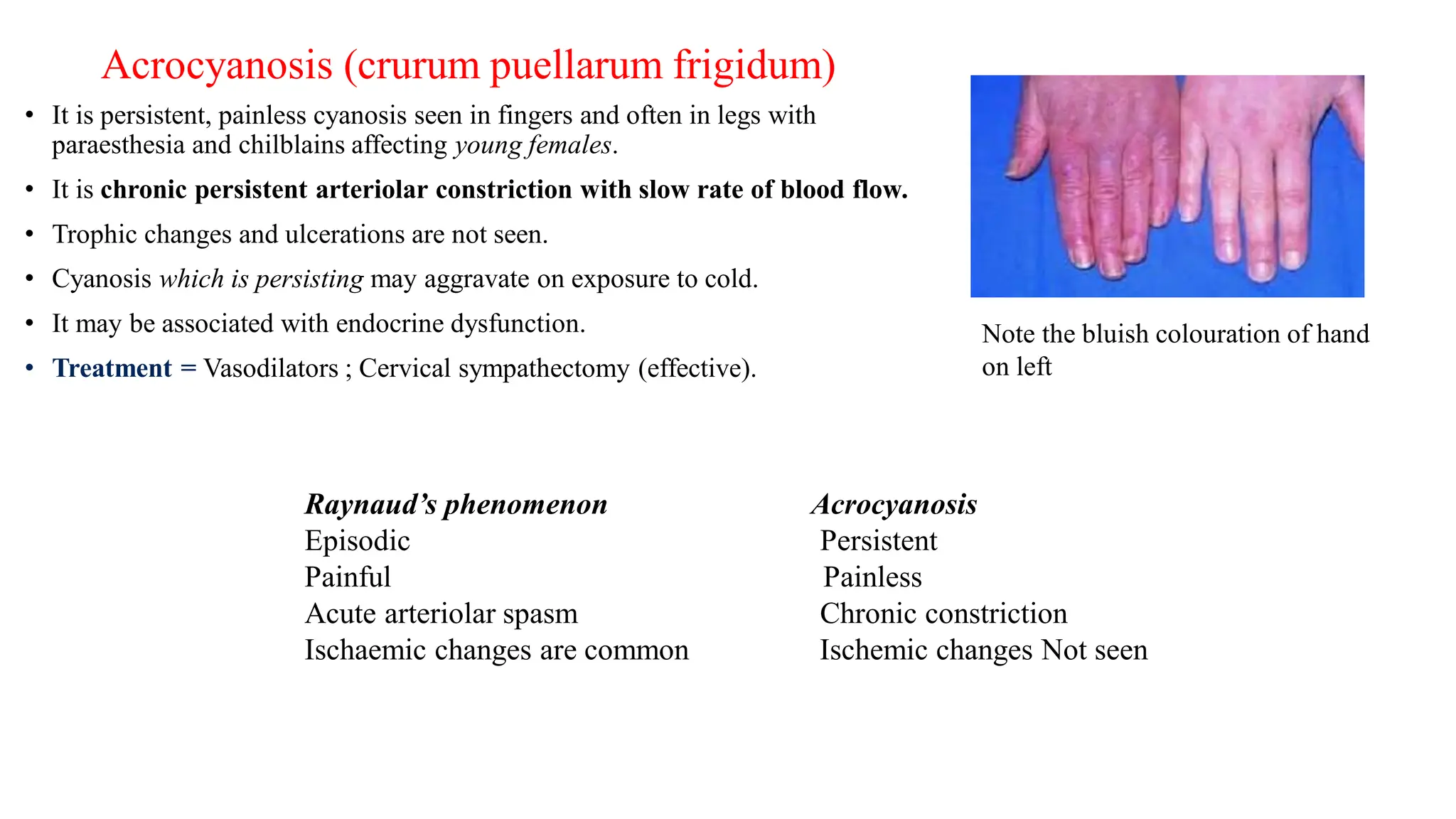
Acrocyanosis (crurum puellarum frigidum)
• It is persistent, painless cyanosis seen in fingers and often in legs with
paraesthesia and chilblains affecting young females.
• It is chronic persistent arteriolar constriction with slow rate of blood flow.
• Trophic changes and ulcerations are not seen.
• Cyanosis which is persisting may aggravate on exposure to cold.
• It may be associated with endocrine dysfunction.
• Treatment = Vasodilators ; Cervical sympathectomy (effective).
Note the bluish colouration of hand
on left
Raynaud’s phenomenon Acrocyanosis
Episodic Persistent
Painful Painless
Acute arteriolar spasm Chronic constriction
Ischaemic changes are common Ischemic changes Not seen
Diabetic foot / diabetic gangrene
It is usually caused by a combination of three factors –
1. Ischaemia secondary to macrovascular disease and microvascular dysfunction
2. Peripheral sensorimotor neuropathy (PSN), which leads to trophic skin
changes
3. Immunosuppression caused by excess of sugar in the tissues, which
predisposes to infection.
• The PSN is usually sensory in the early phase, classically in a stocking
distribution and renders the patients at high risk of soft tissue injury and its
subsequent neglect.
• Ischaemia and PSN act synergistically to increase the risk of diabetic foot
ulceration and reduce its subsequent healing potential. Superadded infection due
to poor wound care can spread rapidly and proximally in subfascial planes
leading to fulminant foot sepsis, gangrene and death.
Treatment
 Drainage of pus + liberal debridement of tissue + regular dressings +
antibiotics + diet and glycemic control
 If needed amputation Diabetic gangrene
Bedsores
• Type of gangrene caused by local pressure.
• Predisposed by five factors: pressure, injury,
anaemia, malnutrition and moisture.
• They can appear and extend rapidly in
immobile patients and in those with
debilitating illness. Prophylactic measures must
be taken, i.e. the avoidance of pressure over
bony prominences by the use of foam blocks or
similar, regular turning and nursing on specially
designed beds that reduce the pressure to the
skin.
• Skilled nursing and the use of appropriate
dressings must prevent maceration of the skin
by sweat, urine, faeces or pus.
• A bedsore can be expected if erythema
appears that does not change colour on
pressure. Once pressure sores develop, they are
difficult to heal. They should be kept clean and
debrided if necessary.
Frost bite
• Frostbite is caused by exposure to cold. It is seen both in
climbers at high altitudes and in the elderly or the vagrant
during cold weather.
• Cold injury damages the wall of the blood vessel, which
causes swelling, and leakage of fluid together with severe
pain. When the pain disappears, a waxy appearance remains.
• Initially redness and oedema (1st degree); blister formation
(2nd degree); skin necrosis (3rd degree); gangrene (4th
degree) develops gradually.
Frostbite of the foot. Note the clear demarcation.
Frostbite of the middle finger in the same
patient. The index finger was lost 2 years before,
also from frostbite.
Treatment is gradual rewarming (44°C in 30 minutes with warm water). Limb elevation (redude edema) ,
analgesics and delayed conservative amputation after demarcation of devitalised tissue.
Ainhum
• Also known as ‘dactylolysis spontanea’ is a painful
constriction of the base of the fifth toe frequently followed
by bilateral spontaneous auto-amputation a few years later.
• Grooving → pain → constriction deepens → tendon, nerve
and vessel involvement → bone gets cut spontaneously
without any bleeding (auto-amputation) in many years (2–5).
• Commonly affects males.
• History of running barefoot in childhood is common.
• Fifth toe is commonly affected.
• A fissure develops at the interphalangeal joint which becomes
a fibrous band, that encircles the digit causing necrosis
(Gangrene of little toe).
• Often it can be bilateral.
Bilateral Ainhum involving 4th and 5th toes of
both feet. Note the constriction ring in the toes.
Treatment : It is early “Z” plasty. Amputation is often required later. Most often autoamputation occurs.
AMPUTATION
GENERAL
• Amputation should be considered when part of limb is dead, deadly or a dead loss
• A limb is dead when arterial occlusive disease is severe enough to cause infarction of macroscopic portions
of tissue, i.e. gangrene. The occlusion may be in major vessels (atherosclerotic or embolic occlusions) or in
small peripheral vessels (diabetes, Buerger’s disease, Raynaud’s disease, inadvertent intra-arterial injection).
If the obstruction cannot be reversed and the symptoms are severe, amputation is required.
• A limb is deadly when the putrefaction and infection of moist gangrene spreads to surrounding viable tissues.
Cellulitis and severe toxaemia are the result. Amputation is required as a life-saving operation. Antibiotic
cover should be broad and massive.
• A limb may be deemed a dead loss in the following circumstances
1. When there is relentless severe rest pain without gangrene and reconstruction is not possible – amputation
will improve quality of life
2. When a contracture or paralysis makes the limb impossible to use and renders it a hindrance
3. When there is major unrecoverable traumatic damage.
Indications of amputation
• In case of arterial occlusive diseases (WIFI ≥2 ) and limb can not be salvaged.
• Acute occlusion due to embolism
• Diabetic foot / gangrene
• TAO
• Frost bite
Depending upon type of disease and
level of obstruction in artery there
are different types of amputations.
Seminar on Peripheral artery diseases.pdf

Seminar on Peripheral artery diseases.pdf

  • 1.
    PERIPHERAL ARTERIAL DISEASES Under theguidance of – DR. SHYAM BHUTRA SIR (HOD & Unit Head) DR. BHAGCHAND KHORWAL SIR (Associate Professor) DR. DINESH YADAV SIR (Assistant Professor) BY – DR. GARVIT NANECHA
  • 2.
    Introduction • Peripheral arterydisease (PAD) is a circulatory condition in which narrowed blood vessels reduce blood flow to the limbs. It is a sign of fatty deposits and calcium building up in the walls of the arteries. • Over the last decade, the global prevalence of PAD has continued to rise and almost 202 million people suffer from PAD across the globe. • The prevalence of PAD has been estimated at 14.5% in patients more than 69 years of age and as high as 20% in patients 80 years of age and older. • The risk factors causing dramatic rise in PAD prevalence include population aging (i.e., increased longevity); the global epidemic of diabetes, hypertension and obesity; and the persistence of tobacco smoking in many parts of the world.
  • 3.
    Artery Vein General appearance round thick wall Flattened collapsed Tunica intima • Endothelium • IEM Ripped due to vessel constriction present Smooth Absent Tunica media • EEM Thick (smooth muscle + elastic) present Thin (smooth muscle + collagen fibres) absent Tunica externa Collagen + elastic fibres Collagen + elastic + smooth muscle Pressure High Low Lumen diameter Narrow Wide Valves Absent Present a) Arteries and (b) veins share the same general features, but the walls of arteries are much thicker because of the higher pressure of the blood that flows through them.
  • 4.
    Arteries of upperlimb AXILLARY ARTERY • Begins at the level of outer border of first rib as a continuation of subclavian artery. • Divided into three parts by pectoralis minor muscle. 1st part - Superior thoracic artery 2nd part - Thoracoacromial artery – acromial , pectoral , clavicular and deltoid branches - Lateral thoracic artery 3rd part - Subscapular artery (largest branch) – gives circumflex scapular artery and continues as thoracodorsal artery. - Anterior circumflex humeral artery - Posterior circumflex humeral artery Continues as Brachial Artery at level of lower border of teres major.
  • 5.
    BRACHIAL ARTERY • Continuationof axillary artery and terminates in cubital fossa , opposite the level of neck of radius, approx. 2cm below bend of elbow by dividing into radial and ulnar arteries. • Branches : Profunda brachii (deep artery of arm) RADIAL ARTERY • Proximal to wrist lies between flexor carpi radialis and brachioradialis. • Passes backwards in anatomical snuff box. • Continues as Deep palmar arch
  • 6.
    ULNAR ARTERY • Largerterminal branch of brachial artery in the cubital fossa. • Continues as superficial palmar arch  Superficial palmar does not supply the radial side of index finger and the thumb.
  • 7.
    Arteries of lowerlimb FEMORAL ARTERY • Continuation of external iliac artery behind inguinal ligament at the level of mid inguinal point. • Branches in femoral triangle 1. Superficial epigastric 2. Superficial circumflex iliac 3. Superficial external pudendal 4. Deep external pudendal 5. Muscular branches 6. Profunda femoris artery (largest branch) : arises 4cm below inguinal ligament • Branches in adductor canal : descending genicular artery POPLITEAL ARTERY • Begins at level of adductor hiatus as a continuation of femoral artery ; ends at the level of lower border of popliteal muscle into Anterior tibial and tibioperoneal trunk. • In popliteal fossa the popliteal vein and tibial nerve lie superficial (posterior) to the artery.
  • 8.
    Anterior tibial artery Dorsalispedis artery • continuation of ATA from midway between the two malleoli • Joins lateral plantar artery completing plantar arterial arch. Posterior tibial artery8 • finally ends as Medial plantar artery which is smaller and Lateral plantar artery is larger .
  • 9.
    Palpation of bloodvessels • Dorsalis pedis artery is felt just lateral to the extensor hallucis longus tendon at the proximal end of first web space, felt against the navicular and middle cuneiform bones. • Posterior tibial artery is felt against the calcaneum just behind the medial malleolus midway between it and tendo- Achilles. • Anterior tibial artery is felt anteriorly in the midway between the two malleoli against the lower end of tibia just above the ankle joint, lateral to extensor hallucis longus tendon. • Popliteal artery is difficult to feel. It is palpated better in prone position with knee flexed about 40-50°, to relax the popliteal fascia. It is felt in the lower part of the fossa over the flat posterior surface of upper end of tibia. • Femoral artery in the groin is felt just below the inguinal ligament at midinguinal point against femoral head. • Radial artery : lower end of the front of radius. • Ulnar artery : lower end of the front of ulna. • Brachial artery is felt in front of the elbow just medial to biceps brachii tendon medial edge of humerus • Axillary artery is felt in apex of the axilla against shaft of the humerus. • Subclavian artery is felt against first rib just above the middle of the clavicle. • Common carotid artery is felt medial to sternomastoid muscle at the level of thyroid cartilage against carotid tubercle (Chassaignac tubercle) of transverse process of 6th cervical vertebra (in carotid triangle). • Superficial temporal artery is felt just in front of the tragus of the ear against zygomatic bone.
  • 10.
    Investigations of arterialdiseases General investigations like full blood count , blood glucose , lipid profile , ECG, ABG, pulmonary function test DOPPLER ultrasound blood flow detection • Works on a principle of doppler shift / effect i.e. change in frequency of wave when reflected by a moving object. • Normal flow is a triphasic 1. Sharp systolic upstroke (forward flow) 2. Reversal of flow in early diastole 3. Late/ low amplitude slow flow in late diastole Simple hand held doppler ultrasound probe A. Triphasic flow B. Biphasic flow : s/o obstruction. Absence of late diastolic flow C. Monophasic flow : s/o severe obstruction.
  • 11.
    Hemodynamic parameters • ABPI(ankle brachial pressure index) • Segmental pressures • Absolute digit pressure / toe systolic pressure : Normal = > 50 mmHg • Toe brachial pressure index (TBI) : Normal = >0.7 • Transcutaneous oxygen pressure : Normal = 50-60 mmHg • Pulse volume recordings ABPI • Measured using hand held doppler probe and sphygmomanometer • 0.9 – 1.3 = normal resting ABPI • <0.9 = some degree of arterial obstruction (intermittent claudication) • <0.5 = rest pain • <0.3 = critical limb threatening ischemia (imminent necrosis) • >1.3 = calcified vessels (in case of DM and CKD) • Post exercise drop in ABPI >0.2 is indicative of arterial occlusion • Also every 0.1 decrease in ABI below 0.9 increases the risk of cvs by 10% Segmental pressure • Help to localise the occlusion • >20 mmHg gradient is abnormal and indicative of occlusion • Inaccurate in calcified artery walls.
  • 12.
    Pulse volume recording(segmental plethysmography) • Measures blood flow in limbs • Absence of brisk upstroke pulse, rounded peak of wave, disappearance of dicrotic notch all these are suggestive of proximal occlusion. Duplex scanning • B mode usg + doppler i.e. provide vessel images and wave forms • Colour coding helps in direction, velocity & turbulence of blood flow • In experienced hands, it is as accurate as angiography and has the advantage of cost effectiveness and safety • Limitations 1. Aortoiliac segment difficult to visualize due to presence of bowel gases 2. Unable to evaluate recently implanted PTFE or Polyester grafts 3. Heavily calcified vessels (cannot determine accurately the length and severity of stenosis)
  • 13.
    Angiography • Gold standardinvestigation • Access through common femoral artery. • Provide diagnosis along with definitive endovascular intervention. • Technique : retrograde transfemoral seldinger (sweden) angiography • Indications: TAO, atherosclerosis, Raynaud’s phenomenon, AV fistula, etc. • Complications: bleeding, hypotension, hematoma formation, pseudoaneurysm, infection, thrombosis, anaphylaxis, arterial dissection DSA (digital subtraction angiography) • The images obtained are digitalised and extraneous background (bone, soft tissue,etc.) is removed to provide clearer images. • Used in case of multilevel disease As depicted in this DSA study multilevel lesion are demonstrated which include focal left iliac artery stenosis (large arrow), right superficial femoral occlusion (curved arrows), left superficial femoral stenosis (small arrow), multiple tibial artery stenosis (arrow heads).
  • 14.
    CT angiography Used whereduplex scanning is not possible like intrathoracic arteries and aortoiliac segment but has a limited role in infrapopliteal visualization of vessels. MR angiography • Contrast enhanced MRA with Gd has high sensitivity and specificity to see severity and length of stenosis. • Superiority in identifying distal target vessels/ infrapopliteal vessels. • In case of DM has ability to separate out contrast from calcifications.
  • 15.
    Arterial occlusion • ACUTE- sudden occlusion of vessels • CHRONIC – gradual occlusion, gives time for formation of collaterals. • Risk factors – age> 50yrs, smoking, hypertension, DM, hyperlipidemia, sedentary lifestyles • Causes – Atherosclerosis (most common cause) buerger’s disease(TAO), arteritis, PAN, wagners’granulomatosis, behcet disease Buerger’s disease (TAO) Atherosclerosis Age/ cause < 30yrs (3rd and 4th decade) >50yrs Gender male Male = female predisposition smoking Multiple factors site LL > UL LL involvement Artery, vein , nerve Like superficial thrombophlebitis And Raynaud’s syndrome Arteries and can also lead to Raynaud’s syndrome Vessel size Small to medium Medium < large progression Distal to proximal Proximal to distal Segmental involvement SKIP lesions present -
  • 16.
    Features of chronicarterial stenosis or occlusion in leg Intermittent claudication Occurs as a result of anaerobic muscle metabolism and described as debilitating cramp like pain felt in muscle : • Reliably brought on by walking; • Not present on taking the first step (unlike osteoarthritis); • Reliably relieved by rest both in the standing and sitting positions; usually within 5 minutes The distance that a patient is able to walk without stopping varies (claudication distance) only slightly from day to day. Relationship of clinical fndings to site of disease. Aortoiliac obstruction Claudication in buttocks, thighs and calves Femoral and distal pulses absent in both limbs Bruit over aortoiliac region Impotence (Leriche) Iliac obstruction Unilateral claudication in the thigh and calf and sometimes the buttock Bruit over the iliac region Unilateral absence of femoral and distal pulses Femoropopliteal obstruction Unilateral claudication in the calf Femoral pulse palpable with absent unilateral distal pulses Distal obstruction Claudication in calf and foot Femoral and popliteal pulses palpable Ankle pulses absent BOYD’S classification
  • 17.
    Differentials of Intermittent vasculogenic claudication Vasculogenic pain (Reproducible) Neurogenic (nerve root compression) Chronic compartment syndrome Osteoarthritis Venous claudication Onset After walking Variable onset Heavy exercise Variable onset After walking Nature Cramp like Sharp lancinating Tight bursting Dull ache Tight bursting Location m/c Calf Radiate down to leg Calf Multiple locations LL (thigh) Relief Stops walking <5 minutes Sit/lie down >5 minutes Very slow Sit down >5 minutes Slow Effect of body position No change required Change in body position Elevation of limb Takes of the weight Elevation
  • 18.
    CLTI (critical limbthreatening ischmeia) New terminology as per the global vascular guidelines. Components : objective evidence of peripheral arterial disease + any of three 1. Ischemic rest pain with confirmatory hemodynamic parameters 2. Tissue loss 3. Gangrene of foot / lower limb 1. Rest Pain • Cry of dying nerves (involvement of vasa nervorum) • Anaerobic muscle metabolism occurs even at rest mainly affecting the foot and leg. • The pain is exacerbated by lying down or elevation of the foot due to loss of the gravitational effects on perfusion in the foot. • Pain is worse at night and may be lessened by hanging the foot out of bed or by sleeping in a chair (effects of gravity restored). • Confirmatory hemodynamic parameters 1. ABPI <0.5 2. Ankle systolic pressure < 50mmHg 3. Toe systolic pressure < 30mmHg 4. Transcutaneous oxygen pressure < 30mmHg Rest pain in a patient suffering from TAO. Holding the foot reduces the pain slightly (hen holding position)
  • 19.
    2. Tissue loss/ ulceration • Definition : tissue loss >2 weeks with objective evidence of PAD / arterial occlusion severe enough to impede blood flow. • present as painful erosion between toes or as shallow, non- healing ulcers on the dorsum of the feet, on the shins and especially around the malleoli. Ischemic ulcer Neuropathic ulcer Ischemic ulcer Painless Painful Normal pulses Absent pulses Regular margin, typically punched out appearance Irregular margin, punched out edges Located on plantar surface of foot, pressure areas On toes, glabrous margins Presence of calluses Absent Loss of sensation, reflexes and vibration Variable sensory findings Increase in blood flow (arteriovenous shunting) Decrease in blood flow Dry, warm foot Cold foot
  • 20.
    3. Gangrene • Refersto death of macroscopic portions of tissue, which turns black because of the breakdown of haemoglobin and the formation of iron sulphide. • It usually affects the most distal part of a limb because of arterial obstruction (from thrombosis, embolus or arteritis). Dry gangrene Wet gangrene Clear line of demarcation is seen Vague line of demarcation Dry, shriveled, mummified Edematous, putrefied, discolored Slow gradual loss of blood supply Sudden loss of blood supply Separation is by aseptic ulceration Septic ulceration causes separation Limits to the demarcation Can extend proximally rapidly Limited amputation is sufficient Major high amputation is often needed Dry gangrene Wet gangrene
  • 21.
    Examination findings ofa patient with PAD • Loss of hair, brittle nails, muscle atrophy, thinning of skin, delayed capillary filling, absence of distal pulses • SUNSET sign – on elevation of limb : presence of pallor and guttering of veins on dependent position : presence of rubor again Drawback : does not include 1. Wound characterstics 2. Severity of infection.
  • 22.
    WIFI classification –Society of vascular surgeons Advantage : Predict the amputation risk and likelihood of benefit following revascularization procedures. LIMB STAGING risk of amputation at 1 year Stage 1 = 0 % Stage 2 = 8 % Stage 3 = 11 % Stage 4 = 38 %
  • 23.
    Flow diagram forthe investigation of patients presenting with suspected chronic limb-threatening ischemia (CLTI). ABI, Ankle-brachial index; PAD, peripheral artery disease; TBI, toe-brachial index; WIfI, wound, ischemia and foot infection.
  • 24.
    TREATMENT Aims 1. Risk factormodification 2. Symptomatic relief 3. Revascularization of limb Medical management 1. Antithrombotic – low dose aspirin 75 mg, clopidogrel 75mg 2. Lipid lowering agents – atorvastatin 10 mg, pravastatin 40 mg 3. Control of HTN – SBP<140 mmHg , DBP<90 mmHg 4. Glycemic control – HbA1c < 7 (eg. metformin) Intervention 1. Claudicants (usually have a single level disease) • Done only when medical management failed • If anatomical factors should be favourable for intervention • Will provide prolonged patency + symptomatic relief 2. Patients with CLTI • Usually have multilevel disease • Needs intervention Life style modification : stop smoking, weight reduction Exercise – 45-60 minutes ; 3 times a week ; for 3 months, exercise should be intense that it elicit claudication Amputation
  • 25.
    Intervention – evaluationand management PLAN concept • P = patient risk • L = limb severity • An = anatomy 1. Stage the severity of limb threat according to WIFI classification 2. Assess individual patient risk Average risk High risk anticipated periprocedural mortality rate < 5 % > 5 % life expectancy > 2 years < 2 years 3. Evaluate arterial anatomy • Establish TAP (target arterial pathway) • DSA : most reliable method and offers best view
  • 26.
    Suggested algorithm foranatomic imaging in patients with CLTI who are candidates for revascularization. In some cases, it may be appropriate to proceed directly to angiographic imaging.
  • 27.
    Define the targetartery path (TAP) ↓ Grade the femoropopliteal and infrapopliteal segment ↓ Look up the overall GLASS (global anatomic staging system) stage ↓ Define the preferred revascularization strategy by integrating patient risk, limb severity (Wifi) and anatomy (Glass) according to the PLAN concept REVASCULARISATION 1. Endovascular treatment • Less mortality and morbidity rate , good option in high risk patient • Disadvantage – decreased durability and increased number of reintervention 2. Surgery • Bypass – grafting : mainly for aortoiliac lesions.
  • 28.
    TRANSLUMINAL ANGIOPLASTY ANDSTENTING • Following percutaneous femoral artery puncture under local anaesthetic, a guidewire is inserted and negotiated through the stenosis or occlusion under fluoroscopic control. • A balloon catheter is then inserted over the guidewire and positioned within the lesion. The balloon is then inflated at high pressure for approximately 30 seconds and deflated. Satisfactory dilation of the lesion is confirmed by performing an angiogram. • Percutaneous transluminal angioplasty (PTA) has proved very successful in dilating the iliac and femoropopliteal segments; the results below the knee are less successful. • Long occlusions may be treated by the technique of subintimal angioplasty, where a new lumen is created by inflation of the balloon. • If the vessel fails to stay adequately dilated (often caused by elastic recoil of the artery), it may be possible to hold the lumen open using a metal stent. This may be introduced on a balloon catheter and expanded by balloon inflation; or alternatively, a self-expanding stent. Narrowed superficial femoral artery before and after transluminal angioplasty Balloon catheter carrying stent expanded stent
  • 29.
    The patient, limb,anatomy (PLAN) framework of clinical decision- making in chronic limb-threatening ischemia (CLTI)
  • 30.
    Acute arterial occlusion •Sudden loss of limb perfusion, can occur upto 2 weeks after an initiating event • 30 day amputation rate = 10-30 % • Etiology Embolism : most common source is heart  Atrial fibrillation, left ventricular mural thrombus (MI), vegetations of heart valves (IE), etc.  Saddle thrombus : embolus at aortoiliac bifurcation  Paradoxical embolus : arises from deep veins, passes from patent foramen ovale to left heart and back to peripheral circulation. It is diagnosed on bubble echocardiography. Thrombosis : can occur in native arteries  Due to underlying atherosclerotic lesion or aneurysmal degeneration with mural thrombosis  Hypercoaguable state Aortic bifurcation embolus. Source of embolus is a recent myocardial infarct or atrial fibrillation. This causes severe, dramatic symptoms. Virchow’s triad
  • 31.
    Presentaion • Arm andleg – pain (mc), pallor, paraesis, pulselessness, paraesthesia and poikilothermia. (6 P’s) • Brain – the middle cerebral artery (or its branches) is most commonly affected, resulting in major or minor (TIA) stroke. • Retina – amaurosis fugax (fleeting blindness). Lasting obstruction causes permanent blindness. • Mesenteric vessels – possible gangrene and perforation of the corresponding loop of intestine. Pathophysiology • Distal ischaemia begins immediately after acute obstruction. Most sensitive peripheral nerves are first involved, and then muscles, subcutaneous tissue and skin are affected in order. Irreversible ischaemia starts in 3 hours and gets completed in 6 hours. Golden period is 1–6 hours. • Acute ischaemia causes endothelial injury of capillaries, arterioles and venules with luminal obliteration. Raised capillary permeability causes fluid leakage into extravascular space forming massive tissue oedema deep to deep fascia which by raising the intracompartmental pressure further reduces the perfusion leading into acute compartment syndrome. Investigations : ECG , hypercoagulable work up, duplex imaging, TTE , TEE arteriography (ho vascular disease)
  • 32.
    Treatment • The immediateadministration of 5000 U of heparin intravenously can reduce this extension and maintain patency of the surrounding (particularly the distal) vessels until the embolus can be treated. • Embolectomy and thrombolysis are the treatments available for patients with limb emboli. • Embolectomy : Fogarty balloon catheter ; Postoperatively, heparin therapy is continued until long-term anticoagulation with warfarin is established to reduce the chance of further embolism. • Thrombolysis : Tissue plasminogen activator (tPA) is infused through the catheter and regular arteriograms are carried out to check on the extent of lysis, which, in successful cases, is achieved within 24 hours. Compartment syndrome • Common in anterior compartment of leg and in front of forearm. • In limbs that have been subject to sudden ischaemia followed by revascularisation, oedema is likely. Muscles swell within confined fascial compartments and cause tissue ischaemia, with both local muscle necrosis, nerve damage and systemic effects such as renal failure secondary to the liberation of muscle breakdown products. • The classical clinical picture is that of severe pain out of proportion with clinical findings that worsens with time. • Examination of the limb reveals a tense compartment with passive flexion and extension of muscles causing pain. The presence of palpable pulses does not rule out compartment syndrome. • Pressure measured by inserting arterial line into compartment > 20 mmHg (requires fasciotomy) • The treatment is urgent compartment fasciotomy to release the compression.
  • 33.
    Thromboangitis obliterans (TAO)/ Buerger’s disease • It is segmental, progressive, occlusive, inflammatory disease of small and medium sized vessels with superficial thrombophlebitis often may present as Raynaud’s phenomenon with microabscesses, along with neutrophil and giant cell infiltration, with skip lesions. • It is a disease very commonly seen in young and middle aged males; seen in smokers and tobacco users. Smoke contains carbon monoxide and nicotinic acid ↓ ← Carboxyhaemoglobin Causes initially vasospasm and hyperplasia of intima causing thrombosis and so obliteration of vessels, commonly medium sized vessels are involved. ↓ Panarteritis is common. Usually involvement is segmental ↓ Eventually artery, vein and nerve are together involved. Nerve involvement causes rest pain. Patient presents with features of ischemia in the limb ↓ Once blockage occurs, plenty of collaterals open up and blood supply is maintained to the ischemic area ↓ It is called as compensatory peripheral vascular disease ↓ If patient continues to smoke, disease progresses into the collaterals, blocking them eventually, leading to severe ischaemia and is called as decompensatory peripheral vascular disease. It is presently called as critical limb threatening ischaemia. It causes rest pain / ulceration / gangrene.
  • 34.
    Shianoya’s criteria forbuerger’ disease • Tobacco use. Only in males • Disease starts before 45 years • Distal extremity involved first without embolic or atherosclerotic features • Absence of diabetes mellitus or hyperlipidaemia • With or without thrombophlebitis Classification of TAO Clinical features • Male smokers (20 – 40 years) i.e. smoker’s disease • Intermittent claudication in foot and calf progressing to rest pain, ulceration, gangrene. • Recurrent migratory superficial thrombophlebitis. • Absence/Feeble pulses distal to proximal Investigations • Hb%, Blood sugar, ABPI. • Arterial Doppler and Duplex scan. • Transfemoral retrograde angiogram through Seldinger technique: shows blockage—sites, extent and severity. Cork screw appearance of the vessel due to dilatation of vasa vasorum. Inverted tree/spider leg collaterals.
  • 35.
    Bilateral lower limbTAO causing gangrene of both feet. Patient needs amputation on both sides. Ischaemic ulcer foot in a TAO patient. Ischaemic features in upper and lower limbs (four limbs) TAO
  • 36.
    Angiogram showing blockin main vessel with opened up collaterals and adequate distal run off. Skip ischaemic ulcers are common in vascular diseases. It suggests severe ischaemia up to most proximal ulcer level.
  • 37.
    Treatment Stop smoking. “Optfor either cigarette or limb, but not both.” DRUGS • Low dose of aspirin 75 mg once a day—antithrombin activity. • Prostacyclins, ticlopidine, praxilene, carnitine • Clopidogrel 75 mg; atorvastatin 10 mg; parvostatin 40 mg; cilastazole 100 mg bd—is a phosphodiesterase inhibitor which improves circulation (ideal drug). • Complamina (xanthine nicotinate) helps to increase claudication distance • Gene therapy – VEGF promotes angiogenesis CARE OF LIMBS • Buerger’s position : head end of bed is raised; foot end of bed is lowered to improve circulation. • Buerger’s exercise : leg is elevated and lowered alternatively, each for 2 minutes for several times at time. • Care of feet (Chiropady): Exposure of feet to more cold and warm temperature should be avoided; Dryness of feet and legs should be avoided by applying oil to the feet and legs. Footwear should be selected carefully. It is better to wear socks with footwear. Heel raise by raising the heels of shoes by 2 cm decreases the calf muscle work to improve claudication. CHEMICAL SYMPATHECTOMY : xylocaine 1% SURGERY : omentoplasty, profundaplasty, lumbar sympathectomy, Amputations.
  • 38.
    Raynaud’s phenomenon • Itis an episodic vasospasm, i.e. arteriolar spasm of small vessels of hands and feet that leads into temperature and colour changes with sequence of clinical features called as Raynaud’s syndrome. • Pallor – Cyanosis - Red Raynaud’s disease • Idiopathic condition usually occurs in young women • Hands > feet • The condition is recognised by the characteristic sequence of blanching, dusky cyanosis and red engorgement, often accompanied by pain. Treatment : protection from cold and avoidance of pulp and nail bed infection. Calcium antagonist (nifedipine) Electrically heated gloves (in winters)
  • 39.
    Raynaud’s syndrome • Peripheralarterial manifestation of a collagen disease, such as SLE or rheumatoid arthritis. • It may also follow the use of vibrating tools. In this context, it is a recognised industrial disease and is known as ‘vibration white finger’. • The syndrome when secondary to collagen disease leads frequently to necrosis of digits and multiple amputations. • Treatment is directed primarily at the underlying condition, along with conservative measures.
  • 40.
    Erythromelalgia (erythralgia) • Itis also called as Mitchell’s disease; an episodic attack precipitated by heat, exertion and stress. • Primary type : familial and autosomal dominant. • Secondary type : gout, polycythaemia, viral infection, drug induced (verapamil, ergots, fluoroquinolines). • There is microvascular and neuropathic changes. • There is severe burning pain in the limbs with redness and sensation of heat. Warmness in the skin; often excoriation or ulceration, flushing, prominent veins, severe hyperesthesia are the usual features. Treatment: Mechanical cooling by elevating the limb (Note: Should not place the affected limb in cold water which may flare up the problems); aspirin; pregabalin, gabapentin, IV lignocaine are different drugs used in this condition.
  • 41.
    Acrocyanosis (crurum puellarumfrigidum) • It is persistent, painless cyanosis seen in fingers and often in legs with paraesthesia and chilblains affecting young females. • It is chronic persistent arteriolar constriction with slow rate of blood flow. • Trophic changes and ulcerations are not seen. • Cyanosis which is persisting may aggravate on exposure to cold. • It may be associated with endocrine dysfunction. • Treatment = Vasodilators ; Cervical sympathectomy (effective). Note the bluish colouration of hand on left Raynaud’s phenomenon Acrocyanosis Episodic Persistent Painful Painless Acute arteriolar spasm Chronic constriction Ischaemic changes are common Ischemic changes Not seen
  • 42.
    Diabetic foot /diabetic gangrene It is usually caused by a combination of three factors – 1. Ischaemia secondary to macrovascular disease and microvascular dysfunction 2. Peripheral sensorimotor neuropathy (PSN), which leads to trophic skin changes 3. Immunosuppression caused by excess of sugar in the tissues, which predisposes to infection. • The PSN is usually sensory in the early phase, classically in a stocking distribution and renders the patients at high risk of soft tissue injury and its subsequent neglect. • Ischaemia and PSN act synergistically to increase the risk of diabetic foot ulceration and reduce its subsequent healing potential. Superadded infection due to poor wound care can spread rapidly and proximally in subfascial planes leading to fulminant foot sepsis, gangrene and death. Treatment  Drainage of pus + liberal debridement of tissue + regular dressings + antibiotics + diet and glycemic control  If needed amputation Diabetic gangrene
  • 43.
    Bedsores • Type ofgangrene caused by local pressure. • Predisposed by five factors: pressure, injury, anaemia, malnutrition and moisture. • They can appear and extend rapidly in immobile patients and in those with debilitating illness. Prophylactic measures must be taken, i.e. the avoidance of pressure over bony prominences by the use of foam blocks or similar, regular turning and nursing on specially designed beds that reduce the pressure to the skin. • Skilled nursing and the use of appropriate dressings must prevent maceration of the skin by sweat, urine, faeces or pus. • A bedsore can be expected if erythema appears that does not change colour on pressure. Once pressure sores develop, they are difficult to heal. They should be kept clean and debrided if necessary.
  • 44.
    Frost bite • Frostbiteis caused by exposure to cold. It is seen both in climbers at high altitudes and in the elderly or the vagrant during cold weather. • Cold injury damages the wall of the blood vessel, which causes swelling, and leakage of fluid together with severe pain. When the pain disappears, a waxy appearance remains. • Initially redness and oedema (1st degree); blister formation (2nd degree); skin necrosis (3rd degree); gangrene (4th degree) develops gradually. Frostbite of the foot. Note the clear demarcation. Frostbite of the middle finger in the same patient. The index finger was lost 2 years before, also from frostbite. Treatment is gradual rewarming (44°C in 30 minutes with warm water). Limb elevation (redude edema) , analgesics and delayed conservative amputation after demarcation of devitalised tissue.
  • 45.
    Ainhum • Also knownas ‘dactylolysis spontanea’ is a painful constriction of the base of the fifth toe frequently followed by bilateral spontaneous auto-amputation a few years later. • Grooving → pain → constriction deepens → tendon, nerve and vessel involvement → bone gets cut spontaneously without any bleeding (auto-amputation) in many years (2–5). • Commonly affects males. • History of running barefoot in childhood is common. • Fifth toe is commonly affected. • A fissure develops at the interphalangeal joint which becomes a fibrous band, that encircles the digit causing necrosis (Gangrene of little toe). • Often it can be bilateral. Bilateral Ainhum involving 4th and 5th toes of both feet. Note the constriction ring in the toes. Treatment : It is early “Z” plasty. Amputation is often required later. Most often autoamputation occurs.
  • 46.
    AMPUTATION GENERAL • Amputation shouldbe considered when part of limb is dead, deadly or a dead loss • A limb is dead when arterial occlusive disease is severe enough to cause infarction of macroscopic portions of tissue, i.e. gangrene. The occlusion may be in major vessels (atherosclerotic or embolic occlusions) or in small peripheral vessels (diabetes, Buerger’s disease, Raynaud’s disease, inadvertent intra-arterial injection). If the obstruction cannot be reversed and the symptoms are severe, amputation is required. • A limb is deadly when the putrefaction and infection of moist gangrene spreads to surrounding viable tissues. Cellulitis and severe toxaemia are the result. Amputation is required as a life-saving operation. Antibiotic cover should be broad and massive. • A limb may be deemed a dead loss in the following circumstances 1. When there is relentless severe rest pain without gangrene and reconstruction is not possible – amputation will improve quality of life 2. When a contracture or paralysis makes the limb impossible to use and renders it a hindrance 3. When there is major unrecoverable traumatic damage.
  • 47.
    Indications of amputation •In case of arterial occlusive diseases (WIFI ≥2 ) and limb can not be salvaged. • Acute occlusion due to embolism • Diabetic foot / gangrene • TAO • Frost bite Depending upon type of disease and level of obstruction in artery there are different types of amputations.