APPROACH TO URINARY TRACT
TRAUMA
DR. SULAV PRADHAN
2ND YEAR RESIDENT
NAMS, BIR HOSPITAL
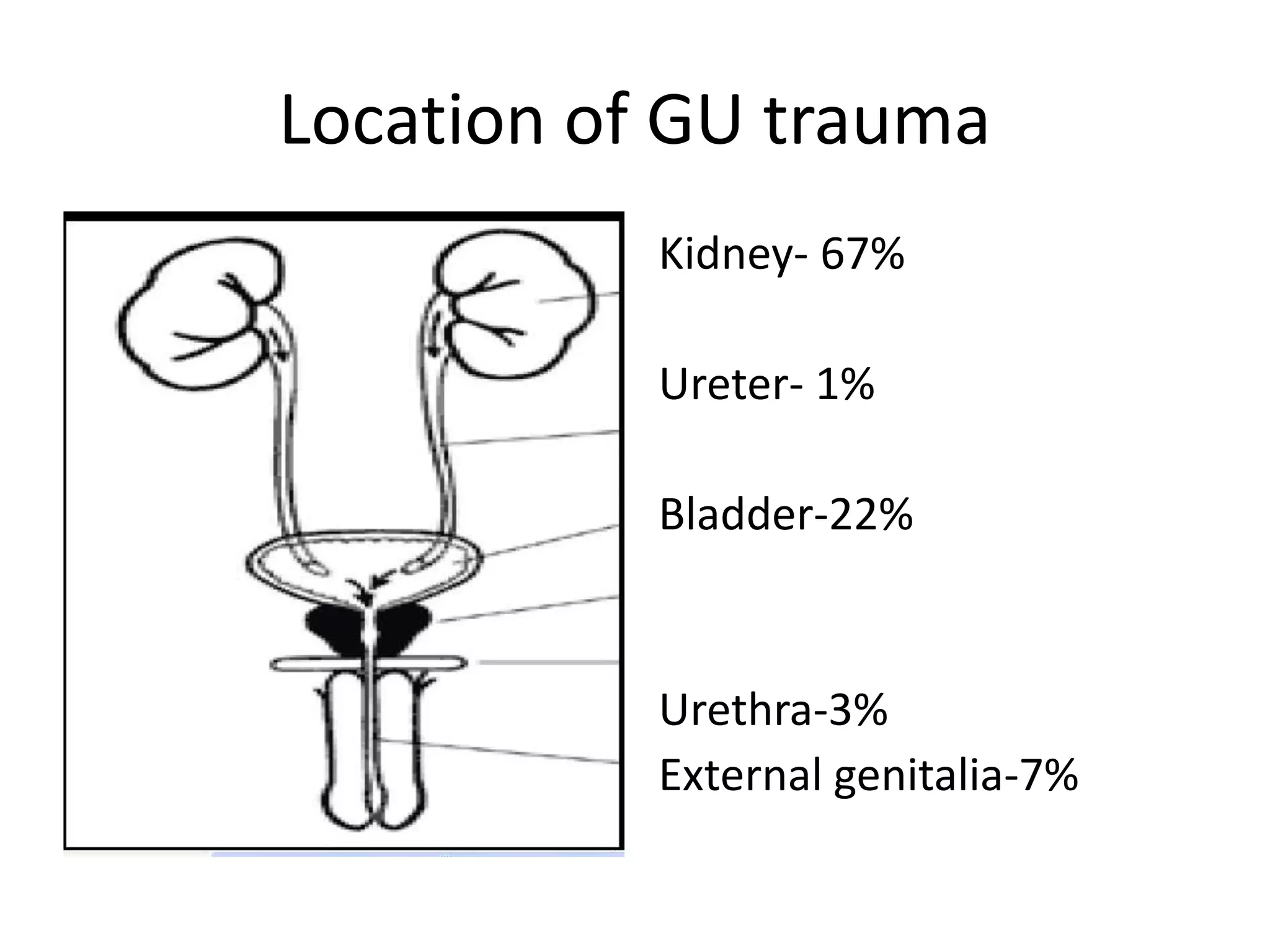
Location of GU trauma
Kidney- 67%
Ureter- 1%
Bladder-22%
Urethra-3%
External genitalia-7%
Renal trauma
• 90% - Blunt, 10%-Penetrating.
• 10% of pts with significant abdominal trauma.
• When severe, associated with injuries to other
organs in upto 80%.
• When kidney is the only organ damaged, injury is
minor in 98%.
Mechanism of renal trauma
• Blunt trauma: direct blow to the kidney.
• Penetrating trauma: stab or gunshot injury,
renal biopsy.
• High-velocity deceleration: pedicle injury
(avulsion of renal vessels).
Predisposing factors
• Pre existing renal abnormalities
- Vulnerable position:
transplant kidneys
horse shoe kidneys
crossed fused ectopia
- Increased bulk: Tumours (angiomyolipoma, RCC),
Cysts, Hydronephrosis
• Paediatric kidneys.
An underlying renal lesion should be suspected if a patient
presents with CT findings of renal injury out of proportion to the
mechanism of injury.
Indications for renal imaging
• Penetrating
• Gross hematuria
• Microhematuria with shock( Systolic BP<90 mmHg)
• Microhematuria with
- Flank impact (contusion, haematoma over flank)
- Fracture of lower ribs, transverse processes or
thoracolumbar spine
• Deceleration injury
• Paediatric
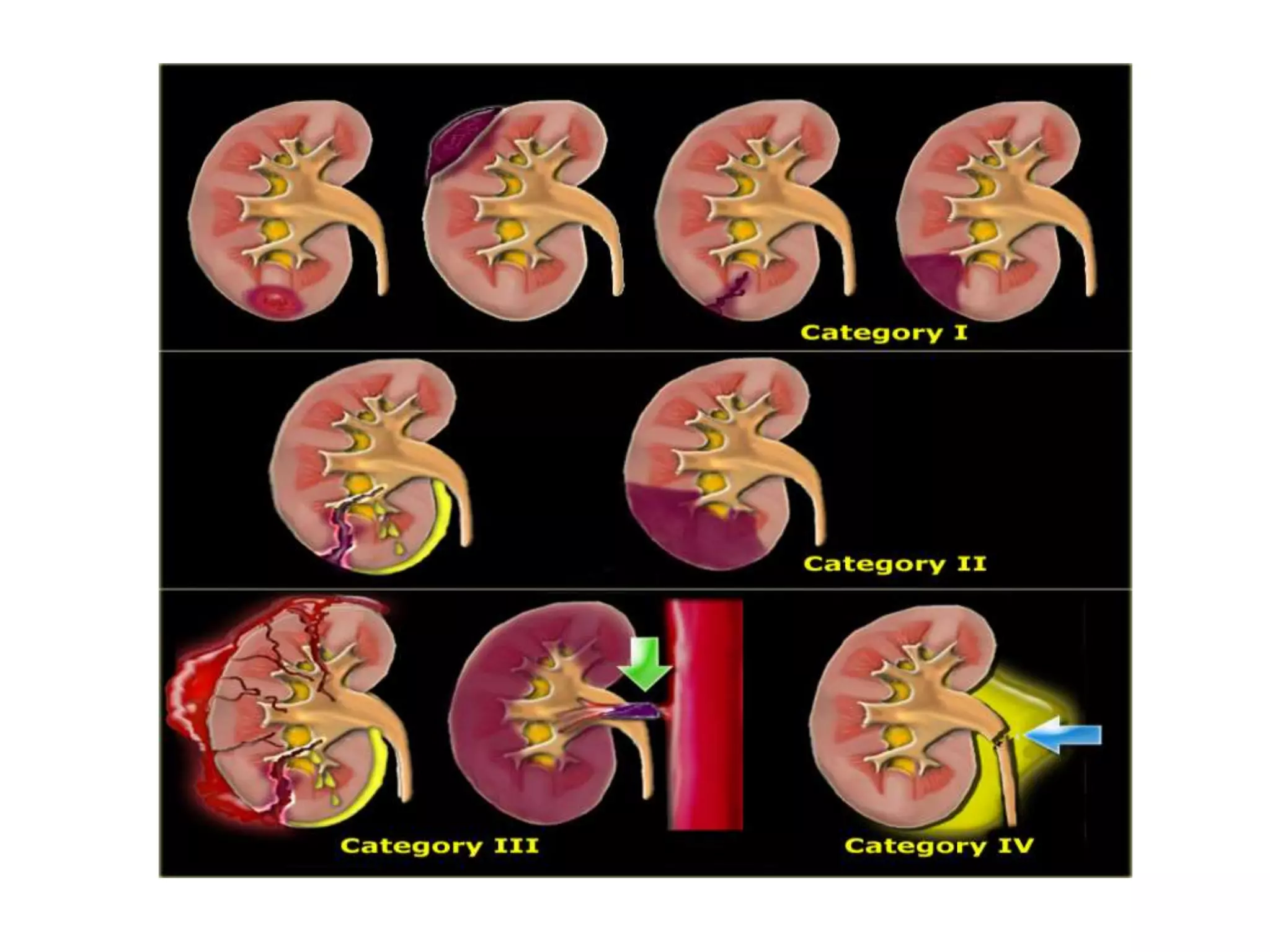
Federle Classification
• Category I- MINOR
- Contusion
- Cortical laceration not extending into a calyx.
• Category II- MAJOR
- Cortical laceration extending into the collecting system (renal
fracture)
• CategoryIII- CATASTROPHIC
- Renal pedicle injuries
- Shattered kidney
• Category IV
- PUJ Injuries
AAST renal injury scale - 2018
• Grade I:
– Subcapsular hematoma/contusion; no laceration
• Grade II:
– Laceration<1 cm not involving the collecting system
– Perirenal hematoma within perirenal fascia
• Grade III:
– Laceration>1 cm not involving the collecting system
– Vascular injury/active bleeding confined within the perirenal fascia
• Grade IV:
– Laceration involving the collecting system with urinary extravasation
– Laceration of the renal pelvis or complete ureteropelvic disruption
– Vascular injury to segmental renal artery or vein
– Segmental infarction
– Active bleeding extending to the retroperitoneum or peritoneum
• Grade V:
– Shattered kidney
– Avulsion of renal hilum or laceration of main renal artery or vein
– Devascularized kidney with active bleeding
Imaging modalities
• CT Scan
• IVU
• Anterograde / Retrograde pyelography
• Cystography
• Urethrography
• USG
• Renal angiography
• MRI
IVU
• Historical interest, largely replaced by cross sectional imaging.
• Quality of IVU in the setting of trauma is likely to be poor;
hypotensive patient minimal or no secretion from both
kidneys.
• Single shot IVU(full length film 15 mins after contrast inj.)in
hemodynamically unstable patients destined for ER
laparotomy.
• Provides information regarding:
-presence of functioning contralateral kidney.
-some gross information about the injured kidney.
• Intra-operative IVU in severely injured patients.
IVU
• Absence of unilateral excretion: major vascular injury
(usually RA avulsion).
• Soft tissue swelling with loss of psoas outline:
retroperitoneal, perinephric and subcapsular
hematomas.
• Disruption of PCS: extravasation of opacified urine
(70% sensitivity for urine leak).
15 min single shot IVU in a pt with stab injury to back. IVU-normal kidneys
and ureter bilaterally. CT-grade 3 renal laceration with perinephric
hematoma.
USG
• Advantages:
easily available, non invasive, high negative predictive value
(96-98%).
• Disadvantages:
- poor resolution (compared to CT).
- does not provide information about renal function.
- significant trauma may be missed (upto 80%of
parenchymal lesions may be overlooked).
Findings in USG
• Acute parenchymal, subcapsular and
perinephric hematomas - echo poor areas.
• More heterogenous and echogenic with time.
• Disruption of renal parenchyma with capsular
tears and urinomas can be identified.
• Doppler-pedicle injuries.
Ultrasound gray-scale image shows normal right kidney.Doppler study shows
absent colour uptake in intrarenal arteries s/o grade 5 injury.
Grade 4 renal injury. Sonogram in an 8-year-old child with posttraumatic renal
infarction shows both kidneys with an avascular area in the lower half of the affected
kidney
Grade 4 renal injury. Sonogram of the same patient shows progressive
shrinkage of the lower half as the kidney goes ischemic autopartial
nephrectomy
CT Scan
• Modality of choice, most accurate technique.
• Allows assessment of entire abdomen,
including liver and spleen.
• Arteriovenous phase
• Delayed scan at 10-20 min
• Technique:
- the abdomen and pelvis should be scanned from the
diaphragmatic dome to pubic symphysis with contrast.
- Protocol:
>commence scanning 30 sec after the start of an injection of
50-100ml of 300 strength contrast at 2-3 ml/sec, collimation 7
mm, pitch 1.3.
>addition of 400-600 ml of oral contrast (4% diatriazoate)
immediately before scan helps in delineating associated
bowel injuries (stomach, duodenum and proximal jejunum).
CT Findings:Grade I Injuries
• Contusions and/or non expanding subcapsular hematomas.
- accounts for 80% of renal injuries.
• Contusions:
- ill-defined or sometimes sharply marginated areas of
reduced enhancement and excretion.
• Sucapsular hematoma:
- crescentic low density area following the convexity of the
outer aspect of the renal cortex .
Grade 1 renal injury, contusion-shows ill-defined area of
hypoenhancement in the medial right kidney.
Grade 1 renal injury, subcapsular hematoma-Image shows crescentic high-
density fluid collection around the left kidney with well-defined outer margin
Grade 1 renal injury, subcapsular
hematoma
Grade 2&3 Injuries
• Grade2: non expanding perinephric hematomas contained by the
retroperitoneum and superficial cortical lacerations less than 1 cm in
depth not extending into a calyx.
• Grade3: cortical lacerations greater than 1 cm in depth not extending into
a calyx.
• Perinephric hematoma :
-ill-defined, hyperattenuating fluid collection located between the Gerota
fascia and the renal parenchyma.
• Renal lacerations :
-jagged or linear parenchymal disruptions that can contain fresh or
clotted blood .
• Both grade 2 and grade 3 renal lacerations : No evidence of urinary
contrast extravasation on delayed CT.
Grade 2 renal trauma-an ill-defined fluid collection in the left perinephric
space and subcapsular hematoma with deformity of the renal parenchyma.
Grade 2 renal injury-superficial (less than 1 cm deep) renal
parenchymal defect with a large perinephric hematoma
Grade 3 renal laceration, CT-renal parenchymal defect with extension greater than 1
cm deep to near the renal pelvis
Grade 3 renal laceration
Grade 4 Injuries
• A) renal lacerations that extend into the collecting system,
B) injuries to the main renal artery or vein with contained hemorrhage, and
C)segmental infarctions without associated lacerations.
• Renal lacerations with collecting system involvement :
- frequently produce extravasation of urine or contrast agent.
- delayed images allow adequate views of any urinary extravasation
• Renal segmental infarctions: well-delineated, linear or wedge-shaped, often
multifocal and non enhancing areas that extend through the parenchyma in a
radial or segmental orientation .
Grade 4 renal injury segmental infarction. Shows a segmental area of non
enhancement in the upper medial left kidney without associated renal laceration.
Grade 4-5 renal injury shows deep lacerations extending into the collecting system of
the right kidney . Extension into the collecting system is confirmed by urinary contrast
extravasation on the delayed image through the kidney in excretory phase.
Grade 5 Injuries
• Shattered or devascularized kidney, UPJ avulsions, and complete
laceration or thrombosis of the main renal artery or vein.
• Shattered kidney: multiple renal fragments.
• Renal artery disruption/avulsion: commonest vascular injury.
- non perfusion of the kidney.
- some preservation of peripheral perfusion due to early take off of the
capsular artery.
- traumatic renal artery dissection may be identified on CT.
• Traumatic renal vein thrombosis
- persistent nephrogram,
- thrombus may be directly demonstrated in the renal vein.
• UPJ avulsion-contrast extravasation
- total disruption - ureter fails to opacify.
- partial disruption - contrast appears in the ureter.
Grade 5 renal injury. Shattered left kidney
Grade 5 renal injury -delayed image shows urinary
contrast extravasation.
Grade 5 renal injury. Shattered kidney with renal vein thrombosis (incomplete). CT
scan shows shattered right kidney and renal vein thrombus extending slightly into the
inferior vena cava.
Grade 5 renal injury, devascularization. CECT shows dissection of the origin of
the left renal artery, with no perfusion of the left kidney.
Angiography
• The use of arteriography in the assessment of renal injuries has
diminished because most vascular injuries can be assessed with CT.
• However, selective renal arteriography can provide more detailed
information regarding the exact anatomic area of vascular injury than is
possible with CT.
• Arteriography with transcatheter embolization may be used for
nonsurgical therapy in hemodynamically stable patients with renal injuries
associated with ongoing hemorrhage and for the evaluation of suspected
vascular complications of injury (eg, arteriovenous fistula,
pseudoaneurysm).
• Venography may be performed to assess suspected injuries to the renal
veins or inferior vena
Pseudoaneurysm in a patient who had sustained a stab wound and had undergone
exploratory laparotomy.
Selective arterial-phase right renal angiogram demonstrates a false aneurysm in the lower
pole of the right kidney (straight arrow).
Subsegmental infarction is noted in the upper pole (curved arrow).
Bleeding was controlled with intraarterial embolization.Surgical staples from the laparotomy
are seen at the midline.
MRI
• MRI provides excellent detail of the renal
anatomy but offers no clear advantage over
CT, and is less able to detect extravasation.
• A rare indication for MRI in the renal trauma
setting may be severe contrast allergy.
Management(EAU 2003 guidelines)
• Blunt : Grade 1-4 conservative MX
• Penetrating :Grade 1-3 conservative Mx
• Absolute indications for SX
Complications
• Urinoma
• Perinephric Abscess
• Pseudoaneurysm
• HTN
• Renal insufficiency
• Urinary fistula
• Pyelonephritis
Urinoma
Ureteric trauma
• <1% of urinary tract trauma
• Mechanism of injury:
a) External:
Penetrating injuries – twice common than blunt injury.
Deceleration injuries:
-PUJ avulsion,
-less often upper 1/3rd of ureter
-more frequent in children(sufficient flexibilty
to produce hyperflexion injuries)
b) Iatrogenic: 0.4-2.5 %, gynaecologic surgery for malignancy.
Grading-AAST
• Haematuria may be absent in one third of
cases.
Features include:
• Contrast extravasation
• Formation of urinoma
• Ureteric discontinuity
Imaging findings
• IVU:
- mild to moderate fullness of the PCS and extravasation at the
site of tear.
- complete tear - ureter fails to opacify below the tear.
- fistulations to other structures.
• Retrograde pyelogram:
- findings as above.
- limited use in acute setting.
- used to document site and extent of disruption, especially
when CT or IVU is inconclusive,
Bladder trauma
• Causes:Trauma
Spontaneous
• Trauma:Blunt
Penetrating
• Blunt trauma:
- most common in patients with multi injury
trauma.
- predisposed by full bladder at the time of trauma.
- pelvic fractures (especially anterior ring)
commonly asscociated.
-7 % symphysis pubis diastasis associated with
bladder trauma.
• Spontaneous:
- pre-existing bladder wall abnormalities and/or
excessive straining.
- bladder tumour, cystitis, peri vesical inflammation,
BOO, neurogenic bladder, previous radiotherapy.
• Iatrogenic trauma:
- surgery particularly ceassarean section and
transurethral bladder resection (usually for tumour).
Classification
1 Contusion (incomplete or partial tear of the bladder mucosa, imaging
findings usually normal)
2 Intraperitoneal rupture (contrast material seen around bowel loops
and in the major peritoneal spaces)
3 Interstitial bladder injury (rare, contrast material dissects into bladder
wall but not outside the bladder)
4 Extraperitoneal rupture (contrast seen within the perivesical
space and a variable number of adjacent extraperitoneal
spaces, depending upon the severity of injury)
5 Combined intraperitoneal and extraperitoneal rupture.
Imaging modalities
• Conventional cystography
• CT Cystography
Conventional Cystography
• Advantages:
- nearly 100% sensitive for detecting rupture, provided that
adequate distention is accomplished and that post voiding
images are obtained.
• Disadvantages:
- time consuming.
- require extra radiography in addition to necessary trauma
evaluation.
- not useful in evaluating trauma to other viscera.
CT cystography
• Advantages of CT Cystography
- less time consuming.
- concomitant injury to other viscera (most
importantly the kidneys).
• The absence of free fluid in the abdomen
during the CT is a strong negative predictor of
bladder injury.
Imaging findings
• Extraperitoneal rupture:
- commonest bladder injury (90% of cases).
- associated anterior pelvic ring fracture in 90% of cases.
- extravasation of contrast into the perivesical space-
- in florid extravasation, contrast may extend
anterosuperiorly along the anterior pelvic and
abdominal wall upto umbilicus, or posteriorly around
the rectum in presacral space.
- associated tear of urogenital diaphragm allowing the
contrast to appear within the perinerum, thigh and
scrotum.
- The extravasated contrast stays close to the bladder and has a sharp
irregular margins.
CT cystogram of victim of motor vehicle collision
(A) shows streaky extravasated contrast material around urinary bladder
consistent with extraperitoneal bladder injury.
(B) Coronal reformatted image better demonstrates the site of injury at the left
bladder base. Note adjacent left superior ramus fracture.
• Intraperitoneal rupture
- contrast extravasates into the peritoneal
cavity and has a more cloudy nebulous
appearance.
-usually tear is along the dome of bladder
which is the weakest part.
-associated pelvic fractures seen in 75%.
Conventional cystogram demonstrating an intraperitoneal
bladder rupture.
Urethral trauma
• Almost entirely restricted to males unless
there is major pelvic trauma in females.
• Should be suspected-
– Pelvic trauma with hematuria or retention
– Blood at the urethral meatus.
Imaging: Retrograde urethrogram
Male posterior urethral injuries
Type Membranous
urethra
Bulbar Urethra Contrast
Extravasation
Perineu
m
Retropu
bic
space
I Contusion or
partial tear
Normal or
stretced
No No
II Rupture
above UGD
Normal or
stretched
No Yes
III Rupture
below UGD
Ruptured Yes No
• Type II injuries-most common, rupture at the
prostatic apex (prostato membranous
junction) immediately above the UGD with
sparing of the UGD itself.
• Type III injuries-membranous urethra ruptures
at the membrano bulbar junction below the
UGD, which itself is disrupted.
Retrograde urethrogram reveals a type I urethral injury with minimal stretching and
slight luminal irregularity of the posterior urethra. No extravasation of contrast
material is present
Retrograde urethrogram - type II urethral disruption. Extravasation of contrast
material (solid arrow) from the posterior urethra is seen superior to an intact
urogenital diaphragm (dashed arrow).
Retrograde urethrogram - type III urethral injury. Extravasation is located in both the
extraperitoneal pelvis and in the perineum (above and below the urogenital
diaphragm).
Anterior urethral trauma
• Mechanisms:
- iatrogenic (attempted catheterisation,
instrumentation)
- blunt perineal trauma(straddle injury):bulbar
urethra and corpus spongiosum are
compressed against the inferior aspect of
anterior pelvic ring.
Straddle injury. Retrograde urethrogram shows a type 5 urethral injury with
extravasation of contrast material from the distal bulbous urethra.
Findings
• Rupture
-partial: contrast extravasation with some
filling of proximal urethra.
-complete: failure of filling of proximal urethra
Complications
• Stricture
• Impotence(up to 10%)
• Incontinence (2%)
SCROTAL TRAUMA
• Injury to the testis may occur from
penetrating wounds, direct impact of high-
velocity objects against the testis or
compression of the testis against the pubic
arch and impacting object.
• Ultrasound is the imaging technique of choice
in acute scrotal trauma.
• Intratesticular haematomas are common after
trauma.
• The ultrasound appearance depends on the
time between occurrence of trauma and ultrasound
evaluation.
• Acute haematomas are typically isoechoic to the
normal testicular parenchyma and can be difficult to
identify.
• Testicular rupture implies tearing of the tunica
albuginea with extrusion of testicular parenchyma
into the scrotal sac.
• The margins of the testis are poorly defined and the
echogenicity of the testis is heterogeneous.
• The use of colour Doppler is essential as rupture of
the tunica albuginea will almost always be associated
with a loss of vascularity to a portion of or the entire
testis.
• Trauma to the testis can also result in dislocation or
torsion.
• Dislocation most commonly results from impact of the
scrotum against the fuel tank in motorcycle accidents.
• Testicular dislocation, typically into the inguinal canal,
may be detected by CT or ultrasound.
• Testicular torsion is preceded by trauma in 5–8% of
cases.
References
• Textbook of radiology and imaging David
Sutton 7th edition
• Grainger and Allison’s Diagnostic Radiology 6th
edition
• Fundamentals of Diagnostic Radiology Bryant
& Helms 4th edition
• Radiopedia
THANK YOU

Genito-urinary trauma

  • 1.
    APPROACH TO URINARYTRACT TRAUMA DR. SULAV PRADHAN 2ND YEAR RESIDENT NAMS, BIR HOSPITAL
  • 2.
    Location of GUtrauma Kidney- 67% Ureter- 1% Bladder-22% Urethra-3% External genitalia-7%
  • 3.
    Renal trauma • 90%- Blunt, 10%-Penetrating. • 10% of pts with significant abdominal trauma. • When severe, associated with injuries to other organs in upto 80%. • When kidney is the only organ damaged, injury is minor in 98%.
  • 4.
    Mechanism of renaltrauma • Blunt trauma: direct blow to the kidney. • Penetrating trauma: stab or gunshot injury, renal biopsy. • High-velocity deceleration: pedicle injury (avulsion of renal vessels).
  • 5.
    Predisposing factors • Preexisting renal abnormalities - Vulnerable position: transplant kidneys horse shoe kidneys crossed fused ectopia - Increased bulk: Tumours (angiomyolipoma, RCC), Cysts, Hydronephrosis • Paediatric kidneys.
  • 6.
    An underlying renallesion should be suspected if a patient presents with CT findings of renal injury out of proportion to the mechanism of injury.
  • 7.
    Indications for renalimaging • Penetrating • Gross hematuria • Microhematuria with shock( Systolic BP<90 mmHg) • Microhematuria with - Flank impact (contusion, haematoma over flank) - Fracture of lower ribs, transverse processes or thoracolumbar spine • Deceleration injury • Paediatric
  • 8.
    Federle Classification • CategoryI- MINOR - Contusion - Cortical laceration not extending into a calyx. • Category II- MAJOR - Cortical laceration extending into the collecting system (renal fracture) • CategoryIII- CATASTROPHIC - Renal pedicle injuries - Shattered kidney • Category IV - PUJ Injuries
  • 10.
    AAST renal injuryscale - 2018 • Grade I: – Subcapsular hematoma/contusion; no laceration • Grade II: – Laceration<1 cm not involving the collecting system – Perirenal hematoma within perirenal fascia • Grade III: – Laceration>1 cm not involving the collecting system – Vascular injury/active bleeding confined within the perirenal fascia
  • 11.
    • Grade IV: –Laceration involving the collecting system with urinary extravasation – Laceration of the renal pelvis or complete ureteropelvic disruption – Vascular injury to segmental renal artery or vein – Segmental infarction – Active bleeding extending to the retroperitoneum or peritoneum • Grade V: – Shattered kidney – Avulsion of renal hilum or laceration of main renal artery or vein – Devascularized kidney with active bleeding
  • 12.
    Imaging modalities • CTScan • IVU • Anterograde / Retrograde pyelography • Cystography • Urethrography • USG • Renal angiography • MRI
  • 13.
    IVU • Historical interest,largely replaced by cross sectional imaging. • Quality of IVU in the setting of trauma is likely to be poor; hypotensive patient minimal or no secretion from both kidneys. • Single shot IVU(full length film 15 mins after contrast inj.)in hemodynamically unstable patients destined for ER laparotomy. • Provides information regarding: -presence of functioning contralateral kidney. -some gross information about the injured kidney. • Intra-operative IVU in severely injured patients.
  • 14.
    IVU • Absence ofunilateral excretion: major vascular injury (usually RA avulsion). • Soft tissue swelling with loss of psoas outline: retroperitoneal, perinephric and subcapsular hematomas. • Disruption of PCS: extravasation of opacified urine (70% sensitivity for urine leak).
  • 15.
    15 min singleshot IVU in a pt with stab injury to back. IVU-normal kidneys and ureter bilaterally. CT-grade 3 renal laceration with perinephric hematoma.
  • 16.
    USG • Advantages: easily available,non invasive, high negative predictive value (96-98%). • Disadvantages: - poor resolution (compared to CT). - does not provide information about renal function. - significant trauma may be missed (upto 80%of parenchymal lesions may be overlooked).
  • 17.
    Findings in USG •Acute parenchymal, subcapsular and perinephric hematomas - echo poor areas. • More heterogenous and echogenic with time. • Disruption of renal parenchyma with capsular tears and urinomas can be identified. • Doppler-pedicle injuries.
  • 18.
    Ultrasound gray-scale imageshows normal right kidney.Doppler study shows absent colour uptake in intrarenal arteries s/o grade 5 injury.
  • 19.
    Grade 4 renalinjury. Sonogram in an 8-year-old child with posttraumatic renal infarction shows both kidneys with an avascular area in the lower half of the affected kidney
  • 20.
    Grade 4 renalinjury. Sonogram of the same patient shows progressive shrinkage of the lower half as the kidney goes ischemic autopartial nephrectomy
  • 21.
    CT Scan • Modalityof choice, most accurate technique. • Allows assessment of entire abdomen, including liver and spleen. • Arteriovenous phase • Delayed scan at 10-20 min
  • 22.
    • Technique: - theabdomen and pelvis should be scanned from the diaphragmatic dome to pubic symphysis with contrast. - Protocol: >commence scanning 30 sec after the start of an injection of 50-100ml of 300 strength contrast at 2-3 ml/sec, collimation 7 mm, pitch 1.3. >addition of 400-600 ml of oral contrast (4% diatriazoate) immediately before scan helps in delineating associated bowel injuries (stomach, duodenum and proximal jejunum).
  • 23.
    CT Findings:Grade IInjuries • Contusions and/or non expanding subcapsular hematomas. - accounts for 80% of renal injuries. • Contusions: - ill-defined or sometimes sharply marginated areas of reduced enhancement and excretion. • Sucapsular hematoma: - crescentic low density area following the convexity of the outer aspect of the renal cortex .
  • 24.
    Grade 1 renalinjury, contusion-shows ill-defined area of hypoenhancement in the medial right kidney.
  • 25.
    Grade 1 renalinjury, subcapsular hematoma-Image shows crescentic high- density fluid collection around the left kidney with well-defined outer margin
  • 26.
    Grade 1 renalinjury, subcapsular hematoma
  • 27.
    Grade 2&3 Injuries •Grade2: non expanding perinephric hematomas contained by the retroperitoneum and superficial cortical lacerations less than 1 cm in depth not extending into a calyx. • Grade3: cortical lacerations greater than 1 cm in depth not extending into a calyx. • Perinephric hematoma : -ill-defined, hyperattenuating fluid collection located between the Gerota fascia and the renal parenchyma. • Renal lacerations : -jagged or linear parenchymal disruptions that can contain fresh or clotted blood . • Both grade 2 and grade 3 renal lacerations : No evidence of urinary contrast extravasation on delayed CT.
  • 28.
    Grade 2 renaltrauma-an ill-defined fluid collection in the left perinephric space and subcapsular hematoma with deformity of the renal parenchyma.
  • 29.
    Grade 2 renalinjury-superficial (less than 1 cm deep) renal parenchymal defect with a large perinephric hematoma
  • 30.
    Grade 3 renallaceration, CT-renal parenchymal defect with extension greater than 1 cm deep to near the renal pelvis
  • 31.
    Grade 3 renallaceration
  • 32.
    Grade 4 Injuries •A) renal lacerations that extend into the collecting system, B) injuries to the main renal artery or vein with contained hemorrhage, and C)segmental infarctions without associated lacerations. • Renal lacerations with collecting system involvement : - frequently produce extravasation of urine or contrast agent. - delayed images allow adequate views of any urinary extravasation • Renal segmental infarctions: well-delineated, linear or wedge-shaped, often multifocal and non enhancing areas that extend through the parenchyma in a radial or segmental orientation .
  • 33.
    Grade 4 renalinjury segmental infarction. Shows a segmental area of non enhancement in the upper medial left kidney without associated renal laceration.
  • 34.
    Grade 4-5 renalinjury shows deep lacerations extending into the collecting system of the right kidney . Extension into the collecting system is confirmed by urinary contrast extravasation on the delayed image through the kidney in excretory phase.
  • 35.
    Grade 5 Injuries •Shattered or devascularized kidney, UPJ avulsions, and complete laceration or thrombosis of the main renal artery or vein. • Shattered kidney: multiple renal fragments. • Renal artery disruption/avulsion: commonest vascular injury. - non perfusion of the kidney. - some preservation of peripheral perfusion due to early take off of the capsular artery. - traumatic renal artery dissection may be identified on CT. • Traumatic renal vein thrombosis - persistent nephrogram, - thrombus may be directly demonstrated in the renal vein. • UPJ avulsion-contrast extravasation - total disruption - ureter fails to opacify. - partial disruption - contrast appears in the ureter.
  • 36.
    Grade 5 renalinjury. Shattered left kidney
  • 37.
    Grade 5 renalinjury -delayed image shows urinary contrast extravasation.
  • 38.
    Grade 5 renalinjury. Shattered kidney with renal vein thrombosis (incomplete). CT scan shows shattered right kidney and renal vein thrombus extending slightly into the inferior vena cava.
  • 39.
    Grade 5 renalinjury, devascularization. CECT shows dissection of the origin of the left renal artery, with no perfusion of the left kidney.
  • 40.
    Angiography • The useof arteriography in the assessment of renal injuries has diminished because most vascular injuries can be assessed with CT. • However, selective renal arteriography can provide more detailed information regarding the exact anatomic area of vascular injury than is possible with CT. • Arteriography with transcatheter embolization may be used for nonsurgical therapy in hemodynamically stable patients with renal injuries associated with ongoing hemorrhage and for the evaluation of suspected vascular complications of injury (eg, arteriovenous fistula, pseudoaneurysm). • Venography may be performed to assess suspected injuries to the renal veins or inferior vena
  • 41.
    Pseudoaneurysm in apatient who had sustained a stab wound and had undergone exploratory laparotomy. Selective arterial-phase right renal angiogram demonstrates a false aneurysm in the lower pole of the right kidney (straight arrow). Subsegmental infarction is noted in the upper pole (curved arrow). Bleeding was controlled with intraarterial embolization.Surgical staples from the laparotomy are seen at the midline.
  • 42.
    MRI • MRI providesexcellent detail of the renal anatomy but offers no clear advantage over CT, and is less able to detect extravasation. • A rare indication for MRI in the renal trauma setting may be severe contrast allergy.
  • 43.
    Management(EAU 2003 guidelines) •Blunt : Grade 1-4 conservative MX • Penetrating :Grade 1-3 conservative Mx • Absolute indications for SX
  • 44.
    Complications • Urinoma • PerinephricAbscess • Pseudoaneurysm • HTN • Renal insufficiency • Urinary fistula • Pyelonephritis
  • 45.
  • 48.
    Ureteric trauma • <1%of urinary tract trauma • Mechanism of injury: a) External: Penetrating injuries – twice common than blunt injury. Deceleration injuries: -PUJ avulsion, -less often upper 1/3rd of ureter -more frequent in children(sufficient flexibilty to produce hyperflexion injuries) b) Iatrogenic: 0.4-2.5 %, gynaecologic surgery for malignancy.
  • 49.
  • 50.
    • Haematuria maybe absent in one third of cases. Features include: • Contrast extravasation • Formation of urinoma • Ureteric discontinuity
  • 51.
    Imaging findings • IVU: -mild to moderate fullness of the PCS and extravasation at the site of tear. - complete tear - ureter fails to opacify below the tear. - fistulations to other structures. • Retrograde pyelogram: - findings as above. - limited use in acute setting. - used to document site and extent of disruption, especially when CT or IVU is inconclusive,
  • 53.
  • 54.
    • Blunt trauma: -most common in patients with multi injury trauma. - predisposed by full bladder at the time of trauma. - pelvic fractures (especially anterior ring) commonly asscociated. -7 % symphysis pubis diastasis associated with bladder trauma.
  • 55.
    • Spontaneous: - pre-existingbladder wall abnormalities and/or excessive straining. - bladder tumour, cystitis, peri vesical inflammation, BOO, neurogenic bladder, previous radiotherapy. • Iatrogenic trauma: - surgery particularly ceassarean section and transurethral bladder resection (usually for tumour).
  • 56.
    Classification 1 Contusion (incompleteor partial tear of the bladder mucosa, imaging findings usually normal) 2 Intraperitoneal rupture (contrast material seen around bowel loops and in the major peritoneal spaces) 3 Interstitial bladder injury (rare, contrast material dissects into bladder wall but not outside the bladder) 4 Extraperitoneal rupture (contrast seen within the perivesical space and a variable number of adjacent extraperitoneal spaces, depending upon the severity of injury) 5 Combined intraperitoneal and extraperitoneal rupture.
  • 57.
    Imaging modalities • Conventionalcystography • CT Cystography
  • 58.
    Conventional Cystography • Advantages: -nearly 100% sensitive for detecting rupture, provided that adequate distention is accomplished and that post voiding images are obtained. • Disadvantages: - time consuming. - require extra radiography in addition to necessary trauma evaluation. - not useful in evaluating trauma to other viscera.
  • 59.
    CT cystography • Advantagesof CT Cystography - less time consuming. - concomitant injury to other viscera (most importantly the kidneys). • The absence of free fluid in the abdomen during the CT is a strong negative predictor of bladder injury.
  • 60.
    Imaging findings • Extraperitonealrupture: - commonest bladder injury (90% of cases). - associated anterior pelvic ring fracture in 90% of cases. - extravasation of contrast into the perivesical space- - in florid extravasation, contrast may extend anterosuperiorly along the anterior pelvic and abdominal wall upto umbilicus, or posteriorly around the rectum in presacral space. - associated tear of urogenital diaphragm allowing the contrast to appear within the perinerum, thigh and scrotum. - The extravasated contrast stays close to the bladder and has a sharp irregular margins.
  • 61.
    CT cystogram ofvictim of motor vehicle collision (A) shows streaky extravasated contrast material around urinary bladder consistent with extraperitoneal bladder injury. (B) Coronal reformatted image better demonstrates the site of injury at the left bladder base. Note adjacent left superior ramus fracture.
  • 62.
    • Intraperitoneal rupture -contrast extravasates into the peritoneal cavity and has a more cloudy nebulous appearance. -usually tear is along the dome of bladder which is the weakest part. -associated pelvic fractures seen in 75%.
  • 64.
    Conventional cystogram demonstratingan intraperitoneal bladder rupture.
  • 65.
    Urethral trauma • Almostentirely restricted to males unless there is major pelvic trauma in females. • Should be suspected- – Pelvic trauma with hematuria or retention – Blood at the urethral meatus. Imaging: Retrograde urethrogram
  • 66.
    Male posterior urethralinjuries Type Membranous urethra Bulbar Urethra Contrast Extravasation Perineu m Retropu bic space I Contusion or partial tear Normal or stretced No No II Rupture above UGD Normal or stretched No Yes III Rupture below UGD Ruptured Yes No
  • 68.
    • Type IIinjuries-most common, rupture at the prostatic apex (prostato membranous junction) immediately above the UGD with sparing of the UGD itself. • Type III injuries-membranous urethra ruptures at the membrano bulbar junction below the UGD, which itself is disrupted.
  • 69.
    Retrograde urethrogram revealsa type I urethral injury with minimal stretching and slight luminal irregularity of the posterior urethra. No extravasation of contrast material is present
  • 70.
    Retrograde urethrogram -type II urethral disruption. Extravasation of contrast material (solid arrow) from the posterior urethra is seen superior to an intact urogenital diaphragm (dashed arrow).
  • 71.
    Retrograde urethrogram -type III urethral injury. Extravasation is located in both the extraperitoneal pelvis and in the perineum (above and below the urogenital diaphragm).
  • 72.
    Anterior urethral trauma •Mechanisms: - iatrogenic (attempted catheterisation, instrumentation) - blunt perineal trauma(straddle injury):bulbar urethra and corpus spongiosum are compressed against the inferior aspect of anterior pelvic ring.
  • 73.
    Straddle injury. Retrogradeurethrogram shows a type 5 urethral injury with extravasation of contrast material from the distal bulbous urethra.
  • 74.
    Findings • Rupture -partial: contrastextravasation with some filling of proximal urethra. -complete: failure of filling of proximal urethra
  • 75.
    Complications • Stricture • Impotence(upto 10%) • Incontinence (2%)
  • 76.
    SCROTAL TRAUMA • Injuryto the testis may occur from penetrating wounds, direct impact of high- velocity objects against the testis or compression of the testis against the pubic arch and impacting object. • Ultrasound is the imaging technique of choice in acute scrotal trauma.
  • 77.
    • Intratesticular haematomasare common after trauma. • The ultrasound appearance depends on the time between occurrence of trauma and ultrasound evaluation. • Acute haematomas are typically isoechoic to the normal testicular parenchyma and can be difficult to identify.
  • 79.
    • Testicular ruptureimplies tearing of the tunica albuginea with extrusion of testicular parenchyma into the scrotal sac. • The margins of the testis are poorly defined and the echogenicity of the testis is heterogeneous. • The use of colour Doppler is essential as rupture of the tunica albuginea will almost always be associated with a loss of vascularity to a portion of or the entire testis.
  • 80.
    • Trauma tothe testis can also result in dislocation or torsion. • Dislocation most commonly results from impact of the scrotum against the fuel tank in motorcycle accidents. • Testicular dislocation, typically into the inguinal canal, may be detected by CT or ultrasound. • Testicular torsion is preceded by trauma in 5–8% of cases.
  • 81.
    References • Textbook ofradiology and imaging David Sutton 7th edition • Grainger and Allison’s Diagnostic Radiology 6th edition • Fundamentals of Diagnostic Radiology Bryant & Helms 4th edition • Radiopedia
  • 82.

Editor's Notes

  • #5 Major renal injury(grade 4 and 5): - up to 25% of blunt, and in up to 70% of penetrating renal trauma cases.
  • #6 (more ant location and proximity to rigid spine or iliac crest)
  • #22 ? omit if normal kidneys with no perinephric, retroperitoneal or pelvic fluid.