Dr.Bom B. C.
MD Radiognosis
NAMS, Bir Hospital
APPROACH TO
MAMMOGRAPHY
General breast anatomy
 Conical, round or hemispherical shape.
 Comprised of 15-20 lobes, each encased in
fascial sheath defined by AMF & PMF
 Extends from 2nd or 3rd intercostal space to 6th
or 7th intercostal space
 Extends laterally to anterior axillary fold and
medially to lateral sternum
Relationship to chest wall
 Superior two-thirds overlies pectoralis major
muscle
 Lateral portions overlies serratus anterior muscle
 Inferior-most margin overlies upper
abdominaloblique muscles
 Axillary tail of Spence: Extension of normal
breast tissue toward axilla.
ZONALANATOMY
Premammary (Subcutaneous) Zone
 Most superficial zone.
 Anterior margin defined by skin, posterior margin
defined by AMF.
 Contains subcutaneous fat, blood vessels, anterior
suspensory (Cooper) ligaments, formed from two
leaflets of AMF inserting into dermis which provides
support for breast and is usually visible on
mammograms and sonograms.
Mammary Zone
 Defined anteriorly by AMF and posteriorly by PMF
 Contains majority of ducts/TDLUs (Terminal dust
lobular units), stromal fat and stromal connective
tissue
 Subdivided haphazardly by interspersed ASLs.
Retromammary Zone
 Most posterior of three zones
 Defined anteriorly by PMF and posteriorly by chest
wall
 Contains fat and PSLs which attach PMF to chest wall
Mammograhy
 Mammography is the radiographic examination of
the breast
tissue (soft tissue radiography).
 To visualize normal structures and pathology
within the breast, it is essential that sharpness,
contrast and resolution are maximized.
 This optimizes, in the image, the relatively small
differences in the absorption characteristics of the
structures comprising the breast.
 A low kVp value, typically 28 kVp, is used.
 Radiation dose must be minimized due to the
radio-sensitivity of breast tissue.
 Mammography is carried out on both
symptomatic women with a known history or
suspected abnormality of the breast and as a
screening procedure in well, asymptomatic
woman.
 Consistency of radiographic technique and image
quality is essential, particularly in screening
mammography, where comparison with former
films is often essential.
 Other techniques such as magnetic resonance
imaging (MRI) and ultrasound have a role in
breast imaging, mammography is undertaken to
image the breast most commonly.
Basics of Screening Mammography
 Performed in asymptomatic women aged 50 years
and over.
 Performed in asymptomatic women aged 35 years and
over who have a high risk of developing breast cancer:
1. Women who have one or more first degree relatives
who have been diagnosed with premenopausal
breast cancer
2. Women with histological risk factors found at
previous surgery, e.g. atypical ductal hyperplasia
 Two views of each breast (MLO and CC.)
 Typically interpreted after patient has left the
department.
 Normal (No recall) vs Abnormal (Recall).
Basics of Daignostics Mammography
 Investigation of symptomatic women aged 35
years and over with a breast lump or other clinical
evidence of breast cancer( Discharge, skin
changes, constant focal pain etc.)
 Surveillance of the breast following local excision
of breast carcinoma
 Evaluation of a breast lump in women following
augmentation mammoplasty
 Abnormal screening mammogram.
 Investigation of a suspicious breast lump in a
man.
Recommended projections
Basic projections
 45-degree medio-lateral oblique (Lundgren)
 Craniocaudal
Supplementary projections
 Extended cranio-caudal laterally rotated
 Extended cranio-caudal medially rotated
 Extended cranio-caudal
 Medio-lateral
 Latero-medial
 Axillary tail
 Localized compression/paddle
 Magnified (full-field/paddle) projections
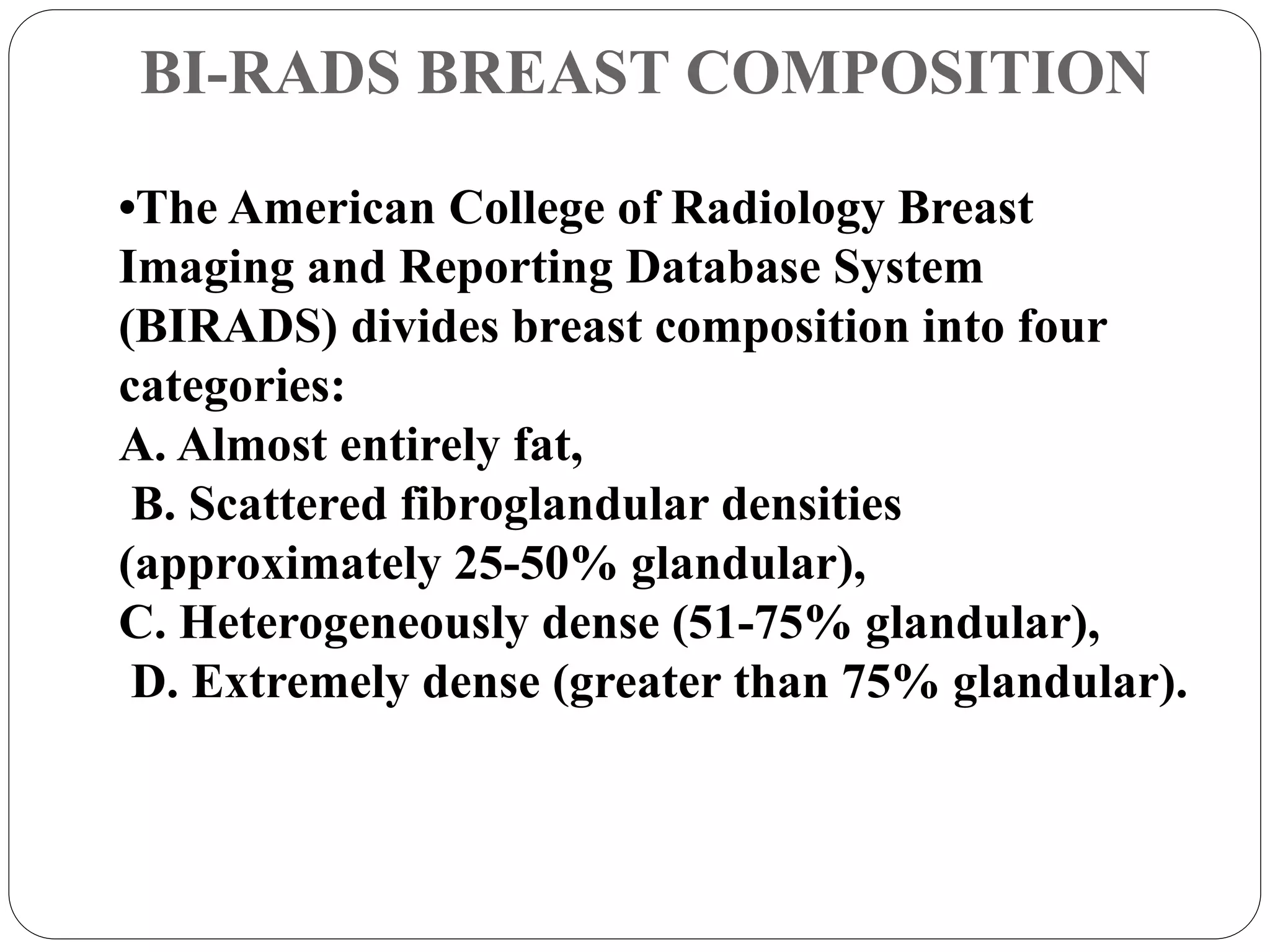
BI-RADS BREAST COMPOSITION
•The American College of Radiology Breast
Imaging and Reporting Database System
(BIRADS) divides breast composition into four
categories:
A. Almost entirely fat,
B. Scattered fibroglandular densities
(approximately 25-50% glandular),
C. Heterogeneously dense (51-75% glandular),
D. Extremely dense (greater than 75% glandular).
 BI-RADS is designed to standardize breast
imaging reporting and to reduce confusion in
breast imaging interpretations.
 It also facilitates outcome monitoring and quality
assessment.
 It contains a lexicon for standardized terminology
(descriptors) for mammography, breast US and
MRI, as well as chapters on Report Organization
and Guidance Chapters for use in daily practice.
A 'Mass' is a space occupying 3D lesion seen in two different
projections.I f a potential mass is seen in only a single projection
it should be called a 'asymmetry' until its three-dimensionality
is confirmed.
o
L
O
I
Density
 High
 Iso
 Low ( not fat)
Fat containing
 Oil cysts
 Lipoma
 Galactocele
 Hamartomas
 Fibroadenolipomas
 Skin Calcification
 Vascular Calcification
 Popcorn Calcification
 Rod like Calcification
 Lucent Centered Deposits
 Eggshell/ Rim Calcification
 Precipitated Calcification in milk of calcium.
 Large Dystrophic Calcification
Skin Calcification
 Tattoo Sign
 Usually located along
inframammary fold parasternally,
Axilla and areola.
 Can be seen in the skin
which is enface
Vascular Calcification
 Linear or parallel tracks
that are usually clearly
associated with blood
vessels.
Popcorn Calcification; Involuting
Fibroadenoma
Rod like calcification
 Within ectatic ducts due
to secretory deposits
and follow ductal
distribution radiating
towards nipple.
 May be continuous or
discontinuous and may
show branching.
 Differentiate from
malignant fine branching
calcifications.
Lucent centered deposits
Fat Necrosis
Calcified Debris inducts
Occasionally in
Fibroadenoms
Eggshell or Rim Calcification
 Wall of the Cyst.
 Fat Necrosis.
 Periphery of
Fibroadenoma
Milk of Calcium
 Are benign sedimented calcification in
macro or micro cysts.
 Typical feature is apparent change in
shape on different projections.
Dystrophic Calcification
 Coarse irregular
shaped calcification.
 In irradiated breast
or following trauma.
Round calcification
 >0.5 mm.
 In fibrocystic
changes
or adenosis or skin
calcification.
Amorphous or indistinct calcification
 Calcification without a clearly
defined shape or form. They
are usually so small or hazy in
appearance, that a more
specific morphologic
classification can not be
determined.
 Present in many benign and
malignant breast diseases.
About 10-20% of amorphous
calcifications turns out to be
malignant.
Coarse Heterogeneous Calcification
 Irregular calcification
that are usually larger
than 0.5 mm but not
the size of large
heterogeneous
dystrophic
calcifications.
 About 10-15% may
have risk of
malignancy.
Fine Pleomorphic:
• < 0.5 mm.
• Variable in size,
density or form
• 25 – 40% risk of
malignancy
Fine Linear or Branching
 < 0.5mm in width.
 Linear or branching distribution.
 Risk of malignancy – 70%
Risk of Malignancy
Distribution of calcifications
The distribution of calcifications is also as important as
morphology. These descriptors are arranged according to
the risk of malignancy:
 Diffuse: distributed randomly throughout the breast.
 Regional: occupying a large portion of breast tissue > 2
cm greatest dimension
 Grouped (historically cluster): few calcifications
occupying a small portion of breast tissue: lower limit 5
calcifications within 1 cm and upper limit a larger number
of calcifications within 2 cm.
 Linear: arranged in a line, which suggests deposits in a
duct.
 Segmental: suggests deposits in a duct or ducts and their
branches.
Risk
of
malig
n-
anacy
As compared to Malignant Calcification, Benign
Calcifications are:
 Larger
 Coarser
 Round and smooth
 Easily seen.
In contrast to a mass, which is a 3-D structure
demonstrating convex outward borders and which is
usually evident on two orthogonal views, asymmetric
findings lack the convex outward borders and the
conspicuity typical of a mass.
•If a potential mass is seen in only a single
view at standard mammography, it should be
called an “asymmetry” until its three-
dimensionality is confirmed.
• Approximately 80% of cases are due to
summation shadow, of normal fibroglandular
breast.
• True lesions may sometimes appear on only
one view because on other views they are
either obscured by overlapping dense
parenchyma or are located outside the field of
view.
•Is seen in both the views.
•Involves a less than one quadrant of breast.
•It can be due to normal variations or some lesion.
•Is seen in both the views.
•Involves a greater volume of breast
tissue (at least a quadrant)
•Without any associated mass
suspicious calcifications, or
architectural distortions.
• It is usually due to normal
variations or hormonal influence and
only significant when it corresponds
to a palpable abnormality.
This is a focal asymmetry that is new,
larger, or denser at current examination
than at previous examinations.
•Well circumscribed.
• < 1cm
• Upper and outer quadrant
• Lucent and invaginated
fatty hilum.
•May appear as 3 or more
round densities in horse
shoe arrangement.
•If a mass is seen in a section other than upper and
outer quadrant, unless it has a clearly defined hilum.
• Lesion in upper outer quadrant does not have
other characteristics, it should be considered
suspicious as malignant node or primary mass.
 Tubular or branching
structure
representing
dilated duct.
 Usually of minor
significance.
 BIRADS III
 Spiculations radiating
from a point without
any
identifiable mass.
 The only
architectural
distortion that does not
require further
evaluation is that
caused
by prior surgery or
trauma.
Other associated features
Architectural distortion(Parenchymal
distortion/Stellate lesion)
 An area of architectural distortion of the breast is seen
mammographically as numerous straight lines usually
measuring from 1 to 4 cm in length radiating toward a
central area .
 The central part of the lesion typically shows no
central soft-tissue mass either on standard or
localized compression views.
 A mammographic work-up including repeat standard
views and, where necessary, localized compression
views should be performed to confirm that a stellate
lesion is present rather than a density with apparent
architectural distortion caused by summation of
normal overlying stromal shadows , and to look for
associated signs such as microcalcifications.
A. Stellate appearance (arrows) due to summation of
overlying stromal shadows. B. Repeat film shows that no
lesion is present.
A B
Stellate opacity due to a
surgical scar.
Stellate lesion due to an invasive tubular carcino
 FINALLY WE HAVE to decide on the significance of
the mammographic findings.
 FINALISE THE REPORT IN 7 SPECIFIC
CATEGORIES.
Mammography
Strengths Weakness
 Provides overview of both
breasts.
 Not operator dependent-
reproducible
 Only proven modality for
screening.
 Shows
microcalcifications.
 Best modality for showing
spiculations.
 Not effective in dense
breasts.
 Difficult to differentiate
cyst vs solid
 Radiation exposure.
Ultrasound
Strenghts Weakness
 Excellent at showing masses.
 Differentiates cyst vs solids.
 High reliabilty in telling
normal tissue from a mass.
 Best modality to correlate a
lump to imaging.
 Easiest method for biopsy.
 Least expensive equipment,
readily available, radiation
free
 Operator dependent.
 Coverage is dependent
on technique.
 Usually may miss
calcifications.
MRI
Strengths Weakness
 Most sensitive modality
(Best modality for
detecting cancers).
 Not dependent on shape
and margin.
 Not affected by dense
breast tissue
 Most expensive, readily
not available.
 Background enhancement
decreases sensitivity.
 Can miss low grade DCIS
presenting as
calcifications.
 Subject to False positives
as benign masses and
normal tissue can
enhance.
Clinical scenarios
A. Palpable abnormality (Lump)
1. USG is absolute mandatory.
2. Mammography is less useful- Good for screening for
the rest of breast.
B. Discharge
1. Subareolar USG to look for dilated duct and intra-ductal
mass.
2. Mammography to look for calcifications.
3. Ductography.
C. Pain
1. Only needs work up if focal and constant
2. USG more useful followed by mammography.
D. Abnormal Mammogram
1. Asymmetry, distortion- Spot compression
mammography and additional projections, do USG if
looks real.
2. Mass- USG, first do additional mammography views
if needed to localize the abnormality.
3. Calcifications- Mammography, most are not seen by
USG, Can try USG as it can be used in biopsy
E. Known cancer
1. MRI is best for assessing size of tumor and extent of
disease, other lesions, chest cell invasion, lymph
node.
2. USG is also good for looking the extent of the
disease- can guide biopsy- can evaluate the axilla.
3. Mammography for seeing extent of calcifications.
F. Chemotherapy response.
MRI is best modality for assessing for response to
neo-adjuvent chemotherapy.
References
 Clark’s Positioning in Radiography
 Textbook of Radiology and Imaging- David
Sutton, Volume 2
 Diagnostic workflow in Imaging: Mammogaphy,
Ultrasound, MRI, Biopsy : John Lewin
 Radioassistant
THANK YOU

Mammography

  • 1.
    Dr.Bom B. C. MDRadiognosis NAMS, Bir Hospital APPROACH TO MAMMOGRAPHY
  • 2.
    General breast anatomy Conical, round or hemispherical shape.  Comprised of 15-20 lobes, each encased in fascial sheath defined by AMF & PMF  Extends from 2nd or 3rd intercostal space to 6th or 7th intercostal space  Extends laterally to anterior axillary fold and medially to lateral sternum
  • 3.
    Relationship to chestwall  Superior two-thirds overlies pectoralis major muscle  Lateral portions overlies serratus anterior muscle  Inferior-most margin overlies upper abdominaloblique muscles  Axillary tail of Spence: Extension of normal breast tissue toward axilla.
  • 4.
    ZONALANATOMY Premammary (Subcutaneous) Zone Most superficial zone.  Anterior margin defined by skin, posterior margin defined by AMF.  Contains subcutaneous fat, blood vessels, anterior suspensory (Cooper) ligaments, formed from two leaflets of AMF inserting into dermis which provides support for breast and is usually visible on mammograms and sonograms.
  • 5.
    Mammary Zone  Definedanteriorly by AMF and posteriorly by PMF  Contains majority of ducts/TDLUs (Terminal dust lobular units), stromal fat and stromal connective tissue  Subdivided haphazardly by interspersed ASLs. Retromammary Zone  Most posterior of three zones  Defined anteriorly by PMF and posteriorly by chest wall  Contains fat and PSLs which attach PMF to chest wall
  • 7.
    Mammograhy  Mammography isthe radiographic examination of the breast tissue (soft tissue radiography).  To visualize normal structures and pathology within the breast, it is essential that sharpness, contrast and resolution are maximized.  This optimizes, in the image, the relatively small differences in the absorption characteristics of the structures comprising the breast.  A low kVp value, typically 28 kVp, is used.  Radiation dose must be minimized due to the radio-sensitivity of breast tissue.
  • 8.
     Mammography iscarried out on both symptomatic women with a known history or suspected abnormality of the breast and as a screening procedure in well, asymptomatic woman.  Consistency of radiographic technique and image quality is essential, particularly in screening mammography, where comparison with former films is often essential.  Other techniques such as magnetic resonance imaging (MRI) and ultrasound have a role in breast imaging, mammography is undertaken to image the breast most commonly.
  • 9.
    Basics of ScreeningMammography  Performed in asymptomatic women aged 50 years and over.  Performed in asymptomatic women aged 35 years and over who have a high risk of developing breast cancer: 1. Women who have one or more first degree relatives who have been diagnosed with premenopausal breast cancer 2. Women with histological risk factors found at previous surgery, e.g. atypical ductal hyperplasia  Two views of each breast (MLO and CC.)  Typically interpreted after patient has left the department.  Normal (No recall) vs Abnormal (Recall).
  • 10.
    Basics of DaignosticsMammography  Investigation of symptomatic women aged 35 years and over with a breast lump or other clinical evidence of breast cancer( Discharge, skin changes, constant focal pain etc.)  Surveillance of the breast following local excision of breast carcinoma  Evaluation of a breast lump in women following augmentation mammoplasty  Abnormal screening mammogram.  Investigation of a suspicious breast lump in a man.
  • 11.
    Recommended projections Basic projections 45-degree medio-lateral oblique (Lundgren)  Craniocaudal Supplementary projections  Extended cranio-caudal laterally rotated  Extended cranio-caudal medially rotated  Extended cranio-caudal  Medio-lateral  Latero-medial  Axillary tail  Localized compression/paddle  Magnified (full-field/paddle) projections
  • 16.
    BI-RADS BREAST COMPOSITION •TheAmerican College of Radiology Breast Imaging and Reporting Database System (BIRADS) divides breast composition into four categories: A. Almost entirely fat, B. Scattered fibroglandular densities (approximately 25-50% glandular), C. Heterogeneously dense (51-75% glandular), D. Extremely dense (greater than 75% glandular).
  • 19.
     BI-RADS isdesigned to standardize breast imaging reporting and to reduce confusion in breast imaging interpretations.  It also facilitates outcome monitoring and quality assessment.  It contains a lexicon for standardized terminology (descriptors) for mammography, breast US and MRI, as well as chapters on Report Organization and Guidance Chapters for use in daily practice.
  • 22.
    A 'Mass' isa space occupying 3D lesion seen in two different projections.I f a potential mass is seen in only a single projection it should be called a 'asymmetry' until its three-dimensionality is confirmed.
  • 24.
  • 26.
  • 27.
    Density  High  Iso Low ( not fat) Fat containing  Oil cysts  Lipoma  Galactocele  Hamartomas  Fibroadenolipomas
  • 32.
     Skin Calcification Vascular Calcification  Popcorn Calcification  Rod like Calcification  Lucent Centered Deposits  Eggshell/ Rim Calcification  Precipitated Calcification in milk of calcium.  Large Dystrophic Calcification
  • 33.
    Skin Calcification  TattooSign  Usually located along inframammary fold parasternally, Axilla and areola.  Can be seen in the skin which is enface
  • 34.
    Vascular Calcification  Linearor parallel tracks that are usually clearly associated with blood vessels.
  • 35.
  • 36.
    Rod like calcification Within ectatic ducts due to secretory deposits and follow ductal distribution radiating towards nipple.  May be continuous or discontinuous and may show branching.  Differentiate from malignant fine branching calcifications.
  • 37.
    Lucent centered deposits FatNecrosis Calcified Debris inducts Occasionally in Fibroadenoms
  • 38.
    Eggshell or RimCalcification  Wall of the Cyst.  Fat Necrosis.  Periphery of Fibroadenoma
  • 39.
    Milk of Calcium Are benign sedimented calcification in macro or micro cysts.  Typical feature is apparent change in shape on different projections.
  • 40.
    Dystrophic Calcification  Coarseirregular shaped calcification.  In irradiated breast or following trauma.
  • 41.
    Round calcification  >0.5mm.  In fibrocystic changes or adenosis or skin calcification.
  • 42.
    Amorphous or indistinctcalcification  Calcification without a clearly defined shape or form. They are usually so small or hazy in appearance, that a more specific morphologic classification can not be determined.  Present in many benign and malignant breast diseases. About 10-20% of amorphous calcifications turns out to be malignant.
  • 43.
    Coarse Heterogeneous Calcification Irregular calcification that are usually larger than 0.5 mm but not the size of large heterogeneous dystrophic calcifications.  About 10-15% may have risk of malignancy.
  • 44.
    Fine Pleomorphic: • <0.5 mm. • Variable in size, density or form • 25 – 40% risk of malignancy
  • 45.
    Fine Linear orBranching  < 0.5mm in width.  Linear or branching distribution.  Risk of malignancy – 70%
  • 48.
  • 49.
    Distribution of calcifications Thedistribution of calcifications is also as important as morphology. These descriptors are arranged according to the risk of malignancy:  Diffuse: distributed randomly throughout the breast.  Regional: occupying a large portion of breast tissue > 2 cm greatest dimension  Grouped (historically cluster): few calcifications occupying a small portion of breast tissue: lower limit 5 calcifications within 1 cm and upper limit a larger number of calcifications within 2 cm.  Linear: arranged in a line, which suggests deposits in a duct.  Segmental: suggests deposits in a duct or ducts and their branches.
  • 50.
  • 51.
    As compared toMalignant Calcification, Benign Calcifications are:  Larger  Coarser  Round and smooth  Easily seen.
  • 53.
    In contrast toa mass, which is a 3-D structure demonstrating convex outward borders and which is usually evident on two orthogonal views, asymmetric findings lack the convex outward borders and the conspicuity typical of a mass.
  • 55.
    •If a potentialmass is seen in only a single view at standard mammography, it should be called an “asymmetry” until its three- dimensionality is confirmed. • Approximately 80% of cases are due to summation shadow, of normal fibroglandular breast. • True lesions may sometimes appear on only one view because on other views they are either obscured by overlapping dense parenchyma or are located outside the field of view.
  • 57.
    •Is seen inboth the views. •Involves a less than one quadrant of breast. •It can be due to normal variations or some lesion.
  • 58.
    •Is seen inboth the views. •Involves a greater volume of breast tissue (at least a quadrant) •Without any associated mass suspicious calcifications, or architectural distortions. • It is usually due to normal variations or hormonal influence and only significant when it corresponds to a palpable abnormality.
  • 60.
    This is afocal asymmetry that is new, larger, or denser at current examination than at previous examinations.
  • 63.
    •Well circumscribed. • <1cm • Upper and outer quadrant • Lucent and invaginated fatty hilum. •May appear as 3 or more round densities in horse shoe arrangement.
  • 64.
    •If a massis seen in a section other than upper and outer quadrant, unless it has a clearly defined hilum. • Lesion in upper outer quadrant does not have other characteristics, it should be considered suspicious as malignant node or primary mass.
  • 66.
     Tubular orbranching structure representing dilated duct.  Usually of minor significance.  BIRADS III
  • 68.
     Spiculations radiating froma point without any identifiable mass.  The only architectural distortion that does not require further evaluation is that caused by prior surgery or trauma.
  • 69.
  • 71.
    Architectural distortion(Parenchymal distortion/Stellate lesion) An area of architectural distortion of the breast is seen mammographically as numerous straight lines usually measuring from 1 to 4 cm in length radiating toward a central area .  The central part of the lesion typically shows no central soft-tissue mass either on standard or localized compression views.  A mammographic work-up including repeat standard views and, where necessary, localized compression views should be performed to confirm that a stellate lesion is present rather than a density with apparent architectural distortion caused by summation of normal overlying stromal shadows , and to look for associated signs such as microcalcifications.
  • 72.
    A. Stellate appearance(arrows) due to summation of overlying stromal shadows. B. Repeat film shows that no lesion is present. A B
  • 73.
    Stellate opacity dueto a surgical scar. Stellate lesion due to an invasive tubular carcino
  • 74.
     FINALLY WEHAVE to decide on the significance of the mammographic findings.  FINALISE THE REPORT IN 7 SPECIFIC CATEGORIES.
  • 77.
    Mammography Strengths Weakness  Providesoverview of both breasts.  Not operator dependent- reproducible  Only proven modality for screening.  Shows microcalcifications.  Best modality for showing spiculations.  Not effective in dense breasts.  Difficult to differentiate cyst vs solid  Radiation exposure.
  • 78.
    Ultrasound Strenghts Weakness  Excellentat showing masses.  Differentiates cyst vs solids.  High reliabilty in telling normal tissue from a mass.  Best modality to correlate a lump to imaging.  Easiest method for biopsy.  Least expensive equipment, readily available, radiation free  Operator dependent.  Coverage is dependent on technique.  Usually may miss calcifications.
  • 79.
    MRI Strengths Weakness  Mostsensitive modality (Best modality for detecting cancers).  Not dependent on shape and margin.  Not affected by dense breast tissue  Most expensive, readily not available.  Background enhancement decreases sensitivity.  Can miss low grade DCIS presenting as calcifications.  Subject to False positives as benign masses and normal tissue can enhance.
  • 80.
    Clinical scenarios A. Palpableabnormality (Lump) 1. USG is absolute mandatory. 2. Mammography is less useful- Good for screening for the rest of breast. B. Discharge 1. Subareolar USG to look for dilated duct and intra-ductal mass. 2. Mammography to look for calcifications. 3. Ductography.
  • 81.
    C. Pain 1. Onlyneeds work up if focal and constant 2. USG more useful followed by mammography. D. Abnormal Mammogram 1. Asymmetry, distortion- Spot compression mammography and additional projections, do USG if looks real. 2. Mass- USG, first do additional mammography views if needed to localize the abnormality. 3. Calcifications- Mammography, most are not seen by USG, Can try USG as it can be used in biopsy
  • 82.
    E. Known cancer 1.MRI is best for assessing size of tumor and extent of disease, other lesions, chest cell invasion, lymph node. 2. USG is also good for looking the extent of the disease- can guide biopsy- can evaluate the axilla. 3. Mammography for seeing extent of calcifications. F. Chemotherapy response. MRI is best modality for assessing for response to neo-adjuvent chemotherapy.
  • 87.
    References  Clark’s Positioningin Radiography  Textbook of Radiology and Imaging- David Sutton, Volume 2  Diagnostic workflow in Imaging: Mammogaphy, Ultrasound, MRI, Biopsy : John Lewin  Radioassistant
  • 88.