VECTOR CALCULUS I
Differential Elements – Cartesian Coordinates
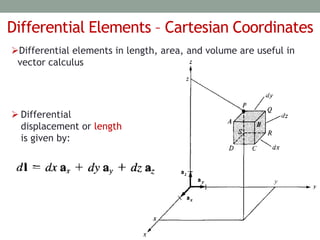
Differential elements in length, area, and volume are useful in
vector calculus
 Differential
displacement or length
is given by:
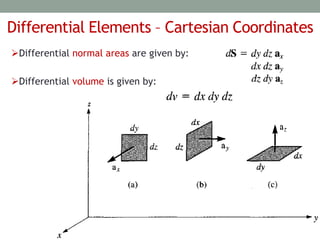
Differential normal areas are given by:
Differential volume is given by:
Differential Elements – Cartesian Coordinates
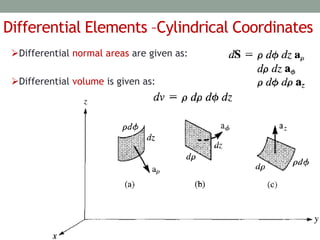
Differential Elements –Cylindrical Coordinates
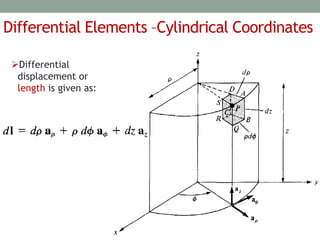
Differential
displacement or
length is given as:
Differential normal areas are given as:
Differential volume is given as:
Differential Elements –Cylindrical Coordinates
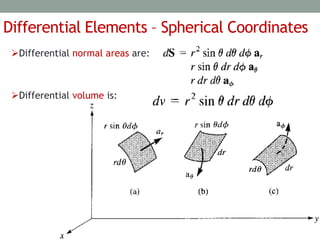
Differential Elements – Spherical Coordinates
Differential
displacement or
length is given as:
Differential normal areas are:
Differential volume is:
Differential Elements – Spherical Coordinates
These differential elements are very important as they will
be referred to again and again throughout the course
The student is encouraged to learn to derive them from the
figures
Differential Elements
Line Integral
Concept of integration will now be extended to cases when the
integrand involves a vector
By a line we mean the path in space
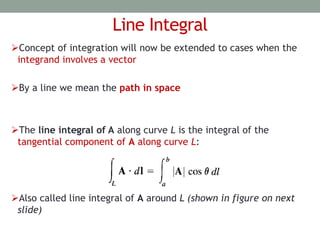
The line integral of A along curve L is the integral of the
tangential component of A along curve L:
Also called line integral of A around L (shown in figure on next
slide)
Line Integral
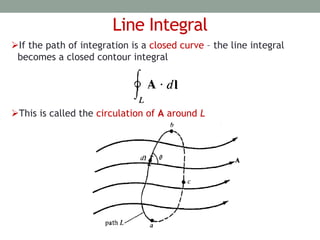
If the path of integration is a closed curve – the line integral
becomes a closed contour integral
This is called the circulation of A around L
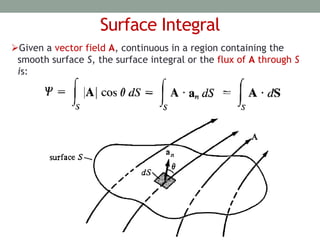
Surface Integral
Given a vector field A, continuous in a region containing the
smooth surface S, the surface integral or the flux of A through S
is:
Volume Integral
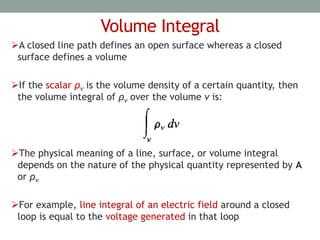
A closed line path defines an open surface whereas a closed
surface defines a volume
If the scalar ρv is the volume density of a certain quantity, then
the volume integral of ρv over the volume v is:
The physical meaning of a line, surface, or volume integral
depends on the nature of the physical quantity represented by A
or ρv
For example, line integral of an electric field around a closed
loop is equal to the voltage generated in that loop
DEL Operator
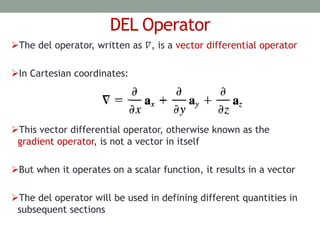
The del operator, written as 𝛻, is a vector differential operator
In Cartesian coordinates:
This vector differential operator, otherwise known as the
gradient operator, is not a vector in itself
But when it operates on a scalar function, it results in a vector
The del operator will be used in defining different quantities in
subsequent sections
DEL Operator – Cylindrical Coordinate System
We have:
Hence:
By substitution:
DEL Operator – Spherical Coordinate System
We have:
Hence:
By substitution:
Gradient of a Scalar
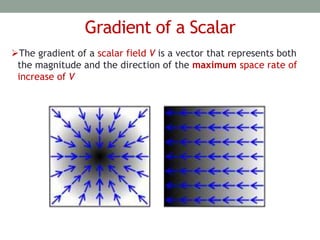
The gradient of a scalar field V is a vector that represents both
the magnitude and the direction of the maximum space rate of
increase of V
Gradient of a Scalar
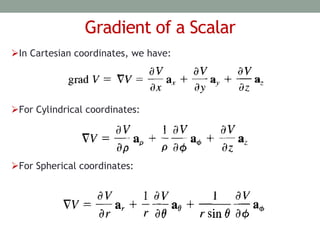
In Cartesian coordinates, we have:
For Cylindrical coordinates:
For Spherical coordinates:
Fundamental Properties of 𝛁𝑉
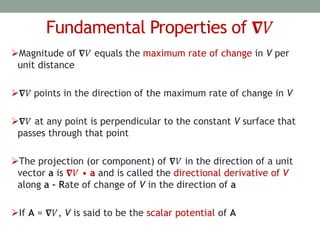
Magnitude of 𝛁𝑉 equals the maximum rate of change in V per
unit distance
𝛁𝑉 points in the direction of the maximum rate of change in V
𝛁𝑉 at any point is perpendicular to the constant V surface that
passes through that point
The projection (or component) of 𝛁𝑉 in the direction of a unit
vector a is 𝛁𝑉 • a and is called the directional derivative of V
along a – Rate of change of V in the direction of a
If A = 𝛁𝑉, V is said to be the scalar potential of A
Problem-1
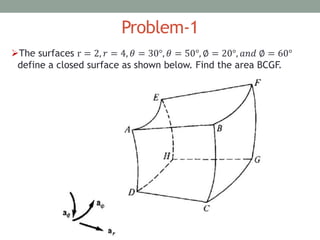
The surfaces r = 2, 𝑟 = 4, 𝜃 = 30°, 𝜃 = 50°, ∅ = 20°, 𝑎𝑛𝑑 ∅ = 60°
define a closed surface as shown below. Find the area BCGF.

Differential Elements in Vector Calculus.pptx

  • 1.
  • 2.
    Differential Elements –Cartesian Coordinates Differential elements in length, area, and volume are useful in vector calculus  Differential displacement or length is given by:
  • 3.
    Differential normal areasare given by: Differential volume is given by: Differential Elements – Cartesian Coordinates
  • 4.
    Differential Elements –CylindricalCoordinates Differential displacement or length is given as:
  • 5.
    Differential normal areasare given as: Differential volume is given as: Differential Elements –Cylindrical Coordinates
  • 6.
    Differential Elements –Spherical Coordinates Differential displacement or length is given as:
  • 7.
    Differential normal areasare: Differential volume is: Differential Elements – Spherical Coordinates
  • 8.
    These differential elementsare very important as they will be referred to again and again throughout the course The student is encouraged to learn to derive them from the figures Differential Elements
  • 9.
    Line Integral Concept ofintegration will now be extended to cases when the integrand involves a vector By a line we mean the path in space The line integral of A along curve L is the integral of the tangential component of A along curve L: Also called line integral of A around L (shown in figure on next slide)
  • 10.
    Line Integral If thepath of integration is a closed curve – the line integral becomes a closed contour integral This is called the circulation of A around L
  • 11.
    Surface Integral Given avector field A, continuous in a region containing the smooth surface S, the surface integral or the flux of A through S is:
  • 12.
    Volume Integral A closedline path defines an open surface whereas a closed surface defines a volume If the scalar ρv is the volume density of a certain quantity, then the volume integral of ρv over the volume v is: The physical meaning of a line, surface, or volume integral depends on the nature of the physical quantity represented by A or ρv For example, line integral of an electric field around a closed loop is equal to the voltage generated in that loop
  • 13.
    DEL Operator The deloperator, written as 𝛻, is a vector differential operator In Cartesian coordinates: This vector differential operator, otherwise known as the gradient operator, is not a vector in itself But when it operates on a scalar function, it results in a vector The del operator will be used in defining different quantities in subsequent sections
  • 14.
    DEL Operator –Cylindrical Coordinate System We have: Hence: By substitution:
  • 15.
    DEL Operator –Spherical Coordinate System We have: Hence: By substitution:
  • 16.
    Gradient of aScalar The gradient of a scalar field V is a vector that represents both the magnitude and the direction of the maximum space rate of increase of V
  • 17.
    Gradient of aScalar In Cartesian coordinates, we have: For Cylindrical coordinates: For Spherical coordinates:
  • 18.
    Fundamental Properties of𝛁𝑉 Magnitude of 𝛁𝑉 equals the maximum rate of change in V per unit distance 𝛁𝑉 points in the direction of the maximum rate of change in V 𝛁𝑉 at any point is perpendicular to the constant V surface that passes through that point The projection (or component) of 𝛁𝑉 in the direction of a unit vector a is 𝛁𝑉 • a and is called the directional derivative of V along a – Rate of change of V in the direction of a If A = 𝛁𝑉, V is said to be the scalar potential of A
  • 19.
    Problem-1 The surfaces r= 2, 𝑟 = 4, 𝜃 = 30°, 𝜃 = 50°, ∅ = 20°, 𝑎𝑛𝑑 ∅ = 60° define a closed surface as shown below. Find the area BCGF.

Editor's Notes

  • #15  𝜕 𝜕𝑥 = 𝜕 𝜕𝜌 𝜕𝜌 𝜕𝑥 + 𝜕 𝜕∅ 𝜕∅ 𝜕𝑥 , and 𝑑 𝑑𝑥 𝑡𝑎𝑛 −1 𝑢 = 1 1+ 𝑢 2 𝑑 𝑑𝑥 [𝑢] are required