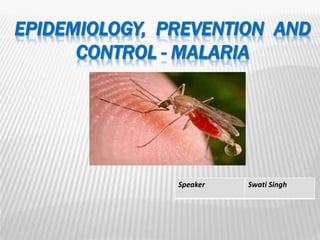
EPIDEMIOLOGY, PREVENTION AND
CONTROL - MALARIA
Speaker Swati Singh
CONTENTS
• Introduction
• Problem statement
• Epidemiology
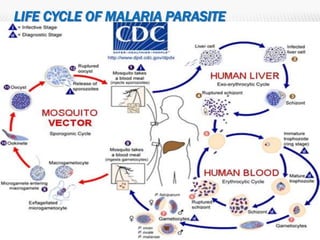
• Lifecycle
• Prevention
• Clinical presentation
• Diagnosis and treatment
• Milestones
• Roll back malaria
• Malaria vaccine
• References
• The term malaria originates from Italian: mala aria — "bad
air“ in 18th century.
• Formerly called ague or marsh fever due to its association
with swamps and marshland.
• In 1897, Ronald Ross established the life cycle of
plasmodium and identified that infection was transmitted by
Anopheles.
PROBLEM STATEMENT
• 198 million cases of malaria occurred globally in 2013 (uncertainty range
124–283 million) and the disease led to 5,84,000 deaths.
• Roughly half the world’s population (3.3 billion people) is at risk of malaria.
About 90% of deaths from malaria occur in Africa.
• Global estimated malaria case incidence rates fell by 30% between 2000
and 2013, while estimated mortality rates fell by 47%.
• Thirty-five countries (30 in sub-Saharan Africa and 5 in Asia) account for
98% of global malaria deaths. In Africa, malaria is the second leading cause
of death from infectious disease, after HIV/ AIDS.
• 7% of under 5 mortality (cerebral malaria & anaemia).
INDIA
• 95 % malaria prone area
• 1.5 – 2 million cases annually.
• The incidence of malaria in India accounted for 58% of cases in the South
East Asia Region of WHO.
• In 2014, there were 1.07 cases of malaria in million, 0.70 cases of
plasmodium falciparum in million and 535 deaths due to malaria.
• 21.98% - high transmission areas.
(High transmission >1 case/ 1000 popln)
• 92% of cases & 97% of death – north-eastern states, Chhattisgarh,
Jharkhand, M.P, Gujarat, Orissa, A.P, W.P, Karnatka.
• API has declined from 3.29 (1995) to o.85 (2012)
VECTORS:
 LIFE SPAN: 10- 12 days
 CHOICE OF HOST : anthrophilic species
 RESTING HABITS : endophily, exophily
 BREEDING HABITS: moving water, wells, fountain, garden
pools (clean water)
 TIME OF BITING : night time
An. culicifacies- rural ,
periurban
An. fluviatilis- forest, hilly
area
An. stephensi – urban,
industrial
An. minimus – foot hills
An. philippinensis
An. sundaicus
MALARIA TREND IN INDIA
LIFE CYCLE OF MALARIA PARASITE
MODE OF TRANSMISSION
• Malaria is caused by a type of
microscopic parasite that's
transmitted most commonly
by mosquito bites.
• Other transmission:
• From mother to unborn child
• Through blood transfusions
• By sharing needles used to
inject drugs
CLINICAL PRESENTATION
• Early symptoms
• Headache
• Malaise
• Fatigue
• Nausea
• Muscular pains
• Slight diarrhea
• Slight fever, usually not intermittent
 Acute febrile illness, may have periodic febrile paroxysms every 48 – 72
hours with afebrile asymptomatic intervals.
 Tendency to recrudesce or relapse over months to years.
 Anemia, thrombocytopenia, jaundice, hepatosplenomegaly, respiratory
distress syndrome, renal dysfunction, hypoglycemia, mental status changes,
tropical splenomegaly syndrome, cerebral malaria.
MALARIAL PAROXYSM
• Can get prodrome 2-3 days before
• Malaise, fever, fatigue, muscle pains, nausea, anorexia.
• Can mistake for influenza or gastrointestinal infection.
• Slight fever may worsen just prior to paroxysm.
• Paroxysm
• Cold stage - rigors
• Hot stage – Max temp can reach 40-41o C, splenomegaly easily palpable
• Sweating stage - Lasts 2-4 hours, start between midnight and midday
 Periodicity
 Days 1 and 3 for P.v., P.o., (and P.f.) - tertian
 Usually persistent fever or daily paroxyms for P.f.
 Days 1 and 4 for P.m. - quartian
Disease Severity and Duration
vivax ovale malariae falciparum
Initial Paraoxysm
Severity
moderate to
severe
mild
moderate to
severe
severe
Average
Parasitemia
(mm3)
20,000 9,000 6,000
50,000-
500,000
Symptom
Duration
(untreated)
3-8weeks 2-3 weeks 3-24 weeks 2-3 weeks
Maximum
Infection
Duration
(untreated)
5-8 years
12-20
months
20-50 years 6-17 months
Anemia ++ + ++ ++++
Complications renal cerebral
MALARIAL INDICES
• ABER = No. of blood smears examined during the year x 100
Population covered under surveillance
• API = Confirmed cases of malaria during one year x 1000
Population covered under surveillance
• SPR= No of blood smears found positive for malaria parasite x 100
No. of blood smear examined
DIAGNOSIS
• Malaria diagnosis is carried out by microscopic examination of
blood films collected by active and passive agencies.
• Health agencies and volunteers treating fever cases in
inaccessible areas are being provided with Rapid Diagnostic Test
(RDT) kits (Pf specific so far and now Bivalent RDT) for diagnosis
of Malaria cases so as to provide full radical treatment to the
confirmed cases.
• The malarial fluorescent antibody test becomes positive two
weeks or more after primary infection.
TREATEMENT
Where Microscopy Result Is Not Available Within 24 Hours And
Monovalent RDT Is Used
• Treatment during pregnancy :
• 1st Trimester : Quinine salt 10mg/kg 3 times daily for 7
days
• 2nd and 3rd trimester: Area-specific ACT as per dosage
schedule given above.
i.e. ACT-AL in North Eastern States
ACT-SP in Other States
CHEMOPROPHYLAXIS
• Short term chemoprophylaxis (up to 6 weeks) Doxycycline : 100
mg once daily for adults and 1.5 mg/kg once daily for
children(contraindicated in children below 8 years). The drug
should be started 2 days before travel and continued for 4 weeks
after leaving the malarious area.
• Chemoprophylaxis for longer stay (more than 6 weeks)
Mefloqiune: 250 mg weekly for adults and should be
administered two weeks before, during and four weeks after
exposure.
MILESTONES
 Sir Bhore Committee Report 1946
 National Malaria Control Program 1953
 National Malaria Eradication Program 1958
 Urban Malaria Scheme 1971
 Modified Plan Of Operation 1977
 Malaria Action Program 1995
 Enhanced Malaria Control Program 1977
 National Anti Malaria Program 1999
 National Health Policy 2002
 National Vector Borne Disease Cont Program 2004
 Intensified Malaria Control Project 2005
 National Rural Health Mission 2005
NATIONAL MALARIA CONTROL
PROGRAMME 1953
OBJECTIVES
• To bring down malaria transmission
• To hold down malaria transmission at low level
STRATEGIES
•INDOOR RESIDUAL SPRAY
•TREATMENT OF PATIENTS REPORTING TO HEALTH
ACHIEVEMENT
•Decline in incidence from 75 million to only 2 million in 1958
NATIONAL MALARIA ERADICATION
PROGRAMME 1958
OBJECTIVE
To eradicate malaria from India in 7 to 9 years
ACTIVITIES
Spraying operation
Fortnightly active case detection
Radical treatment
Investigation of positive cases and remedial measures
ACHIEVEMENTS
Lowest ever incidence of 0.1 million in 1965
No reported deaths due to malaria
URBAN MALARIA SCHEME 1971
In 139 towns in 19 states and union territories.
OBJECTIVES
a) To prevent deaths due to malaria.
b) Reduction in transmission and morbidity.
NORMS
The towns should have a minimum population of 50,000.
The API should be 2 or above.
The towns should strictly implement the civic by-laws to
prevent/eliminate domestic and peri-domestic breeding places.
Control Strategies under Urban Malaria Scheme:
-Parasite control
-Vector control
Parasite control: Treatment is done through passive agencies viz. hospitals, dispensaries both in
private & public sectors and private practitioners. In mega cities malaria clinics are established
by each health sector/ malaria control agencies viz. Municipal Corporations, Railways, Defence
services
Vector control comprises of the following components
Source reduction
Use of larvicides
Use of larvivorous fish
Space spray
Minor engineering
Legislative measure
Aerosol Space Spray
Space spraying of pyrethrum extract (2%) in 50 houses in and around every malaria and
dengue positive cases to kill the infective mosquitoes is recommended.
Town –biologist
State-additional director (malaria/filaria)
Central level-director NVBDCP
•Re-classification Of Endemic Areas
•Based On Annual Parasite Incidence
• API Less Than 2 API Greater Than 2
•Areas With API > 2
•Spraying
•Entomological Assessment
•Surveillance
•Treatment Of Cases
•Decentralization Of Laboratory Services At-phc
•Establishment Of Ddcs And Ftds
MODIFIED PLAN OF OPERATION 1977
OBJECTIVES
•Prevention Of Death Due To Malaria
•Reduction Of Morbidity Due To Malaria
•Retention Of Achievements Gained So Far
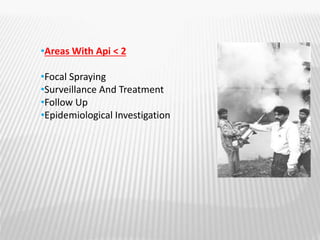
•Areas With Api < 2
•Focal Spraying
•Surveillance And Treatment
•Follow Up
•Epidemiological Investigation
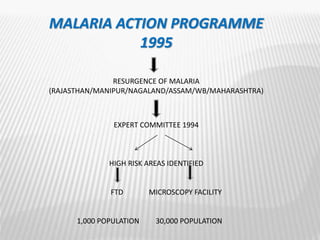
MALARIA ACTION PROGRAMME
1995
RESURGENCE OF MALARIA
(RAJASTHAN/MANIPUR/NAGALAND/ASSAM/WB/MAHARASHTRA)
EXPERT COMMITTEE 1994
HIGH RISK AREAS IDENTIFIED
FTD MICROSCOPY FACILITY
1,000 POPULATION 30,000 POPULATION
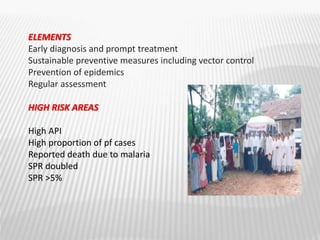
ELEMENTS
Early diagnosis and prompt treatment
Sustainable preventive measures including vector control
Prevention of epidemics
Regular assessment
HIGH RISK AREAS
High API
High proportion of pf cases
Reported death due to malaria
SPR doubled
SPR >5%
ENHANCED MALARIA CONTROL PROJECT 1997
•With World Bank Assistance
•1997-2003, Extn To 2005
Objectives
Effective control of malaria
Bring down malaria morbidity
Prevention of death due to malaria
Consolidation of gain achieved so far
Selection Of Phc-criteria
API>2 for last 3 yrs
P. Falciparum >30% of cases
25% tribal population
Death due to malaria
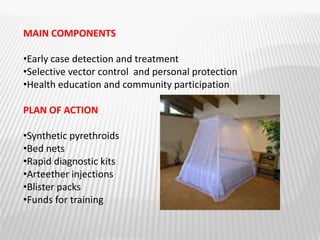
MAIN COMPONENTS
•Early case detection and treatment
•Selective vector control and personal protection
•Health education and community participation
PLAN OF ACTION
•Synthetic pyrethroids
•Bed nets
•Rapid diagnostic kits
•Arteether injections
•Blister packs
•Funds for training
NATIONAL ANTI-MALARIA PROGRAMME 1999
OBJECTIVES
•Reduce malaria morbidity and mortality by 50%
•TARGETS AND INDICATORS
•ABER>10%
•API 1.3 or less
•25% reduction in morbidity and mortality by 2010
•50% reduction in morbidity and mortality by 2012
NATIONAL VECTOR BORNE DISEASE CONTROL
PROGRAMME
•Launched in year 2003-04
•Major vector borne diseases-
•Malaria
•Filaria
•Kala-azar
•Japanese Encephalitis
•Dengue / Dengue Hemorrhagic fevers
•Chikungunya
Integrated accelerated action towards
•Reducing mortality on account of Malaria, Dengue and JE by half
INTENSIFIED MALARIA CONTROL PROJECT
Launched in July 2005 with assistance of global fund for AIDS,TB and
malaria in NE states,Odisha,Jharkhand and WB.
OBJECTIVES:
1-Increase access rapid diagnosis and treatment through community
participation
2-Reduce transmission by used of insecticide treated bednets and
larvivorous fish
3-Enhance awareness about malaria control
4-To promote community,NGO,private sector participation
• Indoor residual spraying or IRS is the process of spraying the inside of
dwellings with an insecticide to kill mosquitoes that spread malaria.
• The main purpose of IRS is to reduce transmission by reducing the
survival of malaria vectors entering houses or sleeping units.
Effectiveness of IRS depends on:
• Target area
• Selection of Insecticides
• Change of Insecticide
• Insecticide formulations used under NVBDCP
1. DDT( Dichloro-diphenyl-trichloroethane)
2. Organophosphorus (OP) compounds
3. Synthetic Pyrethroids
• An insecticide-treated net is a mosquito net that repels,
disables and/or kills mosquitoes coming into contact with
insecticide on the netting material. There are two
categories of ITNs:
• • A conventionally treated net is a mosquito net that
has been treated by dipping in a WHO-recommended
insecticide.
• • A long-lasting insecticidal net is a factory-treated
mosquito net made with netting material that has
insecticide incorporated within or bound around the
fibres.
• Specific Objectives: Reduce human contact, reduce morbidity,
prevent deaths, promote community participation, modalities for
social marketing through public-private partnership.
• Synthetic Pyrethroids mainly two Deltamethrin(2.5%) at a
dosage of 25mg/m2 and cyfluthrin (5%) at 50mg/m2.
• Environmental control: Good water management practices are
best. Could be Temporary and Permanent.
• Biological control: Fishes, Insects, Protozoans, Arthropods,
Bacteria, Fungi & viruses.
• Genetic control: Genetic Engineering like Transgenic Mosquito.
• Chemical control: Given high priority in Operational Measures.
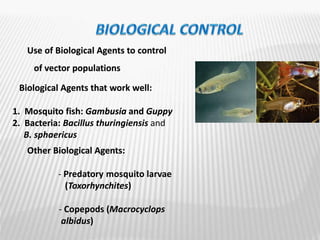
Biological Agents that work well:
1. Mosquito fish: Gambusia and Guppy
2. Bacteria: Bacillus thuringiensis and
B. sphaericus
Other Biological Agents:
- Predatory mosquito larvae
(Toxorhynchites)
- Copepods (Macrocyclops
albidus)
Use of Biological Agents to control
of vector populations
INTEGRATION UNDER NRHM
At Village Level
Monthly meetings of Village Health & Sanitation Committee serve
as a platform for health education and counseling of community.
Involvement of ASHA as-
Surveillance worker to inform any increase in fever cases including
Dengue/ Chikungunya and J.E.
FTD for early detection of suspected malaria cases and treatment.
Linkage between ANC services and prevention & treatment of
malaria.
Organizer, motivator and trainer in village level meetings/training
workshops.
MDG 6 : COMBAT HIV/AIDS, MALARIA AND
OTHER DISEASES
Target 6c: Halt and begin to reverse the incidence of
malaria and other major diseases
6.6 Incidence and death rates associated with malaria
6.7 Proportion of children under 5 sleeping under
insecticide-treated bed nets
6.8 Proportion of children under 5 with fever who are
treated with appropriate anti-malarial drugs
• Integrated Disease Surveillance Project(IDSP) - The
Project with weekly fever alerts is increasingly providing
early warning signals on malaria outbreaks.
• Other Vector borne diseases - Dengue & malaria control
activities overlap in many Urban areas, Malaria & kala-azar
in few districts of Jharkhand.
• Reproductive and Child Health - ANC services utilized in
distribution of LLINs to pregnant women.
• Global Fund for AIDS, TB & Malaria(GFATM) supported
Intensified Malaria Control Project(IMCP):
• It was for a period of 5years from July 2005 to June 2010.
Implemented in 106 districts in 10 states.
• It helped to achieve 23.4% decline in Malaria Incidence.
• IMCP-II has been initiated for a period of five years (2010-
2015).
• Approved for 5years(March 2009-Dec 2012). Total
financial outlay Rs.1000 Crore.
• Being implemented in 93 malarious districts of eight
states including Andhra Pradesh.
• Provides additional Support for procuring ACT, LLIN’s,
Provision of additional manpower.
ROLL BACK MALARIA
• RBM is a global partnership founded in 1998 by (WHO), (UNDP),
(UNICEF) and the World Bank with the goal of halving the
world's malaria burden by 2010.
• It forges consensus among key actors in malaria control,
harmonises action and mobilises resources to fight malaria in
endemic countries and to improve and support capacity to scale
up action against malaria.
• RBM's four pillars of action
ROLL BACK MALARIA is promoting four main strategies
to pursue its goal of halving the world's burden of
malaria by 2010. The strategies are evidence-based
• Prompt access to treatment
• Insecticide-treated mosquito nets (ITNs)
• Prevention and control of malaria in pregnant women
• Malaria epidemic and emergency response
Vaccines developed are basically of three types:
• Pre-erythrocytic stage vaccine
• Blood stage vaccine and
• Transmission blocking vaccine
• SPf-66—1st malaria vaccine that was tried in clinical trials in 1990s.
• RTS,S - Most successful vaccine candidate.
• On July 25th 2015 World's first malaria vaccine got a green light from
European drugs regulators who recommended it should be licensed for
use in babies in Africa at risk of the mosquito-borne disease.
• The shot, called RTS,S or Mosquirix developed by British drugmaker
GlaxoSmithKline in partnership with the PATH Malaria Vaccine Initiative,
would be the first licensed human vaccine against a parasitic disease.
REFERENCES
• AH Suryakant. Community medicine with recent advances. 3rd ed. New
Delhi:Jaypee;2014.
• J.Kishore. National health programs of India. 11th ed. New Delhi:Century
publications;2014.
• K.PARK. Textbook of preventive and social medicine. 23rd ed.
Jabalpur:Banarsidas Bhanot;2015.
• National Drug Policy for Malaria 2010, NVBDCP, MoH&FW, Govt. of India, 2010.
• Operation Manual for Malaria Control for District level Officers. NVBDCP,
2008.
• Website of National Vector Borne Disease Control Programme
http://www.nvbdcp.gov.in/malaria-new.html .
• World Health Organization (2006). WHO Guidelines for the Treatment of
Malaria. Geneva World Health Organization .
• Center for Disease Control and Prevention. How to Reduce Malaria’s
Impact. Center for Disease Control and Prevention.
http://www.cdc.gov/malaria/ malaria_worldwide/reduction/index.html
THANK YOU

Malaria

  • 1.
    EPIDEMIOLOGY, PREVENTION AND CONTROL- MALARIA Speaker Swati Singh
  • 2.
    CONTENTS • Introduction • Problemstatement • Epidemiology • Lifecycle • Prevention • Clinical presentation • Diagnosis and treatment • Milestones • Roll back malaria • Malaria vaccine • References
  • 3.
    • The termmalaria originates from Italian: mala aria — "bad air“ in 18th century. • Formerly called ague or marsh fever due to its association with swamps and marshland. • In 1897, Ronald Ross established the life cycle of plasmodium and identified that infection was transmitted by Anopheles.
  • 4.
    PROBLEM STATEMENT • 198million cases of malaria occurred globally in 2013 (uncertainty range 124–283 million) and the disease led to 5,84,000 deaths. • Roughly half the world’s population (3.3 billion people) is at risk of malaria. About 90% of deaths from malaria occur in Africa. • Global estimated malaria case incidence rates fell by 30% between 2000 and 2013, while estimated mortality rates fell by 47%. • Thirty-five countries (30 in sub-Saharan Africa and 5 in Asia) account for 98% of global malaria deaths. In Africa, malaria is the second leading cause of death from infectious disease, after HIV/ AIDS. • 7% of under 5 mortality (cerebral malaria & anaemia).
  • 6.
    INDIA • 95 %malaria prone area • 1.5 – 2 million cases annually. • The incidence of malaria in India accounted for 58% of cases in the South East Asia Region of WHO. • In 2014, there were 1.07 cases of malaria in million, 0.70 cases of plasmodium falciparum in million and 535 deaths due to malaria. • 21.98% - high transmission areas. (High transmission >1 case/ 1000 popln) • 92% of cases & 97% of death – north-eastern states, Chhattisgarh, Jharkhand, M.P, Gujarat, Orissa, A.P, W.P, Karnatka. • API has declined from 3.29 (1995) to o.85 (2012)
  • 7.
    VECTORS:  LIFE SPAN:10- 12 days  CHOICE OF HOST : anthrophilic species  RESTING HABITS : endophily, exophily  BREEDING HABITS: moving water, wells, fountain, garden pools (clean water)  TIME OF BITING : night time An. culicifacies- rural , periurban An. fluviatilis- forest, hilly area An. stephensi – urban, industrial An. minimus – foot hills An. philippinensis An. sundaicus
  • 8.
  • 10.
    LIFE CYCLE OFMALARIA PARASITE
  • 11.
    MODE OF TRANSMISSION •Malaria is caused by a type of microscopic parasite that's transmitted most commonly by mosquito bites. • Other transmission: • From mother to unborn child • Through blood transfusions • By sharing needles used to inject drugs
  • 12.
    CLINICAL PRESENTATION • Earlysymptoms • Headache • Malaise • Fatigue • Nausea • Muscular pains • Slight diarrhea • Slight fever, usually not intermittent  Acute febrile illness, may have periodic febrile paroxysms every 48 – 72 hours with afebrile asymptomatic intervals.  Tendency to recrudesce or relapse over months to years.  Anemia, thrombocytopenia, jaundice, hepatosplenomegaly, respiratory distress syndrome, renal dysfunction, hypoglycemia, mental status changes, tropical splenomegaly syndrome, cerebral malaria.
  • 13.
    MALARIAL PAROXYSM • Canget prodrome 2-3 days before • Malaise, fever, fatigue, muscle pains, nausea, anorexia. • Can mistake for influenza or gastrointestinal infection. • Slight fever may worsen just prior to paroxysm. • Paroxysm • Cold stage - rigors • Hot stage – Max temp can reach 40-41o C, splenomegaly easily palpable • Sweating stage - Lasts 2-4 hours, start between midnight and midday  Periodicity  Days 1 and 3 for P.v., P.o., (and P.f.) - tertian  Usually persistent fever or daily paroxyms for P.f.  Days 1 and 4 for P.m. - quartian
  • 14.
    Disease Severity andDuration vivax ovale malariae falciparum Initial Paraoxysm Severity moderate to severe mild moderate to severe severe Average Parasitemia (mm3) 20,000 9,000 6,000 50,000- 500,000 Symptom Duration (untreated) 3-8weeks 2-3 weeks 3-24 weeks 2-3 weeks Maximum Infection Duration (untreated) 5-8 years 12-20 months 20-50 years 6-17 months Anemia ++ + ++ ++++ Complications renal cerebral
  • 15.
    MALARIAL INDICES • ABER= No. of blood smears examined during the year x 100 Population covered under surveillance • API = Confirmed cases of malaria during one year x 1000 Population covered under surveillance • SPR= No of blood smears found positive for malaria parasite x 100 No. of blood smear examined
  • 16.
    DIAGNOSIS • Malaria diagnosisis carried out by microscopic examination of blood films collected by active and passive agencies. • Health agencies and volunteers treating fever cases in inaccessible areas are being provided with Rapid Diagnostic Test (RDT) kits (Pf specific so far and now Bivalent RDT) for diagnosis of Malaria cases so as to provide full radical treatment to the confirmed cases. • The malarial fluorescent antibody test becomes positive two weeks or more after primary infection.
  • 17.
  • 18.
    Where Microscopy ResultIs Not Available Within 24 Hours And Monovalent RDT Is Used
  • 20.
    • Treatment duringpregnancy : • 1st Trimester : Quinine salt 10mg/kg 3 times daily for 7 days • 2nd and 3rd trimester: Area-specific ACT as per dosage schedule given above. i.e. ACT-AL in North Eastern States ACT-SP in Other States
  • 22.
    CHEMOPROPHYLAXIS • Short termchemoprophylaxis (up to 6 weeks) Doxycycline : 100 mg once daily for adults and 1.5 mg/kg once daily for children(contraindicated in children below 8 years). The drug should be started 2 days before travel and continued for 4 weeks after leaving the malarious area. • Chemoprophylaxis for longer stay (more than 6 weeks) Mefloqiune: 250 mg weekly for adults and should be administered two weeks before, during and four weeks after exposure.
  • 23.
    MILESTONES  Sir BhoreCommittee Report 1946  National Malaria Control Program 1953  National Malaria Eradication Program 1958  Urban Malaria Scheme 1971  Modified Plan Of Operation 1977  Malaria Action Program 1995  Enhanced Malaria Control Program 1977  National Anti Malaria Program 1999  National Health Policy 2002  National Vector Borne Disease Cont Program 2004  Intensified Malaria Control Project 2005  National Rural Health Mission 2005
  • 24.
    NATIONAL MALARIA CONTROL PROGRAMME1953 OBJECTIVES • To bring down malaria transmission • To hold down malaria transmission at low level STRATEGIES •INDOOR RESIDUAL SPRAY •TREATMENT OF PATIENTS REPORTING TO HEALTH ACHIEVEMENT •Decline in incidence from 75 million to only 2 million in 1958
  • 25.
    NATIONAL MALARIA ERADICATION PROGRAMME1958 OBJECTIVE To eradicate malaria from India in 7 to 9 years ACTIVITIES Spraying operation Fortnightly active case detection Radical treatment Investigation of positive cases and remedial measures ACHIEVEMENTS Lowest ever incidence of 0.1 million in 1965 No reported deaths due to malaria
  • 26.
    URBAN MALARIA SCHEME1971 In 139 towns in 19 states and union territories. OBJECTIVES a) To prevent deaths due to malaria. b) Reduction in transmission and morbidity. NORMS The towns should have a minimum population of 50,000. The API should be 2 or above. The towns should strictly implement the civic by-laws to prevent/eliminate domestic and peri-domestic breeding places.
  • 27.
    Control Strategies underUrban Malaria Scheme: -Parasite control -Vector control Parasite control: Treatment is done through passive agencies viz. hospitals, dispensaries both in private & public sectors and private practitioners. In mega cities malaria clinics are established by each health sector/ malaria control agencies viz. Municipal Corporations, Railways, Defence services Vector control comprises of the following components Source reduction Use of larvicides Use of larvivorous fish Space spray Minor engineering Legislative measure Aerosol Space Spray Space spraying of pyrethrum extract (2%) in 50 houses in and around every malaria and dengue positive cases to kill the infective mosquitoes is recommended. Town –biologist State-additional director (malaria/filaria) Central level-director NVBDCP
  • 28.
    •Re-classification Of EndemicAreas •Based On Annual Parasite Incidence • API Less Than 2 API Greater Than 2 •Areas With API > 2 •Spraying •Entomological Assessment •Surveillance •Treatment Of Cases •Decentralization Of Laboratory Services At-phc •Establishment Of Ddcs And Ftds MODIFIED PLAN OF OPERATION 1977 OBJECTIVES •Prevention Of Death Due To Malaria •Reduction Of Morbidity Due To Malaria •Retention Of Achievements Gained So Far
  • 29.
    •Areas With Api< 2 •Focal Spraying •Surveillance And Treatment •Follow Up •Epidemiological Investigation
  • 30.
    MALARIA ACTION PROGRAMME 1995 RESURGENCEOF MALARIA (RAJASTHAN/MANIPUR/NAGALAND/ASSAM/WB/MAHARASHTRA) EXPERT COMMITTEE 1994 HIGH RISK AREAS IDENTIFIED FTD MICROSCOPY FACILITY 1,000 POPULATION 30,000 POPULATION
  • 31.
    ELEMENTS Early diagnosis andprompt treatment Sustainable preventive measures including vector control Prevention of epidemics Regular assessment HIGH RISK AREAS High API High proportion of pf cases Reported death due to malaria SPR doubled SPR >5%
  • 32.
    ENHANCED MALARIA CONTROLPROJECT 1997 •With World Bank Assistance •1997-2003, Extn To 2005 Objectives Effective control of malaria Bring down malaria morbidity Prevention of death due to malaria Consolidation of gain achieved so far Selection Of Phc-criteria API>2 for last 3 yrs P. Falciparum >30% of cases 25% tribal population Death due to malaria
  • 33.
    MAIN COMPONENTS •Early casedetection and treatment •Selective vector control and personal protection •Health education and community participation PLAN OF ACTION •Synthetic pyrethroids •Bed nets •Rapid diagnostic kits •Arteether injections •Blister packs •Funds for training
  • 34.
    NATIONAL ANTI-MALARIA PROGRAMME1999 OBJECTIVES •Reduce malaria morbidity and mortality by 50% •TARGETS AND INDICATORS •ABER>10% •API 1.3 or less •25% reduction in morbidity and mortality by 2010 •50% reduction in morbidity and mortality by 2012
  • 35.
    NATIONAL VECTOR BORNEDISEASE CONTROL PROGRAMME •Launched in year 2003-04 •Major vector borne diseases- •Malaria •Filaria •Kala-azar •Japanese Encephalitis •Dengue / Dengue Hemorrhagic fevers •Chikungunya Integrated accelerated action towards •Reducing mortality on account of Malaria, Dengue and JE by half
  • 38.
    INTENSIFIED MALARIA CONTROLPROJECT Launched in July 2005 with assistance of global fund for AIDS,TB and malaria in NE states,Odisha,Jharkhand and WB. OBJECTIVES: 1-Increase access rapid diagnosis and treatment through community participation 2-Reduce transmission by used of insecticide treated bednets and larvivorous fish 3-Enhance awareness about malaria control 4-To promote community,NGO,private sector participation
  • 40.
    • Indoor residualspraying or IRS is the process of spraying the inside of dwellings with an insecticide to kill mosquitoes that spread malaria. • The main purpose of IRS is to reduce transmission by reducing the survival of malaria vectors entering houses or sleeping units. Effectiveness of IRS depends on: • Target area • Selection of Insecticides • Change of Insecticide • Insecticide formulations used under NVBDCP 1. DDT( Dichloro-diphenyl-trichloroethane) 2. Organophosphorus (OP) compounds 3. Synthetic Pyrethroids
  • 41.
    • An insecticide-treatednet is a mosquito net that repels, disables and/or kills mosquitoes coming into contact with insecticide on the netting material. There are two categories of ITNs: • • A conventionally treated net is a mosquito net that has been treated by dipping in a WHO-recommended insecticide. • • A long-lasting insecticidal net is a factory-treated mosquito net made with netting material that has insecticide incorporated within or bound around the fibres.
  • 42.
    • Specific Objectives:Reduce human contact, reduce morbidity, prevent deaths, promote community participation, modalities for social marketing through public-private partnership. • Synthetic Pyrethroids mainly two Deltamethrin(2.5%) at a dosage of 25mg/m2 and cyfluthrin (5%) at 50mg/m2.
  • 43.
    • Environmental control:Good water management practices are best. Could be Temporary and Permanent. • Biological control: Fishes, Insects, Protozoans, Arthropods, Bacteria, Fungi & viruses. • Genetic control: Genetic Engineering like Transgenic Mosquito. • Chemical control: Given high priority in Operational Measures.
  • 44.
    Biological Agents thatwork well: 1. Mosquito fish: Gambusia and Guppy 2. Bacteria: Bacillus thuringiensis and B. sphaericus Other Biological Agents: - Predatory mosquito larvae (Toxorhynchites) - Copepods (Macrocyclops albidus) Use of Biological Agents to control of vector populations
  • 45.
    INTEGRATION UNDER NRHM AtVillage Level Monthly meetings of Village Health & Sanitation Committee serve as a platform for health education and counseling of community. Involvement of ASHA as- Surveillance worker to inform any increase in fever cases including Dengue/ Chikungunya and J.E. FTD for early detection of suspected malaria cases and treatment. Linkage between ANC services and prevention & treatment of malaria. Organizer, motivator and trainer in village level meetings/training workshops.
  • 46.
    MDG 6 :COMBAT HIV/AIDS, MALARIA AND OTHER DISEASES Target 6c: Halt and begin to reverse the incidence of malaria and other major diseases 6.6 Incidence and death rates associated with malaria 6.7 Proportion of children under 5 sleeping under insecticide-treated bed nets 6.8 Proportion of children under 5 with fever who are treated with appropriate anti-malarial drugs
  • 47.
    • Integrated DiseaseSurveillance Project(IDSP) - The Project with weekly fever alerts is increasingly providing early warning signals on malaria outbreaks. • Other Vector borne diseases - Dengue & malaria control activities overlap in many Urban areas, Malaria & kala-azar in few districts of Jharkhand. • Reproductive and Child Health - ANC services utilized in distribution of LLINs to pregnant women.
  • 48.
    • Global Fundfor AIDS, TB & Malaria(GFATM) supported Intensified Malaria Control Project(IMCP): • It was for a period of 5years from July 2005 to June 2010. Implemented in 106 districts in 10 states. • It helped to achieve 23.4% decline in Malaria Incidence. • IMCP-II has been initiated for a period of five years (2010- 2015).
  • 49.
    • Approved for5years(March 2009-Dec 2012). Total financial outlay Rs.1000 Crore. • Being implemented in 93 malarious districts of eight states including Andhra Pradesh. • Provides additional Support for procuring ACT, LLIN’s, Provision of additional manpower.
  • 50.
    ROLL BACK MALARIA •RBM is a global partnership founded in 1998 by (WHO), (UNDP), (UNICEF) and the World Bank with the goal of halving the world's malaria burden by 2010. • It forges consensus among key actors in malaria control, harmonises action and mobilises resources to fight malaria in endemic countries and to improve and support capacity to scale up action against malaria.
  • 51.
    • RBM's fourpillars of action ROLL BACK MALARIA is promoting four main strategies to pursue its goal of halving the world's burden of malaria by 2010. The strategies are evidence-based • Prompt access to treatment • Insecticide-treated mosquito nets (ITNs) • Prevention and control of malaria in pregnant women • Malaria epidemic and emergency response
  • 52.
    Vaccines developed arebasically of three types: • Pre-erythrocytic stage vaccine • Blood stage vaccine and • Transmission blocking vaccine • SPf-66—1st malaria vaccine that was tried in clinical trials in 1990s. • RTS,S - Most successful vaccine candidate. • On July 25th 2015 World's first malaria vaccine got a green light from European drugs regulators who recommended it should be licensed for use in babies in Africa at risk of the mosquito-borne disease. • The shot, called RTS,S or Mosquirix developed by British drugmaker GlaxoSmithKline in partnership with the PATH Malaria Vaccine Initiative, would be the first licensed human vaccine against a parasitic disease.
  • 53.
    REFERENCES • AH Suryakant.Community medicine with recent advances. 3rd ed. New Delhi:Jaypee;2014. • J.Kishore. National health programs of India. 11th ed. New Delhi:Century publications;2014. • K.PARK. Textbook of preventive and social medicine. 23rd ed. Jabalpur:Banarsidas Bhanot;2015. • National Drug Policy for Malaria 2010, NVBDCP, MoH&FW, Govt. of India, 2010. • Operation Manual for Malaria Control for District level Officers. NVBDCP, 2008. • Website of National Vector Borne Disease Control Programme http://www.nvbdcp.gov.in/malaria-new.html . • World Health Organization (2006). WHO Guidelines for the Treatment of Malaria. Geneva World Health Organization . • Center for Disease Control and Prevention. How to Reduce Malaria’s Impact. Center for Disease Control and Prevention. http://www.cdc.gov/malaria/ malaria_worldwide/reduction/index.html
  • 54.