AB.RAJAR.
ASSOCIATE PROFESSOR
Email:drabrajar@gmail.com
LEARNING OBJECTIVES
I. Introduction, Definition.
II. Importance of the Medical Entomology.
III. Vectors and their types.
IV. Arthropod born diseases
V. Classification of arthropods.
VI. Winged insects of public health importance.
VII. Wingless insects and their Public health importance.
VIII.General measures for control of Arthropods.
Email:drabrajar@gmail.com
MEDICAL ENTOMOLOGY
• It is the study of arthropod and their relation to humans
• It is concerned with:
• Biology of arthropods
• Damages caused by arthropods
• Control of arthropod and disease they cause
• Their contribution to public health and individual health.
• It takes equal rank in public health like all other branches:
 Tropical Medicine
 Veterinary medicine
 Preventive Medicine.
Email:drabrajar@gmail.com
MEDICAL IMPORTANCE
a. Arthropods may be responsible for transmitting pathogenic
organisms in man or animals.
b. Arthropods borne disease constitute a major health problem in
developing countries.
c. Arthropods can cause hypersensivity due to bites,strings,scales,hair
etc.
d. Direct invasion of human beings by some arthropods like itch mite
(scabies).
Email:drabrajar@gmail.com
Global Burden
• Vector-borne diseases are 17% of all infectious diseases,700 000
deaths /Year.
• 228 million cases of malaria worldwide, deaths stood at 405 000 in
2018.
• Dengue is the most prevalent viral infection,3.9 billion people in over
129 countries are at risk of contracting dengue,96m symptomatic
cases and 40,000 deaths /year.
• Chikungunya fever, Zika virus fever, Yellow fever, West Nile fever, Japanese
encephalitis, tick-borne encephalitis, Chagas disease, Leishmaniasis and
Schistosomiasis etc
• These all affect hundreds of millions of people worldwide.
Association Between Arthropod and Human Health
• Insect and other arthropods can directly affect healthy Persons by:
I. Transmitting diseases.
II. Annoyance to humans by their bites.
III. Poisonous to humans.
IV. Severe irritations.
Email:drabrajar@gmail.com
VECTORS.
• An Arthropod or any other invertebrate which can carry or transmit a
pathogen from one individual to another or from animal to Humans.
TYPES OF VECTORS.
MECHANICAL VECTORS BIOLOGICAL VECTORS.
When arthropods act only as a
passive carrier of the disease,
agents..
e.g.
Common house fly.
When the pathogens depend on
them for completing their life cycle
within the body of arthropods ..
e.g.
Mosquito.
Email:drabrajar@gmail.com
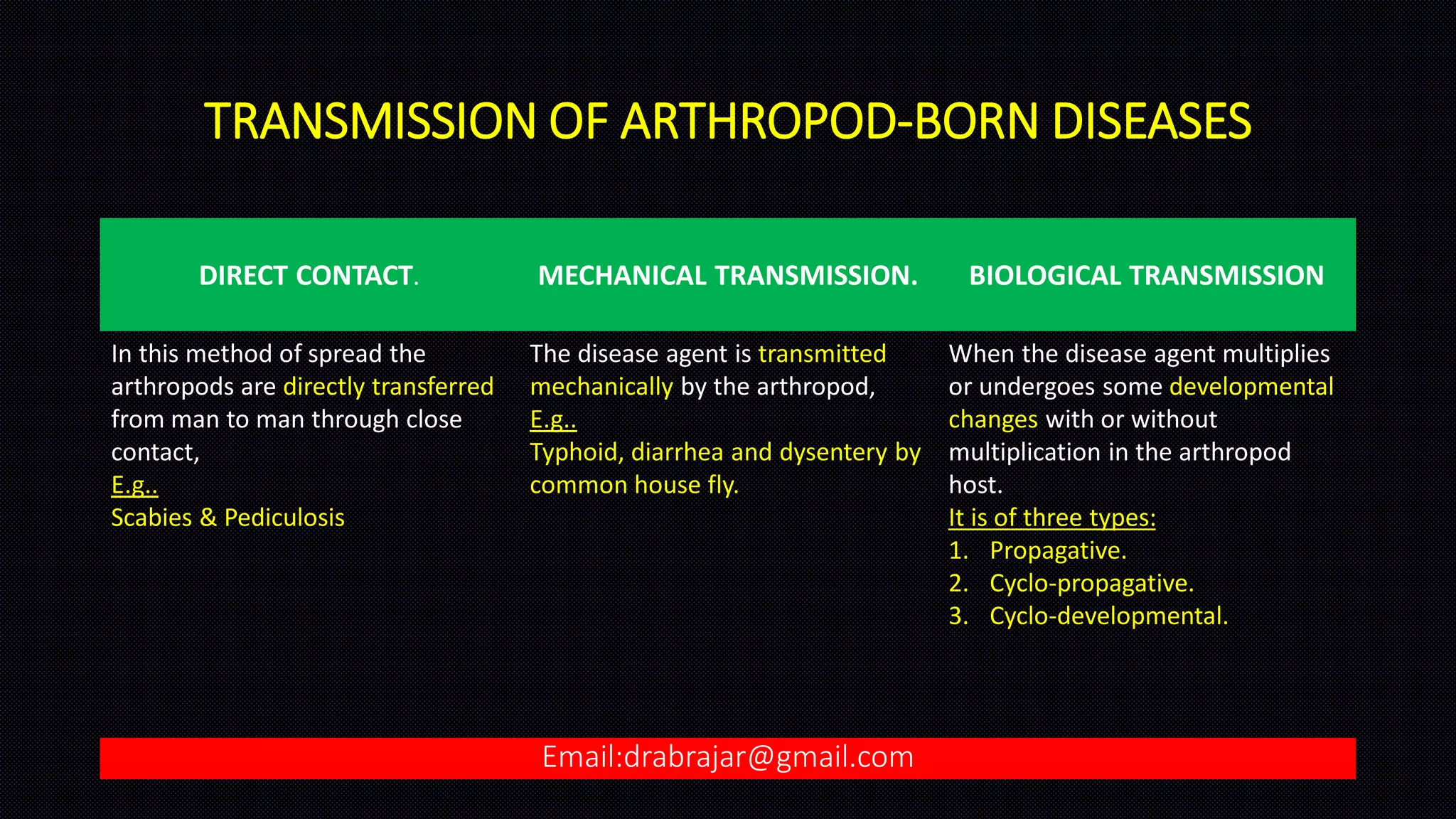
TRANSMISSION OF ARTHROPOD-BORN DISEASES
DIRECT CONTACT. MECHANICAL TRANSMISSION. BIOLOGICAL TRANSMISSION
In this method of spread the
arthropods are directly transferred
from man to man through close
contact,
E.g..
Scabies & Pediculosis
The disease agent is transmitted
mechanically by the arthropod,
E.g..
Typhoid, diarrhea and dysentery by
common house fly.
When the disease agent multiplies
or undergoes some developmental
changes with or without
multiplication in the arthropod
host.
It is of three types:
1. Propagative.
2. Cyclo-propagative.
3. Cyclo-developmental.
Email:drabrajar@gmail.com
BIOLOGICAL TRANSMISSION
 Propagative:
• The disease agent, without any cyclical changes, multiplies in the body of the
vector,e.g,plague bacilli in rat fleas.
 Cyclo-Development:
• There is a cyclical change but no multiplication of disease agent in the body of
the arthropod e.g,Filarial parasite in culex mosquito.
 Cyclo-Propagative:
• There are both the cyclical changes and multiplication of disease agent in the
body of arthropod e.g,malaria parasite in anopheles mosquito.
Email:drabrajar@gmail.com
TRANSMISSION OF ARTHROPOD-BORN DISEASES
 Trans-ovarian/ Trans-stadial transmission:
• It is a type of disease transmission, whereas the causative agent is
transmitted to the immature stage (usually to the egg) from the adult
insects and / or other arthropods which carry disease pathogens.
 E.g. Ticks and sand flies
 Pathogens transferred by arthropods
• – Viruses (arboviruses)
• – Bacteria (also rickettsias)
• – Protozoan parasites
• – Filarial nematode worms
Email:drabrajar@gmail.com
ARTHROPOD-BORN DISEASES
Email:drabrajar@gmail.com
Arthropod Species of Arthropod Disease Transmitted Causative Agent
MOSQUITO
Anopheles
Culex
Aedes.
Mansonia
Anopheles stephensi
Anopheles Culicifacies
Anopheles fluviatilis
Anopheles minimum
Culex fatigans.
Aedes Aegypti
M.Annulifera
Benign tertian malaria.
Mild tertian malaria.
Quartern tertian malaria
Malignant tertian malaria
Filariasis.
Encephalitis.
Yellow fever, Dengue fever
Viral hemorrhagic fever.
Malayan filariasis.
Plasmodium vivax
Plasmodium ovale.
Plasmodium malariae
Plasmodium
falciparum,
Wuchereia Bancroft.
ARBO virus
ARBO virus
Wuchereia Bancroft
Email:drabrajar@gmail.com
ARTHROPOD-BORN DISEASES
Arthropod Species of Arthropod Disease Transmitted Causative Agent
SAND FLY Phlebotomus Papatasii
Phlebotomus Sergenti
Phlebotomus Argentipes
Phlebotomus
Intermedius
Sand fly fever
Tropical sore
Indian kala-Azar
Infantile Kala-Azar
Mucocutaneous
leishmaniasis
ARBO Virus
Lesishmania tropica.
Lesishmania Donovani
Lesishmania infantum
Leishmaina braziliensis
Email:drabrajar@gmail.com
ARTHROPOD-BORN DISEASES
Arthropod Species of Arthropod Disease Transmitted Causative Agent
FLEA
Rat Flea.
Human Flea
Xenopsylla cheopis.
Xenopsylla astia.
Xenopsylla Brazillien
Pulex irritans.
Bubonic plague
Murine typhus
Bubonic plague
Endemic typhus.
Yersenia pestis.
Rickettsia mooseri.
Yersenia pestis.
Email:drabrajar@gmail.com
ARTHROPOD-BORN DISEASES
Arthropod Species of Arthropod Disease Transmitted Causative Agent
LOUCE.
Body louce
Head louce
Pubic louce
Pediculus humanus var
porus
Pediculus humans var
capitus
Pediculus humans var
pubis
Epidemic typhus
Trench fever
Relapsing fever
Vagabond’s disease
Rickesttia Provazaki
Rochalimaea Quintana.
Borrelia recurrentis.
Staphylococcus
Streptococcus.
Email:drabrajar@gmail.com
ARTHROPOD-BORN DISEASES
Arthropod Species of Arthropod Disease Transmitted Causative Agent
House Fly Musca Domestica Cholera
Typhoid,Para Typhoid
Bacillary Dysentery
Diarrhea,Gastoenteritis
Poliomyelitis
infectious Hepatitis
Ameobiasis
Ascariasis
Vibrio cholera
Salmonella Typhyi
Salmonella paratyphi
Shigella Dysentaris
Polio virus 1,2,3
Hepatitis A
E.Histolytica
A-Lumricoides
Email:drabrajar@gmail.com
ARTHROPOD-BORN DISEASES
Arthropod Species of Arthropod Disease Transmitted Causative Agent
TICK
Hard Tick
Soft Tick
Dermacentor
andersoni
Omni Thodorus
Moubata
Rocky mountain spotted
fever.
Encephalitis.
Tick typhus
Viral hemorrhagic fever
Tick paralysis.
Relapsing fever.
Q fever.
Rickettsia rickettsiae
ARBO virus.
Rickettsia conorii
ARBO virus.
Neurotoxin of female tick
Borrelia duttoni.
Email:drabrajar@gmail.com
ARTHROPOD-BORN DISEASES
Arthropod Species of
Arthropod
Disease Transmitted Causative Agent
MITE Sarcoptes scabei
Trombicula
Deliensi
Scabies.
Tsutsugamushi fever
Scrub typhus
Sarcoptes scabei
Rick:Tsutsugamashi
Rickettsia orientalis.
Email:drabrajar@gmail.com
Winged Insects
Wingless Insects
Arthopodods of medical importance are divided into two groups.
CLASSIFICATION OF ARTHROPODS
Email:drabrajar@gmail.com
CLASSIFICATION
Winged Insects.
i. Mosquitoes.
ii. Sand fly.
iii. House fly.
iv. TseTse fly
v. Black Fly
vi. Bee
Wingless Insects.
i. Flea
ii. Louse.
iii. Bed Bug.
iv. Ticks.
v. Mites.
vi. Spiders.
vii. Scorpions.
Email:drabrajar@gmail.com
Winged Insects
Email:drabrajar@gmail.com
MOSQUITOES
• About 2700 species of mosquitoes in the world; among them the
followings three most important genera are responsible to human
health:
A. Anopheles. B. Aedes Egypti C. Culex
Email:drabrajar@gmail.com
TYPES OF MOSQUITOS & THEIR RESIDENCE.
Anopheles
Email:drabrajar@gmail.com
TYPES OF MOSQUITOS & THEIR RESIDENCE.
27
Aedes
Email:drabrajar@gmail.com
ANOPHELES
Email:drabrajar@gmail.com
ANOPHELES
• Malaria is a life-threatening disease caused by parasites that are
transmitted to people through the bites of infected female Anopheles
mosquitoes. It is preventable and curable.
• 228 million cases of malaria worldwide, deaths stood at 405 000 in
2018.
• 67% (272 000) of all malaria deaths were under 5 years globally.
• The WHO African Region carries to 93% of malaria cases and 94% of
malaria deaths.
Email:drabrajar@gmail.com
AEDES AEGPTI
• Aedes aegypti, the yellow fever mosquito, is a mosquito that
can spread yellow fever ,dengue fever, chikungunya, Zika fever, and
other diseases.
• An estimated 390 million dengue infections each year in over 125
countries (CDC).
• The WHO estimates that as many as 4 million people will be infected
with Zika by end of 2016.
• Over 1 million chikungunya infections within 2016.
Email:drabrajar@gmail.com
FILARIASIS
• Lymphatic filariasis impairs the lymphatic system and can lead to the
abnormal enlargement of body parts, causing pain, severe disability
and social stigma.
• In 2000 over 120 m people were infected, with about 40 m disfigured
by the disease
• 893 m people in 49 countries worldwide remain threatened by
lymphatic filariasis.
Email:drabrajar@gmail.com
CONTROL MEASURE FOR MOSQUITOS.
• A. Personal Prophylactic Measures that individuals/communities
can take up:
1. Use of mosquito repellent creams, liquids, coils, mats etc.
2. Screening of the houses with wire mesh
3. Use of bed nets treated with insecticide
4. Wearing clothes that cover maximum surface area of body.
B. Environmental Management & Source Reduction Methods
1. Source reduction i.e. filling of the breeding places
2. Proper covering of stored water
Email:drabrajar@gmail.com
VECTOR CONTROL OF MOSQUITOS.
Chemical Control:
1. Use of Indoor Residual Spray (IRS) with insecticides recommended under the
program
2. Use of chemical larvicides like Abate in potable water
3. Aerosol space spray during day time
4. Malathion fogging during outbreaks
Biological Control:
1) Use of larvivorous fish in ornamental tanks, fountains etc.
2) Use of biocides
Email:drabrajar@gmail.com
SAND FLY [PHLEBOTOMUS]
Email:drabrajar@gmail.com
SAND FLY
• Sandflies are a group of flies, many of which feed on blood and
are vectors of parasites.
• Parasitic diseases spread by the flies include:
• Leishmaniasis Bartonellosis Pappataci fever.
Email:drabrajar@gmail.com
Black Fly [Simulium damnosum]
Email:drabrajar@gmail.com
SIMULIUM DAMNOSUM (BLACK FLY)
• Vector of river blindness
(onchocerciasis).
• Caused by infection with the
parasitic worm Onchocerca
volvulus.
• It is the second-most common
cause of blindness due to
infection, after trachoma.
Email:drabrajar@gmail.com
TSE TSE FLY
Email:drabrajar@gmail.com
TSE TSE FLY (GLOSSINA SPP)
• Vector of African sleeping sickness.
• Also called "human African trypanosomiasis", is a widespread tropical
disease that can be fatal if not treated.
• It is spread by the bite of an infected tsetse fly (Glossina Genus).
Email:drabrajar@gmail.com
HOUSE FLY (MUSCA DOMESTICA)
Email:drabrajar@gmail.com
HOUSE FLY (MUSCA DOMESTICA)
• Mechanical transmission of
many diseases:
i. Bacteria,
ii. Viruses
iii. Parasites,
iv. Protozoa,
v. Helminthes
Email:drabrajar@gmail.com
BEES
BEE STINGS
• Venoms of bees are a mixture of
enzymes and several polypeptides
some of which are pharmacologically
active e.g. histamine or neurotoxic.
• Some people are hypersensitive to
venoms and suffer anaphylactic
reaction , death might result in 1 hour.
Email:drabrajar@gmail.com
Wingless Insects
Email:drabrajar@gmail.com
WINGLESS INSECTS
I. Flea
II. Louse.
III. Bed Bug.
IV. Ticks.
V. Mites.
VI. Spiders.
VII. Scorpions
Email:drabrajar@gmail.com
RAT FLEA
•IDENTIFICATION FEATURES
Bilaterally compressed body
Body covered with bristles
Body Head
•Thorax
•Abdomen
Head bears piercing mouth parts
Thorax – 3 pairs of strong legs
Email:drabrajar@gmail.com
FLEA
Habits
Both male female suck blood
Cant fly hops only.
•Disease transmitted
Bubonic plague Endemic typhus Chiggerosis
Email:drabrajar@gmail.com
CONTROL MEASURES
 INSECTICIDES-
• DDT dust
• Diazinon spray
• Malathion spray
 REPELLENT
• Diethyl toluamide
 Rodent control.
Email:drabrajar@gmail.com
LICE/LOUSE
• Types:
1. Head louse (Pediculus Capitis)
2. Body louse (Pediculus Corporis)
3. Pubic or crab louse ( Phthirus pubis)
Email:drabrajar@gmail.com
LOUSE/LICE BORN DISEASES
• Epidemic typhus • Relapsing Fever • Trench Fever • Dermatitis
Email:drabrajar@gmail.com
CONTROL MEASURES
• INSECTICIDAL CONTROL
0.5% MALATHION lotion
• PERSONAL HYGIENE.
Daily bathing Frequent hair wash No sharing of combs
Email:drabrajar@gmail.com
TICKS
Hard Tick Soft Tick
Email:drabrajar@gmail.com
Diseases Transmitted by Tics
I. Tick – born typhus fever.
II. Relapsing fever.
III. Hemorrhagic fever as Crimean fever caused by Congo virus.
Email:drabrajar@gmail.com
MITES
• The species of mites of medical importance are:
A. TROMBICULA DELIENSI
B. SARCOPTES SCABIES [ ITCH MITE ].
Email:drabrajar@gmail.com
TROMBICULA DELIENSI
• Spider like arthropod
• Vectors of scrub typhus in Asia
and south pacific
• Diseases Transmitted:
• Scrub Typhus.
SARCOPTES SCABIES [ ITCH MITE ]
• Itch mite, causes scabies in human and mange in animals.
• World prevalence is 300 million cases per year.
• Infection acquired by direct contact:
 of infected persons or clothes, infested with mites.
 Female burrows in epidermis and deposit eggs.
 Eggs hatch in 3-4 days,larve excavate new burrows, mature in 4days.
DISEASE TRANSMITTED
Causes SCABIES; first disease of mankind with known cause.
Scabies leads to dermatitis due to secondary infections.
•PARTS AFFECTED
1. Hands and wrist
2. Extensor aspects of elbows
3. Axillae
4. Buttocks
5. Lower abdomen etc
Email:drabrajar@gmail.com
CONTROL MEASURES
All the family members must be treated simultaneously.
Before application of Sarcopticides thorough scrub with soap
and hot water.
Sarcopticides used:
 Benzyl benzoate 25% in water.
 Gamma Hexachlorocyclohexane
 Tetmosol solution 25%
 Sulphur ointment 10-25%.
Ⅰ-Defensive Measures
Ⅱ-Offensive Measures
Arthropods can be controlled two ways.
METHODS OF CONTROL OF ARTHROPODS
Email:drabrajar@gmail.com
DEFENSIVE MEASURES
 Defensive measures are applied where arthropods can not be
destroyed satisfactorily:
I. Protective clothing.
II. Protective shoes
III. Use of mosquito nets.
IV. Screening doors and windows
V. Use of repellents
VI. Chemoprophylaxis.
Email:drabrajar@gmail.com
OFFENSIVE MEASURES
 The aim of offensive measures is to break the vector link the “chain
of infection. "by 3 ways:
A. CONTROL BY NATURAL METHODS
B. CONTROL BY MECHANICAL METHODS
C. CONTROL BY CHEMICAL METHODS
D. CONTROL BY BIOLOGICAL METHODS
Email:drabrajar@gmail.com
A-CONTROL BY NATURAL METHODS
• Need detailed knowledge about arthropod’s:
• Morphology, habitat, life-history and ecology
• Mainly achieved by Eliminate their breeding places:
• Water supply:
• With no leakage, wastage & collection will discourage the in the
locality, thus encourage the fecal disposable, removal of garbage &
waste from the houses and factories etc.
• Engineering Measures:
• Leveling, filling and drainage of breeding places.
• This will eliminate the breeding place of house flies,mosquitos,rodents and other insects
of medical importance
Email:drabrajar@gmail.com
B-CONTROL BY MECHANICAL/ELECTRICAL METHODS
 This can be achieved by mechanical /Electrical devices to kill the
arthropods:
• Methods includes:
 Hand catching of mosquito with a net.
 Destroying the house flies by fly traps or fly paper
 Hand picking of ticks, mites and body louce etc.
Email:drabrajar@gmail.com
C-CONTROL BY CHEMICAL METHODS
 Best method amongst 3,used to destroy and eliminate almost all
medically important arthropods.
 The chemicals used are known as,”Insecticides”,can be classified as:
A. Contact Poisons
B. Chemical acting via GIT or Stomach Poison.
C. Chemical acting via Respiratory tracts or Fumigants.
Email:drabrajar@gmail.com
A-CONTACT POISONS
• The surface poisons are persistent and long acting very useful as they
kill most of the insects.
• Pyrethrum:
• It is effective against common household pests with a rapid lysing action.
• It is harmless to man domestic animals when used with care.
• Dichlorodiphenyltrichloroethane [DDT]:
• It is primarily a contact poison, acts on nervous system of insects.
Email:drabrajar@gmail.com
B-Chemical acting via GIT or Stomach Poison.
• STOMACH POISONS have little use in the control because most of the
insects have pricing and sucking mouth parts.
• Paris Green:
• Used as anopheles larvicide.
• Organophosphorus Compounds:
• They act by inhibiting cholinesterase, the enzyme which catalyze the
degradation of acetyl choline in the synapses of striated muscles.
• Examples:
• Malathion,Fenithion,Chlorithion,Diazinon & Parathion etc.
Email:drabrajar@gmail.com
C-Chemical acting via respiratory tracts or Fumigants.
• Fumigation is the process of killing arthropods by gaseous agents.
• Hydro-cyanic acid (HCN):
• Very effective used in powder form as calcium or sodium cyanide.
• Sulpher dioxide gas:
• Cheap easily available, kills the insects in house but has adverse effects on
metals & fabrics.
• Carbon Disulphide:
• Destroy insects in clothings,furniture, burrows in the ground & in wood.
• Carbon Tetrachloride & Organophosphorus compounds are used as
residual spray.
Email:drabrajar@gmail.com
D-CONTROL BY BIOLOGICAL METHODS
Biological Control:
1) A wide range of small fish feed readily on mosquito larvae.
2) The best known are the Gambusia Affinis and Lobister reticularis
3) Use of larvivorous fish in ponds,burrows,pits,ornamental tanks, fountains
for larvae control.
4) BIOCIDES: Chemical substance or microorganism intended to destroy,
deter, render harmless or exert a controlling effect on any harmful
organism by Chemical or Natural means.
Email:drabrajar@gmail.com

Medical entomology Lecture

  • 1.
  • 2.
    LEARNING OBJECTIVES I. Introduction,Definition. II. Importance of the Medical Entomology. III. Vectors and their types. IV. Arthropod born diseases V. Classification of arthropods. VI. Winged insects of public health importance. VII. Wingless insects and their Public health importance. VIII.General measures for control of Arthropods. Email:drabrajar@gmail.com
  • 3.
    MEDICAL ENTOMOLOGY • Itis the study of arthropod and their relation to humans • It is concerned with: • Biology of arthropods • Damages caused by arthropods • Control of arthropod and disease they cause • Their contribution to public health and individual health. • It takes equal rank in public health like all other branches:  Tropical Medicine  Veterinary medicine  Preventive Medicine. Email:drabrajar@gmail.com
  • 4.
    MEDICAL IMPORTANCE a. Arthropodsmay be responsible for transmitting pathogenic organisms in man or animals. b. Arthropods borne disease constitute a major health problem in developing countries. c. Arthropods can cause hypersensivity due to bites,strings,scales,hair etc. d. Direct invasion of human beings by some arthropods like itch mite (scabies). Email:drabrajar@gmail.com
  • 5.
    Global Burden • Vector-bornediseases are 17% of all infectious diseases,700 000 deaths /Year. • 228 million cases of malaria worldwide, deaths stood at 405 000 in 2018. • Dengue is the most prevalent viral infection,3.9 billion people in over 129 countries are at risk of contracting dengue,96m symptomatic cases and 40,000 deaths /year. • Chikungunya fever, Zika virus fever, Yellow fever, West Nile fever, Japanese encephalitis, tick-borne encephalitis, Chagas disease, Leishmaniasis and Schistosomiasis etc • These all affect hundreds of millions of people worldwide.
  • 6.
    Association Between Arthropodand Human Health • Insect and other arthropods can directly affect healthy Persons by: I. Transmitting diseases. II. Annoyance to humans by their bites. III. Poisonous to humans. IV. Severe irritations. Email:drabrajar@gmail.com
  • 7.
    VECTORS. • An Arthropodor any other invertebrate which can carry or transmit a pathogen from one individual to another or from animal to Humans. TYPES OF VECTORS. MECHANICAL VECTORS BIOLOGICAL VECTORS. When arthropods act only as a passive carrier of the disease, agents.. e.g. Common house fly. When the pathogens depend on them for completing their life cycle within the body of arthropods .. e.g. Mosquito. Email:drabrajar@gmail.com
  • 8.
    TRANSMISSION OF ARTHROPOD-BORNDISEASES DIRECT CONTACT. MECHANICAL TRANSMISSION. BIOLOGICAL TRANSMISSION In this method of spread the arthropods are directly transferred from man to man through close contact, E.g.. Scabies & Pediculosis The disease agent is transmitted mechanically by the arthropod, E.g.. Typhoid, diarrhea and dysentery by common house fly. When the disease agent multiplies or undergoes some developmental changes with or without multiplication in the arthropod host. It is of three types: 1. Propagative. 2. Cyclo-propagative. 3. Cyclo-developmental. Email:drabrajar@gmail.com
  • 9.
    BIOLOGICAL TRANSMISSION  Propagative: •The disease agent, without any cyclical changes, multiplies in the body of the vector,e.g,plague bacilli in rat fleas.  Cyclo-Development: • There is a cyclical change but no multiplication of disease agent in the body of the arthropod e.g,Filarial parasite in culex mosquito.  Cyclo-Propagative: • There are both the cyclical changes and multiplication of disease agent in the body of arthropod e.g,malaria parasite in anopheles mosquito. Email:drabrajar@gmail.com
  • 10.
    TRANSMISSION OF ARTHROPOD-BORNDISEASES  Trans-ovarian/ Trans-stadial transmission: • It is a type of disease transmission, whereas the causative agent is transmitted to the immature stage (usually to the egg) from the adult insects and / or other arthropods which carry disease pathogens.  E.g. Ticks and sand flies  Pathogens transferred by arthropods • – Viruses (arboviruses) • – Bacteria (also rickettsias) • – Protozoan parasites • – Filarial nematode worms Email:drabrajar@gmail.com
  • 11.
  • 12.
    Arthropod Species ofArthropod Disease Transmitted Causative Agent MOSQUITO Anopheles Culex Aedes. Mansonia Anopheles stephensi Anopheles Culicifacies Anopheles fluviatilis Anopheles minimum Culex fatigans. Aedes Aegypti M.Annulifera Benign tertian malaria. Mild tertian malaria. Quartern tertian malaria Malignant tertian malaria Filariasis. Encephalitis. Yellow fever, Dengue fever Viral hemorrhagic fever. Malayan filariasis. Plasmodium vivax Plasmodium ovale. Plasmodium malariae Plasmodium falciparum, Wuchereia Bancroft. ARBO virus ARBO virus Wuchereia Bancroft Email:drabrajar@gmail.com ARTHROPOD-BORN DISEASES
  • 13.
    ARTHROPOD-BORN DISEASES Arthropod Speciesof Arthropod Disease Transmitted Causative Agent SAND FLY Phlebotomus Papatasii Phlebotomus Sergenti Phlebotomus Argentipes Phlebotomus Intermedius Sand fly fever Tropical sore Indian kala-Azar Infantile Kala-Azar Mucocutaneous leishmaniasis ARBO Virus Lesishmania tropica. Lesishmania Donovani Lesishmania infantum Leishmaina braziliensis Email:drabrajar@gmail.com
  • 14.
    ARTHROPOD-BORN DISEASES Arthropod Speciesof Arthropod Disease Transmitted Causative Agent FLEA Rat Flea. Human Flea Xenopsylla cheopis. Xenopsylla astia. Xenopsylla Brazillien Pulex irritans. Bubonic plague Murine typhus Bubonic plague Endemic typhus. Yersenia pestis. Rickettsia mooseri. Yersenia pestis. Email:drabrajar@gmail.com
  • 15.
    ARTHROPOD-BORN DISEASES Arthropod Speciesof Arthropod Disease Transmitted Causative Agent LOUCE. Body louce Head louce Pubic louce Pediculus humanus var porus Pediculus humans var capitus Pediculus humans var pubis Epidemic typhus Trench fever Relapsing fever Vagabond’s disease Rickesttia Provazaki Rochalimaea Quintana. Borrelia recurrentis. Staphylococcus Streptococcus. Email:drabrajar@gmail.com
  • 16.
    ARTHROPOD-BORN DISEASES Arthropod Speciesof Arthropod Disease Transmitted Causative Agent House Fly Musca Domestica Cholera Typhoid,Para Typhoid Bacillary Dysentery Diarrhea,Gastoenteritis Poliomyelitis infectious Hepatitis Ameobiasis Ascariasis Vibrio cholera Salmonella Typhyi Salmonella paratyphi Shigella Dysentaris Polio virus 1,2,3 Hepatitis A E.Histolytica A-Lumricoides Email:drabrajar@gmail.com
  • 17.
    ARTHROPOD-BORN DISEASES Arthropod Speciesof Arthropod Disease Transmitted Causative Agent TICK Hard Tick Soft Tick Dermacentor andersoni Omni Thodorus Moubata Rocky mountain spotted fever. Encephalitis. Tick typhus Viral hemorrhagic fever Tick paralysis. Relapsing fever. Q fever. Rickettsia rickettsiae ARBO virus. Rickettsia conorii ARBO virus. Neurotoxin of female tick Borrelia duttoni. Email:drabrajar@gmail.com
  • 18.
    ARTHROPOD-BORN DISEASES Arthropod Speciesof Arthropod Disease Transmitted Causative Agent MITE Sarcoptes scabei Trombicula Deliensi Scabies. Tsutsugamushi fever Scrub typhus Sarcoptes scabei Rick:Tsutsugamashi Rickettsia orientalis. Email:drabrajar@gmail.com
  • 19.
    Winged Insects Wingless Insects Arthopododsof medical importance are divided into two groups. CLASSIFICATION OF ARTHROPODS Email:drabrajar@gmail.com
  • 20.
    CLASSIFICATION Winged Insects. i. Mosquitoes. ii.Sand fly. iii. House fly. iv. TseTse fly v. Black Fly vi. Bee Wingless Insects. i. Flea ii. Louse. iii. Bed Bug. iv. Ticks. v. Mites. vi. Spiders. vii. Scorpions. Email:drabrajar@gmail.com
  • 21.
  • 22.
    MOSQUITOES • About 2700species of mosquitoes in the world; among them the followings three most important genera are responsible to human health: A. Anopheles. B. Aedes Egypti C. Culex Email:drabrajar@gmail.com
  • 23.
    TYPES OF MOSQUITOS& THEIR RESIDENCE. Anopheles Email:drabrajar@gmail.com
  • 24.
    TYPES OF MOSQUITOS& THEIR RESIDENCE. 27 Aedes Email:drabrajar@gmail.com
  • 25.
  • 26.
    ANOPHELES • Malaria isa life-threatening disease caused by parasites that are transmitted to people through the bites of infected female Anopheles mosquitoes. It is preventable and curable. • 228 million cases of malaria worldwide, deaths stood at 405 000 in 2018. • 67% (272 000) of all malaria deaths were under 5 years globally. • The WHO African Region carries to 93% of malaria cases and 94% of malaria deaths. Email:drabrajar@gmail.com
  • 27.
  • 28.
    AEDES AEGPTI • Aedesaegypti, the yellow fever mosquito, is a mosquito that can spread yellow fever ,dengue fever, chikungunya, Zika fever, and other diseases. • An estimated 390 million dengue infections each year in over 125 countries (CDC). • The WHO estimates that as many as 4 million people will be infected with Zika by end of 2016. • Over 1 million chikungunya infections within 2016. Email:drabrajar@gmail.com
  • 29.
  • 30.
    FILARIASIS • Lymphatic filariasisimpairs the lymphatic system and can lead to the abnormal enlargement of body parts, causing pain, severe disability and social stigma. • In 2000 over 120 m people were infected, with about 40 m disfigured by the disease • 893 m people in 49 countries worldwide remain threatened by lymphatic filariasis. Email:drabrajar@gmail.com
  • 31.
  • 32.
    CONTROL MEASURE FORMOSQUITOS. • A. Personal Prophylactic Measures that individuals/communities can take up: 1. Use of mosquito repellent creams, liquids, coils, mats etc. 2. Screening of the houses with wire mesh 3. Use of bed nets treated with insecticide 4. Wearing clothes that cover maximum surface area of body. B. Environmental Management & Source Reduction Methods 1. Source reduction i.e. filling of the breeding places 2. Proper covering of stored water Email:drabrajar@gmail.com
  • 33.
    VECTOR CONTROL OFMOSQUITOS. Chemical Control: 1. Use of Indoor Residual Spray (IRS) with insecticides recommended under the program 2. Use of chemical larvicides like Abate in potable water 3. Aerosol space spray during day time 4. Malathion fogging during outbreaks Biological Control: 1) Use of larvivorous fish in ornamental tanks, fountains etc. 2) Use of biocides Email:drabrajar@gmail.com
  • 34.
  • 35.
    SAND FLY • Sandfliesare a group of flies, many of which feed on blood and are vectors of parasites. • Parasitic diseases spread by the flies include: • Leishmaniasis Bartonellosis Pappataci fever. Email:drabrajar@gmail.com
  • 36.
    Black Fly [Simuliumdamnosum] Email:drabrajar@gmail.com
  • 37.
    SIMULIUM DAMNOSUM (BLACKFLY) • Vector of river blindness (onchocerciasis). • Caused by infection with the parasitic worm Onchocerca volvulus. • It is the second-most common cause of blindness due to infection, after trachoma. Email:drabrajar@gmail.com
  • 38.
  • 39.
    TSE TSE FLY(GLOSSINA SPP) • Vector of African sleeping sickness. • Also called "human African trypanosomiasis", is a widespread tropical disease that can be fatal if not treated. • It is spread by the bite of an infected tsetse fly (Glossina Genus). Email:drabrajar@gmail.com
  • 40.
    HOUSE FLY (MUSCADOMESTICA) Email:drabrajar@gmail.com
  • 41.
    HOUSE FLY (MUSCADOMESTICA) • Mechanical transmission of many diseases: i. Bacteria, ii. Viruses iii. Parasites, iv. Protozoa, v. Helminthes Email:drabrajar@gmail.com
  • 42.
  • 43.
    BEE STINGS • Venomsof bees are a mixture of enzymes and several polypeptides some of which are pharmacologically active e.g. histamine or neurotoxic. • Some people are hypersensitive to venoms and suffer anaphylactic reaction , death might result in 1 hour. Email:drabrajar@gmail.com
  • 44.
  • 45.
    WINGLESS INSECTS I. Flea II.Louse. III. Bed Bug. IV. Ticks. V. Mites. VI. Spiders. VII. Scorpions Email:drabrajar@gmail.com
  • 46.
    RAT FLEA •IDENTIFICATION FEATURES Bilaterallycompressed body Body covered with bristles Body Head •Thorax •Abdomen Head bears piercing mouth parts Thorax – 3 pairs of strong legs Email:drabrajar@gmail.com
  • 47.
    FLEA Habits Both male femalesuck blood Cant fly hops only. •Disease transmitted Bubonic plague Endemic typhus Chiggerosis Email:drabrajar@gmail.com
  • 48.
    CONTROL MEASURES  INSECTICIDES- •DDT dust • Diazinon spray • Malathion spray  REPELLENT • Diethyl toluamide  Rodent control. Email:drabrajar@gmail.com
  • 49.
    LICE/LOUSE • Types: 1. Headlouse (Pediculus Capitis) 2. Body louse (Pediculus Corporis) 3. Pubic or crab louse ( Phthirus pubis) Email:drabrajar@gmail.com
  • 50.
    LOUSE/LICE BORN DISEASES •Epidemic typhus • Relapsing Fever • Trench Fever • Dermatitis Email:drabrajar@gmail.com
  • 51.
    CONTROL MEASURES • INSECTICIDALCONTROL 0.5% MALATHION lotion • PERSONAL HYGIENE. Daily bathing Frequent hair wash No sharing of combs Email:drabrajar@gmail.com
  • 52.
    TICKS Hard Tick SoftTick Email:drabrajar@gmail.com
  • 53.
    Diseases Transmitted byTics I. Tick – born typhus fever. II. Relapsing fever. III. Hemorrhagic fever as Crimean fever caused by Congo virus. Email:drabrajar@gmail.com
  • 54.
    MITES • The speciesof mites of medical importance are: A. TROMBICULA DELIENSI B. SARCOPTES SCABIES [ ITCH MITE ]. Email:drabrajar@gmail.com
  • 55.
    TROMBICULA DELIENSI • Spiderlike arthropod • Vectors of scrub typhus in Asia and south pacific • Diseases Transmitted: • Scrub Typhus.
  • 56.
    SARCOPTES SCABIES [ITCH MITE ] • Itch mite, causes scabies in human and mange in animals. • World prevalence is 300 million cases per year. • Infection acquired by direct contact:  of infected persons or clothes, infested with mites.  Female burrows in epidermis and deposit eggs.  Eggs hatch in 3-4 days,larve excavate new burrows, mature in 4days.
  • 57.
    DISEASE TRANSMITTED Causes SCABIES;first disease of mankind with known cause. Scabies leads to dermatitis due to secondary infections. •PARTS AFFECTED 1. Hands and wrist 2. Extensor aspects of elbows 3. Axillae 4. Buttocks 5. Lower abdomen etc Email:drabrajar@gmail.com
  • 58.
    CONTROL MEASURES All thefamily members must be treated simultaneously. Before application of Sarcopticides thorough scrub with soap and hot water. Sarcopticides used:  Benzyl benzoate 25% in water.  Gamma Hexachlorocyclohexane  Tetmosol solution 25%  Sulphur ointment 10-25%.
  • 59.
    Ⅰ-Defensive Measures Ⅱ-Offensive Measures Arthropodscan be controlled two ways. METHODS OF CONTROL OF ARTHROPODS Email:drabrajar@gmail.com
  • 60.
    DEFENSIVE MEASURES  Defensivemeasures are applied where arthropods can not be destroyed satisfactorily: I. Protective clothing. II. Protective shoes III. Use of mosquito nets. IV. Screening doors and windows V. Use of repellents VI. Chemoprophylaxis. Email:drabrajar@gmail.com
  • 61.
    OFFENSIVE MEASURES  Theaim of offensive measures is to break the vector link the “chain of infection. "by 3 ways: A. CONTROL BY NATURAL METHODS B. CONTROL BY MECHANICAL METHODS C. CONTROL BY CHEMICAL METHODS D. CONTROL BY BIOLOGICAL METHODS Email:drabrajar@gmail.com
  • 62.
    A-CONTROL BY NATURALMETHODS • Need detailed knowledge about arthropod’s: • Morphology, habitat, life-history and ecology • Mainly achieved by Eliminate their breeding places: • Water supply: • With no leakage, wastage & collection will discourage the in the locality, thus encourage the fecal disposable, removal of garbage & waste from the houses and factories etc. • Engineering Measures: • Leveling, filling and drainage of breeding places. • This will eliminate the breeding place of house flies,mosquitos,rodents and other insects of medical importance Email:drabrajar@gmail.com
  • 63.
    B-CONTROL BY MECHANICAL/ELECTRICALMETHODS  This can be achieved by mechanical /Electrical devices to kill the arthropods: • Methods includes:  Hand catching of mosquito with a net.  Destroying the house flies by fly traps or fly paper  Hand picking of ticks, mites and body louce etc. Email:drabrajar@gmail.com
  • 64.
    C-CONTROL BY CHEMICALMETHODS  Best method amongst 3,used to destroy and eliminate almost all medically important arthropods.  The chemicals used are known as,”Insecticides”,can be classified as: A. Contact Poisons B. Chemical acting via GIT or Stomach Poison. C. Chemical acting via Respiratory tracts or Fumigants. Email:drabrajar@gmail.com
  • 65.
    A-CONTACT POISONS • Thesurface poisons are persistent and long acting very useful as they kill most of the insects. • Pyrethrum: • It is effective against common household pests with a rapid lysing action. • It is harmless to man domestic animals when used with care. • Dichlorodiphenyltrichloroethane [DDT]: • It is primarily a contact poison, acts on nervous system of insects. Email:drabrajar@gmail.com
  • 66.
    B-Chemical acting viaGIT or Stomach Poison. • STOMACH POISONS have little use in the control because most of the insects have pricing and sucking mouth parts. • Paris Green: • Used as anopheles larvicide. • Organophosphorus Compounds: • They act by inhibiting cholinesterase, the enzyme which catalyze the degradation of acetyl choline in the synapses of striated muscles. • Examples: • Malathion,Fenithion,Chlorithion,Diazinon & Parathion etc. Email:drabrajar@gmail.com
  • 67.
    C-Chemical acting viarespiratory tracts or Fumigants. • Fumigation is the process of killing arthropods by gaseous agents. • Hydro-cyanic acid (HCN): • Very effective used in powder form as calcium or sodium cyanide. • Sulpher dioxide gas: • Cheap easily available, kills the insects in house but has adverse effects on metals & fabrics. • Carbon Disulphide: • Destroy insects in clothings,furniture, burrows in the ground & in wood. • Carbon Tetrachloride & Organophosphorus compounds are used as residual spray. Email:drabrajar@gmail.com
  • 68.
    D-CONTROL BY BIOLOGICALMETHODS Biological Control: 1) A wide range of small fish feed readily on mosquito larvae. 2) The best known are the Gambusia Affinis and Lobister reticularis 3) Use of larvivorous fish in ponds,burrows,pits,ornamental tanks, fountains for larvae control. 4) BIOCIDES: Chemical substance or microorganism intended to destroy, deter, render harmless or exert a controlling effect on any harmful organism by Chemical or Natural means. Email:drabrajar@gmail.com
  • 69.