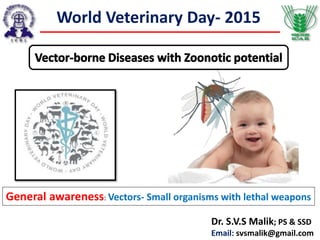
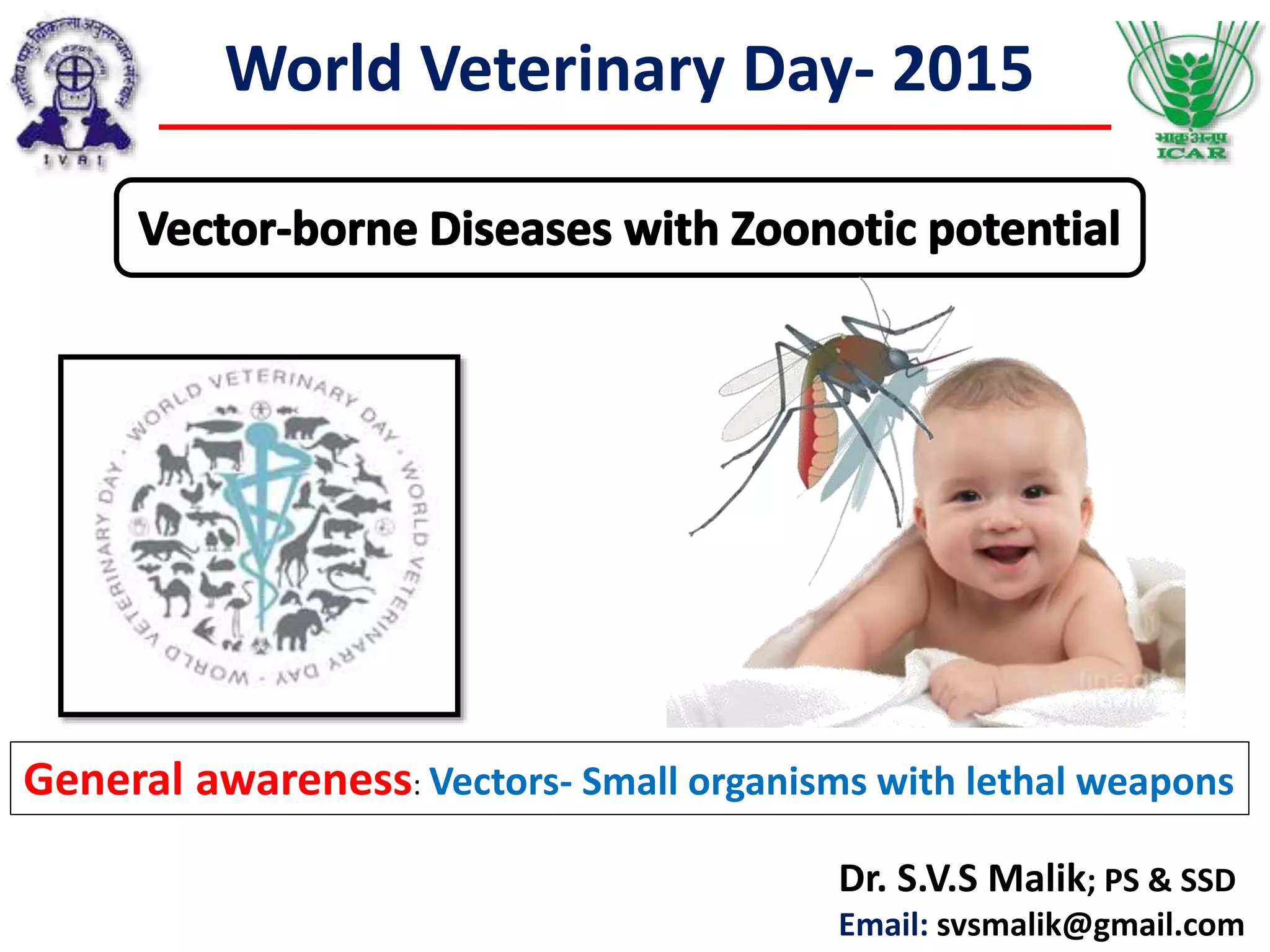
World Veterinary Day- 2015
General awareness: Vectors- Small organisms with lethal weapons
Dr. S.V.S Malik; PS & SSD
Email: svsmalik@gmail.com
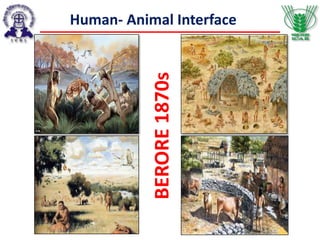
Human- Animal Interface
BERORE1870s
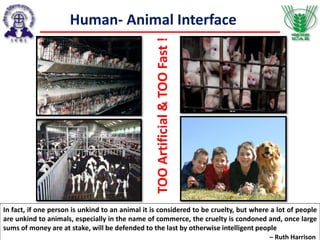
Human- Animal Interface
TOOArtificial&TOOFast!
In fact, if one person is unkind to an animal it is considered to be cruelty, but where a lot of people
are unkind to animals, especially in the name of commerce, the cruelty is condoned and, once large
sums of money are at stake, will be defended to the last by otherwise intelligent people
– Ruth Harrison
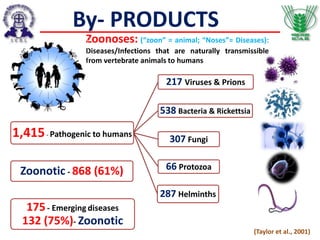
By- PRODUCTS
1,415- Pathogenic to humans
217 Viruses & Prions
538 Bacteria & Rickettsia
307 Fungi
66 Protozoa
287 Helminths
Zoonotic - 868 (61%)
175- Emerging diseases
132 (75%)- Zoonotic
Zoonoses: (“zoon” = animal; “Noses”= Diseases):
Diseases/Infections that are naturally transmissible
from vertebrate animals to humans
(Taylor et al., 2001)
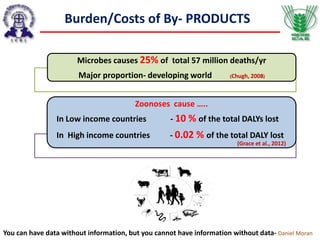
Burden/Costs of By- PRODUCTS
You can have data without information, but you cannot have information without data- Daniel Moran
Microbes causes 25% of total 57 million deaths/yr
Major proportion- developing world (Chugh, 2008)
Zoonoses cause …..
In Low income countries - 10 % of the total DALYs lost
In High income countries - 0.02 % of the total DALY lost
(Grace et al., 2012)
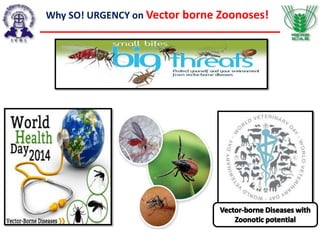
Why SO! URGENCY on Vector borne Zoonoses!
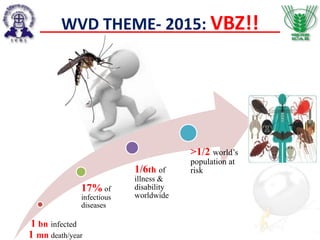
WVD THEME- 2015: VBZ!!
1 bn infected
1 mn death/year
17% of
infectious
diseases
1/6th of
illness &
disability
worldwide
>1/2 world’s
population at
risk
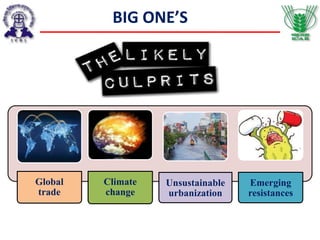
BIG ONE’S
Global
trade
Climate
change
Unsustainable
urbanization
Emerging
resistances
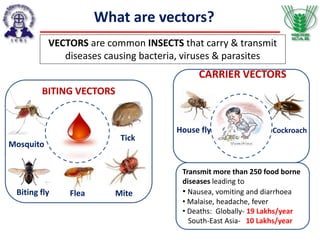
VECTORS are common INSECTS that carry & transmit
diseases causing bacteria, viruses & parasites
What are vectors?
BITING VECTORS
Tick
Mite
Mosquito
Biting fly Flea
CARRIER VECTORS
CockroachHouse fly
Transmit more than 250 food borne
diseases leading to
• Nausea, vomiting and diarrhoea
• Malaise, headache, fever
• Deaths: Globally- 19 Lakhs/year
South-East Asia- 10 Lakhs/year
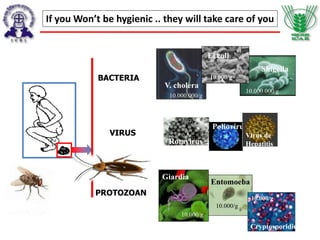
Entomoeba
Giardia
Cryptosporidium
10.000/g
10.000/g
10.000/g
Shigella
V. cholera
E. coli
10.000.000/g
10.000/g
10.000.000/g
Rotavirus
Poliovirus
Virus de
Hepatitis
BACTERIA
VIRUS
PROTOZOAN
If you Won’t be hygienic .. they will take care of you
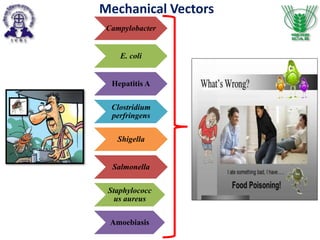
Campylobacter
E. coli
Hepatitis A
Clostridium
perfringens
Shigella
Salmonella
Staphylococc
us aureus
Amoebiasis
Mechanical Vectors
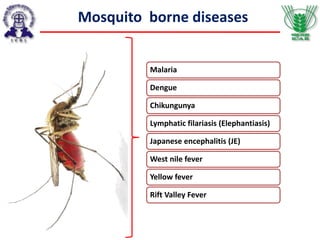
Mosquito borne diseases
Malaria
Dengue
Chikungunya
Lymphatic filariasis (Elephantiasis)
Japanese encephalitis (JE)
West nile fever
Yellow fever
Rift Valley Fever
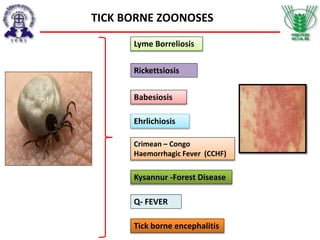
Lyme Borreliosis
Rickettsiosis
Babesiosis
Ehrlichiosis
Crimean – Congo
Haemorrhagic Fever (CCHF)
Kysannur -Forest Disease
TICK BORNE ZOONOSES
Tick borne encephalitis
Q- FEVER
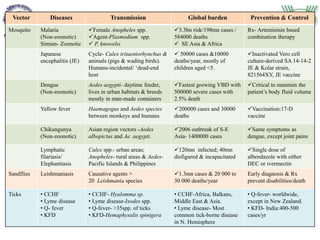
Vector Diseases Transmission Global burden Prevention & Control
Mosquito Malaria
(Non-zoonotic)
Simian- Zoonotic
Female Anopheles spp.
Agent-Plasmodium spp.
 P. knowelsi
3.3bn risk/198mn cases /
584000 deaths
 SE Asia & Africa
Rx- Artemisinin based
combination therapy
Japanese
encephalitis (JE)
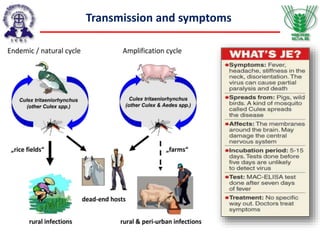
Cycle- Culex tritaeniorhynchus &
animals (pigs & wading birds).
Humans-incidental/ ‘dead-end
host
 50000 cases &10000
deaths/year, mostly of
children aged <5.
Inactivated Vero cell
culture-derived SA 14-14-2
JE & Kolar strain,
821564XY, JE vaccine
Dengue
(Non-zoonotic)
Aedes aegypti- daytime feeder,
lives in urban habitats & breeds
mostly in man-made containers
Fastest growing VBD with
500000 severe cases with
2.5% death
Critical to maintain the
patient’s body fluid volume
Yellow fever Haemagogus and Aedes species
between monkeys and humans
200000 cases and 30000
deaths
Vaccination:17-D
vaccine
Chikungunya
(Non-zoonotic)
Asian region vectors -Aedes
albopictus and Ae. aegypti.
2006 outbreak of S-E
Asia- 1400000 cases
Same symptoms as
dengue, except joint pains
Lymphatic
filariasis/
Elephantiasis
Culex spp.- urban areas;
Anopheles- rural areas & Aedes-
Pacific Islands & Philippines
120mn infected; 40mn
disfigured & incapacitated
Single dose of
albendazole with either
DEC or ivermectin
Sandflies Leishmaniasis Causative agents >
20 Leishmania species
1.3mn cases & 20 000 to
30 000 deaths/year
Early diagnosis & Rx
prevent disabilities/death
Ticks • CCHF
• Lyme disease
• Q- fever
• KFD
• CCHF- Hyalomma sp.
• Lyme disease-Ixodes spp.
• Q-fever- >35spp. of ticks
• KFD-Hemaphysalis spinigera
• CCHF-Africa, Balkans,
Middle East & Asia.
• Lyme disease- Most
common tick-borne disease
in N. Hemisphere
• Q-fever- worldwide,
except in New Zealand.
• KFD- India:400-500
cases/yr
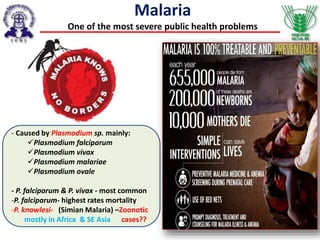
Malaria
One of the most severe public health problems
- Caused by Plasmodium sp. mainly:
Plasmodium falciparum
Plasmodium vivax
Plasmodium malariae
Plasmodium ovale
- P. falciparum & P. vivax - most common
-P. falciparum- highest rates mortality
-P. knowlesi- (Simian Malaria) –Zoonotic
mostly in Africa & SE Asia cases??
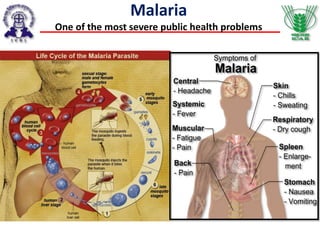
Malaria
One of the most severe public health problems
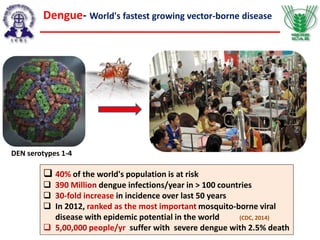
 40% of the world's population is at risk
 390 Million dengue infections/year in > 100 countries
 30-fold increase in incidence over last 50 years
 In 2012, ranked as the most important mosquito-borne viral
disease with epidemic potential in the world (CDC, 2014)
 5,00,000 people/yr suffer with severe dengue with 2.5% death
Dengue- World's fastest growing vector-borne disease
DEN serotypes 1-4
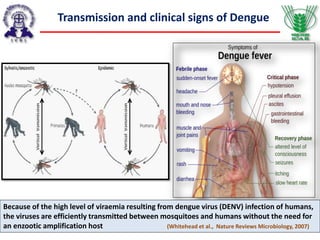
Because of the high level of viraemia resulting from dengue virus (DENV) infection of humans,
the viruses are efficiently transmitted between mosquitoes and humans without the need for
an enzootic amplification host (Whitehead et al., Nature Reviews Microbiology, 2007)
Transmission and clinical signs of Dengue
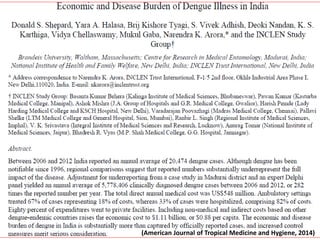
In 2013- 167 deaths
In 2014 (till 28 May, 2014)- 2 deaths
Indian Data-
Fact OR Farce ???????
(NVBDCP, 2013)
(American Journal of Tropical Medicine and Hygiene, 2014)
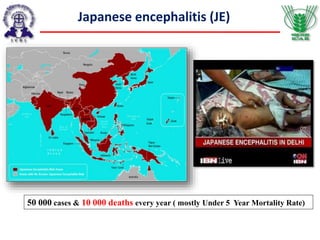
Japanese encephalitis (JE)
50 000 cases & 10 000 deaths every year ( mostly Under 5 Year Mortality Rate)
Transmission and symptoms
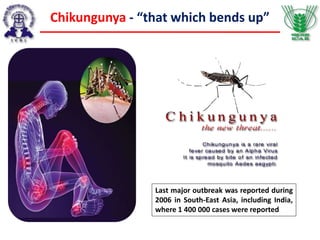
Chikungunya - “that which bends up”
Last major outbreak was reported during
2006 in South-East Asia, including India,
where 1 400 000 cases were reported
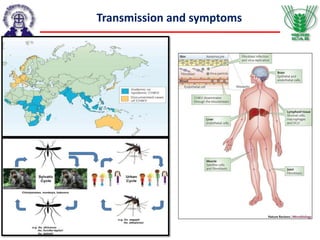
Transmission and symptoms
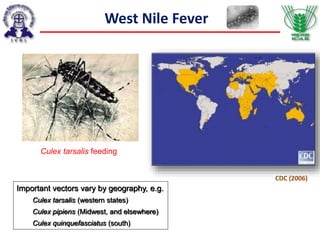
West Nile Fever
Important vectors vary by geography, e.g.
Culex tarsalis (western states)
Culex pipiens (Midwest, and elsewhere)
Culex quinquefasciatus (south)
Culex tarsalis feeding
CDC (2006)
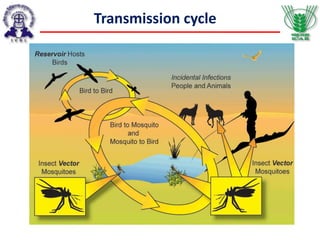
Transmission cycle
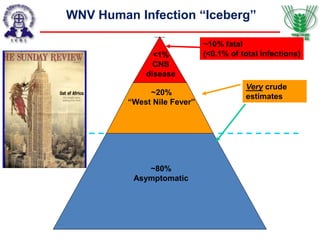
~80%
Asymptomatic
~20%
“West Nile Fever”
<1%
CNS
disease
~10% fatal
(<0.1% of total infections)
WNV Human Infection “Iceberg”
Very crude
estimates
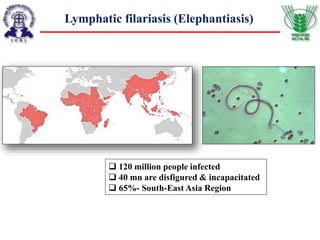
Lymphatic filariasis (Elephantiasis)
 120 million people infected
 40 mn are disfigured & incapacitated
 65%- South-East Asia Region
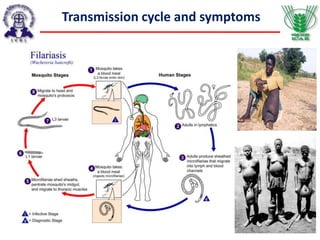
Transmission cycle and symptoms
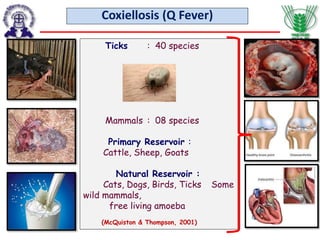
Coxiellosis (Q Fever)
Ticks : 40 species
Mammals : 08 species
Primary Reservoir :
Cattle, Sheep, Goats
Natural Reservoir :
Cats, Dogs, Birds, Ticks Some
wild mammals,
free living amoeba
(McQuiston & Thompson, 2001)
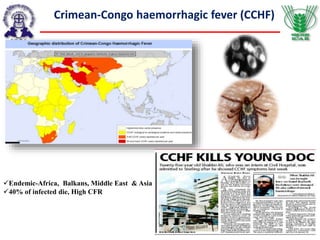
Endemic-Africa, Balkans, Middle East & Asia
40% of infected die, High CFR
Crimean-Congo haemorrhagic fever (CCHF)
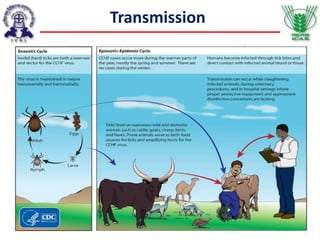
Transmission
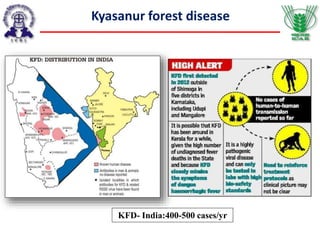
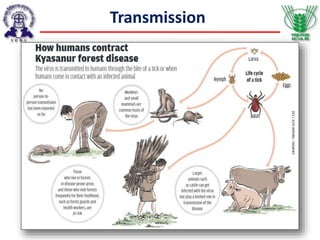
KFD- India:400-500 cases/yr
Kyasanur forest disease
Transmission
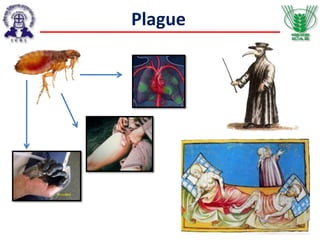
Plague
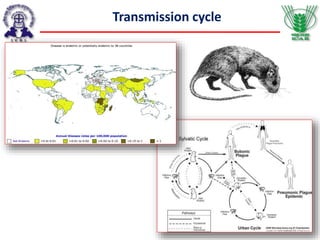
Transmission cycle
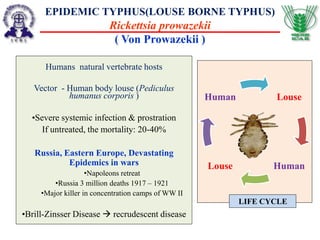
EPIDEMIC TYPHUS(LOUSE BORNE TYPHUS)
Rickettsia prowazekii
( Von Prowazekii )
Humans natural vertebrate hosts
Vector - Human body louse (Pediculus
humanus corporis )
•Severe systemic infection & prostration
If untreated, the mortality: 20-40%
Russia, Eastern Europe, Devastating
Epidemics in wars
•Napoleons retreat
•Russia 3 million deaths 1917 – 1921
•Major killer in concentration camps of WW II
•Brill-Zinsser Disease  recrudescent disease
Louse
HumanLouse
Human
LIFE CYCLE
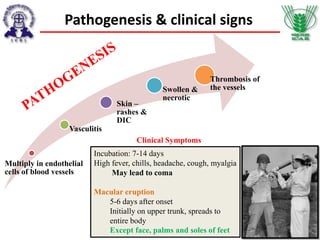
Multiply in endothelial
cells of blood vessels
Vasculitis
Skin –
rashes &
DIC
Swollen &
necrotic
Thrombosis of
the vessels
Incubation: 7-14 days
High fever, chills, headache, cough, myalgia
May lead to coma
Macular eruption
5-6 days after onset
Initially on upper trunk, spreads to
entire body
Except face, palms and soles of feet
Clinical Symptoms
Pathogenesis & clinical signs
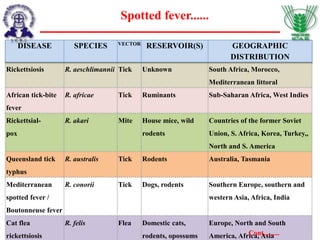
Rickettsiosis R. aeschlimannii Tick Unknown South Africa, Morocco,
Mediterranean littoral
African tick-bite
fever
R. africae Tick Ruminants Sub-Saharan Africa, West Indies
Rickettsial-
pox
R. akari Mite House mice, wild
rodents
Countries of the former Soviet
Union, S. Africa, Korea, Turkey,,
North and S. America
Queensland tick
typhus
R. australis Tick Rodents Australia, Tasmania
Mediterranean
spotted fever /
Boutonneuse fever
R. conorii Tick Dogs, rodents Southern Europe, southern and
western Asia, Africa, India
Cat flea
rickettsiosis
R. felis Flea Domestic cats,
rodents, opossums
Europe, North and South
America, Africa, Asia
DISEASE SPECIES VECTOR
RESERVOIR(S) GEOGRAPHIC
DISTRIBUTION
Spotted fever......
Cont.........
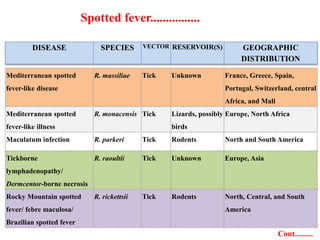
Mediterranean spotted
fever-like disease
R. massiliae Tick Unknown France, Greece, Spain,
Portugal, Switzerland, central
Africa, and Mali
Mediterranean spotted
fever-like illness
R. monacensis Tick Lizards, possibly
birds
Europe, North Africa
Maculatum infection R. parkeri Tick Rodents North and South America
Tickborne
lymphadenopathy/
Dermcentor-borne necrosis
R. raoultii Tick Unknown Europe, Asia
Rocky Mountain spotted
fever/ febre maculosa/
Brazilian spotted fever
R. rickettsii Tick Rodents North, Central, and South
America
DISEASE SPECIES VECTOR RESERVOIR(S) GEOGRAPHIC
DISTRIBUTION
Cont.........
Spotted fever................
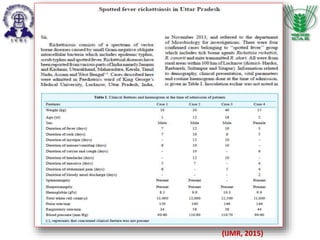
(IJMR, 2015)
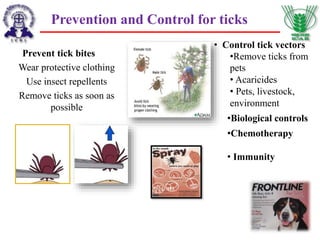
Prevention and Control for ticks
Prevent tick bites
Wear protective clothing
Use insect repellents
Remove ticks as soon as
possible
Center for Food Security and Public
Health, Iowa State University, 2013
• Control tick vectors
•Remove ticks from
pets
• Acaricides
• Pets, livestock,
environment
•Chemotherapy
• Immunity
•Biological controls
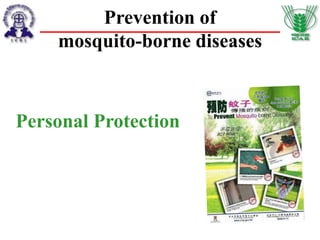
Prevention of
mosquito-borne diseases
Personal Protection
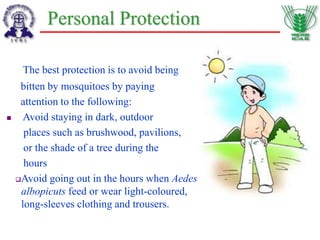
Personal Protection
The best protection is to avoid being
bitten by mosquitoes by paying
attention to the following:
 Avoid staying in dark, outdoor
places such as brushwood, pavilions,
or the shade of a tree during the
hours
Avoid going out in the hours when Aedes
albopicuts feed or wear light-coloured,
long-sleeves clothing and trousers.
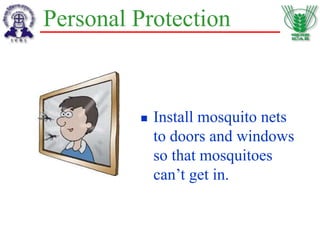
Personal Protection
 Install mosquito nets
to doors and windows
so that mosquitoes
can’t get in.
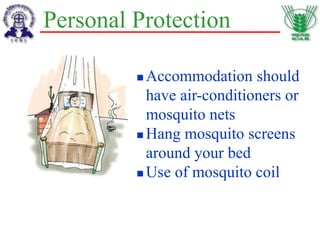
Personal Protection
 Accommodation should
have air-conditioners or
mosquito nets
 Hang mosquito screens
around your bed
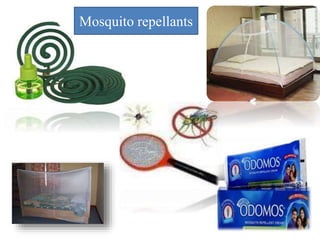
 Use of mosquito coil
DEET containing products, such as
repellents, anti-mosquito patches and
spray are generally most effective to
avoid mosquito bites.
Citronella, Soybean oil and 3-[N-Butyl-
N-acetyl]-aminopropionic acid
containing products also have mosquito
repellent effects.
Portable ultrasonic devices are less
reliable when compared with DEET.
Personal Protection
Choosing the insect repellents
Mosquito repellants
Prevention of mosquito-borne diseases
Elimination of Mosquitoes
The most effective way to
eliminate mosquitoes is to:
 Keep the environment clean.
 Remove stagnant water so that
mosquitoes can’t breed.
Elimination of Mosquitoes
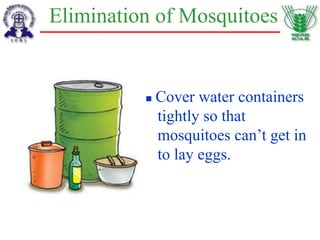
 Cover water containers
tightly so that
mosquitoes can’t get in
to lay eggs.
Elimination of Mosquitoes
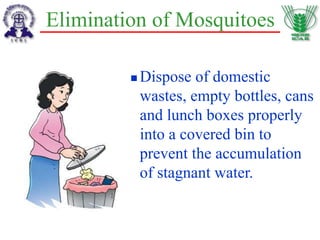
 Dispose of domestic
wastes, empty bottles, cans
and lunch boxes properly
into a covered bin to
prevent the accumulation
of stagnant water.
Elimination of Mosquitoes
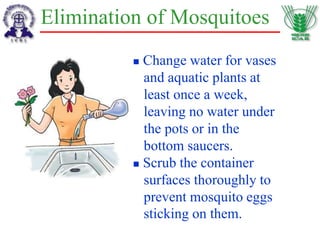
 Change water for vases
and aquatic plants at
least once a week,
leaving no water under
the pots or in the
bottom saucers.
 Scrub the container
surfaces thoroughly to
prevent mosquito eggs
sticking on them.
Elimination of Mosquitoes
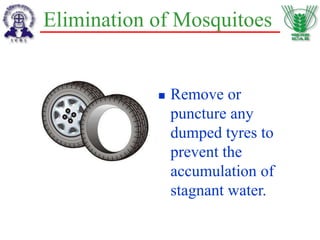
 Remove or
puncture any
dumped tyres to
prevent the
accumulation of
stagnant water.
Elimination of Mosquitoes
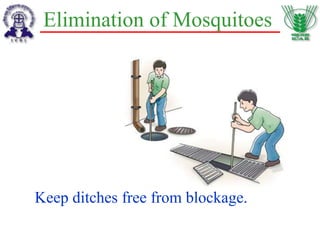
Keep ditches free from blockage.
Elimination of Mosquitoes
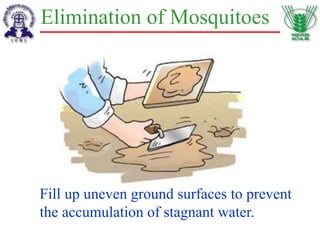
Fill up uneven ground surfaces to prevent
the accumulation of stagnant water.
Elimination of Mosquitoes
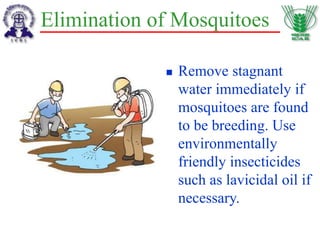
 Remove stagnant
water immediately if
mosquitoes are found
to be breeding. Use
environmentally
friendly insecticides
such as lavicidal oil if
necessary.
Elimination of Mosquitoes
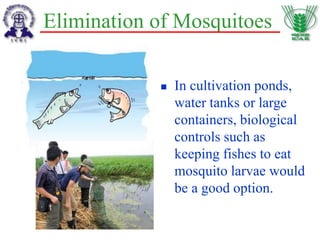
 In cultivation ponds,
water tanks or large
containers, biological
controls such as
keeping fishes to eat
mosquito larvae would
be a good option.
Mosquito Elimination Checklist (1)
 Are containers and other items
where water could accumulate
disposed of properly? (For
example, throwing empty cans,
foam rubber boxes, cups and
bottles into a covered bin)
 Are water containers covered
properly?
Mosquito Elimination Checklist (2)
 Are ditches free from blockage?
 Are containers with stagnant water cleaned
regularly?(For example, vases, saucers
underneath flower pots, water storage
device of an air-conditioner, water tanks
and pools)
 Are uneven ground surfaces filled to
prevent the accumulation of stagnant water?
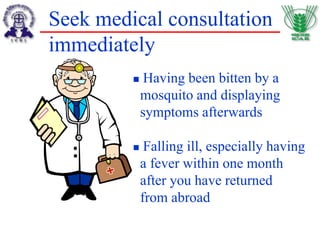
Seek medical consultation
immediately
 Having been bitten by a
mosquito and displaying
symptoms afterwards
 Falling ill, especially having
a fever within one month
after you have returned
from abroad
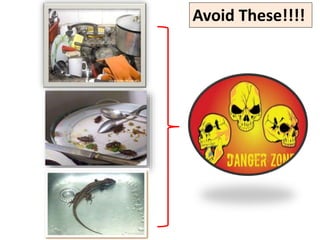
Avoid These!!!!
Mechanical vector borne disease prevention
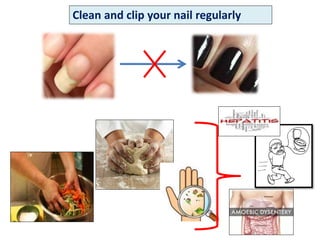
Clean and clip your nail regularly
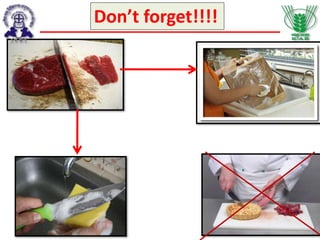
Keep clean habits in kitchen for a healthy family
Wash fruits & vegetable
with clean water
Don’t let the food open
Keep yourself clean before cooking
Don’t forget!!!!
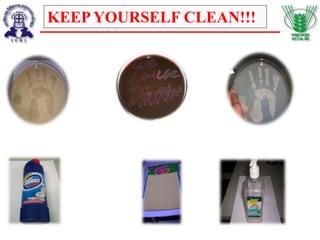
KEEP YOURSELF CLEAN!!!
Hand washing
30/9/2014
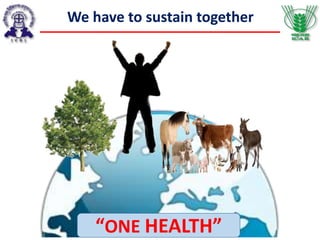
We have to sustain together
“ONE HEALTH”
“Adopt the pace of nature: her secret is patience” - R. Emerson

Vector Borne Zoonoses

  • 1.
    World Veterinary Day-2015 General awareness: Vectors- Small organisms with lethal weapons Dr. S.V.S Malik; PS & SSD Email: svsmalik@gmail.com
  • 2.
  • 3.
    Human- Animal Interface TOOArtificial&TOOFast! Infact, if one person is unkind to an animal it is considered to be cruelty, but where a lot of people are unkind to animals, especially in the name of commerce, the cruelty is condoned and, once large sums of money are at stake, will be defended to the last by otherwise intelligent people – Ruth Harrison
  • 4.
    By- PRODUCTS 1,415- Pathogenicto humans 217 Viruses & Prions 538 Bacteria & Rickettsia 307 Fungi 66 Protozoa 287 Helminths Zoonotic - 868 (61%) 175- Emerging diseases 132 (75%)- Zoonotic Zoonoses: (“zoon” = animal; “Noses”= Diseases): Diseases/Infections that are naturally transmissible from vertebrate animals to humans (Taylor et al., 2001)
  • 5.
    Burden/Costs of By-PRODUCTS You can have data without information, but you cannot have information without data- Daniel Moran Microbes causes 25% of total 57 million deaths/yr Major proportion- developing world (Chugh, 2008) Zoonoses cause ….. In Low income countries - 10 % of the total DALYs lost In High income countries - 0.02 % of the total DALY lost (Grace et al., 2012)
  • 6.
    Why SO! URGENCYon Vector borne Zoonoses!
  • 7.
    WVD THEME- 2015:VBZ!! 1 bn infected 1 mn death/year 17% of infectious diseases 1/6th of illness & disability worldwide >1/2 world’s population at risk
  • 8.
  • 9.
    VECTORS are commonINSECTS that carry & transmit diseases causing bacteria, viruses & parasites What are vectors? BITING VECTORS Tick Mite Mosquito Biting fly Flea CARRIER VECTORS CockroachHouse fly Transmit more than 250 food borne diseases leading to • Nausea, vomiting and diarrhoea • Malaise, headache, fever • Deaths: Globally- 19 Lakhs/year South-East Asia- 10 Lakhs/year
  • 10.
  • 11.
  • 12.
    Mosquito borne diseases Malaria Dengue Chikungunya Lymphaticfilariasis (Elephantiasis) Japanese encephalitis (JE) West nile fever Yellow fever Rift Valley Fever
  • 13.
    Lyme Borreliosis Rickettsiosis Babesiosis Ehrlichiosis Crimean –Congo Haemorrhagic Fever (CCHF) Kysannur -Forest Disease TICK BORNE ZOONOSES Tick borne encephalitis Q- FEVER
  • 14.
    Vector Diseases TransmissionGlobal burden Prevention & Control Mosquito Malaria (Non-zoonotic) Simian- Zoonotic Female Anopheles spp. Agent-Plasmodium spp.  P. knowelsi 3.3bn risk/198mn cases / 584000 deaths  SE Asia & Africa Rx- Artemisinin based combination therapy Japanese encephalitis (JE) Cycle- Culex tritaeniorhynchus & animals (pigs & wading birds). Humans-incidental/ ‘dead-end host  50000 cases &10000 deaths/year, mostly of children aged <5. Inactivated Vero cell culture-derived SA 14-14-2 JE & Kolar strain, 821564XY, JE vaccine Dengue (Non-zoonotic) Aedes aegypti- daytime feeder, lives in urban habitats & breeds mostly in man-made containers Fastest growing VBD with 500000 severe cases with 2.5% death Critical to maintain the patient’s body fluid volume Yellow fever Haemagogus and Aedes species between monkeys and humans 200000 cases and 30000 deaths Vaccination:17-D vaccine Chikungunya (Non-zoonotic) Asian region vectors -Aedes albopictus and Ae. aegypti. 2006 outbreak of S-E Asia- 1400000 cases Same symptoms as dengue, except joint pains Lymphatic filariasis/ Elephantiasis Culex spp.- urban areas; Anopheles- rural areas & Aedes- Pacific Islands & Philippines 120mn infected; 40mn disfigured & incapacitated Single dose of albendazole with either DEC or ivermectin Sandflies Leishmaniasis Causative agents > 20 Leishmania species 1.3mn cases & 20 000 to 30 000 deaths/year Early diagnosis & Rx prevent disabilities/death Ticks • CCHF • Lyme disease • Q- fever • KFD • CCHF- Hyalomma sp. • Lyme disease-Ixodes spp. • Q-fever- >35spp. of ticks • KFD-Hemaphysalis spinigera • CCHF-Africa, Balkans, Middle East & Asia. • Lyme disease- Most common tick-borne disease in N. Hemisphere • Q-fever- worldwide, except in New Zealand. • KFD- India:400-500 cases/yr
  • 15.
    Malaria One of themost severe public health problems - Caused by Plasmodium sp. mainly: Plasmodium falciparum Plasmodium vivax Plasmodium malariae Plasmodium ovale - P. falciparum & P. vivax - most common -P. falciparum- highest rates mortality -P. knowlesi- (Simian Malaria) –Zoonotic mostly in Africa & SE Asia cases??
  • 16.
    Malaria One of themost severe public health problems
  • 17.
     40% ofthe world's population is at risk  390 Million dengue infections/year in > 100 countries  30-fold increase in incidence over last 50 years  In 2012, ranked as the most important mosquito-borne viral disease with epidemic potential in the world (CDC, 2014)  5,00,000 people/yr suffer with severe dengue with 2.5% death Dengue- World's fastest growing vector-borne disease DEN serotypes 1-4
  • 18.
    Because of thehigh level of viraemia resulting from dengue virus (DENV) infection of humans, the viruses are efficiently transmitted between mosquitoes and humans without the need for an enzootic amplification host (Whitehead et al., Nature Reviews Microbiology, 2007) Transmission and clinical signs of Dengue
  • 19.
    In 2013- 167deaths In 2014 (till 28 May, 2014)- 2 deaths Indian Data- Fact OR Farce ??????? (NVBDCP, 2013) (American Journal of Tropical Medicine and Hygiene, 2014)
  • 20.
    Japanese encephalitis (JE) 50000 cases & 10 000 deaths every year ( mostly Under 5 Year Mortality Rate)
  • 21.
  • 22.
    Chikungunya - “thatwhich bends up” Last major outbreak was reported during 2006 in South-East Asia, including India, where 1 400 000 cases were reported
  • 23.
  • 24.
    West Nile Fever Importantvectors vary by geography, e.g. Culex tarsalis (western states) Culex pipiens (Midwest, and elsewhere) Culex quinquefasciatus (south) Culex tarsalis feeding CDC (2006)
  • 25.
  • 26.
    ~80% Asymptomatic ~20% “West Nile Fever” <1% CNS disease ~10%fatal (<0.1% of total infections) WNV Human Infection “Iceberg” Very crude estimates
  • 27.
    Lymphatic filariasis (Elephantiasis) 120 million people infected  40 mn are disfigured & incapacitated  65%- South-East Asia Region
  • 28.
  • 29.
    Coxiellosis (Q Fever) Ticks: 40 species Mammals : 08 species Primary Reservoir : Cattle, Sheep, Goats Natural Reservoir : Cats, Dogs, Birds, Ticks Some wild mammals, free living amoeba (McQuiston & Thompson, 2001)
  • 30.
    Endemic-Africa, Balkans, MiddleEast & Asia 40% of infected die, High CFR Crimean-Congo haemorrhagic fever (CCHF)
  • 31.
  • 32.
  • 33.
  • 34.
  • 35.
  • 36.
    EPIDEMIC TYPHUS(LOUSE BORNETYPHUS) Rickettsia prowazekii ( Von Prowazekii ) Humans natural vertebrate hosts Vector - Human body louse (Pediculus humanus corporis ) •Severe systemic infection & prostration If untreated, the mortality: 20-40% Russia, Eastern Europe, Devastating Epidemics in wars •Napoleons retreat •Russia 3 million deaths 1917 – 1921 •Major killer in concentration camps of WW II •Brill-Zinsser Disease  recrudescent disease Louse HumanLouse Human LIFE CYCLE
  • 37.
    Multiply in endothelial cellsof blood vessels Vasculitis Skin – rashes & DIC Swollen & necrotic Thrombosis of the vessels Incubation: 7-14 days High fever, chills, headache, cough, myalgia May lead to coma Macular eruption 5-6 days after onset Initially on upper trunk, spreads to entire body Except face, palms and soles of feet Clinical Symptoms Pathogenesis & clinical signs
  • 38.
    Rickettsiosis R. aeschlimanniiTick Unknown South Africa, Morocco, Mediterranean littoral African tick-bite fever R. africae Tick Ruminants Sub-Saharan Africa, West Indies Rickettsial- pox R. akari Mite House mice, wild rodents Countries of the former Soviet Union, S. Africa, Korea, Turkey,, North and S. America Queensland tick typhus R. australis Tick Rodents Australia, Tasmania Mediterranean spotted fever / Boutonneuse fever R. conorii Tick Dogs, rodents Southern Europe, southern and western Asia, Africa, India Cat flea rickettsiosis R. felis Flea Domestic cats, rodents, opossums Europe, North and South America, Africa, Asia DISEASE SPECIES VECTOR RESERVOIR(S) GEOGRAPHIC DISTRIBUTION Spotted fever...... Cont.........
  • 39.
    Mediterranean spotted fever-like disease R.massiliae Tick Unknown France, Greece, Spain, Portugal, Switzerland, central Africa, and Mali Mediterranean spotted fever-like illness R. monacensis Tick Lizards, possibly birds Europe, North Africa Maculatum infection R. parkeri Tick Rodents North and South America Tickborne lymphadenopathy/ Dermcentor-borne necrosis R. raoultii Tick Unknown Europe, Asia Rocky Mountain spotted fever/ febre maculosa/ Brazilian spotted fever R. rickettsii Tick Rodents North, Central, and South America DISEASE SPECIES VECTOR RESERVOIR(S) GEOGRAPHIC DISTRIBUTION Cont......... Spotted fever................
  • 40.
  • 41.
    Prevention and Controlfor ticks Prevent tick bites Wear protective clothing Use insect repellents Remove ticks as soon as possible Center for Food Security and Public Health, Iowa State University, 2013 • Control tick vectors •Remove ticks from pets • Acaricides • Pets, livestock, environment •Chemotherapy • Immunity •Biological controls
  • 42.
  • 43.
    Personal Protection The bestprotection is to avoid being bitten by mosquitoes by paying attention to the following:  Avoid staying in dark, outdoor places such as brushwood, pavilions, or the shade of a tree during the hours Avoid going out in the hours when Aedes albopicuts feed or wear light-coloured, long-sleeves clothing and trousers.
  • 44.
    Personal Protection  Installmosquito nets to doors and windows so that mosquitoes can’t get in.
  • 45.
    Personal Protection  Accommodationshould have air-conditioners or mosquito nets  Hang mosquito screens around your bed  Use of mosquito coil
  • 46.
    DEET containing products,such as repellents, anti-mosquito patches and spray are generally most effective to avoid mosquito bites. Citronella, Soybean oil and 3-[N-Butyl- N-acetyl]-aminopropionic acid containing products also have mosquito repellent effects. Portable ultrasonic devices are less reliable when compared with DEET. Personal Protection Choosing the insect repellents
  • 47.
  • 48.
    Prevention of mosquito-bornediseases Elimination of Mosquitoes The most effective way to eliminate mosquitoes is to:  Keep the environment clean.  Remove stagnant water so that mosquitoes can’t breed.
  • 49.
    Elimination of Mosquitoes Cover water containers tightly so that mosquitoes can’t get in to lay eggs.
  • 50.
    Elimination of Mosquitoes Dispose of domestic wastes, empty bottles, cans and lunch boxes properly into a covered bin to prevent the accumulation of stagnant water.
  • 51.
    Elimination of Mosquitoes Change water for vases and aquatic plants at least once a week, leaving no water under the pots or in the bottom saucers.  Scrub the container surfaces thoroughly to prevent mosquito eggs sticking on them.
  • 52.
    Elimination of Mosquitoes Remove or puncture any dumped tyres to prevent the accumulation of stagnant water.
  • 53.
    Elimination of Mosquitoes Keepditches free from blockage.
  • 54.
    Elimination of Mosquitoes Fillup uneven ground surfaces to prevent the accumulation of stagnant water.
  • 55.
    Elimination of Mosquitoes Remove stagnant water immediately if mosquitoes are found to be breeding. Use environmentally friendly insecticides such as lavicidal oil if necessary.
  • 56.
    Elimination of Mosquitoes In cultivation ponds, water tanks or large containers, biological controls such as keeping fishes to eat mosquito larvae would be a good option.
  • 57.
    Mosquito Elimination Checklist(1)  Are containers and other items where water could accumulate disposed of properly? (For example, throwing empty cans, foam rubber boxes, cups and bottles into a covered bin)  Are water containers covered properly?
  • 58.
    Mosquito Elimination Checklist(2)  Are ditches free from blockage?  Are containers with stagnant water cleaned regularly?(For example, vases, saucers underneath flower pots, water storage device of an air-conditioner, water tanks and pools)  Are uneven ground surfaces filled to prevent the accumulation of stagnant water?
  • 59.
    Seek medical consultation immediately Having been bitten by a mosquito and displaying symptoms afterwards  Falling ill, especially having a fever within one month after you have returned from abroad
  • 60.
  • 61.
    Mechanical vector bornedisease prevention
  • 62.
    Clean and clipyour nail regularly
  • 63.
    Keep clean habitsin kitchen for a healthy family Wash fruits & vegetable with clean water Don’t let the food open Keep yourself clean before cooking
  • 64.
  • 65.
  • 66.
  • 68.
  • 70.
    We have tosustain together “ONE HEALTH”
  • 71.
    “Adopt the paceof nature: her secret is patience” - R. Emerson