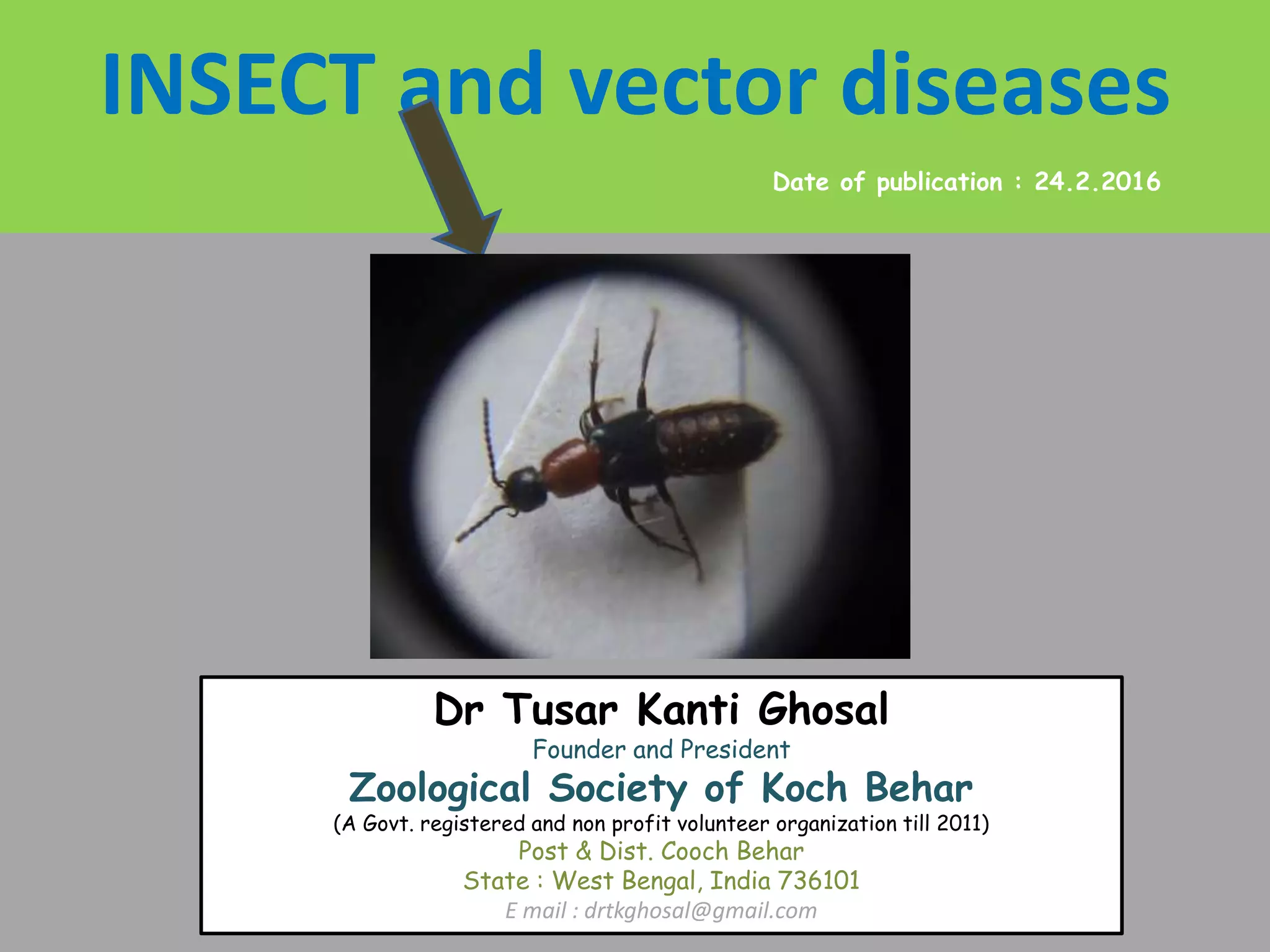
INSECT and vector diseases
Date of publication : 24.2.2016
Dr Tusar Kanti Ghosal
Founder and President
Zoological Society of Koch Behar
(A Govt. registered and non profit volunteer organization till 2011)
Post & Dist. Cooch Behar
State : West Bengal, India 736101
E mail : drtkghosal@gmail.com
TYPHUS DISEASE
Head lice and pubic lice are not involved in
disease transmission but body lice may
carry the agents of epidermic typhus,
trench fever.
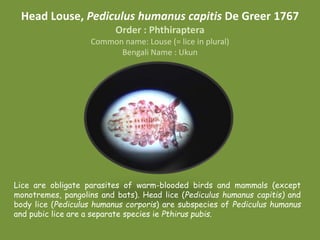
Head Louse, Pediculus humanus capitis De Greer 1767
Order : Phthiraptera
Common name: Louse (= lice in plural)
Bengali Name : Ukun
Lice are obligate parasites of warm-blooded birds and mammals (except
monotremes, pangolins and bats). Head lice (Pediculus humanus capitis) and
body lice (Pediculus humanus corporis) are subspecies of Pediculus humanus
and pubic lice are a separate species ie Pthirus pubis.
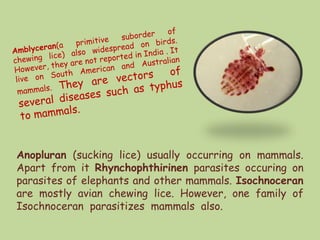
Anopluran (sucking lice) usually occurring on mammals.
Apart from it Rhynchophthirinen parasites occuring on
parasites of elephants and other mammals. Isochnoceran
are mostly avian chewing lice. However, one family of
Isochnoceran parasitizes mammals also.
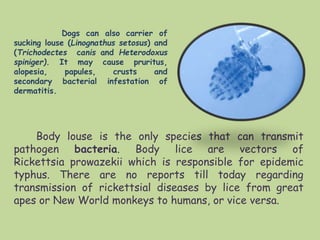
Body louse is the only species that can transmit
pathogen bacteria. Body lice are vectors of
Rickettsia prowazekii which is responsible for epidemic
typhus. There are no reports till today regarding
transmission of rickettsial diseases by lice from great
apes or New World monkeys to humans, or vice versa.
Dogs can also carrier of
sucking louse (Linognathus setosus) and
(Trichodectes canis and Heterodoxus
spiniger). It may cause pruritus,
alopesia, papules, crusts and
secondary bacterial infestation of
dermatitis.
Plague DISEASE
Plague is a disease caused by the
bacterium Yersinia pestis. It occurs primarily in wild
animals, such as rats and other rodents. Plague bacteria are
transmitted by fleas, and humans may be infected by fleas
that have fed on infected animals. In the past, plague was
called the black death and caused disastrous epidemics. Ref
: WHO
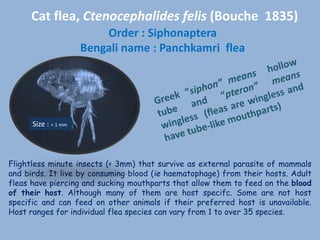
Cat flea, Ctenocephalides felis (Bouche 1835)
Order : Siphonaptera
Bengali name : Panchkamri flea
Flightless minute insects (< 3mm) that survive as external parasite of mammals
and birds. It live by consuming blood (ie haematophage) from their hosts. Adult
fleas have piercing and sucking mouthparts that allow them to feed on the blood
of their host. Although many of them are host specifc. Some are not host
specific and can feed on other animals if their preferred host is unavailable.
Host ranges for individual flea species can vary from 1 to over 35 species.
Size : < 1 mm
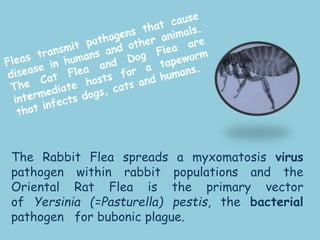
The Rabbit Flea spreads a myxomatosis virus
pathogen within rabbit populations and the
Oriental Rat Flea is the primary vector
of Yersinia (=Pasturella) pestis, the bacterial
pathogen for bubonic plague.
My pusi-cat ( Name : Chao and tiger) can carry this flea and spread
it inside my home. Some time this fleas are attacked us especially
my younger son because his body temperature somewhat higher
than me. Few years ago a pair of Indian civet also made shelter on
the roof corner of my house and affected us seriously.
Bio-control of cat flea:
Skin burn DISEASE
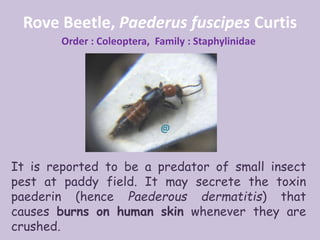
Rove Beetle, Paederus fuscipes Curtis
Order : Coleoptera, Family : Staphylinidae
It is reported to be a predator of small insect
pest at paddy field. It may secrete the toxin
paederin (hence Paederous dermatitis) that
causes burns on human skin whenever they are
crushed.
@
Rove Beetle
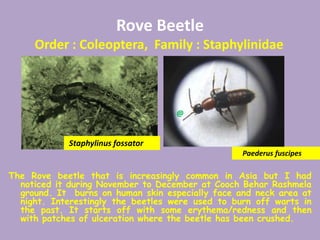
Order : Coleoptera, Family : Staphylinidae
The Rove beetle that is increasingly common in Asia but I had
noticed it during November to December at Cooch Behar Rashmela
ground. It burns on human skin especially face and neck area at
night. Interestingly the beetles were used to burn off warts in
the past. It starts off with some erythema/redness and then
with patches of ulceration where the beetle has been crushed.
Paederus fuscipes
Staphylinus fossator
@
Food poisoning & allergic disease
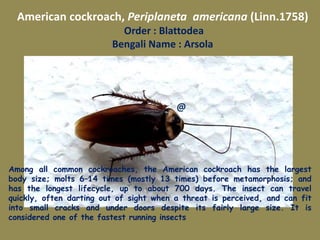
American cockroach, Periplaneta americana (Linn.1758)
Order : Blattodea
Bengali Name : Arsola
Among all common cockroaches, the American cockroach has the largest
body size; molts 6–14 times (mostly 13 times) before metamorphosis; and
has the longest lifecycle, up to about 700 days. The insect can travel
quickly, often darting out of sight when a threat is perceived, and can fit
into small cracks and under doors despite its fairly large size. It is
considered one of the fastest running insects
@
Other species of cochroaches
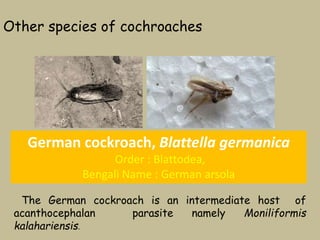
German cockroach, Blattella germanica
Order : Blattodea,
Bengali Name : German arsola
The German cockroach is an intermediate host of
acanthocephalan parasite namely Moniliformis
kalahariensis.
@
Other species of cochroaches
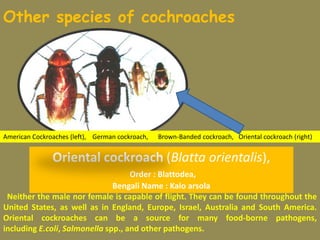
Oriental cockroach (Blatta orientalis),
Order : Blattodea,
Bengali Name : Kalo arsola
Neither the male nor female is capable of flight. They can be found throughout the
United States, as well as in England, Europe, Israel, Australia and South America.
Oriental cockroaches can be a source for many food-borne pathogens,
including E.coli, Salmonella spp., and other pathogens.
American Cockroaches (left), German cockroach, Brown-Banded cockroach, Oriental cockroach (right)
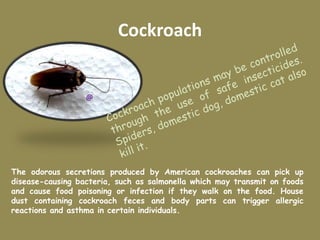
Cockroach
The odorous secretions produced by American cockroaches can pick up
disease-causing bacteria, such as salmonella which may transmit on foods
and cause food poisoning or infection if they walk on the food. House
dust containing cockroach feces and body parts can trigger allergic
reactions and asthma in certain individuals.
@
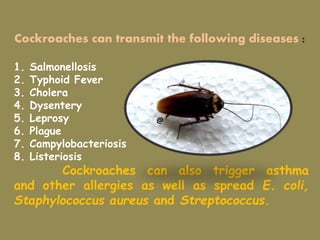
Cockroaches can transmit the following diseases :
1. Salmonellosis
2. Typhoid Fever
3. Cholera
4. Dysentery
5. Leprosy
6. Plague
7. Campylobacteriosis
8. Listeriosis
Cockroaches can also trigger asthma
and other allergies as well as spread E. coli,
Staphylococcus aureus and Streptococcus.
@
MOSQUITO born disease
West Nile virus and
St Louis
encephalitis virus
come from the
genera Culex.
Chikungunya,
dengue and yellow
fever are carried
by Aedes.
Zika is spread by
Aedes agypti or
Aedes albopictus.
Malaria is
transmitted by
species of the
Anopheles
There are over
3,000 species
worldwide, and
approximately 200
are important
medically. Most
species of mosquito
don't even pierce
and suck humans,
some prefer
amphibians, birds,
reptiles. horses,
cows, cats, dogs
etc.
Maleria DISEASE
Mosquitoes are one of the deadliest animals in the world. Their ability to
carry and spread disease to humans causes millions of deaths every year.
They can caused Malaria, Lymphatic filaraiasis (elephantiasis), Yellow fever,
West Nile fever, Dengue fever, Chikunguny, Zika fever, Ross River fever,
Eastern Equine Encephalitis, Japanese Encephalitis, La Crosse Encephalitis,
St. Louis Encephalitis, Western Equine Encephalitis.
Most common
endophilic mosquito species
recorded from North Bengal were
Anopheles minimus, An. varuna,
An. maculatus, An. fluviatilis,
An. vagus, An. culicifacies, An.
hyrcanus, An. Barbirostris.
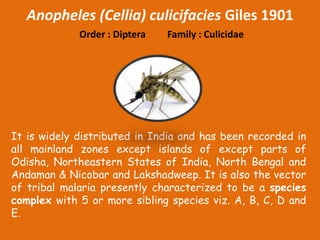
Anopheles (Cellia) culicifacies Giles 1901
Order : Diptera Family : Culicidae
It is widely distributed in India and has been recorded in
all mainland zones except islands of except parts of
Odisha, Northeastern States of India, North Bengal and
Andaman & Nicobar and Lakshadweep. It is also the vector
of tribal malaria presently characterized to be a species
complex with 5 or more sibling species viz. A, B, C, D and
E.
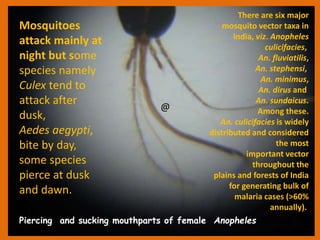
Piercing and sucking mouthparts of female Anopheles
Mosquitoes
attack mainly at
night but some
species namely
Culex tend to
attack after
dusk,
Aedes aegypti,
bite by day,
some species
pierce at dusk
and dawn.
There are six major
mosquito vector taxa in
India, viz. Anopheles
culicifacies,
An. fluviatilis,
An. stephensi,
An. minimus,
An. dirus and
An. sundaicus.
Among these.
An. culicifacies is widely
distributed and considered
the most
important vector
throughout the
plains and forests of India
for generating bulk of
malaria cases (>60%
annually).
@
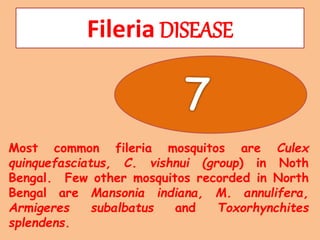
Fileria DISEASE
Most common fileria mosquitos are Culex
quinquefasciatus, C. vishnui (group) in Noth
Bengal. Few other mosquitos recorded in North
Bengal are Mansonia indiana, M. annulifera,
Armigeres subalbatus and Toxorhynchites
splendens.
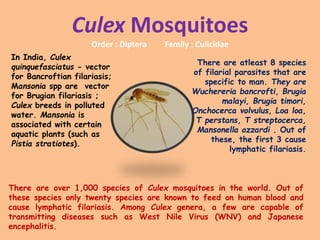
Culex Mosquitoes
Order : Diptera Family : Culicidae
There are over 1,000 species of Culex mosquitoes in the world. Out of
these species only twenty species are known to feed on human blood and
cause lymphatic filariasis. Among Culex genera, a few are capable of
transmitting diseases such as West Nile Virus (WNV) and Japanese
encephalitis.
There are atleast 8 species
of filarial parasites that are
specific to man. They are
Wuchereria bancrofti, Brugia
malayi, Brugia timori,
Onchocerca volvulus, Loa loa,
T perstans, T streptocerca,
Mansonella ozzardi . Out of
these, the first 3 cause
lymphatic filariasis.
In India, Culex
quinquefasciatus - vector
for Bancroftian filariasis;
Mansonia spp are vector
for Brugian filariasis ;
Culex breeds in polluted
water. Mansonia is
associated with certain
aquatic plants (such as
Pistia stratiotes).
Dengue DISEASE
The worldwide incidence of dengue has risen 30 times more in
past three decades. and more countries are reporting their first
outbreaks of the disease. Zika, dengue, chikungunya, and yellow
fever are all transmitted to humans by the Aedes
aegypti mosquito.
Most common dengue mosquito species recorded from North
Bengal were Aedes aegypti and Ae. Albopictus.
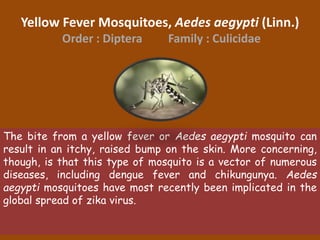
Yellow Fever Mosquitoes, Aedes aegypti (Linn.)
Order : Diptera Family : Culicidae
The bite from a yellow fever or Aedes aegypti mosquito can
result in an itchy, raised bump on the skin. More concerning,
though, is that this type of mosquito is a vector of numerous
diseases, including dengue fever and chikungunya. Aedes
aegypti mosquitoes have most recently been implicated in the
global spread of zika virus.
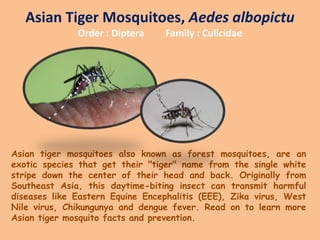
Asian Tiger Mosquitoes, Aedes albopictu
Order : Diptera Family : Culicidae
Asian tiger mosquitoes also known as forest mosquitoes, are an
exotic species that get their "tiger" name from the single white
stripe down the center of their head and back. Originally from
Southeast Asia, this daytime-biting insect can transmit harmful
diseases like Eastern Equine Encephalitis (EEE), Zika virus, West
Nile virus, Chikungunya and dengue fever. Read on to learn more
Asian tiger mosquito facts and prevention.
Conventional Mosquito repellent
Most commercial repellents contain DEET (Diethyl-meta-toluamide)
as their main insect repelling ingredient. DEET works by blocking
the receptors on their antennae that allow them to hone in on
human beings.
Another bio-product is Avon Skin-So-Soft (ASSS). Its formula
contains plant picaridin compound (a chemical that resembles the
natural compound found in the plants used to produce black
pepper ) + IR3535 (a chemical of the naturally occurring amino
acid B-alanine). But it needs to be applied every 20 minutes or
less.
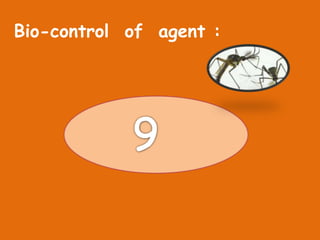
Bio-control of agent :
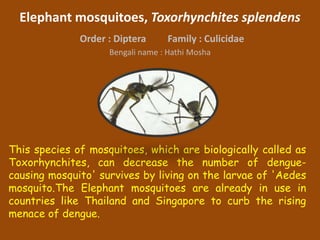
Elephant mosquitoes, Toxorhynchites splendens
Order : Diptera Family : Culicidae
Bengali name : Hathi Mosha
This species of mosquitoes, which are biologically called as
Toxorhynchites, can decrease the number of dengue-
causing mosquito' survives by living on the larvae of 'Aedes
mosquito.The Elephant mosquitoes are already in use in
countries like Thailand and Singapore to curb the rising
menace of dengue.
kala-azar (Viceral Leishmaniasis) disease
In India, Nepal, and Bangladesh Kala azar
is transmitted by the sand flies of the
species Phlebotomus argentipes and P.
chinensis.
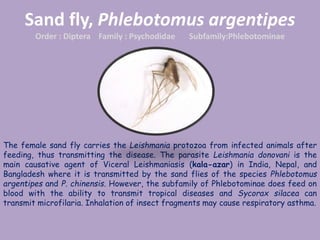
Sand fly, Phlebotomus argentipes
Order : Diptera Family : Psychodidae Subfamily:Phlebotominae
The female sand fly carries the Leishmania protozoa from infected animals after
feeding, thus transmitting the disease. The parasite Leishmania donovani is the
main causative agent of Viceral Leishmaniasis (kala-azar) in India, Nepal, and
Bangladesh where it is transmitted by the sand flies of the species Phlebotomus
argentipes and P. chinensis. However, the subfamily of Phlebotominae does feed on
blood with the ability to transmit tropical diseases and Sycorax silacea can
transmit microfilaria. Inhalation of insect fragments may cause respiratory asthma.
Itchy welts & allergic disease
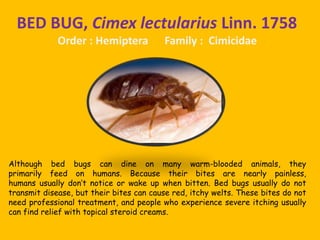
BED BUG, Cimex lectularius Linn. 1758
Order : Hemiptera Family : Cimicidae
Although bed bugs can dine on many warm-blooded animals, they
primarily feed on humans. Because their bites are nearly painless,
humans usually don’t notice or wake up when bitten. Bed bugs usually do not
transmit disease, but their bites can cause red, itchy welts. These bites do not
need professional treatment, and people who experience severe itching usually
can find relief with topical steroid creams.
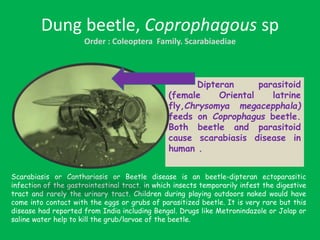
Scarabiasis disease
Dung beetle, Coprophagous sp
Order : Coleoptera Family. Scarabiaediae
Scarabiasis or Canthariasis or Beetle disease is an beetle-dipteran ectoparasitic
infection of the gastrointestinal tract. in which insects temporarily infest the digestive
tract and rarely the urinary tract. Children during playing outdoors naked would have
come into contact with the eggs or grubs of parasitized beetle. It is very rare but this
disease had reported from India including Bengal. Drugs like Metronindazole or Jolap or
saline water help to kill the grub/larvae of the beetle.
Dipteran parasitoid
(female Oriental latrine
fly,Chrysomya megacepphala)
feeds on Coprophagus beetle.
Both beetle and parasitoid
cause scarabiasis disease in
human .
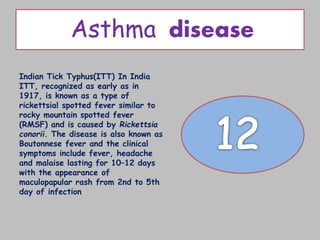
Asthma disease
Indian Tick Typhus(ITT) In India
ITT, recognized as early as in
1917, is known as a type of
rickettsial spotted fever similar to
rocky mountain spotted fever
(RMSF) and is caused by Rickettsia
conorii. The disease is also known as
Boutonnese fever and the clinical
symptoms include fever, headache
and malaise lasting for 10–12 days
with the appearance of
maculopapular rash from 2nd to 5th
day of infection
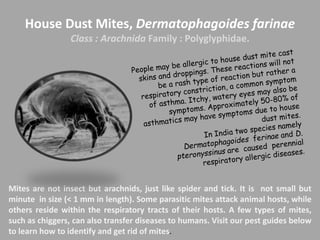
House Dust Mites, Dermatophagoides farinae
Class : Arachnida Family : Polyglyphidae.
Mites are not insect but arachnids, just like spider and tick. It is not small but
minute in size (< 1 mm in length). Some parasitic mites attack animal hosts, while
others reside within the respiratory tracts of their hosts. A few types of mites,
such as chiggers, can also transfer diseases to humans. Visit our pest guides below
to learn how to identify and get rid of mites.
Indian Tick Typhus(ITT) disease
Indian Tick Typhus(ITT) In India
ITT, recognized as early as in
1917, is known as a type of
rickettsial spotted fever similar to
rocky mountain spotted fever
(RMSF) and is caused by Rickettsia
conorii. The disease is also known
as Boutonnese fever and the clinical
symptoms include fever, headache
and malaise lasting for 10–12 days
with the appearance of
maculopapular rash from 2nd to 5th
day of infection
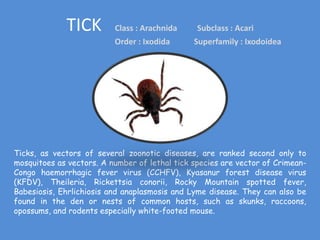
TICK Class : Arachnida Subclass : Acari
Order : Ixodida Superfamily : Ixodoidea
Ticks, as vectors of several zoonotic diseases, are ranked second only to
mosquitoes as vectors. A number of lethal tick species are vector of Crimean-
Congo haemorrhagic fever virus (CCHFV), Kyasanur forest disease virus
(KFDV), Theileria, Rickettsia conorii, Rocky Mountain spotted fever,
Babesiosis, Ehrlichiosis and anaplasmosis and Lyme disease. They can also be
found in the den or nests of common hosts, such as skunks, raccoons,
opossums, and rodents especially white-footed mouse.
U.G. & P.G. students of
UBKV, Cooch Behar,
NBMC, Siliguri, Darjeeling &
SCB Govt. Medical College, Cuttack

Insect and vector diseases

  • 1.
    INSECT and vectordiseases Date of publication : 24.2.2016 Dr Tusar Kanti Ghosal Founder and President Zoological Society of Koch Behar (A Govt. registered and non profit volunteer organization till 2011) Post & Dist. Cooch Behar State : West Bengal, India 736101 E mail : drtkghosal@gmail.com
  • 2.
    TYPHUS DISEASE Head liceand pubic lice are not involved in disease transmission but body lice may carry the agents of epidermic typhus, trench fever.
  • 3.
    Head Louse, Pediculushumanus capitis De Greer 1767 Order : Phthiraptera Common name: Louse (= lice in plural) Bengali Name : Ukun Lice are obligate parasites of warm-blooded birds and mammals (except monotremes, pangolins and bats). Head lice (Pediculus humanus capitis) and body lice (Pediculus humanus corporis) are subspecies of Pediculus humanus and pubic lice are a separate species ie Pthirus pubis.
  • 4.
    Anopluran (sucking lice)usually occurring on mammals. Apart from it Rhynchophthirinen parasites occuring on parasites of elephants and other mammals. Isochnoceran are mostly avian chewing lice. However, one family of Isochnoceran parasitizes mammals also.
  • 5.
    Body louse isthe only species that can transmit pathogen bacteria. Body lice are vectors of Rickettsia prowazekii which is responsible for epidemic typhus. There are no reports till today regarding transmission of rickettsial diseases by lice from great apes or New World monkeys to humans, or vice versa. Dogs can also carrier of sucking louse (Linognathus setosus) and (Trichodectes canis and Heterodoxus spiniger). It may cause pruritus, alopesia, papules, crusts and secondary bacterial infestation of dermatitis.
  • 6.
    Plague DISEASE Plague isa disease caused by the bacterium Yersinia pestis. It occurs primarily in wild animals, such as rats and other rodents. Plague bacteria are transmitted by fleas, and humans may be infected by fleas that have fed on infected animals. In the past, plague was called the black death and caused disastrous epidemics. Ref : WHO
  • 7.
    Cat flea, Ctenocephalidesfelis (Bouche 1835) Order : Siphonaptera Bengali name : Panchkamri flea Flightless minute insects (< 3mm) that survive as external parasite of mammals and birds. It live by consuming blood (ie haematophage) from their hosts. Adult fleas have piercing and sucking mouthparts that allow them to feed on the blood of their host. Although many of them are host specifc. Some are not host specific and can feed on other animals if their preferred host is unavailable. Host ranges for individual flea species can vary from 1 to over 35 species. Size : < 1 mm
  • 8.
    The Rabbit Fleaspreads a myxomatosis virus pathogen within rabbit populations and the Oriental Rat Flea is the primary vector of Yersinia (=Pasturella) pestis, the bacterial pathogen for bubonic plague.
  • 9.
    My pusi-cat (Name : Chao and tiger) can carry this flea and spread it inside my home. Some time this fleas are attacked us especially my younger son because his body temperature somewhat higher than me. Few years ago a pair of Indian civet also made shelter on the roof corner of my house and affected us seriously. Bio-control of cat flea:
  • 10.
  • 11.
    Rove Beetle, Paederusfuscipes Curtis Order : Coleoptera, Family : Staphylinidae It is reported to be a predator of small insect pest at paddy field. It may secrete the toxin paederin (hence Paederous dermatitis) that causes burns on human skin whenever they are crushed. @
  • 12.
    Rove Beetle Order :Coleoptera, Family : Staphylinidae The Rove beetle that is increasingly common in Asia but I had noticed it during November to December at Cooch Behar Rashmela ground. It burns on human skin especially face and neck area at night. Interestingly the beetles were used to burn off warts in the past. It starts off with some erythema/redness and then with patches of ulceration where the beetle has been crushed. Paederus fuscipes Staphylinus fossator @
  • 13.
    Food poisoning &allergic disease
  • 14.
    American cockroach, Periplanetaamericana (Linn.1758) Order : Blattodea Bengali Name : Arsola Among all common cockroaches, the American cockroach has the largest body size; molts 6–14 times (mostly 13 times) before metamorphosis; and has the longest lifecycle, up to about 700 days. The insect can travel quickly, often darting out of sight when a threat is perceived, and can fit into small cracks and under doors despite its fairly large size. It is considered one of the fastest running insects @
  • 15.
    Other species ofcochroaches German cockroach, Blattella germanica Order : Blattodea, Bengali Name : German arsola The German cockroach is an intermediate host of acanthocephalan parasite namely Moniliformis kalahariensis. @
  • 16.
    Other species ofcochroaches Oriental cockroach (Blatta orientalis), Order : Blattodea, Bengali Name : Kalo arsola Neither the male nor female is capable of flight. They can be found throughout the United States, as well as in England, Europe, Israel, Australia and South America. Oriental cockroaches can be a source for many food-borne pathogens, including E.coli, Salmonella spp., and other pathogens. American Cockroaches (left), German cockroach, Brown-Banded cockroach, Oriental cockroach (right)
  • 17.
    Cockroach The odorous secretionsproduced by American cockroaches can pick up disease-causing bacteria, such as salmonella which may transmit on foods and cause food poisoning or infection if they walk on the food. House dust containing cockroach feces and body parts can trigger allergic reactions and asthma in certain individuals. @
  • 18.
    Cockroaches can transmitthe following diseases : 1. Salmonellosis 2. Typhoid Fever 3. Cholera 4. Dysentery 5. Leprosy 6. Plague 7. Campylobacteriosis 8. Listeriosis Cockroaches can also trigger asthma and other allergies as well as spread E. coli, Staphylococcus aureus and Streptococcus. @
  • 19.
    MOSQUITO born disease WestNile virus and St Louis encephalitis virus come from the genera Culex. Chikungunya, dengue and yellow fever are carried by Aedes. Zika is spread by Aedes agypti or Aedes albopictus. Malaria is transmitted by species of the Anopheles There are over 3,000 species worldwide, and approximately 200 are important medically. Most species of mosquito don't even pierce and suck humans, some prefer amphibians, birds, reptiles. horses, cows, cats, dogs etc.
  • 20.
    Maleria DISEASE Mosquitoes areone of the deadliest animals in the world. Their ability to carry and spread disease to humans causes millions of deaths every year. They can caused Malaria, Lymphatic filaraiasis (elephantiasis), Yellow fever, West Nile fever, Dengue fever, Chikunguny, Zika fever, Ross River fever, Eastern Equine Encephalitis, Japanese Encephalitis, La Crosse Encephalitis, St. Louis Encephalitis, Western Equine Encephalitis. Most common endophilic mosquito species recorded from North Bengal were Anopheles minimus, An. varuna, An. maculatus, An. fluviatilis, An. vagus, An. culicifacies, An. hyrcanus, An. Barbirostris.
  • 21.
    Anopheles (Cellia) culicifaciesGiles 1901 Order : Diptera Family : Culicidae It is widely distributed in India and has been recorded in all mainland zones except islands of except parts of Odisha, Northeastern States of India, North Bengal and Andaman & Nicobar and Lakshadweep. It is also the vector of tribal malaria presently characterized to be a species complex with 5 or more sibling species viz. A, B, C, D and E.
  • 22.
    Piercing and suckingmouthparts of female Anopheles Mosquitoes attack mainly at night but some species namely Culex tend to attack after dusk, Aedes aegypti, bite by day, some species pierce at dusk and dawn. There are six major mosquito vector taxa in India, viz. Anopheles culicifacies, An. fluviatilis, An. stephensi, An. minimus, An. dirus and An. sundaicus. Among these. An. culicifacies is widely distributed and considered the most important vector throughout the plains and forests of India for generating bulk of malaria cases (>60% annually). @
  • 23.
    Fileria DISEASE Most commonfileria mosquitos are Culex quinquefasciatus, C. vishnui (group) in Noth Bengal. Few other mosquitos recorded in North Bengal are Mansonia indiana, M. annulifera, Armigeres subalbatus and Toxorhynchites splendens.
  • 24.
    Culex Mosquitoes Order :Diptera Family : Culicidae There are over 1,000 species of Culex mosquitoes in the world. Out of these species only twenty species are known to feed on human blood and cause lymphatic filariasis. Among Culex genera, a few are capable of transmitting diseases such as West Nile Virus (WNV) and Japanese encephalitis. There are atleast 8 species of filarial parasites that are specific to man. They are Wuchereria bancrofti, Brugia malayi, Brugia timori, Onchocerca volvulus, Loa loa, T perstans, T streptocerca, Mansonella ozzardi . Out of these, the first 3 cause lymphatic filariasis. In India, Culex quinquefasciatus - vector for Bancroftian filariasis; Mansonia spp are vector for Brugian filariasis ; Culex breeds in polluted water. Mansonia is associated with certain aquatic plants (such as Pistia stratiotes).
  • 25.
    Dengue DISEASE The worldwideincidence of dengue has risen 30 times more in past three decades. and more countries are reporting their first outbreaks of the disease. Zika, dengue, chikungunya, and yellow fever are all transmitted to humans by the Aedes aegypti mosquito. Most common dengue mosquito species recorded from North Bengal were Aedes aegypti and Ae. Albopictus.
  • 26.
    Yellow Fever Mosquitoes,Aedes aegypti (Linn.) Order : Diptera Family : Culicidae The bite from a yellow fever or Aedes aegypti mosquito can result in an itchy, raised bump on the skin. More concerning, though, is that this type of mosquito is a vector of numerous diseases, including dengue fever and chikungunya. Aedes aegypti mosquitoes have most recently been implicated in the global spread of zika virus.
  • 27.
    Asian Tiger Mosquitoes,Aedes albopictu Order : Diptera Family : Culicidae Asian tiger mosquitoes also known as forest mosquitoes, are an exotic species that get their "tiger" name from the single white stripe down the center of their head and back. Originally from Southeast Asia, this daytime-biting insect can transmit harmful diseases like Eastern Equine Encephalitis (EEE), Zika virus, West Nile virus, Chikungunya and dengue fever. Read on to learn more Asian tiger mosquito facts and prevention.
  • 28.
    Conventional Mosquito repellent Mostcommercial repellents contain DEET (Diethyl-meta-toluamide) as their main insect repelling ingredient. DEET works by blocking the receptors on their antennae that allow them to hone in on human beings. Another bio-product is Avon Skin-So-Soft (ASSS). Its formula contains plant picaridin compound (a chemical that resembles the natural compound found in the plants used to produce black pepper ) + IR3535 (a chemical of the naturally occurring amino acid B-alanine). But it needs to be applied every 20 minutes or less.
  • 29.
  • 30.
    Elephant mosquitoes, Toxorhynchitessplendens Order : Diptera Family : Culicidae Bengali name : Hathi Mosha This species of mosquitoes, which are biologically called as Toxorhynchites, can decrease the number of dengue- causing mosquito' survives by living on the larvae of 'Aedes mosquito.The Elephant mosquitoes are already in use in countries like Thailand and Singapore to curb the rising menace of dengue.
  • 31.
    kala-azar (Viceral Leishmaniasis)disease In India, Nepal, and Bangladesh Kala azar is transmitted by the sand flies of the species Phlebotomus argentipes and P. chinensis.
  • 32.
    Sand fly, Phlebotomusargentipes Order : Diptera Family : Psychodidae Subfamily:Phlebotominae The female sand fly carries the Leishmania protozoa from infected animals after feeding, thus transmitting the disease. The parasite Leishmania donovani is the main causative agent of Viceral Leishmaniasis (kala-azar) in India, Nepal, and Bangladesh where it is transmitted by the sand flies of the species Phlebotomus argentipes and P. chinensis. However, the subfamily of Phlebotominae does feed on blood with the ability to transmit tropical diseases and Sycorax silacea can transmit microfilaria. Inhalation of insect fragments may cause respiratory asthma.
  • 33.
    Itchy welts &allergic disease
  • 34.
    BED BUG, Cimexlectularius Linn. 1758 Order : Hemiptera Family : Cimicidae Although bed bugs can dine on many warm-blooded animals, they primarily feed on humans. Because their bites are nearly painless, humans usually don’t notice or wake up when bitten. Bed bugs usually do not transmit disease, but their bites can cause red, itchy welts. These bites do not need professional treatment, and people who experience severe itching usually can find relief with topical steroid creams.
  • 35.
  • 36.
    Dung beetle, Coprophagoussp Order : Coleoptera Family. Scarabiaediae Scarabiasis or Canthariasis or Beetle disease is an beetle-dipteran ectoparasitic infection of the gastrointestinal tract. in which insects temporarily infest the digestive tract and rarely the urinary tract. Children during playing outdoors naked would have come into contact with the eggs or grubs of parasitized beetle. It is very rare but this disease had reported from India including Bengal. Drugs like Metronindazole or Jolap or saline water help to kill the grub/larvae of the beetle. Dipteran parasitoid (female Oriental latrine fly,Chrysomya megacepphala) feeds on Coprophagus beetle. Both beetle and parasitoid cause scarabiasis disease in human .
  • 37.
    Asthma disease Indian TickTyphus(ITT) In India ITT, recognized as early as in 1917, is known as a type of rickettsial spotted fever similar to rocky mountain spotted fever (RMSF) and is caused by Rickettsia conorii. The disease is also known as Boutonnese fever and the clinical symptoms include fever, headache and malaise lasting for 10–12 days with the appearance of maculopapular rash from 2nd to 5th day of infection
  • 38.
    House Dust Mites,Dermatophagoides farinae Class : Arachnida Family : Polyglyphidae. Mites are not insect but arachnids, just like spider and tick. It is not small but minute in size (< 1 mm in length). Some parasitic mites attack animal hosts, while others reside within the respiratory tracts of their hosts. A few types of mites, such as chiggers, can also transfer diseases to humans. Visit our pest guides below to learn how to identify and get rid of mites.
  • 39.
    Indian Tick Typhus(ITT)disease Indian Tick Typhus(ITT) In India ITT, recognized as early as in 1917, is known as a type of rickettsial spotted fever similar to rocky mountain spotted fever (RMSF) and is caused by Rickettsia conorii. The disease is also known as Boutonnese fever and the clinical symptoms include fever, headache and malaise lasting for 10–12 days with the appearance of maculopapular rash from 2nd to 5th day of infection
  • 40.
    TICK Class :Arachnida Subclass : Acari Order : Ixodida Superfamily : Ixodoidea Ticks, as vectors of several zoonotic diseases, are ranked second only to mosquitoes as vectors. A number of lethal tick species are vector of Crimean- Congo haemorrhagic fever virus (CCHFV), Kyasanur forest disease virus (KFDV), Theileria, Rickettsia conorii, Rocky Mountain spotted fever, Babesiosis, Ehrlichiosis and anaplasmosis and Lyme disease. They can also be found in the den or nests of common hosts, such as skunks, raccoons, opossums, and rodents especially white-footed mouse.
  • 41.
    U.G. & P.G.students of UBKV, Cooch Behar, NBMC, Siliguri, Darjeeling & SCB Govt. Medical College, Cuttack